Showing posts with label Hominidae - Hominoid. Show all posts

Saturday, March 14, 2026

[Paleontology • 2026] Crocodylus lucivenatorLucy’s peril: A Pliocene crocodile from the Hadar Formation, north-eastern Ethiopia


Crocodylus lucivenator
 Brochu, Drumheller, Campisano, Tekle, Getachew, Head, Platt & Leaphart, 2026
 
Artwork by Tyler Stone

Abstract
We herein describe a new crocodile, Crocodylus lucivenator sp. nov., from palaeoanthropological sites in the Pliocene Hadar Formation in north-eastern Ethiopia. It shares derived features and plesiomorphic states with two Pleistocene species of Crocodylus from East Africa. Conversely, C. lucivenator bears a midline boss on the dorsal surface of the rostrum similar to those of modern Neotropical crocodiles and late Miocene crocodiles from Libya and Kenya. A boss is also present on Pliocene specimens from Kanapoi in Kenya previously referred to C. thorbjarnarsoni. Some C. lucivenator also have a more substantial prenarial rostrum than other Palaeoafrican Crocodylus, though not to the same extent as in extant Crocodylus, and its expression is variable. Phylogenetic analysis supports a close relationship between C. lucivenator, Kanapoi CrocodylusC. anthropophagus, C. thorbjarnarsoni, and fossils from the Turkana Basin previously misreferred to C. checchiai. A close relationship with Neoafrican Crocodylus is rejected, reinforcing a comparatively recent arrival for Neoafrican Crocodylus in East Africa. Crocodylus lucivenator and the Kanapoi form are very similar, but an exclusive relationship is not unambiguously supported in our analysis. The phylogenetic placement of the Palaeoafrican clade depends on how one regards the prenarial rostrum, and positions outside crown Crocodylus or close to the Neotropical clade can be equally optimal. One mandible preserves pathological structures consistent with injuries sustained during intraspecific combat. Crocodylus lucivenator appears to have been the only crocodylian in the Hadar Formation, while coeval deposits in the Turkana Basin preserve as many as four species. The reason for this disparity is unclear.
 
Keywords: Crocodylus lucivenator, Hadar Formation, Pliocene, prenarial rostrum, cladistic assessment, Turkana Basin


Crocodylus lucivenator sp. nov.

Etymology. luci-, Latin for light, but here used with reference to A.L. 288-1 (Lucy), the iconic Australopithecus afarensis skeleton from Hadar; -venator, Latin, hunter. There is no evidence A.L. 288-1 was ever attacked by a crocodile, but her species (and most likely Lucy herself) would doubtless have been pursued as prey by this species.


Christopher A. Brochu, Stephanie K. Drumheller, Christopher Campisano, Getahun Tekle, Tomas Getachew, Jason J. Head, Nathan C. Platt & Daniel Leaphart. 2026. Lucy’s peril: A Pliocene crocodile from the Hadar Formation, north-eastern Ethiopia. Journal of Systematic Palaeontology. 24(1); 2614954. DOI: doi.org/10.1080/14772019.2026.2614954 [11 Mar 2026]

Monday, June 10, 2024

[PaleoMammalogy • 2024] Buronius manfredschmidi • A New small hominid (Primates: Hominidae) from the early late Miocene of Hammerschmiede (Bavaria, Germany)


Buronius manfredschmidi  
 Böhme, Begun,Holmes, Lechner & Ferreira, 2024
 

Abstract
The known diversity of European middle and late Miocene hominids has increased significantly during the last decades. Most of these great apes were frugivores in the broadest sense, ranging from soft fruit frugivores most like chimpanzees to hard/tough object feeders like orangutans, varying in size from larger than siamangs (over 17 kg) to larger than most chimpanzees (~60–70 kg). In contrast to the frequent sympatry of hominoids in the early-to-middle Miocene of Africa, in no European Miocene locality more than one hominid taxon has been identified. Here we describe the first case of hominid sympatry in Europe from the 11.62 Ma old Hammerschmiede HAM 5 level, best known from its excellent record of Danuvius guggenmosi. The new fossils are consistent in size with larger pliopithecoids but differ morphologically from any pliopithecoid and from Danuvius. They are also distinguished from early and middle Miocene apes, share affinities with late Miocene apes, and represent a small hitherto unknown late Miocene ape Buronius manfredschmidi. With an estimated body mass of about 10 kg it represents the smallest known hominid taxon. The relative enamel thickness of Buronius is thin and contrasts with Danuvius, whose enamel is twice as thick. The differences between Buronius and Danuvius in tooth and patellar morphology, enamel thickness and body mass are indicative of differing adaptations in each, permitting resource partitioning, in which Buronius was a more folivorous climber.

Buronius manfredschmidi nov. gen. et sp. photographs.
Upper panel: holotype left upper M2 (GPIT/MA/13005), A–occlusal, B–buccal, C–lingual, D–mesial, E–distal.
 Lower panel: paratype left lower P4 (GPIT/MA/13004), F–occlusal, G–buccal, H–lingual, I–mesial, J–distal. Scale bars equal 10 mm.

These 3D prints of the two molars are magnified by a factor of ten. The enamel of the likely Buronius manfredschmidi tooth (left) is very thin, indicating it was an herbivore. The thick enamel of the likely Danuvius guggenmosi tooth (right) suggests it was an omnivore.
Berthold Steinhilber / University of Tübingen


Systematic paleontology
Order Primates Linnaeus, 1758
Infraorder Catarrhini Geoffroy, 1812

Family Hominidae Gray 1825

Buronius manfredschmidi nov. gen. et sp.

Holotype: GPIT/MA/13005: An unworn left upper M2 germ, crown complete with no root formation

Derivation nominis: Genus name after Buron, the medieval name for the city of Kaufbeuren, which is located 5 km to the south of the Hammerschmiede clay-pit. The specific epithet is in honour of Dr. med. dent. Manfred Schmid (Marktoberdorf), a private collector who joined Sigulf Guggenmoos in collecting fossils from Hammerschmiede since the late 1970’s.


M. Böhme, D. R. Begun, A. C. Holmes, T. Lechner and G. Ferreira. 2024. Buronius manfredschmidi—A New small hominid from the early late Miocene of Hammerschmiede (Bavaria, Germany). PLoS ONE. 19(6): e0301002. DOI: 10.1371/journal.pone.0301002

Sunday, July 24, 2022

[PaleoOrnithology • 2022] More Bones of Leptoptilos robustus from Flores reveal New Insights into Giant Marabou Stork Paleobiology and Biogeography


A possible scene at Liang Bua around 70 000 years ago.
A giant marabou stork Leptoptilos robustus challenges a juvenile Komodo dragon Varanus komodoensis for access to the carcass of a dwarf proboscidean Stegodon florensis insularis while other giant marabou storks, vultures(Trigonoceps sp.) and hominins (Homo floresiensis) look on.

in Meijer, Sutikna, et al., 2022. 
Reconstruction by Gabriel Ugueto. 

Abstract
Liang Bua (Flores, Indonesia) has yielded remains of a faunal community that included small-bodied and small-brained hominins, dwarf proboscideans, Komodo dragons, vultures and giant marabou storks (Leptoptilos robustus). Previous research suggested that L. robustus evolved from a smaller Leptoptilos dubius-like Middle Pleistocene ancestor and may have been flightless. However, analyses of this species' considerably expanded hypodigm (n = 43, MNI = 5), which includes 21 newly discovered bones described here for the first time, reveals that the wing bones of L. robustus were well-developed and this species was almost certainly capable of active flight. Moreover, L. robustus bones are broadly similar to Leptoptilos falconeri remains from sites in Africa and Eurasia, and its overall size range is comparable to fossils attributed to L. falconeri and similar specimens, as well as those of Leptoptilos lüi (China) and Leptoptilos titan (Java). This suggests that a Pleistocene dispersal of L. falconeri into Island Southeast Asia may have given rise to populations of giant marabou storks in this region. As L. robustus and L. titan are the most recent known representatives of these once plentiful giant marabou storks, Island Southeast Asia likely acted as a refugium for the last surviving members of this lineage.


A possible scene at Liang Bua around 70 000 years ago.
A giant marabou stork Leptoptilos robustus challenges a juvenile Komodo dragon Varanus komodoensis for access to the carcass of a dwarf proboscidean Stegodon florensis insularis while other giant marabou storks, vultures(Trigonoceps sp.) and hominins (Homo floresiensis) look on.

Reconstruction by Gabriel Ugueto.  twitter.com/SerpenIllus


Hanneke J. M. Meijer, Thomas Sutikna, E. Wahyu Saptomo and Matthew W. Tocheri. 2022. More Bones of Leptoptilos robustus from Flores reveal New Insights into Giant Marabou Stork Paleobiology and Biogeography. R. Soc. open sci. 9220435220435. DOI: 10.1098/rsos.220435


Tuesday, May 31, 2022

[Ichthyology • 2022] Ancistrus luzia • A New Species of Ancistrus (Siluriformes: Loricariidae) from Tapajós and Xingu Basins, Brazil


Ancistrus luzia
Neuhaus, Britto, Birindelli & Sousa, 2022


Abstract
A new Ancistrus species is described from Tapajós and Xingu river basins. It is distinguished from its congeners by the singular body color pattern, consisting of dark vermiculated stripes almost all over the body, and also by combination of features as a narrow head, large internostril distance, and absence of rows of enlarged odontodes on the lateral plates. In addition, the new species is distinguished from congeners that inhabit the rio Tapajós basin by the presence of a fully-developed adipose fin (vs. adipose fin absent in Ancistrus parecis and A. tombador, and vestigial adipose fin or absent in A. krenakarore). It differs from A. ranunculus, also from the rio Xingu, by the color pattern, smaller body size, smaller gill opening, and narrower cleithral width. The new taxon adds a new record to the list of species shared among the Xingu and Tapajós basins.

Keywords: Amazon; Brazilian Shield; Bristlenose pleco; Hypostominae; Taxonomy


Lateral view of Ancistrus luzia, MNRJ 35505, 71.6 mm SL, rio Curuá, Xingu basin.
A. Preserved specimen. B. Specimen in life.

Ancistrus luzia, new species

Ancistrus L 159. ―Stawikowski, 1994:145 [DATZ magazine, new imports from Brazil, figs. 6 and 7].
Ancistrus sp. “lineolatus”. ―Ohara et al., 2017:259 [identification guidebook from Teles Pires].

Diagnosis. Ancistrus luzia is distinguished from its congeners, except A. claro Knaack, 1999 and A. centrolepis Regan, 1913, by the singular body color pattern, consisted of dark-vermiculated stripes on head, dorsal and lateral plates of trunk (vs. body uniformly colored or with light or dark spots or blotches over head or dorsal and lateral plates of trunk). Ancistrus luzia is distinguished from A. claro by its narrower head (head width 30.8–35.1% vs. 35.2–38.2% HL) and greater internostril distance (18.7–23.7% vs. 14.9–17.0% HL), and from A. centrolepis by the absence of rows of greatly enlarged odontodes on the lateral plates (vs. presence of one to three rows of enlarged odontodes on the lateral plates). Juveniles of A. leucostictus (Günther, 1864) might show lines similar to A. luzia, but color changes to light, large spots as specimens grow. In addition, the new species is distinguished from its congeners that inhabit the Tapajós basin by the presence of adipose fin fully developed (vs. adipose fin absent in A. parecis Fisch-Muller, Cardoso, da Silva & Bertaco, 2005, A. tombador Fisch-Muller, Cardoso, da Silva & Bertaco, 2005, and vestigial adipose fin or absent in A. krenakarore de Oliveira, Rapp Py-Daniel & Zuanon, 2016). Ancistrus luzia differs from A. ranunculus Muller, Rapp Py-Daniel & Zuanon, 1994, the only described species from the rio Xingu, by the smaller body size in adults, smaller gill opening (HL/interbranchial distance equals to 1.7 to 2.0 vs. 2.3 to 3.9) and narrower cleithral width (SL/cleithral width equals to 2.8–3.2 vs. 2.1–2.9).

Color pattern of juvenile specimens of Ancistrus luzia.
A, B. MZUSP 99877, 33.2 mm SL, from rio Teles Pires basin.
C, D. MNRJ 35504, 37.5 mm SL, from the rio Curuá, rio Xingu basin. 

Etymology. Named after “Luzia” (Lapa Vermelha IV Hominid 1), a female Homo sapiens skeleton and one of the oldest human remains found in the Americas (11,000–11,500 years before present), in 1974 and 1975 during excavations coordinated by the French archaeologist Annette Lamin-Emperaire (1917–1977) from the site of Lapa Vermelha IV, Lagoa Santa region, municipality of Pedro Leopoldo, state of Minas Gerais, Brazil (Neves et al., 1999). The skeleton is deposited at Museu Nacional Biological Anthropology collection (catalogue number 01959), Universidade Federal do Rio de Janeiro, and was recovered again after the fire that hit the institution on September 2, 2018 by Museu Nacional Rescue team, becoming a symbol of institutional hope and resilience. A noun in apposition.
 

Emanuel B. Neuhaus, Marcelo R. Britto, José Luís O. Birindelli and Leandro M. Sousa. 2022. A New Species of Ancistrus (Siluriformes: Loricariidae) from Tapajós and Xingu Basins, Brazil.  Neotrop. ichthyol. 20(1) • DOI: 10.1590/1982-0224-2021-0129 

Resumo: Uma nova espécie de Ancistrus é descrita das bacias dos rios Tapajós e Xingu. Distingue-se de suas congêneres pelo padrão de colorido único, que consiste em listras vermiculadas escuras em quase todo o corpo, e também pela combinação de características como cabeça estreita, maior distância entre as narinas e ausência de séries de grandes odontódeos nas placas laterais. Adicionalmente, a nova espécie pode ser diferenciada de suas congêneres da bacia do rio Tapajós pela presença de uma nadadeira adiposa totalmente desenvolvida (vs. nadadeira adiposa ausente em Ancistrus parecis e A. tombador, nadadeira adiposa vestigial ou ausente em A. krenakarore). Ela difere de A. ranunculus, a única outra espécie do rio Xingu, pelo padrão de colorido, menor tamanho corporal, menor abertura branquial e menor largura entre os cleitros. O novo táxon adiciona um novo registro à lista de espécies compartilhadas entre as bacias do Xingu e Tapajós.
Palavras-chave: Amazônia; Cascudo; Escudo Brasileiro; Hypostominae; Taxonomia

Saturday, May 28, 2022

[PaleoMammalogy • 2022] Sivatupaia ramnagarensis • A New Genus of Treeshrew and Other Micromammals from the middle Miocene Hominoid Locality of Ramnagar, Udhampur District, Jammu and Kashmir, India


Sivatupaia ramnagarensis
Sehgal, Singh, Gilbert, Patel, Campisano, ... & Singh, 2022


Abstract
The fossil record of treeshrews, hedgehogs, and other micromammals from the Lower Siwaliks of India is sparse. Here, we report on a new genus and species of fossil treeshrew, specimens of the hedgehog Galerix, and other micromammals from the middle Miocene (Lower Siwalik) deposits surrounding Ramnagar (Udhampur District, Jammu and Kashmir), at a fossil locality known as Dehari. The treeshrew from Dehari (Sivatupaia ramnagarensis n. gen. n. sp.) currently represents the oldest record of fossil tupaiids in the Siwaliks, extending their time range by ca. 2.5–4.0 Myr in the region. Dietary analyses suggest that the new tupaiid was likely adapted for a less mechanically challenging or more frugivorous diet compared to other extant and fossil tupaiids. The occurrence of Galerix has only been recently documented from the Indian Siwaliks and the Dehari specimens help establish the likely presence of a relatively large Siwalik Galerix species in the Ramnagar region. In addition to the new treeshrew and hedgehogs, new specimens of the rodents Kanisamys indicus, Sayimys sivalensis, and Murinae indet. from Dehari help confirm that age estimates for the Ramnagar region are equivalent to the Chinji Formation in Pakistan, most likely corresponding to the middle to upper part of the Chinji Formation.


Sivatupaia ramnagarensis n. gen. n. sp.
 

Ramesh Kumar Sehgal, Abhishek Pratap Singh, Christopher C. Gilbert, Biren A. Patel, Christopher J. Campisano, Keegan R. Selig, Rajeev Patnaik and Ningthoujam Premjit Singh. 2022. A New Genus of Treeshrew and Other Micromammals from the middle Miocene Hominoid Locality of Ramnagar, Udhampur District, Jammu and Kashmir, India. Journal of Paleontology.  First View. DOI: 10.1017/jpa.2022.41

Friday, October 29, 2021

[PaleoAnthropology • 2021] Homo bodoensis • Resolving the “Muddle in the Middle”


Homo bodoensis 
Roksandic, Radović, Wu & Bae, 2021


Abstract
Recent developments in the field of palaeoanthropology necessitate the suppression of two hominin taxa and the introduction of a new species of hominins to help resolve the current nebulous state of Middle Pleistocene (Chibanian) hominin taxonomy. In particular, the poorly defined and variably understood hominin taxa Homo heidelbergensis (both sensu stricto and sensu lato) and Homo rhodesiensis need to be abandoned as they fail to reflect the full range of hominin variability in the Middle Pleistocene. Instead, we propose: (1) introduction of a new taxon, Homo bodoensis sp. nov., as an early Middle Pleistocene ancestor of the Homo sapiens lineage, with a pan-African distribution that extends into the eastern Mediterranean (Southeast Europe and the Levant); (2) that many of the fossils from Western Europe (e.g. Sima de los Huesos) currently assigned to H. heidelbergensis s.s. be reassigned to Homo neanderthalensis to reflect the early appearance of Neanderthal derived traits in the Middle Pleistocene in the region; and (3) that the Middle Pleistocene Asian fossils, particularly from China, likely represent a different lineage altogether.

Keywords: hominin taxonomy, Homo bodoensisHomo heidelbergensisHomo rhodesiensis, Middle Pleistocene

Homo bodoensis sp. nov. holotype partial cranium Bodo 1 (Middle Awash, Ethiopia). Frontal (a), left lateral (b), superior (c) inferior (d) views. Scale bar: 5 cm.

Order Primates Linnaeus 1758.
Suborder Anthropoidea Mivart 1864.

Superfamily Hominoidea Gray 1825.
Family Hominidae Gray 1825.

Tribe Hominini Gray 1825.

Genus Homo Linnaeus 1758.

Homo bodoensis sp. nov.

Etymology: The name bodoensis refers to the site of Bodo D'ar where the fossil specimen Bodo 1 was discovered.

Holotype: Bodo 1, a partial cranium of an adult (presumably male) individual, preserving the face and the anterior braincase, found in autumn 1976 by Alemayehu Asfaw, Paul Whitehead and other members of the Rift Valley Research Mission in Ethiopia headed by Jon Kalb.123, 124 The specimen is currently curated in the National Museum of Ethiopia in Addis Ababa, Ethiopia.  

Type locality: Bodo D'ar, the Middle Awash research area, Afar Depression, the northwestern part of the former Hararghe Province, Ethiopia.

Geological age and stratigraphic position: Upper Bodo Sand Unit.123 Dated to ca. 600 ka by laser-fusion 40Ar/39Ar technique (0.64 ± 0.03 Ma), biostratigraphy and tephrochronology.127

Archaeological context: The specimen is associated with an Acheulean stone tool assemblage.

Species diagnosis: The species is diagnosed by a unique combination of cranial traits. The Bodo specimen has already been described as showing a mix of H. erectus-like and H. sapiens-like features. The species is similar to H. erectus in having: a robustly built midface; total facial prognathism128; projecting tori and a flattened low frontal squama; sagittal keeling; a low vault profile; a prominent parietal angular torus; thick vault bones; no foramen lacerum is observable—it is presented as a narrow crevice.20, 128 These traits can be linked to the retention of the general cranial structure from H. erectus. Traits similar to other Middle Pleistocene and later hominin taxa include: increased cranial capacity and associated traits (broader frontal and mid-vault, reduced postorbital constriction, signs of parietal bossing, high and arched temporal squama), a vertical (rather than forward sloping) nasal margin, and the position of the incisive canal in front of the hard palate. Excessively thick and projecting, but segmented brow ridges, with the incipient division of the brow at mid-orbit and attenuated laterally may be considered a distinctive trait of the species.

A simplified model for the evolution of the genus Homo over the last 2 million years, with Homo bodoensis sp. nov. positioned as the ancestral (mostly African) form of Homo sapiens


Mirjana Roksandic, Predrag Radović, Xiu-Jie Wu and Christopher J. Bae. 2021. Resolving the “Muddle in the Middle”: The Case for Homo bodoensis sp. nov. Evolutionary Anthropology: Issues, News, and Reviews. DOI: 10.1002/evan.21929

Saturday, October 26, 2019

[Mammalogy • 2019] The Evolutionary Radiation of Hominids: A Phylogenetic Comparative Study


Geographical distribution of the sampled extant (circles) and fossil (triangles) Hominoid species.
Distinct colors were used for Hominidae (orange) and Hylobatidae (dark cyan) families.

in Rocatti & Perez, 2019. 

Abstract
Over the last 150 years the diversity and phylogenetic relationships of the hominoids have been one of the main focuses in biological and anthropological research. Despite this, the study of factors involved in their evolutionary radiation and the origin of the hominin clade, a key subject for the further understanding of human evolution, remained mostly unexplored. Here we quantitatively approach these events using phylogenetic comparative methods and craniofacial morphometric data from extant and fossil hominoid species. Specifically, we explore alternative evolutionary models that allow us to gain new insights into this clade diversification process. Our results show a complex and variable scenario involving different evolutionary regimes through the hominid evolutionary radiation –modeled by Ornstein-Uhlenbeck multi-selective regime and Brownian motion multi-rate scenarios–. These different evolutionary regimes might relate to distinct ecological and cultural factors previously suggested to explain hominid evolution at different evolutionary scales along the last 10 million years.

Figure 4: Geographical distribution of the sampled extant (circles) and fossil (triangles) Hominoid species. Distinct colors were used for Hominidae (orange) and Hylobatidae (dark cyan) families. Extant species distribution was obtained from IUCN redlist (www.iucnredlist.org) database, while fossil locations were extracted from bibliographical sources.


Guido Rocatti and S. Ivan Perez. 2019. The Evolutionary Radiation of Hominids: A Phylogenetic Comparative Study. Scientific Reports. 9: 15267. nature.com/articles/s41598-019-51685-w


Thursday, June 27, 2019

[PaleoOrnithology • 2019] Pachystruthio dmanisensis • A Giant early Pleistocene Bird from eastern Europe: Unexpected Component of Terrestrial Faunas at the Time of early Homo arrival


Pachystruthio dmanisensis

in Zelenkov, Lavrov, Startsev, et al, 2019
  DOI: 10.1080/02724634.2019.1605521
Illustration: Andrey Atuchin

ABSTRACT
Giant birds, comparable in size to elephant birds and moa, have never been reported from Europe. Here, we describe a femur from the lower Pleistocene of the north Black Sea area (Crimea) that is referred to Pachystruthio dmanisensis, comb. nov., a giant bird with an estimated body mass of about 450 kg. This value makes this extinct bird one of the largest known avians (comparable to Aepyornis maximus) and the only bird of such giant size in Europe and the Northern Hemisphere in general. In contrast to very large insular birds, Pachystruthio dmanisensis was a good runner, which may be explained by its coexistence with large carnivoran mammals. Pachystruthio dmanisensis and associated assemblage of fossil mammals are shared with the Dmanisi locality in Georgia (∼1.8–1.7 Ma); thus, this giant bird was likely a typical component of eastern European faunas at the time of early hominin arrival. We suggest that Pachystruthio dmanisensis, together with early Homo and a variety of mammals, reached the northern Black Sea region via the southern Caucasus and Anatolia, because the older (Pliocene) finds of this fauna are known from Georgia and Turkey.


Illustration: Andrey Atuchin 

SYSTEMATIC PALEONTOLOGY
Order ?STRUTHIONIFORMES

Family INCERTAE SEDIS

Genus PACHYSTRUTHIO Kretzoi, 1954 

?PACHYSTRUTHIO DMANISENSIS (Burchak-Abramovich and Vekua, 1990), comb. nov.

FIGURE 2. Fossil femora of an extinct giant bird from the Crimean Peninsula (eastern Europe), with that of an average Recent ostrich for comparison.
A, C, E, F, Pachystruthio dmanisensis, comb. nov., specimen PIN 5644/56, from Taurida Cave, Crimean Peninsula (early Pleistocene);
B, D, Struthio camelus, osteological collection of PIN 1741-1. A, B, cranial view; C, D, caudal view; E, lateral view; F, proximal view.
 Abbreviations: cf, caput femoris; cl, condylus lateralis; cm, condylus medialis; ct, crista trochanteris; faa, facies articularis antitrochanterica; fop, fossa poplitea; fp, foramen pneumaticum; li, linea intermuscularis; sic, sulcus intercondylaris; sp, sulcus patellaris; tfi, trochlea fibularis.

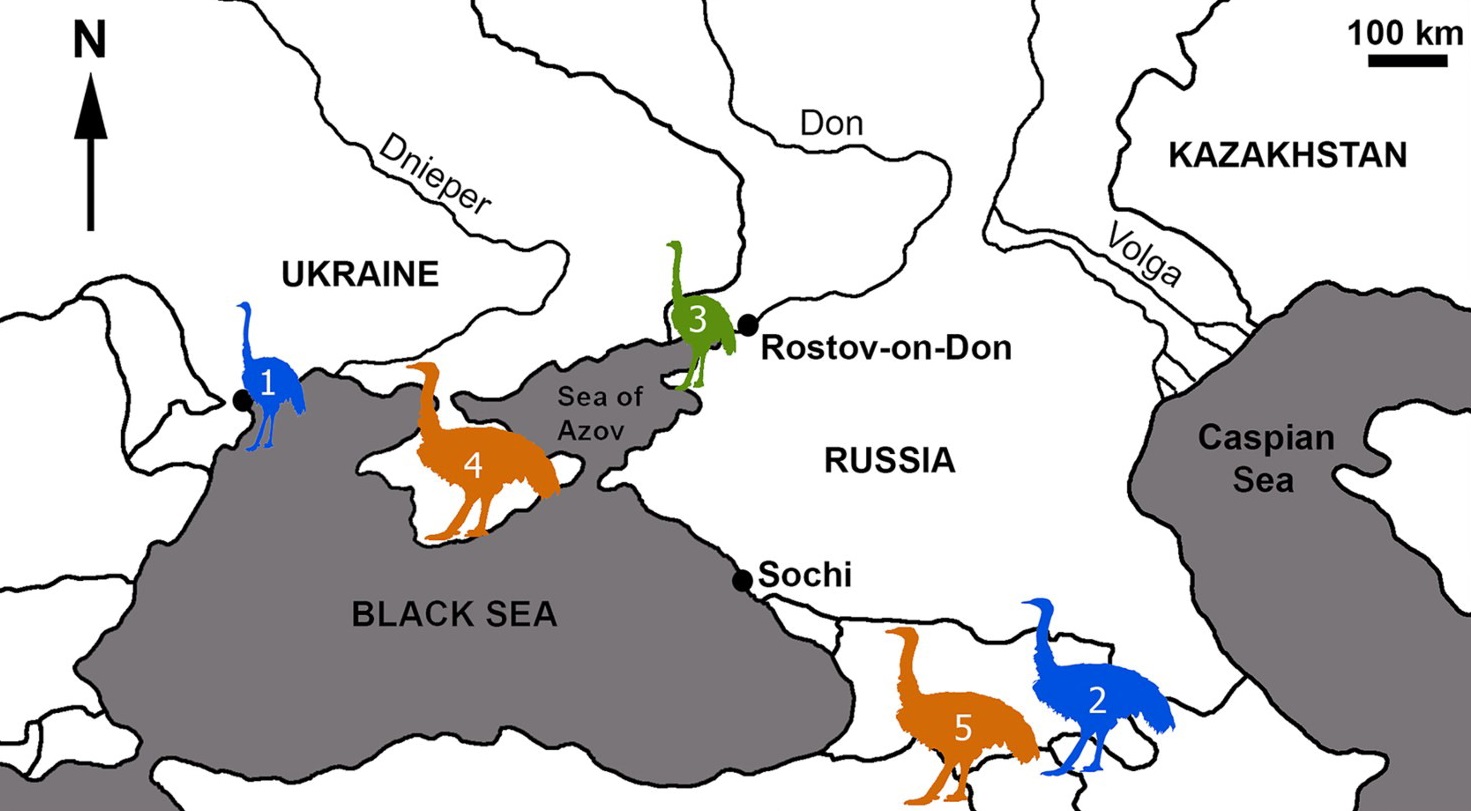
FIGURE 3. Map showing distribution of bony remains of the giant species of Pachystruthio (large ostrich silhouettes) and smaller Struthio ostriches (small ostrich silhouettes) in the Black Sea region in the Pliocene (5.3–2.6 Ma; blue), Gelasian (2.6–1.8 Ma; green), and Calabrian (1.8–0.8 Ma; brown). Pachystruthio from Hungary (Kretzoi, 1954) is not shown. Localities: 1, Odessa catacombs (early Pliocene); 2, Kvabebi (late Pliocene); 3, Liventsovka (Gelasian); 4, Taurida Cave (Calabrian); 5, Dmanisi (Calabrian).


 Nikita V. Zelenkov, Alexander V. Lavrov, Dmitry B. Startsev, Innessa A. Vislobokova and Alexey V. Lopatin. 2019. A Giant early Pleistocene Bird from eastern Europe: Unexpected Component of Terrestrial Faunas at the Time of early Homo arrival. Journal of Vertebrate Paleontology.  e1605521 DOI: 10.1080/02724634.2019.1605521
Half-tonne birds may have roamed Europe at same time as humans  theguardian.com/science/2019/jun/27/half-tonne-birds-roamed-europe-humans 


Thursday, April 11, 2019

[PaleoAnthropology • 2019] Evidence for Increased Hominid Diversity in the Early to Middle Pleistocene of Indonesia


Meganthropus palaeojavanicus 

in Zanolli, Kullmer, Kelley, et al., 2019.

Abstract
Since the first discovery of Pithecanthropus (Homoerectus by E. Dubois at Trinil in 1891, over 200 hominid dentognathic remains have been collected from the Early to Middle Pleistocene deposits of Java, Indonesia, forming the largest palaeoanthropological collection in South East Asia. Most of these fossils are currently attributed to H. erectus. However, because of the substantial morphological and metric variation in the Indonesian assemblage, some robust specimens, such as the partial mandibles Sangiran 5 and Sangiran 6a, were formerly variably allocated to other taxa (Meganthropus palaeojavanicusPithecanthropus dubiusPongo sp.). To resolve the taxonomic uncertainty surrounding these and other contentious Indonesian hominid specimens, we used occlusal fingerprint analysis (OFA) to reconstruct their chewing kinematics; we also used various morphometric approaches based on microtomography to examine the internal dental structures. Our results confirm the presence of Meganthropus as a Pleistocene Indonesian hominid distinct from Pongo, Gigantopithecus and Homo, and further reveal that Dubois’s H. erectus paratype molars from 1891 are not hominin (human lineage), but instead are more likely to belong to Meganthropus.


Clément Zanolli, Ottmar Kullmer, Jay Kelley, Anne-Marie Bacon, Fabrice Demeter, Jean Dumoncel, Luca Fiorenza, Frederick E. Grine, Jean-Jacques Hublin, Anh Tuan Nguyen, Thi Mai Huong Nguyen, Lei Pan, Burkhard Schillinger, Friedemann Schrenk, Matthew M. Skinner, Xueping Ji and Roberto Macchiarelli. 2019. Evidence for Increased Hominid Diversity in the Early to Middle Pleistocene of Indonesia. Nature Ecology & Evolution. DOI: 10.1038/s41559-019-0860-z

Reassessing the Early to Middle Pleistocene hominid diversity in Java


[PaleoAnthropology • 2019] Homo luzonensis • A New Species of Homo from the Late Pleistocene of the Philippines


Homo luzonensis 
Détroit, Mijares, Corny, Daver, Zanolli, Dizon, Robles, Grün & Piper, 2019


Abstract
A hominin third metatarsal discovered in 2007 in Callao Cave (Northern Luzon, the Philippines) and dated to 67 thousand years ago provided the earliest direct evidence of a human presence in the Philippines. Analysis of this foot bone suggested that it belonged to the genus Homo, but to which species was unclear. Here we report the discovery of twelve additional hominin elements that represent at least three individuals that were found in the same stratigraphic layer of Callao Cave as the previously discovered metatarsal. These specimens display a combination of primitive and derived morphological features that is different from the combination of features found in other species in the genus Homo (including Homo floresiensis and Homo sapiens) and warrants their attribution to a new species, which we name Homo luzonensis. The presence of another and previously unknown hominin species east of the Wallace Line during the Late Pleistocene epoch underscores the importance of island Southeast Asia in the evolution of the genus Homo.


Fig. 2: Fossil remains of Homo luzonensis from Late Pleistocene sediments at Callao Cave.

Fig. 1: Geographical location of Callao Cave.

Order Primates Linnaeus, 1758
Suborder Anthropoidea Mivart, 1864

Superfamily Hominoidea Gray, 1825
Family Hominidae Gray, 1825

Tribe Hominini Gray, 1825
Genus Homo Linnaeus, 1758

Homo luzonensis sp. nov.

Etymology. The species name is derived from the island of Luzon, where the specimens were discovered.

Locality. The type locality is Callao Cave, in the Callao Limestone formation in the Peñablanca region of northern Luzon, the Philippines.


Florent Détroit, Armand Salvador Mijares, Julien Corny, Guillaume Daver, Clément Zanolli, Eusebio Dizon, Emil Robles, Rainer Grün and Philip J. Piper. 2019. A New Species of Homo from the Late Pleistocene of the Philippines. Nature. 568; 181–186. DOI: 10.1038/s41586-019-1067-9

Previously unknown human species found in Asia raises questions about early hominin dispersals from Africa nature.com/articles/d41586-019-01019-7 

UP researchers co-discover new human species in Luzon

New species of early human found in the Philippines https://phys.org/news/2019-04-species-early-human-philippines.html via @physorg_com


Saturday, October 31, 2015

[PaleoAnthropology • 2015] Pliobates cataloniae • Miocene Small-bodied Ape from Eurasia sheds light on Hominoid Evolution


A team of researchers from the George Washington University and the Institut Català de Paleontologia Miquel Crusafont identified a new genus and species of small ape that existed before the evolutionary split of humans/great apes (hominids) and gibbons (the 'lesser apes' or hylobatids).
Illustration: Marta Palmero / Institut Català de Paleontologia Miquel Crusafont 


ABSTRACT
Miocene small-bodied anthropoid primates from Africa and Eurasia are generally considered to precede the divergence between the two groups of extant catarrhines—hominoids (apes and humans) and Old World monkeys—and are thus viewed as more primitive than the stem ape Proconsul. Here we describe Pliobates cataloniae gen. et sp. nov., a small-bodied (4 to 5 kilograms) primate from the Iberian Miocene (11.6 million years ago) that displays a mosaic of primitive characteristics coupled with multiple cranial and postcranial shared derived features of extant hominoids. Our cladistic analyses show that Pliobates is a stem hominoid that is more derived than previously described small catarrhines and Proconsul. This forces us to reevaluate the role played by small-bodied catarrhines in ape evolution and provides key insight into the last common ancestor of hylobatids (gibbons) and hominids (great apes and humans).


 STRUCTURED ABSTRACT

INTRODUCTION
Reconstructing the ancestral morphotype from which extant hominoids (apes and humans) evolved is complicated by the mosaic nature of ape evolution, the confounding effects of independently evolved features (homoplasy), and the virtual lack of hylobatids (gibbons and siamangs) in the Miocene fossil record. For several decades, small-bodied anthropoid primates from Africa and Eurasia have not played an important role in this debate, because they generally lack the shared derived features of extant catarrhines (hominoids and Old World monkeys) and are thus considered to precede their divergence. Even some small-bodied catarrhines from Africa (dendropithecids), considered to be stem hominoids by some authors, are viewed as more primitive than the larger-bodied stem ape Proconsul. This has led to the assumption that hylobatids are a dwarfed lineage that evolved from a larger-bodied and more great ape–like common ancestor with hominids (great apes and humans).

RATIONALE
Here we describe a new genus of small-bodied (4 to 5 kg) ape from the Miocene (11.6 Ma), discovered in the Abocador de Can Mata stratigraphic series (Vallès-Penedès Basin, northeast Iberian Peninsula), that challenges current views on the last common ancestor of extant hominoids. This genus is based on a partial skeleton that enables a reliable reconstruction of cranial morphology and a detailed assessment of elbow and wrist anatomy. It exhibits a mosaic of primitive (stem catarrhine–like) and derived (extant hominoid–like) features that forces us to reevaluate the role played by small-bodied catarrhines in ape evolution.


Order: Primates
Suborder: Haplorhini
Superfamily: Hominoidea

Family: Pliobatidae Alba et al. 2015

Genus: Pliobates Alba et al. 2015

Species: Pliobates cataloniae Alba et al. 2015


Reconstruction of the skull (front and side view) and representation of life appearance of Pliobates cataloniae are shown.
Credit: Marta Palmero / Institut Català de Paleontologia Miquel Crusafont 

Long bones from the left arm of Pliobates cataloniae. Humerus (A), radius (B) and ulna (C).
photos: Institut Català de Paleontologia Miquel Crusafont (ICP) 


RESULTS
The new genus retains some features that are suggestive of generalized above-branch quadrupedalism, but it possesses more extensive hominoid-like postcranial features (mostly related to enhanced forearm rotation and ulnar deviation capabilities) than those convergently displayed by atelids. Its overall body plan is more compatible with an emphasis on cautious and eclectic climbing, combined with some degree of below-branch forelimb-dominated suspension (although less acrobatic than in extant gibbons). Its relative brain size implies a monkey-like degree of encephalization (similar to that of hylobatids but below that of great apes), and dental microwear indicates a frugivorous diet. From a phylogenetic viewpoint, the new genus combines craniodental and postcranial primitive features (similar to those of dendropithecids) with multiple derived cranial and postcranial features shared with extant hominoids. Some cranial similarities with gibbons would support a closer phylogenetic link between the new genus and hylobatids. However, this possibility is not supported by the total evidence. A cladistic analysis based on more than 300 craniodental and postcranial features reveals that the new genus is a stem hominoid (preceding the divergence between hylobatids and hominids), although more derived than previously known small catarrhines and Proconsul.

CONCLUSION
As the first known Miocene small-bodied catarrhine to share abundant derived features with extant hominoids, the new genus indicates a greater morphological diversity than previously recognized among this heterogeneous group, and it provides key insight into the last common ancestor of hylobatids and hominids. Our cladistic results, coupled with the chronology and location of the new genus, suggest that it represents a late-surviving offshoot of a small African stem hominoid that is more closely related to crown hominoids than Proconsul is. These results suggest that, at least in size and cranial morphology, the last common ancestor of extant hominoids might have been more gibbon-like (less great ape–like) than generally assumed.

Representation of the environment and some of the species that inhabited the area of Els Hostalets de Pierola about 12 million years ago.
Illustration: Oscar Sanisidro / Institut Català de Paleontologia Miquel Crusafont (ICP) 


D. M. Alba, S. Almecija, D. DeMiguel, J. Fortuny, M. P. de los Rios, M. Pina, J. M. Robles, S. Moya-Sola. 2015. Miocene Small-bodied Ape from Eurasia sheds light on Hominoid Evolution. Science. 350 (6260): aab2625. DOI: 10.1126/science.aab2625

 Meet your gibbon cousin
Apes are divided into two groups: larger-bodied apes, or hominoids, such as humans, chimps, and gorillas; and smaller-bodied hylobatids, such as gibbons. These two lineages are thought to have diverged rather cleanly, sharing few similarities after the emergence of crown hominoids. Alba et al. describe a new ape from the Miocene era that contains characteristics from both hominoids and small-bodied apes (see the Perspective by Benefit and McCrossin). Thus, early small-bodied apes may have contributed more to the evolution of the hominoid lineage than previously assumed.


New Fossil Suggests We Had A Gibbon-Like Early Ancestor | IFLScience http://www.iflscience.com/plants-and-animals/new-fossil-suggests-we-had-gibbon-early-ancestor
A new primate species at the root of the tree of extant hominoids http://phy.so/365332715 via  @physorg_com