Showing posts with label Selaginellaceae. Show all posts

Friday, April 17, 2026

[Botany • 2026] Selaginella magna (Selaginellaceae) • A New Species from China


Selaginella magna H.J.Wei, 

in Fu, Wei, Guo, Zheng, S.-P. Chen et B. Chen, 2026.
硕大卷柏  ||  DOI: doi.org/10.3897/phytokeys.273.170753 

Abstract
Selaginella magna (Selaginellaceae), a new species in S. subg. Stachygynandrum from Guangxi, Fujian and Hunan, China, is here described and illustrated. It is the largest erect Selaginella species in China, characterized by acropetally shortening branches acropetally. Selaginella magna is most similar to S. willdenowii, but can be differentiated by its erect main stem, rhizophores restricted to rhizomes and stolons, and the absence of auricles at the base of both ventral and axillary leaves. Its triangular frond-like leafy stem with an acuminate apex confers a high degree of distinguishability in its natural habitat.

Key words: Deciduous plant, erect habit, IUCN Red List, Selaginella subg. Stachygynandrum, suborbicular sporophyll

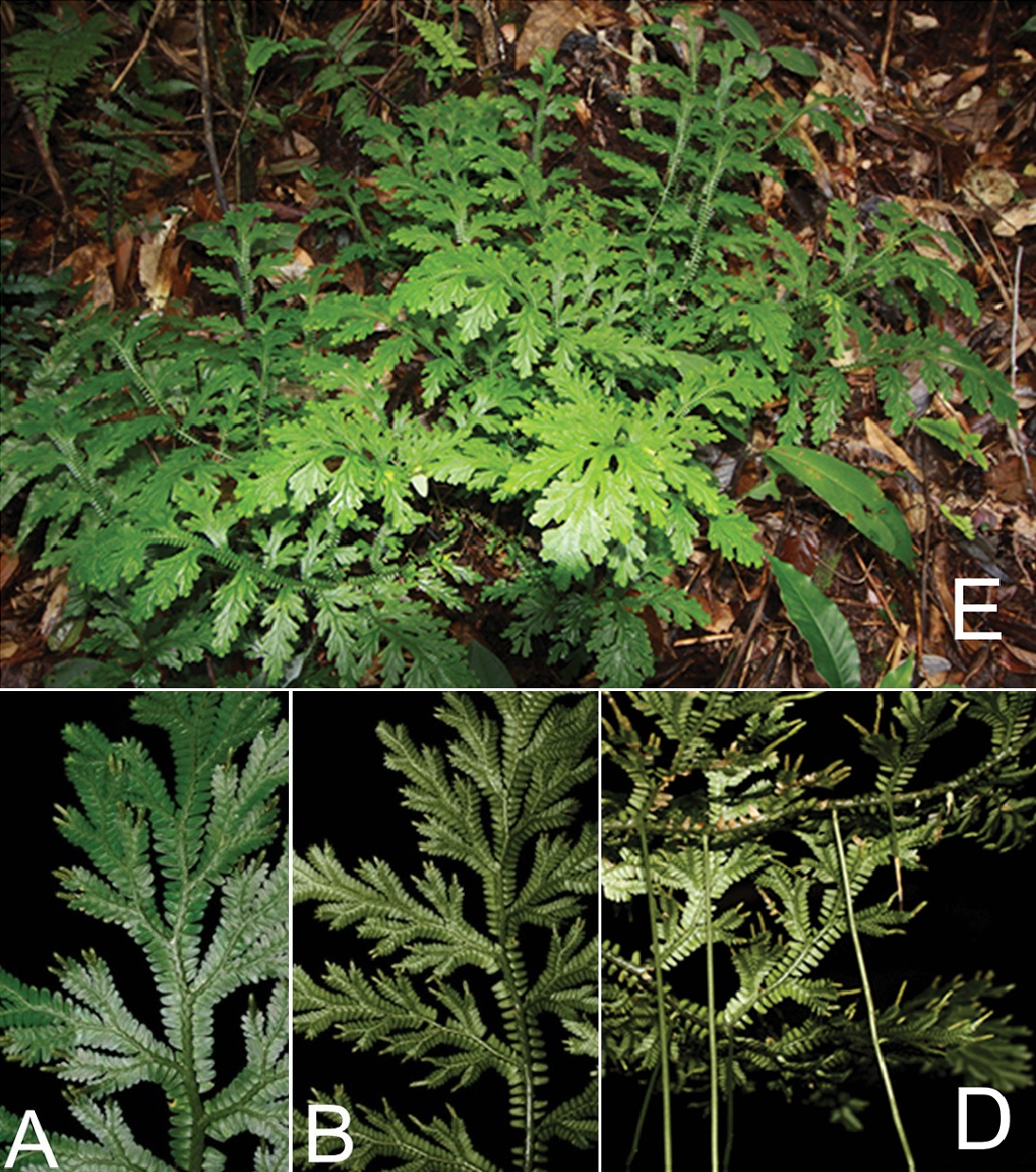
Selaginella magna.
A. Habitat; B. Habit (arrows indicating portion of plant shown in line drawing); C. Abaxial view of portion of plant; D. Adaxial view of portion of plant; E. Megaspores; F. Lower portion of main stem with stolons; G. Microspore; H. Abaxial view of strobile; I. Adaxial view of strobile; J. Adaxial view of ventral leaf with portion of stem; K. Axillary leaf; L. Abaxial view of ventral leaf with portion of stem; M. Dorsal trophophyll.

Selaginella magna H.J.Wei, sp. nov.

Diagnosis. Selaginella magna is closely related to S. willdenowii, but differs by its rhizophores being glabrous (compared to spine-like protuberances at base in the latter), confined to creeping rhizomes and the base of the stem (vs. often extending to the upper part of the main stem in the latter), branches that progressively shorten toward the apex (vs. nearly equal in length except young branches at the apex), ventral and axillary leaves without auricles (vs. with rounded auricles) at the base, and sporophylls that are not white-margined (vs. obviously white-margined).

Etymology. The epithet of the new species is derived from the Latin “magna”, meaning great or large.
Chinese name. 硕大卷柏 (shuò dà juăn băi).


 Hou-Hua Fu, Hong-Jin Wei, Yong-Jun Guo, Shuang-Quan Zheng, Shi-Pin Chen and Bin Chen. 2026. Selaginella magna (Selaginellaceae), A New Species from China. PhytoKeys. 273: 127-136.  DOI: doi.org/10.3897/phytokeys.273.170753 [16 Apr 2026]

Sunday, August 14, 2022

[Botany • 2022] Selaginella wuyishanensis (Selaginellaceae) • A New Species from East China and its Phylogenetic Position based on Molecular Data


Selaginella wuyishanensis K.W.Xu, X.M.Zhou & Y.F.Duan, 

in Xu, Chen, Song, ... et Duan, 2022.
 
Abstract
A new spikemoss species, Selaginella wuyishanensis, is described and illustrated based on materials collected from Fujian Province, East China. The new species can be distinguished from S. lutchuensis Koidzumi and S. albociliata P. S. Wang by its leaves with extremely long cilia (up to 8 mm) and distinctly white margins, ovate ventral sporophylls, and sporophyll-pteryx completely inverted on dorsal sporophylls. In the present work, a molecular phylogeny, taxonomic description, distribution information, line drawing, and photographs of this new species are presented. A morphological comparison is also given to distinguish it from morphologically similar species in Selaginella sect. Tetragonostachyae (Hook. & Grev.) Hieron. & Sadeb.

Keywords: Danxia landform, Selaginella albociliata, Selaginella subg. Heterostachys, species diversity

Illustration of Selaginella wuyishanensis K.W.Xu, X.M.Zhou & Y.F.Duan. 
A habit B adaxial view of branch C abaxial view of branch with rhizophore D axillary leaf E ventral leaf F dorsal leaf G strobili H ventral sporophyll I dorsal sporophyll
(A–F drawn by Sun YB based on the isotype at NF 
G–I drawn by Wei HJ based on the paratype at CSH).

Selaginella wuyishanensis K.W.Xu, X.M.Zhou & Y.F.Duan 
A, B habit C abaxial view of portion of branch D portion of branch showing the dorsal leaves E portion of branch showing the ventral and axillary leaves F, G strobili H axillary leave I axillary leave J dorsal leave K ventral sporophyll L dorsal sporophyll M proximal surface of megaspores N detail of megaspore surface O microscopic structures of microspore surface P proximal surface of microspore.
 
 Selaginella wuyishanensis K.W.Xu, X.M.Zhou & Y.F.Duan, sp. nov.
 
 
Diagnosis: The new species is most similar to Selaginella albociliata and S. lutchuensis in the habit, sterile leaves, and spores. However, S. wuyishanensis can be distinguished from the latter two species by its long leaf cilia (up to 0.6 mm), ovate ventral sporophylls, and the smooth perispore surface of the megaspores (Figs 2, 3).

Distribution and habitat: Selaginella wuyishanensis is known only from Fujian Province, East China. Three populations were observed to grow on rocks of the Danxia landform in evergreen broad-leaved forests at elevations of ca. 200–800 m.
 
Etymology: The species epithet is based on the name of the famous mount Wuyishan, referring to the type locality of the new species.


Ke-Wang Xu, Shui-Fei Chen, Qiang Song, Xiao Zheng, Meng Li, Yan-Ming Fang, Hong-Jin Wei, Hui Ding, Xin-Mao Zhou and Yi-Fan Duan. 2022. Selaginella wuyishanensis (sect. Tetragonostachyae, Selaginellaceae), A New Species from East China and its Phylogenetic Position based on Molecular Data. PhytoKeys. 202: 107-119.  DOI: 10.3897/phytokeys.202.85410

Friday, March 25, 2022

[Botany • 2022] Selaginella orientali-chinensis (Selaginellaceae) • A New Resurrection Spikemoss Species from southeastern China based on Morphological and Molecular Evidences


 Selaginella orientali-chinensis Ching et C. F. Zhang ex H. W. Wang et W. B. Liao, 

co-occurred population of S. orientali-chinensis [A-B] and S. tamariscina [C] 
(S. tamariscina is showed in the red dotted boxes).

in Wang, Dai, Chen, Fan & Liao, 2022.  

Abstract
Selaginella tamariscina (Beauv.) Spring and S. pulvinata (Hook. et Grev.) Maxim. are two closely related rosette forming and resurrection spikemoss species widespread in Asia. In this paper, Selaginella orientali-chinensis Ching et C. F. Zhang ex H. W. Wang et W. B. Liao was described and illustrated. This species was closely related to S. tamariscina and S. pulvinata and previously misidentified as S. tamariscina. By the gross morphological and molecular evidences, we found that this species is easily distinguished from S. tamariscina and S. pulvinata by the absolutely dichotomously branched main stems. Our field works confirmed that this species is widely distributed in southeastern China and mainly inhabits Danxia landforms areas. In some cases, this species shares the same habitats with S. tamariscina. Illustrating the morphological, phylogenetic and distribution characters of this new species would provide new data for the taxonomic studies on the genus Selaginella in the future.
  
Key words: Selaginella, Danxia landforms, morphology, phylogeny, distribution

 Selaginella orientali-chinensis Ching et C. F. Zhang ex H. W. Wang et W. B. Liao. 
A: Lower view of branchlets; B; Upper view of branchlets; C: Dorsal leaf; D: Ventral leaf ; E: Megasporophyll; F: Microsporophyll; G: Lower view of strobilus; H: Upper view of strobilus.  


 Selaginella orientali-chinensis Ching et C. F. Zhang ex H. W. Wang et W. B. Liao. 
A: Habit; B: Dorsal leaf; C: Ventral leaf; D: Strobilus; E: Part of main stem showing ventral leaves, axillary leaves; F: Part of main stem showing dorsal leaves; G: Megasporophyll; H: Microsporophyll. 
(Drawn by Yun-Xiao Liu)

Morphology comparison between Selaginella orientali-chinensis and S. tamariscina
A-B: S. orientali-chinensis; C: S. tamariscina;
D: A co-occurred population of S. orientali-chinensis and S. tamariscina (S. tamariscina is showed in the red dotted boxes).

Selaginella orientali-chinensis Ching et C. F. Zhang ex H. W. Wang et W. B. Liao, sp. nov. 

Diagnosis. The new species is similar to S. tamariscina and S. pulvinata in plant form and the morphology of dorsal leaves, ventral leaves, and sporophylls. However, the main stems of S. orientali-chinensis are absolutely dichotomously branched, while those of S. tarmariscina and S. pulvinata are pinnately branched. Additionally, S. pulvinata usually inhabits alpine, plateau, and temperate region, and the tree-like trunks usually form compact cushions, but S. orientali-chinensis and S. tamariscina are distributed in the mountains or lowland of subtropical regions, and have tree-like trunks that are slender and do not form compact cushions.

Distribution and ecology. Selaginella orientali-chinensis is widely distributed in southern and eastern China (Guangdong, Guangxi, Fujian,  Hunan, Jiangxi and Zhejiang provinces), growing on bare rock and grassy slope at 100 to 1,000 m a.s.l., and mainly in Danxia landforms.


Haowei WANG, Jingmin DAI, Zaixiong CHEN, Qiang FAN and Wenbo LIAO. 2022. Selaginella orientali-chinensis, A New Resurrection Spikemoss Species from southeastern China based on Morphological and Molecular Evidences. ACTA SCIENTIARUM NATURALIUM UNIVERSITATIS SUNYATSENI (中山大学学报(自然科学版). 61(2)

中国东南部复苏卷柏一新种:东方卷柏 ——基于形态学和分子生物学证据
摘要:卷柏和垫状卷柏是两种近缘的莲座状复苏卷柏,两者在亚洲皆有广阔的分布区域。本研究描述并修订了东方卷柏这一新种;该种是卷柏和垫状卷柏的近缘种,此前常被错误鉴定为卷柏。东方卷柏与卷柏和垫状卷柏最大的形态差异在于东方卷柏的主茎为二叉分枝,而卷柏和垫状卷柏的主茎为羽状分支。形态学和分子系统发育数据分析强烈支持卷柏、垫状卷柏和东方卷柏各自独立的物种地位。通过查阅以往被错误鉴定的东方卷柏标本,可知该种广泛地分布于华东和华南地区。此外,野外调查表明该新种主要生长于丹霞地貌区,有时会和卷柏混生。本文对东方卷柏新种的形态、系统发育和地理分布进行了描述,这将有助于未来的植物学和生态学野外工作者开展针对性的相关研究。东方卷柏学名的种加词 orientali-chinensis 是我国蕨类分类学家秦仁昌及张朝芳1982年在标本台纸上对该种作出的鉴定,使用的是裸名,没有描述,本文在此正式合格发表继续采用了该名称,以资纪念。

关键词: 卷柏属, 丹霞地貌, 形态学, 系统发育, 地理分布


Friday, March 8, 2019

[Botany • 2019] Selaginella dianzhongensis (Selaginellaceae) • A New Spikemoss from Yunnan, China


Selaginella dianzhongensis X.C.Zhang

in Shalimov, Zhu, Zhang & Zhang, 2019. 

Abstract
A new species of spikemoss from Yunnan Province of China, Selaginella dianzhongensis, is described and illustrated based on evidence from gross morphology, micromorphology and molecular phylogeny. S. dianzhongensis is most similar to S. amblyphylla in its habit of creeping stem, leaf size, and obviously dimorphic sporophylls, but is distinct by its ventral leaves ovate-oblong, subcordate at base, basiscopic base entire, axillary leaves ovate and decurrent at base. Molecular phylogeny analysis of three chloroplast gene regions (rbcL, atpI, psbA) shows that S. dianzhongensis forms an independent branch with strong support which is distantly related to S. amblyphlla and S. kurzii, but sister to S. bodinieri which is quite different in habitat of erect or ascending stem and rhizophores restricted to the lower part, and slightly dimorphic sporophyllus.

Keywords: Lycophytes, Selaginella amblyphylla, taxonomy, Yunnan, rbcL, atpI, psbA


Figure 1. Selaginella dianzhongensis X.C.Zhang, sp. nov. A habit B adaxial view of strobilus C ventral leaf D axillary leaf E dorsal leaf F adaxial view of lower sporophyll G adaxial view of upper sporophyll H abaxial view of strobilus (Illustration made by Huixia Dong). 


Figure 2. Selaginella dianzhongensis X.C.Zhang, sp. nov. A individual B portion of plant C habit D dorsal leaf E ventral leaf F strobili G axillary leaf H proximal surface of megaspore I distal surface of megaspores J portion of megaspore surface enlarged to show infrastructural detail K distal surface of microspore L proximal surface of microspore M portion of microspore surface enlarged to show infrastructural detail surface (Taken from Yan-Mei Zhu 8158 (PE)).

Selaginella dianzhongensis X.C.Zhang, sp. nov.

Diagnosis: The new species resembles Selaginella amblyphylla in habit and gross morphology, but it is different in stems and branches reddish (vs. stramineous in S. amblyphylla), ventral leaves ovate-oblong, 1.1–2.2 × 0.4–0.8 mm (vs. oblong, 2–3 × 0.6–1.2 mm), base subcordate, basiscopic margin not ciliolate (vs. rounded and margin sparsely ciliolate); dorsal leaves oblique subcordate or cordate at base (vs. obliquely cordate), margin with rather long cilia (vs. denticulate or ciliolate); axillary leaves ovate and decurrent at base (vs. ovate or triangular and obtuse to decurrent at base); strobili 3.2–4.0 × 2.3–3.5 mm (vs. 3.5–10 × 3.2–4.4 mm), ventral sporophylls margin ciliolate, dorsal sporophylls margin denticulate (vs. both sporophylls margin ciliolate).
...


Etymology: Dianzhong means central Yunnan in Chinese: the type locality (Yimen) is in the central Yunnan area which is centered on the Provincial capital city Kunming.

Distribution and habitat: Selaginella dianzhongensis is known only from Yimen county, Yunnan, growing on mossy soils in a mixed evergreen forest, at ca. 1576 m a.s.l. (Fig. 3).


 Aleksandr Petrovich Shalimov, Yan-Mei Zhu, Meng-Hua Zhang and Xian-Chun Zhang. 2019. Selaginella dianzhongensis (Selaginellaceae), A New Spikemoss from China. PhytoKeys. 118: 75-87. DOI: 10.3897/phytokeys.118.30375

Thursday, May 18, 2017

[Botany • 2017] Selaginella guihaia • A New Spikemoss Species (Selaginellaceae) from southern China and northern Vietnam around the Gulf of Tonkin


Selaginella guihaia   X.C.Zhang


Abstract
Selaginella guihaia sp. nov. (Selaginellaceae), a new species of spikemoss from southern China and northern Vietnam around the Gulf of Tonkin (Beibu Gulf), is described and illustrated. Morphological and molecular comparisons of the new species with other similar species (S. doederleinii, S. ornata and S. trachyphylla) are provided. The morphological and molecular evidence clearly indicates S. guihaia is a distinct species. Morphologically S. guihaia differs from other species by its obviously white–margined leaves, the ventral leaves scabrous on upper surfaces throughout the basiscopic or also rarely present on upper halves, and the ovate axillary leaves.

Keywords: Lycopodiophyta, lycophytes, taxonomy, new species, rbcL, ITS


Figure 2. Selaginella guihaia X.C.Zhang
A Habit B Dorsal leaf C Ventral leaf D Part of main stem showing ventral leaves, dorsal leaves, and strobili E Part of main stem showing ventral leaves, axillary leaves, and strobili F Megasporophyll G Microsporophyll
 (Drawn by C.Z. Ji from Beijing Youth Expedition 0980, PE). 

Figure 4. Selaginella guihaia X.C.Zhang, sp. nov.
A Dorsal view of branch B Ventral view of branch. C Strobilus D Rhizophore E Habit. 

Selaginella guihaia X.C.Zhang, sp. nov.

Diagnosis: The new species is similar to Selaginella doederleiniiS. ornata and S. trachyphylla in the habit and the morphology of dorsal leaves, ventral leaves, axillary leaves and sporophylls. However, S. guihaia can be easily recognized by its obvious white–margined leaves. The white-margin is about three cells wide in S. guihaia, but it is only one cell wide in S. doederleiniiS. ornata, and S. trachyphylla.

Type: China, Guangxi: Pingxiang, Mt. Daqingshan, alt. 600m, 27 Aug 1986, Beijing Youth Expedition 0980 (Holotype: PE![No. 1365103]) (Figure 3).


Distribution and ecology: Widely distributed in southern China (Guangxi and Hainan) and northern Vietnam around the Gulf of Tonkin (Beibu Gulf), growing in evergreen broad–leaved forests at 250 to 1000 m a.s.l. (Figures 4, 5).

Etymology: The specific epithet “guihaia” alludes to the ancient Chinese name for the remote geographic region where the species occurs.


 Yu-Dong Wu, Hong-Rui Zhang and Xian-Chun Zhang. 2017. Selaginella guihaia (Selaginellaceae): A New Spikemoss Species from southern China and northern Vietnam around the Gulf of Tonkin. PhytoKeys. 80; 41-52.  DOI: 10.3897/phytokeys.80.11126

Saturday, November 28, 2015

[Botany • 2015] Selaginella chuweimingii • A New Lycophyte Species (Selaginellaceae) from central Yunnan, China


Selaginella chuweimingii Xin M. Zhou, Z. R. He, Liang Zhang & Li Bing Zhang

Abstract
A new lycophyte speciesSelaginella chuweimingii, from central Yunnan, China is described and illustrated. Selaginella chuweimingii is similar to S. sinensis in the habit and the morphology of strobili and sporophylls, but the new species can easily be distinguished from the latter by having ovate or oblong-ovate ventral leaves, extremely asymmetrically dorsal leaves, and oblong-ovate to ovate-lanceolate axillary leaves. Also the new species has lamellate ornamentation on megaspore surfaces and less prominent verrucae and ridges on microspore surfaces. The two species are further separated in geographical distribution with the new species occurring in central Yunnan Province while S. sinensis in northern and eastern China.

Keywords: Articulate group, megaspores, microspores, sporangial arrangement, Selaginella sinensis, Bryophytes, China


Xin-Mao Zhou, Zhao‐Rong He, Liang Zhang and Li-Bing Zhang. 2015. Selaginella chuweimingii (Selaginellaceae) sp. nov. from Yunnan, China. PHYTOTAXA. 231(3): 283–288.  DOI:  10.11646/phytotaxa.231.3.6