Showing posts with label Lungless Amphibian. Show all posts

Wednesday, November 8, 2017

[Herpetology • 2017] Evolution of Coprophagy and Nutrient Absorption in A Cave Salamander

Grotto Salamanders, Eurycea spelaea (Stejneger, 1892)


Abstract
The transition from carnivory to omnivory is poorly understood. The ability to feed at more than one trophic level theoretically increases an animal’s fitness in a novel environment. Because of the absence of light and photosynthesis, most subterranean ecosystems are characterized by very few trophic levels, such that food scarcity is a challenge in many subterranean habitats. One strategy against starvation is to expand diet breadth. Grotto Salamanders (Eurycea spelaea (Stejneger, 1892)) are known to ingest bat guano deliberately, challenging the general understanding that salamanders are strictly carnivorous. Here we tested the hypothesis that grotto salamanders have broadened their diet related to cave adaptation and found that, although coprophagous behavior is present, salamanders are unable to acquire sufficient nutrition from bat guano alone. Our results suggest that the coprophagic behavior has emerged prior to physiological or gut biome adaptations.

Keywords: Guano feeding, salamander, evolution, physiology, behavior

Figure 1. Eurycea spelaea showing troglobitic characters, lack of pigmentation and microphthalmy. Scale bar: 0.5 cm.

 Daphne Soares, Rachel Adams, Shea Hammond, Michael E. Slay, Danté B. Fenolio and Matthew L. Niemiller. 2017. Evolution of Coprophagy and Nutrient Absorption in A Cave Salamander.  Subterranean Biology. 24; 1-9.  DOI: 10.3897/subtbiol.24.15013


Saturday, August 22, 2015

[Herpetology • 2009] Cryptotriton sierraminensis • A New Species of Cryptotriton (Caudata: Plethodontidae) from eastern Guatemala


Cryptotriton sierraminensis
Vásquez-Almazán, Rovito, Good & Wake, 2009
Fig. 2. (A) Dorsal view of the holotype of Cryptotriton sierraminensis , with inset showing view of head. (B) Ventral view of a paratype (USAC 1118), showing characteristic yellow coloration.

Abstract 
 A new species of lungless salamander (Plethodontidae) is described from the mountains of eastern Guatemala. The new species is distinguished from all other members of its genus by its yellow ventral coloration. It is geographically closest to its sister taxon, Cryptotriton veraepacis, from which it differs in several osteological features as well as nostril size and shape. Molecular analyses with allozyme loci and mitochondrial DNA also support its distinctiveness from C. veraepacis. This miniaturized species inhabits cloud forest habitats and has been found most commonly in bromeliads.


Fig. 1. Map of known localities for Cryptotriton adelos (crosses), C. alvarezdeltoroi (diamonds) in Mexico, C. veraepacis (squares), C. sierraminensis (circles), C. monzoni (asterisk), and C. wakei (star) in Guatemala, and C. nasalis (triangles) in Honduras. Light gray shading represents areas between 500 m and 1500 m elevation, and dark gray shading represents areas above 1500 m elevation.

Cryptotriton sierraminensis, new species
Sierra de las Minas Hidden Salamander [Figure 2A, 2B]
Cryptotriton sp. A García-París and Wake, 2000

Life history and ecology.— Cryptotriton sierraminensis is an arboreal, bromeliad-dwelling specialist, as are several other members of its genus (C. veraepacis and C. nasalis: Wake,1987; C. adelos : Papenfuss and Wake, 1987). The salamanders were all collected from inside arboreal bromeliads, as were two clutches of unattended eggs (n = 50 and n = 9, respectively). The number of unattended eggs in the larger clutch suggests communal egg-laying without brooding by adults. This behavior, unusual for tropical plethodontids,has been observed in Nototriton barbouri (McCranie andWilson, 1992). Unattended egg clutches have also been reported in Nototriton picadoi (Good and Wake, 1993; Bruce, 1998), Nototriton guanacaste (Good and Wake, 1993), and Oedipina maritima (García-París and Wake, 2000). Bruce(1998) suggested that the small size of Nototriton may prevent them from effectively defending clutches from predators and that egg desiccation may not be a problem for these cloud forest inhabitants. McCranie and Wilson(1992) also state that, as N. barbouri eggs develop during the wet season, parental care to prevent desiccation may not be necessary. The same may be true in C. veraepacis, as the clutches of eggs were found in July, during the wet season in the Sierra de las Minas. Communal laying of unguarded eggs is also reported in Batrachoseps (Jockusch and Mahoney,1997) and some Hemidactylium (Harris and Gill, 1980).

All specimens have been found at elevations of 1700–2200 m. The habitat is composed of cloud forest in the lower montane moist forest life zone (Holdridge, 1967) with a mixture of large broadleaf and pine trees, as well as tree ferns. Trees are covered in a dense growth of epiphytes and mosses. On Volcán de los Monos, Bolitoglossa helmrichi was found in bromeliads and at Finca Planada de Margot; both B. helmrichi and a second, undescribed species of Bolitoglossa (Larson, 1983; Rovito and Vásquez Almazán, unpubl.) were found along with C. veraepacis in bromeliads. Bolitoglossa meliana was found under ground cover objects at both sites in the 1970s, but has not been seen on recent visits to either site.

Distribution.— Cryptotriton sierraminensis is known from only two localities in Municipio Rio Hondo, Department of Zacapa, Guatemala, which are separated by 18.7 km (by air).Both known localities are on the south side of the Sierra de las Minas, between 1700 m and 2200 m. While the locality on Volcán de los Monos is inside the Sierra de las Minas Biosphere reserve, the type locality is outside the reserve andhas no formal protection at present. The species likely occurs at other sites on the southern side of the Sierra de las Minas. 

Etymology.— The specific epithet is an adjective that makes reference to the Sierra de las Minas, Guatemala, where the species occurs.


 Vásquez-Almazán, C. R.; Rovito, S. M.; Good, D. A. and Wake, D. B. 2009. A New Species of Cryptotriton (Caudata: Plethodontidae) from eastern Guatemala. Copeia. 2009 (2): 313–319. doi: 10.1643/CH-08-086


Resumen
Se describe una nueva especie de la familia Pletodontidae de las montañas del este de Guatemala. Cryptotriton sierraminensis se distingue de todos los otros miembros de su género por su coloración del vientre amarillo. Ésta especie está más cerca geográficamente a su especie hermana, Cryptotriton veraepacis, de la que se distingue por varios aspectos osteológicos y por el tamaño y forma de los orificios nasales. Análisis moleculares con allozimas y ADN mitocondrial apoyan sus diferencias con C. veraepacis. Esta especie miniaturizada vive en los bosques nubosos y ha sido encontrada con mayor frecuencia en bromelias.


Wednesday, August 8, 2012

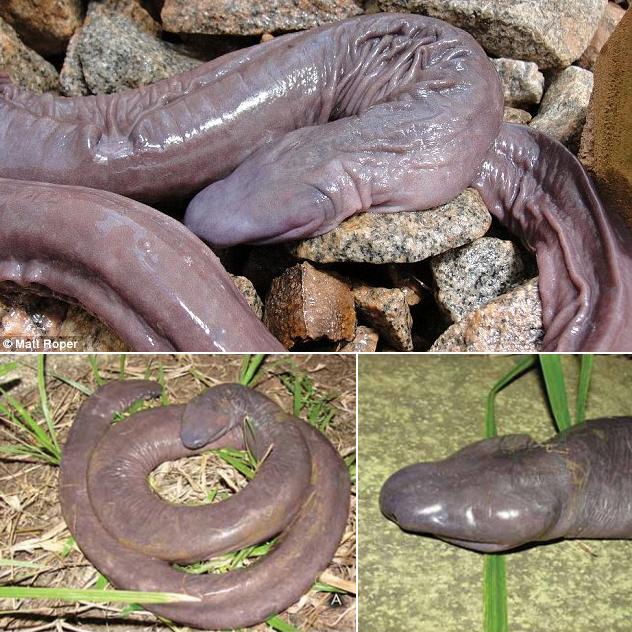
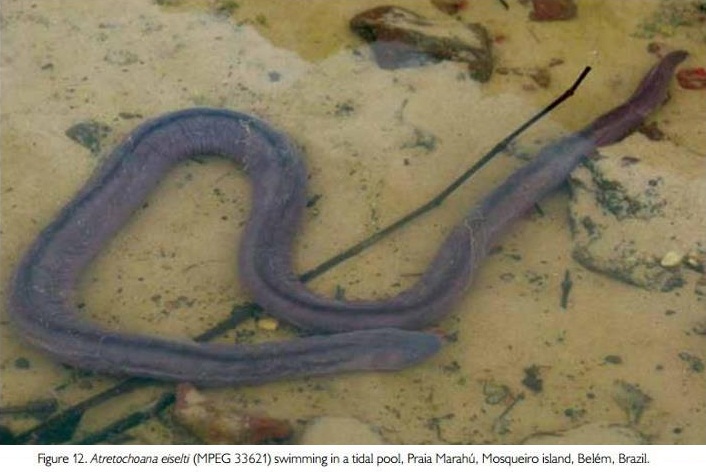
[Herpetology • 2011] Discovery of the largest lungless tetrapod, Atretochoana eiselti (Taylor, 1968) (Amphibia: Gymnophiona: Typhlonectidae) in its natural habitat in Brazilian Amazonia


Abstract
 We report the occurrence of the limbless and lungless tetrapod, Atretochoana eiselti, in two widely separated Brazilian Amazonian lowland localities, one (Mosqueiro island and Baía de Marajó, Belém) near the mouth of the Amazon river and another (Cachoeira Santo Antônio) near the border between Brazil and Bolivia in the Madeira river. It is shown that this species is not an inhabitant of cool, oxygen rich and fast running water in elevated localities as supposed until now, but on the contrary occurs in warm (24-30 °C), turbid, fast running water in the lowland Brazilian Amazon basin. We describe the probable habitat and three freshly preserved specimens (one male, two females) and compare them to the only two specimens known; some data are provided about the biology of this species, that seems to have a wide distribution in Brazilian Amazonia and possibly also occurs in other countries, like Bolivia.

Keywords: Atretochoana eiselti. Gymnophiona. Lungless vertebrate. Amazon Basin. Brazil.


Discovery of the largest lungless tetrapod, Atretochoana eiselti (Taylor, 1968) (Amphibia: Gymnophiona: Typhlonectidae), in its natural habitat in Brazilian Amazonia
Descoberta do maior Tetrapoda apulmonado, Atretochoana eiselti (Taylor, 1968) (Amphibia: Gymnophiona: Typhlonectidae), em seu habitat natural na Amazônia brasileira


Atretochoana : Nussbaum and Wilkinson gave this species its own genus when they reported on the results of their research in a 1995 issue of the Proceedings of the Royal Society of London Series B. The name they gave this genus was Atretochoana, from the Greek word atretos, meaning "imperforate", and the Greek word choana, referring to a funnel or tube.


 Nussbaum, Ronald A.; Wilkinson, Mark. 1995. A New Genus of Lungless Tetrapod: A Radically Divergent Caecilian (Amphibia: Gymnophiona). Proceedings of the Royal Society of London Series B Biological Sciences. 261 (1362): 331–339. DOI:10.1098/rspb.1995.0155.
Wilkinson, M.; Sebben, A.; Schwartz, E.N.F.; Schwartz, C.A. 1998. The largest lungless tetrapod: report on a second specimen of Atretochoana eiselti (Amphibia: Gymnophiona: Typhlonectidae) from Brazil. Journal of Natural History. 32 (4): 617–627. DOI:10.1516/Q417-21HR-6615-7217  bmnh.org/PDFs/MW_98_second.pdf

Hoogmoed, Marinus Steven; Coragem, Juliano Tupan. 2011. Discovery of the largest lungless tetrapod, Atretochoana eiselti (Taylor, 1968) (Amphibia: Gymnophiona: Typhlonectidae), in its natural habitat in Brazilian Amazonia. Boletim do Museu Paraense Emílio Goeldi : Ciências Naturais. 6 (3): 241–262.

[Herpetology • 1998] The largest lungless tetrapod: a second specimen of Atretochoana eiselti (Amphibia: Gymnophiona: Typhlonectidae) from Brazil


The discovery is reported of a second specimen  of the radically divergent lungless aquatic caecilian  Atretochoana eiselti (Taylor), previously known  only from the holotype. Aspects of the morphology of the second specimen  are described and compared to the holotype, allowing a minimal evaluation of variation within this enigmatic  species.  With a  total  length  of  805 mm, the second specimen is the largest known lungless  tetrapod. Most  of the  distinctive  morphological features reported for the holotype are  true  of the second specimen  also indicating  that the  holotype  is  not  a  'hopeful  monster'.  An  important  exception,  from  the perspective of species  identification, is  variation  in  the  form  of the  pattern  of denticulations about the cloacal disk.  Although precise  locality data  are lacking for both the holotype and  the second specimen,  the latter specimen was  almost certainly collected more recently and from within Brazil.  This justifies  increased expectation  that  this  remarkable  species  is  still  extant  and  that  it  will  be rediscovered. 
Keywords:  Atretochoana, Typhlonectidae, Gymnophiona, Caecilian, lunglessness, Neotropics, Brazil. 


 Nussbaum, Ronald A.; Wilkinson, Mark. 1995. A New Genus of Lungless Tetrapod: A Radically Divergent Caecilian (Amphibia: Gymnophiona). Proceedings of the Royal Society of London Series B Biological Sciences. 261 (1362): 331–339. DOI:10.1098/rspb.1995.0155 .

Wilkinson, M.; Sebben, A.; Schwartz, E.N.F.; Schwartz, C.A. 1998. The largest lungless tetrapod: report on a second specimen of Atretochoana eiselti (Amphibia: Gymnophiona: Typhlonectidae) from Brazil. Journal of Natural History. 32 (4): 617–627. DOI:10.1516/Q417-21HR-6615-7217

Hoogmoed, Marinus Steven; Coragem, Juliano Tupan. 2011. Discovery of the largest lungless tetrapod, Atretochoana eiselti (Taylor, 1968) (Amphibia: Gymnophiona: Typhlonectidae), in its natural habitat in Brazilian Amazonia. Boletim do Museu Paraense Emílio Goeldi : Ciências Naturais. 6 (3): 241–262.


[Herpetology • 1995] Atretochoana (originally Typhlonectes) eiselti • A New Genus of Lungless Tetrapod: A Radically Divergent Caecilian (Amphibia: Gymnophiona)


Abstract
Lunglessness is rare in the Tetrapoda and previously recorded only in salamanders (Amphibia: Caudata). Here we report lunglessness in another group of tetrapods, the poorly known tropical caecilians (Amphibia: Gymnophiona). Typhlonectes eiselti is a lungless, aquatic caecilian from South America known only from the single holotype specimen, NMW 9144 (Vienna Museum of Natural History). At a total length of 725 mm, NMW 9144 is by far the largest known lungless tetrapod. It also has a startling array of other radically divergent morphological features, many unique, and some correlated with lunglessness including: sealed choanae (paired internal nostrils); complete absence of pulmonary blood vessels; a repatterned skull with post-occipital jaw articulation; and a novel cranial muscle associated with an elongate and redirected stapes. This remarkable combination of highly derived characters sets Typhlonectes eiselti apart from all other caecilians and places it on a novel evolutionary trajectory. A new genus is described to accommodate this form.

Hoogmoed, Marinus Steven; Coragem, Juliano Tupan. 2011. Discovery of the largest lungless tetrapod, Atretochoana eiselti (Taylor, 1968) (Amphibia: Gymnophiona: Typhlonectidae), in its natural habitat in Brazilian Amazonia. Boletim do Museu Paraense Emílio Goeldi : Ciências Naturais. 6 (3): 241–262.

Wilkinson, M.; Sebben, A.; Schwartz, E.N.F.; Schwartz, C.A. 1998. The largest lungless tetrapod: report on a second specimen of Atretochoana eiselti (Amphibia: Gymnophiona: Typhlonectidae) from Brazil. Journal of Natural History 32 (4): 617–627. DOI:10.1516/Q417-21HR-6615-7217

 Nussbaum, Ronald A.; Wilkinson, Mark. 1995. A New Genus of Lungless Tetrapod: A Radically Divergent Caecilian (Amphibia: Gymnophiona). Proceedings of the Royal Society of London Series B Biological Sciences. 261 (1362): 331–339. DOI:10.1098/rspb.1995.0155 .

[Herpetology • 2010] Caecilita iwokramae • A new lungless caecilian (Amphibia: Gymnophiona) from Guyana


Caecilita iwokramae Wake & Donnelly 2010

Abstract
We report the discovery of a single specimen of a small, terrestrial, lungless caecilian, the second known taxon of lungless caecilians. It differs from all other caecilians in lacking open external nares, and from the large aquatic lungless species described by Nussbaum & Wilkinson (Nussbaum, R. A. & Wilkinson, M. 1995 Proc. R. Soc. Lond. B 261, 331–335) in having no significant skull modifications. All modifications are of ‘soft morphology’ (covered external nares and choanae, lung and pulmonary vessel loss, etc.). A new genus and species are described to accommodate this form. Aspects of its skull and visceral morphology are described and considered in terms of the possible life history and evolution of the species, and compared with those of other lungless amphibians.

Keywords: lungless caecilian, terrestrial, Guayana


Giant Lungless "Worm" Found Living on Land

Wake, Marvalee H.; Donnelly, Maureen A. 2010. A new lungless caecilian (Amphibia: Gymnophiona) from Guyana. Proceedings of the Royal Society of London B. 227. (1683): 915–922.