Showing posts with label incertae sedis. Show all posts

Saturday, October 18, 2025

[Paleontology • 2025] Oura megale • A large early Cambrian Deuteropod with a delta-shaped tailpiece


 Oura megale O’Flynn, Williams & Liu, 

in O’Flynn, Williams, Thomas, Hou et Liu, 2025. 

ABSTRACT
We describe Oura megale n. gen. n. sp., a large (ca. 14 cm long) euarthropod from the lower Cambrian Chengjiang Konservat-Lagerstätte of Yunnan Province, China. It possesses stalked, compound eyes and a possible raptorial frontal appendage (synapomorphies and symplesiomorphies of lower stem- and upper stem-group euarthropods, respectively), but in combination with deuteropodan synapomorphies (e.g., a multi-segmented head). Micro-X-ray fluorescence shows a thorax that consists of 10 comparatively long and five comparatively short segments. The terminal segment articulates with a large, delta-shaped tailpiece that may have conferred high positional manoeuvrability in the water column. The phylogenetic position of O. megale n. gen. n. sp. in the euarthropod stem may add support to the homology of raptorial frontal appendages between lower stem-group euarthropods and deuteropods.

Keywords: new genus; new species; Cambrian Chengjiang biota; euarthropod; micro-X-ray fluorescence; tailpiece

 Oura megale n. gen n. sp. (YKLP 17237).
A, photograph of ventral view. B, Fe map. C, composite line drawing. D, F1 map. E, P map. F, F1 map of head region. G, P map of head region.
 Abbreviations: l, left; r, right; A1, frontal appendage; ex.A6, exopod of 5th head limb on head segment 6; an, cephalic segment (n); as, anterior sclerite; cf, compactional fold; e, eye; es, eye stalk; exn, exopod (n); sn, sternite (n); Tn, thoracic exopod (n); tn, thoracic segment (n). Scale bars represent 20 mm.


SYSTEMATIC PALAEONTOLOGY

Phylum EUARTHROPODA Lankester, 1904

Unranked DEUTEROPODA Ortega-Hernández, 2016

Class, Order and Family incertae sedis

Genus OURA O’Flynn, Williams and Liu, new genus

Etymology. Gr. Oura, f. tail.

Remarks. Oura n. gen. is ascribed to Deuteropoda — as defined by a multi-segmented head and body arthrodization (Ortega-Hernández, 2016). Oura n. gen. bears: stalked, compound eyes, that is, a synapomorphy and symplesiomorphy of lower stem-group Euarthropoda and Deuteropoda, respectively (Ortega-Hernández, 2016, p. 11, table 4); and robust frontal appendages (FA, i.e., A1) that insert approximately one-half the length of the head behind the eye stalks and are inferred to be deutocerebral. The proximal-most three podomeres of the right-side frontal appendage (FA) are preserved, and these are morphologically like those of radiodonts and certain ‘great appendage’-bearing deuteropods.

Oura megale O’Flynn, Williams and Liu, new species
  
Etymology. Gr. Megale, large, great.

Diagnosis. Six cephalic segments. From anterior to posterior, these are: oblate spheroidal anterior sclerite to which large ovate paired stalked lateral eyes are attached; post-ocular segment with paired uniramous deutocerebral FAs; and four subsequent segments. FA antero-laterally orientated, consisting of ≥ three podomeres that bear elongate triangular spines. Thorax consists of 15 segments (anterior-most 10 comparatively long; posterior-most five comparatively short), each with one pair of presumed biramous appendages. Segment 15 articulated with large, ogival delta tailpiece.


Robert J. O’Flynn, Mark Williams, Ed Thomas, Xianguang Hou, and Yu Liu. 2025. Oura megale n. gen. n. sp., A large early Cambrian Deuteropod with a delta-shaped tailpiece. Palaeontologia Electronica. 28(3):a44. DOI: doi.org/10.26879/1547 
palaeo-electronica.org/content/2025/5687-early-cambrian-deuteropod-oura-megale
 x.com/PalaeoE/status/1977837034074210364

Plain Language Abstract:  Oura megale, a large arthropod (segmented, jointed-limbed animal), comparable in size to anomalocaridids (i.e., giant invertebrate Cambrian predators featuring mouthparts composed of a ring of plates), inhabited the Cambrian seas (approximately 518 million years ago) of south-western China. It had stalked eyes and a grasping frontal appendage, but in combination with a multi-segmented head, as we see in, for example, modern insects. Palaeontological techniques show a trunk that consists of 10 long and five short segments. The rearmost segment is associated with a large, delta-shaped tail that may have been conducive to efficient swimming. The evolutionary relationships between O. megale and other arthropods may suggest that the grasping appendage (shared by several arthropods) is inherited from a common ancestor.

Wednesday, April 9, 2025

[PaleoMammalogy • 2025] Weirdodectes napoleoni & Malleodectes arenai • A New Genus and Two New Species of malleodectid (Marsupialia: Malleodectidae) from the Middle and Late Miocene Deposits of the Riversleigh World Heritage Area, northwestern Queensland


Habitat reconstruction of Riversleigh’s Middle Miocene forests including Malleodectes mirabilis (bottom right), M. wentworthi (top left), Malleodectes arenai (top right) and Weirdodectes napoleoni (bottom left).  
 Churchill, Archer & Hand, 2025

Illustration by Nellie Pease. 

Abstract
Isolated upper teeth of a new fourth species of Malleodectes, M. arenai sp. nov. and an isolated lower molar representing a new genus of diminutive malleodectid, Weirdodectes napoleoni sp. nov. are described from Riversleigh’s Middle Miocene deposits. In addition, new malleodectid dental material from Middle and Late Miocene deposits at Riversleigh includes the first lower dentition of Malleodectes mirabilis and the first upper dentition of M. wentworthi. Comparisons of the upper and lower dentitions of M. mirabilis and M. wentworthi with that of the putative dasyurid Barinya wangala suggests that taxon is also a malleodectid. Parsimony and Bayesian phylogenetic analyses support a congeneric relationship between M. mirabilis and M. wentworthi, and support assignment of species of Barinya to Malleodectidae. These analyses support previous studies that found malleodectids were more closely related to dasyurids and myrmecobiids than to thylacinids. The snail-eating hypothesis for malleodectids is restricted to species of Malleodectes, with a more generalised durophagous diet suggested for B. wangala. The diet of Weirdodectes napoleoni sp. nov. is unknown but its dentition suggests it was highly specialised.

Keywords: Dasyuromorphia, Malleodectidae, Riversleigh, Taxonomy, Phylogenetics

MAMMALIA Linnaeus, 1758
MARSUPIALIA Illiger, 1811 sensu Beck et al. (2014)

DASYUROMORPHIA Gill, 1872 sensu Kealy and Beck (2017)
†MALLEODECTIDAE Archer et al., 2016

Type species: Malleodectes mirabilis Arena et al., 2011.

MALLEODECTINAE subfamily novum

Head reconstructions and silhouettes of Malleodectes mirabilis and M. wentworthi.
Illustrations by Nellie Pease

Malleodectes arenai sp. nov.  

Etymology: The species name arenai honours Dr Rick Arena for his contributions to palaeontological and geological research at Riversleigh including description of the genus Malleodectes.

Weirdodectes napoleoni sp. nov. holotype left m1 (QM F61732) microCT images.
a. lingual view; b. buccal view; c. oblique buccal view; ... i. posterior view.

?MALLEODECTIDAE Archer et al., 2016

Subfamily incertae sedis

WEIRDODECTES gen. nov.

Etymology: The genus name, Weirdodectes, describes the bizarre and highly specialised m1 crown morphology of this taxon which is unlike any other marsupial carnivore currently known.

Weirdodectes napoleoni sp. nov.  

Etymology: The species name, napoleoni, honours the late Napoleon, the Great Pyrenees Mountain dog who provided unwavering emotional support throughout my undergraduate, honours and PhD years. You will be missed my loyal and magnificent friend, but never forgotten.

Habitat reconstruction of Riversleigh’s Middle Miocene forests including Malleodectes mirabilis (bottom right), M. wentworthi (top left), M. arenai (top right) and Weirdodectes napoleoni (bottom left). 
 Illustration by Nellie Pease. 

 
Timothy J. Churchill, Michael Archer and Suzanne J. Hand. 2025. A New Genus and Two New Species of malleodectid (Marsupialia, Malleodectidae) from the Middle and Late Miocene Deposits of the Riversleigh World Heritage Area, northwestern Queensland. Journal of Mammalian Evolution. 32, 16. DOI: doi.org/10.1007/s10914-025-09755-6 


Wednesday, October 9, 2024

[PaleoEntomology • 2022] Magicivena sticta, M. elegans & M. antennalis • Early Cretaceous enigmatic Insect Group [Magicivenidae fam. nov.] showing unique Wing Venations and Antennal Sensilla


Magicivena sticta 
Yang, Shih, Rasnitsyn, Ren & Gao, 2022 


Abstract
A new extinct insect group, Magicivena gen. nov. in Magicivenidae fam. nov., with M. sticta sp. nov. (type species), M. elegans sp. nov., M. antennalis sp. nov. and M. sp., is reported as Insecta incertae ordinis based on four specimens from the Lower Cretaceous Yixian Formation of north-eastern China. Magicivenidae are characterized by special antennal structures, such as each flagellomere having two lateral transverse rows of setiferous pits, and forewing venations such as a very short subcostal anterior (Sc), the radial posterior (RS) apparently lost, a weak cubital posterior (CuP), and a single cross-vein crossing the CuP and joining the cubital anterior (CuA) to the first anal vein, all of which differ from those of any other fossil or extant insect taxa documented hitherto. According to the characters forewing with multibranched CuA, hind wing with several long anal veins, and segmented cerci, Magicivenidae should belong to Polyneoptera. The light constitution of a good flier, similar structure of the pterostigma in the hind wing, and transverse furrow on the pronotum all suggest the parallel evolution of Magicivenidae and a dictyopterid family, Alienopteridae. However, the advanced bimotory and loss of an identifiable RS make the possible affinity of Magicivenidae with Alienopteridae problematic, as the latter possess utmost posteromotory and a distinct RS. The antennae of Magicivenidae with their sophisticated sensory apparatus suggest that the four known specimens of Magicivena described here are all males; females are still to be discovered. This new finding enriches the known diversity of Cretaceous insect groups.

Keywords: Magicivena, Magicivenidae, flagellomere, flight, Yixian Formation, Alienopteridae


Magicivenidae fam. nov. 
 
Magicivena gen. nov.   

M. sticta sp. nov. (type species), M. elegans sp. nov., M. antennalis sp. nov


Hongru Yang, Chungkun Shih, Alexandr P. Rasnitsyn, Dong Ren and Taiping Gao. 2022. Early Cretaceous enigmatic Insect Group showing unique Wing Venations and Antennal Sensilla. Papers in Palaeontology. DOI: 10.1002/spp2.1402
  twitter.com/Dean_R_Lomax/status/1445391039439818764

Tuesday, November 16, 2021

[Paleontology • 2021] Lihuacaris ferox & Alacaris? • New Multipodomerous Appendages of Stem-group Euarthropods from the Cambrian (Stage 4) Guanshan Konservat-Lagerstätte, eastern Yunnan, China


Lihuacaris ferox 
 Jiao, Pates, Lerosey-Aubri, Ortega-Hernández, Yang, Lan & Zhang, 2021


Abstract
Stem-group euarthropods are important for understanding the early evolutionary and ecological history of the most species-rich animal phylum on Earth. Of particular interest are fossil taxa that occupy a phylogenetic position immediately crownwards of radiodonts, for this part of the euarthropod tree is associated with the appearance of several morphological features that characterize extant members of the group. Here, we report two new euarthropods from the Cambrian Stage 4 Guanshan Biota of South China. The fuxianhuiid Alacaris? sp. is represented by isolated appendages composed of a gnathobasic protopodite and an endite-bearing endopod of at least 20 podomeres. This material represents the youngest occurrence of the family Chengjiangocarididae, and its first record outside the Chengjiang and Xiaoshiba biotas. We also describe Lihuacaris ferox gen. et sp. nov. based on well-preserved and robust isolated appendages. Lihuacaris ferox exhibits an atypical combination of characters including an enlarged rectangular base, 11 endite-bearing podomeres and a hypertrophied distal element bearing 8–10 curved spines. Alacaris? sp. appendages display adaptations for macrophagy. Lihuacaris ferox appendages resemble the frontal appendages of radiodonts, as well as the post-oral endopods of chengjiangocaridid fuxianhuids and other deuteropods with well-documented raptorial/predatory habits. Lihuacaris ferox contributes towards the record of endemic biodiversity in the Guanshan Biota.

Keywords: Deuteropoda, Euarthropoda, Fuxianhuiida, Lihuacaris ferox, Radiodonta, Chengjiango, carididae 

Figure 2. Locality maps showing occurrences of known Guanshan biotas in South China, and stratigraphic succession of the Cambrian (Stage 4) Lihuazhuang section in Yiliang, Yunnan.
(a) Studied area in South China. (b) Location of 13 sites where fossil assemblages assigned to the Guanshan Biota have been recovered. (c) Enlarged area from (b), showing the location of the Lihuazhuang section in Yiliang. (d) Stratigraphic column showing the occurrence of fossils reported in this study.
Figure reproduced from [Jiao, et al., 2021]: figure 1, licensed under CC BY 4.0.


Systematic palaeontology
SUPERPHYLUM Panarthropoda Nielsen [1995]

ORDER Fuxianhuiida Bousfield [1995]

FAMILY Chengjiangocarididae Hou and Bergström [1997]

Type genus. Chengjiangocaris Hou & Bergström [1991]

Other genera included. Alacaris Yang, Ortega-Hernández, Legg, Lan, Hou & Zhang [2018]

Alacaris Yang, Ortega-Hernández, Legg, Lan, Hou & Zhang [2018]

Alacaris? sp.

....


Figure 6. Lihuacaris ferox nov. gen et sp. from the Cambrian (Stage 4) Guanshan Biota, Yunnan, China. YKLP 12438, holotype, an isolated appendage preserved laterally compressed.
(a) Overview of slab showing appendage and associated with euarthropod tergites.
(b, c) Details of appendage.
(d, e) Details of rectangular structure which is overlain by the large base of the appendage.
Abbreviations: ba, large rectangular base; de, distal element; em?, possible extensor muscle; en, endite; gn, gnathobase; pd, podomere; te, tergite; 1–8 indicate spines on distal element, numbered from proximal to distal.

Incertae sedis

GENUS Lihuacaris gen. nov.

Type species. Lihuacaris ferox gen. et sp. nov.

Diagnosis. Arthropodized elongate appendage composed of a rectangular base, proximal relative to 11 tall rectangular podomeres and a long subtriangular distal element; podomeres increase in length distally, alternate with triangular articulating membranes and bear small triangular endites (one pair per podomere) that insert at the midpoint of ventral margin; distal element bears 8–10 robust curved ventral spines that increase in size towards the distal end of the appendage.

Etymology. Concatenation of the first part of the name of the section where the fossils were found (Lihuazhuang), and the Latin ‘caris’ (or Greek ‘καρις’), meaning ‘crab’ or ‘shrimp’, a suffix commonly used for euarthropods.

Type material. Holotype: YKLP 12438 (figure 6), a complete appendage preserved as a lateral compression; Paratype: YKLP 12439 (figure 7a), an incomplete appendage missing the base and proximalmost six podomeres, preserved as a lateral compression.


Additional material. Four partial specimens YKLP 12440–12443 (figure 7b–e).

Type locality and horizon: Lihuazhuang section, locality ca 2.5 km southeast of the Lihuazhuang village (figure 2). Lower part of Wulongqing Formation, Cambrian Stage 4, Palaeolenus biozone [Hu, et al., 2010].

Lihuacaris ferox sp. nov.

Etymology. From ferox (Latin = ferocious) in reference to the inferred predatory habits of this animal.


Conclusion: 
The endemic taxa Alacaris? sp. and Lihuacaris ferox increase the known diversity of euarthropods in the Guanshan Biota. Alacaris? sp., the second fuxianhuiid reported from this exceptional biota, represents both the first occurrence of the Chengjiangocarididae in these beds and the youngest record of this fuxianhuiid family to date. The exact affinities of the new taxon Lihuacaris ferox are uncertain, but it most likely falls close to radiodonts in the euarthropod stem-lineage, or possibly fuxianhuiids as early members of Deuteropoda. Additional material of Lihuacaris ferox is critical for clarification of its relationships with other stem-group euarthropods and may potentially inform on the sequence of evolution of fundamental euarthropod characters.

Appendages of Lihuacaris ferox appear adapted for capturing non-biomineralized prey. This allows predatory habits to be inferred for this enigmatic taxon and suggests that radiodonts were not the only large predators in the Guanshan Biota. The appendages of Alacaris? sp. feature gnathobasic protopodite indicative of macrophagous feeding habits. The endemism of all these taxa probably reflects the relatively proximal shelf depositional settings of the Guanshan Konservat-Lagerstätte [Jiao, et al., 2021].


De-Guang Jiao, Stephen Pates, Rudy Lerosey-Aubri, Javier Ortega-Hernández, Jie Yang, Tian Lan and Xi-guang Zhang. 2021. New Multipodomerous Appendages of Stem-group Euarthropods from the Cambrian (Stage 4) Guanshan Konservat-Lagerstätte. Royal Society Open Science. DOI: 10.1098/rsos.211134

Wednesday, November 25, 2020

[Invertebrate • 2020] Duobrachium sparksae • A New Genus and Species of Benthopelagic Ctenophore (Ctenophora: Tentaculata: Cydippida) seen at 3,910 m Depth off the Coast of Puerto Rico


 Duobrachium sparksae  
Ford, Bezio & Collins, 2020

 
Abstract
On April 10, 2015, three individuals of an undescribed species of ctenophore were observed moving just above the seafloor in the Arecibo Amphitheater inside the Guajataca Canyon, north-northwest of Puerto Rico at a depth of approximately 3,900 m. The ctenophore is distinctive; having two prominent tentacle arms, a body that is rectangular when observed laterally along the tentacular plane, and rounded when observed laterally along the stomodeal plane. The tentacle arms each give rise to an extensible tentacle bearing short tentilla of uniform length and distribution. One ctenophore appeared to be anchored to the seafloor by its two long flexible tentacles, as well as by two filaments exiting its oral end. The overall form of the ctenophore suggests classification within the problematic, non-monophyletic order Cydippida, but the robust tentacle arms are more reminiscent of benthic species of Platyctenida, particularly those of families Lyroctenidae and Ctenoplanidae. Whereas most platyctenid ctenophores do not possess ctene rows in their adult forms, features that are possessed by the new species described herein, species of Ctenoplanidae retain comb rows as adults and are capable of limited swimming. The species described herein is easily distinguishable from all other known species of Ctenophora and may trace its origin to a lineage diverging near the origin of Platyctenida.

Keywords: Aricebo Amphitheater, Ctenophora, Duobrachium sparksae gen nov. & spec. nov., Puerto Rico, Cydippida

Still captured from video observation of  Duobrachium sparksae n. gen. n. sp.
  Second sighting (USNM 1607332) showing regular tentilla of tentacles and large embryos/eggs within gonads, highlighting the quality of the HD video. 17:37:36 UTC.

Digital illustration of the habit of  Duobrachium sparksae n. gen. n. sp.
 A. tentacular view B. stomodeal view.
Illustrations by Nicholas Bezio.

Phylum Ctenophora Eschscholtz, 1829 
Class Tentaculata Eschscholtz, 1825 
Order Cydippida Gegenbaur, 1856 
Family Cydippida incertae sedis 

Genus Duobrachium gen. nov. 

Diagnosis. Tentaculate cydippid ctenophores with two thick, aboral, conical tentacle arms. Tentacle arms emerge from the center of the body and extend aborally. Body rectangular in the tentacular plane, oblong in the stomodeal plane. The tentacle arms are as long as the body is tall. Tentacles retractile, with simple tentilla of uniform length. Filaments can exit orally, anchoring it to the sediment. Stomodeum darkly pigmented. Gonads globular, not extending the length of the meridional canals. 
 
Etymology. From the Latin “two-arms”, a name reflecting the two prominent arms. The Latin “brachium” is of common gender, but shall be treated as feminine, in accordance with ICZN article 30.1.4.2.

Line drawing schematic of Duobrachium sparksae n. gen. n. sp.
 A. Tentacular view of the main body of the animal. B. Oral view. C. Aboral view.
ct - ctene row, g - gonads, m - mouth, ta - tentillum, tent - tentacle, stat - statocyst, sto - stomodeum.
 Illustrations by Nicholas Bezio.


 Duobrachium sparksae spec. nov.

Etymology. The specific epithet “sparksae” honors Elizabeth Ann Sparks, the wife of Michael Ford. Common name. Sparks’ two-armed ctenophore. 

Distribution. Only known from Guajataca Canyon, north-northwest of Puerto Rico at a depth of approximately 3,900 m, within meters of the seafloor 

 
Michael Ford, Nicholas Bezio and Allen Collins. 2020. Duobrachium sparksae (incertae sedis; Ctenophora: Tentaculata: Cydippida): A New Genus and Species of Benthopelagic Ctenophore seen at 3,910 m Depth off the Coast of Puerto Rico. Plankton and Benthos Research. 15(4); 296-305. DOI 10.3800/pbr.15.296  
 
NOAA Scientists Virtually Discover New Species of Comb Jelly Near Puerto Rico

Friday, May 22, 2015

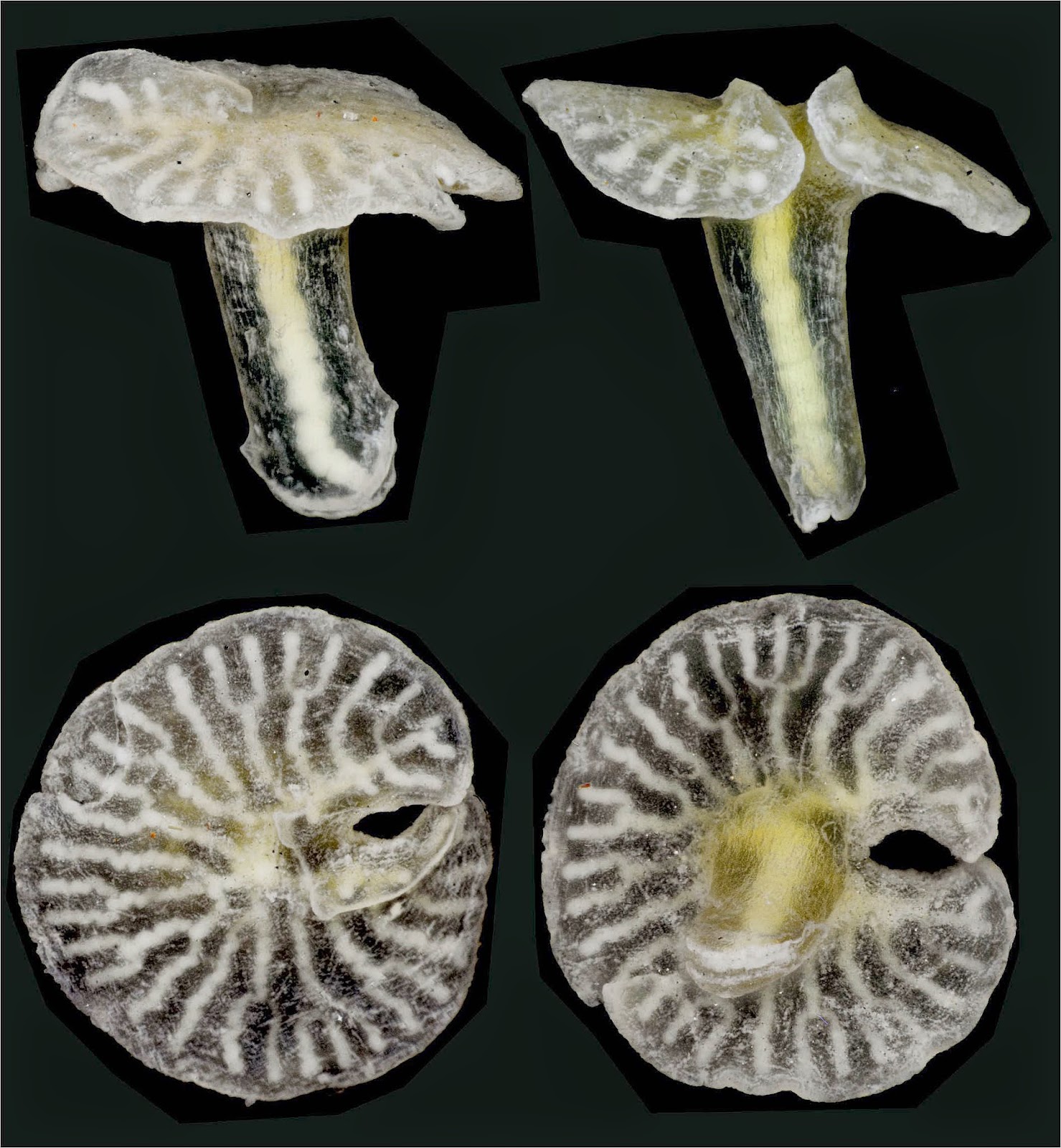
[Invertebrate • 2014] Dendrogramma, New Genus, with Two New Non-Bilaterian Species from the Marine Bathyal of Southeastern Australia (Animalia, Metazoa incertae sedis) – with Similarities to Some Medusoids from the Precambrian Ediacara


Figure 1. Dendrogramma gen. nov.,
paratypes of 
D. enigmatica and (with *) D. discoides.

Figure 3. Dendrogramma enigmatica sp. nov., holotype.

Abstract
A new genus, Dendrogramma, with two new species of multicellular, non-bilaterian, mesogleal animals with some bilateral aspects, D. enigmatica and D. discoides, are described from the south-east Australian bathyal (400 and 1000 metres depth). A new family, Dendrogrammatidae, is established for Dendrogramma. These mushroom-shaped organisms cannot be referred to either of the two phyla Ctenophora or Cnidaria at present, because they lack any specialised characters of these taxa. Resolving the phylogenetic position of Dendrogramma depends much on how the basal metazoan lineages (Ctenophora, Porifera, Placozoa, Cnidaria, and Bilateria) are related to each other, a question still under debate. At least Dendrogramma must have branched off before Bilateria and is possibly related to Ctenophora and/or Cnidaria. Dendrogramma, therefore, is referred to Metazoa incertae sedis. The specimens were fixed in neutral formaldehyde and stored in 80% ethanol and are not suitable for molecular analysis. We recommend, therefore, that attempts be made to secure new material for further study. Finally similarities between Dendrogramma and a group of Ediacaran (Vendian) medusoids are discussed.

Figure 8. Possible positions of Dendrogramma in a simplified phylogeny showing the deepest splits in the metazoan Tree of Life.
The position of Ctenophora is controversial so two possibilities have been shown with dashed lines, one as sister group to the remaining metazoans (the ‘Ctenophora-first’ hypothesis), and one as sister group to Cnidaria (Coelenterata hypothesis). We suggest that Dendrogramma most likely is related to Ctenophora and/Cnidaria (red arrows) due to general similarities in body organisation (see Discussion). However, depending on the position of Ctenophora and on whether certain aspects of Dendrogramma (e.g., mesoglea and gastrovascular system) are ancestral for Metazoa or modified, Dendrogramma can be positioned in a variety of ways below Bilateria (yellow oval).

Figure 1. Dendrogramma gen. nov., all 15 paratypes of D. enigmatica and (with *) D. discoides.
Photographs taken after shrinkage (see Material and Methods).

Metazoa
It has been suggested during review that Dendrogramma could represent a new non-bilaterian phylum. While we may agree, we refrain from erecting such a high-level taxon for the time being, because new material is needed to resolve many pertinent outstanding questions.


Dendrogrammatidae, new family
Diagnosis: Multicellular, mesogleal, apparently diploblastic animal. Body divided into cylindrical stalk and broad, flat disc (Figs 2A, B, 3, 4, 5A, 7). Simple round mouth opening situated in slightly depressed lobed field on rounded apex of stalk. With gastrovascular system comprising a simple tube centrally in stalk (pharynx) running from mouth to base of disc, then branching dichotomously, including first branching node (Fig. 6B), in disc at right angles to stalk. Epidermis composed of single layer of low, uniform cells; gastrodermis composed of single layer of elongate, vacuolated cells tapering towards narrow gastrovascular canal (pharynx) (Fig. 2C); epidermis of mouth-field lobes with thickened, elongate, apparently vacuolated/glandular cells (Fig. 2D). Dense mesoglea milky translucent when formalin fixed except for refractive sheath of spongiose mesoglea surrounding gastrodermis of gastrovascular canal in stalk (pharynx) (Figs 2C, 5C). Mesoglea criss-crossed by fibrils including cylindrical sheet under epidermis (Fig. 2C, D).

Dendrogramma, new genus
Diagnosis: With the characters of the family.

Etymology: The name of the genus alludes to the branching pattern of the gastrovascular system of the disc.

Type-species: Dendrogramma enigmatica new species.
Etymology: This species has been and still is a great enigma.

Additional species: Dendrogramma discoides new species.
Etymology: This species is named for the shape of the disc.


Figure 3. Dendrogramma enigmatica sp. nov., holotype.
A, B, lateral views; C, aboral view, D, adoral view. Photographs taken after shrinkage.

Jean Just, Reinhardt Møbjerg Kristensen and Jørgen Olesen. 2014. Dendrogramma, New Genus, with Two New Non-Bilaterian Species from the Marine Bathyal of Southeastern Australia (Animalia, Metazoa incertae sedis) – with Similarities to Some Medusoids from the Precambrian Ediacara.
PLoS ONE 9 (9): e102976. DOI: 10.1371/journal.pone.0102976

Skinner, Nicole. 2014. Sea creatures add branch to tree of life. Nature. doi: 10.1038/nature.2014.15833.