Showing posts with label Crocodylia. Show all posts

Thursday, September 10, 2026

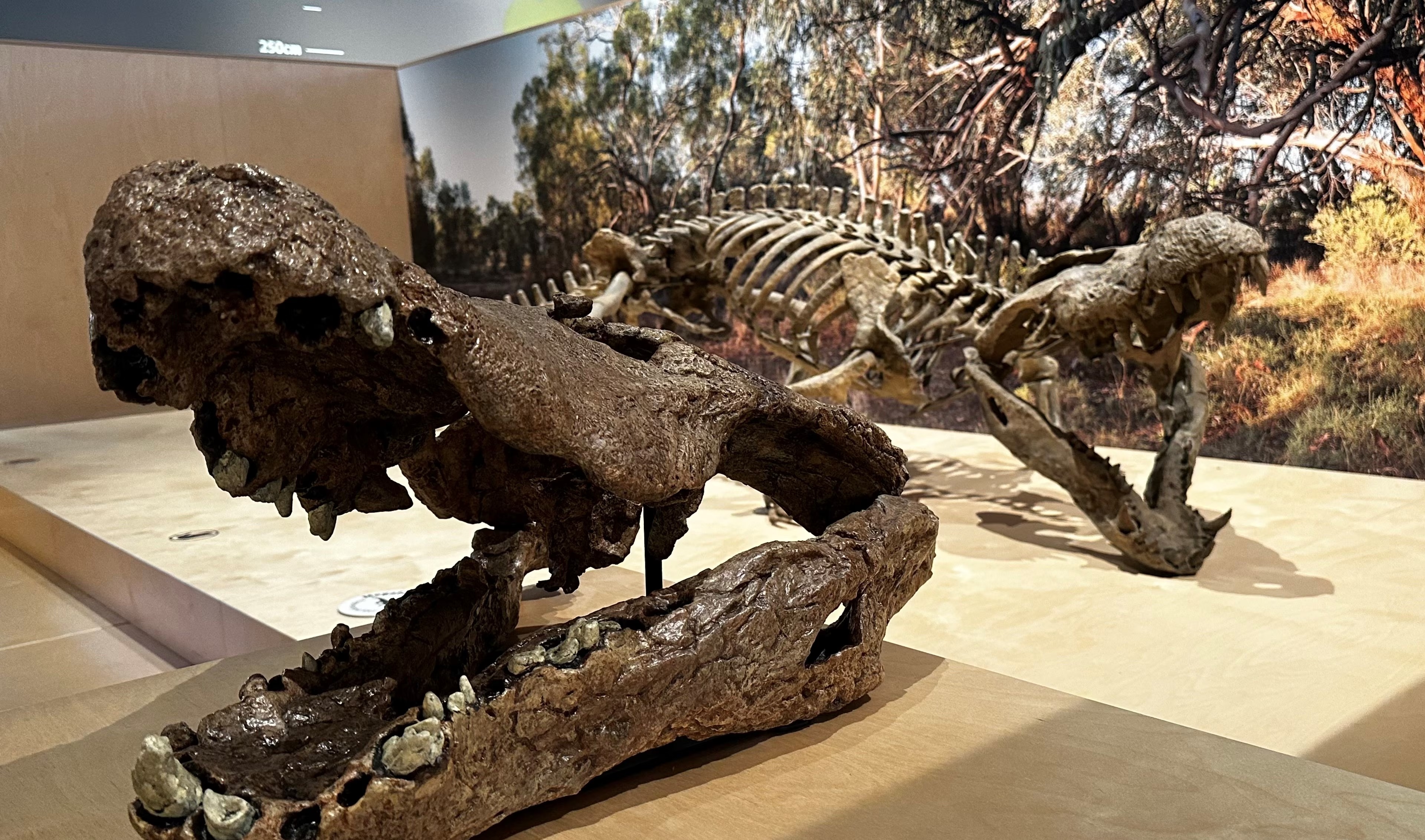
[Paleontology • 2026] Mandrasuchus milleri • A New alligatorid (Crocodylia: Alligatoridae) from the Early Paleocene (Danian) of the Denver Basin supports earliest Paleocene North American alligatorid radiation


Mandrasuchus milleri
Lessner, Sherman, Petermann, Panigot, Duffy & Lyson, 2026 
 
Illustration by Andrey Atuchin

ABSTRACT
The North American eusuchian fossil record through the Cretaceous–Paleogene (K–Pg) mass extinction shows a remarkable increase in diversity across the K–Pg boundary through the early Eocene. This is in contrast to most other vertebrate clades. Despite the group’s uninterrupted existence across the K–Pg boundary, gaps remain in the alligatorid fossil record, particularly near the K–Pg boundary and geographically in Colorado. Here we describe a new alligatorid, Mandrasuchus milleri, gen. et sp. nov., from the lower Paleocene Denver Formation of Corral Bluffs, Colorado, represented by over 15 specimens. We identify a globidontan alligatorine by the globular caudal dentition and blunted rostrum. Regardless of precise taxonomic assignment, the alligatorid is stratigraphically the earliest confirmed alligatorine, with diagnostic crania from ∼350 kyrs (Puercan 2 North American Land Mammal Age [NALMA]) and referred globular teeth from ∼200 kyrs (Puercan 1 NALMA) post-K–Pg mass extinction. The alligatorine is a new representative of a largely unresolved portion of the crocodylian phylogeny, and its addition could help resolve relationships of early diverging alligatorids and taxa historically referred to Allognathosuchus. This taxon’s distinct rostral morphology and globidont dentition suggest its ability to engage in a macrogeneralist diet. Dietary niche partitioning is likely present in this ecosystem as M. milleri lived alongside the generalist macrocarnivore Borealosuchus sternbergii, the other known Denver Formation crocodylian. The eusuchian survivorship across the K–Pg mass extinction and the morphological diversity of these apex freshwater predators underscores the degree to which freshwater terrestrial ecosystems were buffered from Earth's last mass extinction.

Mandrasuchus milleri hunting crayfish along a river bank in Colorado some 65.5 million years ago.

 Mandrasuchus milleri, gen. et sp. nov.

Emily J. Lessner, Sadie M. Sherman, Holger Petermann, Eldon Panigot, Franklin Duffy and Tyler R. Lyson. 2026. New alligatorid, Mandrasuchus milleri, from the Early Paleocene (Danian) of the Denver Basin supports earliest Paleocene North American alligatorid radiation. Journal of Vertebrate Paleontology. e2712566. DOI: doi.org/10.1080/02724634.2026.2712566 [02 Sep 2026]

Saturday, March 14, 2026

[Paleontology • 2026] Crocodylus lucivenatorLucy’s peril: A Pliocene crocodile from the Hadar Formation, north-eastern Ethiopia


Crocodylus lucivenator
 Brochu, Drumheller, Campisano, Tekle, Getachew, Head, Platt & Leaphart, 2026
 
Artwork by Tyler Stone

Abstract
We herein describe a new crocodile, Crocodylus lucivenator sp. nov., from palaeoanthropological sites in the Pliocene Hadar Formation in north-eastern Ethiopia. It shares derived features and plesiomorphic states with two Pleistocene species of Crocodylus from East Africa. Conversely, C. lucivenator bears a midline boss on the dorsal surface of the rostrum similar to those of modern Neotropical crocodiles and late Miocene crocodiles from Libya and Kenya. A boss is also present on Pliocene specimens from Kanapoi in Kenya previously referred to C. thorbjarnarsoni. Some C. lucivenator also have a more substantial prenarial rostrum than other Palaeoafrican Crocodylus, though not to the same extent as in extant Crocodylus, and its expression is variable. Phylogenetic analysis supports a close relationship between C. lucivenator, Kanapoi CrocodylusC. anthropophagus, C. thorbjarnarsoni, and fossils from the Turkana Basin previously misreferred to C. checchiai. A close relationship with Neoafrican Crocodylus is rejected, reinforcing a comparatively recent arrival for Neoafrican Crocodylus in East Africa. Crocodylus lucivenator and the Kanapoi form are very similar, but an exclusive relationship is not unambiguously supported in our analysis. The phylogenetic placement of the Palaeoafrican clade depends on how one regards the prenarial rostrum, and positions outside crown Crocodylus or close to the Neotropical clade can be equally optimal. One mandible preserves pathological structures consistent with injuries sustained during intraspecific combat. Crocodylus lucivenator appears to have been the only crocodylian in the Hadar Formation, while coeval deposits in the Turkana Basin preserve as many as four species. The reason for this disparity is unclear.
 
Keywords: Crocodylus lucivenator, Hadar Formation, Pliocene, prenarial rostrum, cladistic assessment, Turkana Basin


Crocodylus lucivenator sp. nov.

Etymology. luci-, Latin for light, but here used with reference to A.L. 288-1 (Lucy), the iconic Australopithecus afarensis skeleton from Hadar; -venator, Latin, hunter. There is no evidence A.L. 288-1 was ever attacked by a crocodile, but her species (and most likely Lucy herself) would doubtless have been pursued as prey by this species.


Christopher A. Brochu, Stephanie K. Drumheller, Christopher Campisano, Getahun Tekle, Tomas Getachew, Jason J. Head, Nathan C. Platt & Daniel Leaphart. 2026. Lucy’s peril: A Pliocene crocodile from the Hadar Formation, north-eastern Ethiopia. Journal of Systematic Palaeontology. 24(1); 2614954. DOI: doi.org/10.1080/14772019.2026.2614954 [11 Mar 2026]

Thursday, September 25, 2025

[Paleontology • 2025] Thikarisuchus xenodentes • A New, diminutive, heterodont Neosuchian from the Vaughn Member of the Blackleaf Formation (Cenomanian), southwest Montana, and Implications for the Paleoecology of heterodont neosuchians


Thikarisuchus xenodentes
Allen, Wilberg, Turner & Varricchio, 2025  

Illustration by Dane Johnson/Museum of the Rockies

ABSTRACT
Although crocodyliforms from the Campanian–Maastrichtian of North America have received considerable attention, taxa occurring earlier in the Cretaceous have only recently begun to be more thoroughly studied. Of particular interest amongst these recent discoveries is the heterodont neosuchian Wannchampsus kirpachi Adams 2014 and the similar, undescribed ‘Glen Rose Form’ (USNM 22039). Both hold an unclear phylogenetic position, either forming a clade sister to Atoposauridae, a group of small, heterodont neosuchians from the Jurassic and Cretaceous of Laurasia, or to Paralligatoridae, a clade of larger, platyrostral, homodont neosuchians from the Cretaceous of Asia and North America. Here we describe a new species of diminutive, heterodont neosuchian, Thikarisuchus xenodentes gen. et sp. nov., from the early–middle Cenomanian Vaughn Member of the Blackleaf Formation of southwest Montana. The specimen includes cranial, mandibular, axial, and appendicular elements in articulation and dense concentration. It is recovered in a sister relationship with Wannchampsus and USNM 22039. We propose the name Wannchampsidae (clade nov.) for this group of small, heterodont neosuchians endemic to the Cretaceous of North America. Wannchampsidae is more confidently recovered sister to Atoposauridae due to the recognition of new synapomorphies. The new taxon provides greater clarity on the potential diet and paleoecology of Wannchampsidae and Atoposauridae and displays similar craniomandibular and dental characteristics to the notosuchian group Uruguaysuchidae, strongly suggesting these neosuchian groups were also omnivorous or insectivorous and terrestrially adapted, respectively representing a unique diet and reversion to terrestriality within Neosuchia.

SYSTEMATIC PALEONTOLOGY
CROCODYLOMORPHA Hay, 1930 (sensu Nesbitt, 2011)
CROCODYLIFORMES Hay, 1930 (sensu Clark, 1986)
NEOSUCHIA Clark in Benton and Clark, 1988

WANNCHAMPSIDAE, family nov.

Type Genus—Wannchampsus kirpachi Adams, 2014.

Etymology—'The family of Wannchampsus.’ The stem Wannchamps- is based on the designated type genus Wannchampsus. -idae, is a Latin patronymic suffix.

Under Article 29.2 of the Zoological Code, the suffix -idae denotes a family rank within the family-group.

Phylogenetic Definition—Branch-based clade comprising all taxa more closely related to Wannchampsus kirpachi Adams, 2014 than to Theriosuchus pusillus Owen, 1878 or Shamosuchus djadochtaensis Mook, 1924.


 Skeletal diagram of preserved elements of Thikarisuchus xenodentes (MOR 11969). Preserved ribs and osteoderms are not shown. Silhouette based off Araripesuchus spp., illustrating the convergence in craniodental characteristics and terrestrial affinities between these distantly related crocodyliform taxa.

THIKARISUCHUS XENODENTES, gen. et sp. nov.

Locality, Horizon, and Age—Vaughn Member of the upper portions of the Blackleaf Formation (early–middle Cenomanian). Material originates from The Mound (BL-9) in the Lima Peaks area of southwest Montana, southeast of the town of Lima, MT and was recovered on the surface in float or was surface screened, sifted, and later identified/recovered within the lab.

Diagnosis—A small neosuchian crocodyliform with the following unique combination of characters (autapomorphies denoted by an asterisk): longitudinal groove on posterior dentary laterally adjacent to dentary toothrow for reception of posterior maxillary teeth*; extreme mesiodistal elongation and low apicobasal height of posterior ‘low crowned’ maxillary and dentary teeth*; development of frontoparietal midline ridge into a symmetric, elongate hexagonal boss at frontal-parietal suture*; extension of lateral angular ridge onto lateral surface of posterior dentary*; oreinirostral snout; anteriorly oriented external nares; small, anteroposteriorly aligned sulcus present posterior to triple junction of sutures of the premaxilla, maxilla, and nasals; orbitonasal sulcus (sensu Turner, 2015) on lateral surface of maxilla; occlusal pit on palatal process of maxilla adjacent to 4th and 5th maxillary teeth; ventral surface of posterolateral portion of palatal process of maxilla possesses a shallow groove that accommodates some posterior dentary teeth; internal choana bounded almost entirely by pterygoids, with palatines contributing to anterior margin; procoelous cervical, dorsal, and caudal vertebrae; humeral head convex, with the center of the humeral head positioned proximally above the rest of the surface; humerus proximal to deltopectoral crest strongly deflected medially at ∼45° compared with humeral shaft; highly reduced postacetabular process of ilium; elongate proximal process on fibula.

Etymology—After “thikari,” the diminutive form of the Greek word “thiki” meaning sheath, referring to the way in which the posterior maxillary teeth ‘sheath’ within the longitudinal groove on the dentary adjacent to the dentary toothrow as well as the diminutive size of the specimen, and “suchus,” from the Latinized form of “soukhos,” Greek for crocodile. After “xeno,” Greek for strange, and “dentes,” Latin for teeth, referring to the strange heterodont dentition and extremely mesiodistally elongate and apicobasally low posterior teeth.

An artistic rendering of Thikarisuchus xenodentes, an extinct crocodyliform from the Cretaceous of Montana.
Illustration by Dane Johnson/Museum of the Rockies


Harrison J. Allen, Eric W. Wilberg, Alan H. Turner and David J. Varricchio. 2025. A New, diminutive, heterodont Neosuchian from the Vaughn Member of the Blackleaf Formation (Cenomanian), southwest Montana, and Implications for the Paleoecology of heterodont neosuchians. Journal of Vertebrate Paleontology. e2542185. DOI: doi.org/10.1080/02724634.2025.2542185 [22 Sep 2025] 


Monday, August 4, 2025

[Paleontology • 2025] Crocodylus sudani • A new late Pleistocene fossil crocodile from Sudan reveals Hidden Diversity of Crocodylus in Africa
 

Crocodylus sudani
Salih, Müller, Eisawi & Bibi, 2025
   

Abstract
While Crocodylus fossils are common in late Cenozoic deposits of Africa, there is a lack of knowledge about species diversity within the genus, especially after the Early Pleistocene. Here we report on a complete skull of a new fossil Crocodylus from the Late Pleistocene of the Middle Atbara River, eastern Sudan. Cranial morphology resembles Plio-Pleistocene species of Crocodylus from Africa in having upturned squamosals, though not as prominently developed as in these species, whereas the skull differs from fossil and extant Crocodylus in having a vaulted sagittal boss on the dorsal surface of the rostrum, and in the absence of a supraoccipital exposure on the dorsal skull table. Phylogenetic analyses indicate the Atbara Crocodylus represents a separate species and is more closely related to the fossil African crocodiles than the extant forms. The new species represents the first fossil Crocodylus to be described from the Late Pleistocene of Africa, providing new information on the occurrences and diversification of the genus Crocodylus during the Late Pleistocene.

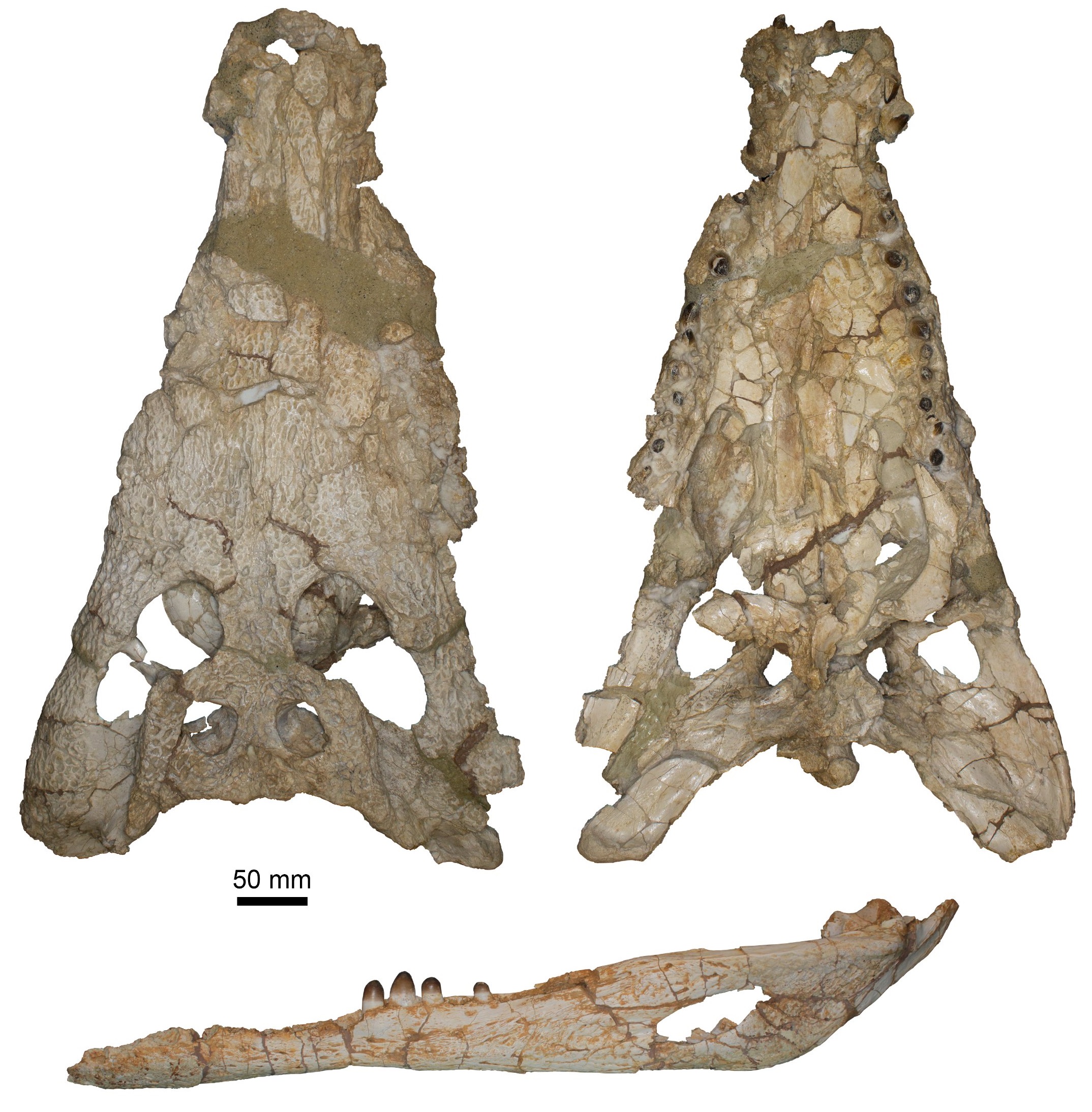
Crocodylus sudani holotype cranium, Atbara 22–172, in dorsal (a) and ventral (b) views.
Scale bar: 10 cm. 

Crocodylus sudani holotype cranium, Atbara 22–172, in occipital (c) and left lateral (d) views.
Scale bar: 10 cm.  

Eusuchia Huxley 1875 
Crocodylia Gmelin 1789, sensu Benton and Clark 1988 

Crocodylidae Gray 1825 

Crocodylus Laurenti, 176921.

Crocodylus sudani, sp. nov.  

 
Khalafallah Salih, Johannes Müller, Ali Eisawi and Faysal Bibi. 2025. A new late Pleistocene fossil crocodile from Sudan reveals Hidden Diversity of Crocodylus in Africa. Scientific Reports. 15, 27433. DOI: doi.org/10.1038/s41598-025-08980-6 [01 August 2025]


Friday, July 25, 2025

[Paleontology • 2025] Direct Evidence of Trophic Interaction between a crocodyliform and a large terror bird in the Middle Miocene of La Venta, Colombia


 a caimanine alligatorid (Purussaurus neivensis) preying/scavenging on a large phorusrhacid bird.
 
in Link, Moreno-Bernal, Degrange, Cooke, ... et Salas-Gismondi, 2025.
Illustrations by Julian Bayona Becerra. 

Abstract
Direct evidence of predation and other trophic relationships provide valuable information about trophic interactions between species in palaeo-communities. Data on ecological interactions amongst extant apex predators open a unique opportunity to better understand how sympatric apex predators coexisted or interacted with each other in the past. Here, we describe direct evidence of a predation or scavenging event in which we hypothesize that a medium-sized caiman (possibly Purussaurus neivensis) consumed (either through scavenging or through direct predation) a large terror bird. The distal part of a left tibiotarsus from a phorusrhacid had four pits inflicted on the cortical bone, and no signs of healing, suggesting it did not survive this trophic event. This record contributes to our current understanding of prey consumed by P. neivensis in the wetlands of the Pebas System of South America and indicates that large phorusrhacids might have had higher predation risk than previously expected. This study provides evidence of a trophic relation between apex predators and the complexity of trophic interactions in the diverse vertebrate palaeo-community of La Venta in the Middle Miocene of northern South America.

Keywords: apex predators, Phorusrhacidae, Purussaurus, superpredation, taphonomy, Caimaninae, scavenging
 
(a) Superimposed 3D models of MT−0200 and a skull of extant black caiman (Melanosuchus niger UF-Herp-53600). Both models at the same scale, the M. niger model is archived on Morphosource (https://doi.org/10.17602/M2/M359353). Total length estimated for the specimen of M. niger is 4.84 meters and is used here as an analogy to a medium sized Purussaurus (skull or mandible not available) [49]. Scale bar is 50 mm. (b) Detail of the superimposed model, showing the close match between the teeth of UF-Herp-53600 and the tooth marks on MT-0200. Scale bar is 50 mm.
(c) Artistic representation of a caimanine alligatorid (Purussaurus neivensis) preying on a large phorusrhacid bird. (d) Artistic representation of a caimanine alligatorid (Purussaurus neivensis) scavenging on a large phorusrhacid bird. Illustrations by Julian Bayona Becerra.  


Andres Link, Jorge Wilson Moreno-Bernal, Federico Javier Degrange, Siobhan B. Cooke, Luis Gonzalo Ortiz-Pabon, Cesar Augusto Perdomo-Rojas and Rodolfo Salas-Gismondi. 2025. Direct Evidence of Trophic Interaction between a crocodyliform and a large terror bird in the Middle Miocene of La Venta, Colombia. Biol. Lett. 21; 20250113. DOI: doi.org/10.1098/rsbl.2025.0113 [23 July 2025]

Thursday, April 24, 2025

[Paleontology • 2025] Expanded Phylogeny elucidates Deinosuchus relationships, Crocodylian Osmoregulation and Body-size Evolution


Deinosuchus riograndensis  

in Walter, Massonne, Paiva, Martin, Delfino et Rabi, 2025. 
illustration by Márton Szabó

Abstract
Transmarine distribution and gigantism in the Late Cretaceous North American crocodyliform Deinosuchus has been difficult to reconcile with consistently inferred phylogenetic relationships to alligatorids, an otherwise freshwater and smaller-bodied group. We present an expanded phylogeny with increased spatiotemporally coherence that reinterprets species of Deinosuchus as stem-group crocodylians together with further putative alligatoroids, Leidyosuchus canadensis and the European Diplocynodon spp. (closely related to North American Borealosuchus). The novel topology elucidates the evolution of osmoregulation in Crocodylia and its close relatives by inferring plesiomorphic saltwater tolerance for Deinosuchus and the crown-group as well as secondary loss already in stem-group alligatorids. Divergence of Alligatoroidea coincided with extreme mid-Cretaceous sea level highs and the distribution of Deinosuchus across the Western Interior Seaway can be best explained by marine dispersal. Phylogenetic body-length analysis using a head-width proxy reveals phyletic dwarfism early in alligatoroid evolution and a reasonable total length estimate for the most complete specimen of Deinosuchus riograndensis. We find that gigantism in crocodyliforms is correlated with high-productive extensive aquatic ecosystems in the present and the past.


Jules D. Walter, Tobias Massonne, Ana Laura S. Paiva, Jeremy E. Martin, Massimo Delfino and Márton Rabi. 2025. Expanded Phylogeny elucidates Deinosuchus relationships, Crocodylian Osmoregulation and Body-size Evolution. Communications Biology. 8: 611. DOI: doi.org/10.1038/s42003-025-07653-4 [23 April 2025]
https://www.science.org/content/article/ancient-megareptile-gets-revised-family-tree
https://edition.cnn.com/2025/04/23/science/terror-crocodile-dinosaur-eating-saltwater/index.html

Thursday, March 20, 2025

[Paleontology • 2019] Portugalosuchus azenhae • A New Eusuchian Crocodylomorph from the Cenomanian (Late Cretaceous) of Portugal reveals Novel Implications on the Origin of Crocodylia


Portugalosuchus azenhae 
Mateus, Puértolas-Pascual & Callapez, 2019


Abstract
The fossil record of Eusuchia extends back to the Early Cretaceous (Barremian), with the English species Hylaeochampsa vectiana being the oldest known representative of the clade so far. However, the eusuchian record from the Barremian to the Santonian is scarce and fragmentary worldwide. Here we described a new eusuchian crocodylomorph based on a partial skull and lower jaw from the Early Upper Cenomanian of the Tentugal Formation, in the Baixo Mondego region, west-central Portugal. The specimen exhibits a series of characters not seen in other taxa, allowing its assignment to a new genus and species named Portugalosuchus azenhae gen. et sp. nov. The results of a cladistic analysis place this specimen within Crocodylia, as the sister taxon to all other non-gavialoid crocodylians. Therefore, this Portuguese specimen represents the only well-documented and valid eusuchian species in the Cenomanian in Europe, and may be the oldest representative of Crocodylia known so far, helping to fill a gap in the fossil record of Eusuchia from the Barremian to the Campanian. In addition, the discovery of this new taxon sheds light on the radiation of Eusuchia and the origin of Crocodylia, which probably took place in Europe.  

Crocodylomorpha, Eusuchia, phylogeny, systematics


Octávio Mateus, Eduardo Puértolas-Pascual and Pedro M Callapez. 2019. A New Eusuchian Crocodylomorph from the Cenomanian (Late Cretaceous) of Portugal reveals Novel Implications on the Origin of Crocodylia. Zoological Journal of the Linnean Society, zly064.  DOI: doi.org/10.1093/zoolinnean/zly064 

 
Portugalosuchus: Paleontólogos portugueses descobrem nova espécie: o mais antigo crocodilo fóssil conhecido dct.fct.unl.pt/investigacao/portugalosuchus
Paleontólogos portugueses descobrem o mais antigo crocodilo fóssil do mundo em Tentúgal: observador.pt/2018/12/06/paleontologos-portugueses-descobrem-o-mais-antigo-crocodilo-fossil/ via @observadorpt
Paleontologia. O fóssil de crocodilo mais antigo do mundo é de Tentúgal publico.pt/2018/12/06/ciencia/noticia/fossil-crocodilo-antigo-mundo-tentugal-1853821

Thursday, March 7, 2024

[Paleontology • 2024] Asiatosuchus oenotriensis • A New Crocodyloidea from the middle Eocene of Zamora (Duero Basin, Spain)


Asiatosuchus oenotriensis
 Narváez, de Celis, Escaso, de Jesús, Pérez-García & Ortega, 2024
 

Abstract
The eusuchian crocodyliforms recorded in the Eocene levels of the Spanish Duero Basin belong to three lineages: Planocraniidae, with the species Duerosuchus piscator; Alligatoroidea, represented by several specimens of the genus Diplocynodon; and Crocodyloidea, which includes several specimens traditionally attributed to Asiatosuchus. The genus Asiatosuchus, established in 1940 based on a middle Eocene species from Mongolia, has subsequently served as a wastebasket taxon for Paleogene remains belonging to several species, not only from Asia but also belonging to the European and North American records. Many of these species are known by highly fragmentary remains, sharing the presence of characters such as a flat and triangular skull, and long symphyses in the lower jaw, recognized as characteristic for the crocodyloids. In addition to isolated cranial remains, among the material traditionally attributed to Asiatosuchus at the Duero Basin stands out a nearly complete skull and a left mandible, from the middle Eocene area of Casaseca de Campeán (Zamora Province). The present study analyses in detail these specimens, previously reported during the 1980s, but analyzed in a very preliminary way. They are included for the first time in a phylogenetic analysis to establish the systematic position of this Spanish form. The results confirm that it corresponds to a new species of basal crocodyloid, defined here as Asiatosuchus oenotriensis sp. nov.

Keywords: Asiatosuchus oenotriensis sp. nov., Crocodylidae, Lutetian, Spanish record, Zamora Province


Asiatosuchus oenotriensis sp. nov.


SYSTEMATIC PALEONTOLOGY
Crocodylomorpha Walker, 1970.
Crocodyliformes Hay, 1930.
Eusuchia Huxley, 1875.

Crocodylia Gmelin, 1789.
Crocodyloidea Fitzinger, 1826.

Asiatosuchus Mook, 1940.
Type species: A. grangeri Mook, 1940.

Distribution: Lutetian (middle Eocene) of Asia and Europe.

Asiatosuchus oenotriensis sp. nov. 

Diagnosis. Basal crocodyloid characterized by the following exclusive combination of characters respect to other non Crocodylidae and non Mekosuchinae Crocodyloidea (sensu Rio & Mannion, 2021): nasals not contacting the external naris; palatine process extending significantly beyond the anterior margin of the suborbital fenestrae, reaching anteriorly the level of the eighth maxillary alveoli; ectopterygoid maxillary ramus forming more than two-thirds of the suborbital fenestra lateral margin; and presence of shallow depressions on the sutural intersection of the frontal with the postorbital and parietal.
...

Etymology. oenotri- refers to Oenotria (from the Greek, “the Land of Wine”) in reference to Tierra del Vino, the name of the natural region where the type locality is located; and -ensis, from the Latin, “belonging to.”

Type locality and horizon. Lutetian (middle Eocene) of Casaseca de Campeán (Zamora Province, Duero Basin, Castile and Leon Autonomous Community, central Spain) (see Ortega et al., 2022; and references therein).


CONCLUSIONS: 
A detailed study of the remains of a crocodyloid from the middle Eocene of Casaseca de Campeán (Province of Zamora, Spain) reveals a set of exclusive characters allowing the establishment of a new crocodyloid taxon, A. oenotriensis sp. nov. Regardless of the phylogenetic analysis carried out, A. oenotriensis sp. nov. is recovered as an early branching crocodyloid closely related to the German synchronous species A. germanicus. Asiatosuchus oenotriensis sp. nov. can be distinguished from the other “Asiatosuchus-like complex” taxa from the European Paleogene on the basis of a unique combination of characters such as the absence of contact between the nasals and the external naris, the presence of a palatine process that extends significantly beyond the anterior end of the suborbital fenestrae, an ectopterygoid maxillary ramus forming more than two-thirds of the lateral margin of the suborbital fenestra, and shallow depressions on the sutural intersection of the frontal with the postorbital and parietal.

In addition, A. oenotriensis sp. nov. shares several characters widely observed in specimens related to the “Asiatosuchus-like complex”, such as the length of the mandibular symphysis, a large medial jugal foramen, the position of the surangular-angular suture, and a short dorsal premaxillary process. Among the “Asiatosuchus-like complex,” A. oenotriensis sp. nov. shows features only shared with the species A. germanicus, such as the participation of the splenial in the mandibular symphysis, a splenial having an anterior perforation for the mandibular branch of cranial nerve V, the presence of 16 mandibular alveoli, a lingual dental occlusion, and a linear frontoparietal suture with a modest entry into the supratemporal fenestrae.

Finally, the recognition of this new middle Eocene basal crocodyloid species increases knowledge on the diversity and distribution of the “Asiatosuchus-like complex” taxa, and adds valuable information to the knowledge of the systematics of the relatively diverse crocodyliform fauna from the Spanish Duero Basin.

 
Iván Narváez, Ane de Celis, Fernando Escaso, Santiago Martín de Jesús, Adán Pérez-García and Francisco Ortega. 2024. A New Crocodyloidea from the middle Eocene of Zamora (Duero Basin, Spain). The Anatomical Record. DOI: 10.1002/ar.25422
  twitter.com/Godzillin/status/1713834021421986095

Monday, September 25, 2023

[Paleontology • 2023] Baru iylwenpenyThe Last Baru (Crocodylia, Mekosuchinae): A New Species of ‘Cleaver-headed Crocodile’ from central Australia and the Turnover of Crocodylians during the Late Miocene in Australia


Baru iylwenpeny 
Yates, Ristevski & Salisbury. 2023
 
 
Abstract
Baru is a genus that includes several large mekosuchine crocodylians from the Oligo-Miocene of Australia. Here we describe Baru iylwenpeny sp. nov. from a large sample of cranial bones from the Upper Miocene Alcoota Local Fauna of the Northern Territory. Baru iylwenpeny can be diagnosed by several autapomorphies that include, but are not limited to: extreme reduction of the pneumatic foramina associated with the diverticula that invade the bones of the suspensorium; and enlargement of the postcaniniform maxillary teeth resulting in crowding of the postcaniniform alveoli and a reduction in the number of maxillary alveoli to 12. The new species is the geologically youngest known member of the genus. While species of Baru are a ubiquitous component of Oligo-Miocene crocodylian assemblages from northern Australia, they are absent from all known Plio-Pleistocene sites, suggesting the extinction of the genus by the latest Miocene. We suggest that the marked taxonomic turnover of crocodylian assemblages between the Upper Miocene Alcoota Local Fauna and the Lower Pliocene is the result of a short period of severe aridity during the latest Miocene, causing widespread crocodylian extinctions across Australia, followed by the establishment of taxonomically novel crocodylian faunas in the Pliocene. This event mirrors similar contemporary losses of crocodylian diversity in Africa and South America, although these cases are partly driven by local tectonic events. It is likely that late Cenozoic global cooling also played a role in these extinctions.

Keywords: Baru, crocodile, Mekosuchinae, Miocene, Australia, extinction


 Baru iylwenpeny sp. nov. 


Adam M. Yates, Jorgo Ristevski and Steven W. Salisbury. 2023. The Last Baru (Crocodylia, Mekosuchinae): A New Species of ‘Cleaver-headed Crocodile’ from central Australia and the Turnover of Crocodylians during the Late Miocene in Australia. Papers in Palaeontology. DOI: 10.1002/spp2.1523
 Researchgate.net/publication/374154980_The_last_Baru_from_Miocene_central_Australia
 
#alcootascientificreserve #Baruiylwenpeny #thelastbaru #Megafaunacentralmuseum #mekosuchine #crocodylian #fossils #MAGNT #MAGNTnaturalsciencecollection #Paleontology #Anmatyerr 

Monday, September 18, 2023

[Paleontology • 2023] Crococopros naduongensis • Exceptionally Well-preserved Crocodilian Coprolites from the Late Eocene of Northern Vietnam: Ichnology and Paleoecological Significance


The Eocene of Na Duong Basin is considered as a fossil Lagerstätte of Southeast Asia
Flora and fauna constituent in the drawing were an actual reconstruction based on palynology analyses, and of body fossil findings from various workers 

Crococopros naduongensis Halaçlar, Rummy, Liu, Hunt, Do, Minh & Deng, 2023
Illustration by Chung-Tat Cheung  facebook.com/ChungTatCheung

Highlights: 
• New ichnogenus and ichnospecies Crococopros naduongensis
• First quantitative study on crocodilian coprolites
• Multidisciplinary approach to understand paleoecology of Na Duong Basin
• Tangible evidence supporting Na Duong Basin as a fossil-Lagerstätte of Southeast Asia

Summary
This study examines 55 coprolites from the Na Duong Basin to reconstruct the paleoenvironment. Coproecology sheds light on understanding the complex prey-predator relationships, trophic dynamics, and ecosystem evolution. Through quantitative and multidisciplinary analysis, the putative coprolites were attributed to crocodilian producers, leading to the establishment of a new ichnogenus and species, Crococopros naduongensis igen. et isp. nov., based on distinct characteristics and comparisons. The study provides compelling evidence of an ancient river or lake-like environment dominated by diverse crocodilian fauna, indicating a thriving food chain in the Na Duong Basin. The findings also highlight the remarkable richness of ichnofauna, fauna, flora, and the presence of a favorable climate, confirming the area as a significant fossil Lagerstätte in Southeast Asia. Overall, this study offers a unique snapshot of the past, providing valuable insights into the regional ecosystem and significantly contributing to our understanding of paleoenvironmental conditions and biotic interactions.


Paleoenvironment reconstruction drawing reflects a real ‘snapshot’ of an intermittently swamped lacustrine–fluvial plain ecosystem with an abundance of crocodilians and testudines
 The Eocene of Na Duong Basin is considered as a fossil Lagerstätte of Southeast Asia (Flora and fauna constituent in the drawing were an actual reconstruction based on palynology analyses, and of body fossil findings from various workers).
Illustration by Chung-Tat Cheung

 
Kazım Halaçlar, Paul Rummy, Jia Liu, Adrian P. Hunt, Truong Van Do, Nguyen Trung Minh and Tao Deng. 2023. Exceptionally Well-preserved Crocodilian Coprolites from the Late Eocene of Northern Vietnam: Ichnology and Paleoecological Significance. iScience.   26(9); 107607. DOI: 10.1016/j.isci.2023.107607