Showing posts with label Ranunculaceae. Show all posts

Monday, December 30, 2024

[Botany • 2024] Clematis brevipes (Ranunculaceae) • an interesting and yet imperfectly known species from Gansu and Sichuan, China

 
 Clematis brevipes  Rehder (1928) 

in Huang, Zeng, Yuan et Yang, 2024.

Abstract
Clematis brevipes (Ranunculaceae), described from southern Gansu province, China, is an interesting and yet imperfectly understood species, with some of its important morphological characters, detailed geographical distribution and habitat information unknown or inconsistently recorded. Based on careful observations of both herbarium specimens (including type material) and living plants in the wild, here we determine the number of leaflets and color of flowers of this species and its geographical distribution. The habitat information is also given for this species for the first time. Furthermore, we discuss aspects of typification of C. brevipes and the affinity of the species with its close allies.

Clematis sect. Cheiropsis, geographical distribution, morphology, taxonomy, Eudicots


QIAO-LAN HUANG, YOU-PAI ZENG, QIONG YUAN and QIN-ER YANG. 2024. Clematis brevipes (Ranunculaceae), an interesting and yet imperfectly known species from southern Gansu and northern Sichuan, China. Phytotaxa. 635(2); 126-136. DOI: doi.org/10.11646/phytotaxa.635.2.2

Tuesday, July 23, 2024

[Botany • 2024] Coptis austrogaoligongensis (Ranunculaceae) • A New Species from West Yunnan, China


Coptis austrogaoligongensis C. L. Long & Z. Cheng, 

in Cheng, Li, Xu, Zhang, Gong et Long, 2024. 
南高黎贡黄连  ||  DOI: 10.3897/phytokeys.244.127978

Abstract
Based on morphological and plastid data, we have described and confirmed that Coptis austrogaoligongensis distributed in Tongbiguan Provincial Nature Reserve, Yingjiang County, Yunnan Province, is a new species of Coptis. It is distinctly different from C. teeta subsp. teeta and C. teeta subsp. lohitensis with differences mainly reflected in the following features: former leaf segment lobes contiguous to each other, and lateral segments equal to central one; plants without developed stolons; inflorescences with only 1–3 flowers; petals have short claws. Phylogenetic analysis indicated that C. austrogaoligongensis is a sister to C. teeta subsp. teeta and C. teeta subsp. lohitensis.

Key words: Coptis, Coptis austrogaoligongensis, taxonomy, Yunnan Province

Coptis austrogaoligongensis C. L. Long & Z. Cheng, sp. nov. 
 A species habitat B leaf C plant in florescence stage D whole plant E petiole F margin with sparsely upturned spiny hairs G rhizome and fibrous roots H calyx I petal J, K bract L fruit.
Photos by Zhuo Cheng & Jiahua Li.

 Coptis austrogaoligongensis C. L. Long & Z. Cheng, sp. nov.
  “南高黎贡黄连”(Nan Gao Li Gong Huang Lian)

Coptis austrogaoligongensis C. L. Long & Z. Cheng, sp. nov.
A species habitat B Fruit C Flower D margin with sparsely upturned spiny hairs E calyx F petal G bract H bract.
Drawn by Xinchen Qu.

Etymology: The specific epithet is derived from the type locality, Gaoligongshan, Yunnan.


 Zhuo Cheng, Jiahua Li, Congli Xu, Lixiang Zhang, Qiangbang Gong and Chunlin Long. 2024. Coptis austrogaoligongensis (Ranunculaceae), A New Species from West Yunnan, China. PhytoKeys. 244: 225-235. DOI: 10.3897/phytokeys.244.127978

Tuesday, June 11, 2024

[Botany • 2021] Aconitum sikkimensis (Ranunculaceae) • A New Species from Sikkim, Indian Eastern Himalaya


Aconitum sikkimensis  Harsh Singh, Aditya Pradhan & D. Adhikari, 

in Singh, Pradhan, Adhikari, Chettri et Barik, 2021. 

Abstract
Aconitum sikkimensis, a new species from Sikkim in the Indian Eastern Himalaya, is described and illustrated in this article. A. hookeri is morphologically closest species to the new species and it resembles in colour of the flower and the shape of the lateral sepals. However, it differs in plant height (A. sikkimensis being taller than A. hookeri), the shape of leaf and degree of dissection in the lamina, number of bracts and their shape and size, length of petiole, semi-orbicular upper sepal (vs. obliquely erect), distinctly curved, pubescent petals (vs. straight, glabrous petals) having spathulate lips (vs. obovate), and well-developed staminal pilose hairs and teeth (vs. non-developed, glabrous). Based on population data, the species was assigned the threat status of ‘Critically Endangered’ following IUCN criteria.

Keywords: Aconitum, A. sikkimensis sp nov., Indian Eastern Himalaya, morphology, threat status, critically endangered, Eudicots


Aconitum sikkimensis Harsh Singh, Aditya Pradhan & D. Adhikari sp. nov. 

Diagnosis:—This new species closely resembles A. hookeri Stapf but is different in lesser dissected leaves, curved pilose petals with spathulate lip, and well-developed pilose staminal teeth.
 

Harsh Singh, Aditya Pradhan, Dibyendu Adhikari, Arun Chettri and Saroj Kanta Barik. 2021. A New Species of Aconitum (Ranunculaceae) from Indian Eastern Himalayan State of Sikkim. Phytotaxa. 484(2); 207–216. DOI: 10.11646/phytotaxa.484.2.5


Sunday, July 31, 2022

[Botany • 2021] Thalictrum bouffordii (Ranunculaceae) • A New Species from the Qionglai Mountains Region in western Sichuan, China


Thalictrum bouffordii  Y. P. Zeng, Q. Yuan & Q. E. Yang,

in Zeng, Yuan & Yang, 2021. 

Abstract
Thalictrum bouffordii (Ranunculaceae), a new species from the Qionglai mountains region in western Sichuan, China, is illustrated and described. Morphologically T. bouffordii is most closely similar to T. xinningense in habit and having clavate filaments, apically recurved styles, and sessile, profoundly ribbed and pubescent achenes, but differs by having proximally glabrous (vs. densely pubescent) stem, inflorescence a many-flowered corymbiform compound monochasium (vs. a thyrse), abaxially pubescent (vs. glabrous) sepals, and purplish (vs. white) filaments.
 
Keywords: morphology, taxonomy, Thalictrum javanicum, Thalictrum xinningense, Eudicots


Thalictrum bouffordii Y. P. Zeng, Q. Yuan & Q. E. Yang, sp. nov.


You-Pai Zeng, Qiong Yuan and Qin-Er Yang. 2021. Thalictrum bouffordii (Ranunculaceae), A New Species from the Qionglai Mountains Region in western Sichuan, China.  Phytotaxa510(1); 18–28. DOI: 10.11646/phytotaxa.510.1.2  

Sunday, May 22, 2022

[Botany • 2022] Clematis pseudotubulosa (Ranunculaceae) • A New Species from Korea


Clematis pseudotubulosa B. K. Park, 

in Park, Kim, Chung, ... et Jang, 2022.

Abstract
Clematis pseudotubulosa (Ranunculaceae), a new species from Gyeonggi-do in the Republic of Korea, is described and illustrated. The new species is morphologically similar to C. takedana but differs in its leaves, which are always ternate with shallowly lobed leaflets (vs. 1-pinnate with deeply lobed three to five leaflets), and its oblong-shaped flower buds (vs. ovoid), larger flowers (vs. smaller flowers), and pantoporate pollen (vs. tricolpate). A detailed species description, geographical distribution, and an identification key for all species of Clematis that occur in Korea are also provided.

Keywords: Clematis, interspecific hybridization, new species, Ranunculaceae


Holotype specimen of Clematis pseudotubulosa B. K. Park
(27 Aug 2019. J.-S. Kim kjs19046 KB).

Illustration of Clematis pseudotubulosa B. K. Park.
A. Plant. B. Adaxial surface of the leaflet. C. Abaxial surface of the leaflet. D. Polar view of the flower. E. Equatorial view of the flower. F. Sepal. G. Stamen. H. Pistil. I. Fruit.
Illustrations by Hee Soo Kim. 

Photographs of Clematis pseudotubulosa B. K. Park.
A. Plant. B. Lignified stem. C. Herbaceous stem. D–F. Leaf (E, adaxial surface; F, abaxial surface). G. Inflorescence. H. Peduncle. I. Pedicel. J. Flower. K–L. Sepal (L, adaxial surface; M, abaxial surface). N. Stamen. O–P. Pistil. Q. Aggregated achenes. R. Achene. S. Seed.


Clematis pseudotubulosa B. K. Park, sp. nov

Vernacular name: Deong-gul-jo-hui-pul (덩굴조희풀)

English colloquial name: Creeping hyacinth-flower clematis
 
Distribution: Clematis pseudotubulosa is restricted to the Korean Peninsula (South Korea, including Hwaseong-si and Gwangju-si, Gyeonggi-do) (Fig. 4).


Beom Kyun PARK, Jin-Seok KIM, Gyu Young CHUNG, Jung-Hyun KIM, Dong Chan SON and Chang-Gee JANG. 2022. Clematis pseudotubulosa (Ranunculaceae), A New Species from Korea. Korean Journal of Plant Taxonomy. 52(1); 35-44. DOI: 10.11110/kjpt.2022.52.1.35


Wednesday, September 23, 2020

[Botany • 2020] Dichocarpum hagiangense • A New Species and An updated Checklist of Ranunculaceae in Vietnam


Dichocarpum hagiangense L.K Phan & V.T. Pham

in Nguyen, Trinh, ... et Pham​​, 2020.

Abstract 
Dichocarpum hagiangense from Ha Giang province, northern Vietnam is described and illustrated. Diagnostic features of the new species are a short rhizomatous stem, (2–)3-foliolate or simple leaves, and pink-purple flowers. The described species is distinct from closely allied D. trifoliolatum in having longer sepals, shape and obcordate apex of petal limbs, shorter flower stem, number and tooth shape of basal leaves; it differs from D. basilare and D. carinatum in having stem leaf, retuse apex and longer of central leaflet, number and (2–)3-foliated (or simple) of leaf. With the support of molecular data, the new species was clearly distinguished from other species in the Dichocarpum group by eight autapomorphic characters in nrITS sequence. A key to all species of Dichocarpum is provided. We suggest the IUCN conservation status of D. hagiangense to be “Critically Endangered”. A newest checklist of the family Ranunculaceae in Vietnam is updated.


Figure 1: Distribution map of Dichocarpum species in Vietnam.
 (A) Southeast Asia, Vietnam and collection point in black; (B) Northern Vietnam, Ha Giang and Lao Cai provinces in grey; (C) Detail of Ha Giang and Lao Cai provinces, the collection and recorded points in black.

Figure 3: Dichocarpum hagiangense L.K. Phan & V.T. Pham.
(A) Flattened flowering specimen. (B) Scaly rhizomes. (C) 3-foliolate leaves adaxial (lower) and abaxial (upper) views. (D) 2-foliolate leaf adaxial view. (E) Single leaves abaxial view. (F, G) Stem leaves. (B) Bract. (I) Inflorescences. (J) Flower frontal view. (K) Flower side view. (L) Flower behind view. (M) Sepals frontal view. (N) Petals. (O) Stamens. (P) Follicles. (Q) Seeds.
Scale bars: A = 5 cm; B, C, D, E = 2 cm; F, G, H, M, Q = 0, 5 cm; I, J, K, L, P = 1 cm; N, O = 0, 2 cm.

Figure 4: Dichocarpum hagiangense L.K. Phan & V.T. Pham in its natural habitat.
(A) Rocky cliff at the limestone forest. (B) Plant with inflorescence. (C) Flower.

Dichocarpum hagiangense L.K Phan & V.T. Pham, sp. nov.

Diagnosis. According molecular characters new species belong to sect. Dichocarpum, subsect. Dichocarpum. Dichocarpum hagiangense is morphologically most similar to D. trifoliolatum, but differs in having longer sepals, shape and obcordate apex of petal limbs, shorter flower stem, number and tooth shape of basal leaves. However, D. hagiangense differs from D. basilare and D. carinatum in having stem leaf, retuse apex and longer of central leaflet, number and (2–)3-foliated (or simple) of leaf.

Habitat and ecology. The new species grows in disturbed primary evergreen forest on a limestone mountain at elevations of 1297 m, as a lithophytic herb on large wet mossy boulders and cliffs on steep slopes (Fig. 4).

Distribution and Conservation status. Dichocarpum hagiangense was only recorded from one small population in Ha Giang province of Vietnam (Fig. 1). The existing population is facing the risk of extinction in the wild, since the area where this species is found does not belong to any protected forest. The habitat is highly disturbed by the local people for cardamom and Lysimachia foenum-graecum cultivations, collecting timber, firewood and non-timber forest products. The species is very rare and only known from one population of less than 50 mature individuals, in a habitat that is seriously threatened. According to IUCN Standards and Petitions Subcommittee (2019) criteria B1ab(ii) + B2ab(ii), with EOO (Extent of Occurrence) = 0 km2 and AOO (Area of Occupancy) = 4.000 km2, this species should be classified as “critically endangered” (CR).

Etymology. The species epithet ‘hagiangense’ refers to Ha Giang province, the only site where the species is currently known.


Minh Ty Nguyen, Ngoc Bon Trinh, Thanh Thi Viet Tran, Tran Duc Thanh, Long Ke Phan and Van The Pham​​. 2020. Dichocarpum hagiangense—A New Species and An updated Checklist of Ranunculaceae in Vietnam.  PeerJ. 8:e9874. DOI: 10.7717/peerj.9874

Friday, March 6, 2020

[Botany • 2020] Eranthis tanhoensis (Ranunculaceae) • An Integrative Taxonomic Approach reveals A New Species of Eranthis in North Asia


Eranthis tanhoensis Erst

in Erst, Sukhorukov, Mitrenina, et al., 2020. 

Abstract
A new endemic species, Eranthis tanhoensis sp. nov., is described from the Republic of Buryatia and Irkutsk Province, Russia. It belongs to Eranthis section Shibateranthis and is morphologically similar to E. sibirica and E. stellata. An integrative taxonomic approach, based on cytogenetical, molecular and biochemical analyses, along with morphological data, was used to delimit this new species.

Keywords: Biochemistry, cytology, integrative taxonomic approach, morphology, phylogeny, Ranunculales, Russia

Figure 5. General habit of Eranthis tanhoensis. Scale bar: 1 cm. 


Eranthis tanhoensis Erst, sp. nov.

Notes: Turczaninow (1842) described the species E. uncinata Turcz., growing at higher altitudes and distinguished from E. sibirica by the number of petals (5–6, not strictly 5), by the shape of the stylodium (recurved rather than straight), smaller flowers and more dissected leaf blades. However, our studies have shown that these morphological characters are variable and all variations can be found both in the foothill and alpine plants. Shipchinskiy (1937) merged E. uncinata with E. sibirica. However, he described two varieties: E. sibirica DC. var. nuda Schipcz. with glabrous pedicels (= E. sibirica var. sibirica) and E. sibirica DC. var. glandulosa Schipcz. with glandular-pubescent pedicels. These varieties were not validly published under ICN Article 39.1 (Turland et al 2018). Nakai (1937) attributed E. sibirica and E. uncinata to the genus Schibateranthis Nakai (≡ Eranthis sect. Schibateranthis (Nakai) Tamura).

Affinity: The new species belongs to E. sect. Shibateranthis (Nakai) Tamura and it is sister to E. sibirica, according to the results of molecular phylogenetic analysis (Fig. 1). E. tanhoensis is morphologically similar to E. sibirica and E. stellata (Figs 5–9) in having white sepals, tubular two-lipped petals with bilobate or forked lips, apically acute lobes with abaxial lip and globular yellow swellings (nectaries) at the top or in the central part. The differences amongst the three species are presented in Table 2.
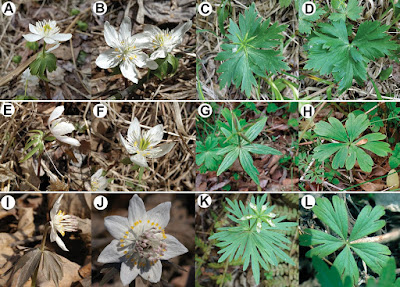
Figure 6. Morphological differences amongst A–D Eranthis tanhoensis E–H Eranthis sibirica; and I–L Eranthis stellata
 A, E, I flower position B, F, J flowers C, G, K involucral bracts and follicles D, H, L basal leaves.

Distribution: (Fig. 10): Eranthis tanhoensis is endemic to southern Baikal (Khamar-Daban range of the Republic of Buryatia and Irkutsk Province).

Habitat and ecology: Eranthis tanhoensis can be found at 350–2400 m a.s.l., where it grows in fir, Siberian pine, spruce and birch forests, on riverbanks, beside streams (up to 1500 m a.s.l.) and in subalpine meadows (at higher altitudes).

Etymology: The specific epithet of the new species is derived from the type locality, Tanhoi village, Republic of Buryatia, Russia.


 Andrey S. Erst, Alexander P. Sukhorukov, Elizaveta Yu. Mitrenina, Mikhail V. Skaptsov, Vera A. Kostikova, Olga A. Chernisheva, Victoria Troshkina, Maria Kushunina, Denis A. Krivenko, Hiroshi Ikeda, Kunli Xiang and Wei Wang. 2020. An Integrative Taxonomic Approach reveals A New Species of Eranthis (Ranunculaceae) in North Asia. PhytoKeys. 140: 75-100. DOI: 10.3897/phytokeys.140.49048

Monday, August 5, 2019

[Botany • 2019] Clematis guniuensis (Ranunculaceae) • A New Species from Eastern China


Clematis guniuensis W.Y.Ni, R.BWang & S.B.Zhou

in Wang, Ni, Xu, Gui & Zhou, 2019. 

Abstract
Clematis guniuensis sp. nov., a new narrowly endemic species of Clematis, is described and illustrated from the Huangshan Mountains of Eastern China. A description of C. guniuensis is presented along with illustrations, photographs and diagnostic differences between the new species and its putative close allies.

Keywords: Anhui, Early diverging eudicots, Ranunculales, Taxonomy

Figure 1. Clematis guniuensis W.Y.Ni, R.BWang & S.B.Zhou.
A Habitat in flowering period B Inflorescences with budding flower, showing the bracts C Stamen D Pistil E Achene F Stem cross-section.  


Figure 3. Clematis guniuensis W.Y.Ni, R.B.Wang & S.B.Zhou.
A Habitat B Young branches, showing stems 6–grooved, puberulous C Inflorescences, showing style and abaxial surface view of leaf blade D Dorsal view of cymes, showing peduncles and bracts E Frontal view of flower, showing stamens F Fruit G Achenes, showing persistent style.

Clematis guniuensis W.Y.Ni, R.B.Wang & S.B.Zhou, sp. nov.

Diagnosis: Resembles C. florida Thunb. and C. huchouensis Tamura but can be distinguished from the former one by puberulous leaflet blades, longer petiole, larger flowers with light green sepals, longer stamens and white filaments and from the latter by its longer petioles, 3-lobed leaflet blades, shorter pedicel, larger flowers, 4 sepals, filaments about 3–5 times the length of the anther, persistent style 1.5–2 cm long, and yellow plumose.
...

Etymology: The specific epithet is derived from the type locality, Guniujiang National Nature Reserve.

Vernacular name: Gǖ Niǘ Tiě Xiãn Lián (Chinese pronunciation); 牯牛铁线莲 (Chinese name).

Distribution and habitat: To date, C. guniuensis is only known from the type locality, Guniujiang National Nature Reserve, Huangshan City, Anhui Province (Fig. 4). Currently the species is known from a few collections and there is only one known population with ca. 20 individuals at the type locality. The species is mostly found in tea plantations or forest edges along valleys of evergreen broad-leaved forests, at an elevation of 1,500 m a.s.l.


 Rong-Bin Wang, Wei-Yong Ni, Wen-Jing Xu, Zheng-Wen Gui and Shou-Biao Zhou. 2019. Clematis guniuensis (Ranunculaceae), A New Species from Eastern China. PhytoKeys. 128: 47-55. DOI: 10.3897/phytokeys.128.33891

Friday, February 15, 2019

[Botany • 2019] Clematis mae (Ranunculaceae) • A New Species of Clematis sect. Meclatis from Xinjiang, China


Clematis mae Z.Z.Yang & L.Xie

in He, Lyu, Yao, Xie & Yang, 2019. 

Abstract
Clematis mae Z.Z.Yang & L.Xie, a new species of Ranunculaceae from Xinjiang, China, is described and illustrated. The new species is morphologically similar to C. orientalis and C. glauca but can be distinguished for being a less hairy plant (hairy in C. orientalis), often 2-ternate leaves (1–2-pinnate for C. orientalis and C. glauca), lanceolate to linear-lanceolate leaflets (elliptic or ovate in C. glauca), larger flowers (smaller flower in C. orientalis) and narrowly lanceolate sepals with acute to slightly attenuate apex (narrowly oblong sepals in C. orientalis and ovate to broadly lanceolate sepals in C. glauca). The new species is endemic to the southern slope of North Tianshan Mountain in Central Xinjiang. The conservation status of the species is also discussed.

Keywords: Anemoneae, Asia, Eudicots, Ranunculales, vine

Figure 2. Illustration of Clematis mae Z.Z.Yang & L.Xie.
Drawn by S.F. Li

Figure 1. Holotype specimen (M. Ma & Z.Z. Yang 99348, deposited in BJFC) of the new species, Clematis mae Z.Z.Yang & L.Xie, collected from Yuer gou, Toksun, Xinjiang, China. 

Clematis mae Z.Z. Yang & L. Xie, sp. nov.

Diagnosis: The new species is most similar to C. orientalis L. and C. glauca Willd. and it can be distinguished from the latter two species by the following combinations of characteristics. Plants of the new species are less hairy than C. orientalis and, in this respect, are similar to C. glauca. The leaves of the new species are often 2-ternate, with lanceolate to linear lanceolate leaflets. Its leaflets are larger than those of C. orientalis, but narrower than those of C. glauca. The flowers are also significantly larger than those of C. orientalis and slightly larger than those of C. glauca. The sepals of the new species are also less hairy than those of C. orientalis and similar to those of C. glauca. The shape of the sepal is lanceolate and the apex is acute to slightly attenuate. In C. orientalis, the sepals are often linear, oblong and reflexed. The sepals of C. glauca are often wider than those of the new species (Table 1, Fig. 3).
...

Figure 3. Field photographs of three closely related species of Clematis sect. Meclatis
A–C Clematis mae Z.Z.Yang & L.Xie. (photo taken by M. Ma & Z.Z. Yang) A Biternate leaf and flower buds B Ascending flower and its outside sepals C Flower inside
 D–F Clematis orientalis L. (photo taken at Shihezi, Xinjiang, China, by Z.Z. Yang) D Habitat and plants of C. orientalis E Flower showing spreading and reflexed sepals F Flower showing discernible hair on the inside sepals
G–I Clematis glauca Willd. (photo taken at Liancheng, Gansu, China, by J. He and L. Xie) G Habitat and plant in flower H Cyme and leaves I Flower and young fruit.

Distribution: Only known from its type locality, Yuer gou, Toksun, Xinjiang, China.

Etymology: The species epithet is chosen in honour of the collector, Ms. Ma Ming, who first noticed this new species and guided the last author to collect specimens.

Vernacular name: Ming Tie Xian Lian (明铁线莲; new Chinese name)


 Jian He, Ru-Dan Lyu, Min Yao, Lei Xie and Zong-Zong Yang. 2019. Clematis mae (Ranunculaceae), A New Species of Clematis sect. Meclatis from Xinjiang, China. PhytoKeys. 117: 133-142. DOI: 10.3897/phytokeys.117.31854

Wednesday, January 30, 2019

[Botany • 2019] Trollius austrosibiricus (Ranunculaceae) • A New Species from South Siberia


Trollius austrosibiricus  Erst & Luferov

Erst, Luferov, Troshkina, et al., 2019. 

Abstract
Trollius austrosibiricus Erst & Luferov, sp. nov.a new species from Russian South Siberia is described and illustrated. This new species is endemic to Western and Central Siberia. Morphologically, it is close to the East Asian species T. chinensis and T. macropetalus. However, it differs from the aforementioned species due to the morphology of the rhizomes, aerial shoots, sepals and petals. This species is also distinguished from T. asiaticus, which is widespread in Russia (Western and Eastern Siberia), Mongolia, China, north-eastern Kazakhstan and in the northeast of the European part of Russia, in having a smaller number of sepals, longer persistent styles and petals longer than sepals. In addition, an identification key for all Russian species is given and all species have been discussed.

Keywords: Ranunculaceae, Trollius, new species, South Siberia, Russia


Figure 2. Photograph of Trollius austrosibiricus. A Flowering plant B Flower C Leaf laminae
(Photographs by E. Balde and A. Erst).

Trollius austrosibiricus Erst & Luferov, sp. nov.

Diagnosis: Trollius austrosibiricus is morphologically close to T. chinensis Bunge and T. macropetalus (Regel) Fr.Schmidt. It differs from these species in simple rhizomes, shorter aerial shoots, smaller flowers and shorter persistent styles. The new species is distinguished from T. asiaticus L. by a smaller number of sepals, longer persistent styles and petals longer than sepals.
...

Habitat and ecology: Trollius austrosibiricus grows in subalpine and forest zones, in moist valleys at 350–2400 m elevation. It occurs in forest glades and fringes, in mixed-grass and mixed-grass-cereal dry and swampy meadows, along the banks of rivers, streams and small ponds with fresh water.

Etymology: The specific epithet of the new species is derived from the type locality, South Siberia, Russia.


 Andrey Erst, Alexander Luferov, Victoria Troshkina, Dmitry Shaulo, Alexander Kuznetsov, Kunli Xiang and Wei Wang. 2019. Trollius austrosibiricus (Ranunculaceae), A New Species from South Siberia. PhytoKeys. 115: 83-92. DOI: 10.3897/phytokeys.115.30863

Saturday, November 11, 2017

[Botany • 2017] Semiaquilegia quelpaertensis • A New Species (Ranunculaceae) from the Republic of Korea


Semiaquilegia quelpaertensis D.C. Son & K. Lee

Son, Jeong, Lee, Kim & Chang, 2017  

Abstract
Semiaquilegia quelpaertensis sp. nov.a new species belonging to the family Ranunculaceae, from Hallasan National Park in Jeju-do, Republic of Korea, is described and illustrated. The new species is similar to Semiaquilegia adoxoides (DC.) Makino, but can be readily distinguished by a thick underground stem, shallowly lobed leaflets, larger flowers, (4–)6 staminodes and conspicuously rugose tuberculate seed surface.

Keywords: Ranunculaceae, Isopyroideae, Hallasan National Park, Eudicots


Figure 1. Semiaquilegia quelpaertensis D.C. Son & K. Lee, illustrations.
A Habit B Flower (lateral view) B’ Flower (top view) C Flower with sepals cut away to show petals D Sepals E Flower with some sepals and petals removed, showing stamens and styles F Petals G Flower with sepals, petals and some stamens removed, showing stamens, staminodes and pistils H Stamens I Staminodes J Pistils (after fertilisation) K Inflorescence in fruiting L Follicles (immature) L’ Dehisced follicles, showing seed M Seed N Inflorescence O Petiole P Leaflet (abaxial surface).
 Illustrations by Heesoo Kim.

 Semiaquilegia quelpaertensis D.C. Son & K. Lee; Flowering plant

 Photographs by Kang-Hyup Lee.

Semiaquilegia quelpaertensis D.C. Son & K. Lee, sp. nov.

Diagnosis:  Semiaquilegia quelpaertensis is most similar to S. adoxoides in general vegetative and floral morphology, but obviously differs from the latter by the shallowly lobed leaflets, larger flowers, (4–)6 staminodes and conspicuously rugose tuberculate seed surface.

Figure 2. Semiaquilegia quelpaertensis D.C. Son & K. Lee.
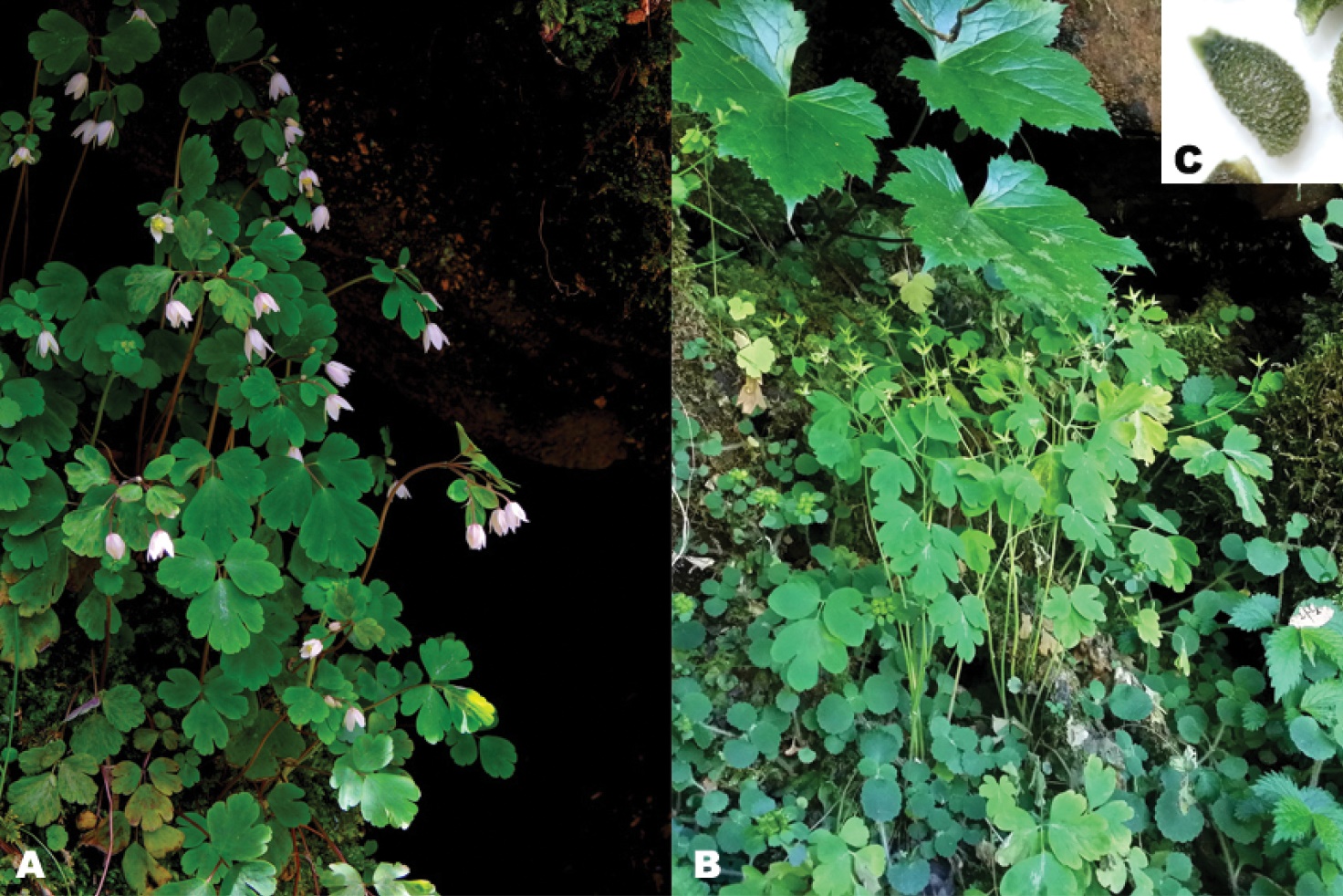
 A Flowering plant B Fruiting plant C Seeds.
Photographs by Kang-Hyup Lee.

Distribution: Endemic to the Province Jeju-do (Republic of Korea).

Vernacular (Korean) name: Keun-gae-gu-ri-bal-top (큰개구리발톱; new Korean name).

Habitat and ecology: Semiaquilegia quelpaertensis grows in submontane broadleaf forests and in moist valleys at 800–850 m elevation. Its habitat is dominated by Styrax obassis Siebold & Zucc. (Styracaceae), with Dryopteris dickinsii (Franch. & Sav.) C. Chr. (Dryopteridaceae), Elatostema umbellatum (Siebold & Zucc.) Blume (Urticaceae), Pimpinella hallaisanensis (W. Lee & G. Jang) G. Jang, W.K. Paik & W. Lee (Apiaceae), Cardamine tanakae Franch. & Sav. (Brassicaceae), Peracarpa carnosa var. circaeoides (F. Schmidt ex Miq.) Makino (Campanulaceae), Viola boissieuana Makino (Violaceae) and Anemone stolonifera Maxim. (Ranunculaceae).

Etymology: The specific epithet of the new species is derived from the type locality, Jeju-do, Republic of Korea.


 Dong Chan Son, Keum Seon Jeong, Kang-Hyup Lee, Heesoo Kim and Kae Sun Chang. 2017. Semiaquilegia quelpaertensis (Ranunculaceae), A New Species from the Republic of Korea. PhytoKeys. 89; 107-113.  DOI:  10.3897/phytokeys.89.21004