|
Ostromia crassipes (Meyer, 1857)
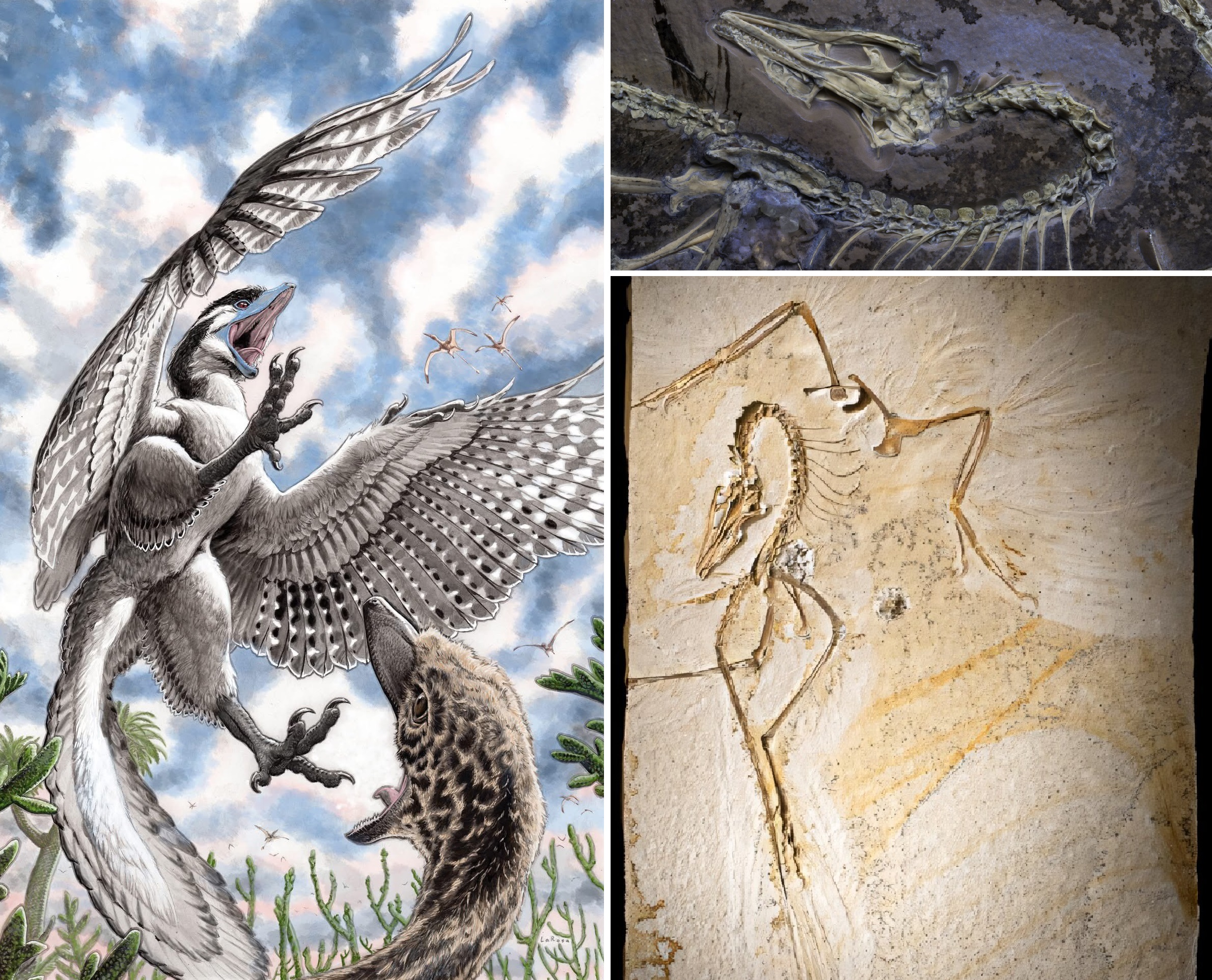
“Haarlem specimen”, holotype of Ostromia crassipes (Meyer, 1857).
Counterslab, Teylers Museum TM 6929 (left) and main slab, TM 6928 (right).
|
Abstract
Background
Archaeopteryx is an iconic fossil that has long been pivotal for our understanding of the origin of birds. Remains of this important taxon have only been found in the Late Jurassic lithographic limestones of Bavaria, Germany. Twelve skeletal specimens are reported so far. Archaeopteryx was long the only pre-Cretaceous paravian theropod known, but recent discoveries from the Tiaojishan Formation, China, yielded a remarkable diversity of this clade, including the possibly oldest and most basal known clade of avialan, here named Anchiornithidae. However, Archaeopteryx remains the only Jurassic paravian theropod based on diagnostic material reported outside China.
Results
Re-examination of the incomplete Haarlem Archaeopteryx specimen did not find any diagnostic features of this genus. In contrast, the specimen markedly differs in proportions from other Archaeopteryx specimens and shares two distinct characters with anchiornithids. Phylogenetic analysis confirms it as the first anchiornithid recorded outside the Tiaojushan Formation of China, for which the new generic name Ostromia is proposed here.
Conclusions
In combination with a biogeographic analysis of coelurosaurian theropods and palaeogeographic and stratigraphic data, our results indicate an explosive radiation of maniraptoran coelurosaurs probably in isolation in eastern Asia in the late Middle Jurassic and a rapid, at least Laurasian dispersal of the different subclades in the Late Jurassic. Small body size and, possibly, a multiple origin of flight capabilities enhanced dispersal capabilities of paravian theropods and might thus have been crucial for their evolutionary success.
Keywords: Maniraptora, Anchiornithidae, Late Jurassic, Biogeography, Radiation
 |
| Fig. 1 Overview of the “Haarlem specimen”, holotype of Ostromia crassipes (Meyer, 1857). Counterslab, Teylers Museum TM 6929 (left) and main slab, TM 6928 (right). |
Systematic Palaeontology
Theropoda Marsh, 1881
Maniraptora Gauthier, 1986
Anchiornithidae tax. Nov.
Type genus. Anchiornis
Xu, Zhao, Norell, Sullivan, Hone, Erickson, Wang, Han, and Gao, 2009
Definition. Anchiornithidae is a stem-based taxon defined as all maniraptoran theropods that are more closely related to Anchiornis huxleyi than to Passer domesticus, Archaeopteryx lithographica, Dromaeosaurus albertensis, Troodon formosus, or Oviraptor philoceratops.
Ostromia gen. nov.
Ostromia crassipes von Meyer, 1857
Holotype. Teylers Museum TM 6928, 6929, part and counterpart of a fragmentary skeleton.
Locality and horizon. Jachenhausen locality, near Riedenburg, Bavaria, Germany. Early Tithonian laminated limestones of the Painten Formation.
Etymology. The generic name honours the late John Ostrom, who identified the Haarlem specimen as a theropod.
Conclusions
A re-evaluation of one of the twelve skeletal specimens referred to the ‘Urvogel’ Archaeopteryx, the Haarlem specimen, revealed that this specimen represents a separate taxon, Ostromia crassipes. Phylogenetic analysis identifies Ostromia as the first representative of the basal avialian clade Anchiornithidae outside eastern Asia. In combination with a biogeographic analysis, a rapid radiation of maniraptoran theropods in eastern Asia with a subsequent dispersal of many lineages in the Late Jurassic is indicated; dispersal of maniraptorans was facilitated by small body size of basal members of all clades and, possibly, several independent acquisitions of flight capabilities. In the fragmenting world of Pangean break-up during the Late Jurassic and Cretaceous, increased dispersal potential might have been a key factor to explain the success of maniraptoran, and especially avialian theropods, with dispersal events being followed by endemic radiations of different clades.
Christian Foth and Oliver W. M. Rauhut. 2017. Re-evaluation of the Haarlem
Archaeopteryx and the Radiation of Maniraptoran Theropod Dinosaurs.
BMC Evolutionary Biology. 17:236. DOI:
10.1186/s12862-017-1076-y
Groot nieuws! De beroemde #Archaeopteryx
van Teylers Museum blijkt nog ouder dan gedacht en wereldwijd uniek te zijn. Het is een fossiel van een nieuw ontdekte dinosaurussoort met veren, die de naam Ostromia
heeft gekregen. #breakingnews http://bit.ly/2jdITeB @TEYLERS