Showing posts with label Meliphagidae - Honeyeater. Show all posts

Thursday, March 6, 2025

[Ornithology • 2025] Myzomela babarensis • A Taxonomic Revision of Banda Myzomela Myzomela boiei (S. Müller 1843), including the Description of A New Species from Babar Island, Indonesia


Myzomela babarensis
 Berryman, Spencer, Sharma & Eaton, 2025
 
Babar Myzomela  |  DOI: 10.25226/bboc.v145i1.2025.a4 

Abstract
Banda Myzomela Myzomela boiei (S. Müller 1843) is a small honeyeater distributed in two subspecies across three island groups in Maluku Province, Indonesia: M. b. boiei on the Banda Islands, and c.350 km to the south, M. b. annabellae on the Tanimbar Islands and Babar. We compare data from 28 museum specimens and 21 sound recordings, and report the results of 152 playback experiments, to investigate the taxonomy of these three populations. Compared to M. b. annabellae, M. b. boiei has a c.10% longer wing, bill and tarsus, more extensive black breast-band, duskier posterior underparts, and a highly divergent song; in playback experiments, M. b. boiei proved unresponsive to recordings of M. b. annabellae. However, the songs of M. b. annabellae on the Tanimbars and Babar are also highly divergent, with populations on both islands unresponsive to the song of the other. Birds on Babar are also slightly larger than annabellae on the Tanimbars (with a c.10% longer tail) and may have more scarlet on the back. We consider the vocal differences between the three populations to be highly indicative of reproductive isolation and recommend they be treated as three independent species under a modern interpretation of the Biological Species Concept. Because no nomen is available for the Babar population, we name it as a new species.

Distribution of Banda Myzomela Myzomela boiei taxa in relation to the Banda Sea Islands mentioned in the text.


Photographs of the three populations of Myzomela boiei s. s.
(a) M. b. boiei, Banda Neira, 8 December 2023 (Andrew J. Spencer);
(b) M. b. annabellae, Tanimbar (Yamdena), 11 November 2024 (James A. Eaton); and
(c) Myzomela babarensis M. b. annabellae, Babar, 6 November 2024 (James A. Eaton)

Myzomela babarensis M. b. annabellae, Babar,
6 November 2024
  photo by James A. Eaton 

Myzomela babarensis sp. nov.

Diagnosis.—Compared to M. boiei sensu stricto, male M. babarensis differs in having a much narrower black breast-band that is confined to the upper breast (vs. extending onto the lower breast in M. b. boiei; Figs. 3–4). The lower underparts (especially the vent and flanks) of M. boiei are dusky, but consistently much paler cream-white in the nine specimens of M. babarensis examined. In plumage, females of the two populations appear to be identical. M. boiei s. s. is larger in wing, bill and tarsus length (Table 1) than M. babarensis. Morphologically, M. babarensis is similar to M. annabellae (restricted here to the Tanimbar Islands) and only very subtly identifiable. Male M. babarensis has a larger wing, bill and tail with no overlap (Table 1 and Fig. 2), and the available specimens (n = 5 for M. annabellae) appear to consistently have more extensive scarlet-red on the upperparts, especially on the uppertail-coverts. Female plumages appear inseparable. All three species differ radically in song (Table 2, Fig. 5 and accompanying descriptions) and playback experiments show them to be unresponsive to one another's song. ...
 
Etymology.—The species is named babarensis for the island of Babar, to which it is endemic. We propose the English name ‘Babar Myzomela’ (and ‘Tanimbar Myzomela’ for M. annabellae s. s.).

 
Alex J. Berryman, Andrew J. Spencer, Puja Sharma and James A. Eaton. 2025. A Taxonomic Revision of Banda Myzomela Myzomela boiei (S. Müller 1843), including the Description of A New Species from Babar Island, Indonesia.  Bulletin of the British Ornithologists’ Club. 145(1); 35-48. DOI: 10.25226/bboc.v145i1.2025.a4 [5 March 2025] 


Saturday, October 5, 2019

[Ornithology • 2019] Myzomela prawiradilagae • A New Myzomela Honeyeater (Meliphagidae) from the Highlands of Alor Island, Indonesia


Myzomela prawiradilagae 
Irham, Ashari, Suparno, Trainor, Verbelen, Wu & Rheindt, 2019


Abstract
We here describe a new species of Myzomela honeyeater from the Lesser Sunda island of Alor (southeast Indonesia). The new species is phylogenetically most closely related to Myzomela kuehni from the adjacent island of Wetar and most closely resembles that species in plumage. However, it differs in important morphological, bioacoustic and ecological characteristics. The discovery of a new bird species on Alor is of great biogeographic importance and elevates this island to the status of an Endemic Bird Area. The new Alor Myzomela is restricted to montane eucalypt woodland mostly above 900 m elevation and is currently known from few sites across the island. Based on its occurrence records and human population trends in the highlands of Alor Island, we recommend classification under the IUCN threat status endangered.

Keywords: Myzomela, Honeyeater, Alor, Wetar, Plumage, Bioacoustics, Ecological characteristics, Novel species 

 Two individuals of the new Alor Myzomela Myzomela prawiradilagae perched in Eucalyptus urophylla tree at 1250 m near Manmas-Subo in April 2014.
 (photo: Philippe Verbelen). 

Myzomela prawiradilagae
English name: Alor Myzomela. 
Indonesian name: Myzomela Alor.

Etymology: The new Alor Myzomela is named after Dr. Dewi Malia Prawiradilaga. One of the frst leading female Indonesian ornithologists, “Ibu Dewi” is the head of the bird division at the Museum Zoologicum Bogoriense, Research Center for Biology, Indonesian Institute of Science. She has made substantial contributions to the development of research on the ecology and conservation of Indonesian birds.


Mohammad Irham, Hidayat Ashari, Suparno, Colin R. Trainor, Philippe Verbelen, Meng Yue Wu and Frank E. Rheindt. 2019. A New Myzomela Honeyeater (Meliphagidae) from the Highlands of Alor Island, Indonesia. Journal of Ornithology. DOI: 10.1007/s10336-019-01722-2


Monday, January 8, 2018

[Ornithology • 2017] Myzomela irianawidodoae • A Colourful New Species of Myzomela Honeyeater from Rote Island in eastern Indonesia


Myzomela irianawidodoae
Prawiradilaga, Baveja, Suparno, Ashari, Ng, Gwee, Verbelen & Rheindt, 2017

 photo:  Philippe Verbelen 

ABSTRACT
The avifauna of Rote Island in the Lesser Sundas is not well studied and generally considered to be similar to that of adjacent Timor Island. However, some cases of bird endemism have recently been documented on this island. A population of Myzomela honeyeater is one such example. First observed in October 1990, it has been subsumed with Myzomela dammermani from Sumba Island given its superficially similar appearance. Based on extensive morphological inspection and bioacoustic analysis, we here describe this population as a new taxon to science. Apart from previously overlooked plumage distinctions, the new taxon bioacoustically differs from M. dammermani in the presence or absence of several unique call types and considerable differences across two parameters in shared call types. Considering the importance of bioacoustics in avian species delimitation, we propose that the new Rote Myzomela be considered a distinct species. Given continued habitat conversion across its small range, we propose the International Union for Conservation of Nature and Natural Resources (IUCN) threat status Vulnerable for the species.

Key words: bird, Lesser Sundas, Myzomela, new species, Rote Island


Male ‘Rote Myzomela’ Myzomela irianawidodoae sp. nov., near Bolatena village, Rote Island, East Nusa Tenggara Province, Indonesia, April 2014.

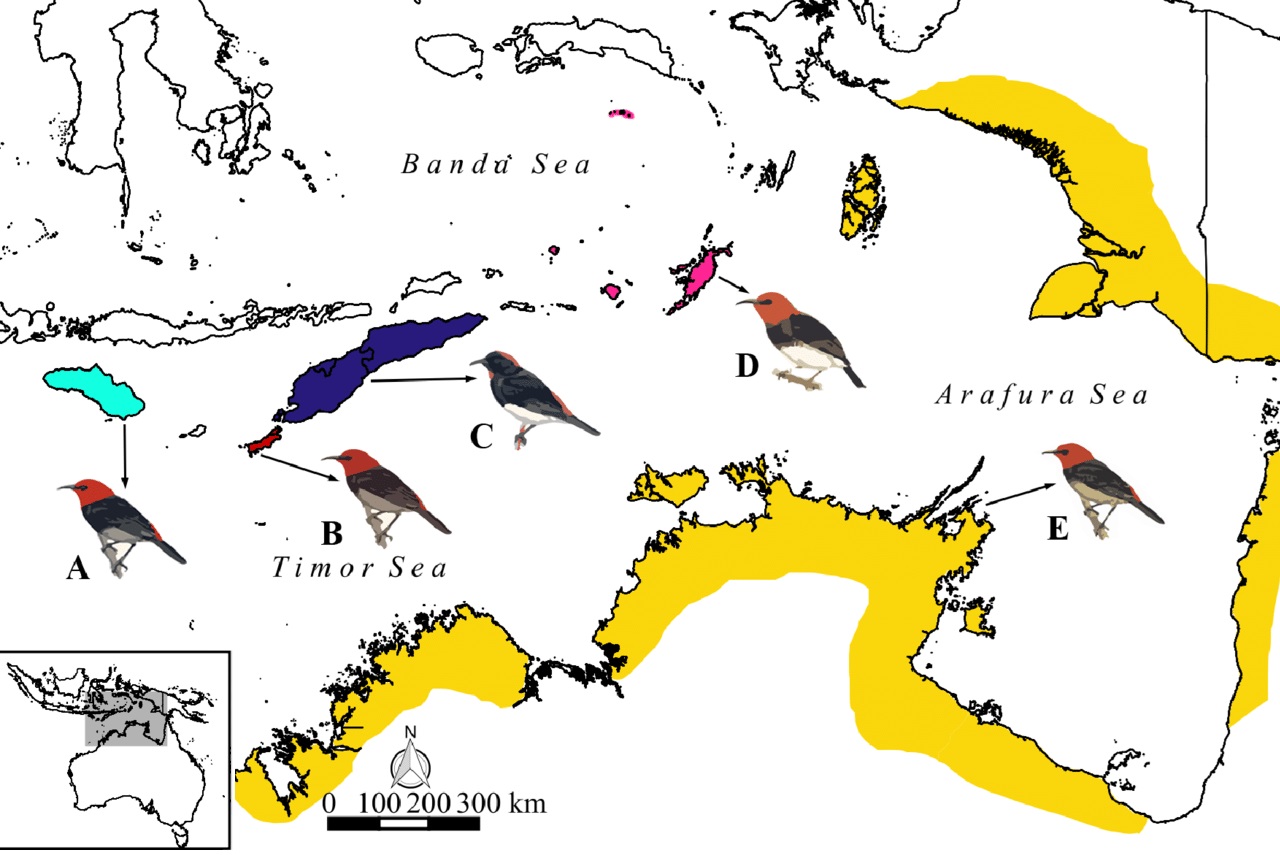
Figure 1. Map showing distribution of a select group of Myzomela taxa with a similar morphology.
A – Sumba Myzomela M. dammermani (Sumba Island; turquoise), B – the newly-described Rote Myzomela [Myzomela irianawidodoae] (Rote Island; red), C – Timor Myzomela M. vulnerata (Timor Island; dark blue), D – Banda Myzomela M. boiei (Banda Island arc and Tanimbar Islands; pink), E –Red-headed Myzomela M. erythrocephala (coastal Australia and Papua, Aru Islands; yellow).

Myzomela irianawidodoae, species nova
English name: Rote Myzomela
Indonesian name: Myzomela Rote

Etymology: We are pleased to name this species after Iriana Widodo, the current First Lady of the Republic of Indonesia, to recognise her keen interest in Indonesia’s birdlife and her valuable stewardship and advocacy for Indonesia’s natural environments.

....


Dewi Malia Prawiradilaga, Pratibha Baveja, Suparno, Hidayat Ashari, Nathaniel Sheng Rong Ng, Chyi Yin Gwee, Philippe Verbelen and Frank Erwin Rheindt. 2017.    A Colourful New Species of Myzomela Honeyeater from Rote Island in eastern Indonesia. Treubia. 44; 77-100.
http://e-journal.biologi.lipi.go.id/index.php/treubia/article/view/3414
 ResearchGate.net/publication/322163070_A_COLOURFUL_NEW_SPECIES_OF_MYZOMELA_HONEYEATER_FROM_ROTE_ISLAND_IN_EASTERN_INDONESIA

Philippe Verbelen, Colin R. Trainor, Veerle Dossche and Rohan P. Fisher. 2017. Rote Island, East Nusa Tenggara Province, Indonesia: an emerging hotspot of avian endemism. BirdingAsia. 27; 57-73.
ResearchGate.net/publication/319099457_Rote_Island_East_Nusa_Tenggara_Province_Indonesia_an_emerging_hotspot_of_avian_endemism

Description d'une nouvelle espèce d'oiseau en Indonésie, le Myzomèle de Rote (d'Iriana Widodo) | Ornithomedia.com: ornithomedia.com/magazine/etudes/description-nouvelle-espece-oiseau-indonesie-myzomele-rote-iriana-widodo-02595.html 


The discovery of Myzomela irianawidodoae — named after Indonesia’s first lady, Iriana Joko Widodo — involved a series of separate field studies between 1990 and 2015 by different groups of researchers, according to a paper published Dec. 31, 2017, in the scientific journal Treubia.

Meet Indonesia’s new honeyeater species from Rote Island news.mongabay.com/2018/01/meet-indonesias-new-honeyeater-species-from-rote-island/ via @Mongabay

Thursday, March 16, 2017

[Ornithology • 2016] Radiating Despite A Lack of Character: Ecological Divergence Among Closely Related, Morphologically Similar Honeyeaters (Aves: Meliphagidae) Co-occurring in Arid Australian Environments


Abstract
Quantifying the relationship between form and function can inform use of morphology as a surrogate for ecology. How the strength of this relationship varies continentally can inform understanding of evolutionary radiations; for example, does the relationship break down when certain lineages invade and diversify in novel habitats? The 75 species of Australian honeyeaters (Meliphagidae) are morphologically and ecologically diverse, with species feeding on nectar, insects, fruit, and other resources. We investigated Meliphagidae ecomorphology and community structure by (1) quantifying the concordance between morphology and ecology (foraging behavior), (2) estimating rates of trait evolution in relation to the packing of ecological space, and (3) comparing phylogenetic and trait community structure across the broad environmental gradients of the continent. We found that morphology explained 37% of the variance in ecology (and 62% vice versa), and we uncovered well-known bivariate relationships among the multivariate ecomorphological data. Ecological trait diversity declined less rapidly than phylogenetic diversity along a gradient of decreasing precipitation. We employ a new method (trait fields) and extend another (phylogenetic fields) to show that while species in phylogenetically clustered, arid-environment assemblages are similar morphologically, they are as varied in foraging behavior as those from more diverse assemblages. Thus, although closely related and similar morphologically, these arid-adapted species have diverged in ecological space to a similar degree as their mesic counterparts.

Keywords: community assembly, ecomorphology, functional traits, interspecific competition, phylogenetic community structure, phylogenetic niche conservatism.


Eliot T. Miller, Sarah K. Wagner, Luke J. Harmon and Robert E. Ricklefs. 2016. Radiating Despite A Lack of Character: Ecological Divergence Among Closely Related, Morphologically Similar Honeyeaters (Aves: Meliphagidae) Co-occurring in Arid Australian Environments.  American Naturalist. 189; E14–E30. DOI: 10.1086/690008.

 Birds fly, whales swim, cheetahs run, and amoebae ooze (not very fast)
Birds Evolve Their Behavior Without Changing Their Bodies: The Case Of Australia’s Honeyeaters


Sunday, April 21, 2013

[Ornithology • 2008] Convergent Evolution of Hawaiian and Australo-Pacific Honeyeaters from Distant Songbird Ancestors


Until the 1980s, when the last one went extinct, five species of Hawaiian honeyeaters sipped nectar from Hawaii's flowers. These songbirds, illustrated at lower left (Hawaii ‘o’o) and upper center (kioea), have always been considered Australasian honeyeaters (family Meliphagidae; two on right branch) and share many similarities in form, behavior, and ecology. However, DNA sequence analysis of museum specimens by Fleischer, James, and Olson reveal that the Hawaiian species are distantly related to meliphagids and instead form a new songbird family, the Mohoidae, related to Holarctic waxwings (shown at upper left), neotropical silky flycatchers, and related families. The mohoids and meliphagids are a remarkable example of convergent evolution and are the only bird family known to go extinct over the past few centuries.

Summary
The Hawaiian “honeyeaters,” five endemic species of recently extinct, nectar-feeding songbirds in the genera Moho and Chaetoptila, looked and acted like Australasian honeyeaters (Meliphagidae), and no taxonomist since their discovery on James Cook's third voyage has classified them as anything else. We obtained DNA sequences from museum specimens of Moho and Chaetoptila collected in Hawaii 115–158 years ago. Phylogenetic analysis of these sequences supports monophyly of the two Hawaiian genera but, surprisingly, reveals that neither taxon is a meliphagid honeyeater, nor even in the same part of the songbird radiation as meliphagids. Instead, the Hawaiian species are divergent members of a passeridan group that includes deceptively dissimilar families of songbirds (Holarctic waxwings, neotropical silky flycatchers, and palm chats). Here we designate them as a new family, the Mohoidae. A nuclear-DNA rate calibration suggests that mohoids diverged from their closest living ancestor 14–17 mya, coincident with the estimated earliest arrival in Hawaii of a bird-pollinated plant lineage. Convergent evolution, the evolution of similar traits in distantly related taxa because of common selective pressures, is illustrated well by nectar-feeding birds, but the morphological, behavioral, and ecological similarity of the mohoids to the Australasian honeyeaters makes them a particularly striking example of the phenomenon.


On the cover: Until the 1980s, when the last one went extinct, five species of Hawaiian honeyeaters sipped nectar from Hawaii's flowers. These songbirds, illustrated at lower left (Hawaii ‘o’o) and upper center (kioea), have always been considered Australasian honeyeaters (family Meliphagidae; two on right branch) and share many similarities in form, behavior, and ecology. However, DNA sequence analysis of museum specimens by Fleischer, James, and Olson reveal that the Hawaiian species are distantly related to meliphagids and instead form a new songbird family, the Mohoidae, related to Holarctic waxwings (shown at upper left), neotropical silky flycatchers, and related families. The mohoids and meliphagids are a remarkable example of convergent evolution and are the only bird family known to go extinct over the past few centuries.
Illustration by John Anderton.

Figure 2. Illustrations of Three of the Five Species of Hawaiian “Honeyeaters” and Three Representative Meliphagid Honeyeaters 
The three Hawaiian taxa represent the three primary morphological types found in Hawaiian “honeyeaters” (Mohoidae: [A], Moho nobilis; [C], Chaetoptila angustipluma; and [E], Moho braccatus). The three meliphagids include one from New Zealand ([B], Prosthemadera novaeseelandiae), one from Australia ([D], Anthochaera carunculata), and one from Samoa ([F], Gymnomyza samoensis).

Paintings by John Anderton 

R Fleischer, H James, S Olson. 2008. Convergent Evolution of Hawaiian and Australo-Pacific Honeyeaters from Distant Songbird Ancestors. Current Biology. DOI:  10.1016/j.cub.2008.10.051

When is a Honeyeater not a Honeyeater& The Tricks of Convergent Evolution http://on.natgeo.com/11bsyFs   
Picture of the Week — Hawaiian Honeyeaters http://blogs.smithsonianmag.com/science/2008/12/picture-of-the-week%e2%80%94hawaiian-honeyeaters via @SmithsonianMag