Showing posts with label Russia. Show all posts

Wednesday, October 1, 2025

[Entomology • 2025] The Genus Sophronia (Lepidoptera: Gelechiidae) in the Altai Mountains


1–3. Sophronia huiagaai sp. nov. Šumpich, 2025
 4–6. S. consanguinella (Herrich-Schäffer, 1855)
 7–9. S. chilonella (Treitschke, 1833)  

in Šumpich, 2025. 
 
Abstract 
This work summarizes current knowledge about the occurrence of Sophronia Hübner, [1825] species in the Altai Mountains. Previously, two species of the genus have been recorded, both two from the Russian Altai. Sophronia huiagaai sp. nov. is described from the southern Altai Mts in Mongolia. No Sophronia species is known from the Chinese and Kazakh parts of the mountains. Photographs of moths and genitalia of both sexes are provided for S. huiagaai sp. nov. S. chilonella (Treitschke, 1833) is recorded from the Altai Mts for the first time.

1–3. Sophronia huiagaai sp. nov., Mongolia; 1. Holotype, male; 2. Paratype, female; 3. Head, paratype, male;
4–6. S. consanguinella (Herrich-Schäffer, 1855). 4. Male, Russia, Southern Ural; 5. Female, Czechia; 6. Head, Czechia, male;
7–9. S. chilonella (Treitschke, 1833); 7. Male, Russia, Altai Mts; 8. Female, Czechia; 9. Head, Czechia, male.
 

Jan Šumpich. 2025. The Genus Sophronia in the Altai Mountains (Lepidoptera, Gelechiidae). Nota Lepidopterologica. 48: 137-144. DOI: doi.org/10.3897/nl.48.147394 

Wednesday, June 4, 2025

[PaleoBotany • 2025] Karkenia bracteata • A New Species of Karkenia (Ginkgoales: Karkeniaceae) from the Lower Jurassic of East Siberia (Russia): palaeobiogeographical and evolutionary implications

 
Karkenia bracteata
Frolov, Enushchenko & Mashchuk, 2025

 
Abstract
The family Karkeniaceae is the most ancient of the Ginkgoales. It is known from the lower Permian to the Lower Cretaceous. Cladistic analysis has shown that Karkeniaceae represents a distinct lineage among the Mesozoic ginkgoaleans and is much closer to Trichopitys. However, the absence of the complex ovule shoots of ginkgoaleans with remains of ‘intercalated bracts’ in the palaeontological record makes it difficult to reconstruct the transformation series linking Trichopityaceae to Karkeniaceae. Here, we report Karkenia bracteata sp. nov. from the Lower Jurassic of East Siberia (Russia). We examined impressions and compressions using light microscopy and scanning electron microscopy. Karkenia bracteata consists of the main axis bearing helically arranged bract–ovule complexes, each composed of a long laminar bract subtending and sheathing an ovule stalk with a single ovule. The presence of a bract distinguishes this species from all known Karkenia. However, the ovule structure, stomatal guard cells and megaspore membrane indicate that the new species belongs to Karkeniaceae. Karkenia could have evolved from Trichopitys due to reduction and condensation from an ancestral state. The ovulate short shoots must have fused to form a compact structure, while the main axis was strongly reduced. The leaves of such branches became reduced and further disappeared. Therefore, the leaves of the intermediate form between Trichopitys and Karkenia must have been bracts. Thus, K. bracteata corresponds to the hypothetical intermediate form linking Trichopityaceae to Karkeniaceae and confirms the hypothesis of the cone-like nature of Karkenia megastrobili.

Keywords: Trichopitys, Sphenobaiera, Ginkgoales, palaeobiogeography, compound seed cone, intercalated bract


Karkenia bracteata sp. nov. 


Andrey О. Frolov, Ilya V. Enushchenko and Irina M. Mashchuk. 2025. A New Species of Karkenia (Karkeniaceae, Ginkgoales) from the Lower Jurassic of East Siberia (Russia): palaeobiogeographical and evolutionary implications. Papers in Palaeontology. DOI: doi.org/10.1002/spp2.70019 [02 June 2025]


Friday, May 2, 2025

[Ichthyology • 2025] Gobio uralensisOn the border of Europe and Asia: A New Species of Gudgeons (Cypriniformes: Gobionidae) from the Caspian Sea Basin


Gobio uralensis
 Turbanov, Bolotovskiy, Artaev, Gandlin, Levina, Vasil’eva & Levin, 2025
 
 Ural gudgeon | уральский пескарь  ||  DOI: doi.org/10.3897/zse.101.147368 

Abstract
A new species of cypriniform fish was discovered during studies of the riverine fish fauna of the Caspian Sea basin, employing an integrative taxonomy approach. The Ural gudgeon is herein described as a new species from the Ural River system, which is considered a geographical boundary between Europe and Asia. The new species is distinguished from the other gudgeon species by a combination of morphological characters and genetic data. Morphologically, it is very similar to Gobio volgensis from the Volga basin. Genetically, however, it is closer to G. acutipinnatus, which occurs in the upper Irtysh River (Ob’ River system), and to G. multipunctatus from the Lake Alakol basin in Central Asia (p-distance = 0.037; COI mtDNA). Therefore, the Ural gudgeon, which is endemic to the Ural River system, is of Asian rather than European origin. The biogeography of freshwater aquatic animals in the region is discussed in relation to paleogeographic events and connections between the Caspian Sea and Ob’ drainages.

Key Words: Biogeography, DNA barcoding, endemics, freshwater fish, genetics, taxonomy

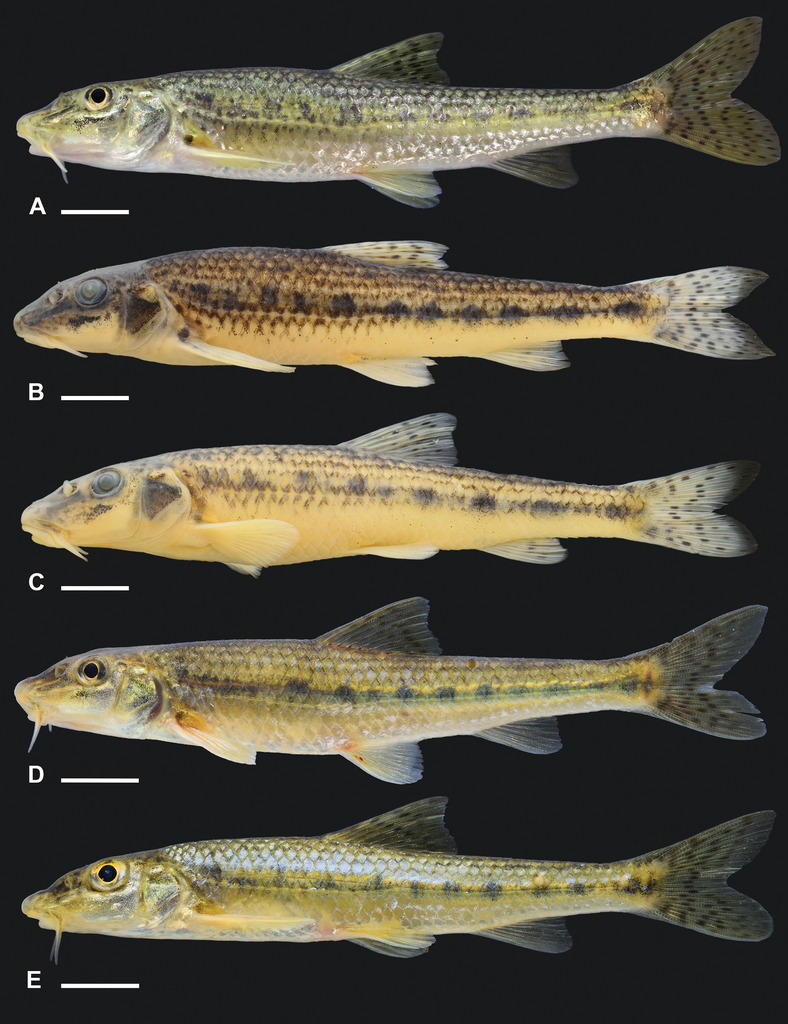
Lateral view of Gobio uralensis sp. nov.:
A–C. Bolshoy Kizil River near Ryskuzhino (A, B. Holotype; C. Paratype);
D. Uskalyk River near Verkhniy Muinak; E. Ural River near Krasnogor (right side, inverted image).
A, D, E. Live coloration; B, C. After fixation in 10% formalin (5 months), then transferred to 70% ethanol.
Scale bar: 10 mm.


Class Actinopteri Cope, 1871
Order Cypriniformes Bleeker, 1859

Family Gobionidae Bleeker, 1863
Genus Gobio Cuvier, 1816

 Gobio uralensis sp. nov.
 (English name – Ural gudgeon, 
Russian name – уральский пескарь)


 Ilya S. Turbanov, Aleksey A. Bolotovskiy, Oleg N. Artaev, Aleksandr A. Gandlin, Marina A. Levina, Ekaterina D. Vasil’eva and Boris A. Levin. 2025. On the border of Europe and Asia: Gobio uralensis, A New Species of Gudgeons (Cypriniformes, Gobionidae) from the Caspian Sea basin. Zoosystematics and Evolution. 101(2): 855-874.  DOI: doi.org/10.3897/zse.101.147368 

Saturday, January 4, 2025

[Crustacea • 2024] Proasellus abini • A New Species of the Genus Proasellus (Isopoda: Asellidae) from the Abin River Basin, with the preliminary data on the Diversity of the Genus in the southwestern foothills of the Russian Caucasus


Proasellus abini 
Marin & Sinelnikov, 2024
 

ABSTRACT 
 A new stygobiotic species of the genus Proasellus Dudich, 1925 (Crustacea: Isopoda: Asellidae), Proasellus abini sp. n., is described from the hyporheic habitats and groundwater of the Abin River basin, located in the southwestern foothills of the Caucasian Ridge. The new species is morphologically and genetically close to Proasellus linearis Birštein, 1967, known from the Evstafiev Sсhel (=Ashamba River) near Gelendzhik. Data on phylogeny, ecology and feeding of the species and other SW Caucasian species of the genus are also presented in the paper.

KEY WORDS: Crustacea, diversity, Proasellus, new species, hyporhea, stygobiotic, southwestern Caucasus, Russia.

General view and natural habitat of Proasellus abini sp. n.:
 A — a forest well, Shids, general view; B, C — individuals of the new species on the bottom and walls of the well; D, F — general dorsal view of alive individual of the new Proasellus abini sp.n. and its lateral view (E).

 Proasellus abini sp. n.

 
Marin I.N. and Sinelnikov S.Yu. 2024. A New Species of the Genus Proasellus (Crustacea: Isopoda: Asellidae) from the Abin River Basin, with the preliminary data on the Diversity of the Genus in the southwestern foothills of the Russian Caucasus. Invertebrate Zoology. 21(1); 81–93. 
  x.com/iee_ras/status/1871075641082237437

Monday, December 23, 2024

[Crustacea • 2024] Proasellus mikhaili • A New stygobiotic Species of the genus Proasellus Dudich, 1925 (Isopoda: Asellidae) from the Black Sea coast of the Caucasus, Russia


 Proasellus mikhaili Palatov & Chertoprud, 2024

Map of collection sites in the Black Sea coast of the Caucasus, general view and natural habitats of described species: A — habitus of P. mikhaili sp.n., paratype (♂); 6 — collection sites
C — photos of collection sites of P. mikhaili: 6a — spring stream (rheokrene) on Kadosh Cape, 3.5 km to NW of Tuapse town, ...; 6b — the Agoy River on the NE outskirts of Agoy village, ...


ABSTRACT 
A new stygobiotic species of water louses of the genus Proasellus Dudich, 1925 (Crustacea: Isopoda), P. mikhaili sp. n., is described from springs and groundwaters in the vicinity of the town of Tuapse on the Black Sea coast of the northwestern Caucasus, Russia. Representatives of this genus are reported for the first time from this coastal area. This new species is characterized by a number of unique features that immediately distinguish it from all known other Caucasian species of the genus. At present, this is the only species described from the region that has three connecting hooks in the retinacula of male pleopods I, as well as a shortened exopodite of pleopod V, significantly shorter than the endopodite in length. Among the diagnostic characters of this species are also a poor ornamentation of pereopods I–VII and a specific chetotaxis of the pleotelson represented by a dense covering of thin, hair-like setae. Probably, this species is an endemic of the Tuapsinsky District.

KEY WORDS: Crustacea, Asellidae, new species, stygobionts, crenobionts, local endemism, Transcaucasia.

Map of collection sites for Proasellus mikhaili sp. n. in the Black Sea coast of the Caucasus, general view and natural habitats of described species: 
A — habitus of P. mikhaili sp.n., paratype (♂);
B — map of collection sites for Proasellus in the Black Sea coast of the Caucasus. Numbers refer to: 1 — P. infirmus; 2 — P. linearis; 3 — P. ljovuschkini; 4 — P. similis; 5 — P. abini; 6 — P. mikhaili sp. n.;
C — photos of collection sites of P. mikhaili: 6a — spring stream (rheokrene) on Kadosh Cape, 3.5 km to NW of Tuapse town, 44°07ʹ37.55″N 39°02ʹ03.92″E; 6b — the Agoy River on the NE outskirts of Agoy village, 44°09ʹ05.1″N 39°02ʹ59.7″E.

Order Isopoda Latreille 1816 
Suborder Asellota Latreille, 1802 

Superfamily Aselloidea Latreille, 1802 
Family Asellidae Latreille, 1802 
Genus Proasellus Dudich, 1925 
 
Proasellus mikhaili sp. n.

DIAGNOSIS. Medium sized, depigmented species. Antenna I with six to seven flagellar articles, flagellum of antenna II with 42–55 articles. Inner plate of maxillula with five or six apical pappose setae. Propodus I elongate, oval, its inferior margin without a proximal apophysa, with two or three robust spiniform setae. Dactylus I with four or five short robust setae on inferior margin and ...

ETYMOLOGY. The species is named in honor of the renowned Russian hydrobiologist Mikhail Vitalievich Chertoprud (30.01.1975–23.02.2023), who spent many years studying aquatic invertebrates in the Krasnodar Territory and repeatedly conducted hydrobiological training courses at Cape Kadosh near Tuapse. 


Dmitry M. Palatov and Elizaveta M. Chertoprud. 2024. A New stygobiotic Species of the genus Proasellus Dudich, 1925 (Crustacea: Isopoda: Asellidae) from the Black Sea coast of the Caucasus, Russia. Invertebrate Zoology. 21(3); 369–383. 

Tuesday, December 17, 2024

[Crustacea • 2024] Protracheoniscus krivolutskyi • A New Species of the Genus Protracheoniscus Verhoeff, 1917 (Isopoda: Oniscidea: Agnaridae) from the northwestern Caucasus


Protracheoniscus krivolutskyi Gongalsky, 

in Gongalsky, Byzov et Medvedev, 2024

ABSTRACT 
 Protracheoniscus krivolutskyi sp. n. (Agnaridae) is described from the Utrish State Nature Reserve at the Black Sea coast of Russia. Analysis of COI gene and Scanning Electron Microscopy support the validity of this species. Affinities of the species within the genus are discussed.

KEY WORDS: Isopoda, COI, phylogenetic analysis, Oniscidea, Abrau Peninsula, woodlouse, Protracheoniscus.

Alive specimen of Protracheoniscus krivolutskyi sp. n. (female), from the Urtish State Nature Reserve, NE Caucasus, Russia, kept in culture.

TAXONOMY 
Class Malacostraca Latreille, 1802 
Order Isopoda Latreille, 1817 
Family Agnaridae Schmidt, 2003 

Genus Protracheoniscus Verhoeff, 1917 

Protracheoniscus krivolutskyi Gongalsky sp. n.
 
DIAGNOSIS. The species of Protracheoniscus is characterized by the antennal flagellum with the articles of a ratio 1:2; noduli laterales are located anteriorly of the middle line of pereonite 1.

ETYMOLOGY. The species name krivolutskyi originates from Prof. Dr. Dmitri A. Krivolutsky (1939–2004), a prominent Russian soil zoologist who encouraged the first author to study soil biology.


Konstantin B. Gongalsky, Philipp S. Byzov and Dmitry A. Medvedev. 2024. A New Species of the Genus Protracheoniscus Verhoeff, 1917 (Isopoda: Oniscidea: Agnaridae) from the northwestern Caucasus. Arthropoda Selecta. 33(1): 65–75. DOI: doi.org/10.15298/arthsel.33.1.06  

Sunday, December 8, 2024

[Botany • 2024] A Taxonomic Monograph of the Eurasian holoparasitic plant Genus Lathraea L. (Orobanchaceae)


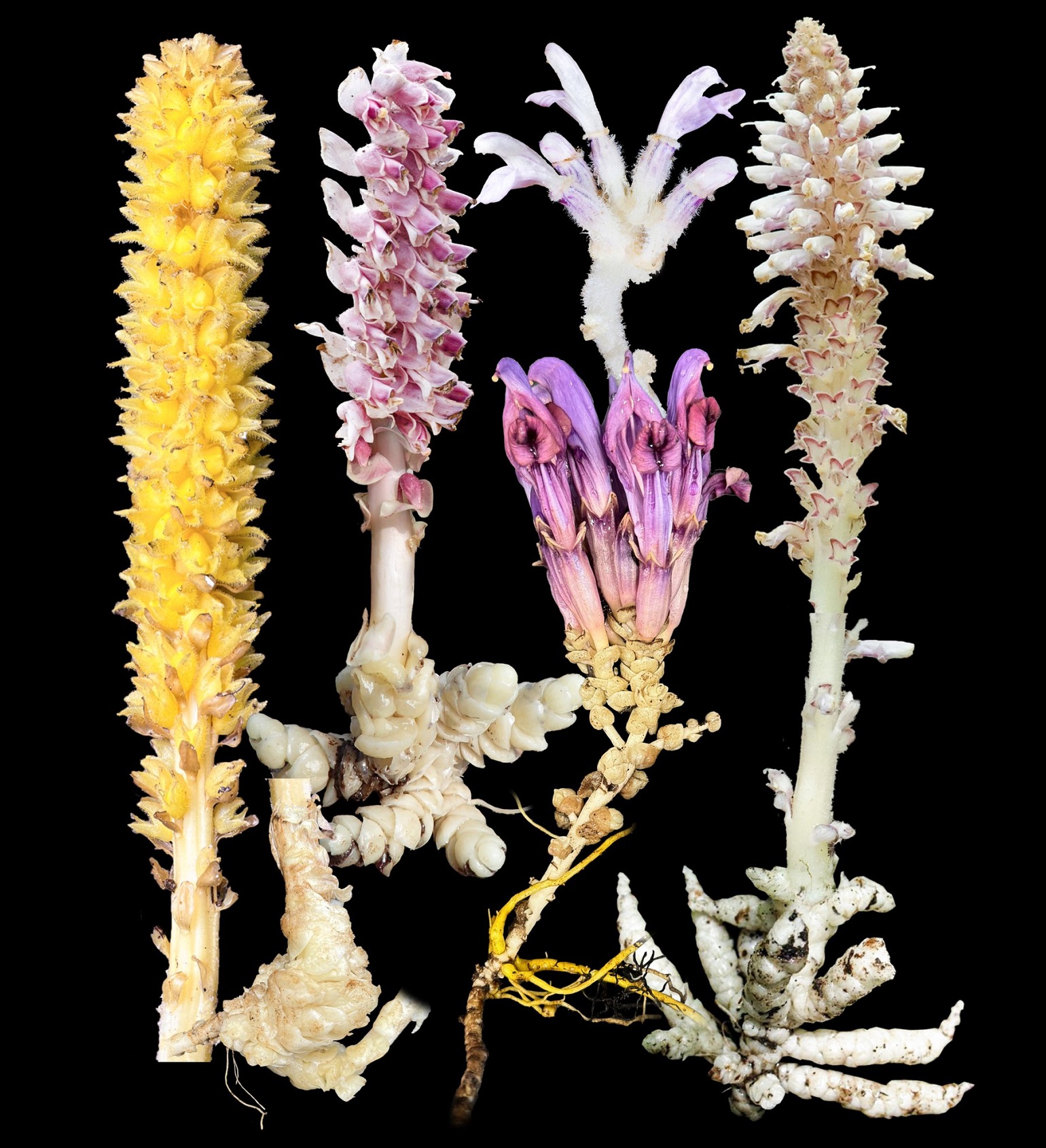
 Five species of Lathraea
 Lathraea squamariaLathraea clandestina, Lathraea japonicaLathraea rhodopeaLathraea purpurea

in Hatt, Tsiftsis et Thorogood, 2024. 

Abstract
A taxonomic monograph is presented for Lathraea L. (Orobanchaceae), a genus of holoparasitic plants distributed across Europe and Asia. Plants in this genus are characterised by their underground stems, achlorophyllous scales with internal gland-lined cavities, and, in some species, explosive seed dehiscence. Despite their conspicuousness, no taxonomic treatment of the genus has been written since 1930. Our work draws upon extensive international field data and a comprehensive survey of herbarium specimens. Detailed descriptions are provided for each species, along with full synonymy, distribution maps, and notes on habitat, host specificity, phenology, ecology, ethnobotany and threat risk. We present evidence to consolidate Lathraea into five species, resolving taxonomic confusion. The infrageneric classification is reviewed and a key to species is provided. Species are illustrated with photographs of living and dried material.

Lamiales, Lathraea, Orobanchaceae, Lathraea squamariaLathraea clandestina, parasitic plants, holoparasite, Lathraea japonicaLathraea rhodopeaLathraea purpurea, Eudicots


Sebastian A. Hatt, Spyros Tsiftsis and Chris J. Thorogood. 2024. A Taxonomic Monograph of the Eurasian holoparasitic plant Genus Lathraea L. (Orobanchaceae). Phytotaxa. 672(1); 1-29. DOI: doi.org/10.11646/phytotaxa.672.1.1

Friday, November 29, 2024

[Botany • 2024] Orobanche dagestanica (Orobanchaceae) • A New Species from the Greater Caucasus


Orobanche dagestanica Ó.Sánchez, Piwow., Fateryga, Svirin & Murtaz., 

in Piwowarczyk, Sánchez Pedraja, Fateryga, Svirin et Murtazaliev, 2024.
 
Abstract
A new, probably endemic species, Orobanche dagestanica is described from Dagestan in Russia (the Greater Caucasus). The species grows in alpine shale scree slopes, and is a parasite of the roots of species from the genus Lophiolepis (Asteraceae). Based on morphological and phylogenetic data, the newly-described species belongs to Orobanche subsect. Curvatae, and specifically to O. ser. Krylowianae, however it is distinct from all other taxa in this group. A detailed description, diagnosis, illustrations, a comparison with related species, as well as phylogenetic analysis are provided.

Curvatae, Krylowianae, holoparasites, Dagestan, Lophiolepis, Cirsium, taxonomy, Eudicots


Renata Piwowarczyk, Óscar Sánchez Pedraja, Alexander V. Fateryga, Sergey A. Svirin and Ramazan A. Murtazaliev. 2024. Orobanche dagestanica (Orobanchaceae): A New Species from the Greater Caucasus.  Phytotaxa. 653(1); 67-78. DOI: doi.org/10.11646/phytotaxa.653.1.5


Monday, July 1, 2024

[PaleoMammalogy • 2024] Temporal Dynamics of Woolly Mammoth Genome Erosion prior to Extinction


woolly mammoth Mammuthus primigenius wanders the frozen shore of Wrangel Island. 

in Dehasque, Morales, et al., 2024. 
    DOI: 10.1016/j.cell.2024.05.033    
 Artwork by Beth Zaiken

Highlights: 
• Analysis of long-term genomic changes using 21 high-coverage woolly mammoth genomes
• Severe bottleneck of the last surviving population when Wrangel Island was isolated
• The population partially recovered within a few generations and then remained stable
• Inbreeding depression and purging persisted for thousands of years after the recovery

Summary:
  A number of species have recently recovered from near-extinction. Although these species have avoided the immediate extinction threat, their long-term viability remains precarious due to the potential genetic consequences of population declines, which are poorly understood on a timescale beyond a few generations. Woolly mammoths (Mammuthus primigenius) became isolated on Wrangel Island around 10,000 years ago and persisted for over 200 generations before becoming extinct around 4,000 years ago. To study the evolutionary processes leading up to the mammoths’ extinction, we analyzed 21 Siberian woolly mammoth genomes. Our results show that the population recovered quickly from a severe bottleneck and remained demographically stable during the ensuing six millennia. We find that mildly deleterious mutations gradually accumulated, whereas highly deleterious mutations were purged, suggesting ongoing inbreeding depression that lasted for hundreds of generations. The time-lag between demographic and genetic recovery has wide-ranging implications for conservation management of recently bottlenecked populations.

Keywords: Mammuthus primigenius, woolly mammoth, extinction, ancient DNA, paleogenomics, mutation load, inbreeding, bottleneck, climate, Wrangel Island

The last woolly mammoth Mammuthus primigenius wanders the frozen shore of Wrangel Island. 
 Artwork by Beth Zaiken

 
M. Dehasque, H. E. Morales, et al. 2024. Temporal Dynamics of Woolly Mammoth Genome Erosion prior to Extinction. Cell.  DOI: 10.1016/j.cell.2024.05.033    

New genetic study reveals the woolly mammoths' journey towards extinction
 

Thursday, May 16, 2024

[Paleontology • 2024] Kiyacursor longipes • The Last Ceratosaur of Asia: A New noasaurid from the Early Cretaceous Great Siberian Refugium


Kiyacursor longipes
  Averianov, Skutschas, Atuchin, Slobodin, Feofanova & Vladimirova, 2024

 
Abstract
The noasaurid ceratosaur Kiyacursor longipes gen. et sp. nov. is described based on a fragmentary skeleton including cervical vertebra, pectoral girdle, humerus and hind limbs from the Lower Cretaceous (Aptian) Ilek Formation at Shestakovo 1 locality in Western Siberia, Russia. This is the first ceratosaur from the Early Cretaceous of Asia, extending the stratigraphic range of Ceratosauria by 40 Myr on that continent. Kiyacursor shares unique hind limb proportions with Elaphrosaurus and Limusaurus, suggesting improved cursorial ability. These taxa show an ostrich-like specialization of the pes, with a large third metatarsal and greatly reduced second metatarsal. By contrast, all other fast running non-avian theropod dinosaurs have an arctometatarsalian pes, with the third metatarsal strongly reduced proximally. The new taxon lived in the Early Cretaceous ecosystem containing a number of other Jurassic relics, such as stem salamanders, protosuchian and shartegosuchid crocodyliforms, tritylodontid synapsids and docodontan mammaliaforms.

Keywords: Dinosauria, Theropoda, Ceratosauria, Early Cretaceous, Western Siberia, Russia


Kiyacursor longipes gen. et sp. nov.

 
Alexander O. Averianov, Pavel P. Skutschas, Andrey A. Atuchin, Dmitry A. Slobodin, Olga A. Feofanova and Olga N. Vladimirova. 2024. The Last Ceratosaur of Asia: A New noasaurid from the Early Cretaceous Great Siberian Refugium. Proc. R. Soc. B. 291: 20240537. DOI: 10.1098/rspb.2024.0537
 

Monday, April 8, 2024

[Mammalogy • 2024] Spermophilus vorontsovi • Traditional Multilocus Phylogeny fails to fully resolve Palearctic Ground Squirrels Genus Spermophilus (Rodentia: Sciuridae: Marmotini) Relationships but reveals A New Species endemic to West Siberia


Spermophilus vorontsovi
Simonov, Lopatina, Titov, Ivanova, Brandler, Surin, Matrosova, Dvilis, Oreshkova, Kapustina, Golenishchev & Ermakov, 2024


Highlights: 
• The first multi-locus and complete taxon sampling phylogeny of Palaearctic ground squirrels.
• Four major clades diverged during the Late Miocene.
• The main speciation events took place during the Calabrian stage of the Pleistocene.
• A new species from West Siberia is discovered and described.

Abstract
Previous efforts to reconstruct evolutionary history of Palearctic ground squirrels within the genus Spermophilus have primarily relied on a single mitochondrial marker for phylogenetic data. In this study, we present the first phylogeny with comprehensive taxon sampling of Spermophilus via a conventional multilocus approach utilizing five mitochondrial and five nuclear markers. Through application of the multispecies coalescent model, we constructed a species tree revealing four distinct clades that diverged during the Late Miocene. These clades are 1) S. alaschanicus and S. dauricus from East Asia; 2) S. musicus and S. pygmaeus from East Europe and northwestern Central Asia; 3) the subgenus Colobotis found across Central Asia and its adjacent regions and encompassing S. brevicauda, S. erythrogenys, S. fulvus, S. major, S. pallidicauda, S. ralli, S. relictus, S. selevini, and S. vorontsovi sp. nov.; and 4) a Central/Eastern Europe and Asia Minor clade comprising S. citellus, S. taurensis, S. xanthoprymnus, S. suslicus, and S. odessanus. The latter clade lacked strong support owing to uncertainty of taxonomic placement of S. odessanus and S. suslicus. Resolving relationships within the subgenus Colobotis, which radiated rapidly, remains challenging likely because of incomplete lineage sorting and introgressive hybridization. Most of modern Spermophilus species diversified during the Early–Middle Pleistocene (2.2–1.0 million years ago). We propose a revised taxonomic classification for the genus Spermophilus by recognizing 18 species including a newly identified one (S. vorontsovi sp. nov.), which is found only in a limited area in the southeast of West Siberia. Employing genome-wide single-nucleotide polymorphism genotyping, we substantiated the role of the Ob River as a major barrier ensuring robust isolation of this taxon from S. erythrogenys. Despite its inherent limitations, the traditional multilocus approach remains a valuable tool for resolving relationships and can provide important insights into otherwise poorly understood groups. It is imperative to recognize that additional efforts are needed to definitively determine phylogenetic relationships between certain species of Palearctic ground squirrels.
 
Keywords: Species tree, Riverine barrier, MIG-seq, Marmotini, North Eurasia


Spermophilus vorontsovi 


Evgeniy Simonov, Natalia V. Lopatina, Sergey V. Titov, Anastasiya D. Ivanova, Oleg V. Brandler, Vadim L. Surin, Vera A. Matrosova, Alisa E. Dvilis, Nataliya V. Oreshkova, Svetlana Yu. Kapustina, Fedor N. Golenishchev and Oleg A. Ermakov. 2024. Traditional Multilocus Phylogeny fails to fully resolve Palearctic Ground Squirrels (Spermophilus) Relationships but reveals A New Species endemic to West Siberia. Molecular Phylogenetics and Evolution. 195, 108057. DOI: 10.1016/j.ympev.2024.108057

Thursday, March 2, 2023

[PaleoEntomology • 2023] The Earliest Pollen-loaded Insects from the Lower Permian of Russia


an Permian insect (Tillyardembia antennaeplana) feeding on a pollen cone of ruflorian cordaites

in Khramov, Foraponova et Węgierek, 2023.
reconstruction by Andrey Atuchin. 
 
Abstract
Recent fossil discoveries suggest that the coevolution of insect pollinators and gymnosperms started long before the appearance of flowering plants. One of the keys to understanding the origins of pollination relationships is fossil insects with gymnosperm pollen attached to the body surface. Such fossils are exceedingly rare to find, especially from the Palaeozoic, a time when ambers with insect inclusions were absent. Here, we report compression fossils of Early Permian tillyardembiid insects (Polyneoptera) preserved with pollen on their heads, thoraces, legs and abdomens. This is the earliest finding of pollen-bearing insects, predating the previous oldest record from the Middle Jurassic by ca 120 Ma. Judging by the pollen composition, tillyardembiids visited a narrow range of host plants, including Rufloriaceae (Cordaitales). While it is impossible to say for certain whether tillyardembiids as pollen consumers contributed to pollination, a trophic specialization of this kind could be considered an evolutionary precursor of pollination mutualism.

 Keywords: Palaeozoic, plant-insect interactions, pollination 


An artistic reconstruction of an Early Permian insect (Tillyardembia antennaeplana) feeding on a pollen cone of ruflorian cordaites. 
Artwork: Andrey Atuchin. 


Alexander V. Khramov, Tatiana Foraponova and Piotr Węgierek. 2023. The Earliest Pollen-loaded Insects from the Lower Permian of Russia. Biol. Lett. 1920220523. DOI: 10.1098/rsbl.2022.0523

Friday, December 23, 2022

[Paleontology • 2022] Annemys variabilis • Xinjiangchelyid Turtles from the Middle Jurassic of the Berezovsk Coal Mine (Krasnoyarsk Territory, Russia): Systematics, Skeletal Morphology, Variation, Relationships and Palaeobiogeographic Implications


 Annemys variabilis 
Obraztsova, Krasnolutskii, Sukhanov & Danilov, 2022

Artwork by Alexander Ostroshabov.

Abstract
This paper is devoted to the description of a new species of xinjiangchelyid turtle – Annemys variabilis sp. nov. – represented by thousands of isolated bones and several more complete specimens from the Middle Jurassic (Bathonian) Itat Formation of the Berezovsk coal mine, Krasnoyarsk Territory, western Siberia, Russia. The description is based on a sample of the best-preserved specimens. The new species differs from other Annemys spp. by a combination of cranial and shell characters. The basisphenoids (about 200 specimens) of A. variabilis demonstrate variation in 12 characters, some of which are reported in turtles for the first time. About 20 shell characters of A. variabilis are subject to ontogenetic or interindividual variation. Some of these characters are variable in other Annemys spp. and other xinjiangchelyids. The formula of the cervical vertebrae [(2(3()4()5()6()7()8) or (2(3()4()5()6()7()8(] with two opisthocoelous vertebrae (2 and 3), four or five amphicoelous vertebrae (4–7 or 4–8), and one procoelous vertebra is unique for this species among xinjiangchelyids, which were previously known to have only amphicoelous cervicals. Other characters of the non-shell postcranium correspond to those of other xinjiangchelyids. Of the three phylogenetic analyses performed in this study, Analysis 1 does not support the monophyly of either Xinjiangchelyidae or Annemys, Analysis 2 shows paraphyly of Xinjiangchelyidae and monophyly of the Annemys clade (A. latiens, A. levensis, A. variabilis and A. wusu), and Analysis 3 supports monophyly of the Annemys clade with A. latiens, A. levensis and A. variabilis, only in the majority rule consensus tree. The diversity of the turtle assemblage of the Itat Formation is re-assessed as containing 2–3 taxa (A. variabilis [=Testudines indet. 2], Testudines indet. 1 and 3), which is in agreement with similar diversities seen in some other Middle Jurassic Asian turtle assemblages. The known record of Annemys spp. is restricted to the northern part of Asia.


Annemys variabilis 

 
Ekaterina M. Obraztsova, Sergei A. Krasnolutskii, Vladimir B. Sukhanov and Igor G. Danilov. 2022. Xinjiangchelyid Turtles from the Middle Jurassic of the Berezovsk Coal Mine (Krasnoyarsk Territory, Russia): Systematics, Skeletal Morphology, Variation, Relationships and Palaeobiogeographic Implications. Journal of Systematic Palaeontology. 20(1); 1-61. DOI: 10.1080/14772019.2022.2093662

Wednesday, September 7, 2022

[Paleontology • 2022] Boreognathus pogorevichi • A Remarkable New polychaete annelid from the lower Permian of the Pechora Basin, Russia


Boreognathus pogorevichi 
 Shcherbakov, Tzetlin & Zhuravlev, 2022


Abstract
The sclerotized jaw elements (scolecodonts) of polychaete annelids are rarely preserved as articulated jaw apparatuses. Here we describe a morphologically unusual, rather large, and symmetrical jaw apparatus, assigned to the new taxon Boreognathus pogorevichi gen. et sp. nov., from the Kungurian (lower Permian) of the Pechora Coal Basin, northern Cis-Urals, Russia. Whereas the specimen is mainly preserved as a three-dimensional external mould of the near-complete dorsal maxillary apparatus, some organic matter comprising the original jaw wall is also retained. The new taxon combines edentate, pincer-like first maxillae (MI) typical of the extant Labidognatha apparatus type with long slender carriers common in the Prionognatha type. Unlike the smooth MI, MII are consistently and prominently denticulated. The new genus represents a hitherto unknown type of polychaete jaw apparatus and is assigned to the Palaeozoic family Atraktoprionidae.

Keywords: polychaetes, Eunicida, scolecodonts, jaw apparatus, symmetry, Permian, Russia


 Boreognathus pogorevichi gen. et sp. nov.


Dmitry E. Shcherbakov, Alexander B. Tzetlin and Andrey Yu. Zhuravlev. 2022. Boreognathus pogorevichi, A Remarkable New polychaete annelid from the lower Permian of the Pechora Basin, Russia. Papers in Palaeontology. DOI: 10.1002/spp2.1461 

Tuesday, March 15, 2022

[Paleontology • 2020] A Gigantic Pliosaurid (Pliosauridae: Brachaucheninae) from the Cenomanian (Upper Cretaceous) of the Volga Region, Russia


in Zverkov et Pervushov, 2020. 
Illustration: Andrey Atuchin   twitter.com/AndreyAtuchin

Abstract
Pliosaurid plesiosaurs were among the largest predators of Mesozoic marine ecosystems attaining giant sizes up to 10–11 m in length, near a quarter of which could be constituted by a massive head. The known Late Cretaceous pliosaurids are comparatively smaller than the stratigraphically older taxa and lack a suite of macropredaceous features, demonstrating a somewhat decline of the group members towards their extinction in the Turonian. However, the early Late Cretaceous (Cenomanian) record of pliosaurids is scarce and mostly represented by isolated teeth, thus hampering the recognition of diversity and disparity of pliosaurids in this time interval. Here we describe a very large isolated cervical centrum (19 cm in maximum diameter) belonging to a brachauchenine pliosaurid. The comparison with other pliosaurids indicates that the centrum belonged to one of the largest known pliosaurids, comparable in size to Kronosaurus queenslandicus, ‘Kronosaurusboyacensis and Sachicasaurus vitae from the Aptian–Albian of Australia and Barremian–Aptian of Colombia. This finding indicates that gigantic pliosaurids were also present in the Cenomanian. Thus, the previously inferred decrease in size of pliosaurids in the Late Cretaceous is likely a result of sampling bias, and, if present, it happened not earlier than in the late Cenomanian–Turonian, right before the extinction of the group.
 
Keywords: Pliosauridae, Brachaucheninae, Gigantic pliosaurids, Late Cretaceous, Cenomanian


 Nikolay G. Zverkov and Evgeny M. Pervushov. 2020. A Gigantic Pliosaurid from the Cenomanian (Upper Cretaceous) of the Volga Region, Russia. Cretaceous Research. 110, 104419. DOI: 10.1016/j.cretres.2020.104419 

Найденный на берегу Волги позвонок удлинил время существования гигантских плиозавров