Showing posts with label Cryptodira. Show all posts

Thursday, December 18, 2025

[Paleontology • 2025] Byeoljubuchelys yeosuensis • A New, Early Cretaceous carettochelyid Turtle (Trionychia: Carettochelyidae) from South Korea provides insights into Softshell Evolution and Aquatic Ecology


Byeoljubuchelys yeosuensis
Kim, J. Jung, Joyce, Park, H.-Y. Jung, Jo & Huh, 2025


Abstract
Here, we present a new Cretaceous carettochelyid turtle, Byeoljubuchelys yeosuensis gen. et sp. nov., from the Lower Cretaceous Hasandong Formation of Yeosu, Korea. A nearly complete shell and select elements of the girdles and limbs provide crucial insight into the evolution and aquatic adaptation of this family. Phylogenetic analyses place Byeoljubuchelys yeosuensis at the most basal position within Carettochelyidae. The mid-sized plastron of Byeoljubuchelys yeosuensis appears to be plesiomorphic for the group. The expansion of the plastron during carettochelyid evolution, especially during the Paleogene, may be an evolutionary response to increasing body size or the threat of mammalian predators. Although the shell of Byeoljubuchelys yeosuensis lacks distinct scute sulci, traces are apparent that are reminiscent of juvenile scutes in the extant Carettochelys insculpta, suggesting that scute loss was facilitated in trionychian evolution through the thickening of the epidermis. Byeoljubuchelys yeosuensis possesses a plesiomorphic humerus with a proximally located lateral process and a sigmoidal shaft lacking torsion, implying rowing locomotion rather than the underwater flapping seen in more recent carettochelyids. The repeated acquisition of a softshell in two clades of trionychians during the mid-Cretaceous may be related to an environmental shift towards humid climates at that time, perhaps reflecting a remarkable adaptation to freshwater ecosystems.

Keywords: Byeoljubuchelys yeosuensis, Early Cretaceous, Hasandong formation, Korea, Carettochelyidae, Paleoecology, Micro-CT

Systematic paleontology
Testudines Batsch, 1788
Cryptodira Cope, 1868
Trionychia Hummel, 1929
Carettochelyidae Gill, 1889

Geographical and geological settings of the type locality of Byeoljubuchelys yeosuensis gen. et sp. nov. 
A, Geographical map of South Korea. B, Geological map of Gyeongsang Basin in South Korea. C, Geological map of Gwangyang Bay. D, Aerial photograph of Soneuk Island with adjacent islands. E, Photographs of the holotype in situ. The red asterisks indicate fossil locality


Byeoljubuchelys yeosuensis gen. et sp. nov.
Photographs (A, C) and micro-CT generated three-dimensional models (B, D) of the holotype [KDRC-YS-SR-001]
A, B, shell in dorsal view. C, D, shell in ventral view.
Abbreviations: co, costal; ent, entoplastron; epi, epiplastron; hyo, hyoplastron; hypo, hypoplastron; nc, nuchal; ne, neural; pe, peripheral; py, pygal; spy, suprapygal; xip, xiphiplastron
 
Byeoljubuchelys yeosuensis gen. et sp. nov.

Diagnosis—Byeoljubuchelys yeosuensis can be diagnosed as a member of Carettochelyidae by the presence of 10 pairs of peripherals, a single, triangular suprapygal, a thickened pygal with an anterior groove, plastral kinesis, a triangular entoplastron, and the absence of plastral scutes. It differs from other carettochelyids by the unique combination of the following characters: neurals and pygal lacking midline keel, neural series broad and continuous, a reversal of neural orientation at neural II, vermiculated peripheral ornamentation, absence of distinct carapacial scute sulci, a lack of paired nuchal processes, a relatively broad cruciform plastron, long cervical vertebrae, and a humerus with sigmoidal shaft and lateral and medial processes at the level of the humeral head.

Type Locality and Horizon—Soneuk Island, Yeosu, Republic of Korea, near the Aptian/Albian boundary, Early Cretaceous.

Etymology—The genus name ‘Byeoljubuchelys’ is derived from the combination of the Korean word ‘Byeoljubu’, a turtle character in Sugungga, one of the epic tales of Pansori (a traditional Korean musical storytelling art), and the Ancient Greek word ‘chelys’ meaning turtle. The species name ‘yeosuensis’ is derived from Yeosu City, where the fossil was found.
 
The peripherals and pygal of KDRC-YS-SR-001, holotype of Byeoljubuchelys yeosuensis gen. et sp. nov. 
Interpretive drawing of carapace in dorsal view and micro-CT generated three-dimensional models of peripherals in dorsal and posterior view. Dotted lines express the reconstructed outline of peripherals and pygal. pe, peripheral
 
 
Minguk Kim, Jongyun Jung, Walter G. Joyce, Jae-Il Park, Hye-Yeon Jung, Hyemin Jo and Min Huh. 2025. A New, Early Cretaceous carettochelyid Turtle from South Korea provides insights into Softshell Evolution and Aquatic Ecology. Swiss Journal of Palaeontology. 144, 75. DOI: doi.org/10.1186/s13358-025-00415-z [08 December 2025]

Saturday, November 1, 2025

[Paleontology • 2025] Manouria morlathe Ancient One: An Early Miocene large Tortoise (Cryptodira: Testudinidae) from the Swamps of Ahníkov, Czechia


Manouria morla   
Chroust, Szczygielski & Luján, 2025
  
Digital painting by Rudolf Hima

Abstract
Tortoises (Testudinidae) are a clade of turtles highly specialized to terrestrial environments, mainly living in semi-arid conditions. Herein, we present Manouria morla sp. nov., a new species of the genus Manouria, which is considered to be the most basal extant testudinid genus. The studied material comes from the Ahníkov I fossil site, formerly known as Merkur or Merkur-North, located in the Most Basin in NW Bohemia (Czechia), dated to the Early Miocene (Burdigalian, MN 3). Manouria morla sp. nov. is the oldest member of the Manouria lineage, which nowadays inhabits SE Asia only, and therefore its biogeography and plausible European origin are discussed. The specific type of multiplication of plastral scutes in the inguinal region is discussed as a new morphological character diagnostic for the genus. Based on zoological studies, specific environmental requirements of the genus Manouria allow us to use this taxon as a proxy for the paleoclimate reconstruction of the Ahníkov I fossil site which suggests a broadleaf evergreen tropical wet forest. The simplified use of fossil testudinids as a proxy for reconstructing semi-arid palaeoclimate is therefore disproven.

Manouria morla sp. nov. (Ahníkov I, Early Miocene),
anterior part of the plastron in A internal view (photograph), B external view (photograph), C internal view, D external view, E left lateral view, F anterior (epiplastral) view, G right lateral view. Posterior part of the plastron in H internal view (photograph), I external view (photograph), J internal view, K external view

Hypothetical reconstruction of the shell of Manouria morla sp. nov. (Ahníkov I, Early Miocene).
A dorsal view of the carapace, B ventral view of the plastron, C dorsal view of the plastron. Preserved parts indicated in grey color


Systematic palaeontology
Testudinata Klein, 1760
Cryptodira Cope, 1868
Testudinoidea Fitzinger, 1826

Pan-Testudinidae Joyce et al., 2004
Testudinidae Gray, 1825

Genus Manouria Gray, 1854

Manouria morla sp. nov. 

Diagnosis: The genus Manouria can be diagnosed by the following autapomorphies: prominent visceral rims associated with the body wall attachment, developed close to the sutures between the peripherals and costals (also on the nuchal and the pygal); thin carapacial elements (costals/neurals); axillary buttresses long and thin and just barely in contact with costal bones; the visceral surface of costal 5 shows the attachment for the inguinal buttress; the sinusoidal shape of the posterior carapacial edge; the presence of the pygal notch; the presence of 12 marginal pairs; coincidence between the costo-peripheral suture and the pleuro-marginal sulcus; significant serration of the posterior peripherals; posterior sulcus of the fifth vertebral coinciding with the suprapygal-pygal suture; overlap of the plastral scutes into the dorsal surface of the anterior and posterior plastral lobes; lateral portion of the humero-pectoral sulcus perpendicular to the axial plane and anteriorly deflected; pectorals medially short; contact between the inguinal and femoral scutes is present; the presence of the multiplication of inguinal scutes.

Etymology. The species is named after Morla, a fantasy character from the book The Neverending Story (orig. Die unendliche Geschichte) written by Michael Ende (1929–1995), firstly published in 1979, later adapted as a movie in 1984. Morla, the Ancient One, is a giant tortoise who lives in the Swamps of Sadness. The new species described herein is the oldest known species of the genus from the Early Miocene of Czechia; therefore, the Ancient One. Its remains come from the swamp deposits of Ahníkov, a parallel to the Swamps of Sadness.

Life restoration of Manouria morla sp. nov.  
Digital painting by Rudolf Hima
 
Conclusion: 
We describe Manouria morla sp. nov., the oldest member of the extant genus Manouria, from the Ahníkov I (formerly known as Merkur or Merkur-North) fossil site from Czechia (MN 3, Early Miocene). To aid the description, Manouria morla sp. nov. was scored and included in a phylogenetic analysis. According to our results, it seems that the genus Manouria originated in Europe just before the MMCO and later spread to Asia, where it persists until now. In the end, the use of the genus Manouria as an environmental indicator is coherent with the knowledge of the swamp ecosystem of the Most Basin.
 

Milan Chroust, Tomasz Szczygielski and Àngel H. Luján. 2025. Manouria morla sp. nov., the Ancient One: an Early Miocene large tortoise from the Swamps of Ahníkov, Czechia. Swiss Journal of Palaeontology. 144, 63. DOI: doi.org/10.1186/s13358-025-00400-6 [03 October 2025]
  x.com/HimaRudolf/status/1974115834210725948


Wednesday, October 8, 2025

[Paleontology • 2025] Helianthochelys redondita • the southernmost dermochelyid turtle from the Miocene


Helianthochelys redondita 
Sterli, Vlachos, Cuitiño, Cerda & Buono, 2025


Abstract
 Dermochelyids are a unique lineage of turtles where the primary carapace underwent an extreme reduction, with its maximum expression in the extant Dermochelys coriacea. Above the primary carapace (thecal), a secondary (epithecal) carapace formed by thousands of ossicles appeared in the late Paleocene. In general, the fossil record of dermochelyids is incomplete, fragmentary, and patchy. Besides, no indepth and detailed studies on their anatomy led to a poorly resolved alpha taxonomy. In this contribution, we present one of the most complete dermochelyids in the world. Our new turtle was found in the Gaiman Formation (Lower Miocene) in Chubut, Argentina. This Burdigalian record of Patagonia represents the southernmost species in the fossil record of dermochelyid turtles in the Southern Hemisphere in the Miocene. The histological analysis of long bones shows a highly remodeled cortex, a unique condition in turtles. The tissue compaction recorded in this new turtle would suggest it was a very old individual. The phylogenetic analysis recovered the new species in a clade characterized by longitudinal ridges in the carapace and ossicles arranged in a “sunflower” pattern. Exploring the diversity patterns of dermochelyids, we recognize two peaks of diversity and three extinction events, comparable with those observed in other marine tetrapods (e.g., cetaceans, penguins). 

Key words. Dermochelyidae. Marine tetrapods. Gaiman Formation. Patagonia. Diversity.

Anatomy of Helianthochelys redondita gen. and sp. nov. MPEF-PV 10918 from the Gaiman Formation of Chubut Province, Argentina.
1, dorsal view of the carapace with a reconstruction of the carapace outline. 2, oblique view of the carapace showing the primary, middle, secondary, and tertiary ridges. 3, detail of the carapace showing the sunflower pattern and defining the disc and ray ossicles; white scale bar equals 10 cm. 4, visceral view of the carapace showing the various bones in their recovery position. Black scale bar equals 50 cm.

  Testudinata Klein, 1760 (sensu Joyce et al., 2020a) 
Testudines Batsch, 1788 (sensu Joyce et al., 2020b) 
Cryptodira Cope, 1868 (sensu Joyce et al., 2020c) 
Durocryptodira Danilov & Parham, 2006 (sensu Joyce et al., 2021) 
Americhelydia Joyce et al., 2013 (sensu Joyce et al., 2021) 
Chelonioidea Baur, 1893 (sensu Joyce et al., 2021) 
Dermochelyidae Lydekker, 1889 (sensu Joyce et al., 2021) 

Helianthochelys redondita gen. et sp. nov.  

Derivation of the name. The generic name, Helianthochelys, comes from the combination of the Greek words ήλιος (Helios, sun) and ανθός (anthos, flower) combined as “sunflower” and the feminine word χέλυς (chelys, turtle), in allusion to the sunflower pattern of ossicles in the secondary carapace. The specific name, redondita, refers to the type locality Estancia La Redonda Chica, hence the Latin diminutive -ita in the end. 

Holotype. MPEF-PV 10918, almost complete carapace (secondary ossicles and nuchal bone) with a putative skull fragment (jugal) and postcranial elements (cervical vertebrae 4, 7, and 8, ten thoracic vertebrae, thoracic ribs, two sacral neural arches, three caudal vertebrae, both scapulae, both pubes, both ischia, both ilia, right femur), forming part of the paleoherpetological collection of MPEF (see Sterli et al., 2021 for additional information). 

Type locality. Coastal creek located 5 km east of La Redonda Chica House in La Redonda Chica Farm, Chubut province, Argentina (Fig. 2). Age. Gaiman Formation, Burdigalian, Early Miocene (Cuitiño et al., 2023). 

Diagnosis (same for genus and species). Helianthochelys redondita is a dermochelyid turtle, based on the presence of a mosaic carapace (psephophore dermochelyid turtles) and the remaining diagnostic synapomorphies listed above. Helianthochelys redondita shares with other more crownward dermochelyids the presence of the characteristic sunflower pattern formed by the ossicles (helianthophore dermochelyid turtles). Differs from Natemys and is associated with more derived helianthophores in the absence of some elongated ossicles and the presence of anteroposterior ridges. Differs from the type of Psephophorus polygonous and is associated with other closely related taxa from the Atlantic coasts (e.g., “Psephophorusscaldii and Westerschelde specimen from Europe and “Psephophoruscalvertensis from the Atlantic side of North America) due to the absence of change of curvature until the tip of the ridge, in cross-section. Differs from all these Atlantic helianthophores based on the presence of secondary (and even tertiary) anteroposterior ridges between the five primary ridges. Differs from the Westerschelde specimen and “Psephophoruscalvertensis and is more closely related to “Psephophorusscaldii based on higher counts of “ray” ossicles around the central “disk” ossicle (up to 13 ossicles) and the presence of comparatively thinner, medium-thick (0.6–1.1 cm) ossicles as well. Differs from “Psephophorus” scaldii based on the disk/ray pattern: Helianthochelys redondita has usually three ray ossicles between two successive disk ossicles, whereas “Psephophorus” scaldii has, usually, a single ray ossicle between two successive disk ossicles.  


Juliana Sterli, Evangelos Vlachos, José Ignacio Cuitiño, Ignacio A. Cerda, and Mónica Romina Buono. 2025. SOUTHERNMOST DERMOCHELYID TURTLE FROM THE MIOCENE. AMEGHINIANA. 62(4); 1–19. https://www.ameghiniana.org.ar 
https://www.ameghiniana.org.ar/index.php/ameghiniana/libraryFiles/downloadPublic/149
https://x.com/mefpatagonia/status/1974240673780916342

Sunday, September 14, 2025

[Paleontology • 2025] Ueloca colemanorum • A New Leatherback Marine Turtle from the lower Oligocene of North America and A Phylogenetic Nomenclature for Dermochelyidae


Ueloca colemanorum 
 Gentry, Burns, Ebersole, Gregson, Martinez & Parham, 2025 

Abstract
The modern leatherback sea turtle Dermochelys coriacea possesses a unique, flexible mosaic carapace adapted for deep diving. The evolutionary origins of this structure remain poorly understood because of the fragmentary nature of the fossil record. Here we describe Ueloca colemanorum n. gen. n. sp., a novel ridgeless leatherback turtle from the lower Oligocene Glendon Limestone of Alabama, USA. This specimen (MSC 49490) represents one of the most complete fossil leatherback carapaces known and provides new insight into dermochelyid diversity and shell evolution. The carapace is composed of parallel rows of enlarged ossicles interspersed with smaller ossicles arranged in distinctive floriform patterns. Histological analysis reveals a cancellous core with an external cortex but no basal cortex, a condition also observed in Dermochelys coriacea. Phylogenetic analysis places Ueloca within a clade of ridgeless leatherbacks (Uelocini), which diverged from ridge-bearing Dermochelyini in the Eocene. Our revised phylogeny suggests that Uelocini and Dermochelyini represent the two main lineages of dermochelyines, both characterized by mosaic carapaces that undergo parallel morphological trends. These findings clarify the deep history of leatherback shell evolution and emphasize the need for additional well-preserved fossils to further refine dermochelyid systematics.

KEYWORDS: Dermochelys, Glendon Limestone Member, Gulf Coastal Plain, North America

Ueloca colemanorum n. gen. n. sp. from the lower Oligocene of Alabama, USA.
A, B – MSC 49490, holotype, carapace in dorsal view. Scale bar = 10 cm.

Dermochelyinae Weems, 1988
Uelocini new clade

Ueloca new genus
 
Etymology: The generic name, Ueloca (pronounced Wee-low-juh), is a Mvskoke (Creek) name derived from the Mvskoke words “Uewv” for water and “Loca” for turtle. This name honors the indigenous people of southern Alabama and serves as recognition of the contributions of Poarch Creek Indian tribal members to this project.

 Ueloca colemanorum n. gen. n. sp. 
 
Ueloca colemanorum new species
  
Etymology: The species name, colemanorum, honors the Coleman family (Adrienne, Adam, Talah, and Corey) of Mobile, Alabama, who discovered MSC 49490 and then dedicated an extraordinary amount of time, energy, and resources to its recovery.

Holotype: MSC 49490.

Occurrence: Site AMo-10, Monroe County, AL, USA. Lower Oligocene (Rupelian) Glendon Limestone Member of the Byram Formation (NP 22, 33–32 Ma).

Diagnosis: Ueloca colemanorum can be differentiated from most dermochelyids by an absence of carapacial ridges and by having a carapace with parallel, anteroposteriorly oriented rows of enlarged ossicles and clusters of ossicles arranged in floriform or ‘sunflower’ patterns. U. colemanorum. can be distinguished from other ridgeless dermochelyids with floriform ossicle patterns (Ca. rupeliensis and N. peruvianus) by having unsculptured ossicles that regularly exceed 4 cm in length, that are not associated with either floriform patterns or rows of enlarged ossicles, lacking deeply interdigitating ossicle sutures, and having central ossicles of floriform patterns which are only moderately scalloped.


Andrew D. Gentry, Michael E. Burns, Jun A. Ebersole, Kimberly A. Gregson, Emma C. Martinez and James F. Parham. 2025. A New Leatherback Marine Turtle from the lower Oligocene of North America and A Phylogenetic Nomenclature for Dermochelyidae. Palaeodiversity. 18(1):127-149. DOI: doi.org/10.18476/pale.v18.a6 [12 September 2025]

Sunday, March 23, 2025

[Paleontology • 2021] Yakemys multiporcata • A large Macrobaenid Turtle (Cryptodira: Macrobaenidae) from the Basal Cretaceous of Thailand, with a Review of the Turtle Fauna from the Phu Kradung Formation and Its Stratigraphical Implications


Yakemys multiporcata 
 Tong, Chanthasit, Naksri, Ditbanjong, S. Suteethorn, Buffetaut, V. Suteethorn, Wongko, Deesri & Claude. 2021 
  
ยักษ์คีมิส มัลติพอร์คาตา  | เต่ายักษ์ หมวดหินภูกระดึง  ||  DOI: doi.org/10.3390/d13120630 

Abstract
Yakemys multiporcata n. g. n. sp. is described on the basis of shell elements from the upper part of the Phu Kradung Formation (basal Cretaceous), Khorat Plateau, NE Thailand and assigned to Macrobaenidae. The new taxon is unusually large for an early macrobaenid (with an estimated carapace length about 70 cm) and is characterized by a large, rounded, low shell, the presence of a midline keel and numerous additional strong ridges on the carapace, the anterolateral margin upturned to form a gutter, posterolateral peripherals mesiolaterally expanded, narrow vertebrals, the vertebral 4 triangular and narrowed posteriorly, a greatly reduced plastron with a short bridge, an oval and elongate entoplastron with reduced ventral exposure, and strip-shaped epiplastra. The discovery of a macrobaenid turtle provides further support for an Early Cretaceous age for the upper part of the Phu Kradung Formation.  

Keywords: Testudines; Macrobaenidae; Yakemys multiporcata; Phu Kradung Formation; Early Cretaceous; Khorat Plateau; Thailand

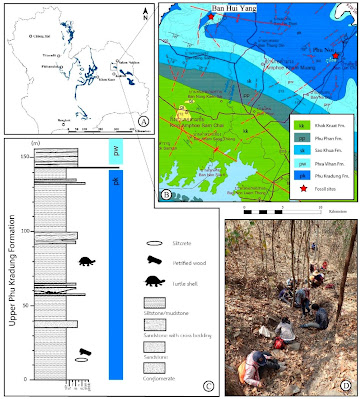
  (A), Map of northern Thailand showing location of Sam Chai area, and outcrops of the Phu Kradung Formation; (B): Geological map of Sam Chai area (modified from [Bumrungsong & Yamunsabideen, 2009]; (C): Stratigraphical column of Ban Hui Yang site; (D): Field work.


 Yakemys multiporcata n. g. n. sp. from the upper part of the Phu Kradung Formation (basal Cretaceous) of Khorat Plateau, NE Thailand. Holotype (SM KS39) from Ban Hui Yang locality, Sam Chai District, Kalasin Province.
(A, B) Carapace in dorsal view; (C, D) shell in ventral view; (E) detail of ornamentation of the carapace surface (on costal 2, indicated by a white rectangle on A), and (F) neural 6–8 with adjacent costal fragments in ventral view.
 Scale bar = 10 cm for (A–D,F) and 2 cm for (E). 
Abbreviations: co, costal plate; Ma, marginal scute; n, neural plate; pe, peripheral plate; py, pygal plate; spy, suprapygal plate; V, vertebral scute.

Testudines Linnaeus, 1758
Cryptodira Cope, 1868
Macrobaenidae Sukhanov, 1964

Yakemys multiporcata n. gen. n. sp.

Diagnosis: A genus of Macrobaenidae of large size, with the carapace length about 70 cm and a combination of characters that differs from all other Macrobaenidae as follows: narrow vertebral scutes; vertebral 4 triangular and narrowed posteriorly, strong midline keel extending to the suprapygal 2, large lateral longitudinal keels on the vertebral region, and additional ridges on the pleural region; plastron reduced, with a triangular short anterior lobe, epiplastron reduced to a strip-shaped plate, entoplastron oval in dorsal view but with a much reduced ventral exposure and an extremely reduced bridge that is shorter than the anterior lobe.

Etymology: Genus name from Yak, giant in Thai (ยักษ์); species name from Latin “multi”: multiple; porcata: from Latin “porca”, ridge.


Conclusions: 
Yakemys multiporcata n. g. n. sp. represents one of the earliest Macrobaenidae hitherto known, and this finding extends the paleogeographical distribution of the group to SE Asia. The discovery of a macrobaenid turtle in Thailand provides further support for the Early Cretaceous age of the upper part of the Phu Kradung Formation and the new evidence of faunal exchange between the SE Asia and more northern parts of mainland Asia at the very beginning of the Cretaceous. Yakemys multiporcata commonly occurs together with Basilochelys macrobios, although both turtles were likely aquatic animals as indicated by their low shell; the different morphology of the shell, especially the plastron, suggests that these turtles had different modes of life. Further discovery of more complete material, especially skull and limb bones, is expected for a better understanding of the phylogenetic relationships and the lifestyle of this strange turtle.


Haiyan Tong, Phornphen Chanthasit, Wilailuck Naksri, Pitaksit Ditbanjong, Suravech Suteethorn, Eric Buffetaut, Varavudh Suteethorn, Kamonlak Wongko, Uthumporn Deesri and Julien Claude. 2021. Yakemys multiporcata n. g. n. sp., a large Macrobaenid Turtle from the Basal Cretaceous of Thailand, with a Review of the Turtle Fauna from the Phu Kradung Formation and Its Stratigraphical Implications. Diversity. 13(12), 630. DOI: doi.org/10.3390/d13120630 
    facebook.com/fossilworld/posts/4864491833572637  ยักษ์คีมิส มัลติพอร์คาตา

Monday, June 24, 2024

[Paleontology • 2024] Xianyuechelys yingliangi • A New nanhsiungchelyid Turtle (Cryptodira: Nanhsiungchelyidae) from the Late Cretaceous of Ganzhou Basin, China


Xianyuechelys yingliangi 
Ke, Niu, Rummy, Tong, Hu & Han, 2024
 

Abstract
Nanhsiungchelyidae is a group of large Pan-Trionychia that lived in North America and Asia during the Cretaceous. Despite a long research history, their taxonomy and internal nodes are still controversial. Here, we erect a new taxon, Xianyuechelys yingliangi gen. et sp. nov., from the Upper Cretaceous Lianhe Formation of Ganzhou Basin, China. Xianyuechelys yingliangi is attributed to Nanhsiungchelyidae based on its carapace being covered by a sculpturing of large pits. However, the new species also possesses an unique combination of characteristics among nanhsiungchelyids such as a wide, crescentic nuchal, absence of a pair of anterolateral processes, and the fourth and fifth vertebral scutes that contact at a point. The holotype is a juvenile or sub-adult based on the incomplete ossification of carapace, but its morphological characteristics can mostly be regarded as taxonomically informative rather than ontogenetic in origin. Phylogenetic analysis suggests Xianyuechelys yingliangi forms a monophyletic group with Nanhsiungchelys spp. and Anomalochelys angulata, supported by two unambiguous synapomorphies: wide vertebral scutes and wide neurals. The phylogenetic analysis also suggests Basilemys, Jiangxichelys and ‘Zangerlia’ form a monophyletic group. Our new finding increases the known diversity of nanhsiungchelyids in southern China.

Keywords: Nanhsiungchelyidae, Late Cretaceous, phylogeny, Ganzhou Basin, China


Xianyuechelys yingliangi gen. et sp. nov.

 
Yuzheng Ke, Kecheng Niu, Paul Rummy, Haiyan Tong,Jinfeng Hu and Fenglu Han. 2024. Xianyuechelys yingliangi: A New nanhsiungchelyid Turtle from the Late Cretaceous of Ganzhou Basin, China. Journal of Systematic Palaeontology. 22(1); 2346838. DOI: 10.1080/14772019.2024.2346838

Tuesday, August 22, 2023

[Paleontology • 2023] Proadocus hadongensis • The First adocid Turtle (Cryptodira: Pan-Trionychia) in South Korea (Lower Cretaceous) and the early Evolution of the Adocidae


Proadocus hadongensis
 Kim, Lee, Ko, Park, Kim, Lee, Jung & Kong, 2023

 
Abstract
An adocid turtle was collected from the Lower Cretaceous Hasandong Formation, representing the first occurrence of the Adocidae in South Korea. The specimens consist of moderately preserved hard shells (carapace and plastron) with a limb bone (humerus). They turned out to be a new taxon named Proadocus hadongensis, gen. et sp. nov., characterized by combining synapomorphic characters of adocids and primitive characters ancestrally retained from basal pantrionychians. The pattern of marginal scales extension and pygal shape are shared with Sinaspideretes wimani and Basilochelys macrobios, the basal pantrionychian taxa of the Late Jurassic–Early Cretaceous in Southeast Asia. A cladistic analysis places it as the most basal taxon in Adocidae. Such phylogenetic position of Proadocus involves important implications about the origin and early evolution of the Adocidae. First, Proadocus supports the Southeast Asian origin of this family. Secondly, a new paleobiogeographic analysis, including Proadocus in Korea, requests a new interpretation of the adocid diversification and dispersion in East Asia during the Early Cretaceous.


Testudines Batsch, 1788 
Cryptodira Cope, 1868 

Pan-Trionychia Hummel, 1929 
Adocusia Danilov and Parham, 2006 

Adocidae Cope, 1870 

Proadocus hadongensis, gen. et sp. nov.


Do Hyeon Kim, Yuong-Nam Lee, Hyejin Ko, Jin-Young Park, Su-Hwan Kim, Sungjin Lee, Seung-Ho Jung and Dal-Yong Kong. 2023. The First adocid Turtle in South Korea (Lower Cretaceous) and the early Evolution of the Adocidae. Cretaceous Research. 151; 105665. DOI: 10.1016/j.cretres.2023.105665 


Saturday, July 8, 2023

[Paleontology • 2023] Titanochelon schleichi • A New Species of A Giant Tortoise (Cryptodira: Testudinidae) from Sandelzhausen (MN5, Burdigalian/Langhian boundary, Early/Middle Miocene, South Germany)


Titanochelon schleichi 
Pappa, Vlachos & Moser, 2023


Abstract
We describe a new species of a giant tortoise of the genus Titanochelon from the locality of Sandelzhausen in south Germany (MN5, Burdigalian/Langhian boundary, Early/Middle Miocene). The material comprises at least two different individuals, one of which is a male individual preserving large parts of the carapace and plastron and several appendicular elements. The second individual is quite fragmented, preserving parts of the bridge and the posterior rim of the carapace. The new species, Titanochelon schleichi sp. nov., is the first species of a giant tortoise named from Germany and allows reconstructing an important diversity and expansion of titanochelones in the Western Palaearctic during the earlier parts of the Neogene.

Keywords: gigantism, shell, Testudinidae, turtles


Titanochelon schleichi sp. nov.

 
Irena Pappa, Evangelos Vlachos and Markus Moser. 2023. A New Species of A Giant Tortoise from Sandelzhausen (MN5, Burdigalian/Langhian boundary, Early/Middle Miocene, South Germany). The Anatomical Record. DOI: 10.1002/ar.25280 
 twitter.com/yatachelys/status/1673661704511651844

Thursday, January 12, 2023

[Paleontology • 2023] Astrochelys rogerbouri • Ancient DNA elucidates the Lost World of western Indian Ocean Giant Tortoises and reveals A New Extinct Species from Madagascar


Top: Madagascar, from left to right, †Aldabrachelys abrupta, †AlgrandidieriPyxis planicaudaP. arachnoides, †Astrochelys rogerbouri n. sp.Asyniphora, and Asradiata
Center: Granitic Seychelles (extinct), Aldabra, Algigantea.

Kehlmaier, Graciá, Ali, Campbell, Chapman, Deepak, ... et Fritz, 2023
Artwork: Michal Rössler; photo of Al. gigantea: Massimo Delfino.

Abstract
Before humans arrived, giant tortoises occurred on many western Indian Ocean islands. We combined ancient DNA, phylogenetic, ancestral range, and molecular clock analyses with radiocarbon and paleogeographic evidence to decipher their diversity and biogeography. Using a mitogenomic time tree, we propose that the ancestor of the extinct Mascarene tortoises spread from Africa in the Eocene to now-sunken islands northeast of Madagascar. From these islands, the Mascarenes were repeatedly colonized. Another out-of-Africa dispersal (latest Eocene/Oligocene) produced on Madagascar giant, large, and small tortoise species. Two giant and one large species disappeared c. 1000 to 600 years ago, the latter described here as new to science using nuclear and mitochondrial DNA. From Madagascar, the Granitic Seychelles were colonized (Early Pliocene) and from there, repeatedly Aldabra (Late Pleistocene). The Granitic Seychelles populations were eradicated and later reintroduced from Aldabra. Our results underline that integrating ancient DNA data into a multi-evidence framework substantially enhances the knowledge of the past diversity of island faunas.

 Top: Madagascar, from left to right, †Aldabrachelys abrupta, †AlgrandidieriPyxis planicaudaP. arachnoides, †Astrochelys rogerbouri n. sp.Asyniphora, and Asradiata
Center: Granitic Seychelles (extinct), Aldabra, Algigantea.
Bottom: Mascarenes, from left to right, †Cylindraspis indica (Réunion), †Cinepta, †C. triserrata (both Mauritius), †C. vosmaeri, and †C. peltastes (both Rodrigues).
Sizes to scale, corresponding to reported maximum SCLs. 
Artwork: Michal Rössler; photo of Al. gigantea: Massimo Delfino.

Top: Madagascar, from left to right, †Aldabrachelys abrupta, †AlgrandidieriPyxis planicaudaP. arachnoides, †Astrochelys rogerbouri n. sp.Asyniphora, and Asradiata. Center: Granitic Seychelles (extinct), Aldabra, Algigantea.
Artwork: Michal Rössler; photo of Al. gigantea: Massimo Delfino.

Astrochelys rogerbouri n. sp.
 
 Diagnosis: A large-sized extinct tortoise species of the genus Astrochelys with an estimated SCL of 50 cm, only known from a single tibia. Astrochelys rogerbouri n. sp. can be separated from the two extant species of the genus by 59 diagnostic mutations in the mitochondrial genome (table S4 and data file S1) and 23 mutations in the reference alignment of four concatenated nuclear loci (HMGB2, HNF1α, R35, and TB73; 3047 bp; table S5 and data file S2). The mitochondrial genome of the new species differs by an uncorrected p distance of approximately 8% from As. radiata and As. yniphora (data file S3); the concatenated nuclear loci of As. rogerbouri n. sp. differ by 0.9 to 1.3% from its two congeners (data file S4).

Etymology: The new species is named for the late Roger Bour (9 July 1947 – 7 March 2020), who was an outstanding herpetologist and expert on western Indian Ocean giant tortoises. Without his pioneering studies and his advice regarding museum specimens, this investigation would not have been possible.

Placement of extinct Malagasy and Mascarene giant tortoises in the tortoise phylogeny. The shown maximum likelihood (ML) topology is based on near-complete mitochondrial genomes (15,537 bp) of all genera and species groups of tortoises (Testudinidae). Codes preceding scientific names are DNA Data Bank of Japan (DDJB)/European Nucleotide Archive (ENA)/GenBank accession numbers or museum numbers. Genus names of extinct taxa bear dagger symbols. Numbers at nodes are thorough bootstrap values and posterior probabilities from a Bayesian analysis yielding the same topology. Asterisks indicate maximum support under both approaches. Colored boxes represent different geographic regions. Inset pictures show the past and present diversity of native tortoise species of the western Indian Ocean (extinct species are in gray). Top: Madagascar, from left to right, †Aldabrachelys abrupta, †AlgrandidieriPyxis planicaudaP. arachnoides, †Astrochelys rogerbouri n. sp.Asyniphora, and Asradiata. Center: Granitic Seychelles (extinct), Aldabra, Algigantea. Bottom: Mascarenes, from left to right, †Cylindraspis indica (Réunion), †Cinepta, †C. triserrata (both Mauritius), †C. vosmaeri, and †C. peltastes (both Rodrigues). Sizes to scale, corresponding to reported maximum SCLs. Artwork: Michal Rössler; photo of Al. gigantea: Massimo Delfino.

 
Christian Kehlmaier, Eva Graciá, Jason R. Ali, Patrick D.Campbell, Sandra D. Chapman, V. Deepak, Flora Ihlow, Nour-Eddine Jalil, Laure Pierre-Huyet, Karen E. Samonds, Miguel Vences and Uwe Fritz. 2023. Ancient DNA elucidates the Lost World of western Indian Ocean Giant Tortoises and reveals A New Extinct Species from Madagascar.  SCIENCE ADVANCES. 9(2). DOI: 10.1126/sciadv.abq2574

Molecular Archeology: 1200-Year-Old DNA Sequences From Madagascar Lead to the Discovery of an Extinct Tortoise
twitter.com/geobiodiversity/status/1613466403058638848