Showing posts with label Gobiesociformes. Show all posts

Tuesday, April 30, 2024

[Ichthyology • 2024] Rhinolepadichthys gen. nov. • A New Generic Name for the “Lepadichthys lineatus complex (Gobiesocidae: Diademichthyinae) with A Rediagnosis of Discotrema, a senior synonym of Unguitrema, and Comments on their phylogenetic relationships


Representatives of diademichthyine clingfishes.
Rhinolepadichthys lineatus (Oman); B Rhinolepadichthys geminus (Anilao, Philippines);
Rhinolepadichthys geminus (Okinoerabu Islands, Amami Islands, Japan); D Discotrema crinophilum (Amami-oshima Island, Amami Islands, Japan: KPM-NR 78755);
Lepadichthys frenatus (Lord Howe Island, Australia); F Diademichthys lineatus (Lembeh Strait, Indonesia: KPM-NR 147468).

in Fujiwara, Motomura, Summers & Conway, 2024. 
All images except F with sides reversed.
photos by J. Randall, J. Eyre and K. Uehara. 

Abstract

Rhinolepadichthys, a new genus of the gobiesocid subfamily Diademichthyinae, is described for the “Lepadichthys” lineatus complex (including Rhinolepadichthys geminus comb. nov., R. heemstraorum comb. nov., R. lineatus comb. nov., and R. polyastrous comb. nov.). Detailed investigation of external morphology and osteological anatomy of the new genus and related genera suggests that Rhinolepadichthys represents the sister genus to Discotrema, based on the following putative synapomorphies: (1) presence of a hardened (potentially keratinized) cap on the surface of at least some disc papillae (vs. surface of disc papillae soft, without hardened cap); and (2) the anterolateral part of the ventral postcleithrum extended anteriorly as a well-developed rod-like process, its tip close to the base of pelvic-fin soft ray 4 (vs. only weakly pointed, or irregular). Compared with DiscotremaRhinolepadichthys gen. nov. is distinguished by the presence of a row of 8–12 large papillae on the inner surface of the upper and lower lips (vs. inner surface of lips smooth, without distinct papillae); the absence (vs. presence) of a well-developed lateral process on the pterotic immediately posterior to the opening of the otic canal; the presence (vs. absence) of gill rakers on the anterior edge of ceratobranchials 1–3; the presence (vs. absence) of gill rakers on the posterior edge of ceratobranchial 4; having the upper pharyngeal teeth arranged in a loose patch on the ventral surface of the pharyngobranchial 3 toothplate, with tooth tips directed posteroventrally (vs. arranged in a single row along posteroventral edge of the pharyngobranchial 3 toothplate, with tooth tips directed posteriorly); features of the adhesive disc, including outline of disc papillae roughly hexagonal or ovoid and with a flattened surface (vs. outline circular, at least some with raised, dome-like surface); the absence (vs. presence) of a deep cavity at the center of disc region C; the absence (vs. presence) of three paired and one median cluster of small papillae (reminiscent of bunches of grapes) across the surface of the adhesive disc; and having the ventral postcleithrum entire, not divided into two separate, articulating elements (vs. ventral postcleithrum divided into an anterior and posterior element, separated via a specialized joint). Reexamination of materials of the poorly known genus Unguitrema, considered a close relative of Discotrema, revealed no morphological differences between the two genera. Unguitrema therefore represents a junior synonym of Discotrema.

Keywords: Clingfishes, Indo-Pacific, morphology, taxonomy, Teleostei

Representatives of diademichthyine clingfishes.
Rhinolepadichthys lineatus (Oman: J. Randall); B Rhinolepadichthys geminus (Anilao, Philippines: J. Eyre);
Rhinolepadichthys geminus (Okinoerabu Islands, Amami Islands, Japan: K. Uehara); D Discotrema crinophilum (Amami-oshima Island, Amami Islands, Japan: KPM-NR 78755, K. Uchino);
Lepadichthys frenatus (Lord Howe Island, Australia: J. Eyre); F Diademichthys lineatus (Lembeh Strait, Indonesia: KPM-NR 147468, K. Uchino).
All images except F with sides reversed.

Rhinolepadichthys gen. nov.

Included species: The genus contains the following four valid species, previously included in the “Lepadichthyslineatus complex by Fujiwara and Motomura (2021): Rhinolepadichthys geminus (Fujiwara and Motomura, 2021) comb. nov., Rhinolepadichthys heemstraorum (Fujiwara and Motomura, 2021) comb. nov., Rhinolepadichthys lineatus (Briggs, 1966) comb. nov., and Rhinolepadichthys polyastrous (Fujiwara and Motomura, 2021) comb. nov.

Etymology: The suffix rhino-, meaning nose, in combination with Lepadichthys, a genus of the Diademichthyinae. In reference to the pointed snout in members of this genus, which distinguishes the new genus from Lepadichthys (sensu stricto). Gender masculine.


Discotrema Briggs, 1976

Included species: The genus contains the following four valid species, Discotrema crinophilum Briggs, 1976, Discotrema monogrammum Craig & Randall, 2008, Discotrema nigrum (Fricke, 2014), comb. nov. (validity tentative, see below), and Discotrema zonatum Craig & Randall, 2008.

 
Kyoji Fujiwara, Hiroyuki Motomura, Adam P. Summers and Kevin W. Conway. 2024. A New Generic Name for the “Lepadichthys” lineatus complex with A Rediagnosis of Discotrema, a senior synonym of Unguitrema, and Comments on their phylogenetic relationships (Gobiesocidae: Diademichthyinae). Vertebrate Zoology. 74: 279-301. DOI: 10.3897/vz.74.e113955
 

Saturday, March 30, 2024

[Ichthyology • 2022] Lepadichthys geminus, L. heemstraorum & L. polyastrous • Review of the Lepadichthys lineatus complex (Gobiesocidae: Diademichthyinae) with Descriptions of Three New Species


Lepadichthys geminus
Fujiwara & Motomura, 2022


Abstract
The Lepadichthys lineatus complex (Gobiesocidae: Diademichthyinae) is defined by three unique characters within Lepadichthys: (a) upper-jaw lip fused with snout skin, usually lacking a distinct groove between the dorsal lip margin and snout (if present, very weak, restricted to posterior portion of jaw); (b) snout tip well extended, distinctly beyond lower-jaw tip; and (c) inner surface of both lips with oral papillae. A taxonomic review of the complex recognized four valid species: Lepadichthys geminus sp. nov. (southern Japan and Indonesia), Lepadichthys heemstraorum sp. nov. (southwestern Indian Ocean), Lepadichthys polyastrous sp. nov. (southwestern Indian Ocean) and L. lineatus Briggs, 1966 (Red Sea, Arabian Sea, Seychelles and Sri Lanka). L. geminus and L. lineatus are distinct from L. heemstraorum and L. polyastrous in having a circular (vs. elliptical) disc and more posteriorly located anus [L. geminus and L. lineatus with disc length and width 15.0–18.7 (mean 16.9) and 12.9–16.5 (14.6) % LS, respectively, and length to width ratio 1.03–1.25 cf. L. heemstraorum and L. polyastrous, 17.0–21.5 (18.9) and 11.6–15.2 (13.0) % LS, respectively, and 1.26–1.61; pre-anus length and disc to anus length 65.1–73.6 (68.7) and 25.7–31.6 (28.6) % LS, respectively vs. 60.2–68.3 (65.3) and 21.6–28.9 (25.5) % LS, respectively]. Body depth (as % of LS) is also useful to distinguish L. geminus and L. polyastrous from L. heemstraorum and L. lineatus [viz., 12.7–16.1 (14.4) in L. geminus and 10.8–14.9 (13.1) in L. polyastrous vs. 15.0–17.1 (15.9) in L. heemstraorum and 14.6–18.9 (16.8) in L. lineatus]. L. geminus differs distinctly from other species in the complex as follows: snout tip directed upward, usually on same horizontal level with lower margin of eye lens (lateral view) (vs. directed somewhat downward, horizontal level usually between lower margins of eye and eye lens in L. heemstraorum and L. lineatus, lower margin of eye in L. polyastrous); and lower abdomen with two yellow stripes (vs. a single stripe along ventral midline in L. polyastrous and L. lineatus, unknown in L. heemstraorum). L. polyastrous has unique patterns of yellow dots on the dorsal and ventral body surfaces, forming c. six to eight and three to five longitudinal rows, respectively [vs. usually forming c. three to five longitudinal rows and a single broken line, respectively, in L. geminus and L. lineatus; yellow dots usually absent in L. heemstraorum]. A poorly known species, Lepadichthys caritus Briggs, 1969, is regarded as a junior synonym of L. lineatus.

Fresh holotype of Lepadichthys geminus sp. nov. (KAUM–I. 145214, 22.3 mm LS, Okinoerabu Island, Amami Islands, Japan).  

The Lepadichthys lineatus complex

 Lepadichthys geminus sp. nov. 
New English name: Pacific Doubleline Clingfish; 
standard Japanese name: Tasuji-umishida-ubauo

Etymology. The specific name “geminus” is derived from Latin, meaning “twin” or “double,” in reference to the two yellow stripes under the abdomen and the close morphological similarity of the new species to L. lineatus, with which it had previously been identified.

 Lepadichthys heemstraorum sp. nov. 
New English name: Heemstra's Clingfish

Etymology. The specific name “heemstraorum” is in honour of an esteemed ichthyologist, the late Dr Phil Heemstra, who with his wife Elaine Heemstra collected type specimens of L. heemstraorum and L. polyastrous.

 Lepadichthys polyastrous sp. nov. 
New English name: Starry Clingfish

Etymology. The specific name “polyastrous,” a combination of the New Greek “polys” and “astrous,” means “many stars,” in reference to the many characteristic yellow dots on the body.

Lepadichthys lineatus Briggs 1966
English name: Doubleline Clingfish


Kyoji Fujiwara and Hiroyuki Motomura. 2022. Review of the Lepadichthys lineatus complex (Gobiesocidae: Diademichthyinae) with Descriptions of Three New Species. Journal of Fish Biology. 100(1); 62-81. DOI: 10.1111/jfb.14919 


Friday, October 15, 2021

[Ichthyology • 2021] Erdmannichthys alorensis • A New Genus of Gobiesocidae (Teleostei: Gobiesociformes), and Notes on the Rare Clingfish E. alorensis (Allen & Erdmann, 2012), new combination


Erdmannichthys alorensis (Allen & Erdmann, 2012)

in Conway, Fujiwara, Motomura & Summers, 2021.
RAFFLES BULLETIN OF ZOOLOGY. 69 

Abstract
 Erdmannichthys, a new genus of the family Gobiesocidae, is introduced to include a species previously assigned to Aspasmichthys. This act is supported by morphological characters and the results of a recent molecular phylogenetic study that placed the two currently described species of Aspasmichthys as distant relatives within the subfamily Diademichthyinae (i.e., polyphyletic). New details on live colouration and skeletal anatomy are provided for Erdmannichthys alorensis, new combination, based on photographs and one additional specimen collected from Padar Island, Komodo Group (Indonesia). 

Key words. Diademichthyinae, Aspasmichthys, computer tomographic scanning, miniature 

Five individuals of Erdmannichthys alorensis at a submerged reef (10 metres depth) off south east coast of Padar island, Nusa Tenggara Province, Indonesia.
A–C. Not collected, not measured. D. Potentially WAM P.34629-001, 13.3 mm SL; E–F. Potentially WAM P.34629-005, 9.1 mm SL.
photographed by M.V. Erdmann. 

Erdmannichthys, new genus

 Diagnosis. A genus of the subfamily Diademichthyinae sensu Conway et al. (2020), distinguished from all other genera of this subfamily by the presence of a prominent dark reddishbrown oval to triangular marking at base of caudal fin (Figs. 3, 4). The new genus is distinguished from Diademichthys, Discotrema, Flabellicauda, “Lepadichthys”, Lepadicyathus and Unguitrema by having a double adhesive disc (Fig. 5) (vs. single adhesive disc). It is distinguished from the remaining diademichthyine genera (viz. Aspasma, Aspasmichthys, Aspasmodes, Briggsia, Flexor, Liobranchia, Lissonanchus, Pherallodus, Pherallodichthys and Propherallodus), all with a double adhesive disc, by the presence of three white lines on the body surface in life (Figs. 3, 4), including a mid-dorsal stripe (originating on tip of snout posterior to upper lip and extending to dorsal-fin origin) and a pair of dorsolateral stripes (originating on dorsolateral part of snout adjacent to anterior nostril and extending posterior, through upper part of eye, to area on upper body side close to caudal fin base) (vs. colour pattern in life largely uniform, with smaller indistinct dark markings [Aspasma, Aspasmodes, Briggsia, Flexor and Lissonanchus] or with prominent darker stripes, saddles or other markings [Aspasmichthys, Pherallodus, Pherallodichthys and Propherallodus] but without prominent white lines along long axis of body; life colour unknown for Liobranchia). It is further distinguished from the other diademichthyine genera with a double adhesive disc by the following combination of characters: gill membranes united and free from isthmus forming single continuous gill opening (Figs. 4, 5A) (vs. gill membranes connected to isthmus restricting gill opening to side of head in Aspasma, Aspasmichthys, Aspasmodes, Briggsia, Liobranchia, Lissonanchus and Pherallodichthys); papillae of disc region A continuous across centre (Fig. 5A, B) (vs. centre of region A without papillae in Aspasma, Aspasmichthys [Fig. 5C, D] and Pherallodus); mandibular portion of preoperculo-mandibular lateral-line canal absent (Fig. 6C) (vs. present on anguloarticular in Aspasmichthys); preopercular portion of preoperculo-mandibular lateral-line canal with two pores (PR1 and PR3) only (Fig. 6B, C) (vs. three pores, PR1–3, in Aspasma, Aspasmichthys, Flexor and Propherallodus, preopercle without canal in Briggsia, Lissonanchus and Pherallodus); presence of a small oval gap in dorsal view between anterior tips of premaxillae formed by a semicircular indentation along medial edge of premaxilla (Fig. 6A) (vs. minute square gap in Aspasma, medial edge of premaxilla straight, without gap between premaxillae in Aspasmodes, Liobranchia and Pherallodichthys); subopercle poorly ossified, posterior margin rounded (Fig. 6B, C) (vs. subopercle well ossified, posterior edge with spine-like posterior process in Aspasmichthys). 

Etymology. Named for Mark V. Erdmann, in honour of his work on Indo-Pacific reef fishes. Gender masculine. 

Type species. Aspasmichthys alorensis Allen & Erdmann, 2012, by present designation.


Kevin W. Conway, Kyoji Fujiwara, Hiroyuki Motomura and Adam P. Summers. 2021. Erdmannichthys, A New Genus of Gobiesocidae (Teleostei: Gobiesociformes), and Notes on the Rare Clingfish E. alorensis (Allen & Erdmann, 2012), new combination. RAFFLES BULLETIN OF ZOOLOGY. 69; 428–437


Wednesday, September 13, 2017

[Ichthyology • 2017] Trachelochismus aestuarium • A New Species of the Clingfish Genus Trachelochismus (Teleostei: Gobiesocidae) from Bay and Estuarine Areas of New Zealand


Trachelochismus aestuarium 
Conway, Stewart & King, 2017 


Abstract

Trachelochismus aestuarium, new species, is described on the basis of 120 specimens, 10.1–45.5 mm SL, collected from shallow (0–29 meters depth) bay and estuarine areas along the coast of New Zealand. It is distinguished from congeners (T. melobesia and T. pinnulatus) by a combination of characters, including features of the cephalic sensory system, adhesive disc papillae, and colouration in life, head shape, and gill-raker, fin ray and vertebrae counts. Phylogenetic analyses of mitochondrial loci (cytrochrome c oxidase subunit 1 and 12S ribosomal RNA) and one nuclear locus (zic family member 1) for all three species of Trachelochismus and two outgroup taxa resulted in phylogenetic hypotheses in which T. aestuarium is the sister taxon to either T. pinnulatus (mitochondrial loci) or T. pinnulatus + T. melobesia (ZIC1). A new terminology is introduced for the superficial neuromasts arranged in rows on the surface of the head in members of Trachelochismus.

Keywords: Pisces, Taxonomy, Marine Fishes, Acanthomorpha, Cephalic sensory system


Kevin W. Conway, Andrew L. Stewart and Cragen King. 2017. A New Species of the Clingfish Genus Trachelochismus from Bay and Estuarine Areas of New Zealand (Teleostei: Gobiesocidae). Zootaxa. 4319(3); 531–549.  DOI:  10.11646/zootaxa.4319.3.6


Tuesday, April 18, 2017

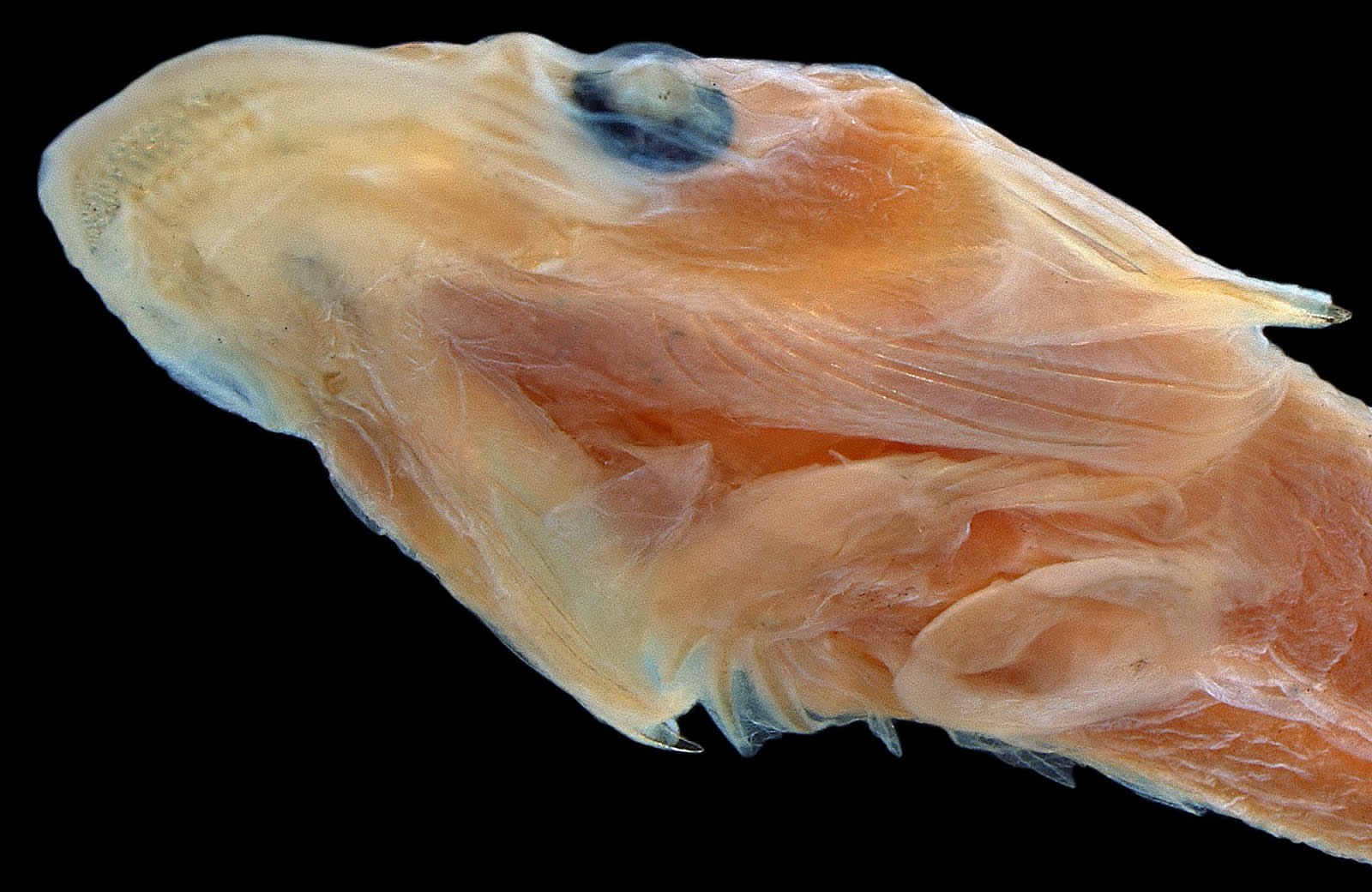
[Ichthyology • 2017] Nettorhamphos radula • A New Genus and Species of Clingfish (Teleostei: Gobiesocidae) from Western Australia


Nettorhamphos radula 
 Conway, Moore & Summers, 2017 


Nettorhamphos radula, new genus and species, is described from two specimens, 20.3–40.2 mm SL, trawled from sponge and algae reefs between 30–40 meters in depth offshore from Fremantle, Western Australia. The new taxon is distinguished from all other members of the Gobiesocidae by having vast fields of tiny conical teeth throughout the oral jaws that are arranged in multiple, regular rows along the lingual surface of the premaxilla and the dentary. The new taxon is tentatively considered a close relative of two other southern Australian endemic clingfish taxa (Posidonichthys and the undescribed “Genus A”) based on the presence of a well-developed and heavily ossified subopercular bone that articulates strongly with both the opercle (dorsally) and the preopercle (anteriorly).


Nettorhamphos, new genus

Type species.— Nettorhamphos radula, new species 

Etymology.— A combination of the Greek words (netta), meaning duck, and (rhamphos), meaning bill, curved-beak. Gender neuter.


Nettorhamphos radula, new species 
Common name: Duckbilled Clingfish 

Distribution and habitat.— Known to date only from two locations to the west of Five Fathom Bank (Indian Ocean), off the coast of Fremantle, Western Australia (Fig. 11). The new species was collected via trawls through algae/sponge reefs between 33–37 meters in depth. Other species of fishes collected by the same trawls include the pipefish Stigmatopora nigra, the labrids Austrolabrus maculatus, Eupetrichthys angustipes, Siphonognathus caninus, and S. attenuatus, and the gobiesocids Alabes occidentalis and ‘‘Genus A sp. 2’’ (sensu Hutchins, 2008)

Etymology.— From the Latin radula, a tool used for scraping. In reference to the many tiny conical teeth on the lingual surface of the premaxilla and dentary, which are reminiscent of the radula of a snail. A noun in apposition. 

A full-body scan showing the underside of the fish.  

The only two known specimens were found on museum shelves, where they had sat for 40 years.
photo: Kevin Conway and Glenn Moore 


Kevin W. Conway, Glenn I. Moore and Adam P. Summers. 2017. A New Genus and Species of Clingfish (Teleostei: Gobiesocidae) from Western Australia.
 Copeia. 105(1); 128-140. DOI: 10.1643/CI-16-560 

New many-toothed clingfish discovered with help of digital scans