Showing posts with label Ammonite. Show all posts

Monday, September 18, 2023

[Paleontology • 2023] Idahocolumbites phatthalungensis • Olenekian (Early Triassic) Ammonoids and Conodonts from southern Thailand


Idahocolumbites phatthalungensis Thongterm & Shigeta, 

in Tongtherm, Shigeta, Sardsud, Asato, Maekawa, Haga, Agematsu et Sashida, 2023
National Museum of Nature and Science Monographs. 54. 

Abstract 
We document an extensive biostratigraphic investigation of a section of the Phukhaothong Dolomite Member of the marine Triassic Chaiburi Formation (part of the Sibumasu [or Shan-Thai] Block), which is exposed on the north side of an isolated mountain at Khao Thong in the Phatthalung area of southern Thailand. The 104 m+ thick section, consisting of bedded to massive, light grey dolomite, contains ammonoids in the middle to upper parts, and conodonts occur in abundant throughout the section. Seven distinct early Spathian (late Olenekian) ammonoid assemblages, a late Smithian (early Olenekian) conodont zone and three early Spathian conodont zones are recognized in ascending order as follows: ammonoids-Columbites sp. indet. beds, Arctomeekoceras? sp. indet. beds, Tirolites sp. indet. B beds, Tirolites sp. indet. C beds and Tirolites sp. indet. D bed in the Tirolites-Columbites Zone, and the Idahocolumbites cheneyi beds and Idahocolumbites phatthalungensis beds in the Idahocolumbites Zone; conodonts-late Smithian, Hadrodontina aequabilis-Staeschegnathus perrii Zone, early Spathian Icriospathodus crassatus Zone, Triassospathodus symmetricus-Novispathodus anhuiensis Zone and Novispathodus sp. I-Novispathodus sp. J Zone. The age of the primitive ichthyopterygian Thaisaurus chonglakmanii collected from the Idahocolumbites cheneyi beds is constrained to the early Spathian, thus suggesting it is the oldest known ichthyopterygian, because the range of Marcouxia and Idahocolumbites is limited to the Columbites parisianus Subzone of the lower Spathian in the western USA. The Spathian ammonoid faunas exhibit a very strong relationship with other Tethyan as well as eastern Panthalassa faunas in the low paleolatitudes, but bear very little or no relationship with middle and higher latitudinal faunas, suggesting the existence of a strong latitudinal diversity gradient during the Spathian. Late Smithian and early Spathian conodont faunas also exhibit a strong relationship with low paleolatitudinal faunas. Fifty-eight taxa (ammonoids: 26, conodonts: 32) are documented and one new ammonoid species, i.e., Idahocolumbites phatthalungensis, is described.

Keywords: ammonoids, biostratigraphy, Chaiburi Formation, conodonts, Early Triassic, Olenekian,
Phatthalung, Smithian, Spathian, Thailand.


 Idahocolumbites phatthalungensis


  Kittichai Tongtherm, Yasunari Shigeta, Apsorn Sardsud, Kaito Asato, Takumi Maekawa, Takuma Haga, Sachiko Agematsu and Katsuo Sashida. 2023. Olenekian (Early Triassic) Ammonoids and Conodonts from southern Thailand. National Museum of Nature and Science Monographs. 54.

หมวดหินชัยบุรี ในยุคไทรแอสซิก ที่พบใน จ.พัทลุง 

ชั้นหินบริเวณเขาทองอยู่ในช่วงรอยต่อของต้นยุคไทรแอสซิก อายุย่อย Smithian-Spathian ซึ่งตรงกับเหตุการ Smithian-Spathian boundary (SSB) ที่เป็นช่วงตรวจเจอปริมาณคาร์บอนสะสมเป็นจำนวนมากในทะเลส่วนหนึ่งเป็นผลมาจากการปะทุของลาวา ซึ่งทำให้เกิดการสูญพันธุ์ครั้งใหญ่ช่วงสิ้นยุคเพอร์เมียน (P–T extinction event) ที่กว่าสิ่งมีชีวิตจะฟื้นตัวกลับมาใช้เวลานานมาก ทั้งนี้กลุ่มแอมโมนอยด์และโคโนดอนต์เป็นกลุ่มที่ฟื้นตัวเร็วกว่ากลุ่มอื่น โดยในครั้งนี้สามารถกำหนด Biozone ของหมวดหินนี้จากฟอสซิลได้และเทียบเคียงได้กับชั้นหินเดียวกันทั่วโลก ที่เราพบอยู่ประมาณ 33 แหล่งเท่านั้น

งานครั้งนี้พบซากดึกดำบรรพ์ทั้งสิ้น 58 ชนิด เป็นแอมโมนอยด์ 26 ชนิด โคโนดอนต์ 32 ชนิด และนอกจากนี้เรายังพบแอมโมนอยด์ชนิดใหม่ทางวิทยาศาสตร์ คือ Idahocolumbites phatthalungensis ไอดาโฮโคลัมไบเทส พัทลุงเอนซิส โดยตั้งชื่อตามชื่อจังหวัดพัทลุง


Wednesday, January 27, 2021

[Paleontology • 2021] Yezoceras elegans • A New Species of Yezoceras (Ammonoidea, Nostoceratidae) from the Coniacian in the Northwestern Pacific Realm


Yezoceras elegans
 Aiba, Karasawa & Iwasaki, 2021


Abstract
A nostoceratid ammonoid Yezoceras elegans sp. nov. is newly described from the Coniacian of the Haboro area in Hokkaido, northern Japan. Yezoceras elegans sp. nov. having loosely coiled whorls, a wide umbilicus, and two prominent tubercle rows concentrated in the lower part of the whorls, is distinguished from the other species by these characteristics. Yezoceras elegans sp. nov. might have originated from Y. nodosum, judging from the stratigraphic correlation. The restricted occurrences of three Yezoceras species (Y. elegans sp. nov., Y. nodosum and Y. miotuberculatum) in Hokkaido, northern Japan suggest that the speciation of Yezoceras occurred in the northwestern Pacific realm during the Coniacian age.


Yezoceras elegans sp. nov. 


Daisuke Aiba, Tomoki Karasawa and Tetsuro Iwasaki. 2021. A New Species of Yezoceras (Ammonoidea, Nostoceratidae) from the Coniacian in the Northwestern Pacific Realm. Paleontological Research. 25(1); 1-10. DOI: 10.2517/2020PR008

 北海道羽幌町より新種の異常巻きアンモナイトを発見 [プレスリリース]

Tuesday, September 1, 2020

[Paleontology • 2020] Jaws of A Large Belemnite and An Ammonite from the Aalenian (Middle Jurassic) of Switzerland


Jurassic belemnite jaws: Acrocoelites conoideus & Hibolithes semisulcatus.

in Klug, Etter, et al., 2020. 
Reconstructions by Kenneth De Baets.


Abstract
Although belemnite rostra can be quite abundant in Jurassic and Cretaceous strata, the record of belemnite jaws was limited to a few specimens from Germany and Russia. Here, we describe and figure three cephalopod jaws from the Middle Jurassic Opalinus Clay of northern Switzerland. Although flattened, the carbonaceous fossils display enough morphological information to rule out an ammonoid, nautiloid or octobrachian origin of the two larger jaws. Their similarities to belemnite jaws from Germany and Russia conforms with our interpretation of these specimens as belemnite jaws. Based on their rather large size, we tentatively assign these two jaws to the megateuthidid Acrocoelites conoideus. The third jaw is a rather small upper jaw of an ammonoid. Since Leioceras opalinum is by far the most common ammonite in this unit in northern Switzerland, we tentatively suggest that the upper jaw belongs to this species.

Keywords: Cephalopoda, Megateuthididae, Graphoceratidae, Mouthparts, Body size, Opalinus clay


Reconstructions of Jurassic belemnite jaws.
a–c Acrocoelites conoideus from the Swiss Aalenian.
d–f Hibolithes semisulcatus from the German Kimmeridgian, modified after Klug et al. (2010b); the inner lamella of the lower jaw was enlarged


Christian Klug, Walter Etter, René Hoffmann, Dirk Fuchs and Kenneth De Baets. 2020. Jaws of A Large Belemnite and An Ammonite from the Aalenian (Middle Jurassic) of Switzerland. Swiss Journal of Palaeontology. 139, 4. DOI: 10.1186/s13358-020-00207-7

Thursday, July 6, 2017

[Paleontology • 2016] Suture Pattern Formation in Ammonites and the Unknown Rear Mantle Structure


Damesites cf. damesi
reconstruction: Takashi Oda @StudioCorvo 
Inoue & Kondo, 2016

Abstract
Ammonite shells have complex patterns of suture lines that vary across species. The lines are formed at the intersection of the outer shell wall and the septa. The wavy septa can form if the rear mantle of the ammonite, which functions as the template, has a complex shape. Previous hypotheses assumed that the rear mantle is like a flexible membrane that can be folded by some physical force. The elucidation of the mechanism of septa formation requires that the detailed shape of the septa should be known. We developed a new protocol of X-ray micro-computed tomography (CT) and obtained high-resolution three-dimensional (3D) images of the septa of the Upper Cretaceous ammonite Damesites cf. damesi. The obtained image suggested that the wavy and branched structures of the rear mantle grew autonomously. We found that some extant sea slugs have branched structures and showed similar shape and growth sequence as those in fossils, suggesting that the mantle of molluscs basically has the potential to form branched projections. Based on the characteristics of the obtained 3D structure, we explain how ammonites might have formed the complex suture patterns.


Shinya Inoue and Shigeru Kondo. 2016. Suture Pattern Formation in Ammonites and the Unknown Rear Mantle Structure. Scientific Reports. 6; 33689. DOI:  10.1038/srep33689
    

Sunday, May 14, 2017

[Paleontology • 2017] An 8.5 m Long Ammonite Drag Mark from the Upper Jurassic Solnhofen Lithographic Limestones, Germany


An artistic reconstruction of the floating ammonite leaving behind the drag mark.
Illustration: James McKay

 MCFO 0492, the drag mark created by the drifting shell of a dead ammonite (Subplanites rueppellianus)

Abstract

Trackways and tracemakers preserved together in the fossil record are rare. However, the co-occurrence of a drag mark, together with the dead animal that produced it, is exceptional. Here, we describe an 8.5 m long ammonite drag mark complete with the preserved ammonite shell (Subplanites rueppellianus) at its end. Previously recorded examples preserve ammonites with drag marks of < 1 m. The specimen was recovered from a quarry near Solnhofen, southern Germany. The drag mark consists of continuous parallel ridges and furrows produced by the ribs of the ammonite shell as it drifted just above the sediment surface, and does not reflect behaviour of the living animal.

Fig 2. Various Plattenkalk localities of the Franconian and Swabian Alb. 


Fig 1. MCFO 0492, the entire drag mark created by the drifting shell of a dead ammonite (Subplanites rueppellianus), with close-up of several portions. A. The first portion of the drag mark clearly showing two prominent ridges. B. Drag mark showing two prominent ridges with additional faint ridges. C. Drag mark showing four prominent ridges and a gentle curve. D. Drag mark showing numerous prominent ridges, along with the ammonite.
Large scale measures 1 m. Small scales measure 10 cm.DOI:  10.1371/journal.pone.0175426 


Fig 3. The ammonite Subplanites rueppellianus, the producer of the drag mark (MCFO 0492). Note the touch down mark which changes the orientation (and number) of the ridges in the substrate, anteroventral to the ammonite. Scale measures 5 cm.


Conclusions: 
This exceptionally long fossil was produced by an ammonite shell post-mortem. The shell must have been partially buoyant, firstly because only a small portion of the shell contacts the substrate over the length of the mark, and secondly to be moved by a current that was gentle enough not to disturb the surrounding sediment. It is likely that the ammonite was losing buoyancy over the length of the drag mark, which resulted in eventual loss of all buoyancy and the ammonite falling on its side.

The drag mark of the studied specimen does not represent a mortichnion because it was not created by the animal when alive. Rather, this structure should more correctly be considered a tool mark. As such, behaviour must not be inferred from the drag mark of specimens such as MCFO 0492, and they have to be interpreted as non-biogenic structures produced by physical means. MCFO 0492 represents the hitherto longest fossil drag mark created by a dead animal, complete with the animal preserved at the end.


Dean R. Lomax, Peter L. Falkingham, Günter Schweigert and Alejandro P. Jiménez. 2017. An 8.5 m Long Ammonite Drag Mark from the Upper Jurassic Solnhofen Lithographic Limestones, Germany. PLoS ONE. 12(5): e0175426.  DOI: 10.1371/journal.pone.0175426

Monday, May 30, 2016

[Paleontology • 2016] Macrofossil Evidence for A Rapid and Severe Cretaceous–Paleogene Mass Extinction in Antarctica


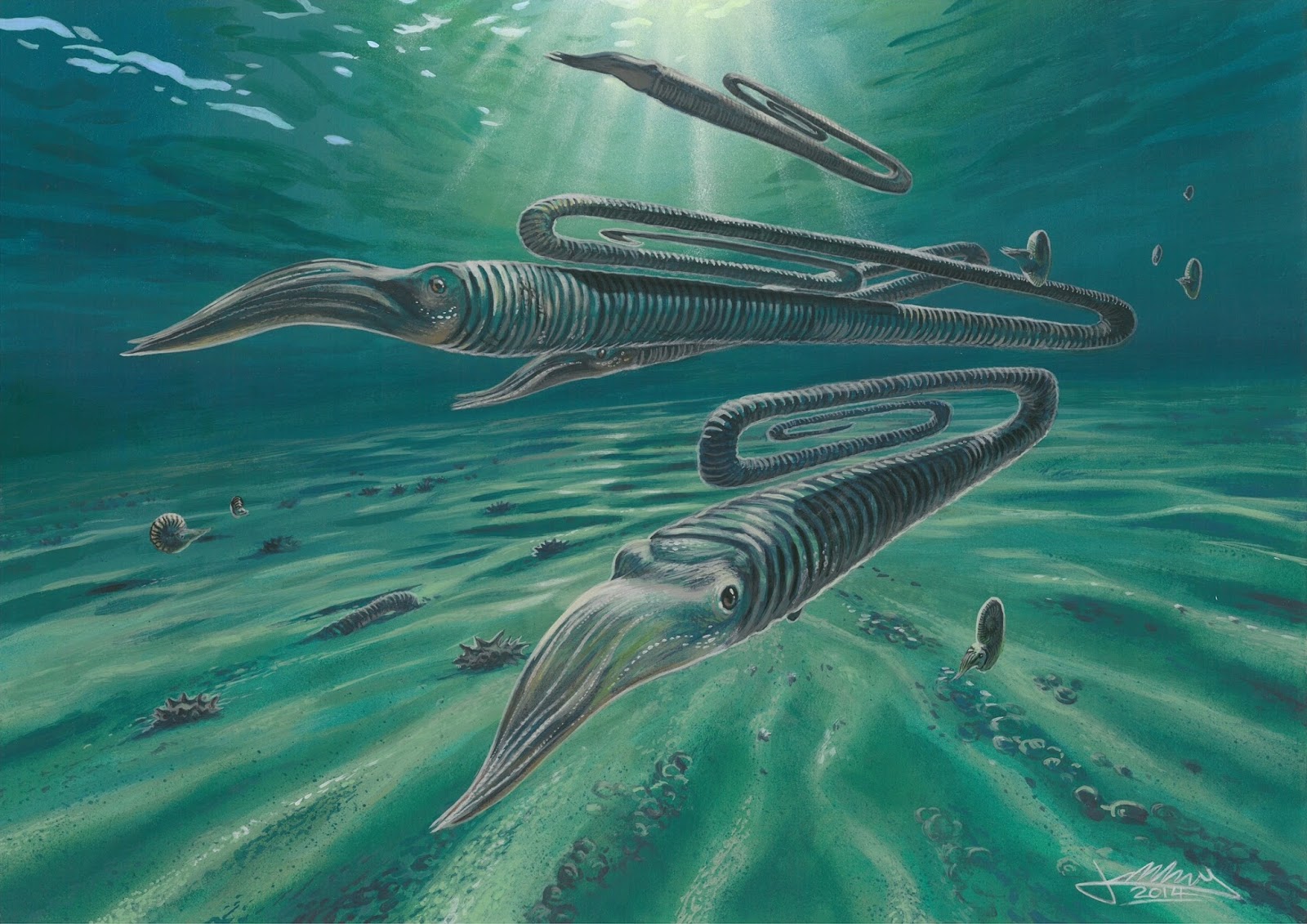
 Typical Cretaceous marine environment in Antarctica, including the paperclip-shaped 'heteromorph' ammonite Diplomoceras
Painted reconstruction: James McKay DOI:  10.1038/ncomms11738 

Debate continues about the nature of the Cretaceous–Paleogene (K–Pg) mass extinction event. An abrupt crisis triggered by a bolide impact contrasts with ideas of a more gradual extinction involving flood volcanism or climatic changes. Evidence from high latitudes has also been used to suggest that the severity of the extinction decreased from low latitudes towards the poles. Here we present a record of the K–Pg extinction based on extensive assemblages of marine macrofossils (primarily new data from benthic molluscs) from a highly expanded Cretaceous–Paleogene succession: the López de Bertodano Formation of Seymour Island, Antarctica. We show that the extinction was rapid and severe in Antarctica, with no significant biotic decline during the latest Cretaceous, contrary to previous studies. These data are consistent with a catastrophic driver for the extinction, such as bolide impact, rather than a significant contribution from Deccan Traps volcanism during the late Maastrichtian.


James D. Witts, Rowan J. Whittle, Paul B. Wignall, J. Alistair Crame, Jane E. Francis, Robert J. Newton and Vanessa C. Bowman. 2016. Macrofossil Evidence for A Rapid and Severe Cretaceous–Paleogene Mass Extinction in Antarctica. Nature Communications. 7, Article number: 11738. DOI:  10.1038/ncomms11738 

Antarctic fossils reveal creatures weren’t safer in the south during dinosaur extinction  http://scienmag.com/?p=1471552 via  @Scienmag

Painted reconstruction of typical Cretaceous marine environment in Antarctica, ....: https://goo.gl/vQbTs5
Images from Seymour Island in the Antarctic Peninsula: https://goo.gl/jrVOb1
Photographs of fossils: https://goo.gl/NYRHb1  Credit: Richard Cruise, University of Leeds

Saturday, July 5, 2014

[Paleontology • 2014] The Soft-tissue Attachment Scars in Late Jurassic ammonites from Central Russia


Fig. 14. Reconstruction of two Late Volgian ammonites from Craspeditidae family,
Kachpurites fulgens (A), Garniericeras catenulatum (B).

Ten arms are shown because Nautilus and representatives of Coleoidea exhibit five arm pairs in embryos, it can be a base number of arms in Cephalopoda (Kröger et. al. 2011). Two long tentacles are very speculative. However, such tentacles for external-shelled cephalopods could be very useful for catching pray which is at a distance; since rapid jumping forward could be difficult to these mollusks. The large hyponome were shown because of the presence of a funnel-locking apparatus and hyponomic retractors, and also due to the shape of aperture edges with lateral apertural sinuses and the presence of a large round opening between lappets in some ammonites (Westermann 1990: fig. 2). The eyes were drawn similar to coleoid eyes because Ammonoidea and Coleoidea were sister taxons (Jacobs and Landman 1993). The dark transverse bands on the shells correspond to the most common ammonites’ color pattern (Keupp 2000). The presence of such a color pattern in the Craspeditidae family is confirmed by findings of shells with transverse dark bands (AAM unpublished material). This picture, drawn by Andrey Atuchin, was based on the sketch of the author of this article.


Soft-tissue attachment scars of two genera and four species of Upper Jurassic (Upper Volgian) craspeditid ammonites from the Russian Platform are described. A previously suggested relationship between lateral attachment scars and ammonoid hyponome is confirmed, however, a new interpretation is proposed for dorsal attachment scars: they could have been areas not only for attachment of the dorsal (nuchal)  retractors, but also of the cephalic retractors. The new type of the soft-tissue attachment – anterior lateral sinuses, located between the lateral attachment scars and the aperture of the ammonite body chamber is described. Enclosed elliptical or subtriangular areas in apertural parts of the anterior lateral sinuses were found for the first time. Their presence and location suggest that this structure could have been used for attaching the funnel-locking apparatus, similar to those of coleoids. A transformation of shape and position of lateral attachment scars through the evolution of the Late Jurassic craspeditid lineage starting from platycones (Kachpurites fulgens) to keeled oxycones (Garniericeras catenulatum) is recognized. 

Keywords: Ammonoidea, Craspeditidae, Kachpurites, Garniericeras, soft-tissue attachment scars, paleobiology, Jurassic, Russia. 
  
Mironenko, A.A. 2014. The Soft-tissue Attachment Scars in Late Jurassic ammonites from Central Russia. Acta Palaeontologica Polonica. XX (X): xxx-xxx. http://dx.doi.org/10.4202/app.00041.2013 
http://app.pan.pl/archive/published/app59/app000412013_acc.pdf