Showing posts with label Orectolobiformes - Carpet shark. Show all posts

Saturday, January 25, 2020

[Ichthyology • 2020] Walking, Swimming or Hitching A Ride? Phylogenetics and Biogeography of the Walking Shark Genus Hemiscyllium


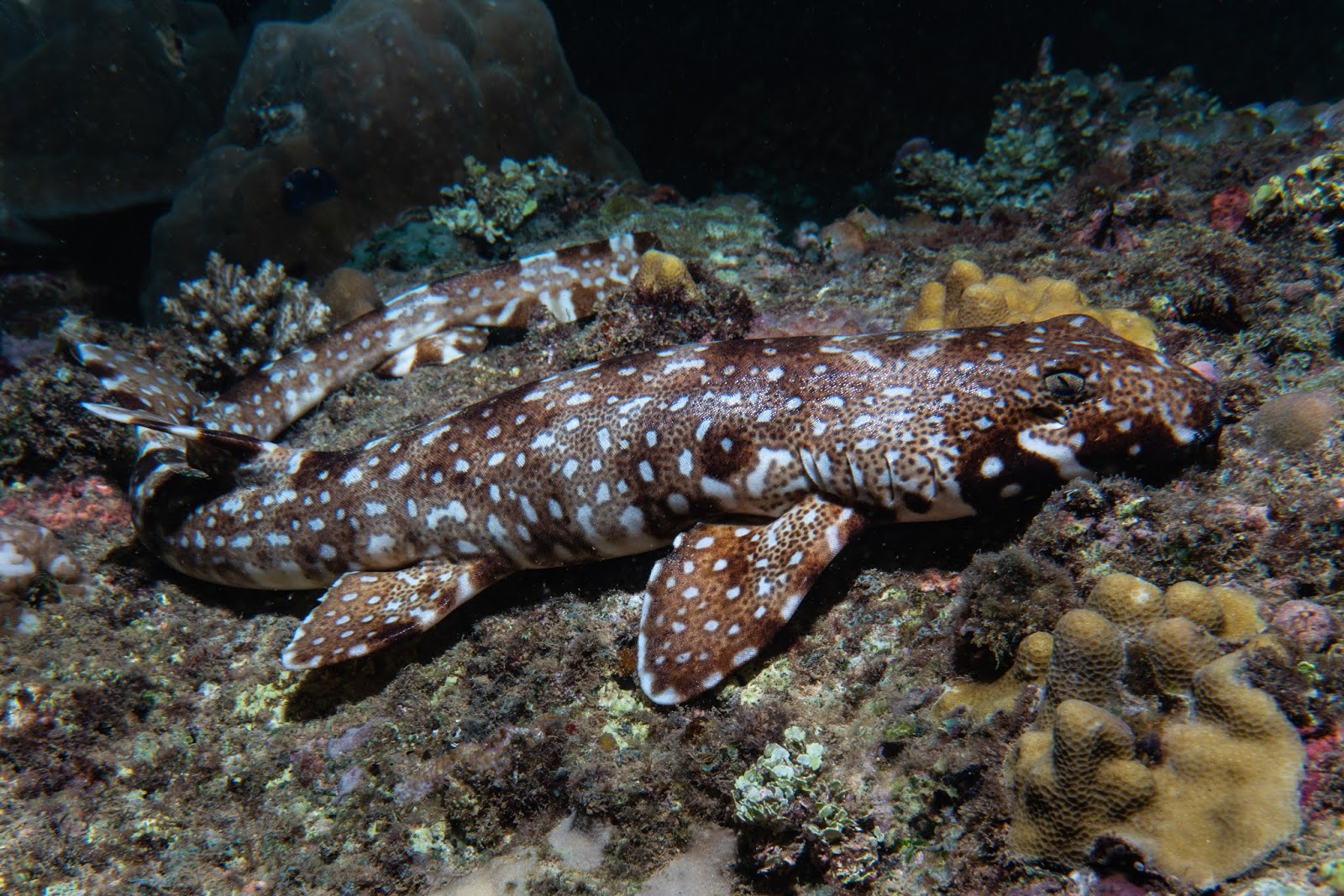
Hemiscyllium strahani  Whitley, 1967
Hemiscyllium michaeli G. R. Allen & Dudgeon, 2010

in Dudgeon, Corrigan, Yang, Allen, Erdmann, et al., 2020. 
photos: Mark Erdmann / Conservation International conservation.org 

 Abstract
It can be challenging to identify the forces that drive speciation in marine environments for organisms that are capable of widespread dispersal because their contemporary distributions often belie the historical processes that were responsible for their initial diversification. In this contribution we explore the likely sequence of events responsible for the radiation of walking sharks in the genus Hemiscyllium using a dated molecular phylogeny. The nine currently recognised species in the genus consist of small, benthic sharks that are restricted to the Indo-Australian Archipelago and show limited dispersal at both juvenile and adult stages. We discuss how major tectonic changes, sea level fluctuations and the unique biology of the species may have influenced speciation in the group, as well as the current distribution of the genus and each of its constituent species. Phylogeographic analysis of the genus combined with biogeographic reconstruction of the region shows a recent radiation during the Miocene and Pliocene, and supports a combination of vicariance and founder modes of speciation mediated by major tectonic, geological and oceanographic historical processes.

 keywords: Australia, eastern Indonesia, epaulette shark, New Guinea, radiation, Sahul region.

A walking shark Hemiscyllium strahani in Depapre Bay, Indonesia.

photo: Mark Erdmann /
 Conservation International conservation.org 


A juvenile walking shark Hemiscyllium michaeli, the leopard epaulette shark,
in Milne Bay, Papua New Guinea.

photo: Mark Erdmann / Conservation International conservation.org


Christine L. Dudgeon, Shannon Corrigan, Lei Yang, Gerry R. Allen, Mark V. Erdmann, Fahmi, Hagi Y. Sugeha, William T. White and Gavin J. P. Naylor. 2020. Walking, Swimming or Hitching A Ride? Phylogenetics and Biogeography of the Walking Shark Genus HemiscylliumMarine and Freshwater Research.  DOI: 10.1071/MF19163

Walking sharks discovered in the tropics tinyurl.com/vfz22wa via @uq_news
Discovery afoot: New study cracks mystery of how ‘walking’ sharks split conservation.org/blog/discovery-afoot-new-study-cracks-mystery-of-how-walking-sharks-split


Thursday, September 26, 2019

[Ichthyology • 2019] The Sandy Zebra Shark: A New Color Morph of the Zebra Shark Stegostoma tigrinum, with A Redescription of the Species and A Revision of Its Nomenclature


Stegostoma tigrinum Forster, 1781

in Dahl, Sigsgaard, Mwangi, et al., 2019.

Abstract
The Zebra Shark, in recent years known as Stegostoma fasciatum (Hermann, 1783), is well known for its dramatic ontogenetic change of color pattern, from striped (“zebra”) juveniles to spotted (“leopard”) adults. Nevertheless, many aspects of the species' biology, ecology, and morphology are still unknown or inadequately described, and its nomenclature is contentious. This study introduces a hitherto undescribed color morph of the Zebra Shark and provides an updated diagnosis and redescription of the species. Firstly, we establish that the Zebra Shark remains a single species based on genetic data from mitochondrial COI and ND4 markers. Secondly, through morphological analyses, we conclude that there are two morphs of the species, the known, zebra striped morph and a new, sandy colored morph. Both morphs were studied morphometrically to expose any ontogenetic changes, such as a decrease in the relative length of the tail with increasing total length (TL). The external coloration pattern clearly differentiates the two morphs, and both morphs can be further divided into three stages based on color pattern and size: juveniles (255–562 mm TL), transitionals (562–1395 mm TL), and adults (>1300 mm TL). The transitional sandy morph is dorsally covered by a swirly pattern of thin, dark brown bands edged with freckle-like brown spots. The adults are a uniform sandy beige, partially covered with brown freckles. A mature male of the zebra morph displayed a yet unknown feature of the claspers: a small, triangular spike extruding from the dorsal terminal of the clasper glands. Finally, we reviewed the nomenclature of the species and suggest that the original name Stegostoma tigrinum Forster, 1781 should be used as the senior synonym for the species.


Stegostoma Müller and Henle, 1837
Squalus Seba, 1759; Forster, 1781; Hermann, 1783; Bloch, 1784; Broussonet, 1784; Bonnaterre, 1788; Gmelin, 1789; Pennant, 1791; Shaw, 1804; Bleeker, 1852; Gronow, 1854.
Scyllia van Hasselt, 1823.
Scyllium Rüppel, 1837.
Stegostoma Müller and Henle, 1837; Blyth, 1847; Günther, 1870; Garman, 1913; Whitley, 1939; Bass et al., 1975; Dingerkus, 1986; Compagno, 2001; Goto, 2001; Weigmann, 2016.
Stegostonea Regan, 1929: 293, possible error for Stegostoma Müller and Henle, 1837.
Stegastoma Herre, 1934: 10, possible error for Stegostoma Müller and Henle, 1837.
Stegastoma Last and Stevens, 1994: 138 apparent error for Stegostoma Müller and Henle, 1837.

Type species.— Squalus fasciatus Bloch and Schneider, 1801, by original designation, equals Squalus fasciatus Hermann, 1783.
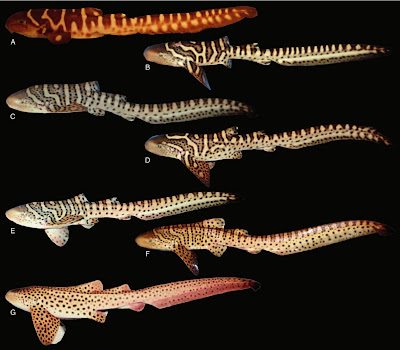
Fig. 5: The three ontogenetic stages of the external morphology of the zebra morph of Stegostoma tigrinum:
 juvenile (A), transitional (B–F), and adult (G).


Stegostoma tigrinum
Zebra Shark

Diagnosis: Stegostoma tigrinum is characterized by a long caudal fin (49.9–54.2% TL) and five dorsolateral ridges along the body, visible even in hatchlings. Spiracles bean shaped, large (length 0.4–1.7% TL); eyes small (length 0.9–2.1% TL); barbels two, short (0.6–2.8% TL); gill slits five, but fourth and fifth partly fused so only four noticeable from a distance; pectoral fins large (anterior margin length 10.4–19.1% TL), broad and rounded; first dorsal fin originates far posteriorly above pelvic fins. Two color morphs, with a three-stage ontogenetic color and pattern change. Zebra morph: juveniles with dark brown background and cream colored bands (zebra-like); transitionals light brown with dark bands, broken up by dots; adults beige to yellow with spotted pattern (can be leopard-like). Sandy color morph: transitionals light beige background with swirly pattern of narrow, darker brown bands with tiny spots breaking up the pattern; adults uniformly sandy beige with tiny dark brown freckles. Maximum length 2050 mm TL, hatchlings approx. 250 mm TL; pectoral-fin rays of semi-plesodic structure, reaching approx. 66–88% of pectoral fin. Total vertebrae 207–262, monospondylous precaudal vertebrae 43–49, diplospondylous precaudal vertebrae 38–50, diplospondylous caudal vertebrae 120–175, precaudal vertebrae 81–101. Tooth rows upper jaw: 13–30, lower jaw: 22–30, and series count, upper jaw: 7–27, lower jaw: 8–16. Ring-type intestine with 18–20 valvular turns.
...

Distribution: The sandy color morph of S. tigrinum has in the present study been documented from a single location, off the coast of Kenya, ca. 10 km north of Malindi (Fig. 9). Six specimens of this morph were caught in June 2016 (rainy season) at a depth of 12 m, on a sandy substrate. A seventh specimen was caught in May 2017, 15 km north of Malindi on sandy bottom, also at 12 m depth.

Etymology: The name Stegostoma tigrinum is made up of the Greek stego meaning cover, and stoma meaning mouth, and can thus be translated to ‘covered mouth' (Froese and Pauly, 2018). The epithet tigrinum refers to the juveniles’ banded pattern.

Fig. 7: Specimens of Stegostoma tigrinum from Kenya in the transitional stage, shown from smallest to largest body size (no. 1–24) in dorsal and lateral view.
No. 1–6: 565–670 mm TL, no. 7–12: 675–710 mm TL, no. 13–18: 740–800 mm TL, and no. 19–24: 802–975 mm TL.


Rikke Beckmann Dahl, Eva Egelyng Sigsgaard, Gorret Mwangi, Philip Francis Thomsen, René Dalsgaard Jørgensen, Felipe de Oliveira Torquato, Lars Olsen and Peter Rask Møller. 2019. The Sandy Zebra Shark: A New Color Morph of the Zebra Shark Stegostoma tigrinum, with A Redescription of the Species and A Revision of Its Nomenclature. Copeia. 107(3); 524-541.  DOI: 10.1643/CG-18-115


Friday, September 6, 2013

[Ichthyology • 2013] Hemiscyllium halmahera • A New Species of Bamboo Shark (Hemiscylliidae) from Ternate, Halmahera, the Maluku Islands, (eastern) Indonesia


Halmahera Epaulette Shark | Hemiscyllium halmahera
Allen, Erdmann & Dudgeon, 2013

Abstract
Hemiscyllium halmahera new species is described from two specimens, 656-681 mm TL, collected at Ternate, Halmahera, Indonesia. The new species is clearly differentiated on the basis of colour pattern. Its features include a general brown colouration with numerous clusters of mainly 2-3 dark polygonal spots, widely scattered white spots in the matrix between dark clusters, relatively few (< 10), large dark spots on the interorbital/snout region, a pair of large dark marks on the ventral surface of the head, and a fragmented post-cephalic mark consisting of a large U-shaped dark spot with a more or less continuous white margin on the lower half, followed by a vertical row of three, smaller clusters of 2-3 polygonal dark marks. The new species is most similar in general appearance to H. galei from Cenderawasih Bay, West Papua, which differs in having 7-8 large, horizontally elongate dark spots on the lower side between the abdomen and caudal-fin base, a cluster of solid dark post-cephalic spots, and usually about 25 dark spots on the upper surface of the head.

Gerald R. Allen, Mark V. Erdmann and Christine L. Dudgeon. 2013. Hemiscyllium halmahera, a new species of Bamboo Shark (Hemiscylliidae) from Indonesia. aqua, International Journal of Ichthyology19 (3): 123-136. 

__________________________

Hemiscyllium halmahera: New Species of ‘Walking’ Shark from Indonesia
Dr Gerald Allen, a research associate at the Western Australian Museum, and his colleagues from Australia have described a new species of shark from eastern Indonesian waters.

Halmahera epaulette shark, a rare species of bamboo shark from Indonesia, photographed in the Ternate sea in Maluku, Indonesia. || The week in wildlife – in pictures http://gu.com/p/46tym/stw#img-17

[Ichthyology • 2010] Hemiscyllium michaeli | Milne Bay epaulette shark • a new species of Bamboo Shark (Hemiscyllidae) from Papua New Guinea


Hemiscyllium michaeli G. R. Allen & Dudgeon, 2010
Milne Bay epaulette shark
photo by Scott W. Michael | http://gobiestogrizzlies.blogspot.com

Holotype: USNM 218602, female, 610 mm TL, coral reef in Harvey Bay, east of Oro Bay, Papua New Guinea, 0-10 m, T. Roberts, 6-7 August 1975. 

Diagnosis: A species of bamboo shark belonging to the genus Hemiscyllium, distinguished from related species by a unique colour pattern, particu-larly the combination of dense leopard-like spotting on the body and a large black ocellate spot on the middle of the side, just behind the head. It lacks diagnostic colour pattern features that typify the other known species in the genus including: black hood or face-mask marking on the head (H. strahani), large intensely black ovate spots on body (H. hallstromi), ocellate shoulder spot and numerous small black spots on body (H. ocellatum), ocellate shoulder spot with two curved black marks on posterior edge and numerous diffuse dark spots on head body and fins (H. trispeculare), row of 7-8 large, horizontally ovate spots on lower side between abdomen and caudal-fin base (H. galei), "double-ocellus" shoulder marking (H. henryi) and a fragmented or diffuse shoulder marking and sparse spot pattern on dorsal surface of snout (H. freycineti). 

Distribution and habitat: The new species is known only from eastern Papua New Guinea (Fig. 1) with observation and collecting records from Samarai Island, Milne Bay (vicinity of Alotau and Sullivan Patches), vicinity of Harvey Bay (Oro Province), and the Trobriand Islands. It is typically encountered on coastal fringing reefs and patch reefs while diving at night, although it is sometimes seen during the day, sheltering under rocky outcrops or tabular corals. The known depth range is approximately 2-20 m. 

Etymology: The species is named H. michaeli in honour of Scott W. Michael, who first brought the difference between this species and H. freycineti to our attention. In addition, he has contributed a wealth of information, including valuable photographs, for the first author's research on Indo-Pacific fishes. 


Allen & Dudgeon. 2010. Hemiscyllium michaeli, a new species of Bamboo Shark (Hemiscyllidae) from Papua New Guinea. Aqua International Journal of Ichthyology. 16 (1): 19–30.

[Ichthyology • 2008] Hemiscyllium galei & H. henryi • Two new species of bamboo sharks (Orectolobiformes: Hemiscylliidae) from the Bird’s Head region of western New Guinea (Papua Barat Province, Indonesia)


Hemiscyllium henryi G. R. Allen & Erdmann, 2008

Abstract
Two new species of hemiscylliid sharks are described from the Bird’s Head region of western New Guinea (Papua Barat Province, Indonesia). They differ from congeners on the basis of both colour patterns and DNA composition. Hemiscyllium galei is described from two specimens, 542.5-567.5 mm TL, collected at Cenderawasih Bay. The species is similar in appearance to H. freycineti, reported from areas immediately westward including the Raja Ampat Islands. The new species differs from H. freycineti in possessing white lines and spots along the margin of the large, dark dorsal saddles as well as scattered white spots, mainly on the upper side. In addition, H. galei is characterised by a row of about seven well-defined, horizontally-ovate, dark spots on the lower side between the abdomen and caudal-fin base. Hemiscyllium henryi is described from three specimens, 564.0-815.0 mm TL, collected in the vicinity of Triton Bay. It is most similar in general appearance to H. ocellatum from northern Australia, but differs in the structure of the postcephalic ocellus (usually a pair of merged “twin-ocelli” with a poorly defined white halo) and possesses well-defined dark brown saddles/bars along the back and dorsal margin of the caudal fin as well as a dark spot at the origin of the pectoral and pelvic fins. A final difference concerns the presence of numerous small brown spots on the dorsal fins of H. ocellatum, in contrast to the mainly spotless pattern on the dorsal fins of H. henryi.

Fig. 1. Map of western New Guinea (Papua Barat Province, Indonesia) showing collection locations (star symbols) of new species of Hemiscyllium.
Abbreviations as follows: BH = Bird’s Head Peninsula, CB = Cenderawasih Bay, and RA = Raja Ampat Islands.
NASA satellite images.

 Hemiscyllium galei G. R. Allen & Erdmann, 2008
compared to H. freycineti (lower), reported from areas immediately westward including the Raja Ampat Islands

Holotype: NCIP 6324, male, 567.5 mm TL, reef near Rumberpon Village, western Cenderawasih Bay, Papua Barat Province, Indonesia, 3-4 m, collected by hand, M. and A. Erdmann, 19 February 2007.


Diagnosis: A species of bamboo shark belonging to the genus Hemiscyllium, distinguished by its unique colour pattern, particularly the combination of white lines/spots along the margin of the large, dark saddles on the back, scattered white spots (mainly on upper side), and a row of 7-8 well-defined, horizontally-ovate, dark spots on the lower side between the abdomen and caudal-fin base.

Distribution and habitat: The new species is apparently confined to Cenderawasih Bay, Papua Barat Province, Indonesia. The habitat typically consists of shoreline fringing reefs or shallow patch reefs. The three individuals reported to date have all been encountered at night at depths between 2-4 m. They were usually seen resting on the bottom, but occasionally were observed while slowly swimming or “walking” over the bottom with the pectoral and pelvic fins. Presumably it is sedentary during daylight hours, sheltering under rocky outcrops or tabular corals, which is typical for other family members.

Etymology: The new species is named galei in honour of Jeffrey Gale, an avid underwater photographer, shark enthusiast, and benefactor of the marine realm. Mr. Gale successfully bid to support the conservation of this species at the Blue Auction in Monaco on 20 September 2007 and has given generously to support Conservation International’s Bird’s Head Seascape marine conservation initiative.

Hemiscyllium henryi G. R. Allen & Erdmann, 2008

Holotype: NCIP 6323, male, 783 mm TL, small bay in northwestern portion of Selat Iris, immediately south of Triton Bay, Papua Barat Province, Indonesia, 3-4 m, collected by hand, M. V. Erdmann and M. Allen, 24 April 2006.

Diagnosis: A species of bamboo shark belonging to the genus Hemiscyllium, distinguished by its unique colour pattern, particularly the combination of small scattered spots on the head, body and fins including 13-18 spots on interorbital/dorsal snout region and 6-18 spots on dorsal surface of pectoral fins, and a unique “double-ocellus” marking on middle of side, just behind the head.

Distribution and habitat: The new species is known only from western New Guinea (Papua Barat Province, Indonesia) in the vicinity of Triton Bay in the southern Bird’s Head region. It has been observed/collected both in the bay and at nearby Selat Iris, a narrow channel between the mainland and Aiduma Island. Unlike other parts of the Bird’s Head Peninsula such as Cenderawasih Bay and the Raja Ampat Islands, there is almost no shallow, fringing reef habitat due to the unique geomorphology of the area. Hence, the typical habitat for this shark extends into deeper water (at least 30 m), although it has also been sighted in depths less than 4 m. It is usually seen resting on the bottom, but occasionally is observed while slowly swimming or “walking” over the bottom with the pectoral and pelvic fins. During the day it is generally sedentary, sheltering under rocky outcrops or tabular corals.
Etymology: The species is named H. henryi in honour of Wolcott Henry of Washington D.C., who has generously supported Conservation International’s marine initiatives, including taxonomy of western New Guinea fishes.


Allen & Erdmann. 2008. Two new species of bamboo sharks (Orectolobiformes: Hemiscylliidae) from Western New Guinea. aqua (Miradolo Terme) 13 (3-4): 93–108.