Showing posts with label Cameroon. Show all posts

Tuesday, January 20, 2026

[Botany • 2026] Phragmanthera bidaultii (Loranthaceae) • A New Species from the Sanaga River Basin, Cameroon


Phragmanthera bidaultii Libalah & O.Lachenaud,
 
in Simo-Droissart, Lachenaud, Libalah et Sonké. 2026. 
 Photos by Ehoarn Bidault & Murielle Simo-Droissart 
 
Abstract
Background and aims – Riverine habitats along the Sanaga River in Cameroon were until recently little-explored by botanists, although they are facing increasing threats, notably from the construction of hydroelectric dams. Recent botanical inventories in the area have led to the discovery of several taxonomical novelties, including a new species of Phragmanthera (Loranthaceae) that is described here.

Material and methods – This paper is based on field studies and examination of herbarium collections of the new species and its relatives. Classic practices of herbarium taxonomy have been applied. The conservation status of the new species is assessed following the IUCN Red List Categories and Criteria.

Key results – Phragmanthera bidaultii sp. nov. is identified by its non-septate anthers (a unique character in the genus), by the patent to reflexed corolla lobes with the apex thickened into a conical appendage, and by its relatively narrow leaves, initially with sparse rufous barbellate hairs but soon becoming glabrescent on both sides. It has a very restricted distribution along the Sanaga River in Cameroon, where it grows in riparian forest, and it is assessed as Endangered (EN).

Keywords: hydroelectric dam, IUCN Red List assessment, mistletoes, riverine forests, Santalales, taxonomy, threatened species

Phragmanthera bidaultii.
A. Flowering branch. B. Detail of the corolla. C. Flowers. D. Branch with young fruits (green) and one mature fruit (orange). E. Apex of branch with young leaves (note rufous hairs) and one mature fruit.
A–C from Bidault et al. 6039; D from Sonké & Simo 7412; E from Sonké & Simo 7430. Photos by Ehoarn Bidault (A–C), Murielle Simo-Droissart (D, E).

Phragmanthera bidaultii Libalah & O.Lachenaud, sp. nov.
 
Diagnosis: Phragmanthera bidaultii has patent to reflexed corolla lobes, a style with a distinct neck under the stigma and stamen filaments without an apical tooth, in which characters it resembles P. leonensis (Sprague) Balle, P. nigritana (Hook.f. ex Benth.) Balle, and P. vignei Balle, but differs from all of them by the apex of the corolla lobes being thickened into a conical appendage (vs not appendaged) and its smaller anthers, 0.7–1.0 mm long (vs 1.5–3.5 mm) that are not septate (all its congeners have septate anthers). It is further separated from the first two species by its soon glabrescent lower leaf surface (vs persistently hairy), from the last two by its non-foliaceous bracts not or scarcely exceeding calyx (vs foliaceous and long exceeding it) and its corolla with hairs barbellate for most of their length (vs at their base only).


Murielle Simo-Droissart, Olivier Lachenaud, Moses Libalah and Bonaventure Sonké. 2026. A New Species of Phragmanthera (Loranthaceae) from the Sanaga River Basin, Cameroon. Plant Ecology and Evolution. 159(1): 27-34. DOI: doi.org/10.5091/plecevo.172526 

Friday, September 26, 2025

[Diplopoda • 2025] Scaptodesmus manengouba, S. kala & S. vandenspiegeli • Taxonomic Review of the Afrotropical Millipede Genus Scaptodesmus Cook, 1896 (Polydesmida: Chelodesmidae), with Integrative Descriptions of Three New Species from Cameroon


Scaptodesmus manengouba
Scaptodesmus kala
Scaptodesmus vandenspiegeli
Fiemapong, Blandenier, Tamesse & Mitchell, 2025


Abstract
The genus Scaptodesmus Cook, 1896, is revised based on recent material collected from Cameroon. Three new species are described and illustrated: Scaptodesmus kala sp. nov., S. manengouba sp. nov., and S. vandenspiegeli sp. nov. Additionally, the diagnoses of two old and well-defined species of the genus, S. porati Cook, 1896, and S. granulosus (Attems, 1931), are revised. The species Scaptodesmus dentatus Silvestri, 1909, previously regarded as incertae sedis, is here confirmed as such, since its taxonomic affiliation remains uncertain. An identification key to and a distribution map for all Scaptodesmus species known so far are provided. Barcoding base on COI sequencing was successfully performed for all three new species and compared with previously published sequences from the family Chelodesmidae. The results reveal that the three new species are all genetically distinct from one another. A maximum likelihood phylogenetic tree constructed using the dataset of available species resulted in a well-resolved and well-supported phylogeny. In all cases, barcoding data were consistent with traditional morphological taxonomic classifications. This work highlights the importance of integrated taxonomy in resolving relationships within millipede species groups below the family level.

Myriapoda, taxonomy, COI, DNA barcoding, millipede, Pepodesminae, Afrotropical Region
 
Scaptodesmus kala sp. nov,. female paratype (NHMN-62-4).
A, B & C. Habitus, dorsolateral, ventrolateral and lateral views, respectively. Scale bars: 1.0 mm.

Scaptodesmus manengouba sp. nov., male paratype (NHMN-62-11).
A. habitus, lateral view; B. ventral view, C. dorsal view. Scale bars: 1.0 mm (A, B , C)

Scaptodesmus vandenspiegeli sp. nov., male paratype (NHMN-62-14), habitus, dorsal view. Scale bar: 5 mm.


Armand Richard Nzoko FIEMAPONG, Quentin BLANDENIER, Joseph Lebell TAMESSE and Edward A. D. MITCHELL. 2025. Taxonomic Review of the Afrotropical Millipede Genus Scaptodesmus Cook, 1896 (Diplopoda, Polydesmida, Chelodesmidae), with Integrative Descriptions of Three New Species from Cameroon.  Zootaxa. 5696(3); 361-384. DOI: doi.org/10.11646/zootaxa.5696.3.3 [2025-09-25]

Tuesday, May 6, 2025

[Crustacea • 2025] Louisea cataracta • A New Species of Louisea Cumberlidge, 1994 (Brachyura: Potamonautidae: Liberonautinae), A Freshwater Crab from the Ekom-Nkam Waterfall, Cameroon


Louisea cataracta 
Ndongo, Rintelen, Clark & Cumberlidge, 2025  
     

 Abstract
A new species of Louisea Cumberlidge, 1994 (Brachyura: Potamonautidae: Liberonautinae) is described from the Nkam River below the Ekom Nkam Waterfalls, near Melong (5.06__°N, 10.03__°E), in the tropical rainforests of Cameroon. The new species is recognized by a unique combination of characters of the carapace, thoracic sternum, and male cheliped, and is supported as a separate lineage by a phylogenetic analysis of species of Louisea based on mtDNA (COI and 16S rRNA). Notes are provided on the ecology and the conservation of Louisea cataracta sp. nov..

Crustacea, Central Africa, taxonomy, Louisea cataracta n. sp., ecology, conservation 

 Louisea cataracta sp. nov.
A, Ekom-Nkam Waterfalls, the type locality. B, adult male holotype, CW 17.5 mm, Ekom-Nkam Waterfalls, Cameroon, ZMB Crust. 33410: whole animal, dorsal view. 

Louisea cataracta sp. nov. adult male holotype, CW 17.5 mm, Ekom-Nkam Waterfalls, Cameroon, ZMB Crust.33410:
A, carapace, frontal view; B, whole animal, dorsal view showing natural colour; C, cephalothorax, ventral view; D,carapace, dorsal view. 
 
Louisea cataracta n. sp.

Etymology. The species name, cataracta, is derived from the Latin for waterfall in reference to the Ekom Nkam waterfalls where the specimens were collected. The specific epithet is used as a Latin noun in apposition. 


Pierre A. Mvogo NDONGO, Thomas Von RINTELEN, Paul F. CLARK and Neil CUMBERLIDGE. 2025. A New Species of Louisea Cumberlidge, 1994, A Freshwater Crab from the Ekom-Nkam Waterfall, Cameroon (Brachyura: Potamonautidae: Liberonautinae).  Zootaxa. 5590(1); 113-123. DOI: doi.org/10.11646/zootaxa.5590.1.6 [2025-02-20]

[Botany • 2025] Begonia ebo sp. nov. (Begoniaceae, sect. Filicibegonia), endangered in Ebo, a highly threatened forest in Littoral Region, Cameroon


Begonia ebo H.Lockwood,

in Lockwood et Tchatchouang, 2025. 

Abstract  
Begonia ebo H.Lockwood sp. nov., a terrestrial herb endemic to Cameroon cloud forest, is described, mapped and illustrated. It is the first species of Begonia Section Filicibegonia known to have yellow flowers (vs pink or white), to have inflorescences that are epiphyllous, appearing to emerge from the upper leaf surface (vs ordinarily axillary) and, also, the first species of the section known to be endemic to Cameroon. It is also endemic to the Cross-Sanaga River Interval. In contrast, six of the nine species of Sect. Filicibegonia are endemic to the interval between the Sanaga River of Cameroon and the Congo River. So far Begonia ebo is only known from inside or adjacent to the Ebo forest, Littoral Region, Cameroon, apart from a single record from the Chaine de Nkohom in Central Region c. 60 km distant. In view of the massive ongoing threats of industrial logging to the Ebo Forest, the stronghold and main centre of this species on current evidence, the conservation status of Begonia ebo is provisionally assessed as Endangered, EN B1 ab(iii) +B2ab(iii).

Keywords: Cross-Sanaga River interval, epiphyllous, yellow-flowered

Begonia ebo.
Habit showing male and female flower. Lockwood 61 (K, YA).
Photo by H. Lockwood.

Begonia ebo.
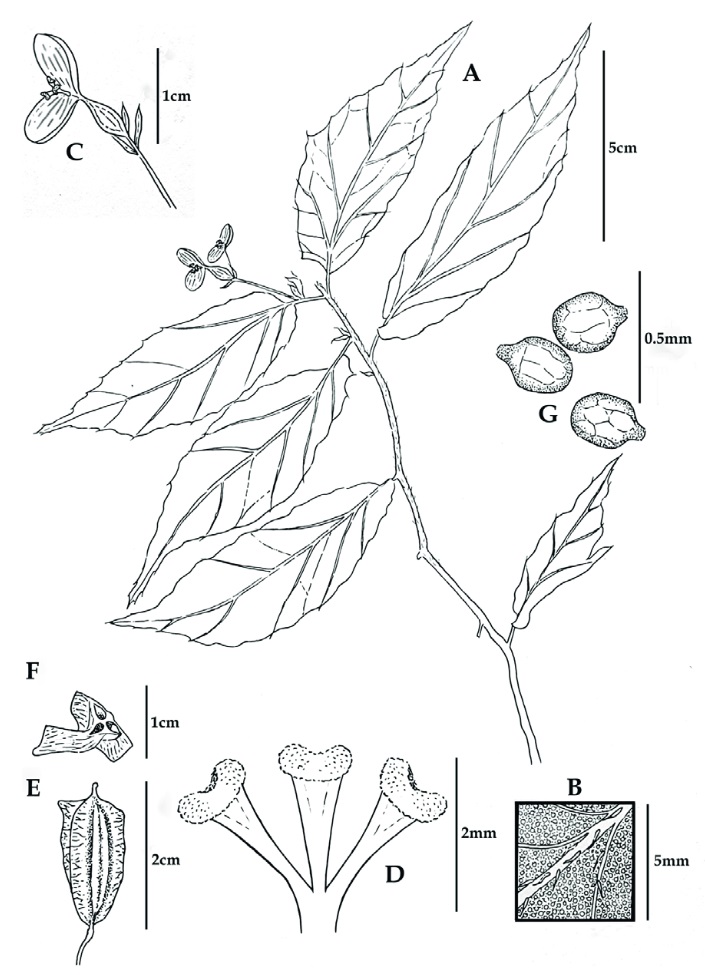
A habit, flowering stem; B. detail of abaxial blade surface showing midrib and hairs; C. female flower and inflorescence; D. style and stigmas; E fruit, side view showing unequal dorsal wing; F. fruit, transverse section showing locules; G. seeds, side view.
All from Lockwood 61 (K). Drawn by H. Lockwood.

Begonia ebo H.Lockwood sp. nov.

 Diagnosis: Begonia ebo differs from all known species of Begonia Sect. Filicibegonia due to its yellow (not white or pink) perianth lobes, and also in the peculiar posture of the inflorescence, which lie along the groove of the adaxial petiole leaf-blade midrib, the flowers appearing superficially to arise from the middle of the leaf-blade (vs inflorescence sessile, or held above or below the leaf blades).

Etymology: Named as a noun in apposition for the forest of Ebo, Littoral  Region,  whence  most  of  the  known  specimens  were found.


Helen Lockwood and Eric Ngansop Tchatchouang. 2025. Begonia ebo sp. nov. (Sect. Filicibegonia-Begoniaceae), endangered in Ebo, a highly threatened forest in Littoral Region, Cameroon. Webbia. Journal of Plant Taxonomy and Geography. 80(1); 77-87. DOI: doi.org/10.36253/jopt-17739 [2025-04-17]

Saturday, December 21, 2024

[Botany • 2024] Talbotiella couteronii (Leguminosae: Detarioideae) • A New gregarious Tree Species from Cameroon


Talbotiella couteronii  Sonké, M.Simo & Burgt,
 
in Sonké, Simo-Droissart, Bidault, Ngoula et van der Burgt. 2024. 

Abstract
Background and aims – For some time now, the forests of the Sanaga basin in Cameroon have been threatened by the construction of numerous hydroelectric dams. In anticipation to this construction work, botanical surveys were carried out, resulting in the discovery of many species new to science. One of these certainly belongs to the genus Talbotiella in Leguminosae.

Material and methods – This study is based on morphological observations on herbarium specimens, through detailed examination of 28 specimens of the new tree species as well as specimens of existing species of Talbotiella.

Key results – Talbotiella couteronii is described and illustrated. The new species resembles Talbotiella batesii but has fewer leaflets, 5–10 pairs; an inflorescence usually with fewer flowers, 5–12; and flowers with longer pedicels, 10–20 mm long. Talbotiella couteronii is endemic to Cameroon, where it is restricted to the middle Sanaga basin in the Central Region and the Littoral Region. It occurs gregariously in periodically flooded riverine forests. Talbotiella couteronii is preliminarily assessed as Endangered following the IUCN Red List categories and criteria. The genus Talbotiella now consists of 10 species; of which six species are endemic to Cameroon. A comparative table summarizes the main vegetative characteristics of the 10 species. This treatment also includes an update of the description of T. bakossiensis.

Keywords: Cameroon, conservation, Endangered species, IUCN Red List assessment


Talbotiella couteronii. A. Flowering branch. B. Infructescence with two pods; two seeds. C. Flower with a single bract, two bracteoles, four sepals and 10 stamens. D. Stipule. E. Leaflet lower side, with two glands. F. Leaf upper side, with nine pairs of leaflets.
A, E, F drawn from Sonké & Ngoula 7886 (K); B from Sonké & Ngoula 7889 (K); C from Sonké & Ngoula 7887 (K); D from Sonké & Ngoula 7888 (K). Drawing by Xander van der Burgt.

Talbotiella couteronii.
A. Opened flowers. B. Twig with inflorescences. C. Young leaves with stipules. D. Infructescence with two fruits. E. Immature fruits and five unripe seeds.
A from Sonké & Ngoula 7888; B from Sonké & Ngoula 7886; C from Sonké & Ngoula 7895; D, E from Sonké & Ngoula 7889.

Talbotiella couteronii Sonké, M.Simo & Burgt, sp. nov.
 
Diagnosis: This species closely resembles T. batesii, from which it differs by the number of bud scales (11–17 vs 3–5), narrower stipules (9–15 × 1–1.5 mm vs 13–15 × 2–2.5 mm) that are glabrous on both surfaces (vs pubescent outside along the midrib), usually fewer leaflets ((5–)6–9(–10) pairs vs 9–13 pairs), looser inflorescence with longer pedicels (10–20 mm vs 3–8.5 mm) and usually fewer flowers (5–12 vs 10–18), larger ovary (4–6 × 2–3 mm vs 1.5–3.5 × 1–1.3 mm), and larger seeds (14–21 × 10–15 × 2–3 mm vs 9–10 × 9–10 × 2–3 mm).

Etymology: This new species is named after Dr Pierre Couteron (Institut de Recherche pour le Développement, Montpellier, France) in recognition for his constant support to the first author.


 Bonaventure Sonké, Murielle Simo-Droissart, Ehoarn Bidault, Fernandez Ngoula, Xander M van der Burgt. 2024. Talbotiella couteronii (Leguminosae: Detarioideae), A New gregarious Tree Species from Cameroon. Plant Ecology and Evolution. 157(3): 407-416. DOI: doi.org/10.5091/plecevo.133256

Monday, March 25, 2024

[Botany • 2024] Voacanga madureirae (Apocynaceae: Tabernaemontaneae) • A New Species from Atlantic Central Africa


Voacanga madureirae  Paiva, O.Lachenaud & Covelo,

in Lachenaud, Paiva, Covelo, Cheek et Onana. 2024. 
photos by Quentin Luke and Maria Do Céu Madureira.

Summary
A new species of Apocynaceae from Atlantic Central Africa, Voacanga madureirae Paiva, O.Lachenaud & Covelo, is mapped, described and illustrated. It occurs on the Gulf of Guinea islands of Príncipe (São Tomé and Príncipe) and Bioko (Equatorial Guinea) and in the highlands of western Cameroon. The new species differs from other African Voacanga by its calyx distinctly exceeding the corolla (vs shorter or at most equalling it). It is further separated from V. chalotiana Pierre ex Stapf by the presence of a row of colleters in the upper half of the calyx (not near the base) and from other Central African species by its syncarpous fruits and almost straight (not strongly twisted) corolla tube. It is assessed as Near Threatened according to IUCN criteria.

Key Words: Bioko, Cameroon, Equatorial Guinea, Gulf of Guinea islands, São Tomé and Príncipe, Tabernaemontaneae.

Voacanga madureirae. A flowers, Q. Luke 13274; B fruit, M. C. Madureira & Equipa Proj. Pagué III 87; C fruit cut in two halves, showing the inside, M. C. Madureira & M. Sebastião 3 MCM.
photos: A Quentin Luke, B – C Maria Do Céu Madureira.

Voacanga madureirae Paiva, O.Lachenaud & Covelo sp. nov. 

RECOGNITION. Voacanga madureirae is easily recognised by its syncarpous fruits, its almost straight (not strongly twisted) corolla tube, and its calyx distinctly exceeding the corolla and bearing inside a dense row of colleters in the upper half of the tube. The first two characters are also found in V. chalotiana Pierre ex Stapf, which, however, has a smaller calyx, bearing a row of colleters near the base and much exceeded by the corolla. All other Central African species of Voacanga have apocarpous fruits, strongly twisted corolla tubes and a corolla usually exceeding the calyx, or equalling it in V. diplochlamys K.Schum., which, however, has puberulous stems and inflorescence while these parts are glabrous in V. madureirae.


Olivier Lachenaud, Jorge Paiva, Filipe Covelo, Martin Cheek and Jean Michel Onana. 2024. Voacanga madureirae (Apocynaceae), A New Species from Atlantic Central Africa. Kew Bulletin. DOI: 10.1007/s12225-024-10179-3

Tuesday, May 2, 2023

[Botany • 2023] Drypetes stevartii (Putranjivaceae)A Matter of Warts: A Taxonomic Treatment for Drypetes verrucosa and A New cauliflorous Species from Cameroon and Nigeria


Drypetes stevartii Sonké & Quintanar,  

in Quintanar, Sonké, Simo-Droissart, Barberá, Libalah et Harris, 2023. 

Abstract
Background and aims – Specimens of a new tree species in the genus Drypetes (Putranjivaceae) distributed in Cameroon and eastern Nigeria, D. stevartii, were associated with D. verrucosa, another tree species endemic to Gabon, due to its warty fruits and to the overall morphological resemblances of both species.

Material and methods – The present study is based on the study of 20 gatherings of D. verrucosa and 26 gatherings of D. stevartii. Morphological observations on herbarium specimens belonging to the new species and D. verrucosa were carried out in order to describe them.

Key results – This treatment includes the detailed descriptions of these two species, the typification of their names, a comparative table summarizing their main morphological differences, an identification key, photographs of both, as well as information about their distribution, habitat, and phenology. Preliminary IUCN Red List assessments show that both D. verrucosa and D. stevartii are ‘Near Threatened’ species.

Keywords: Central Africa, conservation, dioecy, fruit dispersal, herbarium, isothiocyanates, IUCN Red List assessments, pollination, taxonomy

Drypetes stevartii Sonké & Quintanar.
A. Branchlet and leaves. B. Female inflorescence. C. Male inflorescence. D. Infructescences on the trunk. E. Infructescence with ripe fruits. F. Infructescence with immature fruits.
A, C from Sonké 7097; B from Sonké 7096; D from Sonké 7127 (type); E from Sonké 6975; F from Sonké 7094. Photographs A–F by Bonaventure Sonké, E by Murielle Simo-Droissart.

Drypetes stevartii Sonké & Quintanar, sp. nov.

Diagnosis: Haec species a Drypete verrucosa Pierre ex Hutch. stipulis 1.9–2.2 mm longis anguste triangularibus caducis, petiolis (2.6–)3–4.6(–5.1) mm longis confertim subtiliter rugosis, laminis foliorum (6.5–)7–11.1(–13.7) cm longis ad basim plerumque obliquis aliquando asymmetricis subter pubescentibus imprimis in nervis, inflorescentiis in truncum et ramorum principalium positis constantibus ex 1–7(–18) floribus, pedicello florum masculinorum (9.2–)14.7–20 mm longo, sepalis florum masculinorum 4.7–4.9 mm longis, disco florum masculinorum 3.1–3.3 mm diametro aliquantum exili sparsim pubescenti, staminibus 19–20, filamento 1.5–1.6 mm longo, anthera 2.2–2.4 mm longa anguste ellipsoidea sparsim pubescenti, pedicello florum femininorum 5.5–6.2 mm longo, sepalis florum femininorum 2.6–3.2 mm longis, disco florum femininorum 2.1–2.4 mm diametro glabro, fructibus (18–)20–29(–31) × 17–23(–25) mm late ovoideis, exocarpio 1–3 mm lato phymatodeo brunneo diluto luteolo tum aurantiacescenti vel rubescenti differt.

Distribution and chorology: Cameroon (Centre, East, Littoral, and West Regions) and eastern Nigeria (Adamawa) (Fig. 2). Lower Guinea subcentre of endemism (White 1979).

Etymology: According to the wishes of Bonaventure Sonké, the collector of the type specimen, we have named this new species after the botanist Tariq Stévart (b. 1974, Coordinator, West and Central Africa Program, Missouri Botanical Garden, Africa & Madagascar Department), in recognition of his helpful collaboration to our research on Drypetes and especially of his constant support to the second and third authors.


Alejandro Quintanar, Bonaventure Sonké, Murielle Simo-Droissart, Patricia Barberá, Moses Libalah and David J. Harris. 2023. A Matter of Warts: A Taxonomic Treatment for Drypetes verrucosa (Putranjivaceae, Malpighiales) and A New cauliflorous Species from Cameroon and Nigeria, D. stevartii. Plant Ecology and Evolution. 156(2): 160-173. DOI: 10.5091/plecevo.102004

Wednesday, January 25, 2023

[Mammalogy • 2023] Pseudoromicia mbamminkom • A Review of Bats of the Genus Pseudoromicia (Chiroptera: Vespertilionidae) with the Description of A New Species from Cameroon


Pseudoromicia mbamminkom 
Grunwald, Demos, Nguéagni, Tchamba, Monadjem, Webala, Peterhans, Patterson & Ruedas, 2023

Mbam Minkom Serotine  ||  DOI: 10.1080/14772000.2022.2156002 

Abstract
The Cameroon Volcanic Line, which divides the Congo Basin fauna from the West African fauna, is a known area of high endemism for various taxa, but the region’s bat fauna has received little attention. We review variation in morphological and molecular (mitochondrial Cytochrome b) characters in the Tropical African vespertilionid bat genus Pseudoromicia. Assessment of this variation indicates the existence of a new species of Pseudoromicia, from the Mbam Minkom Massif in the Centre Region of Cameroon. The new species is diagnosable by sequence data and is morphologically similar to its putative sister taxon, P. kityoi, from Uganda. Although we suggest that it be assigned to the IUCN category of Data Deficient, there should be some concern as to the conservation status of this species: the Mbam Minkom Massif ecosystem is threatened due to lack of legal conservation frameworks and exposure to increasing human pressure. The new species is in a clade with P. roseveari and P. kityoi. These three species may be relicts of a single widespread species originating in the West African “white-winged” group of Pseudoromicia that then spread east across the tropical moist broadleaf forest into East Africa, and are now restricted to a few upland rainforest patches in West Africa (P. roseveari), in outliers of the Cameroon Volcanic Line region (Pseudoromicia sp.), and the Lake Victoria area (P. kityoi). The smaller, white-winged species are hypothesized to be ancestral, with one extant putative species (P. rendalli) also extending into East and southern Africa (Van Cakenberghe & Happold, 2013). The larger, dark-winged taxa likely dispersed to East Africa and subsequently back to West Africa (e.g., Pseudoromicia sp., P. roseveari). Our data illustrate the potential importance of the Dahomey Gap and climatic changes in the evolution of this group of species.
 
Key words: Africa, bat, biodiversity, Cameroon, mitochondrial DNA, systematics, taxonomy

 Dorsal view of the body of the holotype of Pseudoromicia mbamminkom sp.nov.
 The frosted look is an effect of the lighting: the coloration is homogeneous. 

  Map of the type localities of Pseudoromicia species. Species marked with an asterisk ( Ã ) are part of the white-winged group. Map created using ArcGIS software by Esri (2020); basemap created by subsetting ESRI's RESOLVE Ecoregions dataset (2017) containing 846 terrestrial ecoregions grouped into 14 biomes.


 Dorsal, ventral, and lateral view of the skull of
the holotype of Pseudoromica kityoi (right) and
the holotype of Pseudoromicia mbamminkom sp.nov. (left).

Pseudoromicia mbamminkom sp. nov.
Mbam Minkom Serotine

Etymology. A noun in apposition, named for the type locality, the most prominent summit in its namesake Mbam Minkom Massif, an isolated gneiss inselberg formation emerging from the surrounding lowland forest matrix.

Distribution. Based on a single record at an elevationof 785 m on Mount Mbam Minkom in the Centre Region of Cameroon (Fig. 1) 


Amanda L. Grunwald, Terrence C. Demos, Yvette Nguéagni, Martin N. Tchamba, Ara Monadjem, Paul W. Webala, Julian C. Kerbis Peterhans, Bruce D. Patterson and Luis A. Ruedas. 2023. A Review of Bats of the Genus Pseudoromicia (Chiroptera: Vespertilionidae) with the Description of A New Species. Systematics and Biodiversity. 21(1); 2156002. DOI: 10.1080/14772000.2022.2156002 

Tuesday, October 18, 2022

[Botany • 2021] Cyrtorchis okuensis (Orchidaceae: Angraecinae) • Taxonomic Description and Pollination Ecology A New Species Endemic to the Cameroon Volcanic Line


Cyrtorchis okuensis Droissart, Azandi & M.Simo, 
  
in Azandi, Stévart, Sonké, ... et Droissart, 2021.

Abstract
Background and aims – A recent taxonomic and molecular study of the genus Cyrtorchis revealed three new species. Here, we describe one of these new species, endemic to the Cameroon Volcanic Line (CVL), and compare it to its closest relatives. Its conservation status is provided along with detailed information on its ecology and reproductive biology.
Material and methods – A detailed examination of 21 herbarium specimens was performed using standard practices of herbarium taxonomy. The conservation status of the new species was assessed using the IUCN Red List Categories and Criteria. Furthermore, we investigated the reproductive biology of the new species in an easily accessible subpopulation in Cameroon and tested the hypothesis of hawkmoth pollination in the genus Cyrtorchis.
Key results – The newly discovered species, here named C. okuensis, is restricted to the montane forest (1600 to 2500 m elevation) of the CVL and is currently assessed as Near Threatened (NT). Among angraecoid orchids in which hawkmoth pollination is recorded (~16 species), C. okuensis has the shortest nectar spur (19–40 mm). In situ observations revealed hawkmoths with short proboscis of the genus Hippotion (H. celerio, H. eson, and H. osiris) as the main pollinators. The rate of pollination and fruiting under natural conditions was low and among the 448 surveyed flowers only 38.8% (174/448 flowers) had their pollinia removed, 19% produced fruits (87/448 flowers), and 16% (70/448 flowers) set mature fruits.
Conclusion – Cyrtorchis okuensis is clearly differentiated from C. submontana by its longer and wider floral bracts, longer anther caps, and wider triangular dorsal sepal.
  
Keywords: angraecoid orchids, epiphyte, hawkmoth, IUCN Red List Categories and Criteria, pollination, systematics


Cyrtorchis okuensis Droissart, Azandi & M.Simo (Azandi 26).
 A. Habit and inflorescence. B. Flower, frontal. C. Flower, side view. D. Fruit (cultivated plant Y 6377 BA, fruit ID 499). E. Labellum with spur frontal. F. Dorsal sepal. G. Lateral sepal. H. Petal. I. Anther cap, side view. J. Anther cap, frontal. K. Viscidium with stipites frontal (Droissart et al. (Ombrière de Yaoundé) 5109). L. Column, frontal. M. Column, side view. N. Ovary section. O. Pollinia.
 Drawing by Tania D’haijère.

Cyrtorchis okuensis Droissart, Azandi & M.Simo
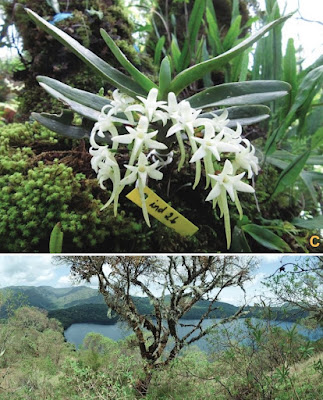
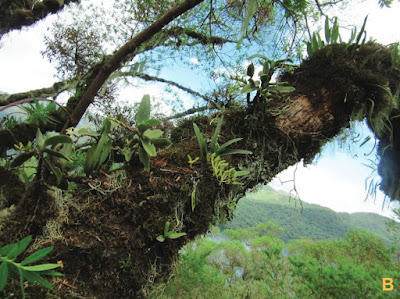
 in its natural habitat, the shrubby savannah around the volcanic lake Oku.
A. Panoramic view of C. okuensis habitat in the survey area.
 B. Individuals of C. okuensis growing on a 2 meter-long branch of Gnidia glauca.
 C. A flowering plant of C. okuensis growing with mosses Leptodontium viticulosoides, and the ferns Lepisorus excavatus and Asplenium theciferum.
 Photographs by Vincent Droissart (A) and Laura Azandi (B, C).

Cyrtorchis okuensis in its natural habitat, the shrubby savannah around the volcanic lake Oku.
A. Panoramic view of C. okuensis habitat in the survey area. 


Cyrtorchis okuensis in its natural habitat, the shrubby savannah around the volcanic lake Oku.
C. A flowering plant of C. okuensis growing with mosses Leptodontium viticulosoides, and the ferns Lepisorus excavatus and Asplenium theciferum.
 Photograph by  Laura Azandi 

Cyrtorchis okuensis Droissart, Azandi & M.Simo, sp. nov.
Cyrtorchis aff. guillaumetii “Oku” (Azandi et al. 2021). 

Diagnosis – Cyrtorchis okuensisis similar to Csubmontana but differs in having wider floral bracts (7–12.5 × 8–13.7 mm vs 4–6.5 × 5–7 mm), longer anther caps (2.5–3 vs 1–2 mm), and wider triangular dorsal sepal (4–5 mm vs 2–3 mm). These species also differ by their habitat; C. submontana is found in submontane and evergreen moist forest (between 550 and 1,200 m), whereas C. okuensis is restricted to the upper montane vegetation (between 1,600 and 2,500 m) along the  Cameroon Volcanic Line.

Distribution – Endemic to the Cameroon Volcanic Line: Nigeria, Cameroon, and Bioko (Equatorial Guinea) (fig. 3).

Habitat and ecology – Restricted to montane vegetation (moist forest, forest-grassland edge, and wooded savannah from 1,600 to 2,500 m), Cyrtorchis okuensis grows on mossy branches of Gnidia glauca (Fresen.) Gilg (Thymelaeaceae), Albizia gummifera (J.F.Gmel.) C.A.Sm. (Fabaceae), and Prunus africana (Hook.f.) Kalkman (Rosaceae). On these phorophytes, C. okuensis is usually found growing with mosses, lichens, ferns, and other orchid species (see details below in “Ecology and reproductive biology”). 

Etymology – The epithet okuensis refers to Oku, a subdivision in the North-West Region of Cameroon where the large, surveyed subpopulation was discovered around Lake Oku. The term Oku also refers to the people who live in this area and their native language.


Laura N. Azandi, Tariq Stévart, Bonaventure Sonké, Murielle Simo-Droissart, Tania D’haijère and Vincent Droissart. 2021. Taxonomic Description and Pollination Ecology of Cyrtorchis okuensis (Orchidaceae, Angraecinae), A New Species Endemic to the Cameroon Volcanic Line. Plant Ecology and Evolution. 154(3); 483-496. DOI: 10.5091/plecevo.2021.1823


Friday, July 8, 2022

[Botany • 2022] Impatiens smetsiana (Balsaminaceae) • Another Example of Convergent Evolution of Flower Morphology in Impatiens


Impatiens smetsiana S.B.Janssens, Taedoumg & Dessein, 

in Janssens, Taedoumg & Dessein, 2022.

Abstract
Background and aims – The genus Impatiens is known for its enormous convergent phenotypic adaptation, with similar floral traits having independently evolved in distantly related lineages. The large functional convergence of Impatiens flowers causes a high degree of homoplasy for several phenotypic characters resulting in increased difficulties to distinguish between species with a similar morphology that are only distantly related, however. As a result, some species remain under the radar, as they are confused with other well-known species. This was the case for a new Impatiens species from the Tchabal Mbabo Mountains in Cameroon – Impatiens smetsiana – that was initially mistaken for the morphologically similar species I. erecticornis, an endemic from Central East Africa.

Material and methods – A combined molecular-morphological approach was applied in which phylogenetics (ITS, ImpDEF1, and ImpDEF2), biogeography, and age estimation analyses were combined with morphological data on floral and vegetative structures.

Key results – In this study, we demonstrate the close affinity of the newly collected material with a group of Equatorial West African species, including I. filicornu, I. nzabiana, I. oumina, and I. kamerunensis. The present finding represents a clear case of convergent evolution in which two distantly related taxa independently converged on practically the same flower morphology.

Conclusion – Within Impatiens, several examples of floral homoplasy have been observed yet not in such a clear way. The convergent evolution of the flowers of I. smetsiana and I. erecticornis is undoubtedly closely correlated with an adaptation to a similar pollination syndrome.

Keywords: Adamawa, biogeography, Cameroon, convergent evolution, diversification, Impatiens, speciation

  Impatiens smetsiana S.B.Janssens, Taedoumg & Dessein, 
A. Habit. B. Frontal view of flower. C. Lateral view of flower. D. United lateral petals. E. Dorsal petal. F. Lateral sepals. G. Lower sepal and spur.
Drawn by Antonio Fernandez 
from Dessein & Taedoumg 2971 (BR [BR0000034048368]).

A. Frontal view of Impatiens smetsiana flower. B. Lateral view of I. smetsianaflower.
C. Frontal view of I. kamerunensis subsp. kamerunensis flower. D. Frontal view of I. erecticornis flower.
A–B: Dessein & Taedoumg 2971 (BR [BR0000034048368]); C: Dessein et al. 2673 (BR [BR0000005605668]); D: Fischer s.n. (BONN). 
Photos by: A–C: Steven Dessein, D: Eberhard Fischer.

Impatiens smetsiana S.B.Janssens, Taedoumg & Dessein, sp. nov.
 
Diagnosis: Impatiens smetsiana belongs to the Equatorial West African Impatiens lineage. It differs from I. kamerunensis, I. filicornu, and I. nzabiana in having an elliptic leaf shape, no leaf fimbriae, an oblong-shallowly cucullate dorsal petal shape, and an asymmetric obovate lower lateral petal shape.

Etymology: The species epithet smetsiana refers to the Belgian botanist, Erik F. Smets.


Steven B. Janssens, Hermann Taedoumg and Steven Dessein. 2022. Impatiens smetsiana, Another Example of Convergent Evolution of Flower Morphology in ImpatiensPlant Ecology and Evolution. 155(2): 248-260. DOI: 10.5091/plecevo.89701

Sunday, January 9, 2022

[Botany • 2022] Uvariopsis dicaprio (Annonaceae) • A New Tree Species with Notes on Its Pollination Biology, and the Critically Endangered narrowly endemic Plant Species of the Ebo Forest, Cameroon


Uvariopsis dicaprio Cheek & Gosline,
 
in Gosline, Cheek​​, Onana, ... et Dagallier, 2022.

Abstract 
Background: 
The Ebo Forest area is a highly threatened centre of diversity in the Littoral Region of Cameroon, globally important for conservation with many threatened species including 68 threatened species of plant, yet not formally protected. The tropical African evergreen forest tree genus Uvariopsis Engl. & Diels (Annonaceae) is characterised by unisexual, usually cauliflorous flowers with a uniseriate corolla of four petals, and two sepals. Cameroon is the centre of diversity of the genus with 14 of the 19 known species.

Methods: 
The herbarium collection MacKinnon 51 from Ebo is hypothesized to represent a new species to science of Uvariopsis. This hypothesis is tested by the study of herbarium specimens from a number of herbaria known to hold important collections from Cameroon and surrounding countries.

Results: 
We test the hypothesis that MacKinnon 51 represents a new species to science, using the most recent dichotomous identification key, and comparing it morphologically with reference material of all known species of the genus. We make a detailed comparative morphological study focussing on three other Cameroonian species, Uvariopsis solheidii, U. korupensis and the sympatric U. submontana. In the context of a review of the pollination biology of Uvariopsis, we speculate that in a genus otherwise with species with dull, flesh-coloured (pink, red to brown) flowers pollinated (where known) by diptera, orthoptera and blattodea (flies, crickets and cockroaches), the glossy, pale yellow-green flowers of Uvariopsis dicaprio, with additional traits unique in the genus, may be pollinated by nocturnal moths. Based on MacKinnon 51, we formally name Uvariopsis dicaprio Cheek & Gosline (Annonaceae) as new to science, and we describe, and illustrate, and map it. Restricted so far to a single site in evergreen forest in the Ebo Forest, Littoral Region, Cameroon, Uvariopsis dicaprio is provisionally assessed as Critically Endangered using the IUCN, 2012 standard because the forest habitat of this species remains unprotected, and there exist imminent threats of logging and conversion to plantations.

Discussion: 
We show that the highest density of species of the genus (12), and of narrow endemics (5), is found in the Cross-Sanaga Interval of SE Nigeria and Western Cameroon. A revised key to the 14 Cameroonian species of Uvariopsis is presented. We review the other seven narrowly endemic and threatened species unique to the Ebo forest of Cameroon and discuss the phytogeographic affinities of the area.

Conclusions: 
Uvariopsis dicaprio adds to the growing list of species threatened with extinction at Ebo Forest due to current anthropogenic pressures.


Uvariopsis dicaprio Cheek & Gosline. 
(A) habit, cauliflorous inflorescences on trunk; (B) leafy branch, one season’s growth; (C) inflorescence, showing pedicel articulations, bracts and bracteoles; (D) flower, with one petal removed to show the staminal dome; (E) detail of sparse hairs on abaxial petal surface; (F) stamen, different views; (G) junction of base of leaf with stem, showing dome-like axillary bud.
 All drawn from MacKinnon 51 (K) by Meg Griffiths. 

Uvariopsis dicaprio Cheek & Gosline.
Cauliflorous inflorescences on trunk.
Photo Lorna MacKinnon.

Uvariopsis dicaprio Cheek & Gosline sp. nov.

Syn. Uvariopsis ebo nom. nud. (Gosline et al., 2021: 5).

Diagnosis. Similar to Uvariopsis solheidii (De Wild.) Robyns & Ghesq., differing in the stem, petioles and abaxial midrib glabrous (versus tomentose); number of secondary nerves on each side of the midrib 5–8 (versus 8–13); petals yellow-green, (14–) 16 × (5.5–) 9 mm (versus wine brown, 7–10 × 2.5–5 mm).

HABITAT. Uvariopsis dicaprio is so far only known from lower submontane forest (850 m elev.). below the elevation for the upper montane forest indicator species Podocarpus latifolius (Thunb.) R.Br. ex Mirb. The geology is ancient, highly weathered basement complex, with some ferralitic areas in foothill areas which are inland, c. 100 km from the coast. Altitude varies from c. 200 m to 1,200 m elevation. The wet season (successive months with cumulative rainfall >100 mm) falls between March and November and is colder than the dry season. Average annual rainfall at Bekob measured 2010–2016 is 2,336 mm (E. Abwe, 2018 Ebo Forest Research Programme, Cameroon, personal communication, Abwe & Morgan, 2008; Cheek et al., 2018a).

ETYMOLOGY. This threatened and spectacular tree is named for the American actor and conservationist Leonardo DiCaprio, who, through several months in 2020, lobbied extensively on social media (e.g. instagram.com/p/B_0LSAhFRue; twitter.com/LeoDiCaprio/status/1257729388314943490 both accessed 12 April 2021) to draw attention to threats for the numerous rare Ebo species from the logging concession that had been announced at Ebo earlier that year. The concession was cancelled in August 2020, surely partly due to his efforts.


Conclusions: 
Such discoveries as this new species underline the urgency for making further such discoveries while it is still possible since in all but one of the cases given above, the species have very narrow geographic ranges and/or very few individuals, and face threats to their natural habitat, putting these species at high risk of extinction.

About 2,000 new species of vascular plant have been discovered each year for the last decade or more. Until species are known to science, they cannot be assessed for their conservation status and the possibility of protecting them is reduced (Cheek et al., 2020). Documented extinctions of plant species are increasing, e.g. Oxygyne triandra Schltr. and Afrothismia pachyantha Schltr. of South West Region, Cameroon are now known to be globally extinct (Cheek & Williams, 1999; Cheek et al., 2018c; Cheek, Etuge & Williams, 2019). In some cases, species appear to be extinct even before they are known to science, such as Vepris bali Cheek, also from the Cross-Sanaga interval in Cameroon (Cheek, Gosline & Onana, 2018) and elsewhere, Nepenthes maximoides Cheek (King & Cheek, 2020). Most of the 815 Cameroonian species in the Red Data Book for the plants of Cameroon are threatened with extinction due to habitat clearance or degradation, especially of forest for small-holder and plantation agriculture following logging (Onana & Cheek, 2011). Efforts are now being made to delimit the highest priority areas in Cameroon for plant conservation as Tropical Important Plant Areas (TIPAs) using the revised IPA criteria set out in Darbyshire et al. (2017). This is intended to help avoid the global extinction of additional endemic species such as Uvariopsis dicaprio which will be included in the proposed Ebo Forest IPA.

With only one locality known, Uvariopsis dicaprio represents another narrowly endemic Cameroonian species threatened with extinction due to deforestation for oil palm plantations, small-scale agriculture, mining and logging, widespread threats posing extinction risks to plant species in Cameroon (Onana & Cheek, 2011; Cheek et al., 2018a).


George Gosline, Martin Cheek​​, Jean Michel Onana, Eric Ngansop Tchatchouang, Xander M. van der Burgt, Lorna MacKinnon and Léo-Paul M. J. Dagallier. 2022. Uvariopsis dicaprio (Annonaceae) A New Tree Species with Notes on Its Pollination Biology, and the Critically Endangered narrowly endemic Plant Species of the Ebo Forest, Cameroon. PeerJ. 9:e12614. DOI: 10.7717/peerj.12614