Showing posts with label camouflage. Show all posts

Thursday, May 16, 2024

[Entomology • 2021] Arria muscoamicta • First Record of the Genus Arria (Mantodea: Haaniidae: Arriini) from Thailand, with the Description of A New Species of Moss-dwelling Praying Mantis


 Arria muscoamicta Unnahachote & Shcherbakov, 

in Unnahachote, Shcherbakov et Pinkaew, 2021. 
photos by W. Pathomwattananuruk & W. Khaikaew. 

Abstract
Arria muscoamicta Unnahachote & Shcherbakov, sp. nov. is described based on a male from central Thailand. This is the first record of Arria Stål, 1877 from the country. The new species is closely allied to A. leigongshanensis (Ge & Shen, 2008) from China, differing by the absence of prozonal tubercles, the elongated pronotum, nine tibial anteroventral spines, and the truncated hindwings. The new species is a moss-camouflaging mantis living at high altitude. The taxonomic problems of the genus are briefly discussed.

Keywords: Camouflage, predatory insect, Southeast Asia, taxonomy

 Arria muscoamicta sp. nov. in life aspect
 A adult male (the holotype), dorsal view B adult male (the holotype), lateral view C male nymph.
A, B W. Pathomwattananuruk, published with permission C W. Khaikaew, published with permission.

Systematic accounts
Order Mantodea Burmeister, 1838
Family Haaniidae Giglio-Tos, 1915
Subfamily Haaniinae Giglio-Tos, 1915

Tribe Arriini Giglio-Tos, 1919

Genus Arria Stål, 1877

Arria muscoamicta Unnahachote & Shcherbakov, sp. nov.

 
Differential diagnosis: 
A. muscoamicta sp. nov. is similar to the type species of Arria, A. cinctipes, in foreleg armament and shape of the prothorax and wings; it fits the current concept of the genus Arria (but see Discussion).
Arria muscoamicta sp. nov. can be distinguished from the most similar species, A. leigongshanensis, by the following characters: 1) pronotum distinctly longer; MzL/PzL = 1.97 [vs MzL/PzL = 1.24], 2) prozone without distinct pair of conical spines posteriorly [vs with distinct pair of conical spines posteriorly, anteriad of supracoxal sulcus], 3) foretibia have nine anteroventral spines [vs 11–13 anteroventral spines], 4) apical lobe of hindwing almost truncated [vs more or less parabolic].
Arria muscoamicta sp. nov. can also be easily distinguished from A. cinctipes by the following characters: 1) six tibial posteroventral spines [vs seven tibial posteroventral spines], 2) lack of a pair of small conical tubercles in prozone posteriorly [presence of a pair of small conical tubercles in prozone posteriorly]; from A. meghalayensis by six tibial posteroventral spines [vs seven tibial posteroventral spines]; from A. oreophilus by following characters: 1) present of conical tubercles on dorsal surface of pronotum [vs lack of conical tubercles, relatively smooth in male], 2) forewing not narrows distally [vs forewing narrows distally]; from A. sticta and A. pallida by the apex of hindwing more or less truncate [vs pointed apex].

Etymology: The name of the species means “clothed by moss” in Latin and refers to the moss-like colouration and morphology of the adults and especially the nymphs.


 Thornthan Unnahachote, Evgeny Shcherbakov and Nantasak Pinkaew. 2021. First Record of the Genus Arria (Mantodea, Haaniidae, Arriini) from Thailand, with the Description of A New Species of Moss-dwelling Praying Mantis. ZooKeys. 1028: 49-60. DOI: 10.3897/zookeys.1028.62347

Thursday, March 17, 2022

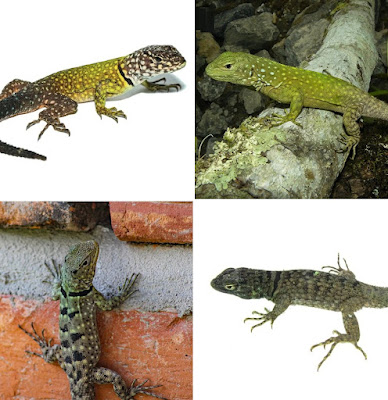
[Herpetology • 2022] Stenocercus asenlignus, S. qalaywasi, etc. • Four New Species of Polychromatic Spiny-tailed Iguanian Lizards, Genus Stenocercus (Iguania: Tropiduridae), from Peru


Venegas, García-Ayachi, Chávez-Arribasplata & García-Bravo, 2022


Abstract
The tropical Andes Mountains exhibit high levels of endemism and spatial turnover in the distribution of species. The lizard genus Stenocercus Duméril & Bibron, 1837, contains 76 species and most of them occur in the tropical Andes, reaching elevations up to 4,000 m. We describe four new species of Stenocercus based on the examination of newly collected material from the Amazonian slopes of the Peruvian Andes. Stenocercus asenlignus sp. nov. inhabits the premontane forest of northern and central Peru, departments of Amazonas, San Martín and Huánuco, at elevations between 1,500 and 2,036 m, in the basins of the Mayo, Huayabamba, and Huallaga rivers. Stenocercus leybachi sp. nov. inhabits the premontane forest of the upper Huallaga River, Huánuco department in central Peru, at elevations between 824 and 1,270 m. Stenocercus qalaywasi sp. nov. was collected in a small village at the headwaters of the Mantaro River, Junín department in central Peru, at an elevation of 2,587 m. Finally, S. nigrocaudatus sp. nov. inhabits the montane forest from extreme northern Peru, Cajamarca department, at elevations of 1,700 and 1,892 m. These species are characterized by having granular scales on the posterior surface of the thighs, relatively short tail, caudals spinose, two caudal whorls per autotomic segment, and the ability to change coloration from green to brown or gray; they differ from other species of Stenocercus in scutellation features and color pattern.

Keywords: Reptilia, Andes, arboreal, camouflage, caudal whorl, ecoregion, Peruvian Yungas, thermoregulation 


Pablo J. Venegas, Luis A. García-Ayachi, Juan C. Chávez-Arribasplata, and Antonio García-Bravo. 2022. Four New Species of Polychromatic Spiny-tailed Iguanian lizards, genus Stenocercus (Iguania: Tropiduridae), from Peru. Zootaxa. 5115(1); 1-28. DOI: 10.11646/zootaxa.5115.1.1

Tuesday, June 16, 2020

[Mollusca • 2020] Phestilla viei • A New Species of Coral-feeding Nudibranch (Gastropoda) from the Gulf of Thailand


Phestilla viei Mehrotra, Caballer & Chavanich  

in Mehrotra, Arnold, Wang, Chavanich, Hoeksema & Caballer, 2020. 

Abstract
The validity and position of the Indo Pacific genus Phestilla Bergh, 1874 (Fionoidea: Trinchesiidae) have been subject of some controversy as a result of several recent studies, which have sequentially synonymized or re-established it. At present, the genus includes eight valid species, the most of them described in the nineteenth and twentieth centuries, and all but one feeding on scleractinian corals of four genera: Porites Link, 1807 (Poritidae), Tubastraea Lesson, 1830, Dendrophyllia Blainville, 1830 (Dendrophylliidae) and Montipora Blainville, 1830 (Acroporidae). The discovery of an unknown Phestilla species feeding on Pavona explanulata (Lamarck, 1816) (Agariciidae) in Koh Tao, Thailand, motivates this work, in which this new species is described providing morphoanatomical and molecular characters. In addition, its systematic position and ecological significance as coral parasite are discussed.

Keywords: Fionoidea, Trinchesiidae, Ecto-parasite, Phestilla Bergh, 1874, Pavona explanulata (Lamarck, 1816), Camouflage


Fig. 1 Phestilla viei Mehrotra, Caballer & Chavanich sp. nov. on Pavona explanulata.
 a Living specimen (28 mm long) in dorso-lateral view with low symbiont density; b Specimen (23 mm long) camouflaged among the coral; c Living specimen (17 mm long) in lateral view; d Two specimens with low symbiont density with their egg masses. Durusdinium sp. associated to Phestilla viei sp. nov; e General view of a section of a single ceras; f Durusdinium sp. in the ceras matrix; g Details of the symbiont cells


Systematics
Order Nudibranchia Cuvier, 1814 (in Blainville 1814).
Superfamily Fionoidea Gray, 1857.

Family Trinchesiidae Nordsieck, 1972.

Genus Phestilla Bergh, 1874.

Phestilla viei Mehrotra, Caballer & Chavanich sp. nov.

Phestilla sp.: Fritts-Penniman 2016: 116, Fig. 3.1 E.
Phestilla sp. 2: Gosliner et al. 2008: 372; Gosliner et al. 2015: 357.
Tenellia sp. 83: Gosliner et al. 2018: 300.
?Tenellia D4: Fritts-Penniman et al. 2020: Fig. 1G.

Derivatio nominis: Phestilla viei Mehrotra, Caballer & Chavanich sp. nov. is named in honor of Mr. Vie Panyarachun for his years of facilitating citizen science and contributions in curating records of sea slug diversity in Thai waters, and his continued efforts as a marine naturalist.


Rahul Mehrotra, Spencer Arnold, Adam Wang, Suchana Chavanich, Bert W. Hoeksema and& Manuel Caballer. 2020. A New Species of Coral-feeding Nudibranch (Mollusca: Gastropoda) from the Gulf of Thailand. Marine Biodiversity. 50: 36. DOI: 10.1007/s12526-020-01050-2

A New Species of Coral-Eating Nudibranch

Friday, September 16, 2016

[Paleontology • 2016] 3D Camouflage in an Ornithischian Dinosaur, Psittacosaurus Countershading


Countershading matches diffuse light in Psittacosaurus.

Photograph: Jakob Vinther   cell.com

SUMMARY
Countershading was one of the first proposed mechanisms of camouflage. A dark dorsum and light ventrum counteract the gradient created by illumination from above, obliterating cues to 3D shape. Because the optimal countershading varies strongly with light environment, pigmentation patterns give clues to an animal’s habitat. Indeed, comparative evidence from ungulates shows that interspecific variation in countershading matches predictions: in open habitats, where direct overhead sunshine dominates, a sharp dark-light color transition high up the body is evident; in closed habitats (e.g., under forest canopy), diffuse illumination dominates and a smoother dorsoventral gradation is found. We can apply this approach to extinct animals in which the preservation of fossil melanin allows reconstruction of coloration. Here we present a study of an exceptionally well-preserved specimen of Psittacosaurus sp. from the Chinese Jehol biota. This Psittacosaurus was countershaded with a light underbelly and tail, whereas the chest was more pigmented. Other patterns resemble disruptive camouflage, whereas the chin and jugal bosses on the face appear dark. We projected the color patterns onto an anatomically accurate life-size model in order to assess their function experimentally. The patterns are compared to the predicted optimal countershading from the measured radiance patterns generated on an identical uniform gray model in direct versus diffuse illumination. These studies suggest that Psittacosaurus sp. inhabited a closed habitat such as a forest with a relatively dense canopy.


Jakob Vinther, Robert Nicholls, Stephan Lautenschlager, Michael Pittman, Thomas G. Kaye, Emily Rayfield, Gerald Mayr and Innes C. Cuthill. 2016.  3D Camouflage in an Ornithischian Dinosaur. Current Biology. 26, 1–7. 

Scientists reveal most accurate depiction of a dinosaur ever created | Elsa Panciroli https://www.theguardian.com/science/2016/sep/14/scientists-reveal-most-accurate-depiction-of-a-dinosaur-ever-created
This Dinosaur Wore Camouflage http://on.natgeo.com/2cKd89s  via @NatGeo