Showing posts with label Embryology. Show all posts

Sunday, August 22, 2021

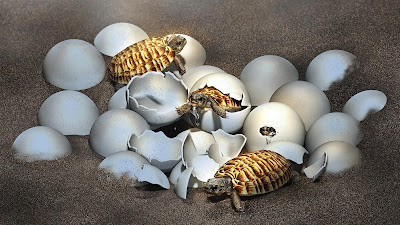
[Herpetology • 2021] A Large and Unusually Thick-shelled Turtle Egg (Cryptodira: Nanhsiungchelyidae) with Embryonic Remains from the Upper Cretaceous of China


in Ke, Wu, Zelenitsky, ... et Han, 2021
Illustration: Masato Hattori.
 
Abstract
Turtle eggs containing embryos are exceedingly rare in the fossil record. Here, we provide the first description and taxonomic identification, to our knowledge, of a fossilized embryonic turtle preserved in an egg, a fossil recovered from the Upper Cretaceous Xiaguan Formation of Henan Province, China. The specimen is attributed to the Nanhsiungchelyidae (Pan-Trionychia), an extinct group of large terrestrial turtles (possibly the species Yuchelys nanyangensis). The egg is rigid, spherical, and is one of the largest and thickest shelled Mesozoic turtle eggs known. Importantly, this specimen allowed identification of other nanhsiungchelyid egg clutches and comparison to those of Adocidae, as Nanhsiungchelyidae and Adocidae form the basal extinct clade Adocusia of the Pan-Trionychia (includes living soft-shelled turtles). Despite the differences in habitat adaptations, nanhsiungchelyids (terrestrial) and adocids (aquatic) shared several reproductive traits, including relatively thick eggshells, medium size clutches and relatively large eggs, which may be primitive for trionychoids (including Adocusia and Carrettochelyidae). The unusually thick calcareous eggshell of nanhsiungchelyids compared to those of all other turtles (including adocids) may be related to a nesting style adaptation to an extremely harsh environment.

Keywords: Nanhsiungchelyidae, China, thick egg, shell, Upper Cretaceous, embryo, turtle egg

Systematic palaeontology: 
Order Testudines Linnaeus, 1758
Infraorder Cryptodira Cope, 1868

Superfamily Trionychoidae Fitzinger, 1826
Family Nanhsiungchelyidae Yeh, 1966

Genus and species indet.


A Nanhsiungchelyid turtle egg containing an embryo. 


Material. CUGW EH051, a complete egg containing embryonic remains.

Locality and horizon. Specimen CUGW EH051 was collected in Neixiang County, Nanyang City, Henan Province, China (electronic supplementary material, figure S1); Xiaguan Formation, Upper Cretaceous. ....


Illustration: Masato Hattori.


Yuzheng Ke, Rui Wu, Darla K. Zelenitsky, Don Brinkman, Jinfeng Hu, Shukang Zhang, Haishui Jiang and Fenglu Han. 2021. A Large and Unusually Thick-shelled Turtle Egg with Embryonic Remains from the Upper Cretaceous of China. Proceedings of the Royal Society B. DOI: 10.1098/rspb.2021.1239


Friday, December 1, 2017

[Paleontology • 2017] Hamipterus tianshanensis • Egg Accumulation with 3D Embryos provides insight into the Life History of A Pterosaur


Hamipterus tianshanensis 

Wang, Kellner, Jiang, et al. 2017
reconstruction by Zhao Chuang.  DOI: 10.1126/science.aan2329

 Abstract
Fossil eggs and embryos that provide unique information about the reproduction and early growth of vertebrates are exceedingly rare, particularly for pterosaurs. Here we report on hundreds of three-dimensional (3D) eggs of the species Hamipterus tianshanensis from a Lower Cretaceous site in China, 16 of which contain embryonic remains. Computed tomography scanning, osteohistology, and micropreparation reveal that some bones lack extensive ossification in potentially late-term embryos, suggesting that hatchlings might have been flightless and less precocious than previously assumed. The geological context, including at least four levels with embryos and eggs, indicates that this deposit was formed by a rare combination of events, with storms acting on a nesting ground. This discovery supports colonial nesting behavior and potential nesting site fidelity in the Pterosauria.


The reconstruction image made by Zhao Chuang shows the species Hamipterus tianshanensis according to the discoveries in a desert in Hami, northwest China's Xinjiang Uygur Autonomous Region. Over 200 three-dimensionally preserved eggs of pterosaurs have been unearthed in China, providing new insight into the life history of the rulers of the skies in the age of dinosaurs.  

Xiaolin Wang, Alexander W. A. Kellner, Shunxing Jiang, Xin Cheng, Qiang Wang, Yingxia Ma, Yahefujiang Paidoula, Taissa Rodrigues, He Chen, Juliana M. Sayão, Ning Li, Jialiang Zhang, Renan A. M. Bantim, Xi Meng, Xinjun Zhang, Rui Qiu and Zhonghe Zhou. 2017. Egg Accumulation with 3D Embryos provides insight into the Life History of A Pterosaur. Science. 358(6367); 1197-1201.  DOI: 10.1126/science.aan2329

Even more like birds
Ecological convergence between pterosaurs and birds is often invoked, but to what degree the two groups share behavior is debated. Wang et al. describe a site with more than 100 fossilized pterosaur eggs that reveals that hatchling pterosaurs were likely not as precocial as previously thought. Furthermore, the overlaying of multiple clutches suggests that the pterosaurs may have exhibited breeding site fidelity, similar to rookery-breeding seabirds. Thus, the similarity between these two groups goes beyond wings.

Over 200 fossilized eggs found in China reveal how pterosaurs breed

Hundreds of pterosaur eggs reveal early life insights phy.so/431279920 via @physorg_com
Hundreds of Pterosaur Eggs Found in Record-Breaking Fossil Haul  on.natgeo.com/2itv92e via @NatGeo
Ancient flying reptiles cared for their young, fossil trove suggests  .sciencemag.org/news/2017/11/ancient-flying-reptiles-cared-their-young-fossil-trove-suggests