Showing posts with label Subgenus. Show all posts

Saturday, March 7, 2026

[Entomology • 2026] Staphylus neideae, S. ricardoi, ... • Integrative Taxonomic Revision of Capilla Grishin, 2023, Subgenus of Staphylus Godman & Salvin, 1896 (Lepidoptera: Hesperiidae: Pyrginae), with Descriptions of Four New Species


[M–P] Staphylus (C.) nicoleae Lemes, sp. nov.; [Q, R] S. (C.) neivae sp. nov.
[S, T] S. (C.) ricardoi Lemes, sp. nov.; [U–X] S. (C.) neideae Lemes, sp. nov.

in Lemes, Siewert, Mielke, Casagrande et Warren, 2026. 

Abstract
The taxonomy of the subgenus Staphylus (Capilla) is reviewed, including redescriptions of known species, identification keys, and detailed distribution maps. The female genitalia of Staphylus (Capillaazteca (Scudder, 1872), S. (C.) caribbea (Williams & Bell, 1940), S. (C.) corumba (Williams & Bell, 1940), S. (C.) eryx Evans, 1953, S. (C.) tucumanus (Plötz, 1884) and S. (C.) tyro (Mabille, 1878) are described and illustrated for the first time. Four new species are described: Staphylus (Capillanicoleae Lemes sp. nov. from Colombia and Venezuela, S. (C.) ricardoi Lemes, sp. nov. from Peru, S. (C.) neideae Lemes sp. nov. and S. (C.) neivae sp. nov. from Brazil. Pholisora imperspicua Hayward, 1940 is a syn. nov. of Staphylus (C.) lizeri lizeri (Hayward, 1938) and Hesperia melangon epicaste Mabille, 1903 is a syn. nov. of Staphylus (C.) melangon melangon (Mabille, 1883). Neotypes are designated for Staphylus epicaste Mabille, 1903, Nisoniades tucumanus Plötz, 1884 and Staphylus fascia Hayward, 1933. Lectotypes are designated for Pholisora azteca Scudder, 1872, Bolla machuca Schaus, 1913, Helias tyro Mabille, 1878, Staphylus anginus Schaus, 1902, Hesperia melangon 1883, Hesperia musculus Burmeister, 1875 and Helias aurocapilla Staudinger, 1876.

Keywords: Butterflies, Cytochrome oxidase subunit 1, Neotropical, Skippers

Species of Staphylus (Capilla) in dorsal and ventral views.  
A–D S. (C.) ascalon: A, B male (Brazil, São Paulo, Teodoro Sampaio, Morro do Diabo, OM 17.996); C, D female (Brazil, Minas Gerais, Passa Quatro, DZ 46.813).
E, F S. (C.) buena: male (Bolivia, Santa Cruz, Buenavista, holotype, CMNH 7188).
G–J S. (C.) caribbea: G, H male (Costa Rica, Limón Province, La Bomba, MGCL 1112082); I, J female (Costa Rica, Limón Province, Germania, MGCL 1112078).
K–N S. (C.) eryx: K, L male (Brazil, Pará, Santarém, DZ 46.566); M, N female (Brazil, Pará, Santarém, MGCL 1112109).
O–R S. (C.) corumba: O, P male (Brazil, Pará, Santo Antônio do Tauá, Reserva Sonho Azul, DZ 45.033); Q, R female (Brazil, Pará, Santo Antônio do Tauá, Reserva Sonho Azul, DZ 45.005).
S, T S. (C.) lizeri album: male (Brazil, Minas Gerais, Carmo do Rio Claro, OM 2.788). U–X S. (C.) lizeri lizeri: U, V male (Peru, Madre de Dios, Tambopata Reserve, DZ 46.176); W, X female (Colombia, Meta, Villavencio, Bosque Bavaria, DZ 45.526).
 Scale bar = 1 cm.

Species of Staphylus (Capilla) in dorsal and ventral views.
A–D S. (C.) tucumanus: A, B male (Argentina, Salta, Pichanal, DZ 45.125); C, D female (Paraguay, Presidente Hayes, Estancia Victoria, Rio Norte Lindo, OM 37.963).
E–H S. (C.) azteca: E, F male (El Salvador, La Libertad, Santa Tecla, MGCL 1112133); G, H female (Mexico, Chiapas, San Jerónimo, DZ 45.085).
I–L S. (C.) tyro: I, J male (Venezuela, Aragua, Ocumare de la Costa, DZ 22.893); K, L female (Venezuela, Aragua, Ocumare de la Costa, DZ 46.608).

M–P Staphylus (C.) nicoleae sp. nov.: M, N male (Colombia, Cundinamarca, El Boqueron, holotype, DZ 45.163); O, P female (Colombia, no specific locality, paratype, NHMUK015052554);
Q, R S. (C.) neivae sp. nov.: male (Brazil, Paraíba, São José da Mata, Campina Grande, holotype, DZ 44.944).
S, T S. (C.) ricardoi sp. nov.: male (Peru, Tingo Maria, holotype, OM 41.643).
U–X S. (C.) neideae sp. nov.: U, V male (Brazil, Minas Gerais, Brumadinho, holotype, OM 55.562); W, X female (Brazil, Minas Gerais, Brumadinho, paratype, OM 55.476).
Scale bar = 1 cm.

M–P Staphylus (C.) nicoleae sp. nov.: M, N male (Colombia, Cundinamarca, El Boqueron, holotype, DZ 45.163); O, P female (Colombia, no specific locality, paratype, NHMUK015052554);
Q, R S. (C.) neivae sp. nov.: male (Brazil, Paraíba, São José da Mata, Campina Grande, holotype, DZ 44.944). 
S, T S. (C.) ricardoi sp. nov.: male (Peru, Tingo Maria, holotype, OM 41.643).
U–X S. (C.) neideae sp. nov.: U, V male (Brazil, Minas Gerais, Brumadinho, holotype, OM 55.562); W, X female (Brazil, Minas Gerais, Brumadinho, paratype, OM 55.476).
Scale bar = 1 cm.


Staphylus (Capillanicoleae Lemes sp. nov. from Colombia and Venezuela, 
S. (C.) ricardoi Lemes, sp. nov. from Peru, 
S. (C.) neideae Lemes sp. nov. and S. (C.) neivae sp. nov. from Brazil.  


 José Ricardo Assmann Lemes, Ricardo Russo Siewert, Olaf Hermann Hendrik Mielke, Mirna Martins Casagrande and Andrew David Warren. 2026. Integrative Taxonomic Revision of Capilla Grishin, 2023, Subgenus of Staphylus Godman & Salvin, 1896 (Lepidoptera, Hesperiidae, Pyrginae, Carcharodini), with Descriptions of Four New Species. Arthropod Systematics & Phylogeny. 84: 123-173. DOI: doi.org/10.3897/asp.84.e179328 [24 Feb 2026]

Thursday, December 18, 2025

[Herpetology • 2025] Cryptomantis subgenus nov. & Pristimantis paganus • Vast Cryptic Diversity in Direct-developing Frogs Pristimantis (Anura: Strabomantidae): A New Subgenus and the Description of A New Species from the eastern Andes of Ecuador

 
Pristimantis paganus  
Loza-Carvajal, Yánez-Muñoz, Quilumbaquin & Ortega-Andrade, 2025
 
Amazonian pagan rainfrog| Cutín pagano Amazónico  ||  DOI: doi.org/10.7717/peerj.20512

Abstract 
Pristimantis, a genus of direct-developing frogs within the family Strabomantidae, comprises 617 recognized species, making it the most species-rich genus of vertebrates worldwide. This group include 264 described (43% of the world) species in Ecuador, being one of the countries in the region with the highest rate of species description, greatest diversity and endemism. In this study, we analyze the phylogenetic position and describe a new Pristimantis species from the Colonso Chalupas Biological Reserve and Llanganates National Park in northeastern Ecuador, using phylogenetic, genetic, morphological, and geographic evidence. Additionally, we propose a new subgenus within Pristimantis that includes the Pristimantis prolatus and Pristimantis bicantus species groups. Our results indicate that the new species and related species form a well-supported group with significant genetic divergence based on the 16S rRNA gene (average uncorrected p-distance = 2.8–7.5%), within the Pristimantis bicantus species group. Morphologically, the new species is characterized by a black to dark-gray dorsum and marbled venter (less intense or brown in males), being endemic to the Guacamayos mountain range and the Llanganates region in the northeastern Andean foothills of Ecuador. We emphasize the importance of including topotypic specimens to analyze and compare species groups to delimiting species, like Pristimantis.
 
Keywords: Integrative taxonomy, Cryptic diversity, Pristimantis paganus sp. nov., Pristimantis prolatus group, Pristimantis bicantus group, Cryptomantis gen. nov.


Pristimantis paganus sp. nov. 
Holotype in life DHMECN 16810, adult female, SVL = 27.2 mm.
(A) Dorsal view; (B) frontal view; (C) lateral view; (D) ventral view. Photographs by Mario H. Yánez Muñoz.

Pristimantis paganus sp. nov.
Suggested common English name: Amazonian pagan rainfrog
Common name in Spanish: Cutín pagano Amazónico.

Diagnosis. Pristimantis paganus sp. nov. (Figs. 2–7) is a member of the subgenus Cryptomantis and P. bicantus species group, characterized by the following combination of characters: (1) dorsal skin finely granular with dorso-laterally aligned flattened warts, areolate venter, discoidal fold present and visible posteriorly, dorsolateral folds weak and discontinuous in females, continuous in males; scapular W-shaped fold in males; (2) tympanic membrane and tympanic annulus present, round, horizontal diameter of tympanum equal to 38% of eye diameter, antero-dorsal margin with a supratympanic fold and large subconical postrictal tubercles; (3) snout short, subacuminate in dorsal view, rounded in profile with slightly flared lips; (4) upper eyelid with at least three to four large rounded tubercles surrounded by several small rounded tubercles, two subconical tubercles behind each eye; no cranial crest; (5) dentigerous processes of vomers, oblique in outline each process with 3–8 teeth; (6) vocal slits absent; no nuptial pad and no vocal sac; (7) Finger I shorter than Finger II; broad, expanded disks dilated with circummarginal grooves; (8) fingers with thin lateral cutaneous fringes; (9) subarticular tubercles, present, prominent; hyperdistal subarticular tubercle, present; ulnar tubercles absent; (10) heel with one subconical tubercle; outer edge with two flattened tubercles, tarsal fold absent; (11) inner metatarsal tubercle oval in females 3 times larger than rounded outer metatarsal tubercle; supernumerary tubercles absent; (12) toes with thin lateral fringes present, interdigital membrane absent, Toe V longer than Toe III; (13) The distinctive coloration of females, characterized by a uniformly black dorsum and black markings on a cream to pinkish-cream background on the flanks, belly, and throat, distinguishes this species from its congeners and other Pristimantis species inhabiting the eastern montane forests of Ecuador; (14) adult males, SVL = 17.20–21.5 mm (mean = 19.6, n = 13), females SVL= 24.8–29.8 mm (mean = 29.6 mm, n = 6), (Tables 2, 3, S3).

Etymology. The specific epithet is from the Latin word “paganus”, an adjective derived from “pagus”, which refers to the inhabitants of the forest or village, far from civilization and towns, referring to the remote and unexplored sites where this species inhabits, in the montane cloud forests at the Colonso Chalupas Biological Reserve and Llanganates National Park, northeastern flanks of the Andes in Ecuador.

Habitat and specimens of Pristimantis paganus sp. nov.
(A) Cloud forest with epiphytic plants, type locality, Colonso Chalupas Biological Reserve; (B) female, DHMECN 19962;
(C) paratype, male, DHMECN 15602; (D) paratype, adult female, DHMECN 17222.
Photographs: Jorge Brito (A), Keyko D. Loza-Carvajal (B), H. Mauricio Ortega-Andrade (C), Zane Libke (D).

Representative species of the subgenus Cryptomantis.
Subclade A-Pristimantis prolatus species group:
(A) Pristimantis ganonotus DHMECN 16961, Colonso Chalupas Reserve, Napo; (B) P. burtoniorum DHMECN 14479, Paratype, Mayordomo Reserve, Tungurahua; (C) P. prolatus DHMECN 11564, Topotype, Río El Reventador, Sucumbíos;
(D) P. c.sp. 1, DHMECN 15674, Colonso Chalupas Reserve, Napo.
Subclade B-Pristimantis bicantus species group: (E) P. c.sp. 2, QCAZ 70020, Llanganates National Park, Napo; (F) P. marcoreyesi, DHMECN 13833, Tungurahua volcano, Tungurahua; (G) P. paganus sp. nov. DHMECN 15606, Colonso Chalupas Reserve, Napo;
(H) P. tungurahua, DHMECN 14428, Vizcaya Reserve, Tungurahua; (I) P. sacharuna, QCAZ 52496, Zúñag Reserve, Tungurahua; (J) P. c.sp. 3, QCAZ 51553, San Antonio de Juval, Cañar;
(K) P. nelsongalloi, DHMECN 5223, Zúñag Reserve, Tungurahua; (L) P. bicantus, DHMECN 12359, El Reventador, Sucumbíos; (M) P. c.sp. 5, QCAZ 52489, Sangay National Park, Morona Santiago.
Photo credit: Gustavo Pazmiño, Bioweb (E); Santiago Ron, Bioweb (I), Bioweb (J, M); Keyko D. Loza, Carvajal (A); Mario H. Yánez Muñoz (B, C, F, H, K, L); H. Mauricio Ortega-Andrade (D, G).

Conclusions: 
We described a new species, Pristimantis paganus, from the Colonso Chalupas Biological Reserve and Llanganates National Park, northeastern Ecuador. Furthermore, we define a new subgenus, Cryptomantis, within Pristimantis that includes the Pristimantis prolatus and Pristimantis bicantus species groups. Our results indicate at least five Candidate species within Cryptomantis. We emphasize the importance of including topotypic specimens to analyze and compare specios groups to delimiting species, like Pristimantis.

 
Keyko D. Loza-Carvajal, Mario H. Yánez-Muñoz, Walter Quilumbaquin and H. Mauricio Ortega-Andrade​. 2025. Vast Cryptic Diversity in Direct-developing Frogs Pristimantis (Anura: Strabomantidae): A New Subgenus and the Description of A New Species from the eastern Andes of Ecuador. PeerJ. 13:e20512. DOI: doi.org/10.7717/peerj.20512 [December 17, 2025]
 

Tuesday, June 17, 2025

[Entomology • 2025] Ceraphron chularoipaad • Review of the Subgenus Larsoceraphron Dessart, 1981 of the Genus Ceraphron Jurine, 1807 (Hymenoptera: Ceraphronidae) with the Description of A New Species from Thailand


Ceraphron (Larsoceraphronchularoipaad   
Ghafouri Moghaddam, Salden & Butcher,

in Moghaddam, Salden, Latibari et Butcher, 2025. 

Abstract
The subgenus Larsoceraphron Dessart, 1981 of the genus Ceraphron Jurine, 1807 is reviewed, and a new species, Ceraphron (Larsoceraphron) chularoipaad sp. nov., from Thailand is described and illustrated. This represents the first species-level record of the genus Ceraphron in Thailand. Additionally, we provide the redescriptions and illustrations of three previously known species viz., C. (L.) huggertiC. (L.) sylviae, and C. (L.) tobiasi. We also include two identification keys for all known subgenera of Ceraphron and species of the subgenus Larsoceraphron.

Keywords: Identification key, Oriental, redescription, species discovery, Taxonomy 
 
Ceraphron (Larsoceraphronchularoipaad sp. nov., female holotype from Thailand (CUMZ)
A habitus and antenna, lateral view B fore and hind wing C head, dorsofrontal view D head, lateral view E head, dorsal view F mesosoma, dorsal view G posterior mesosoma and anterior syntergum, dorsal view H syntergum, dorsal view I head and mesosoma, lateral view J metasoma, lateral view K posterior metasoma, dorsal view.

 Ceraphron (Larsoceraphronchularoipaad 
Ghafouri Moghaddam, Salden & Butcher, sp. nov.

Etymology. The specific epithet chularoipaad is derived from “Chula”, referring to Chulalongkorn University, and “roi paad”, which means “one hundred and eight” in Thai, commemorating the 108th anniversary of Chulalongkorn University in 2025. The name is treated as a noun in apposition.


 Mostafa Ghafouri Moghaddam, Tobias Salden, Minoo Heidari Latibari and Buntika A. Butcher. 2025. Review of the Subgenus Larsoceraphron Dessart, 1981 of the Genus Ceraphron Jurine, 1807 (Hymenoptera, Ceraphronidae) with the Description of A New Species from Thailand. Journal of Hymenoptera Research. 98: 579-602. DOI: doi.org/10.3897/jhr.98.151607 

Wednesday, August 14, 2024

[Botany • 2024] A Synopsis of Carex subgenus Psyllophorae, sect. Junciformes (Cyperaceae) in South America


 Carex subgenus Psyllophorae, sect. Junciformes

in Morales-Alonso, Muñoz-Schüler, Pereira-Silva, Donadío, Martín-Bravo et Jiménez-Mejías, 2024. 
 
Abstract
This is the second study of a series of thorough studies into the taxonomy and systematics of Carex in South America. Here, we present the systematic placement, taxonomic account, formal typifications, and summarized distributions for the 31 accepted South America species of Carex subg. Psyllophorae, all belonging to sect. Junciformes. We have conducted an exhaustive revision of literature, more than 400 specimens from 32 South and North American and European herbaria have been studied, and a Sanger phylogenetic study with four DNA regions and morphometric analyses for the C. phalaroides group have been performed. We present an enlarged phylogenetic study where sect. Junciformes sampling has increased by 11 species regarding previous studies, only lacking four species of the group (C. herba-alpacae, C. moorei, C. nelmesiana, and C. transandina). South American species of sect. Junciformes are grouped into four major lineages: C. camptoglochin Clade, Aciculares Clade (South America and Australia–New Zealand), C. phalaroides group, and Junciformes Clade. We have resolved the C. phalaroides complex into six independent species with a clear geographic structure. We successfully unravelled the systematic placement of three species included here for the first time (C. boelckeiana, C. reicheana, and C. manuelbarrosii). An identification key is provided for the studied species. We propose 30 new typifications, and four new species are described (C. herba-alpacae, C. manuelbarrosii, C. melliza, and C. via-montana).

neotropics, phylogeny, taxonomy

 Representative images of living specimens of sect. Junciformes.
A, C. andina (Chile, Ñuble). B, C. aphylla (Chile, Biobío). C, C. argentina (Chile, Metropolitana de Santiago). D, C. herba-alpacae (Peru, Lima),
E, C. camptoglochin (Chile, Los Lagos). F, C. boelckeiana (Chile, Araucaní). G, C. caduca (Chile, Los Lagos). H, C. reicheana (Chile, Araucanía).
I, C. setifolia (Chile, Maule). J, C. pungens (Chile, Valparaíso). K, C. sorianoi (Chile, O’ Higgins). L, C. vallis-pulchrae subsp. barrosiana (Argentina, Tierra del Fuego).
M, C. chlorolepis (Chile, Biobío). N, C. phalaroides (Brazil, Paraná). O, C. paraguayensis (Brazil, Rio Grande do Sul). P, C. via-montana (Ecuador, Pichincha).
Pictures: P. Muñoz-Schüler(A, B, E, I, J, M), M. Maldonado (D), P. Jiménez-Mejías (F, G, O), S. Martín-Bravo (C, H), M. Luceño (K, L, N), and A. Morales-Alonso (P).

Representative inflorescence variation displayed by sect. Junciformes species. 
From A to J, Aciculares Clade; from L to Y, Junciformes Clade; and from Z to AE, C. phalaroides group. ...
Scale bar = 4 cm.


Ana Morales-Alonso, Paulo Muñoz-Schüler, Luciana Pereira-Silva, Sabina Donadío, Santiago Martín-Bravo and Pedro Jiménez-Mejías. 2024. A Synopsis of Carex subgenus Psyllophorae, sect. Junciformes (Cyperaceae) in South America. Botanical Journal of the Linnean Society. boae038. DOI: doi.org/10.1093/botlinnean/boae038

Sunday, January 28, 2024

[Entomology • 2024] Lasioglossum iridescens, L. dilisena & L. silveirai • A Problematic Species Complex of Lasioglossum Subgeneric Diagnostics in North America (Hymenoptera: Halictidae)


Lasioglossum (Sphecodogastra) dilisena
 Hettiarachchi & Gibbs, 2024

 
Abstract
A problematic species complex within Lasioglossum subgenus Sphecodogastra with unusual metallic reflections on the mesosoma is described from North America. Three new species in this complex are described and illustrated: Lasioglossum (Sphecodogastrairidescens sp. nov., Lasioglossum (Sphecodogastra) dilisena sp. nov., and Lasioglossum (Sphecodogastrasilveirai sp. nov. Our study addresses the challenge of diagnosing Lasioglossum subgenera within North America. We present an updated key for the North American Lasioglossum subgenera.

Key words: Apoidea, classification, cryptic species, new species, taxonomy


Lasioglossum (Sphecodogastra) iridescens sp. nov. 

Etymology. The specific epithet refers to the iridescent colouration of the new species.


Lasioglossum (Sphecodogastra) dilisena sp. nov. , ♀, holotype.
A. Dorsal habitus. b. Face. C. Lateral habitus. D.Metasoma.
Scale bars = 1 mm.

Lasioglossum (Sphecodogastra) dilisena sp. nov. 

Etymology. The specific epithet ‘dilisena’ is derived from the Sinhala word ‘dilisena’ දිලිසෙන, which means ‘shining’, but is used here as a noun in apposition. This name was chosen because all three species described in this paper have an unusual metallic reflection on the mesosoma that is not seen in other known North American species in the subgenus Sphecodogastra. The first author is also a native speaker of Sinhala from Sri Lanka. Sinhala language is one of the official and national languages of Sri Lanka and the mother tongue of the majority people of Sri Lanka. Through this naming choice, we hope to honour all the linguistic and cultural diversity of the world.

 
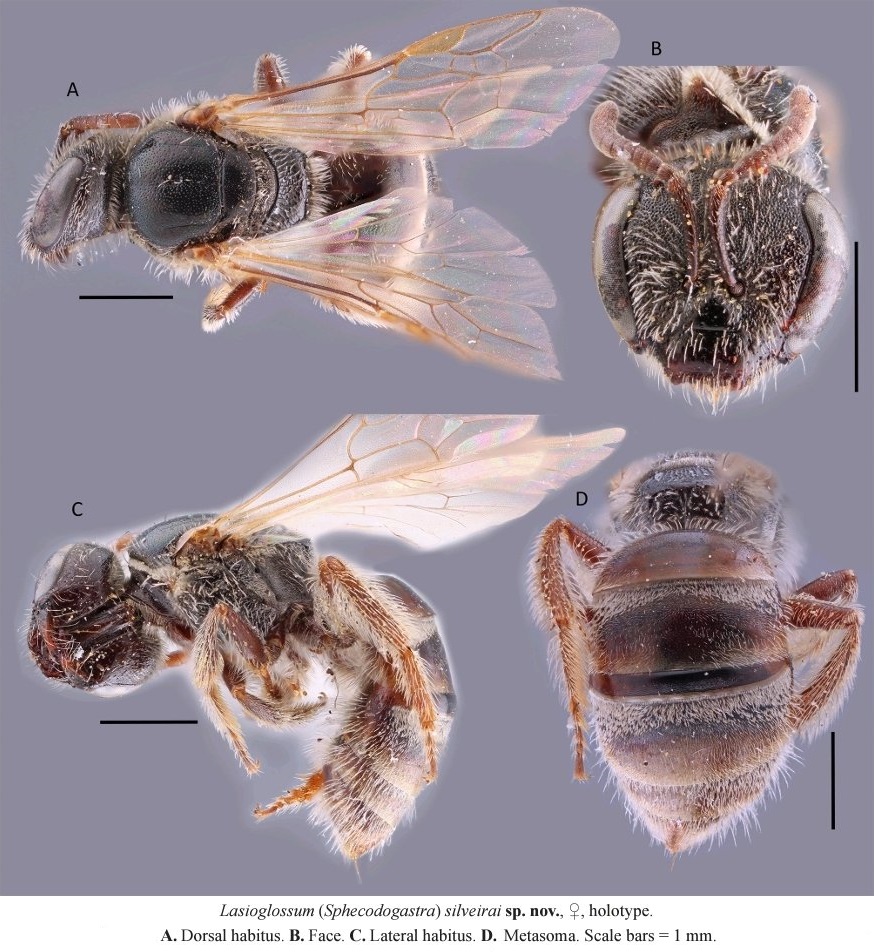
Lasioglossum (Sphecodogastrasilveirai sp. nov., ♀, holotype.
A. Dorsal habitus. b. Face. C. Lateral habitus. D. Metasoma.
Scale bars = 1 mm.

Lasioglossum (Sphecodogastrasilveirai sp. nov.

Etymology. This species is named in honour of the late Fernando Silveira (Universidade Federal de Minas Gerais) for his contributions to bee taxonomy and his warm, jovial spirit, which made it a delight to attend international conferences on pollinators.

  
Thilina Hettiarachchi and Jason Gibbs. 2024. A Problematic Species Complex of Lasioglossum Subgeneric Diagnostics in North America (Hymenoptera: Halictidae). Zootaxa. 5404(1); 206-235. DOI: 10.11646/zootaxa.5404.1.13

Saturday, November 25, 2023

[Herpetology • 2023] Nanorana laojunshanensis • A New Species of Nanorana (Anura: Dicroglossidae) from Northwestern Yunnan, China, with Comments on the Taxonomy of Nanorana arunachalensis and Allopaa


 Nanorana laojunshanensis 
Tang, Liu & Yu, 2023

Laojunshan Slow Frog | 老君山倭蛙  ||  DOI: 10.3390/ani13213427 

 Abstract

The genus Nanorana contains three subgenera, namely Nanorana, Paa, and Chaparana, and currently, there are four species known to science in Nanorana (Nanorana). In this study, we describe a new species belonging to the subgenus Nanorana from northwestern Yunnan, China. Phylogenetically, the new species, Nanorana laojunshanensis sp. nov., is the sister to the clade of N. pleskei and N. ventripunctata. Morphologically, the new species can be distinguished from known congeners by the combination of following characters: present tympanum, equal fingers I and II, small body size, yellow ventral surface of limbs, distinct vomerine teeth, indistinct subarticular tubercles, head width greater than head length, slender supratympanic fold, absent dorsolateral fold, nuptial spines present on fingers I and II in adult males, absent vocal sac, and paired brown spines on the chest. Moreover, we suggest moving the genus Allopaa into Nanorana (Chaparana) and consider that N. arunachalensis is neither an Odorrana species nor a member of the subfamily Dicroglossinae (therefore Nanorana), but probably represents a distinct genus closely related to Ingerana or belongs to Ingerana, pending more data. Additionally, we consider that Nanorana minica deserves the rank of an independent subgenus, and we suggest assigning N. arnoldi, N. blanfordii, N. ercepeae, N. polunini, N. rarica, N. rostandi, N. vicina, N. xuelinensis, and N. zhaoermii into the subgenus Paa and placing N. kangxianensis, N. phrynoides, and N. sichuanensis in the subgenus Chaparana.

Keywords: Nanorana; Paa; Chaparana; Allopaa; northwestern Yunnan

 Holotype of Nanorana laojunshanensis sp. nov.
in life (A,B) and in preservative (C,D).

Nanorana (Nanorana) laojunshanensis sp. nov. 

Diagnosis: The new species was assigned to Nanorana (Nanorana) using the following morphological characters: oval tongue, shallowly notched posterior; blunt finger and toe tips; absent webbing between fingers, absent supernumerary tubercle; developed webbing between toes; paired patches of spine on chest [Fei, et al., 2009]. The new species can be distinguished from other members of Nanorana by having a combination of the following characters: (1) present tympanum; (2) small body size; (3) distinct vomerine teeth; (4) indistinct subarticular tubercles; (5) head width greater than head length; (6) slender supratympanic fold; (7) finger I equal to finger II; (8) absence of dark blotches on ventral surface and yolk-yellow ventral surface of limbs; (9) absent dorsolateral fold; (10) nuptial spines present only on fingers I and II in adult males; (11) absent vocal sac; and (12) paired brown spines on chest.
...

Etymology: The specific epithet is named after the type locality, Mt. Laojun, Lijiang, Yunnan, China. We suggested “laojunshan slow frog” for the common English name and “老君山倭蛙 (Lǎo Jūn Shān Wō Wā)” for the common Chinese name.

Minipaa subgen. nov.
Type species: Nanorana minica (Dubois, 1975)
Included species: Nanorana minica (Dubois, 1975).

Distribution: Nepal, India, Bhutan.

Etymology: From the Latin mini, “small”, and from the generic name Paa, Dubois, 1975 (from the Tamang name paa, “frog”), in which this species was originally placed. This name refers to the small body size of this taxon.

 
 Shangjing Tang, Shuo Liu and Guohua Yu. 2023. A New Species of Nanorana (Anura: Dicroglossidae) from Northwestern Yunnan, China, with Comments on the Taxonomy of Nanorana arunachalensis and AllopaaAnimals. 13(21), 3427. DOI: 10.3390/ani13213427 
 
Simple Summary: Currently, the genus Nanorana contains thirty-two species, and four of them belong to the subgenus Nanorana, namely N. bangdaensis, N. parkeri, N. pleskei, and N. ventripunctata. In this study, on the basis of molecular and morphological evidence, we described a new species of Nanorana (Nanorana) from northwestern Yunnan, China, where only one member (N. ventripunctata) of Nanorana (Nanorana) has been reported. Additionally, the taxonomic status of Nanorana arunachalensis and Allopaa hazarensis were discussed, and subgeneric allocations of Nanorana species were suggested. The findings in this study bring the number of Nanorana species to 33 and improve our understanding on the taxonomy of genus Nanorana and the species diversity of Nanorana (Nanorana), an alpine group widely distributed in the southern and southeastern Qinghai–Tibetan Plateau.

Thursday, January 26, 2023

[Botany • 2023] Phylogeny based Generic Reclassification of Muscari sensu lato (Asparagaceae) using Plastid and Genomic DNA


Inflorescences of Muscari species incorporated in this study.
A–H, M. subg. Muscari: A, M. anatolicum; B, M. adilii; C, M. armeniacum; D, M. discolor; E, M. sivrihisardaghlarense; F, M. vuralii; G, M. neglectum; H, M. commutatum.
I, M. subg. Muscarimia: M. macrocarpum.
J–L, Muscari subg. Pulchella (subg. nov.): J, M. latifolium; K, M. pulchellum; L, M. bourgaei.
 — Names listed above follow the new classification here proposed. 

in Böhnert, Neumann, Quandt & Weigend, 2023.
Images: T. Böhnert. twitter.com/TimBoeh

Abstract
The grape hyacinth (Muscari) represents an important ornamental plant group in Asparagaceae subfamily Scilloideae, comprising some 80 species distributed mainly in the Mediterranean. However, genus delimitation has repeatedly shifted over the past two centuries and a general consensus has not been reached so far. The present study investigates the phylogeny of Muscari s.l. (i.e., including the disputed segregates Pseudomuscari and Leopoldia) with a broad sampling of about half the currently recognized species using both chloroplast markers (trnK(matK)-psbA, trnL-trnF, rpl16) and genome-wide single nucleotide polymorphism (SNP) data generated by double-digest restriction site-associated DNA sequencing (ddRAD). We perform concatenated maximum likelihood inference for both datasets as well as a coalescent-based approach and principal component analysis (PCA) on the ddRAD data. We find that the morphological characters traditionally used to distinguish different genera are not diagnostic for the clades here retrieved. Also, the segregates Pseudomuscari and Leopoldia are deeply nested in Muscari and we therefore propose a broadly defined Muscari with five subgenera. The subgenera roughly correspond to previously recognized entities, with the exception of the newly identified clade here proposed as M. subg. Pulchella subg. nov. We provide a provisional assignment of the 80 currently accepted taxa to these subgenera.

Keywords: ddRAD, geophyte, Leopoldia, Mediterranean, Pseudomuscari, Scilloideae

Inflorescences of 16 Muscari species incorporated in this study.
A–H, Msubg. Muscari: A, M. anatolicum; B, M. adilii; C, M. armeniacum; D, M. discolor; E, M. sivrihisardaghlarense; F, M. vuralii; G, M. neglectum; H, M. commutatum.
I, M. subg. MuscarimiaM. macrocarpum.
J–L, M. subg. Pulchella (subg. nov.): J, M. latifolium; K, M. pulchellum; L, M. bourgaei.
M–P, M. subg. Pseudomuscari: M, M. parviflorum; N, M. chalusicum; O, M. inconstrictum; P, Mcoeruleum.
 — Names listed above follow the new classification here proposed. 
Images: T. Böhnert.

CONCLUSION AND OUTLOOK: 
Muscari is a very natural group, best recognized as a single genus. The ddRAD data are able to reconstruct a highly resolved and highly supported phylogeny. Comprehensive sampling of the remaining ca. 45 species would be highly desirable to reach a comprehensive understanding of this important geophyte genus. Our data show evidence for lineage admixture and future analyses should be directed towards understanding the role of hybridization in the evolution of the genus by testing for introgression and possibly ongoing gene flow. It would also be expected that the evolution of Muscari is correlated to the geological and climatic history of the Mediterranean basin and this could be tested with a dated phylogeny of this genus. Beyond molecular data, additional and critical morphological analyses are required to hopefully provide a morphological characterization of the different subgenera.


Tim Böhnert, Michael Neumann, Dietmar Quandt and Maximilian Weigend. 2023. Phylogeny based Generic Reclassification of Muscari sensu lato (Asparagaceae) using Plastid and Genomic DNA. TAXON. DOI: 10.1002/tax.12864

Friday, September 30, 2022

[Entomology • 2022] Dasypolia sejilaensis & D. cerritula • Taxonomic Review of the Subgenus Tatsipolia of the Genus Dasypolia (Lepidoptera: Noctuidae) with Descriptions of Two New Species from southern Xizang, China


 Dasypolia (Tatsipoliasejilaensis
 Dasypolia (Tatsipoliacerritula

 Chen, Pan, Volynkin, Saldaitis & Benedek, 2022.

Abstract
The subgenus Tatsipolia Benedek, Behounek, Floriani & Saldaitis, 2011 of the genus Dasypolia Guenée, 1852 is reviewed. Two new species, D. (T.) sejilaensis sp. nov. and D. (T.) cerritula sp. nov. are described from the Linzhi (Nyingchi) Prefecture in southern Xizang, China. The adults and the male and female genitalia of all species in the subgenus are illustrated. Additionally, Dasypolia (Auropolia) carlotta Floriani, Benedek, Behounek & Saldaitis, 2011 is reported from Xizang for the first time.

Keywords: Antitypina, new record, Noctuinae, Owlet moth, systematics, taxonomy, Xylenini


Noctuidae Latreille, 1809
Noctuinae Latreille, 1809

Xylenini Guenée, 1837
Antitypina Forbes & Franclemont, 1954

Genus Dasypolia Guenée, 1852
 
Subgenus Tatsipolia Benedek, Behounek, Floriani & Saldaitis, 2011
Dasypolia (Tatsipolia) Benedek et al. 2011: 108. 
Type species: Dasypolia (Tatsipolia) ruficilia Benedek, Behounek, Floriani & Saldaitis, 2011, by original designation.

Diagnosis: Members of the subgenus are small moths (forewing length is 11-13 mm) externally similar to taxa of the subgenus Cteipolia. However, despite the external similarity, the subgenus is characterised by the following diagnostic features in the male genitalia: (1) The uncus is short but wide, triangular, dorso-ventrally flattened; (2) The harpe is reduced, tubercle- or spine-like; (3) The digitus is robust, thorn-like; (4) The juxta bears a medial process posteriorly; and (5) The phallus is relatively short but broad, with vesica bearing one or two clusters of spine-like cornuti. In the female genitalia, the broad ostium bursae and the sideways curved ductus and corpus bursae are characteristic for the subgenus.

Distribution: Species of the subgenus are known only from south-western China (Sichuan and southern Xizang).

Species content of Dasypolia (Tatsipolia)
D. (T.) sejilaensis sp. nov.
D. (T.) cerritula sp. nov.
D. (T.) vignai L. Ronkay & Zilli, 1993.
D. (T.) ruficilia Benedek, Behounek, Floriani & Saldaitis, 2011.

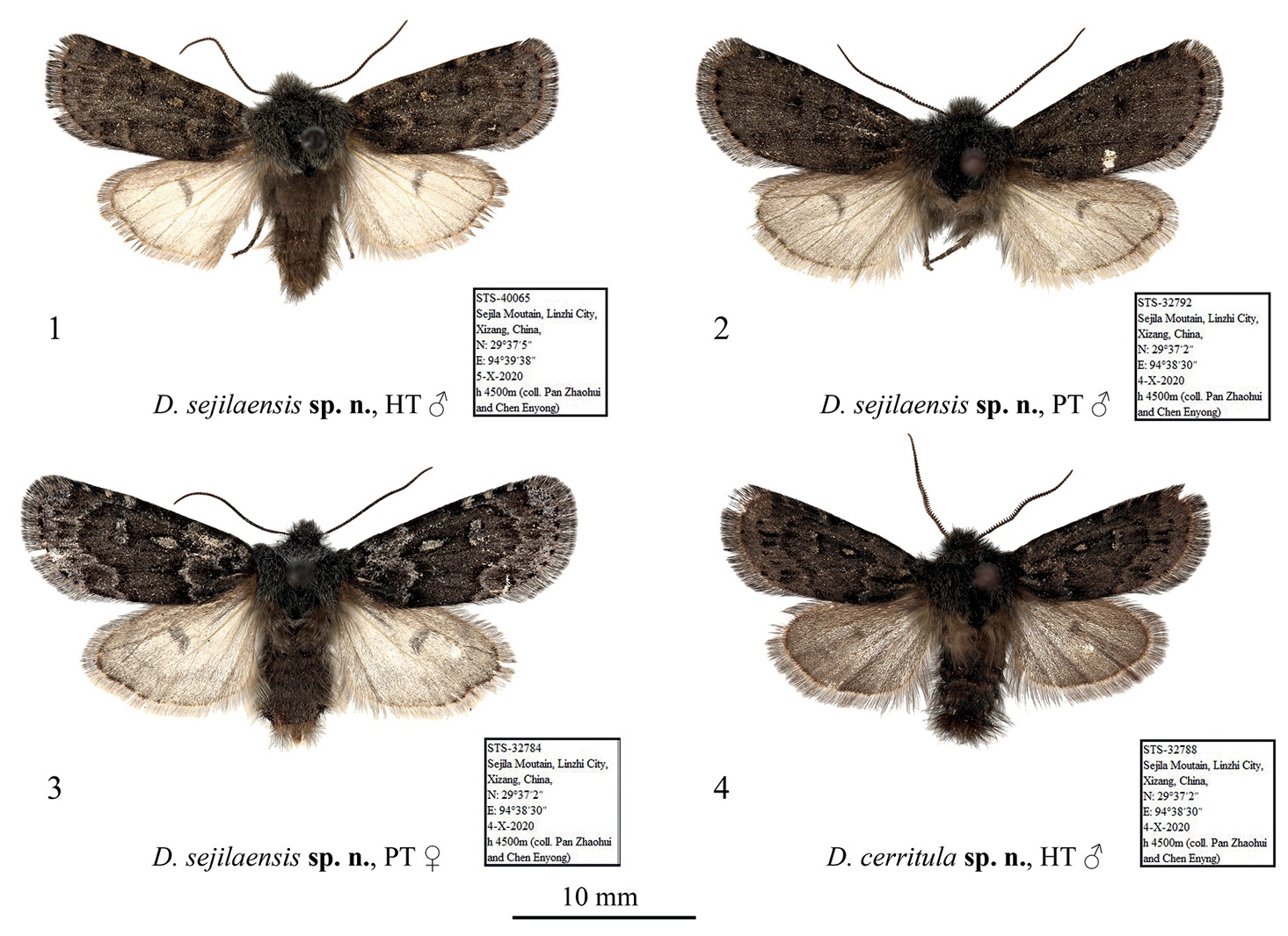
Dasypolia (Tatsipolia and Auropolia) spp., adults.
 Depositories of the specimens: 1–4 and 8 in TAAHU 5 in AFM 6 in HNHM (photo by B. Tóth) 7 in ZSM.


 Dasypolia (Tatsipolia) sejilaensis sp. nov.

Distribution: The new species is known only from Sejila Mountain in southern Xizang Province of China.

Etymology: The specific epithet refers to the type locality [Sejila Mountain].


 Dasypolia (Tatsipoliacerritula sp. nov.

Distribution: The new species is known only from Sejila Mountain in southern Xizang Province of China.

Etymology: In Latin, ‘cerritulus’ means ‘weird.’ The specific epithet refers to the unusual cucullus densely covered with robust, spine-like setae.


Enyong Chen, Zhaohui Pan, Anton V. Volynkin, Aidas Saldaitis and Balázs Benedek. 2022. Taxonomic Review of the Subgenus Tatsipolia Benedek, Behounek, Floriani & Saldaitis of the Genus Dasypolia Guenée with Descriptions of Two New Species from southern Xizang, China (Insecta, Lepidoptera, Noctuidae). ZooKeys. 1115: 187-198. DOI: 10.3897/zookeys.1115.84527

Saturday, October 2, 2021

[Botany • 2021] Indigofera wenholdiae (Fabaceae, Indigofereae) • A New Species from the Western Cape Province, South Africa


 Indigofera wenholdiae du Preez & Schrire, 

in du Preez, Dreyer, ... et Schrire, 2021. 

Abstract
In this study, Indigofera wenholdiae, a new species of Fabaceae from the Agulhas Plain Region of the Western Cape Province, South Africa, is described. A composite photographic plate is included along with a distribution map, description of habitat and ecology and proposed IUCN conservation status. Indigofera wenholdiae is unique in the I. brachystachya group by having digitately compound (vs. pinnately compound) leaves, white and unscented flowers (vs. pink and sweetly scented flowers) and grows on sandstone hillsides (vs. coastal limestone plains and outcrops).

Keywords: Indigofera, Leguminosae, Greater Cape Floristic Region, fynbos, taxonomy


Figure 1. Indigofera wenholdiae du Preez & Schrire
 A single inflorescence B flower lateral view C leaf abaxial view D multiple inflorescences on branches E whole plant.
Photographs by Brian du Preez. Voucher B. du Preez 836 (BOL).

Indigofera wenholdiae du Preez & Schrire, sp. nov.
 
Diagnosis: Similar to I. brachystachya, but differs in its digitately compound, 5–7 foliolate leaves (versus pinnately compound, 7–9 foliolate leaves), leaflets 4–6 mm long (versus leaflets 9–15 mm long), racemes up to 7 mm long, flowers ± 4–5 per raceme (versus racemes > 10 mm long, flowers > 8 per raceme), flowers creamy white, unscented (versus flowers pale pink, scented), branching divaricate (versus branching random), populations restricted to sandstone fynbos (versus populations restricted to limestone fynbos).

Etymology: The specific epithet “wenholdiae” is assigned in honour of Mrs Hannerie Wenhold who has funded large-scale conservation efforts in this area, including the funding of the botanist post at Grootbos Nature Reserve of Miss Rebecca Dames who brought this species to our attention in April 2020.


 Brian du Preez, Leanne L. Dreyer, Charles H. Stirton, A. Muthama Muasya and Brian D. Schrire. 2021. Indigofera wenholdiae (Indigofereae, Fabaceae), A New Species from the Western Cape Province, South Africa. PhytoKeys. 182: 107-112.  DOI: 10.3897/phytokeys.182.72170


Tuesday, March 9, 2021

[Entomology • 2021] Ankylopteryx (A.) diffluens & A. (A.) rubrocincta • Two New Species of the Green Lacewing Subgenus Ankylopteryx Brauer, 1864 (s. str.) (Neuroptera, Chrysopidae) from China


Ankylopteryx (Ankylopteryx) diffluens 
Ma & Liu, 2021


Abstract
Two new species of the green lacewing subgenus Ankylopteryx Brauer are described from southern Yunnan, China, namely Ankylopteryx (A.) diffluens sp. nov. and Ankylopteryx (A.) rubrocincta sp. nov.. An updated key to the species of this subgenus is provided.

Keywords: Neuroptera, new species, green lacewing, key

 
Yunlong Ma and Xingyue Liu. 2021. Two New Species of the Green Lacewing Subgenus Ankylopteryx Brauer, 1864 (s. str.) (Neuroptera, Chrysopidae) from China. Zootaxa. 4941(3); 425–433. DOI: 10.11646/zootaxa.4941.3.7

Monday, February 15, 2021

[Botany • 2021] A Monograph of the Genus Polhillia (Fabaceae: Genisteae)


Polhillia fortunata B.du Preez, sp. nov.
  Polhillia groenewaldii B.du Preez, sp. nov.  
 
Subgen. Roseopolhillia B.du Preez, subgen. nov.
Polhillia involucrata (Thunb.) B.-E.van Wyk & A.L.Schutte

in du Preez, Dreyer, Stirton et Muasya, 2021. 
 Scale bars: 4 mm. Photographs by B. du Preez


Highlights: 
• Four new species are described.
Polhillia canescens synonymized under P. connata.
• Molecular phylogenetic reconstruction confirms monophyly of the genus.
• New monotypic subgenus described.
• Updated Red Data List status for all 11 Polhillia species.

Abstract
Polhillia is a small, but poorly known genus of legumes endemic to the Greater Cape Floristic Region (GCFR) of South Africa. The genus was described three decades ago to accommodate species erroneously placed in Argyrolobium and other Cape legume genera. Polhillia is the third most threatened plant genus in South Africa, hence priority for taxonomic study and current knowledge on distribution patterns are essential for conservation interventions. Eight species were known at the start of this study, all of which are threatened with extinction. Species boundaries were, however, unclear and many Renosterveld fragments, in particular in the Overberg, required further exploration in pursuit of the various Polhillia species. The phylogenetic relationships among species and monophyly of the genus, especially regarding the position of the morphological aberrant P. involucrata, had not been tested. This study was built upon a foundation of widespread field sampling and analysis of herbarium specimens. Having considered morphological, anatomical, palynological and molecular data, we present an updated taxonomy of the genus Polhillia. Morphological characters between species were often obscure and unique characters were uncommon, as such species are recognized based on unique combinations of characters. Pollen and leaf anatomical studies did not provide substantial taxonomically informative characters, although some interspecific differences were noted. Molecular phylogenetic reconstructions confirm Polhillia to be monophyletic and sister to Argyrolobium, and that Argyrolobium may not be monophyletic. The morphologically distinct species, P. involucrata, is strongly supported as sister to the rest of the genus. Internal phylogenetic resolution in Polhillia is weak in many clades, due to the low variability among DNA markers studied, and several polytomies are still present. Based on the morphological and molecular evidence, we place P. involucrata in the new monotypic subgenus Roseopolhillia. Four new species are described (P. fortunata B.du Preez, P. groenewaldii B.du Preez, P. stirtoniana B.du Preez, P. xairuensis B.du Preez), and a previously recognized species (P. canescens C.H.Stirt.) is placed in synonymy under P. connata (Harv.) C.H.Stirt. Red data list assessments are provided for all species to highlight their conservation importance. Maps and compound colour plates are provided for each species.
 
Keywords: Polhillia, Cape flora, Conservation, Legumes, New species, Phylogeny, Taxonomy


Polhillia C.H.Stirt. subgen. Polhillia 
Type species: Polhillia obsoleta (Harv.) B.-E.van Wyk 
(=Polhillia waltersii (C.H.Stirt.) C.H.Stirt.)

Shrubs erect or spreading, sprouting from rootstock after fire; stipules 2, deltoid, sericeous, veins not visible, connate around base, sheathing stem, often persistent; leaves subsessile or petiolate in P. brevicalyx, pubescent, conduplicate (or flattened in P. ignota); flowers single, paired or in clusters (4–5 in P. brevicalyx, P. ignota and P. fortunata), subsessile or pseudo-pedunculate up to 15 mm long; flowers yellow, 8–13 mm long; calyx yellow-green, often flushed red, villous or sericeous; standard broadly ovate, apex emarginate, pubescent abaxially; wing petals variable in shape and sculpturing, mostly glabrous or pilose along midrib; keel petals variable in shape and level of pubescence, usually restricted to the fore edge; pistil green, sericeous or villous, ovules 7–12, style sub-erect to erect; fruit indehiscent, oblong, laterally compressed between seeds, plicate in P. ignota, P. obsoleta, P. groenewaldii, and P. fortunata, sericeous to glabrescent; seeds ovate-reniform, smooth, uniformly coloured, olive green to dark brown (except for P. connata and P. pallens that have occasional mottling).

 Species included: 
1. Polhillia brevicalyx (C.H.Stirt.) B.-E.van Wyk & A.L.Schutte
2. Polhillia connata (Harv.) C.H.Stirt.
3. Polhillia curtisiae C.H.Stirt. & Muasya
4. Polhillia fortunata B.du Preez
5. Polhillia groenewaldii B.du Preez
6. Polhillia ignota Boatwr.
7. Polhillia obsoleta (Harv.) B.-E.van Wyk
8. Polhillia pallens C.H.Stirt.
9. Polhillia stirtoniana B.du Preez
10. Polhillia xairuensis B.du Preez

 Etymology: The generic and subgeneric epithet Polhillia honours the renowned botanist and legume systematist Dr. Roger M. Polhill from the Royal Botanical Gardens, Kew (Stirton. 1986a).


Fig. 20. Composite plate of Polhillia involucrata.
 1 – Inflorescence with pink flowers; 2 – Inflorescence with white flowers; 3 – Side view of inflorescence showing pink-flushed sepals; 4 – Calyx; 5 – Flower side view; 6 – Flower bottom view; 7 – Wing petals; 8 – Keel petal; 9 – Androecium; 10 – Gynoecium; 11 – Fruit; 12 – Dehiscent fruit on bush; 13 – Close-up of leaves and stipules; 14 – Habit.
Scale bars: 4 mm. Photographs by B. du Preez

Fig. 20. Composite plate of Polhillia involucrata.
1 – Inflorescence with pink flowers; 2 – Inflorescence with white flowers;
3 – Side view of inflorescence showing pink-flushed sepals;12 – Dehiscent frfrfruit on bush;
 13 – Close-up of leaves and stipules; 14 – Habit.
Scale bars: 4 mm. Photographs by B. du Preez

Polhillia C.H.Stirt. Subgen. Roseopolhillia B.du Preez, subgen. nov.
 
Type species: Polhillia involucrata (Thunb.) B.-E.van Wyk & A.L.Schutte,
 Kew Bulletin 44: 3 (1989).

Shrubs erect, sprouting from rootstock after fire; stipules 2, deltoid-oblong, glabrous abaxially, villous adaxially with three prominent veins, connate around base, sheathing stem, often persistent; leaves digitately trifoliolate, shortly petiolate, glabrous or rarely sparsely hairy, conduplicate; inflorescence terminal, flowers in clusters of 2–5, subsessile, surrounded by enlarged stipules; flowers rose pink or rarely white, 10–12 mm long; calyx with trifid ventral lip, sparsely pilose, green, often flushed maroon; standard broadly elliptic to ovate, apex emarginate, pubescent only along abaxial midrib; wing petals broadly oblong with lamellate sculpturing along most part of dorsal half; keel petals lunate, pilose along ventral fore edge; stamens 10, monadelphous with single dorsal slit, filaments fused for most of their length, anthers alternating between long and short; pistil sericeous, variable in length, ovules 7, style sub-erect, stigma regular, capitate; fruit dehiscent, pale cream-brown, oblong, laterally compressed between seeds, sericeous; seeds ovate-squared, smooth, dark-brown to mottled pale-orange.

 Species included: Polhillia involucrata (Thunb.) B.-E.van Wyk & A.L.Schutte.

  Etymology: The subgeneric epithet Roseopolhillia was chosen to highlight the distinct and diagnostic rose pink coloured flowers unique to Polhillia species.


 Polhillia fortunata B.du Preez, sp. nov.  1 – Flower front view; 3 – Flower bottom view; 9 – Close-up of leaves and stipules; 11 – Habit.  
 Polhillia groenewaldii B.du Preez, sp. nov. 1 – Flower front view; 2 – Flower side view; 9 – Fruit; 10 – Habit.  

Polhillia stirtoniana B.du Preez, sp. nov. 1 – Flower front view; 2 – Flower side view; 8 – Fruit; 9 – Close-up of recurved leaves and stipules; 10 – Habit. 
Polhillia xairuensis B.du Preez, sp. nov. 1 – Flower front view; 2 – Flower side view; 9 – Leaves and stipules; 10 – Close-up of leaf; 11 – Habit. 
 Scale bars: 4 mm. Photographs by B. du Preez


Polhillia fortunata B.du Preez, sp. nov.  1 – Flower front view; 3 – Flower bottom view; 9 – Close-up of leaves and stipules; 11 – Habit. Scale bars: 4 mm. 
 Polhillia groenewaldii B.du Preez, sp. nov. 1 – Flower front view; 2 – Flower side view; 9 – Fruit; 10 – Habit. Scale bars: 4 mm. 
 Scale bars: 4 mm. Photographs by B. du Preez

Polhillia fortunata B.du Preez

 Etymology: The specific epithet is a direct translation from Latin meaning “lucky”. This epithet was selected as the discovery of this species was fortuitous. The area in which this species occurs was burnt in a massive fire for the first time in nearly 100 years in February 2018, allowing profusion of resprouting shrubs to be visible from the road in what was previously near-senescent Renosterveld vegetation.


Polhillia groenewaldii B.du Preez

Etymology: The specific epithet “groenewaldii” honours Mr Jannie Groenewald who first discovered this species and brought it to our attention. This honours the incredible work he has done in increasing our knowledge of new species and also new populations of threatened species in the Overberg region. This is also in recognition of the tremendous help he provided during fieldwork conducted for this study.


Polhillia stirtoniana B.du Preez, sp. nov. 1 – Flower front view; 2 – Flower side view; 8 – Fruit; 9 – Close-up of recurved leaves and stipules; 10 – Habit. 
Polhillia xairuensis B.du Preez, sp. nov. 1 – Flower front view; 2 – Flower side view; 9 – Leaves and stipules; 10 – Close-up of leaf; 11 – Habit.
 Scale bars: 4 mm. Photographs by B. du Preez
    
Polhillia stirtoniana B.du Preez

Etymology: The specific epithet honours Prof. Charles Howard Stirton for his extensive work on Cape legumes and his late wife, Dr Jana Stirton (Born Žantovská) who shared his love and passion for the diversity and conservation of the Overberg Renosterveld. They assisted in the formation of the Overberg Renosterveld Conservation Trust and establishment of the Haarwegskloof Private Nature Reserve and research centre. Prof. Stirton has significantly mentored the first author in his development as botanist.


Polhillia xairuensis B.du Preez

Etymology: The specific epithet is derived from the Hessequa Khoi name for the Suurbraak area, namely “!Xairu” which means ‘Beauty’ or ‘A place called Paradise’, referring to the beautiful nature of the area (Fourie, 2013). Pronunciation of the epithet can be with or without a click. Although much of the area has now been transformed for agriculture, the Langeberg Mountains above the town of Suurbraak remain scenic and lowland vegetation fragments hold beautiful floral gems such as this Polhillia species.


  B. du Preez, L. L. Dreyer, C. H. Stirton and A. M. Muasya. 2021. A Monograph of the Genus Polhillia (Genisteae: Fabaceae).  South African Journal of Botany. 138; 156-183. DOI: 10.1016/j.sajb.2020.12.022