Showing posts with label Characidae. Show all posts

Wednesday, May 29, 2024

[Ichthyology • 2016] Hyphessobrycon wadaiA Name for the ‘Blueberry Tetra’, An Aquarium Trade popular Species of Hyphessobrycon Durbin (Characiformes: Characidae) from Amazon Basin, Brazil


Hyphessobrycon wadai
Marinho, Dagosta, Camelier & Oyakawa, 2016
  

Abstract
A new species of Hyphessobrycon is described from a tributary of the upper Rio Tapajós, Amazon basin, Mato Grosso, Brazil. Its exuberant colour in life, with blue to purple body and red fins, is appreciated in the aquarium trade. Characters to diagnose the new species from all congeners are the presence of a single humeral blotch, absence of a distinct caudal-peduncle blotch, absence of a well-defined dark mid-lateral stripe on body, the presence of 16–18 branched anal-fin rays, nine branched dorsal-fin rays and six branched pelvic-fin rays. A brief comment on fish species descriptions solely based on aquarium material and its consequence for conservation policies is provided.

Keywords: freshwater fish; Hyphessobrycon coelestinus; Rio Juruena; Rio Tapajós; taxonomy


Hyphessobrycon wadai

Etymology — The specific name, wadai, is a patronym that honours Luiz Wada, ornamental fish breeder and enthusiastic aquarist, in recognition of his help in many scientific researches with fishes.

Distribution — Hyphessobrycon wadai is known from tributaries of the Rio do Sangue, affluent of the Rio Juruena, upper Rio Tapajós basin, Brazil.


 M. M. F. Marinho , F. C. P. Dagosta , P. Camelier and O. T. Oyakawa. 2016. A Name for the ‘Blueberry Tetra’, An Aquarium Trade popular Species of Hyphessobrycon Durbin (Characiformes, Characidae), with Comments on fish species descriptions lacking accurate Type Locality.  Journal of Fish Biology. [Special Issue: Fish and Aquatic Habitat Conservation in South America]. 89(1); 510–521. DOI: 10.1111/jfb.12991

[Ichthyology • 2024] Hyphessobrycon citrus • Redescription of Hyphessobrycon cachimbensis (Characiformes: Characidae) with the Description of A New congener from the Serra do Cachimbo, Brazil


Hyphessobrycon citrus
Marinho & Dagosta, 2024
 

Abstract
The Serra do Cachimbo is a highland area at the southeastern portion of the Amazon Forest drained by the headwaters of tributaries of rios Xingu and Tapajós. It is known as an area of high level of endemism of fish, low species diversity, and very few taxa with broad distribution in the other parts of the Amazon. Despite its biogeographical importance, there are still many poorly sampled areas. Four expeditions to the region yielded in the rediscovery of a poorly known, endemic species, Hyphessobrycon cachimbensis, and the discovery of a similar, allopatric undescribed congener, frequently misidentified as H. cachimbensis. We provided the redescription of H. cachimbensis and the description of the new species. Both can be differentiated from most congeners by having a conspicuous longitudinal dark stripe on body and anal-fin base convex in males, due to thicker musculature insertion in the region. Other diagnostic features are mostly related to counts of scales and fin rays.

Keywords: Endemism; Ostariophysi; Rio Tapajós; Rio Xingu; Tetra

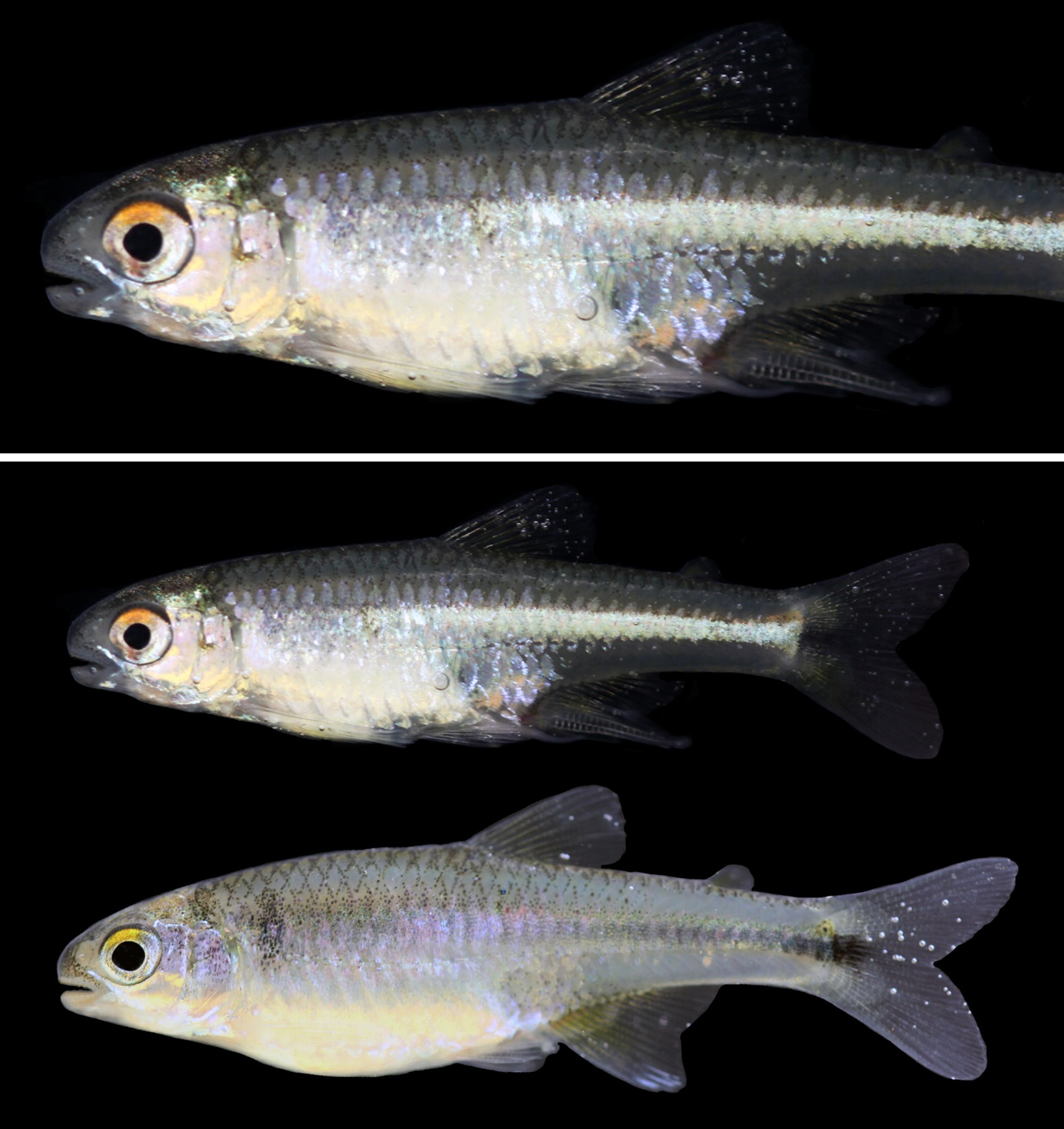
Hyphessobrycon citrus, Brazil, Pará State, rio Tapajós basin, rio Teles Pires drainage, tributary of rio Braço Norte. A. MZUSP 128236, holotype, 38.0 mm SL, male; B. MZUSP 101429, paratype, 39.4 mm SL, female.

Hyphessobrycon citrus, new species

Diagnosis. Hyphessobrycon citrus can be distinguished from its congeners, except H. cachimbensis, H. chiribiquete, H. comodoro, H. cyanotaenia, H. fernandezi, H. melanostichos, H. nigricinctus, H. paucilepis, H. petricolus, H. piranga, H. psittacus, H. scholzei, H. sovichthys, H. stegemanni, H. taphorni, H. tuyensis, and H. vilmae,by the presence of a well-defined, relatively narrow dark midlateral stripe on body, from immediately behind the opercular opening to the tip of middle caudal-fin rays (vs. longitudinal stripe absent, stripe starting approximately at vertical through the dorsal-fin origin, or midlateral dark stripe becoming blurred towards the caudal peduncle). It can be distinguished from the aforementioned species, except H. cachimbensis, H. chiribiquete, H. comodoro, H. cyanotaenia, H. melanostichos, H. nigricinctus, and H. petricolus, by the presence of a humeral spot (vs. absence). Hyphessobrycon citrus can be distinguished from H. cachimbensis, H. comodoro, H. cyanotaenia, and H. melanostichos by having the longitudinal black stripe starting immediately behind the opercle (vs. starting at the posterior margin of orbit), from H. chiribiquete, H. nigricinctus and from H. cachimbensis by having 14–17 anal-fin rays (vs. 18 or more), and from H. petricolus by having 14 horizontal scale rows around caudal peduncle (vs. 12) and non-symphyseal teeth of the premaxillary inner row with 7 to 9 cusps (vs. 3 to 5). The yellow citrus coloration and a vivid colored red eye in life also help distinguishing H. citrus from congeners.

Etymology. The specific epithet comes from the Latin “citrus”, referring to its bright yellow coloration similar to several citrus fruits. A noun in apposition.


Manoela Maria Ferreira Marinho and Fernando Cesar Paiva Dagosta. 2024. Redescription of Hyphessobrycon cachimbensis (Characiformes: Characidae) with the Description of A New congener from the Serra do Cachimbo, Brazil.  Neotrop. ichthyol. 22 (2); DOI: 10.1590/1982-0224-2023-0127   

Sunday, April 7, 2024

[Ichthyology • 2024] Monotocheirodon duda • A New characid Species with remarkable sexual dimorphism (Characiformes: Characidae: Stevardiinae) from the upper Guayabero River, Orinoco Basin, Colombia


Monotocheirodon duda
Carvalho, Thomaz, Urbano-Bonilla & Prada-Pedreros, 2024
 
 
Abstract
A new species of characid with remarkable sexual characteristics is described from the upper Guayabero River drainage from the Orinoco basin in Colombia. The new species is included in the genus Monotocheirodon by sharing most of the previously proposed diagnostic features of this genus. It differs from all Stevardiinae by the combination, in adult males, of an enlarged urogenital papilla in contact with the first anal-fin unbranched ray and a highly modified anal fin with enlarged and distally elongated first and second branched anal-fin rays, forming a gonopodium-like structure. In addition, it differs from congeners by the presence of an adipose fin, an incomplete lateral line, an ascending process of the premaxilla dorsally oriented, and a long snout. The new species was discovered from a poorly sampled region in Colombia and is an unexpected new record given its disjunct geographic distribution from other species of the genus. Monotocheirodon species were previously known from piedmont drainages in Bolivia and Peru. The conservation status of the new species is herein categorized following IUCN criteria.

Keywords: endemism, insemination, Monotocheirodon, sexual characters, South America, species diversity

Lateral view of live specimens of Monotocheirodon duda showing live colouration. Above a male and below a female specimen. Specimens not cataloged.

 Monotocheirodon duda, new species

Diagnosis: The new species differs from all Stevardiinae species by the combined presence in adult males of an enlarged urogenital papilla (length about one-third to half of the first unbranched ray), which is in contact with the first anal-fin unbranched ray and a highly modified anal fin, with enlarged (anteroposteriorly) and distally elongated first and second branched anal-fin rays, forming a gonopodium-like structure (Figure 2). The new species differs from all other species of Monotocheirodon by the presence of an adipose fin (Figure 1, vs. absent); lateral line incomplete, pored scales not reaching the caudal fin (vs. lateral line complete); ascending process of the premaxilla dorsally directed (Figure 3, vs. strongly bent posteroventrally); and a longer snout that occupies about a fourth of the head length (HL), between 23.1% and 30.0% of HL (vs. short snout, <20% of the HL).

Etymology: Monotocheiron duda is named after the river where the new species was captured, mostly tributaries to the Duda River or captured in the Duda River itself (type locality). In Spanish, the epithet specific “duda” means doubt, which also refers to its presumed placement into the genus Monotocheirodon, an assumption that needs further evaluation.


Tiago P. Carvalho, Andréa Tonolli Thomaz, Alexander Urbano-Bonilla and Saúl Prada-Pedreros. 2024. A New characid Species with remarkable sexual dimorphism (Characiformes: Characidae: Stevardiinae) from the upper Guayabero River, Orinoco basin, Colombia. Journal of Fish Biology. DOI: 10.1111/jfb.15738

Saturday, March 9, 2024

[Ichthyology • 2023] Moenkhausia iris • A New colorful Species of Moenkhausia (Characiformes: Characidae) from the upper rio Madeira Basin at the Chapada dos Parecis, Brazil, with comments on its conservation and putative biogeographic history


Moenkhausia iris
Marinho & Dagosta, 2023


Abstract
A new species, Moenkhausia iris, is described from the upper rio Madeira basin, Mato Grosso State, Brazil. The new species is unique among congeners by its color in life, which is the dorsal half of body blue or green and ventral half red, more intense above the anal fin. Additionally, it can be distinguished by having a single, vertically elongated humeral spot, a lateral surface of body, caudal peduncle, and anal fin without distinct blotches or oblique marks and 18–19 branched anal-fin rays. The new species is endemic from a small tributary of the Rio Guaporé, rio Madeira drainage at Chapada dos Parecis. Its putatively close relatives are endemic to the upper rio Juruena located at the same shield. Both headwaters are very close to each other, sharing other restricted range species, and their hydrogeological topography indicates the upper rio Juruena stretch was captured by the rio Guaporé through a headwater capture event. Moenkhausia iris is much appreciated in the international aquarium trade, as well as many other tetras endemic from the same area. Exportation is based on the capture of wild individuals so sustainable exploitation is necessary for its conservation.

Keywords: endemism, Guaporé, headwater capture, ornamental fish trade, taxonomy


Moenkhausia iris sp. nov. 

Etymology. The epithet iris, a feminine noun in apposition, means rainbow, referring to the colorful body of the species, containing the different colors of the rainbow. It is also an allusion to the vivid and multicolored iris of the species 


Manoela Maria Ferreira Marinho and Fernando César Paiva Dagosta. 2023. On A New colorful Species of Moenkhausia (Characiformes: Characidae) from the upper rio Madeira Basin at the Chapada dos Parecis, Brazil, with comments on its conservation and putative biogeographic history. Journal of Fish Biology. 103(5); 1122-1128. DOI: 10.1111/jfb.15513

Tuesday, November 28, 2023

[Ichthyology • 2022] Hyphessobrycon bayleyi • A New sexually dimorphic Hyphessobrycon (Characiformes: Characidae) from the western Amazon Basin


Hyphessobrycon bayleyi
Lima, Bastos, Rapp Py-Daniel & Ota, 2022

 
Abstract
A new species of Hyphessobrycon presenting dimorphic males is described from the western Amazon basin in Brazil, Colombia, Ecuador, and Peru. The new species has been mistakenly identified in the literature with the non-congener Hemigrammus marginatus, with which shares a similar color pattern by presenting dark patches of dark pigmentation on caudal-fin lobes. It can be distinguished from the latter species, as well as from Hemigrammus durbinae, and two similar congeners, Hyphessobrycon diancistrus and Hy. otrynus, all of which sharing the same caudal fin color pattern, by the combination of presenting a dark patch of pigmentation on the dorsal fin, a single large anal-fin hook at the last unbranched anal-fin ray in mature males, and a moderately high body depth (22.4–32.5 % SL, mean 28.4 %). The new species is more similar to Hyphessobrycon diancistrus, which is putatively its closely related taxon. A putative close relationship with Hyphessobrycon otrynus, and with a non-congener presenting a distinct color pattern but sharing a similar sexual dimorphism on anal-fin hook morphology, Hemigrammus boesemani, is suggested.

Color pattern, Hemigrammus boesemaniHemigrammus durbinaeHemigrammus marginatusHemigrammus diancistrusHemigrammus otrynus, Neotropical region, Pisces


Hyphessobrycon bayleyi: (A) ZUEC 15475, paratype, female, 37.2 mm SL: Brazil, Amazonas, igarapé do Adolfo (tributary of rio Javari); (B) INPA 56395, paratype, male, 30.2 mm SL: Brazil, Amazonas, rio Itaquaí basin; in life.


Flavio C.T. Lima, Douglas A. Bastos, Lucia H. Rapp Py-Daniel and Rafaela P. Ota. 2022. A New sexually dimorphic Hyphessobrycon from the western Amazon basin (Characiformes: Characidae). Zootaxa. 5116(2); 253-266. DOI: 10.11646/zootaxa.5116.2.4 

Monday, November 27, 2023

[Ichthyology • 2021] Hyphessobrycon cantoi • A New Hyphessobrycon (Characiformes: Characidae) of the Hyphessobrycon heterorhabdus species-group from the lower Amazon Basin, Brazil


 Hyphessobrycon cantoi
Faria, Guimarães, Rodrigues, Oliveira & Lima, 2021


ABSTRACT
A new species of Hyphessobrycon belonging to the Hyphessobrycon heterorhabdus species-group from the lower rio Tapajós, state of Pará, Brazil, is described. The new species is allocated into the Hyphessobrycon heterorhabdus species-group due to its color pattern, composed by an anteriorly well-defined, horizontally elongated humeral blotch that becomes diffuse and blurred posteriorly, where it overlaps with a conspicuous midlateral dark stripe that becomes blurred towards the caudal peduncle and the presence, in living specimens, of a tricolored longitudinal pattern composed by a dorsal red or reddish longitudinal stripe, a middle iridescent, golden or silvery longitudinal stripe, and a more ventrally-lying longitudinal dark pattern composed by the humeral blotch and dark midlateral stripe. It can be distinguished from all other species of the group by possessing humeral blotch with a straight or slightly rounded ventral profile, lacking a ventral expansion present in all other species of the group. The new species is also distinguished from Hyphessobrycon heterorhabdus by a 9.6% genetic distance in the cytochrome c oxidase I gene. The little morphological distinction of the new species when compared with its most similar congener, H. heterorhabdus, indicates that the new species is one of the first truly cryptic fish species described from the Amazon basin.

Keywords: Biodiversity; Cryptic Species; DNA Barcoding; Rio Amazonas; Rio Tapajós.

 Hyphessobrycon cantoi.
 Living specimen, Brazil, Pará, Santarém, stream tributary of lago Maicá (not preserved).

Hyphessobrycon cantoi, new species

Diagnosis. Hyphessobrycon cantoi can be distinguished from all congeners, except H. amapaensis, H. ericae, H. heterorhabdus, H. sateremawe and H. wosiackii, by the presence of an elongated, anteriorly well-defined humeral blotch that becomes progressively diffuse and blurred posteriorly, overlapping with a midlateral dark stripe. Hyphessobrycon cantoi can be distinguished from H. ericae and H. wosiackii by lacking a caudal peduncle blotch (vs. presence of a caudal peduncle blotch). Hyphessobrycon cantoi can be distinguished from H. amapaensis, H. heterorhabdus and H. sateremawe by lacking a ventral extension of the humeral blotch (vs. ventral extension of the humeral blotch present, although absence of ventral extension may occurs in specimens of H. amapaensis). Hyphessobrycon cantoi can be further distinguished from H. amapaensis by presenting a conspicuous midlateral dark stripe (vs. inconspicuous midlateral dark stripe) and by possessing a relatively thin red longitudinal stripe (vs. midlateral red stripe very thick and conspicuous). Hyphessobrycon cantoi can be also further distinguished from H. sateremawe by presenting a humeral blotch narrower, occupying vertical height equivalent to less than one scale row to middle of body (vs. humeral blotch and continuous midlateral stripe broad, occupying vertical height equivalent of two scale rows to middle of body). Hyphessobrycon cantoi is also distinguished from H. heterorhabdus by >9% of genetic distance in the cytochrome c oxidase I (COI) gene. Hyphessobrycon cantoi can be distinguished from H. heterorhabdus by 53-79 mutations and from Hericae by 87 mutations in the COI gene (S3).

Etymology. The specific name is a homage to André Luiz C. Canto, curator of the fish collection of the Universidade Federal do Oeste do Pará (UFOPA), in recognition of his contribution to the knowledge of the fishes from the rio Tapajós basin. A genitive noun.


Tiago C. Faria, Karen L. A. Guimarães, Luís R. R. Rodrigues, Claudio Oliveira and Flávio C.T. Lima. 2021. A New Hyphessobrycon (Characiformes: Characidae) of the Hyphessobrycon heterorhabdus species-group from the lower Amazon Basin, Brazil.   Neotrop. ichthyol. 19(1); DOI: 10.1590/1982-0224-2020-0102

[Ichthyology • 2020] Hyphessobrycon sateremawe • A New Hyphessobrycon of the Hyphessobrycon heterorhabdus species-group (Characiformes: Characidae) from the Central Amazon Basin, Brazil


Hyphessobrycon sateremawe 
Faria, Bastos, Zuanon & Lima, 2020


Abstract
A new species of Hyphessobrycon Durbin from the Paraná do Urariá system in Central Amazon region, Amazonas state, Brazil, is described. The new species is allocated into the Hyphessobrycon heterorhabdus species-group due to its color pattern, composed by a well-defined, horizontally elongated humeral blotch continuous with a conspicuous midlateral dark stripe that becomes blurred towards the caudal peduncle, and can be distinguished from all other species of the group by possessing humeral blotch and continuous midlateral stripe broad, occupying vertical height equivalent of two scale rows. A tricolored pattern composed dorsally by a red or reddish longitudinal stripe, a middle iridescent, golden or silvery longitudinal stripe, and ventrally by a variably-developed longitudinal dark stripe is identified as a putative additional character shared by the species of the Hyphessobrycon heterorhabdus species-group. The presence of bony hooks in all fins in mature males of some species of the Hyphessobrycon heterorhabdus species-group is also discussed.

Keywords: Pisces, Paraná do Urariá system, rio Abacaxis, rio Maués-Açu, fin hooks, Hyphessobrycon amapaensis


Hyphessobrycon sateremawe 

Etymology: The specific name honors the Sateré-Mawé, an indigenous group of the Tupi-Guarani language family that lived in the region between the lower portions of rio Tapajós and rio Madeira, including the area of rio Abacaxis and rio Maués-Açu. The Sateré-Mawé joined the Cabanagem rebellion (1835–1839) and were in reprisal decimated by loyalist forces of the Brazilian empire. They were later (1850) living under an extensive mission under the Fransciscan friar Pedro de Ciriana ( Hemming, 1995). The Sateré-Mawé are renowned as the indigenous group that discovered and started using the guaraná (Paullinia cupana), and for the Tocandira ant ritual, a rite of passage where boys insert their hands in gloves with fastened, living tocandira ants (Paraponera clavata) ( Botelho & Weigel, 2011). Today the Sateré-Mawé people live mainly in the Terra Indígena Andirá-Marau, with one group in the Terra Indígena Coatá-Laranjal and groups in the cities of Manaus, Nova Olinda do Norte, Barreirinha, Maués and Parintins, all from the state of Amazonas, Brazil.


Tiago C. Faria, Douglas A. Bastos, Jansen Zuanon, Flávio C.T. Lima. 2020. A New Hyphessobrycon (Characiformes: Characidae) of the Hyphessobrycon heterorhabdus species-group from the Central Amazon basin, Brazil. Zootaxa. 4859(2); 275–284. DOI: 10.11646/zootaxa.4859.2.6  

Friday, August 18, 2023

[Ichthyology • 2023] Moenkhausia guaruba • A New Species of Moenkhausia (Characiformes: Characidae) from rio Braço Norte, rio Tapajós Basin, with Comments on the Fish Endemism of Serra do Cachimbo Plateau


Moenkhausia guaruba
de Lima, Vita, Dutra, Ohara & Pastana, 2023

 
Abstract
A new species of Moenkhausia is described from the rio Braço Norte, a tributary of Rio Teles Pires draining the Serra do Cachimbo, rio Tapajós basin, Pará, Brazil. The new species is diagnosed from all congeners, except M. moisae and M. pirauba, by having a high number of scales in the longitudinal series (43–46 vs. 23–41 in other Moenkhausia species). It can also be distinguished from the aforementioned species based on the combination of the following characters: a single humeral blotch, 21–25 branched anal-fin rays, and a round and symmetrical caudal blotch not continuous anteriorly with the dark midlateral stripe. The new tetra herein described represents an additional, possibly endemic, taxon from the headwaters draining from Serra do Cachimbo, in the Brazilian Shield.

Keywords: Pisces, Amazon Basin, Neotropical fishes, taxonomy, Moenkhausia moisaeMoenkhausia pirauba

Live specimen of Moenkhausia guaruba, MZUSP 119389, paratype, SL uncertain,
 Brazil, Pará, Novo Progresso, rio Braço Norte, rio Tapajós basin.

Moenkhausia guaruba, new species

Diagnosis. Moenkhausia guaruba is distinguished from its congeners, except Moenkhausia moisae Géry, Planquette & Le Bail 1995 and Moenkhausia pirauba Zanata, Birindelli & Moreira 2010 by having a higher numberof scales in the longitudinal series (43–46 vs. 23–41 in other Moenkhausia species). The new species differs fromM. moisae by having fewer branched anal-fin rays (21–25, modal 23 vs. 25–29, modal 27 in M. moisae; Fig. 2),a complete and regularly arranged series of predorsal scales (vs. irregular arranged of scales at predorsal region),and by having a single, vertically elongated and relatively wide humeral blotch (vs. two humeral blotches in M.moisae; see Discussion for further details). Moenkhausia guaruba differs from M. pirauba by having a conspicuous,rounded, and symmetrical dark blotch located at the posterior limit of the caudal peduncle and base of caudal-fin rays (vs. caudal blotch horizontally elongated, asymmetrical, continuous anteriorly with midlateral stripe andextending posteriorly to margins of four or five middle caudal-fin rays in M. pirauba), and a thin longitudinal lineformed by dark pigmentation running along horizontal septum of body (vs. dark longitudinal line wide, forming anelongated blotch at caudal peduncle in M. pirauba).  

Etymology. The specific name guaruba refers to the Brazilian popular name for Guaruba guarouba Gmelin1788, also known as the Golden Parakeet, a medium-sized golden-yellow Neotropical parrot native to the Brazilian Amazon domain. The name alludes to the intense yellow present on all fins of the new species. A noun inapposition. 

 Type locality of Moenkhausia guaruba at upper rio Braço Norte at Serra do Cachimbo, tributary of rio Teles Pires, rio Tapajós basin, Pará State, Brazil:
(a) waterfall upstream, substrate composed mainly by rocks; (b) sandy beach downstream to the waterfall.


Arthur de Lima, George Vita, Guilherme M. Dutra, William M. Ohara and Murilo N. L. Pastana. 2023. A New Moenkhausia (Characiformes: Characidae) from rio Braço Norte, rio Tapajós Basin, with Comments on the Fish Endemism of Serra do Cachimbo Plateau.  Zootaxa. 5330(4); 586-596. DOI: 10.11646/zootaxa.5330.4.6 

Monday, August 14, 2023

[Ichthyology • 2023] Astyanax apiaka • A New Species of Astyanax (Characiformes: Characidae) from the rio Apiacás, rio Teles Pires Basin, Mato Grosso, Brazil


  Astyanax apiaka
Ferreira, Lima, Ribeiro, Flausino, Machado & Mirande, 2023


Abstract
A new species of Astyanax Baird & Girard, 1854 is described from the rio Apiacás, a tributary of the rio Teles Pires, rio Tapajós basin, Mato Grosso state, Brazil. The new taxon can be distinguished from all congeners, except those belonging to the Astyanax bimaculatus species group and to the Astyanax orthodus species group, by the presence of a horizontally elongated to rounded humeral blotch. The new taxon can be readily distinguished from all species belonging to the A. bimaculatus species group and to the A. orthodus species group by presenting a distinct morphology in premaxillary and dentary teeth with conspicuous diastema (a teeth gap) between them. We also present a hypothesis about the phylogenetic relationships of the new taxon within Astyanax.

Key words: taxonomy, Stethaprioninae, Gymnocharacini, Astyanax apiaka, rio Tapajós basin, Neotropical region

 Astyanax apiaka, uncatalogued specimen photographed alive during field work. Lateral view, left side.

Astyanax apiaka, sp. nov.

Etymology: The specific name honors the Apiaká, an indigenous group, which inhabits the region where the new species was collected, and also the eponymous river from where the species is endemic. A noun in apposition. 

 Rio Cabeça de Boi, a tributary of the rio Apiacás, rio Teles Pires basin, Brazil, type-locality of  Astyanax apiaka.


Katiane M. Ferreira, Flávio C. T. Lima, Alexande C. Ribeiro, Nelson Flausino Jr., Francisco A. Machado and Juan Marcos Mirande. 2023. A New Species of Astyanax (Characiformes, Characidae) from the rio Apiacás, rio Teles Pires Basin, with a discussion on its phylogenetic position. Canadian Journal of Zoology. 101(2). DOI: 10.1139/cjz-2022-0153

Wednesday, July 5, 2023

[Ichthyology • 2023] Knodus borari • A New Species (Characiformes: Characidae) from the lower Rio Tapajós Basin


 Knodus borari
Silva-Oliveira, Canto & Ribeiro, 2023


Abstract
A new species of Knodus from the Rio Cupari, a right-bank tributary of the lower Rio Tapajós, is described. Among its congeners, the new species shares exclusively with K. figueiredoi the presence of only uni-tricuspid teeth in the premaxilla, maxilla and dentary. Knodus borari differs from K. figueiredoi by the colour pattern and morphological characteristics. The new species is the fifth species of the genus described from the Rio Tapajós basin, and the second restricted to the lower portion of the basin. This is additional evidence that the lower Rio Tapajós basin is a region of ichthyofaunal endemism.

Keywords: Amazonian fishes, biodiversity, endemism, Stevardiinae, taxonomy

Coloration in life of Knodus borari. UFOPA-I 1365: (a) 35.2 mm Ls; (b) 32.3 mm Ls. Rio Cupari drainage, lower Rio Tapajós basin, Rurópolis, Pará State, Brazil

Lateral view of left side of upper and lower jaws of  Knodus borari, UFOPA-I 1365, paratype, 33.4 mm Ls. Scale bar = 1 mm

Type locality of  Knodus borari, Rio Braço Leste, Rio Cupari drainage, Rio Tapajos basin, Rurópolis, Pará State, Brazil

 
Cárlison Silva-Oliveira, André L. Colares Canto and Frank Raynner V. Ribeiro. 2023. Knodus borari, A New Species from the lower Rio Tapajós Basin (Characiformes: Characidae). Journal of Fish Biology. DOI: 10.1111/jfb.15422

Saturday, June 3, 2023

[Ichthyology • 2023] Phenacogaster lucenae Molecular Species Delimitation and Description of A New Species of Phenacogaster (Characiformes: Characidae) from the southern Amazon Basin


Phenacogaster lucenae
Souza, Mattox, Vita, Ochoa, Melo & Oliveira, 2023


Abstract
Phenacogaster is the most species-rich genus of the subfamily Characinae with 23 valid species broadly distributed in riverine systems of South America. Despite the taxonomic diversity of the genus, little has been advanced about its molecular diversity. A recent molecular phylogeny indicated the presence of undescribed species within Phenacogaster that is formally described here. We sampled 73 specimens of Phenacogaster and sequenced the mitochondrial cytochrome c oxidase subunit I (COI) gene in order to undertake species delimitation analyses and evaluate their intra- and interspecific genetic diversity. The results show the presence of 14 species, 13 of which are valid and one undescribed. The new species is known from the tributaries of the Xingu basin, the Rio das Mortes of the Araguaia basin, and the Rio Teles Pires of the Tapajós basin. It is distinguished by the incomplete lateral line, position of the humeral blotch near the pseudotympanum, and shape of the caudal-peduncle blotch. Meristic data and genetic differentiation relative to other Phenacogaster species represent strong evidence for the recognition of the new species and highlight the occurrence of an additional lineage of P. franciscoensis.

Keywords: Biodiversity, Characinae, mitochondrial DNA, Neotropical freshwater fishes, Phenacogasterini

Phenacogaster lucenae
A MZUSP 126754, holotype, 26.7 mm SL, Brazil, Pará, Novo Progresso, Xingu basin, stream affluent of Rio Curuá
 B LBP 30738, paratype, 38.1 mm SL, Brazil, Mato Grosso, Primavera do Leste, Xingu basin, Rio Culuene, Córrego Xavante
C LBP 25217, paratype, 30.6 mm SL, Brazil, Pará, Altamira, Xingu basin, Rio Treze de Maio.

 Phenacogaster lucenae sp. nov.
Phenacogaster sp. Xingu: Souza et al. 2022: 9, figs 3, 5 
[molecular phylogeny; cited in figures also as Phenacogaster sp. Xingu].

Diagnosis: Phenacogaster lucenae is distinguished from all congeners except P. tegata (Eigenmann, 1911), P. carteri (Norman, 1934), P. napoatilis Lucena & Malabarba, 2010, and P. capitulata Lucena & Malabarba, 2010 by having an incomplete lateral line (vs. complete lateral line). It differs from P. tegata by the presence of a round or slightly longitudinal oval humeral blotch near the pseudotympanum and distant from the vertical through dorsal-fin origin (vs. humeral blotch longitudinally elongated distant from pseudotympanum, closer to vertical through dorsal-fin origin). The new species differs from P. carteri by having a humeral blotch in males and females (vs. absence of humeral blotch in both sexes) and from P. napoatilis and P. capitulata by having a humeral blotch in both sexes (vs. absence of humeral blotch in males). In addition to the incomplete lateral line (vs. complete), P. lucenae differs from P. retropinna Lucena & Malabarba, 2010 by the anal-fin origin at vertical through base of first or second dorsal-fin branched ray (vs. anal-fin origin located posteriorly to that point), and from P. ojitata Lucena & Malabarba, 2010 by the round caudal peduncle blotch slightly reaching over the middle caudal-fin rays (vs. a diamond-shaped caudal peduncle blotch and further extending over the middle caudal-fin rays).

Etymology: Phenacogaster lucenae is named in honor of Dr. Zilda Margarete Seixas de Lucena, an eminent ichthyologist who has significantly contributed to our knowledge of Phenacogaster taxonomy. A noun in genitive case.


 Camila S. Souza, George M. T. Mattox, George Vita, Luz E. Ochoa, Bruno F. Melo and Claudio Oliveira. 2023. Molecular Species Delimitation and Description of A New Species of Phenacogaster (Teleostei, Characidae) from the southern Amazon Basin. ZooKeys. 1164: 1-21. DOI: 10.3897/zookeys.1164.102436

Wednesday, January 11, 2023

[Ichthyology • 2023] Knodus ytuanama • A New Rheophilic Species of Knodus Eigenmann (Characiformes: Characidae: Stevardiinae) from the upper rio Juruena, rio Tapajós basin, Chapada dos Parecis, Mato Grosso, Brazil


Knodus ytuanama

Abstract
Knodus ytuanama, new species, is described from the upper rio Juruena, rio Tapajós drainage, Amazon basin, Mato Grosso, Brazil. The new species differs from its congeners by presenting the interradial membranes of the caudal fin thickened, forming folds, and also differs from most congeners by the presence of a dark, wide midlateral stripe extending from the posterior margin of opercle to the middle caudal-fin rays, the absence of a humeral blotch in adults, and by having four rows of scales between the lateral line and the pelvic-fin origin, among another features. We also provide a discussion on the presence of membranous flaps on the fins as an adaptation for living in fast-water environments in Knodus ytuanama n. sp. as well as in a congener, K. tiquiensis.

Key words: Knodus tiquiensis, Diapomini, Amazon Basin, rheophily

Knodus ytuanama, holotype, CPUFMT 7756, 81.2 mm SL:
Brazil, Mato Grosso, Comodoro, rio Mutum.

Knodus ytuanama INPA 59847, paratypes, 83.2 mm SL (upper) and 75.7 mm SL (lower), immediately after capture.

Knodus ytuanama, new species 

Etymology. The specific epithet ytuanama derives from the Tupi language, from the words ytu, waterfall, andanama, friend, and it refers to the fast-flowing habitat of the new species. A noun in apposition.  

 Type locality of Knodus ytuanama, rio Mutum near road BR-174, affluent of upper rio Juruena, rio Tapajós basin, Comodoro, Mato Grosso, Brazil.
 

Katiane M. Ferreira and Willian Massaharu Ohara. 2022. A New Rheophilic Species of Knodus Eigenmann (Characiformes: Characidae: Stevardiinae) from the upper rio Juruena, rio Tapajós basin, Chapada dos Parecis, Mato Grosso, Brazil. Zootaxa5227(3); 365-377

Sunday, June 19, 2022

[Ichthyology • 2022] Phylogenomic Analysis of the Neotropical Fish Subfamily Characinae (Characiformes: Characidae) using Ultraconserved Elements


 Representative specimens of Characinae.
(A) Phenacogaster sp.; (B) Phenacogaster eurytaenia;
(C) Acanthocharax microlepis; (D) Cynopotamus atratoensis;
(E) Roeboides descalvadensis; (F) Galeocharax humeralis;
(G) Charax condei; (H) Acestrocephalus sardina.

in Souza, Melo, Mattox & Oliveira, 2022. 

 Photographs by Martin Taylor (A, B), Johnny Jensen (C), Frank Schäefer (D, E), Frank Teigler (G), Pablo Giorgis (F), and Ralf Britz (H).

Highlights
• First phylogenomic study of the Neotropical fish subfamily Characinae.
• Characinae and six genera are monophyletic.
• A novel hypothesis of intergeneric and interspecific to Characinae.
• A new tribe is proposed to allocate Acanthocharax.
• Subclades are proposed for Phenacogaster, Cynopotamus and Charax.

Abstract
Characinae is one of the most species-rich subfamilies of Characidae and holds special taxonomic importance because it includes Charax, type-genus of Characidae and Characiformes. Currently, the monophyly and the hypotheses of intergeneric and interspecific relationships of Characinae are based on a few morphological and molecular studies but all with low species coverage. Given their diversity, taxonomic importance, and the lack of a taxon-dense phylogeny, we sought to buttress the systematic understanding of Characinae collecting DNA sequence data from ultraconserved elements (UCEs) of the genome from 98 specimens covering 57 species (61%) plus 17 characiforms as outgroups. We used maximum likelihood, Bayesian inference, and coalescent-based species tree approaches and the resulting phylogeny with 1,300 UCE loci (586,785 characters) reinforced the monophyly of the subfamily as well as of six genera: Acestrocephalus, Charax, Cynopotamus, Galeocharax, Phenacogaster, and Roeboides. The phylogeny provides a hypothesis of intergeneric and interspecific relationships for the subfamily with Phenacogaster sister to all genera, and Acanthocharax sister to Cynopotamini (Cynopotamus (Acestrocephalus Galeocharax)) and Characini (Charax Roeboides). We propose a new tribe Acanthocharacini to allocate Acanthocharax, two subclades for Phenacogaster, two for Cynopotamus, three for Charax, and reinforced the four subclades for Roeboides previously identified by morphological studies. Additionally, we generated a time-calibrated phylogeny for Characinae that suggested an initial diversification during the Miocene at around 19 million years ago and discussed historical biogeographic events for major subclades. The results obtained here will contribute to the development of further research on the evolutionary processes modulating species diversification in Characinae.
 
Keywords: Biodiversity, Characiformes, Freshwater fish, Neotropics, Ostariophysi, Systematics

 Representative specimens of Characinae.
(A) Phenacogaster sp.; (B) Phenacogaster eurytaenia;
(C) Acanthocharax microlepis; (D) Cynopotamus atratoensis;
(E) Roeboides descalvadensis; (F) Galeocharax humeralis;
(G) Charax condei; (H) Acestrocephalus sardina.
 Photographs by Martin Taylor (A, B), Johnny Jensen (C), Frank Schäefer (D, E), Frank Teigler (G), Pablo Giorgis (F), and Ralf Britz (H).

 
Camila S. Souza, Bruno F. Melo, George M. T. Mattox and Claudio Oliveira. 2022. Phylogenomic Analysis of the Neotropical Fish Subfamily Characinae using Ultraconserved Elements (Teleostei: Characidae). Molecular Phylogenetics and Evolution. 171, 107462. DOI: 10.1016/j.ympev.2022.107462

Sunday, April 24, 2022

[Ichthyology • 2019] Astyanax varii • A New Species of Astyanax (Characiformes: Characidae) from the rio de Contas basin, Bahia, Brazil


 Astyanax varii
Zanata, Burger, Vita & Camelier, 2019


ABSTRACT
A new species of Astyanax from tributaries of the rio de Contas, Bahia, Brazil, is described. The new species differs from congeners by having three horizontal series of scales from lateral line to pelvic-fin origin and the distal margin of third infraorbital distinctly separated from vertical and horizontal limbs of preopercle, leaving a broad area not covered by superficial bones. The new species further differs from most congeners by the presence of bony hooks on all fins of mature males. Particularly from congeners occurring in rivers of the Northeastern Mata Atlântica freshwater ecoregion, it further differs by having the highest body depth just anterior to the dorsal-fin origin, 34-37 pored lateral line scales, a vertically elongated conspicuous dark humeral blotch reaching below the lateral line and a conspicuous dark wide midlateral stripe extending from the clear area on the rear of the humeral blotch to the end of middle caudal-fin rays and forming an inconspicuous blotch on caudal peduncle.

Keywords: Endemism; Northeastern Mata Atlântica freshwater ecoregion; Sexual dimorphism; Taxonomy


 Astyanax varii, Brazil, Bahia State:
(a) MZUSP 121062, holotype, 41.4 mm SL,Ubaitaba, lower rio de Contas basin, rio Coricó;
(b) live paratype, not catalogued.
 

Astyanax varii, new species

Astyanax sp. 6.-Camelier, Zanata (2014):686, tab. 1 [listed; species from the Northeastern Mata Atlântica freshwater ecoregion].
Astyanax sp.-Barreto et al. (2018): 1158 [citation; co-occurence with Nematocharax varii].

Diagnosis. Astyanax varii can be distinguished from most congeners, except A. brachypterygium Bertaco & Malabarba, A. brucutu, A. cremnobates Bertaco & Malabarba, A. epiagos, A. eremus Ingenito & Duboc, A. gymnogenys Eigenmann, A. rupestris Zanata, Burger & Camelier, A. taeniatus (Jenyns), A. totae Haluch & Abilhoa, and A. varzeae Abilhoa & Duboc, by having the distal margin of third infraorbital distinctly separated from vertical and horizontal limbs of preopercle (Fig. 2), leaving a broad area without superficial bones (vs. margins of the third infraorbital close to the limbs of preopercle, with narrow or no space between the two bones). The new species differs from the aforementioned species by having three horizontal series of scales from the lateral line to the pelvic-fin origin (vs. four or more series of scales) and by having small bony hooks on all fins of mature males (vs. bony hooks absent or not present on all fins of mature males). Astyanax varii also differs from the species listed above by having highest body depth approximately at vertical through dorsal-fin origin (vs. body deepest on a vertical through middle or posterior portion of pectoral fin in A. brachypterygium, A. cremnobates, A. epiagos, A. eremus, A. gymnogenys, A. rupestris, A. totae, and A. varzeae), five horizontal series of scales from the dorsal-fin origin to the lateral line (vs. six or more in A. brachypterygium, A. brucutu, A. cremnobates, A. eremus, A. rupestris, A. totae, A. taeniatus, and A. varzeae), 14 horizontal scale rows around caudal peduncle (vs. 15 or more in A. brachypterygium, A. eremus, A. gymnogenys, and A. totae), and 34-37 pored lateral line scales (vs. 38 or more in A. eremus, A. gymnogenys, and A. taeniatus).

Etymology. The specific name varii is in honor to the ichthyologist Richard P. Vari for his friendship, mentoring, and outstanding contribution to the systematic of South American freshwater fishes.
 

Angela Maria Zanata, Rafael Burger, eorge Vita and Priscila Camelier. 2019. A New Species of Astyanax (Characiformes: Characidae) from the rio de Contas basin, Bahia, Brazil. Neotropical Ichthyology. 17(3) DOI: 10.1590/1982-0224-20190061 

RESUMO: Uma espécie nova de Astyanax de tributários do rio de Contas, Bahia, Brasil, é descrita. A espécie nova difere das congêneres por ter três séries horizontais de escamas entre a linha lateral e a origem da nadadeira pélvica e margem distal do terceiro infraorbital distintamente separada dos ramos vertical e horizontal do pré-opérculo, deixando uma ampla área sem ossos superficiais. A espécie nova difere, ainda, da maioria das congêneres pela presença de ganchos ósseos em todas as nadadeiras de machos maduros. Particularmente das congêneres que ocorrem nas drenagens da Ecorregião Mata Atlântica Nordeste, difere ainda por ter a maior altura do corpo imediatamente anterior à origem da nadadeira dorsal, 34-37 escamas perfuradas na linha lateral, presença de uma mancha umeral conspícua, verticalmente alongada, ultrapassando ventralmente a linha lateral e uma faixa escura mediana lateral larga, estendendo-se da área clara após a mancha umeral até o fim dos raios medianos caudais e formando uma mancha inconspícua no pedúnculo caudal.
Palavras-chave: Dimorfismo sexual; Ecorregião Mata Atlântica Nordeste; Endemismo; Taxonomia