Showing posts with label New Zealand. Show all posts

Wednesday, March 4, 2026

[PaleoOrnithology • 2026] Meterchen luti • A Review of Fossil Goose (Anseriformes: Anserinae) Records from the Miocene St Bathans deposits, New Zealand, with the Description of A New Species

 
 Meterchen luti 
Tennyson, Steell, Lubbe, Adams, Greer, Brown, Wilson, Campbell, Dale & Rawlence, 2026
 
Artwork by Sasha Votyakova

ABSTRACT
The early-middle Miocene deposits of St Bathans, New Zealand, are renowned for their diverse and internationally important avian fossil biota that includes an abundance of fragmentary yet recognisable fossils from the crown bird clade Anseriformes (ducks and geese). We reviewed the taxonomic status of 11 isolated fossil bones previously referred to geese (Anserinae, Anseriformes) from St Bathans. Rigorous reassessment of these specimens using an expanded comparative morphological dataset demonstrated that four specimens can be assigned to the tadornine Miotadorna sanctibathansi and five are probably from a large anatid, potentially the purported anserine Notochen bannockburnensis. A second, slightly smaller, probable anserine is represented by one or possibly two bones, which we name as a new species, Meterchen luti gen. et sp. nov. We did not find any bones that showed a clear affinity with cereopsine anserines, thereby contradicting a previous hypothesis that cereopsines have a long history in Zealandia dating back to at least the early-middle Miocene. Our findings are consistent with current molecular divergence time estimates suggesting that the ancestors of the recently extinct cereopsine Cnemiornis arrived in Zealandia in the late Miocene.
 
KEYWORDS: Altonian, Anseriformes, Bannockburn Formation, Burdigalian, Otago

An artist’s impression of the St Bathans goose Meterchen luti that once lived in New Zealand.
Artwork by Sasha Votyakova/Te Papa Tongarewa, CC BY-NC-SA  

 Meterchen luti gen. et sp. nov. 


Alan J. D. Tennyson, Elizabeth M. Steell, Pascale Lubbe, Amy L. Adams, Liam Greer, Alex H. Brown, Laura J. E. Wilson, Timothy C. Campbell, Tobia C. Dale and  Nicolas J. Rawlence. 2026. A Review of Fossil Goose (Aves: Anserinae) Records from the Miocene St Bathans deposits, New Zealand, with the Description of A New Species. Historical Biology: An International Journal of Paleobiology. DOI: doi.org/10.1080/08912963.2025.2601236 [17 Feb 2026]

Tuesday, December 9, 2025

[Entomology • 2019] Arctesthes avatar & A. titanica • Review of the endemic New Zealand Genus Arctesthes Meyrick (Lepidoptera: Geometridae: Larentiinae), with Descriptions of Two New Range-restricted Species


12) Arctesthes avatar, male paratype upperside, Denniston Plateau NN; 13) A. avatar, female upperside, Denniston Plateau NN; 
14) A. catapyrrha, male underside, Yaldhurst MC; 15) A. siris, male underside, Zero Gully CO; 
16) A. titanica, male paratype underside, White Burn OL; 17) A. avatar, male underside, Denniston Plateau NN.

B. H. Patrick, H. J.H. Patrick & Hoare, 2019
Scale bars: 10 mm.

Abstract
The genus Arctesthes Meyrick (Geometridae: Larentiinae: Xanthorhoini), endemic to the South Island of New Zealand, is revised. Four species are recognised, including two new species, as follows: Arctesthes catapyrrha (Butler, 1877), A. siris (Hudson, 1908), A. titanica sp. nov. and A. avatar sp. nov. All except A. catapyrrha are restricted to subalpine and alpine localities. Adults and genitalia are fully described and illustrated for all species; larvae of A. catapyrrha are also briefly described and illustrated. Only Arctesthes catapyrrha is widespread; A. siris is restricted to a few mountain ranges of Central Otago; A. titanica is only known from two wetland localities in the Von Valley of the Otago Lakes district, and A. avatar is only known from a few wetlands in a restricted area of north-west Nelson. The two new species are considered of very high priority for conservation.

Key Words: New Zealand, Southern Alps, Geometridae, Larentiinae, Xanthorhoini, new species, conservation

Arctesthes spp. 
12) A. avatar, male paratype upperside, Denniston Plateau NN; 13) A. avatar, female upperside, Denniston Plateau NN; 
14) A. catapyrrha, male underside, Yaldhurst MC; 15) A. siris, male underside, Zero Gully CO;
16) A. titanica, male paratype underside, White Burn OL; 17) A. avatar, male underside, Denniston Plateau NN. Scale bars: 10 mm.


Brian H. Patrick, Hamish J.H. Patrick and Robert J.B. Hoare. 2019. Review of the endemic New Zealand Genus Arctesthes Meyrick (Lepidoptera, Geometridae, Larentiinae), with Descriptions of Two New Range-restricted Species. Alpine Entomology. 3: 121-136. DOI: 10.3897/alpento.3.33944 
 

Tuesday, September 9, 2025

[PaleoOrnithology • 2025] Daniadyptes primaevus, Waiparadyptes gracilitarsus, Archaeodyptes waitahaorum & Waimanutaha kenlovei • Multiple exceptionally preserved Fossils from the Paleocene Waipara Greensand inform the Diversity of the Oldest stem group Sphenisciformes and the Formation of their Diving Adaptations


Daniadyptes primaevus gen. et sp. nov., Waiparadyptes gracilitarsus gen. et sp. nov., 
Archaeodyptes waitahaorum gen. et sp. nov., Waimanutaha kenlovei gen. et sp. nov.


Mayr, Pietri, Proffitt, Blokland, Clarke, Love, Mannering, Crouch, Reid & Scofield, 2025  

Abstract 
We report new stem group sphenisciforms (ancestral penguins) from the Paleocene of the Waipara Greensand (Canterbury, New Zealand), and describe four new genera and species (Daniadyptes primaevus gen. et sp. nov., Waiparadyptes gracilitarsus gen. et sp. nov., Archaeodyptes waitahaorum gen. et sp. nov., Waimanutaha kenlovei gen. et sp. nov.) and a small species, which is tentatively assigned to the taxon Kupoupou. New material of Muriwaimanu tuatahi includes the first complete skull of this species. The fossils show previously unknown features of the earliest penguins, such as well-developed basipterygoid processes and a long hind toe, and for the first time gastroliths are preserved in a stem group sphenisciform. The very small D. primaevus as well as W. gracilitarsus and A. waitahaorum exhibit plesiomorphic features, which support a position outside a clade formed by M. tuatahi and more crownward taxa. The penguins from the Waipara Greensand show that during early penguin evolution selective forces mainly acted on the wing, pectoral girdle, and foot morphology, whereas the greatly elongated beak remained relatively unchanged for more than 20 Myr. Furthermore, the fossils support the New Zealand region as the centre of origin of sphenisciforms and document multiple radiations of stem group Sphenisciformes throughout the Cenozoic.


Daniadyptes primaevus gen. et sp. nov., 
Waiparadyptes gracilitarsus gen. et sp. nov., 
Archaeodyptes waitahaorum gen. et sp. nov., 
Waimanutaha kenlovei gen. et sp. nov.


Gerald Mayr, Vanesa L De Pietri, James Proffitt, Jacob C Blokland, Julia A Clarke, Leigh Love, Al A Mannering, Erica M Crouch, Catherine Reid and R Paul Scofield. 2025. Multiple exceptionally preserved Fossils from the Paleocene Waipara Greensand inform the Diversity of the Oldest stem group Sphenisciformes and the Formation of their Diving Adaptations. Zoological Journal of the Linnean Society. Volume 204, Issue 4, August 2025, zlaf080. DOI: doi.org/10.1093/zoolinnean/zlaf080 [12 August 2025]

Friday, August 15, 2025

[PaleoOrnithology • 2025] Tadorna rekohu • Ancient DNA and Morphometrics reveal A New Species of extinct insular Shelduck (Anatidae: Tadorninae) from Rēkohu Chatham Islands, Aotearoa New Zealand


  Tadorna rekohu 
Rawlence, Lubbe, Adams, Shepherd, Cole, Knapp, Llamas, Wood, Mitchell & Tennyson, 2025

 Rēkohu shelduck  ||  DOI: doi.org/10.1093/zoolinnean/zlaf069
Artwork by Sasha Votyakova
 
Abstract
The Rēkohu Chatham Islands, 785 km east of mainland Aotearoa New Zealand, exhibit high levels of species endemism. Prior to human settlement, the islands supported a rich waterfowl fauna comprising at least eight anatid species. Here we describe a new extinct duck from Holocene fossil bone deposits on the Chatham Islands. Geometric morphometric analyses and phylogenetic analysis of complete mitogenomes confirm that the Rēkohu shelduck (Tadorna rekohu sp. nov.) was the sister-taxon to the pūtangitangi paradise shelduck Tadorna variegata (Gmelin, 1789) from mainland New Zealand. The ancestors of the Rēkohu shelduck colonized the Chatham Islands around 390 000 years ago during the Late Pleistocene. Comparatively short, robust wing bones and long leg bones indicate that the species was flight-reduced relative to their mainland congener. The presence of Rēkohu shelduck bones in early Moriori midden deposits suggests its extinction was due to over-hunting prior to the later European and Māori settlement of the islands in the 19th century.

dispersal, island evolution, New Zealand, palaeogenetics, Pleistocene, Tadorna


Artistic reconstruction of a female Rēkohu shelduck (Tadorna rekohu) showing the darker plumage common in birds isolated on islands.
Artwork by Sasha Votyakova, © Te Papa CC BY 4.0

Systematic palaeontology
Anseriformes Wagler, 1831
Anatidae Leach, 1819
Tadorninae Reichenbach, 1849
Tadornini Reichenbach, 1849

Tadorna Boie, 1822

Tadorna rekohu Rawlence, Lubbe, Adams, Shepherd, Cole, Knapp, Llamas, Wood, Mitchell, Tennyson sp. nov.
Common name: Rēkohu shelduck

Type locality: Maunganui, Chatham Island.

Etymology: After the Moriori name for the Chatham Islands, New Zealand, where T. rekohu formerly occurred. The name was gifted by the Hokotehi Moriori Trust, who represent the Indigenous people of Rēkohu Chatham Islands.

Diagnosis: A species of Tadorna with different proportions to T. variegata and differing from T. variegata in the following osteological features and allometries:

Cranium: The skull of T. rekohu is longer and has a smaller interorbital width.
Humerus, ulna, radius, and carpometacarpus: The humeri of T. rekohu are on average shorter, with more robust proximal and distal ends. The ulnae and carpometacarpi are on average shorter in T. rekohu, and the proximal radius width is on average larger in T. rekohu.

Humerus to femur ratio: The femur of T. rekohu is longer relative to the humerus total length. The ratio of mean humerus to femur length in T. rekohu ranges from 1.92 to 1.96 (associated skeletons) compared to 2.00–2.11 and 2.02–2.18 in female and male T. variegata, respectively.
Femur and tarsometatarsus: The femora and tarsometatarsi of T. rekohu are longer on average.


Nicolas J Rawlence, Pascale Lubbe, Amy L Adams, Lara D Shepherd, Theresa L Cole , Michael Knapp, Bastien Llamas, Jamie R Wood, Kieren J Mitchell and Alan J D Tennyson. 2025. Ancient DNA and Morphometrics reveal A New Species of extinct insular Shelduck from Rēkohu Chatham Islands. Zoological Journal of the Linnean Society. 204(3); zlaf069. DOI: doi.org/10.1093/zoolinnean/zlaf069 [25 July 2025]

Thursday, June 12, 2025

[Ichthyology • 2023] Kentrocapros flavimaculatus • A New Boxfish of the Genus Kentrocapros (Tetraodontiformes: Aracanidae) collected from New Zealand


Kentrocapros flavimaculatus
Matsuura, 2023


Abstract 
A new boxfish, Kentrocapros flavimaculatus, is described on the basis of two specimens collected from New Zealand. The new species is distinguished from all other species of Kentrocapros by the following combination of characters: many yellow spots on the lateral sides of the body, a distinct spine on the middle of each dorsolateral ridge of the carapace, no spines on the lateral and ventrolateral ridges, and the gill opening located below the posterior half of the eye. 

Key words: boxfish, taxonomy, Kentrocapros flavimaculatus, distribution.


Holotype (A–C) and paratype (D) of Kentrocapros flavimaculatus n. sp.
Lateral (A), dorsal (B), and ventral (C) views of holotype (AIM MA180380, 62.7 mm SL), and lateral view of paratype (NSMT-P 43344, 114 mm SL).
Photographs of A–C, courtesy of AIM.

Kentrocapros flavimaculatus n. sp.


 Keiichi Matsuura. 2023. A New Boxfish of the Genus Kentrocapros collected from New Zealand (Acanthopterygii, Tetraodontiformes, Aracanidae). Bull. Natl. Mus. Nat. Sci., Ser. A, 49(4); 191–196.  DOI: doi.org/10.50826/bnmnszool.49.4_191 [November 22, 2023 ]

Wednesday, March 19, 2025

[Invertebrate • 2024] Rhabdopleura chathamica, R. emancipata, ... • Four New Species and A ribosomal Phylogeny of Rhabdopleura (Hemichordata: Graptolithina) from New Zealand, with A Review and Key to all described extant taxa


Rhabdopleura emancipata
Gordon, Quek & Huang, 2024

 
Abstract
All eight extant species of Rhabdopleura described between 1869 and 2018 are provisionally accepted as valid based on a review of the literature and new data on two little-known species from the Azores. Additionally, four new species are described from the New Zealand region, increasing global diversity by 50%, and a dichotomous key to all 12 described species is provided based on morphological criteria. The distinction between colony morphologies based on erect-tube inception is regarded as particularly helpful in initial characterization of species. Erect ringed tubes are either produced directly from the surface of creeping-tubes or indirectly, i.e. a short adherent side branch from a creeping tube is interpolated between the creeping tube and an erect tube; such side branches are blind-ending. These two modes of erect-tube origination are here respectively termed direct and indirect. Species with indirect erect-tube budding are predominant in the North Atlantic whereas species with direct erect-tube budding dominate in New Zealand waters. The only indirect-erect species from New Zealand, Rhabdopleura chathamica n. sp., was discovered on deepwater coral from 1008‒1075 m, constituting the deepest record of the genus to date. Rhabdopleura emancipata n. sp., collected only in a detached state, constitutes a three-dimensional tangled growth that grew freely into the water column—a unique morphology hitherto unknown among extant species. Owing to this growth mode, it provided a substratum for epibionts from several phyla. Rhabdopleura francesca n. sp. and Rhabdopleura decipula n. sp. are morphologically very similar but are distinguishable by their distinct placements in a phylogeny based on 16S mitochondrial and 18S nuclear rRNA genes. Phylogenetic reconstructions based on rRNA and mitochondrial genome data contribute to an updated phylogeny of all Rhabdopleura species sequenced thus far, some of which require more molecular sequences and morphological analyses for taxonomic determination.

 Hemichordata, Pterobranchia, Rhabdopleurida, mitogenome, erect-tube inception, deepest record epibionts, ribosomal phylogeny


Dennis P. GORDON, Z. B. Randolph QUEK and Danwei HUANG. 2024. Four New Species and A ribosomal Phylogeny of Rhabdopleura (Hemichordata: Graptolithina) from New Zealand, with A Review and Key to all described extant taxa.  Zootaxa. 5424(3); 323-357. DOI: doi.org/10.11646/zootaxa.5424.3.3 [2024-03-14]

Saturday, March 15, 2025

[Crustacea • 2025] Paraclimenes frigo • A New Species of Paraclimenes (Decapoda: Palaemonidae) from New Zealand Waters


Paraclimenes frigo 
De Grave & Forman, 2025

 
Abstract
A new species of the palaemonid genus Paraclimenes is described from relatively deep water in New Zealand. The new species can easily be distinguished from the only other two known species in the genus by the non-spatulate chela of the first pereiopod, the size of the uropods and the produced distal telson margin.

Crustacea, New species, New Zealand, Palaemonidae


Paraclimenes frigo sp. nov. 


Sammy De GRAVE and Jeff FORMAN. 2025. A New Species of Paraclimenes from New Zealand Waters (Crustacea: Decapoda: Palaemonidae).  Zootaxa. 5590(1); 124-132. DOI: doi.org/10.11646/zootaxa.5590.1.7 [2025-02-20]

Monday, January 27, 2025

[Entomology • 2024] Isoplectron bicolor, I. virgatum, Praecantrix silvatica, P. saxicola, etc. • Revision of the New Zealand Cave Wētā Genus Isoplectron (Orthoptera: Rhaphidophoridae), with synonymy of Petrotettix and Setascutum, and the Description of A New Genus


Live Isoplectron Hutton, 1896 and Praecantrix gen. nov. in their natural habitats.
A. Isoplectron virgatum sp. nov., adult ♀. B. Isoplectron ferratum sp. nov.
C. Isoplectron parallelum sp. nov., adult ♀. D. Praecantrix saxicola sp. nov., adult ♀. 
E. Praecantrix silvatica silvatica gen., sp. et subsp. nov. adult ♀. FPraecantrix silvatica lutea gen., sp. et subsp. nov. adult ♀. 

in Hegg, Morgan-Richards et Trewick, 2024. 

Abstract  
The New Zealand cave wētā genus Isoplectron was first described by Hutton (1896) and included two species, Isoplectron armatum and I. calcaratum. Two more species, I. cochleatum and I. aciculatum, were described by Karny in 1935 and in 1937, respectively. The species I. cochleatum was later moved to the genus Pharmacus Pictet & de Saussure, 1893. Here we clarify the status and appearance of all known species of Isoplectron, and of other closely related cave wētā. Based on morphology and mtDNA sequences we determine that the genera Petrotettix Richards, 1972 and Setascutum Richards, 1972, belong in Isoplectron, and are thus synonymised with the latter. We also infer that Isoplectron aciculatum Karny, 1937 does not hold species rank, and that it should be considered a subspecies of Isoplectron armatum instead. The male of Isoplectron pallidum (Richards, 1972) comb. nov. and the female of Isoplectron armatum aciculatum Karny, 1937 are described here for the first time. Using molecular data, we also establish that two new species that are morphologically similar to Isoplectron are in fact more closely related to Pharmacus. These species are assigned to a new genus, Praecantrix gen. nov. We describe seven new species and two new subspecies of New Zealand rhaphidophorids belonging to the genera Isoplectron Hutton, 1896 and Praecantrix: Isoplectron bicolor sp. nov., I. maculatum sp. nov., I. virgatum sp. nov., I. ferratum sp. nov., I. parallelum sp. nov., Praecantrix silvatica silvatica gen., sp. et subsp. nov., P. silvatica lutea gen., sp. et subsp. nov. and P. saxicola gen. et sp. nov. Species demoted to subspecies rank: Isoplectron aciculatum Karny, 1937 becomes Isoplectron armatum aciculatum Karny, 1937. New combinations: Setascutum pallidum Richards, 1972 becomes Isoplectron pallidum (Richards, 1972) comb. nov.Petrotettix serratus Richards, 1972 becomes Isoplectron serratum (Richards, 1972) comb. nov. New synonyms: Isoplectron calcaratum Hutton, 1896 = Isoplectron armatum Hutton, 1896 syn. nov.; Setascutum ohauensis Richards, 1972 = Isoplectron armatum Hutton, 1896 syn. nov.; Petrotettix spinosus Richards, 1972 = Isoplectron serratum (Richards, 1972) syn. nov.; Petrotettix cupolaensis Richards, 1972 = Isoplectron serratum (Richards, 1972) syn. nov.; Petrotettix nigripes Richards, 1972 = Isoplectron serratum (Richards, 1972) syn. nov.

Keywords: cave cricket, Isoplectron, Praecantrix, Rhaphidophoridae, New Zealand, systematics

Live Isoplectron Hutton, 1896 in their natural habitats.
A. I. pallidum (Richards, 1972) comb. nov., adult ♀. Staircase Hut Track, Waianakarua. B. I. maculatum sp. nov., adult ♂. Middle Mt Peel, South Canterbury.
C–F. I. serratum (Richards, 1972) comb. nov. C.Adult ♀. The Gap, Torlesse Range. D. Adult ♂. Mt Richmond, Richmond Range. E.Mating pair. Mt Altimarloch, Black Birch Range. F. Female nymph. Mt Altimarloch, Black Birch Range.

Live Isoplectron Hutton, 1896 and Praecantrix gen. nov. in their natural habitats.
A. Isoplectron virgatum sp. nov., adult ♀ on Astelia Banks & Sol. ex R.Br.leaf. Bob’s Hut, Matakitaki River. B. Isoplectron ferratum sp. nov. in black beech Fuscospora solandri (Hook.f.) Heenan & Smissen tree canopy. Cave Brook, Gouland Downs, Kahurangi NP.
C. Isoplectron parallelum sp. nov., adult ♀ on flax Phormium tenax J.R.Forst. & G.Forst. flower. Wellington. D. Praecantrix saxicola sp. nov., adult ♀. Mt St Bathans, Central Otago.
E. Praecantrix silvatica silvatica gen., sp. et subsp. nov. adult ♀. Mt Arthur Tablelands, Kahurangi NP. FPraecantrix silvatica lutea gen., sp. et subsp. nov. adult ♀. Hinau Track, Kaikōura.


Danilo Hegg, Mary Morgan-Richards and Steven A. Trewick. 2024. Revision of the New Zealand Cave Wētā Genus Isoplectron Hutton (Orthoptera: Rhaphidophoridae), with synonymy of Petrotettix Richards and Setascutum Richards, and the Description of A New Genus. European Journal of Taxonomy, 971(1), 1–75. DOI: doi.org/10.5852/ejt.2024.971.2761 

Monday, January 20, 2025

[PaleoOrnithology • 2025] DNA and Spores from Coprolites reveal that Colourful Truffle-like Fungi endemic to New Zealand were consumed by extinct Moa Megalapteryx didinus (Dinornithiformes)


upland moa Megalapteryx didinus (Owen, 1883)
(c) Gallacea scleroderma*, 
(d) Gallacea sp. ‘Nelson Lakes’*, 
(e) Rossbeevera pachydermis*, 
(f) Russula macrocystidiata*,

in Boast, Wood, Cooper, Bolstridge, Perry et Wilmshurst, 2025. 
 
Abstract
Mycovores (animals that consume fungi) are important for fungal spore dispersal, including ectomycorrhizal (ECM) fungi symbiotic with forest-forming trees. As such, fungi and their symbionts may be impacted by mycovore extinction. New Zealand (NZ) has a diversity of unusual, colourful, endemic sequestrate (truffle-like) fungi, most of which are ECM. As NZ lacks native land mammals (except bats), and sequestrate fungi are typically drab and mammal-dispersed, NZ’s sequestrate fungi are hypothesized to be adapted for bird dispersal. However, there is little direct evidence for this hypothesis, as 41% of NZ’s native land bird species became extinct since initial human settlement in the thirteenth century. Here, we report ancient DNA and spores from the inside of two coprolites of NZ’s extinct, endemic upland moa (Megalapteryx didinus) that reveal consumption and likely dispersal of ECM fungi, including at least one colourful sequestrate species. Contemporary data from NZ show that birds rarely consume fungi and that the introduced mammals preferentially consume exotic fungi. NZ’s endemic sequestrate fungi could therefore be dispersal limited compared with fungi that co-evolved with mammalian dispersers. NZ’s fungal communities may thus be undergoing a gradual species turnover following avian mycovore extinction and the establishment of mammalian mycovores, potentially affecting forest resilience and facilitating invasion by exotic tree taxa.

Keywords: evolutionary anachronism, moa, New Zealand, extinction, ancient DNA, mycophagy

(a) Upland moa skeleton, (b) HC coprolite X17/11/33,
and (c–h) examples of fungi identified from aDNA (* denotes taxa with congruent spore evidence):
(c) Gallacea scleroderma*, (d) Gallacea sp. ‘Nelson Lakes’*, 
(e) Rossbeevera pachydermis*, (f) Russula macrocystidiata*,
(g) Cortinarius sp. ‘Blyth Track’, (h) Cortinarius violaceovolvatus.
Photo credits: (a) Wikimedia Commons, (b) Alexander P. Boast, (c–h) Noah Siegel.


Alexander P. Boast, Jamie R. Wood, Jerry Cooper, Nic Bolstridge, George L. W. Perry and Janet M. Wilmshurst. 2025. DNA and Spores from Coprolites reveal that Colourful Truffle-like Fungi endemic to New Zealand were consumed by extinct Moa (Dinornithiformes). Biol. Lett. 2120; 240440. DOI: doi.org/10.1098/rsbl.2024.0440  


Tuesday, September 3, 2024

[Mollusca • 2024] Haliotis pirimoanaHaliotis virginea Gmelin, 1791 and A New Abalone (Gastropoda: Haliotidae) from Aotearoa New Zealand


Haliotis pirimoana 
Walton, Marshall, Rawlence & Spencer, 2024

 
ABSTRACT
Several subspecies and forms of Haliotis virginea Gmelin, 1791 have been recognised, with intergrading variants between many of them. Published genetic data recovered none of the named subspecies as both monophyletic and significantly divergent from one another. Conversely, specimens previously referred to H. virginea from Manawatāwhi Three Kings Islands formed a strongly supported, highly divergent, monophyletic clade, herein described as Haliotis pirimoana n. sp. This species differs subtly but consistently in having finer and more numerous spiral threads than H. virginea at an equivalent stage of growth. Haliotis crispata A. Gould,1847, H. gibba R.A. Philippi, 1846, H. huttoni Filhol, 1880, H. virginea morioria A.W.B. Powell, 1938, and H. virginea stewartae M. Jones & B. Owen, 2004 are interpreted as synonyms of H. virginea. Neotypes are designated for H. crispata and H. huttoni. 

KEYWORDS: Manawatāwhi, Paua, Pāua, systematics, taxonomy, Three Kings Islands, Vetigastropoda

Shells of Haliotis pirimoana n. sp. from Manawatāwhi Three Kings Islands (A–D) and H. virginea Gmelin, 1791 (E–G).
A, Holotype, South East Bay, Great Island, M.333915; B, SW corner of South East Bay, Great Island, M.337867; C, E corner of North West Bay, Great Island, M.059511; D, South East Bay, Great Island, M.134648;
E, Two Thumb Bay, N of Caswell Sound entrance, south-western South Island, M.144345; F, Northeast Harbour, Campbell Island, M.301663; G, Motuhora Island, Bay of Plenty, M.036228.
Scale bar 5 mm (A–C) and 0.5 mm (D–G). Images generated by Jean-Claude Stahl (Te Papa).

Systematics: 
Subclass Vetigastropoda Salvini-Plawen, 1980
Order Lepetellida Moskalev, 1971

Superfamily Haliotoidea Rafinesque, 1815
Family Haliotidae Rafinesque, 1815

Genus Haliotis Linnaeus, 1758

Haliotis Linnaeus, 1758: 779. 
Type species (by subsequent designation of Montfort 1808–1810: 119): Haliotis asinina Linnaeus, 1758: 780, extant, Indian and Pacific Oceans.
Subgenus Paua C.A. Fleming, 1952: 230. 
Type species (by original designation): Haliotis iris Gmelin, 1791: 3691; extant, New Zealand.

Haliotis (Paua) pirimoana n. sp.

Etymology: The epithet pirimoana (a noun in apposition) stems from the te reo Māori words ‘piri’ (to cling to) and ‘moana’ (the sea), and was suggested by Sheridan Waitai with support from Jerry Norman, both of Ngāti Kuri. Ngāti Kuri are Mana i te whenua for the area of Manawatāwhi and surrounding lands and waters.


Kerry Walton, Bruce A. Marshall, Nicolas J. Rawlence and Hamish G. Spencer. 2024. Haliotis virginea Gmelin, 1791 and A New Abalone from Aotearoa New Zealand (Mollusca: Gastropoda: Haliotidae). Molluscan Research.  DOI: doi.org/10.1080/13235818.2024.2390476 
  www.otago.ac.nz/news/newsroom/new-species-of-paua-found

Monday, September 2, 2024

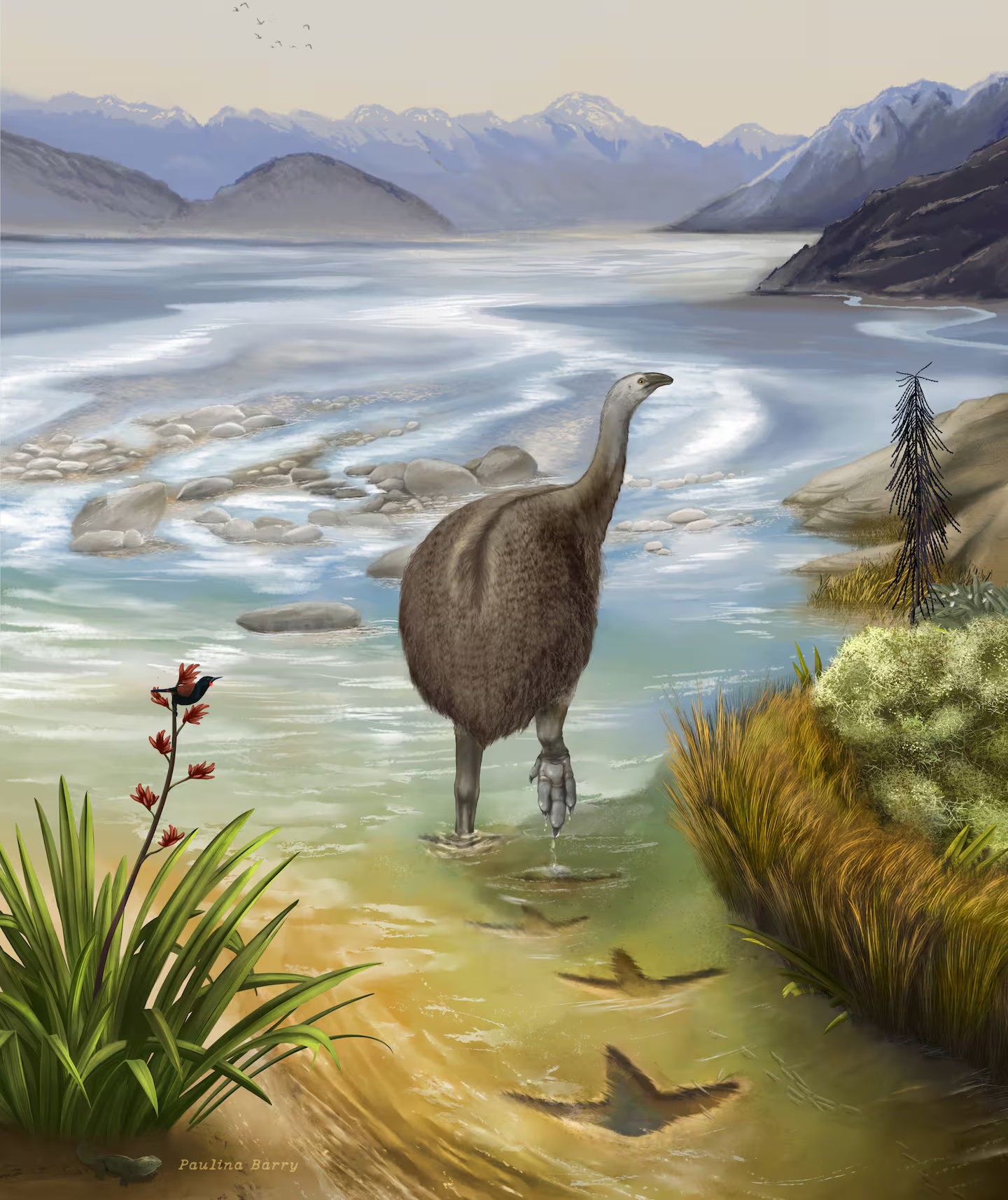
[PaleoOrnithology • 2024] The Moa Footprints from the Pliocene – early Pleistocene of Kyeburn, Otago, New Zealand


An artist’s impression of the moa which created the Kyeburn footprints.

in Fleury, Burns, Richards, Norton, Read, Wesley, Fordyce et Wilcken, 2024. 
 Artwork by Paulina Barry.
 
ABSTRACT
In March, 2019, a trackway of seven footprints was found at a riverbank outcrop of Maniototo Conglomerate Formation in the Kyeburn River, Central Otago, South Island, New Zealand. In this study, we describe this first known occurrence of moa (Dinornithiformes) footprints to be found and recovered in Te Waipounamu/South Island. Footprints of the trackway were ∼46 mm deep, 272–300 mm wide and 260–294 mm in length. An associated separate footprint was 448 mm wide and 285 mm long. Cosmogenic nuclide dating of adjacent overlying beds from the same formation establishes a mean minimum age of burial age for the tracks of 3.57 Ma (+1.62/−1.18 Ma) with a mode of 2.9 Ma, which we interpret to be Late Pliocene, with a conservative age range of Pliocene to Early Pleistocene. The trackway maker is identified as a moa from the Emeidae family, probably from the genus Pachyornis, with a mean mass of 84.61 kg that was travelling at a speed of 2.61 kmh−1. The single adjacent footprint was made by an individual from the family Dinornithidae, most likely from the genus Dinornis with an estimated mass of 158 kg. These moa footprints represent the second earliest fossil record of moa.

KEYWORDS: Trackway, moa footprint‌, Dinornithiformes, cosmogenic nuclide dating, Pliocene‌, Maniototo Conglomerate


Kane Fleury, Emma Burns, Marcus D. Richards, Kevin Norton, Stephen Read, Rachel Wesley, R. Ewan Fordyce and Klaus Wilcken. 2024. The Moa Footprints from the Pliocene – early Pleistocene of Kyeburn, Otago, New Zealand. Journal of the Royal Society of New Zealand. 54(5); 620-642. DOI: doi.org/10.1080/03036758.2023.2264789 
Special issue: Fossil vertebrates from Southern Zealandia: taonga of international significance. Guest Editors: Carolina Loch, Daniel Thomas, Jeffrey Robinson

www.linkedin.com/posts/pamela-naidoo-ameglio_feathery-moas-fossilised-footprints-ancient-activity-7132122722146385920-rgTz

Friday, August 23, 2024

[Ichthyology • 2024] Harriotta avia • A New rhinochimaerid (Chimaeriformes: Rhinochimaeridae) described from the Southwest Pacific


Harriotta avia 
 Finucci,  Didier, Ebert, Green & Kemper, 2024 
 
 Australasia Narrow-nosed Spookfish  ||  DOI: 10.1007/s10641-024-01577-4

Abstract
Harriotta avia sp. nov., a new species of long-nose chimaera (Holocephali: Chimaeriformes: Rhinochimaeridae), is described from specimens collected off New Zealand in the Southwest Pacific Ocean. The species is distinguished from its congeners by a combination of the following characters: elongated, narrow and depressed snout up to 56% BDL; long, slender trunk; beak-like vomerine tooth plate; large eye, length 8–12% BDL and height 5–7% BDL; long dorsal spine reaching slightly beyond apex of the dorsal fin; and slender rod-like pelvic claspers. The skin is deciduous, and uniform chocolate brown when intact. Harriotta avia sp. nov. is also distinguished from other Harriotta species based on DNA sequence divergence of the NADH2 gene. Harriotta avia sp. nov. is reported from the New Zealand-Australian region. Conclusions here show that Harriotta raleighana, a presumed globally distributed species, likely comprises several species and the genus Harriotta warrants a revision with specimens representing all ocean basins.

Keywords: Holocephali, Integrated Taxonomy, Morphology, Genetics, New Zealand, Australia


Harriotta avia sp. nov.

Etymology: The species name is derived from the Latin noun avia (grandmother), in memory of June Thomas who proudly supported her granddaughter’s (BF) science career. The proposed English common name is the Australasia Narrow-nosed Spookfish.


Brittany Finucci, Dominique Didier, David A. Ebert, Madeline E. Green and Jenny M. Kemper. 2024. Harriotta avia sp. nov. – A New rhinochimaerid (Chimaeriformes: Rhinochimaeridae) described from the Southwest Pacific. Environmental Biology of Fishes. DOI: 10.1007/s10641-024-01577-4

Thursday, August 1, 2024

[PaleoOrnithology • 2024] Pakudyptes hakataramea • A New tiny fossil Penguin from the Late Oligocene of New Zealand and the Morphofunctional Transition of the Penguin Wing


Pakudyptes hakataramea 
 Ando, Robinson, Loch, Nakahara, Hayashi, Richards & Fordyce, 2024

 
ABSTRACT
The Late Oligocene is a period of high penguin diversity, following major changes in the marine environment at the Eocene/Oligocene boundary and prior to the emergence of crown penguins in the Miocene. Historically, a large morphological gap existed between the most crownward Platydyptes among the Oligocene penguins from New Zealand and the Early Miocene stem penguins such as Palaeospheniscus from South America. Here we describe a new species that contributes to filling this gap. Pakudyptes hakataramea gen. et sp. nov. is the earliest tiny penguin, overlapping in size with the little penguin Eudyptula minor. Its distinctive combination of a well-developed proximal end of the humerus and an archaic elbow joint provides clues to the evolution of penguin wings. Phylogenetic analysis indicates that penguin wings evolved rapidly from the Late Oligocene to the Early Miocene, together with the acquisition of morphofunctional and hydrodynamical characteristics that enable the excellent swimming ability of modern penguins. As an indicator of aquatic adaptation, bone microanatomy shows a comparable structure to that of Eudyptula. The appearance of the smallest body size and the evolution of modern wings may have led to the ecological diversity of modern penguins, which confirms the importance of Zealandia in penguin evolution.

KEYWORDS: Smallest fossil penguin, Latest Oligocene, New Zealand, phylogeny, evolution of wing


 Pakudyptes hakataramea gen. et sp. nov.


Tatsuro Ando, Jeffrey Robinson, Carolina Loch, Tamon Nakahara, Shoji Hayashi, Marcus D. Richards and Robert Ewan Fordyce. 2024. A New tiny fossil Penguin from the Late Oligocene of New Zealand and the Morphofunctional Transition of the Penguin Wing. Journal of the Royal Society of New Zealand. DOI: doi.org/10.1080/03036758.2024.2362283  
[Special issue: Fossil vertebrates from southern Zealandia]