Showing posts with label Accipitridae. Show all posts

Friday, December 8, 2023

[PaleoOrnithology • 2023] Dynatoaetus pachyosteus • Pleistocene Raptors from Cave deposits of South Australia, with A Description of A New Species of Dynatoaetus (Accipitridae): Morphology, Systematics and Palaeoecological Implications


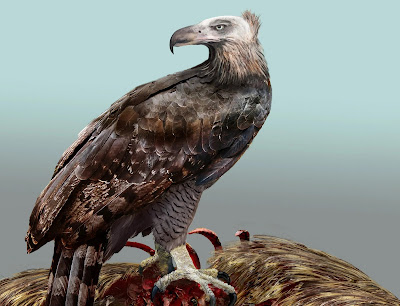
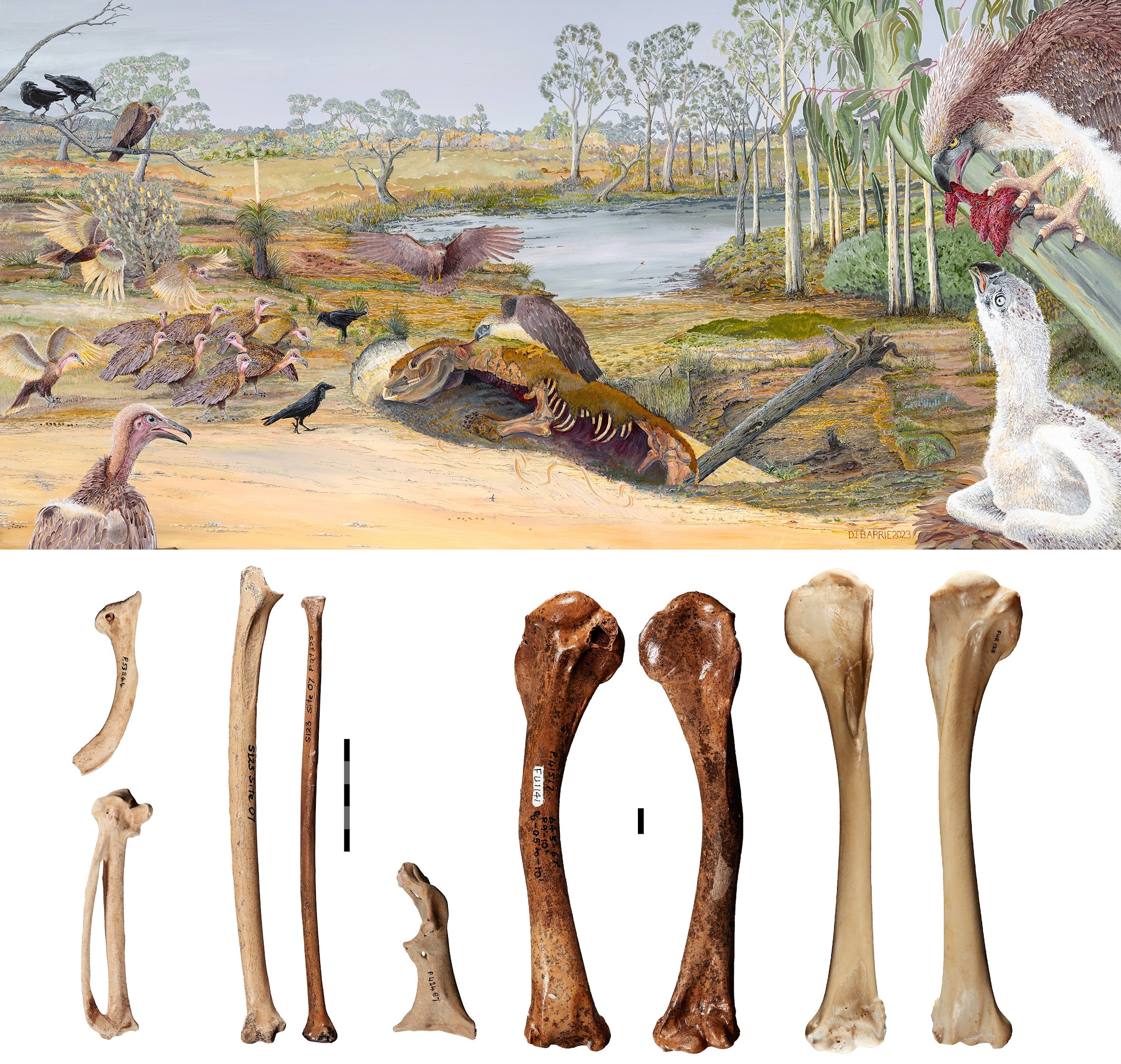
A flock of vultures (Cryptogyps lacertosus) and Australian ravens watch and wait (left), as an adult eagle Dynatoaetus pachyosteus feeds on the carcass of a dead Diprotodon (centre), while a younger bird seeks to join in. In the nearby treetops, a second adult D. pachyosteus feeds its hungry chick (right).

Mather, Lee, Fusco, Hellstrom & Worthy, 2023
Artwork: John Barrie

ABSTRACT 
The Pleistocene fossil record of Australian raptors (Accipitridae: eagles, hawks and Old World vultures) is very poorly understood with only three distinct extinct species confirmed until now. The small Necrastur alacer remains unstudied; however recent research has established Cryptogyps lacertosus as a valid species that, along with the very large Dynatoaetus gaffae, has potential affinities with the Aegypiinae–Circaetinae clade. These, along with a single large liv- ing inland raptor, the Wedge-tailed Eagle Aquila audax, suggest that Australia had an impover- ished diversity of large raptors compared to other similar continental regions. However, fossil material similar in size to A. audax from multiple Pleistocene cave deposits raises the possibility of further taxa and is here assessed. A partial skeleton from Green Waterhole/Fossil Cave in the Tantanoola District of South Australia is referred to Cryptogyps lacertosus on the basis of similar size to bones of this species and that the associated coracoid is identical to that found with a tarsometatarsus that was previously referred to this species, coming from Leaena’s Breath Cave on the Nullarbor Plain, Western Australia. This partial skeleton allowed additional material from the Old Collections, Wellington Caves, and Walli Caves in New South Wales to be referred to this species. A second species, more robust than A. audax, is identified from material from Victoria Fossil Cave at Naracoorte. Phylogenetic analyses determined this species to be the sister taxon of the much larger Dynatoaetus gaffae recently described from several Australian sites, and so we name it as Dynatoaetus pachyosteus sp. nov. Further fragmentary remains attributable to either A. audax, C. lacertosus or D. pachyosteus are recorded from sites in the Wellington Caves complex, NSW. This study increases the known diversity of raptors in Pleistocene Australia, consistent with the presence of the more diverse megafaunal prey that existed at the time.

KEYWORDS: Pleistocene extinction, Australia, Aegypiinae, Circaetinae, avian predators, avian scavengers, taxonomy


A flock of vultures (Cryptogyps lacertosus) and Australian ravens watch and wait (left), as an adult eagle Dynatoaetus pachyosteus feeds on the carcass of a dead Diprotodon (centre), while a younger bird seeks to join in. In the nearby treetops, a second adult D. pachyosteus feeds its hungry chick (right).
Artwork: John Barrie


Ellen K. Mather, Michael S. Y. Lee, Diana A. Fusco, John Hellstrom and Trevor H. Worthy. 2023. Pleistocene Raptors from Cave deposits of South Australia, with A Description of A New Species of Dynatoaetus (Accipitridae: Aves): Morphology, Systematics and Palaeoecological Implications. Alcheringa: An Australasian Journal of Palaeontology. DOI: 10.1080/03115518.2023.2268780 
https://drive.google.com/drive/folders/16mcI69azApGg9oSEPUrI1Mcbn0nmrM2P
  theconversation.com/giant-eagles-and-scavenging-vultures-shared-the-skies-of-ancient-australia-216358
 theguardian.com/australia-news/2023/nov/17/prehistoric-australian-vultures-and-eagles-brought-to-life-in-gory-new-painting


Friday, March 17, 2023

[PaleoOrnithology • 2023] Dynatoaetus gaffae • A Giant Raptor (Aves: Accipitridae) from the Pleistocene of southern Australia


Dynatoaetus gaffae
Mather, Lee, Camens & Worthy, 2023


Abstract
The giant accipitrid Dynatoaetus gaffae gen. et sp. nov. is described from existing and newly collected material. Initial fossil remains were collected from Mairs Cave (Flinders Ranges, South Australia) in 1956 and 1969, and comprised a sternum, distal humerus and two ungual phalanges. A further 28 bones from this individual—including the neurocranium, vertebrae, furculum, and additional wing and leg bones, most of which were incomplete—were discovered at the site in 2021. This allowed identification of additional fossils from the same species in collections from Cooper Creek (Lake Eyre Basin, SA), Victoria Fossil Cave (Naracoorte, SA) and Wellington Caves (Wellington, NSW). Dynatoaetus has variable similarity across elements to those of living species in the Perninae, Gypaetinae, Circaetinae and Aegypiinae. Parsimony and Bayesian phylogenetic analyses of combined morphological and DNA data resolved it as the immediate sister-group to the Aegypiinae within the Circaetinae + Aegypiinae clade. The robust and eagle-like morphology of the lower hindlimbs suggest that the species was a predator, rather than a scavenger, and thus functionally similar to large circaetines such as the Philippine Eagle Pithecophaga jefferyi. Furthermore, this new species is the largest known bird of prey from Australia, much larger than the modern Wedge-Tailed Eagle Aquila audax. It is outsized in Australasia only by female Hieraaetus moorei (the extinct Haast’s Eagle from New Zealand). It is inferred to have been Australia’s top terrestrial avian predator during the Pleistocene, ranging from arid inland Australia to the more temperate coast, and likely became extinct around the time of the megafaunal mass extinction which peaked around 50 Ka. Its extinction in the late Pleistocene, along with the recently described scavenging vulture Cryptogyps lacertosus, marked a distinct decline in the diversity and function of Australia’s raptor guild.

Keywords: Aegypiinae, Accipitriformes, Circaetinae, Taxonomy, Extinction, Pleistocene predatory birds


Visual representation of the parts of the skeleton known from Dynatoaetus gaffae (coloured grey). Image based on Meyer (1897), plate 121


Systematic palaeontology
Accipitriformes Vieillot 1816
Accipitridae Vigors 1824

Dynatoaetus gen. nov.
 
Diagnosis: A large accipitrid distinguishable from other genera by the following combination of characters: a neurocranium that is (1) relatively short and wide compared to Aquila audax; (2) has the line linking the tip of the processus zygomaticus to the ventral tip of the processus paroccipitalis aligned about 45 degrees to the plane of basioccipital-parasphenoidal plane and ventrally encloses a tympanic recess that is longer than high; (3) the condylus occipitalis is relatively large; (4) the mamillar tuberosities (tubercula basilaria) are robust, and prominent caudally; (5) the foramen magnum is near-perpendicular to the basioccipital plane (~ 10 degrees off perpendicular); (6) has prominent tubercula for the insertion for m. pseudotemporalis superficialis on the facies orbitalis. A sternum with (7) distinct and prominently projecting processus labrum internum; (8) a spina externa that is narrower than the apex carinae; (9) a crista medialis carinae that does not extend to the base of the spina externa. A humerus with (10) a weakly ventrally projecting epicondylus ventralis; (11) the distance between the interior margin of the tuberculum supracondylare ventrale and the proximal tip of the condylus dorsalis is equal to that between the tip of the condylus dorsalis and the dorsal margin; and (12) a deep insertion pit for the distal head of the m. pronator profundus. An ulna with (13) a tuberculum carpale that has little prominence cranioventrally. A tarsometatarsus that (14) is robust; (15) has a trochlea metatarsi II that is broad and more distally elongate than trochlea metatarsi III; (16) has the trochleae metatarsorum II and IV with robust plantar flanges and with (17) the plantar openings of the foramen vasculare proximale medialis positioned on the lateral side of the crista medialis hypotarsi; and (18) has the medial side of the shaft deeply excavated caudally by the fossa parahypotarsalis medialis such that the medial margin is very thin.

Etymology: The genus name is a combination of the ancient Greek words δῠνᾰτός (dynatós), meaning strong, mighty, or powerful, and ᾱ̓ετός (āetós) meaning eagle.

 
Dynatoaetus gaffae gen. et sp. nov.

Etymology: The name ‘gaffae’ honours Priscilla Gaff, who first discussed the fossil material of this species in her 2002 thesis revising Australian accipitrids.


Ellen K. Mather, Michael S. Y. Lee, Aaron B. Camens and Trevor H. Worthy. 2023. A Giant Raptor (Aves: Accipitridae) from the Pleistocene of southern Australia. Journal of Ornithology.  DOI: 10.1007/s10336-023-02055-x
  

Wednesday, July 20, 2022

[PaleoOrnithology • 2022] Cryptogyps lacertosus • A New Look at An Old Australian Raptor places “Taphaetuslacertosus de Vis 1905 in the Old World vultures (Accipitridae: Aegypiinae)


Cryptogyps lacertosus (de Vis, 1905)

Cryptogyps Mather, Lee and Worthy 2022 gen. nov.
in Mather, Lee & Worthy, 2022. 

Abstract 
The Australian Pleistocene fossil record of the Accipitridae (hawks, eagles and Old World vultures) is sparse and poorly known. Only two extinct confirmed accipitrid species have been described for this time period; both have received little investigation since their description. One is “Taphaetuslacertosus de Vis, 1905, described from a distal humerus and a quadrate from north-eastern South Australia. While this species was verified as an accipitrid in subsequent studies, its more precise taxonomic affinities have remained conjectural. In this study, a new analysis incorporating newly referred material and phylogenetic analyses using a wide range of accipitriforms reveals that the lectotype humerus of “T.” lacertosus is an Old World vulture in the subfamily Aegypiinae. The associated quadrate, one of two original syntypes from which de Vis named this species, is of an indeterminate species of ardeid. We erect the novel genus Cryptogyps, to accommodate the species ‘lacertosus’, as it cannot be placed in Taphaetus de Vis, 1891, because the type species of this genus, Uroaetus brachialis de Vis, 1889, was transferred back to the genus Uroaetus, a synonym of Aquila Brisson, by de Vis in 1905. Further, U. brachialis is now considered a synonym of Aquila audax (Latham, 1801). Moreover, Taphaetus de Vis, 1891 is a senior homonym of Taphaetus de Vis, 1905, type species Taphaetus lacertosus de Vis, 1905, making the 1905 version of the genus unavailable. Newly referred fossils from Wellington Caves (NSW) and the Nullarbor Plains (WA) reveal this taxon had a wide geographical range across Pleistocene Australia. The referred tarsometatarsus lacks hyper-developed trochleae, indicating that Cryptogyps lacertosus (de Vis, 1905) comb. nov., was probably a scavenger like other aegypiines. Identification of Cryptogyps lacertosus as an aegypiine significantly expands the palaeogeographical range of the Old World vultures, hitherto unknown in Australia. The avian guild of large, obligate scavenging birds of prey, is currently absent in the modern Australian biota, but its former presence is not surprising given the megafauna-rich communities of the Pleistocene.

Key words: Pleistocene fossil birds, Accipitriformes, extinction, scavengers, biogeography, Australia


Cryptogyps Mather, Lee and Worthy 2022 gen. nov.

Type species: ‘Taphaetus’ lacertosus de Vis, 1905: 
Annals of the Queensland Museum 6: 4, pl. 1, fig. 1.

Etymology: The name is derived from a combination of the Ancient Greek words ‘kryptós’ (hidden) and ‘gýps’ (vulture), in reference to the fact that this taxon was known for over 100 years but was generally believed to be an eagle. Cryptogyps also relates to the word ‘crypt’, a word used to describe an underground burial chamber, referencing the discovery of the new material in caves.


Conclusion: 
Taphaetuslacertosus de Vis, 1905, is confirmed to be a valid species of extinct accipitrid, for which the new genus Cryptogyps is erected. Cryptogyps lacertosus (de Vis, 1905) is shown to be an aegypiine vulture that was widespread in southern Australia in the middle to late Pleistocene. The presence of Old World vultures (Aegypiinae) among Pleistocene Australian accipitrids indicates that their taxonomic and ecological diversity was significantly greater then than it is today; the extinction of Cryptogyps lacertosus likely had a distinct impact on those ancient ecosystems.


Ellen K. Mather, Michael S. Y. Lee and Trevor H. Worthy. 2022. A New Look at An Old Australian Raptor places “Taphaetus” lacertosus de Vis 1905 in the Old World vultures (Accipitridae: Aegypiinae). Zootaxa. 5168(1); 1-23. DOI: 10.11646/zootaxa.5168.1.1


Wednesday, December 8, 2021

[PaleoOrnithology • 2021] Hieraaetus moorei • New Zealand's Extinct Giant Raptor killed like An Eagle, ate like A Condor


Hieraaetus moorei (Haast, 1872)

in van Heteren, Wroe, Tsang, ... et Sansalone, 2021. 

Abstract
The extinct Haast's eagle or harpagornis (Hieraaetus moorei) is the largest known eagle. Historically, it was first considered a predator, then a scavenger, but most recent authors have favoured an active hunting ecology. However, the veracity of proposed similarities to carrion feeders has not been thoroughly tested. To infer feeding capability and behaviour in harpagornis, we used geometric morphometric and finite-element analyses to assess the shape and biomechanical strength of its neurocranium, beak and talons in comparison to five extant scavenging and predatory birds. The neurocranium of harpagornis is vulture-like in shape whereas its beak is eagle-like. The mechanical performance of harpagornis is closer to extant eagles under biting loads but is closest to the Andean condor (Vultur gryphus) under extrinsic loads simulating prey capture and killing. The talons, however, are eagle-like and even for a bird of its size, able to withstand extremely high loads. Results are consistent with the proposition that, unlike living eagles, harpagornis habitually killed prey larger than itself, then applied feeding methods typical of vultures to feed on the large carcasses. Decoupling of the relationship between neurocranium and beak shape may have been linked to rapid evolution.

Keywords: finite-element analysis, geometric morphometrics, Haast's eagle, diet, Hieraaetus


 At Craigmore Station, inland Timaru, the Cave of the Eagle shows a painting of Hieraaetus moorei with a dark-coloured body, but an uncoloured head.
 Photographed by Gerard Hindmarsh. 


A. H. van Heteren, S. Wroe, L. R. Tsang, D. R. Mitchell, P. Ross, J. A. Ledogar, M. R. G. Attard, D. Sustaita, P. Clausen, R. P. Scofield and G. Sansalone. 2021. New Zealand's Extinct Giant Raptor (Hieraaetus moorei) killed like An Eagle, ate like A Condor. Proc. R. Soc. B. DOI: 10.1098/rspb.2021.1913
https://phys.org/news/2021-12-bald-haast-eagle-feasted-moa.html

Tuesday, September 28, 2021

[PaleoOrnithology • 2021] Archaehierax sylvestris • An Exceptional Partial Skeleton of A New Basal Raptor (Accipitriformes: Accipitridae) from the late Oligocene Namba Formation, South Australia


Archaehierax sylvestris
Mather, Lee, Camens & Worthy, 2021

 
ABSTRACT
The Australian pre-Pleistocene fossil record of Accipitridae (eagles, hawks, old-world vultures) comprises one latest Oligocene or early Miocene and one middle Miocene species, each represented by partial bones. Globally, most fossil accipitrids are based on single bones. The recent discovery of an older and considerably more complete accipitrid from late Oligocene sediments in Australia is therefore significant. It is derived from the Pinpa Local Fauna from the Namba Formation at Lake Pinpa, South Australia (~26–24 Ma). The fossil, described as Archaehierax sylvestris gen. et sp. nov., represents a raptor that was larger than the black-breasted buzzard Hamirostra melanosternon but smaller and more gracile than the wedge-tailed eagle Aquila audax. Comprehensive morphological and molecular phylogenetic analyses resolved Archaehierax as a basal accipitrid, not closely related to any living subfamily and perhaps the sister taxon to all other accipitrids exclusive of elanines. Relatively short wings similar to species of Spizaetus and Spilornis suggest it was adapted for flight within enclosed forests. Additional accipitrid fossils from the Namba Formation, a distal femur and a distal humerus, are incomparable with the holotype of A. sylvestris; they may represent distinct species or smaller individuals of the new taxon.  

KEYWORDS: Lake Pinpa, Accipitriformes, Cenozoic fossil birds, accipitrid evolution, Australia


Skeleton of an osprey by Eyton (1867) with shaded sections indicating which bones are preserved in the fossil of Archaehierax sylvestris.


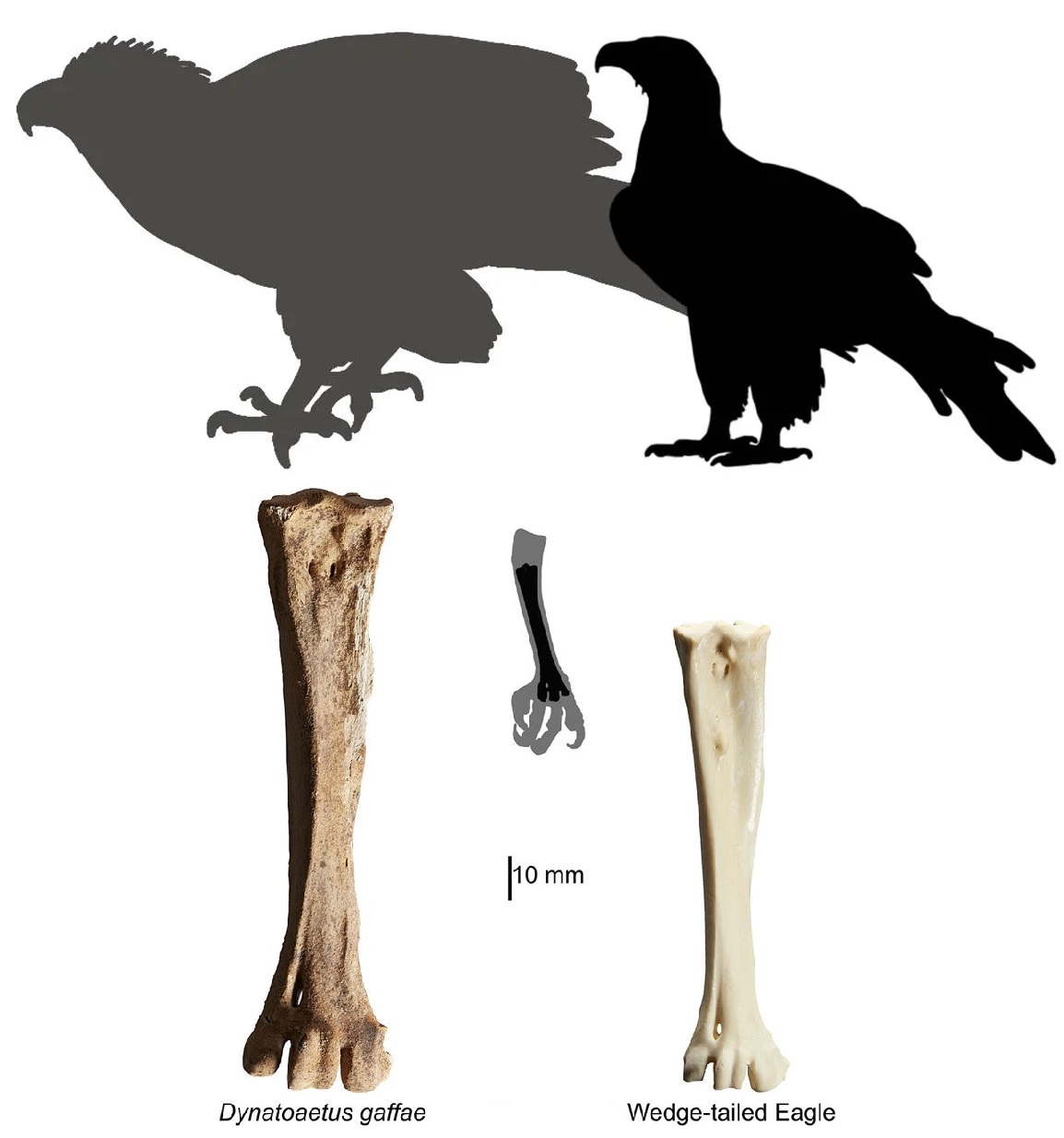
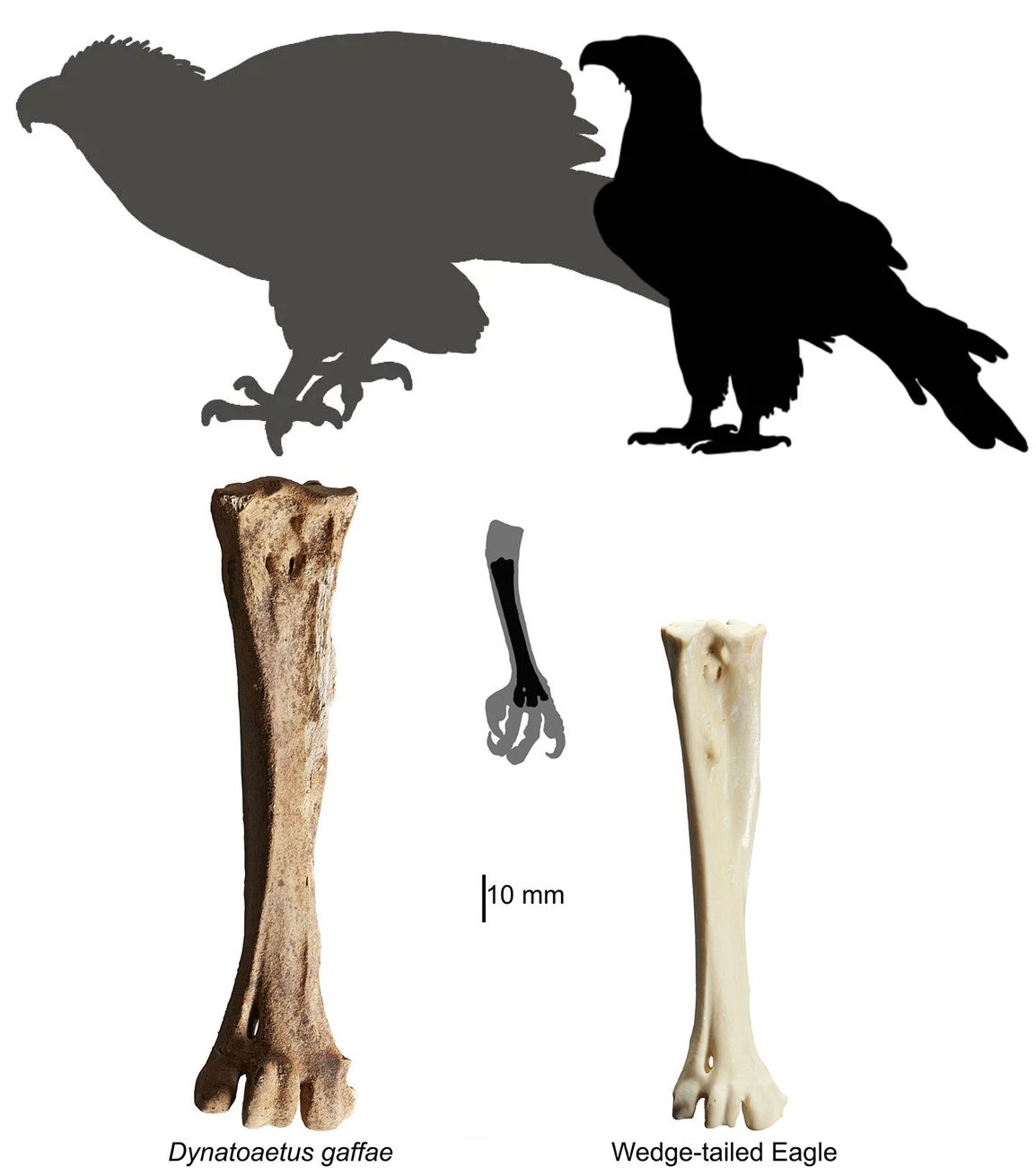
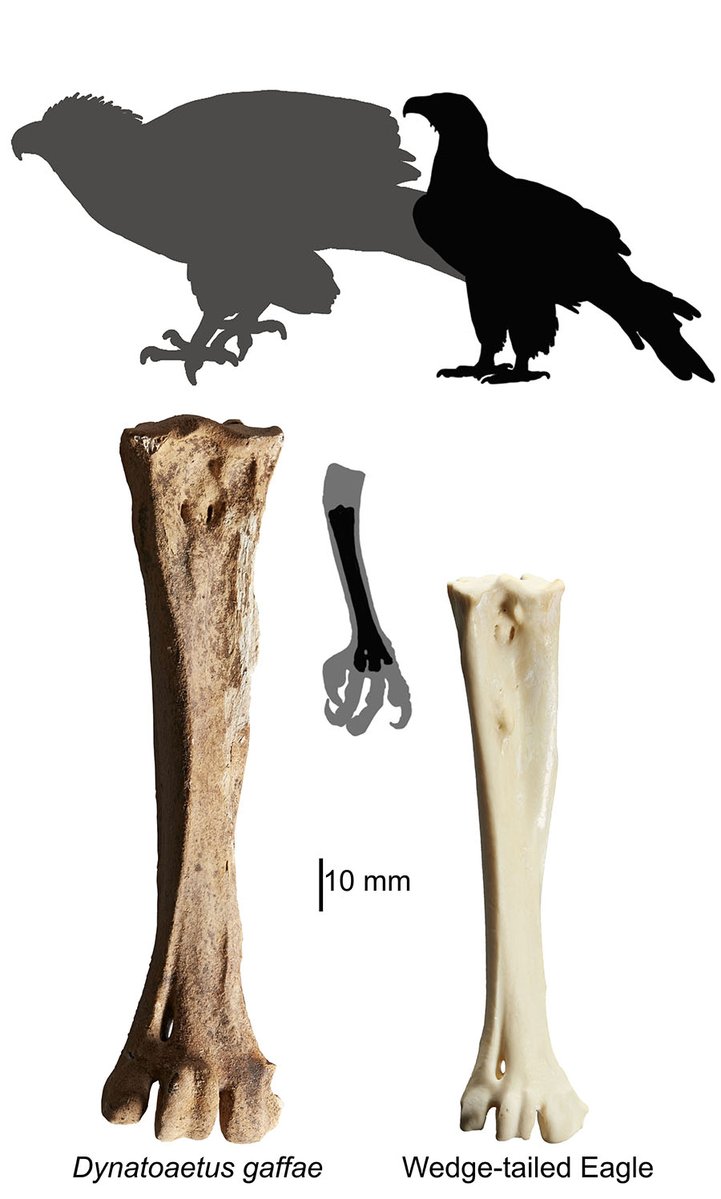
 A comparison of the prepared fossil tarsometatarsus (foot bone) and a hypothesised silhouette of Archaehierax sylvestris (left) compared to the wedge-tailed eagle Aquila audax (right).
The scale bar is 10 mm long.

Systematic palaeontology
Class Aves Linnaeus, 1758
Order Accipitriformes Vieillot 1816 Family Accipitridae Vigors, 1824

Subfamily: Archaehieraxinae subfam. nov.
Type genus: Archaehierax gen. nov.

Remarks: 
The fossil is identified as an accipitrid due to the following combination of characters: Skull – Rostrum deep and narrow, with hooked tip and a large, broad nasal aperture; Tibiotarsus – Pons supratendineus ossified, aligned steeply transversely, medially placed, with unbranched canalis tendinosus, and distal condyles much wider than craniocaudally deep; Tarsometatarsus – Robust, with monosulcate hypotarsus, the lateral and medial hypotarsal crests widely separated and trochleae metatarsorum splayed both medially and laterally, and dorsally arched in distal view; Foot – Four digits with raptorial unguals, those of digits 1 and 2 relatively large; Digit IV – phalanges 2 and 3 are very short compared to phalanx 4.

The fossil can be excluded from Falconiformes (Falconidae) and the other families of Accipitriformes (Cathartidae, Sagittariidae, Pandionidae) by the morphology of the tarsometatarsal hypotarsus cristae and sulcus. The cristae are fused or partially fused together to enclose the sulcus in Cathartidae, Sagittariidae, and Pandionidae, while in Falconidae the medial crista is connected to the shaft by a ridge that extends two-thirds of its length, features that are absent in the fossil.

Diagnosis: 
Accipitrids in which the following autapomorphic features are found: the pila medialis of the sternum dorsally separates two deep pneumatic fossae, the humerus has the caput humeri only slightly elevated proximally past the tuberculum ventralis, the tip of the processus procoracoideus of the coracoid sharply curves inwards ventrally towards the medial face of the bone, the tibiotarsus has the lateral/distal retinaculum scar in a deep fossa, the tarsometatarsus is relatively elongate with narrow trochleae metatarsorum that are separated by wide incisurae, and the incisura for the m. flexor hallucis brevis tendon is large, distinct, and extends distal to the fossa metatarsi I. In addition to this, the following features occur: the rostral tip of the rostrum is hooked below the tomial margin at a relatively shallow 30–40° angle, the quadrate has a deep, distinct foramen pneumaticum caudomediale, and the sternum has the apex carinae displaced caudally from the base of the spina externa.,


Genus Archaehierax Mather, Lee, Camens and Worthy gen. nov.
 
Etymology: Archaehierax is derived from the Greek words ‘archaios’, meaning ancient, and ‘hierax’, meaning hawk. Gender masculine.


Archaehierax sylvestris Mather, Lee, Camens and Worthy gen. et sp. nov.

Etymology: The species name ‘sylvestris’ is derived from the Greek world ‘sylvas’, meaning forest, and the Latin suffix ‘-estris’, meaning ‘belonging to’.


Ellen K. Mather, Michael S. Y. Lee, Aaron B. Camens and Trevor H. Worthy. 2021. An Exceptional Partial Skeleton of A New Basal Raptor (Aves: Accipitridae) from the late Oligocene Namba Formation, South Australia. Historical Biology: An International Journal of PaleobiologyDOI: 10.1080/08912963.2021.1966777

25-million-year-old ancient eagle ruled the roost in Australia
63 bone fossil finding in desert is one of the “best preserved” eagles ever and a very rare discovery

Tuesday, July 26, 2016

[PaleoOrnithology • 2016] Mioneophron longirostris • A New Old World Vulture from the late Miocene of China sheds light on Neogene shifts in the past Diversity and Distribution of the Gypaetinae


Mioneophron longirostris 
 Li, Clarke, Zhou & Deng, 2016
 
 DOI: 10.1642/AUK-15-240.1 

ABSTRACT
Neogene fossils of Old World vultures (Aegypiinae and Gypaetinae) are known from both Old World and New World records. There are no extant Old World vultures in the Americas today, although a large diversity of Gypaetinae is known from Miocene to late Pleistocene records. Despite a comparatively large number of North American gypaetine fossils, complete specimens have rarely been reported from Eurasia and Africa. We describe the exceptional skeleton of a new gypaetine vulture from the late Miocene deposits of the Linxia Basin in northwestern China. The specimen is the oldest record of Gypaetinae from Eurasia or Africa. A reexamination of the geographic and temporal distribution of most Old World vultures from Neogene deposits indicates a diverse radiation, coincident with early- to mid-Miocene grassland expansion for Gypaetinae. Although the diversification of Aegypiinae has been linked to the transition from C3 to C4 grassland, Gypaetinae diversification predates that transition in both North America and Asia. A shift in the known latitudinal distribution is also noted. Neogene records of Old World vultures are found primarily in mid- and high-latitude regions of North America and Eurasia as well as in the middle and low latitudes of Eurasia and Africa. With very few records in the middle to late Miocene, a latitudinal distribution similar to that of extant species is first seen in the early Pliocene. The new fossil provides further temporal constraints on avian subclade diversification. It is also consistent with an emerging pattern of profound recent shifts in avian diversity and distribution more generally.

Keywords: extinction, fossil, Gypaetinae, Linxia, Old World vulture


SYSTEMATIC PALEONTOLOGY

AVES Linnaeus, 1758
ACCIPITRIDAE Vieillot, 1816
Gypaetinae Vieillot, 1816

Mioneophron longirostris, gen. et sp. nov. (Figures 1–4)


Holotype: HMV 1877: A nearly complete skeleton (Figure 1) preserved in yellow-brownish siltstone with carbonate cementation. The proximal right tarsometatarsus and distal left tarsometatarsus have been rearranged after collection (illustrated as dark gray regions in Figure 1). Some bones have been fabricated and others recomposed in a wrong position (e.g., pedal digits). The left distal humerus is reconstructed with plaster and the proximal right tarsometatarsus appears to be a proximal tibiotarsal fragment, without any definite clue to its affinity. The position of the hallux opposite of where it should be in the right pes is one indication that the pedal digits were recomposed.

Locality and horizon: The holotype was collected from Baihua Village, Zhuangheji Town, Guanghe County, in Gansu Province, northwestern China (Figure 5: star), in the Upper Miocene Liushu Formation, Linxia Basin. All currently known fossil birds in the Linxia Basin are from the same unit, which is characterized by a distinct matrix lithology (Deng et al. 2013). The bird fossils have been acquired from local farmers and collectors. The holotype specimen is archived in the Hezheng Paleozoological Museum, Gansu Province, China.

Etymology: The genus name, “Mioneophron,” references the Miocene age and the proposed affinity of the new specimen with Neophron. The adjectival species name, longirostris, references an elongate rostrum.

Diagnosis: Mioneophron longirostris can be differentiated from all other gypaetine and aegypiine vultures by the unique presence of a combination of the following features: a long and narrow rostrum with small oval-shaped nares (Figure 1), a well-projected and globose humeral head and distinct caudal ridge on the margin of the deltopectoral crest, a much longer ulna than tibiotarsus (ratio = 1.45), and a distinct groove between the dorsal iliac ridges (Figure 2).


Systematic placement of the new species

The new species shares several features with gypaetine vultures, including the relatively weakly projected transverse nuchal crest on the basicranium as well as the broad humeral deltopectoral crest. It also has fewer cervical vertebrae (14, vs. 15–17 in Aegypiinae; Rich 1980, Holdaway 1994), and the postacetabular ilia are incompletely fused to the sacrum (Figure 4; Jollie 1976, 1977a, 1977b, 1977c), both of which are features consistent with gypaetine vultures. However, Mioneophron has a wider deltopectoral crest than aegypiine vultures, a deeper humeral capital incisure, a gentler bicipital crest, and a shorter mandibular symphysis. Furthermore, unlike in aegypiine vultures, no pneumatic foramina are present on the proximal surface of the pisiform process of the carpometacarpus (Manegold et al. 2014). The medial hypotarsal crest is slightly higher than that of the lateral one in the cranial view, whereas in Aegypius, Trigonoceps, and Torgos the 2 hypotarsal crests are very similar in height.


 Zhiheng Li, Julia A. Clarke, Zhonghe Zhou and Tao Deng. 2016. A New Old World Vulture from the late Miocene of China sheds light on Neogene shifts in the past diversity and distribution of the Gypaetinae.  The Auk. 133(4); 615-625. DOI: 10.1642/AUK-15-240.1


RESUMEN: Los fósiles del Neógeno de buitres del Viejo Mundo (Aegypiinae y Gypaetinae) se conocen de localidades en el Viejo y el Nuevo Mundo. Actualmente no existen buitres del Viejo Mundo en las Américas, aunque se conoce una gran diversidad de Gypaetinae a partir de registros del Mioceno al Pleistoceno tardío. A pesar de un número comparativamente grande de fósiles de Gypaetinae en Norte América, los reportes de especímenes completos en Eurasia y África son raros. En este trabajo describimos el esqueleto excepcional de un nuevo buitre gypaetino de los depósitos del Mioceno tardío de la cuenca Linxia en el noreste de China. El espécimen es el registro más viejo de Gypaetinae de Eurasia o África. La reevaluación de la distribución geográfica y temporal de la mayoría de los buitres del Viejo Mundo en depósitos del Neógeno indica una radiación diversa que coincide con la expansión de las praderas durante el Mioceno temprano a medio. Aunque la diversificación de Aegypiinae ha sido relacionada con la transición de praderas C3 a praderas C4, la diversificación de Gypaetinae precede esa transición en Norte América y Asia. También notamos un cambio en la distribución latitudinal. Los registros del Neógeno de buitres del Viejo Mundo se encuentran principalmente en regiones de latitud media y alta en Norte América y Eurasia, y también en regiones de latitud media y baja en Eurasia y África. Con tan pocos registros en el Mioceno medio a tardío, una distribución latitudinal similar a la de las especies actuales sólo se ve inicialmente en el Plioceno temprano. El nuevo fósil impone más restricciones temporales en la diversificación de subclados de aves. También es consistente con un patrón emergente de cambios profundos recientes en la diversidad y distribución de las aves en general.

Palabras clave: buitres del Viejo Mundo, extinción, fósil, Gypaetinae, Linxia

Wednesday, September 25, 2013

[Ornithology • 2013] Discovery of the critically endangered Flores Hawk-Eagle Nisaetus floris on Alor island, Indonesia


The Flores Hawk Eagle Nisaetus floris was first treated as a separate species by Gjershaug et al. (2004) because it is morphologically distinct from Changeable Hawk Eagle N.cirrhatus; it was previously considered to be a subspecies of the latter. It is now an Indonesian endemic only known to occur on Flores, Sumbawa and Lombok as well as on two satellite islands, Satonda near Sumbawa and Rinca near Flores. Komodo was mentioned by Coates & Bishop (1997) as part of the range but no further details were provided. However further confirmation came in November 2011 when a bird was photographed on a tiny island just 800 m from Komodo, perched in mangroves, presumably examining a colony of fruit bats roosting there.

......


Collaerts P, Collaerts E, Verbelen P, Trainor C.R. 2013. Discovery of the critically endangered Flores Hawk-Eagle Nisaetus floris on Alor island, Indonesia. BirdingASIA. 19:48-51.

[Ornithology • 2006] Taxonomy and Conservation status of Hawk-eagles (genus Nisaetus) in South-East Asia


Javan Hawk-eagle Spizaetus bartelsi 
by Trond Haugskott

Morphological, vocal and molecular data have been used to reevaluate the taxonomy of some Asian Nisaetus taxa. This name is used instead of Spizaetus because the latter genus is polyphyletic with clades in Asia, South America and Africa. The Changeable Hawk-eagle complex (N. cirrhatus cirrhatus, N. c. limnaeetus, N. c. floris, N. lanceolatus and N. philippensis) has been studied. We propose that Nisaetus floris (Flores Hawk-eagle) should be treated as a distinct species, whereas the taxonomic status of Nisaetus c. cirrhatus and N. c. limnaeetus is still uncertain. We also propose that the Philippine Hawk-eagle should be split into two species Nisaetus philippensis and N. pinskeri. In the Mountain Hawk-eagle Nisaetus nipalensis complex, we propose that Nisaetus kelaarti (Legge’s Hawk-eagle) should be treated as a distinct species. The conservation status of Nisaetus floris, Nisaetus kelaarti and Nisaetus bartelsi has been evaluated from population density estimates, which are based on territory size. N. floris and N. bartelsi qualify for the category “Endangered” on the IUCN Red List, whereas N. kelaarti qualifies as “Near Threatened”. The changes in taxonomy of Nisaetus floris and N. kelaarti meet the qualification for being included in the Red List. 


Gjershaug, Jan Ove. 2006. Taxonomy and Conservation status of Hawk-eagles (genus Nisaetus) in South-East Asia. Doctoral theses at NTNU (Norwegian University of Science and Technology). pp. 91. 

[Ornithology • 2004] Nisaetus (Spizaetus) floris | Flores Hawk Eagle • The Taxonomic Status of the Flores Hawk Eagle Spizaetus floris


Abstract
The Changeable Hawk Eagle Spizaetus cirrhatus complex ranges from India (cirrhatus) through South-East Asia (mainly limnaeetus) to Flores, Sumbawa and Lombok, Indonesia (floris). The latter taxon is morphologically very distinct from the widespread limnaeetus. It has diagnostic white patches on the upperside of the inner parts of the primaries, a juvenile-like adult plumage, and it is much larger than limnaeetus. It is allopatric with limnaeetus without any known geographical overlap. The large morphological differences indicate that the two taxa are reproductively isolated. We suggest that Spizaetus floris be treated as a distinct species with the English name of Flores Hawk Eagle.

Figure 1. Ranges of taxa in the Changeable Hawk Eagle Spizaetus cirrhatus complex.


Gjershaug, J. O., Kwaløy, K., Røv, N., Prawiradilaga, D. M., Suparman, U. & Rahman, Z. 2004. The Taxonomic Status of the Flores Hawk Eagle Spizaetus floris. Forktail. 20: 55–61.