Showing posts with label 1995. Show all posts

Thursday, May 9, 2024

[Paleontology • 2024] Phylogenetic Position of Kinnareemimus khonkaenensis (Dinosauria: Theropoda: Ornithomimosauria) from the Lower Cretaceous of Thailand


Kinnareemimus khonkaenensis  Buffetaut, Suteethorn & Tong, 2009

in Samathi, 2024. 

Abstract
A small-bodied ornithomimosaur, Kinnareemimus khonkaenensis Buffetaut, Suteethorn, and Tong 2009, from the Lower Cretaceous Sao Khua Formation of northeastern Thailand was first reported in 1995, then named in 2009. It is the only report of this group in Southeast Asia and was concluded to be a member of Ornithomimosauria, more derived than Harpymimus and Garudimimus but more basal than Archaeornithomimus. Since then, a few published studies have analyzed the phylogenetic position of Kinnareemimus but failed to find it within the clade Ornithomimosauria. Here, the phylogenetic analyses for assessing the relationships of Kinnareemimus within Ornithomimosauria were performed. The results suggested it might be a basal ornithomimosaur or belongs to the subclade Deinocheiridae. Kinnareemimus shares with deinocheirids the proximally projected cnemial crest and the shape of the fibula in proximal view. Its metatarsal III shows subarctometatarsalian condition with metatarsal III pinched between II and IV but visible in anterior view proximally, which might have evolved independently from other ornithomimids. However, the basal position of Kinnareemimus could also be due to the immaturity and the incomplete nature of this animal.

Reptilia, Ornithomimosauria, Southeast Asia, subarctometatarsalian metatarsus, Early Cretaceous Sao Khua Formation, Paleobiogeography


Adun SAMATHI. 2024. Phylogenetic Position of Kinnareemimus khonkaenensis (Dinosauria: Theropoda: Ornithomimosauria) from the Lower Cretaceous of Thailand. Zootaxa. 5448(1); 67-84. DOI: 10.11646/zootaxa.5448.1.4 
 

Thursday, June 16, 2016

[Herpetology • 2016] How Embryos Escape from Danger: the Mechanism of Rapid, Plastic Hatching in Red-eyed Treefrogs Agalychnis callidryas


Red-eyed treefrog eggs Agalychnis callidryas hatching to escape from a cat-eyed snake Leptodeira septentrionalis
photo: Karen M. Warkentin NationalGeographic.com  DOI:  10.1242/jeb.139519

ABSTRACT

Environmentally cued hatching allows embryos to escape dangers and exploit new opportunities. Such adaptive responses require a flexibly regulated hatching mechanism sufficiently fast to meet relevant challenges. Anurans show widespread, diverse cued hatching responses, but their described hatching mechanisms are slow, and regulation of timing is unknown. Arboreal embryos of red-eyed treefrogs, Agalychnis callidryas, escape from snake attacks and other threats by very rapid premature hatching. We used videography, manipulation of hatching embryos and electron microscopy to investigate their hatching mechanism. High-speed video revealed three stages of the hatching process: pre-rupture shaking and gaping, vitelline membrane rupture near the snout, and muscular thrashing to exit through the hole. Hatching took 6.5–49 s. We hypothesized membrane rupture to be enzymatic, with hatching enzyme released from the snout during shaking. To test this, we displaced hatching embryos to move their snout from its location during shaking. The membrane ruptured at the original snout position and embryos became trapped in collapsed capsules; they either moved repeatedly to relocate the hole or shook again and made a second hole to exit. Electron microscopy revealed that hatching glands are densely concentrated on the snout and absent elsewhere. They are full of vesicles in embryos and release most of their contents rapidly at hatching. Agalychnis callidryas' hatching mechanism contrasts with the slow process described in anurans to date and exemplifies one way in which embryos can achieve rapid, flexibly timed hatching to escape from acute threats. Other amphibians with cued hatching may also have novel hatching mechanisms.


Kristina L. Cohen, Marc A. Seid and Karen M. Warkentin. 2016. How Embryos Escape from Danger: the Mechanism of Rapid, Plastic Hatching in Red-eyed Treefrogs. Journal of Experimental Biology. 219: 1875-1883; DOI:  10.1242/jeb.139519

How red-eyed treefrog embryos hatch in seconds http://phy.so/385231208 via @physorg_com


 ABSTRACT: The life histories of many animals are characterized by niche shifts, the timing of which can strongly affect fitness. In the tree frog Agalychnis callidryas, which has arboreal eggs, there is a trade-off between predation risks before and after hatching. When eggs are attacked by snakes, tadpoles escape by hatching rapidly and falling into the water below. Eggs not attacked by snakes hatch later, when newly emerged tadpoles are less vulnerable to aquatic predators. Plasticity in hatching allows embryos to use immediate, local information on risk of mortality to make instantaneous behavioral decisions about hatching and the accompanying shift from arboreal to aquatic habitats.

K M Warkentin. 1995. Adaptive Plasticity in Hatching Age: A Response to Predation Risk Trade-Offs. Proc. Natl. Acad. Sci. USA.  92(8); 3507-3510. DOI: 10.1073/pnas.92.8.3507

Karen M. WARKENTIN. 2000. Wasp predation and wasp-induced hatching of red-eyed treefrog eggs. ANIMAL BEHAVIOUR. 60, 503–510. DOI: 10.1.1.540.2688

History of the Golfo Dulce Region, Costa Rica [Historia natural y cultural de la región del Golfo Dulce, Costa Rica] 


Monday, March 3, 2014

[Invertebrate • 1995] Review of Scorpionida from Thailand with descriptions of Thaicharmus mahunkai gen. et sp. n. and Lychas krali sp. n. (Buthidae)


Kovařík. 1995. Review of Scorpionida from Thailand with descriptions of Thaicharmus mahunkai gen. et sp. n. and Lychas krali sp. n. (Buthidae). Acta Soc. Zool. Bohem. 59(3/4); 187-207. 

Wednesday, July 10, 2013

[Ichthyology • 1995] Carinotetraodon salivator • a New Species of Pufferfish (Teleostei: Tetraodontidae) from Sarawak, Malaysia


Carinotetraodon salivator K. K. P. Lim & Kottelat, 1995

Abstract
 Carinotetraodon salivator, a new species of freshwater pufferfish, is described from Sarawak. It differs from its only known congener, C. lorteti, in having a shallower body (depth 36-41% SL, vs. 45- 5 3), 10 anal fin rays (vs. 11), 16-17 pectoral fin rays (vs. 14-15), 17-18 (mode 18) vertebrae (vs. 15-17, mode 16), eyes situated nearer the dorsal profile of the head, a distinct pale blotch present under the lower lip, a white distal margin absent from the caudal fin, and a ventrum which is striped in females and cross-banded in mature males. A lectotype is designated for Tetraodon borneensis Regan, 1902 .

Kelvin K.P. Lim; Maurice Kottelat . 1995. Carinotetraodon salivator, a New Species of Pufferfish from Sarawak, Malaysia (Teleostei: Tetraodontidae). Japanese Journal of Ichthyology. 41(4): 359-365.  http://www.wdc-jp.biz/pdf_store/isj/publication/pdf/41/414/41401.pdf

Saturday, September 1, 2012

[Paleontology • 1995 / Invalid] Chatterjeea elegans • Late Triassic (Carnian-Norian) Tetrapods from the Southwestern United States

Chatterjeea elegans Long & Murry, 1995 


Long R and Murry P 1995. Late Triassic (Carnian-Norian) Tetrapods from the Southwestern United States. New Mexico Museum of Natural History and Science Bulletin 4. Pp. 153-163.

Wednesday, August 8, 2012

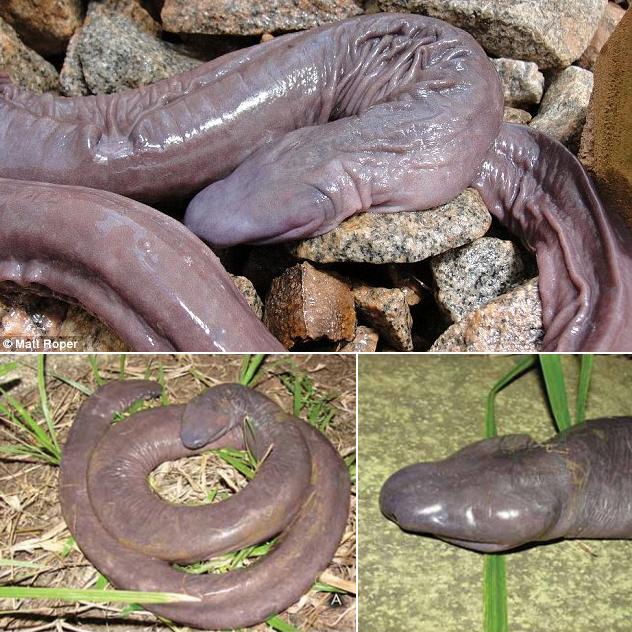
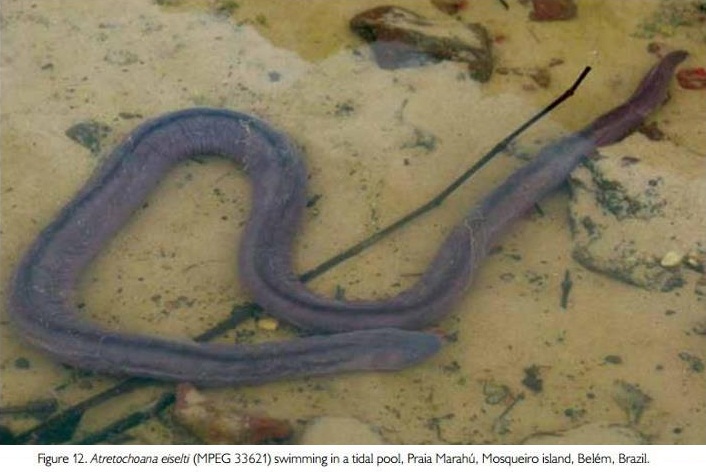
[Herpetology • 2011] Discovery of the largest lungless tetrapod, Atretochoana eiselti (Taylor, 1968) (Amphibia: Gymnophiona: Typhlonectidae) in its natural habitat in Brazilian Amazonia


Abstract
 We report the occurrence of the limbless and lungless tetrapod, Atretochoana eiselti, in two widely separated Brazilian Amazonian lowland localities, one (Mosqueiro island and Baía de Marajó, Belém) near the mouth of the Amazon river and another (Cachoeira Santo Antônio) near the border between Brazil and Bolivia in the Madeira river. It is shown that this species is not an inhabitant of cool, oxygen rich and fast running water in elevated localities as supposed until now, but on the contrary occurs in warm (24-30 °C), turbid, fast running water in the lowland Brazilian Amazon basin. We describe the probable habitat and three freshly preserved specimens (one male, two females) and compare them to the only two specimens known; some data are provided about the biology of this species, that seems to have a wide distribution in Brazilian Amazonia and possibly also occurs in other countries, like Bolivia.

Keywords: Atretochoana eiselti. Gymnophiona. Lungless vertebrate. Amazon Basin. Brazil.


Discovery of the largest lungless tetrapod, Atretochoana eiselti (Taylor, 1968) (Amphibia: Gymnophiona: Typhlonectidae), in its natural habitat in Brazilian Amazonia
Descoberta do maior Tetrapoda apulmonado, Atretochoana eiselti (Taylor, 1968) (Amphibia: Gymnophiona: Typhlonectidae), em seu habitat natural na Amazônia brasileira


Atretochoana : Nussbaum and Wilkinson gave this species its own genus when they reported on the results of their research in a 1995 issue of the Proceedings of the Royal Society of London Series B. The name they gave this genus was Atretochoana, from the Greek word atretos, meaning "imperforate", and the Greek word choana, referring to a funnel or tube.


 Nussbaum, Ronald A.; Wilkinson, Mark. 1995. A New Genus of Lungless Tetrapod: A Radically Divergent Caecilian (Amphibia: Gymnophiona). Proceedings of the Royal Society of London Series B Biological Sciences. 261 (1362): 331–339. DOI:10.1098/rspb.1995.0155.
Wilkinson, M.; Sebben, A.; Schwartz, E.N.F.; Schwartz, C.A. 1998. The largest lungless tetrapod: report on a second specimen of Atretochoana eiselti (Amphibia: Gymnophiona: Typhlonectidae) from Brazil. Journal of Natural History. 32 (4): 617–627. DOI:10.1516/Q417-21HR-6615-7217  bmnh.org/PDFs/MW_98_second.pdf

Hoogmoed, Marinus Steven; Coragem, Juliano Tupan. 2011. Discovery of the largest lungless tetrapod, Atretochoana eiselti (Taylor, 1968) (Amphibia: Gymnophiona: Typhlonectidae), in its natural habitat in Brazilian Amazonia. Boletim do Museu Paraense Emílio Goeldi : Ciências Naturais. 6 (3): 241–262.

[Herpetology • 1998] The largest lungless tetrapod: a second specimen of Atretochoana eiselti (Amphibia: Gymnophiona: Typhlonectidae) from Brazil


The discovery is reported of a second specimen  of the radically divergent lungless aquatic caecilian  Atretochoana eiselti (Taylor), previously known  only from the holotype. Aspects of the morphology of the second specimen  are described and compared to the holotype, allowing a minimal evaluation of variation within this enigmatic  species.  With a  total  length  of  805 mm, the second specimen is the largest known lungless  tetrapod. Most  of the  distinctive  morphological features reported for the holotype are  true  of the second specimen  also indicating  that the  holotype  is  not  a  'hopeful  monster'.  An  important  exception,  from  the perspective of species  identification, is  variation  in  the  form  of the  pattern  of denticulations about the cloacal disk.  Although precise  locality data  are lacking for both the holotype and  the second specimen,  the latter specimen was  almost certainly collected more recently and from within Brazil.  This justifies  increased expectation  that  this  remarkable  species  is  still  extant  and  that  it  will  be rediscovered. 
Keywords:  Atretochoana, Typhlonectidae, Gymnophiona, Caecilian, lunglessness, Neotropics, Brazil. 


 Nussbaum, Ronald A.; Wilkinson, Mark. 1995. A New Genus of Lungless Tetrapod: A Radically Divergent Caecilian (Amphibia: Gymnophiona). Proceedings of the Royal Society of London Series B Biological Sciences. 261 (1362): 331–339. DOI:10.1098/rspb.1995.0155 .

Wilkinson, M.; Sebben, A.; Schwartz, E.N.F.; Schwartz, C.A. 1998. The largest lungless tetrapod: report on a second specimen of Atretochoana eiselti (Amphibia: Gymnophiona: Typhlonectidae) from Brazil. Journal of Natural History. 32 (4): 617–627. DOI:10.1516/Q417-21HR-6615-7217

Hoogmoed, Marinus Steven; Coragem, Juliano Tupan. 2011. Discovery of the largest lungless tetrapod, Atretochoana eiselti (Taylor, 1968) (Amphibia: Gymnophiona: Typhlonectidae), in its natural habitat in Brazilian Amazonia. Boletim do Museu Paraense Emílio Goeldi : Ciências Naturais. 6 (3): 241–262.


[Herpetology • 1995] Atretochoana (originally Typhlonectes) eiselti • A New Genus of Lungless Tetrapod: A Radically Divergent Caecilian (Amphibia: Gymnophiona)


Abstract
Lunglessness is rare in the Tetrapoda and previously recorded only in salamanders (Amphibia: Caudata). Here we report lunglessness in another group of tetrapods, the poorly known tropical caecilians (Amphibia: Gymnophiona). Typhlonectes eiselti is a lungless, aquatic caecilian from South America known only from the single holotype specimen, NMW 9144 (Vienna Museum of Natural History). At a total length of 725 mm, NMW 9144 is by far the largest known lungless tetrapod. It also has a startling array of other radically divergent morphological features, many unique, and some correlated with lunglessness including: sealed choanae (paired internal nostrils); complete absence of pulmonary blood vessels; a repatterned skull with post-occipital jaw articulation; and a novel cranial muscle associated with an elongate and redirected stapes. This remarkable combination of highly derived characters sets Typhlonectes eiselti apart from all other caecilians and places it on a novel evolutionary trajectory. A new genus is described to accommodate this form.

Hoogmoed, Marinus Steven; Coragem, Juliano Tupan. 2011. Discovery of the largest lungless tetrapod, Atretochoana eiselti (Taylor, 1968) (Amphibia: Gymnophiona: Typhlonectidae), in its natural habitat in Brazilian Amazonia. Boletim do Museu Paraense Emílio Goeldi : Ciências Naturais. 6 (3): 241–262.

Wilkinson, M.; Sebben, A.; Schwartz, E.N.F.; Schwartz, C.A. 1998. The largest lungless tetrapod: report on a second specimen of Atretochoana eiselti (Amphibia: Gymnophiona: Typhlonectidae) from Brazil. Journal of Natural History 32 (4): 617–627. DOI:10.1516/Q417-21HR-6615-7217

 Nussbaum, Ronald A.; Wilkinson, Mark. 1995. A New Genus of Lungless Tetrapod: A Radically Divergent Caecilian (Amphibia: Gymnophiona). Proceedings of the Royal Society of London Series B Biological Sciences. 261 (1362): 331–339. DOI:10.1098/rspb.1995.0155 .

Monday, July 30, 2012

[Paleontology • 1995] Montanazhdarcho minor • an azhdarchid pterosaur from the Two Medicine Formation (Late Cretaceous, Campanian) of Montana.


The wing skeleton of the Campanian azhdarchid pterosaur Montanazhdarcho minor Vidian et al. 1995 is described and compared to other Cretaceous pterosaurs. It is distinguished from all other known azhdarchids by its small mature size, among other characters. Notable features include elongated cervical vertebrae with weak neural crests, a ring-like pectoral girdle, and an unwarped deltopectoral crest that is 30% of the length of the humerus. The ulna is slightly longer than the wing metacarpal, and the articular surface of the radius lacks a central pneumatic foramen. The wing metacarpal has a rounded dorsal condyle but there is no median ridge between the distal condyles. The mandible is edentulous, further support is given to the reduced distal expansion of the deltopectoral crest as an azhdarchid svnapomorphv. 


Padian, K., Horner, J.R., and de Ricqlès, A.J. 1993. A new azhdarchid pterosaur from the Two Medicine Formation (Late Cretaceous, Campanian) of Montana, identified on the basis of bone histology. Journal of Vertebrate Paleontology. 13: 52A
K. Padian, A. J. de Ricqlès, and J. R. Horner. 1995. Bone histology determines identification of a new fossil taxon of pterosaur (Reptilia: Archosauria). Comptes Rendus de l’Academie des Science, Serie II (320): 77-84.
McGowen, M.R.; Padian, K.; de Sosa, M.A.; Harmon, R.J. 2002. Description of Montanazhdarcho minor, an azhdarchid pterosaur from the Two Medicine Formation (Campanian) of Montana. PaleoBios. 22 (1): 1–9.

Thursday, July 12, 2012

[Paleontology • 1995] Carniadactylus rosenfeldi • A new pterosaur (Reptilia, Pterosauria) from the Norian (Late Triassic) of Friuli (Northeastern Italy)


Dalla Vecchia F.M., 1995, A new pterosaur (Reptilia, Pterosauria) from the Norian (Late Triassic) of Friuli (Northeastern Italy), Preliminary note. Gortania, 16 (1994): 59-66

Dalla Vecchia, Fabio M. 2009. Anatomy and systematics of the pterosaur Carniadactylus (gen. n.) rosenfeldi (Dalla Vecchia, 1995). Rivista Italiana de Paleontologia e Stratigrafia.115 (2): 159-188.


Sunday, February 19, 2012

[Herpetology • 1995] 6 new Brookesia | B. ambreensis, B. antakarana, B. lineata, B. lolontany, et. al. • Systematics, speciation and biogeography of the dwarf chameleons (Brookesia; Reptilia, Squamata, Chamaeleontidae) of northern Madagascar


Brookesia ambreensis 

Brookesia dwarf chameleons, endemic to Madagascar, were surveyed at  the following localities in  northern  Madagascar (north of 16”s): Montagne  d’Ambre, Ankarana, Manongarivo, Tsaratanana, Marojejy and Masoala. A total of 15 species occur in this region. Six new species are  described  and five new synonyms are identified. The genus Brookesia, the most speciose chamaeleontid genus in Madagascar, contains 23 species. 
Almost all the northern Brookesia species are restricted to rainforest and occupy a relatively narrow elevational range. Although the northern rainforests represent just one-third of the total rainforest and  about 5 %  of the total island  area,  65%  of the Brookesia species occur in this region, and 52% are endemic t o  the northern rainforest. Five new biogeographic regions of the northern rainforest are identified based on centres of Brookesia endemicity: Montagne d’Ambre, Northwest, Tsaratanana, Northeast and East. Speciation is thought to have been facilitated in the  north  through geographic isolation, with  the  Tsaratanana mountain range and the dry forests south of Montagne d’Ambre forming barriers  to dispersal,  and the Tsaratanana mountains acting as a centre of isolation. The fragmented distribution of several Brookesia species of low altitude rainforest suggests a period in Madagascar’s history when the climate was wetter and low altitude rainforest much more widespread. 


Brookesia ambreensis sp. nov. 
Holotype- UMMZ  203635,  mature  male,  collected  8  January  1992,  Antomboka  River, Montagne D’Ambre National  Park,  12’29’5  49” lO’E,  670 m  altitude,  Antsiranana Fivondronana, Antsiranana (Diego Suarez) Province, Madagascar,  by J.B. Ramanamanjato,  A. Raselimanana and C.J. Raxworthy.

Etymology- The  specific name refers to the type locality Montagne d’Ambre
Habitat and  distribution.- All  specimens collected  in  primary rainforest. All known specimens were collected between 650 and 1150m altitude a t  Montagne  d’Ambre, within the National Park and Parcel 2 of the Special Reserve. This species is probably endemic to  Montagne d’Ambre.


Brookesia antakarana sp. nov. 
Holotype- UMMZ  200071,  mature male, collected  6  December  1991, Antomboka  River, Montagne d’Ambre National Park,  12’32’S, 49’10’E,  1050 m altitude, Antsiranana Fivondronana, Antsiranana  (Diego Suarez) Province, Madagascar, by J.B. Ramanamanjato, A. Raselimanana and C.J. Raxworthy.

Etymology- The specific name refers to the Antakarana people and region of northern Madagascar, where this species appears to be restricted. 
Habitat  and  distribution- All  known specimens were collected in rainforest between  50-1200 m altitude  at Montagne d'Ambre, within the National Park and from Parcel 2 of the Special Reserve. This species is probably endemic to Montagne d'Ambre. 


Brookesia bekolosy sp. nov. 
Holotype- UMMZ  200078, mature male, collected 8 March  1992, Bekolosy, Manongarivo Special Reserve, 14"03'S, 48" 1 S'E,  1200 m altitude, Ambanja Fivondronana, Antsiranana (Dikgo Suarez) Province, Madagascar, by C.J. Raxworthy.

Etymology- The specific name refers to the type locality, the Bekolosy Plateau at  Manongarivo. 
Habitat and distribution- The  holotype was collected at 22:00 h, roosting on a thin branch at 1 m height, in primary rainforest at 1200m altitude on a ridge. No other locality is presently known  for  this species. The rainforest  a t  Berkolosy is  high altitude, with the forest  canopy typically between  5-10m in height,  and  tree branches  heavily  draped  with lichens. A more intensive survey was made by us at lower elevation forests in the Manongarivo Reserve (between 50-800m).  The absence of this species a t  these lower altitudes makes us think it is restricted to higher  elevation forest,  probably  in  excess  of  1000m. This species is  probably  restricted  to rainforest in the Northwest biogeographic region (see below). 


Brookesia brygooi sp. nov .  
Holotype- MHNP 8219,  female, collected  at  Analavelona, Southwest  Madagascar by H.  Humbert.

Etymology- The  specific name honours Dr  E.  R. Brygoo, who first described specimens of this new species, and contributed to the understanding of Brookesia systematics. 
Habitat and distribution- In  addition  to the localities given for the holotype, paratype  and other specimens, Brygoo (1 978) reported specimens (without calalogue numbers) from Bemaraha (Rtserve Naturelle IntCgrale No. 11) and Antsalova, also in the Southwest, Brookesia brygooi is found  in  the arid  Southwest  and  West  of  Madagascar,  occurring between  17-23"S,  and  is probably restricted t o  native deciduous forests in these regions. Brookesia brygooi is one of the few  arid-adapted species of the genus. The other species found in arid habitats of the Western Domain are B. bonsi, B. decaryi, B. perarmata  and B. stumpfi. 


Brookesia lineata sp. nov. 
Holotype- UMMZ  200073, mature male, collected 8 March  1992, Bekolosy, Manongarivo Special Reserve, 14"03'S, 48" 18'E, 1200 m altitude, Ambanja Fivondronana, Antsiranana (Diego Suarez) Province, Madagascar, by A. Raselimanana. 

Etymology- The  specific name refers t o  the unusual dark lines on the body of this species. 
Habitat and distribution- The  holotype was collected a t  night, roosting on a leaf a t  1 m height, in primary rainforest  a t  1200 m altitude on a ridge. No other locality is presently known for this species. For additional information see comments on habitat for Brookesia bekolosy
Remarks- Brookesia lineata is unusual in that  the flanks are marked  by  bold, dark brown, longitudinal lines. Brygoo (1978) does  not  describe such  a coloration pattern for any other Brookesia species, although dark flank lines occur in male Brookesia thieli (UMMZ 196217-8). 


Brookesia lolontany sp. nov. 
Holotype- UMMZ  203629,  mature  female, collected  29  March  1993, Matsabory  Lake, Tsaratanana,  14"09/S, 48"58/E, 2050 m altitude,  Bealanana  Fivondronana,  Mahajanga Province, Madagascar, by Angeluc Razafimanantsoa. 

Etymology- The  specific name “lolontany” is  the Malagasy name of  the Tsaratanana mountain spirits that are believed to occupy the forests where the types were collected. 
Habitat  and distribution- UMMZ  203629 collected at  20:00h, roosting on a leaf at 0.7m height, in bamboo dominated primary rainforest; UMMZ  203630 collected at  20:00 h, roosting on  a branch  a t   0.05m  height, in  primary rainforest.  Both specimens were  collected  in  the Tsaratanana mountain range, which includes the highest mountain in Madagascar, Maromokotro,  at  2876m altitude. The holotype of Brookesia lolontany was collected at  a higher altitude than any other Brookesia species. This species is probably restricted to  high altitude rainforest in the Tsaratanana Mountains. 
Remarks- The only other species known to occur at a similarly high elevation is Brookesia nasus, which  has been collected up to 1650m altitude at Andringitra. The latter species is morphologically the most similar species to Brookesia lolontany


Raxworthy, C. J. & R. A. Nussbaum 1995. Systematics, speciation and biogeography of the dwarf chameleons (Brookesia; Reptilia, Squamata, Chamaeleontidae) of northern Madagascar. J. Zool., London 235: 525-558. http://deepblue.lib.umich.edu/bitstream/2027.42/75501/1/j.1469-7998.1995.tb01767.x.pdf

Thursday, July 14, 2011

Rio Pescado stubfoot toad | Atelopus balios • Rediscovered after 15 years in Ecuador


FOUND! September 2010
Photograph: Eduardo Toral-Contreras
/Conservation International

Rio Pescado stubfoot toad | Atelopus balios
• Rediscovered after 15 years in Ecuador by Eduardo Toral-Contreras and Elicio Tapia. Researchers feared that the deadly amphibian chytridiomycosis had wiped out this species along with many other closely related species in Ecuador. This find is significant and very encouraging, offering an opportunity to protect this rare species

Last seen in 1995 in Ecuador
Photograph: Luis Coloma/Conservation International

This species lives on riverbanks and lowland rainforest in southwestern Ecuador. Little is known about their breeding habits, but it is likely that they breed in streams like other species in the genus.


FOUND! September 2010
Photograph: Eduardo Toral-Contreras
/Conservation International

Worldwide search for 'lost frogs' ends with 4% success, but some surprises:news.Mongabay.com/2011/0215-hance_lostfrogs.html

Haiti earthquake: Rediscovered frog species offer signs of hope -Gallery
Search launched for 'lost' amphibians - Guardian.co.uk/2010/lost-amphibians-frogs-search