Showing posts with label Author: Chaowasku. Show all posts

Thursday, June 4, 2026

[Botany • 2026] Pseuduvaria sirindhorniana (Annonaceae) • Phylogenetic and Morphological Evidence supports the Recognition of A New Species from southern Thailand


Pseuduvaria sirindhorniana Yoosukkee, Damth. & Chaowasku, 

in Yoosukkee, Damthongdee, Aongyong, Baka, Sama-ae et Chaowasku, 2026. 
รุจิสิริน  ||  DOI: doi.org/10.3767/blumea.2026.70.03.02  

Abstract
Based on the molecular phylogenetic analyses of six plastid DNA regions (matK and rbcL exons; trnL intron; atpB-rbcL, psbA-trnH and trnL-trnF intergenic spacers) and including 57 samples of Pseuduvaria, as well as thorough morphological studies, Pseuduvaria sirindhorniana (Annonaceae, Miliuseae) is described and illustrated here as a new species from Narathiwat, southern Thailand. The new species belongs to a major clade that also includes P. fragrans, P. gardneri, P. glossopetala, P. kwangtungensis, P. multiovulata and P. phuyensis. Pseuduvaria sirindhorniana is morphologically most similar to P. glossopetala, but differs by having basally connate (vs. free) sepals, larger petals, elliptic-ovate (vs. obovate) outer petals, inner petals that are only connivent at the apex (vs. connivent from the base to ± the midpoint and at the apex), with openings formed from the base (vs. openings formed from ± the midpoint). Pseuduvaria kwangtungensis turns out to be a putative sister of the new species, but the two are morphologically dissimilar in several traits, such as leaf base, inner petal appearance and glands on the inner side of the inner petals.

Keywords: Magnoliids; Malmeoideae; Miliuseae; Pseuduvaria; Systematics; Taxonomy; Thailand

Pseuduvaria sirindhorniana Yoosukkee, Damth. & Chaowasku.
 a. Inflorescences with flowers, from living material of Aongyong & Baka 55.
b. Infructescence with monocarps, from living material of Aongyong & Baka 56.
— Photographs by A. Baka.

 Holotype of Pseuduvaria sirindhorniana Yoosukkee, Damth. & Chaowasku (Aongyong & Baka 55, CMUB).

Pseuduvaria sirindhorniana Yoosukkee, Damth. & Chaowasku sp. nov. 

 Pseuduvaria sirindhorniana differs from the morphologically most similar species, P. glossopetala, by having basally connate (vs. free) sepals, larger petals, elliptic-ovate (vs. obovate) outer petals, inner petals that are only connivent at the apex (vs. connivent at the apex and from the base to ± the midpoint), with openings formed from the base (vs. openings formed from ± the midpoint). 

Etymology — The specific epithet honours H.R.H. Princess Maha Chakri Sirindhorn of Thailand, who has continuously supported the study of plant taxonomy in Thailand and worldwide, on the auspicious occasion of her 72nd (6th cycle) birthday anniversary (2 April 2027). She has also been instrumental in establishing the Plant Genetic Conservation Project under the Royal Initiative (RSPG), which aims to train personnel and develop plant genetic resources for the conservation of plant diversity, with benefits extending to farmers and related sectors of the country.
Vernacular name — Ruchi Sirin (รุจิสิริน).


  C. Yoosukkee, Anissara Damthongdee, Kithisak Aongyong Chanthamrong, Abdulromea Baka, I. Sama-ae and Tanawat Chaowasku. 2026. Molecular Phylogenetic and Morphological Evidence supports the Recognition of Pseuduvaria sirindhorniana (Annonaceae), A New Species from southern Thailand.   Blumea - Biodiversity, Evolution and Biogeography of Plants. DOI: doi.org/10.3767/blumea.2026.70.03.02 [May 26, 2026]

Tuesday, May 12, 2026

[Botany • 2025] Polyalthia acuminatissima & P. chiangmaica, P. miliusifolia ... (Annonaceae: Miliuseae) • Uncovering Five New Species of Polyalthia from Thailand: Molecular and Morphological Congruence


พงศ์พะงา Polyalthia acuminatissima Wiya, Damth. & Chaowasku; 
มธุรสา P. esanensis Wiya, Damth. & Chaowasku; 
บุษบาดง P. chiangmaica Wiya, Damth. & Chaowasku; 
ไพรผกา P. maxwelliana Wiya, Chanthamrong & Chaowasku;
พนาศัย P. miliusifolia Wiya, Chanthamrong & Chaowasku

in Wiya, Damthongdee, Chanthamrong, Ue-aree et Chaowasku, 2025. 


Abstract 
Based on molecular phylogenetic analyses using seven plastid DNA markers (matK, rbcL, ndhF and ycf1 exons; trnL intron; psbA-trnH and trnL-trnF intergenic spacers) and detailed morphological investigations, five new species of Polyalthia Blume (Annonaceae Juss.) from Thailand are recognized, described and illustrated. These species are: Polyalthia acuminatissima Wiya, Damth. & Chaowasku sp. nov. (from Nakhon Phanom Province, northeastern region), P. esanensis Wiya, Damth. & Chaowasku sp. nov. (from eastern and northeastern regions), P. chiangmaica Wiya, Damth. & Chaowasku sp. nov. (from Chiang Mai Province, northern region), P. maxwelliana Wiya, Chanthamrong & Chaowasku sp. nov. and P. miliusifolia Wiya, Chanthamrong & Chaowasku sp. nov. (both from Kanchanaburi Province, southwestern region). All five species belong to one of the three major clades within the genus. Three of them (P. acuminatissima, P. esanensis and P. chiangmaica) were previously misidentified as P. evecta (Pierre) Finet & Gagnep., which is polyphyletic. Comparisons with their phylogenetically related or morphologically similar species are provided and a key to the species of this major clade occurring in Thailand is included. The conservation status of all five new species is provisionally assessed as Data Deficient. 

Keywords: Magnoliids, Malmeoideae, molecular phylogeny, systematics, taxonomy


Chattida Wiya, Anissara Damthongdee, Kithisak Chanthamrong, Phasit Ue-aree and Tanawat Chaowasku. 2025. Uncovering Five New Species of Polyalthia (Annonaceae, Miliuseae) from Thailand: Molecular and Morphological Congruence.  European Journal of Taxonomy. 1022(1), 243-276. DOI: doi.org/10.5852/ejt.2025.1022.3093 [2025-10-14]

พืชชนิดใหม่ของโลกวงศ์กระดังงา 5 ชนิด จากประเทศไทย 
นักอนุกรมวิธานพืช องค์การสวนพฤกษศาสตร์ ร่วมค้นพบ

ดร.ฉัตรธิดา วิยา นักอนุกรมวิธานพืช องค์การสวนพฤกษศาสตร์ ร่วมกับทีมวิจัย นำโดย รองศาสตราจารย์ ดร.ธนวัฒน์ เชาวสกู ภาควิชาชีววิทยา คณะวิทยาศาสตร์ มหาวิทยาลัยเชียงใหม่  ดร.อานิสรา ดำทองดี นักวิจัยหลังปริญญาเอก นายกิติศักดิ์ ฌานธำรง นักวิจัยอิสระ และนายพสิษฐ์ เอื้ออารีย์ ผู้ช่วยนักวิจัย กรมอุทยานแห่งชาติ สัตว์ป่า และพันธุ์พืช ร่วมกันค้นพบพืชชนิดใหม่ของโลกในวงศ์กระดังงา (Annonaceae) สกุลกล้วยเต่า (𝙋𝙤𝙡𝙮𝙖𝙡𝙩𝙝𝙞𝙖 Blume) จำนวน 5 ชนิด คือ
มธุรสา (𝙋𝙤𝙡𝙮𝙖𝙡𝙩𝙝𝙞𝙖 𝙚𝙨𝙖𝙣𝙚𝙣𝙨𝙞𝙨 Wiya, Damth. & Chaowasku) เป็นไม้ต้นขนาดเล็ก สูงประมาณ 1.5 เมตร พบที่จังหวัดอำนาจเจริญและอุดรธานี คำระบุชนิดแสดงถึงแหล่งที่พบ คือภาคตะวันออกเฉียงเหนือ หรืออีสาน 
พนาศัย (𝙋𝙤𝙡𝙮𝙖𝙡𝙩𝙝𝙞𝙖 𝙢𝙞𝙡𝙞𝙪𝙨𝙞𝙛𝙤𝙡𝙞𝙖 Wiya, Chanthamrong & Chaowasku) เป็นไม้ต้นขนาดเล็ก สูงประมาณ 60 เซนติเมตร พบที่จังหวัดกาญจนบุรี คำระบุชนิดแสดงถึงลักษณะใบที่คล้ายกับใบของพืชในสกุลระฆังสยาม (Miliusa Lesch. ex A.DC.) บางชนิด
ไพรผกา (𝙋𝙤𝙡𝙮𝙖𝙡𝙩𝙝𝙞𝙖 𝙢𝙖𝙭𝙬𝙚𝙡𝙡𝙞𝙖𝙣𝙖 Wiya, Chanthamrong & Chaowasku) เป็นไม้ต้นขนาดเล็ก สูง 1.5–4 เมตร พบที่จังหวัดกาญจนบุรี คำระบุชนิดตั้งขึ้นเพื่อเป็นเกียรติแก่ Mr. James Franklin Maxwell (2488–2558) นักสำรวจและเก็บตัวอย่างพรรณไม้ไทยผู้มีผลงานโดดเด่น และเป็นหนึ่งในผู้ร่วมก่อตั้งหอพรรณไม้ภาควิชาชีววิทยา คณะวิทยาศาสตร์ มหาวิทยาลัยเชียงใหม่ (CMUB) พร้อมทั้งเป็นภัณฑารักษ์คนแรก
บุษบาดง (𝙋𝙤𝙡𝙮𝙖𝙡𝙩𝙝𝙞𝙖 𝙘𝙝𝙞𝙖𝙣𝙜𝙢𝙖𝙞𝙘𝙖 Wiya, Damth. & Chaowasku) เป็นไม้พุ่ม สูงประมาณ 6 เมตร พบที่จังหวัดเชียงใหม่ คำระบุชนิดแสดงถึงแหล่งที่พบ คือจังหวัดเชียงใหม่
พงศ์พะงา (𝙋𝙤𝙡𝙮𝙖𝙡𝙩𝙝𝙞𝙖 𝙖𝙘𝙪𝙢𝙞𝙣𝙖𝙩𝙞𝙨𝙨𝙞𝙢𝙖 Wiya, Damth. & Chaowasku) เป็นไม้ต้นขนาดเล็ก สูง 1–2 เมตร พบที่จังหวัดนครพนม คำระบุชนิดแสดงถึงลักษณะปลายใบที่มักจะเรียวแหลมและยืดยาวอย่างเด่นชัด
พืชชนิดใหม่ทั้ง 5 ชนิดนี้ มีลักษณะดอกที่คล้ายคลึงกัน จึงจำเป็นต้องใช้ข้อมูลลำดับเบสดีเอ็นเอเพื่อช่วยในการกำหนดขอบเขตชนิดและสถานะทางอนุกรมวิธาน อนึ่ง พบว่าต้นมธุรสา บุษบาดง และพงศ์พะงา เคยถูกระบุชนิดเป็น 𝙋𝙤𝙡𝙮𝙖𝙡𝙩𝙝𝙞𝙖 𝙚𝙫𝙚𝙘𝙩𝙖 (Pierre) Finet & Gagnep. แต่ข้อมูลสัณฐานวิทยาและวิวัฒนาการชาติพันธุ์เชิงโมเลกุลสามารถแยกพืชทั้ง 3 ชนิด และ 𝙋. 𝙚𝙫𝙚𝙘𝙩𝙖 ออกจากกันได้ ผลงานวิจัยนี้ได้ถูกตีพิมพ์ในวารสาร European Journal of Taxonomy เล่มที่ (Volume) 1022 หน้าที่ 243–276 (DOI: doi.org/10.5852/ejt.2025.1022.3093)
อย่างไรก็ตาม ข้อมูลด้านการกระจายพันธุ์และขนาดประชากรของพืชชนิดใหม่ทั้ง 5 ชนิดยังไม่เพียงพอต่อการประเมินสถานภาพการอนุรักษ์ ปัจจุบันองค์การสวนพฤกษศาสตร์ได้ดำเนินโครงการสำรวจภาคสนามเพื่อรวบรวมข้อมูลการกระจายพันธุ์และขนาดประชากรของพืชในสกุลกล้วยเต่าเพิ่มเติมเพื่อใช้ประเมินสถานภาพการอนุรักษ์เบื้องต้นและจัดลำดับความเร่งด่วนของพืชที่มีความเสี่ยงต่อการสูญพันธุ์ อันจะนำไปสู่การกำหนดแนวทางการอนุรักษ์ที่เหมาะสมต่อไป โดยโครงการดังกล่าวได้รับการสนับสนุนงบประมาณจากกองทุนส่งเสริมวิทยาศาสตร์ วิจัยและนวัตกรรม (กองทุน ววน.)
ในด้านการใช้ประโยชน์ พบว่า “มธุรสา” มีดอกที่มีกลิ่นหอมหวาน จึงมีศักยภาพในการพัฒนาเป็นไม้ดอกหอม นอกจากนี้ พืชทั้ง 5 ชนิด ยังมีแนวโน้มในการพัฒนาเป็นพืชสมุนไพร เนื่องจากมีรายงานการพบสารทุติยภูมิหลายกลุ่มที่แสดงฤทธิ์ทางเภสัชวิทยาในพืชสกุลนี้ ปัจจุบันนักอนุกรมวิธานพืชขององค์การสวนพฤกษศาสตร์ได้หารือร่วมกับอาจารย์และนักวิจัยจากมหาวิทยาลัยเชียงใหม่ ได้แก่ ภาควิชาเคมี และศูนย์วิจัยวิทยาศาสตร์สิ่งแวดล้อม คณะวิทยาศาสตร์ โดยมุ่งพัฒนาวิธีการสกัดสารจากพืชชนิดใหม่ให้มีประสิทธิภาพทั้งเชิงคุณภาพและปริมาณของสารสกัด พร้อมทั้งทดสอบคุณสมบัติทางกายภาพและชีวภาพ เพื่อยืนยันคุณสมบัติของสารที่ได้จากพืช อันจะนำไปสู่การสนับสนุนการใช้ประโยชน์จากพืชควบคู่กับการอนุรักษ์ความหลากหลายทางชีวภาพอย่างยั่งยืน
เขียนและเรียบเรียง: ฉัตรธิดา วิยา และคณะผู้วิจัย

Saturday, September 13, 2025

[Botany • 2025] Goniothalamus obovatus (Annonaceae) • A New Species from southern Thailand


Goniothalamus obovatus Chaowasku & Damth.,

 in Damthongdee, Narintarangkul Na Ayutthaya, Chanthamrong, Ruangritthidech, Wiya et Chaowasku, 2025. 
ปาหนันทุ่งหว้า || https://taiwania.ntu.edu.tw/abstract/2119

Abstract
Goniothalamus obovatus Chaowasku & Damth., a new species of Annonaceae from southern Thailand is described and illustrated. It is morphologically most similar to G. banii endemic to Vietnam, but can be distinguished from it by possessing terete (vs ± angular) branches, a subcordate to cordate (vs rounded) leaf base, shorter inner petals, an inner petal apex that is ± acute (vs long-acuminate), a lower ratio of inner petal to outer petal length, fewer stamens per flower, a staminal connective apex that is ± apiculate (vs rounded), fewer carpels per flower and densely hairy (vs glabrous) ovaries. The conservation status of the new species is provisionally assessed as Data Deficient.

Keyword: Annoninae, Goniothalamus, Goniothalamus banii, new species, Satun, taxonomy, Thailand


 Flowers and floral organs of Goniothalamus obovatus sp. nov.
 A. Flowers. B. Flower with one outer petal removed. C. Adaxial side of outer petal. D. Adaxial side of inner petal. E. Flower with petals removed. F. Flower with petals, stamens and carpels removed. G. Abaxial side of stamen. H. Carpel. All from the holotype (B–H from material in spirit).

 Holotype of Goniothalamus obovatus sp. nov. at CMUB.

Goniothalamus obovatus Chaowasku & Damth., sp. nov.


Diagnosis: The new species morphologically most similar to G. banii B.H.Quang, R.K.Choudhary & V.T.Chinh endemic to Vietnam (Quang et al., 2016) mainly in leaf, sepal and outer petal shape, as well as number of ovules per ovary, but distinguishable from it by having terete (vs ± angular) branches, a subcordate to cordate (vs rounded) leaf base, shorter inner petals, an inner petal apex that is ± acute (vs long-acuminate), a lower ratio of inner petal to outer petal length, fewer stamens per flower, a staminal connective apex that is ± apiculate (vs rounded), fewer carpels per flower and densely hairy (vs glabrous) ovaries (Table 1).

Etymology: The specific epithet refers to the obovate leaves of this species. 


Anissara Damthongdee, Pimjan Narintarangkul Na Ayutthaya, Kithisak Chanthamrong, Setthikij Ruangritthidech, Chattida Wiya and Tanawat Chaowasku. 2025. Goniothalamus obovatus (Annonaceae), A New Species from southern Thailand.  Taiwania. 70(4); 631-634. DOI: 10.6165/tai.2025.70.631 [04 September 2025] 

Tuesday, May 13, 2025

[Botany • 2025] Sageraea multiovulata • Molecular Phylogenetic Analyses of Winitiinae (Annonaceae) shed light on the Evolution of Floral Sex, with A New Species of Sageraea from southern Thailand


Sageraea multiovulata Wiya, Sinbumr. & Chaowasku   

in Wiya, Sinbumroong, Damthongdee, Chalermwong, Suekaew, Duangjai, Jongsook et Chaowasku, 2025. 
ธาราทุม, กะโมกน้ำ ||  DOI: doi.org/10.1007/s00606-025-01940-7  

Abstract
Molecular phylogenetic inferences of the recently described subtribe Winitiinae (consisting of Sageraea, Stelechocarpus and Winitia), which belongs to the tribe Miliuseae of the pantropical family Annonaceae, have been performed using seven plastid DNA regions (matK, rbcL, ndhF and ycf1 exons; trnL intron; psbA-trnH and trnL-trnF intergenic spacers) and including, among others, almost all species of Sageraea, the only species of Stelechocarpus and all species of Winitia. The phylogenetic results corroborate the erection of Winitiinae and a detailed description of the subtribe is given. Moreover, Sageraea elliptica appears paraphyletic and should be reclassified, awaiting detailed morphological reinvestigations. In addition, ancestral state reconstructions of floral sex, with the emphasis on Winitiinae, have been carried out. The results indicate that in Winitiinae two independent shifts from bisexual flowers to unisexual flowers have occurred. Further, Sageraea multiovulata, a new species from Surat Thani Province, southern Thailand is described, illustrated and compared with its congeners. It belongs in a clade with two other species: S. lanceolata and S. sarawakensis, but the relationships in this clade are unresolved. The new species occurs in a unique habitat, i.e., near the shore of Tapi River, with inundation for c. 6 months. The conservation status of S. multiovulata is provisionally assessed as Critically Endangered.

Keywords: Magnoliids, Malmeoideae, Molecular phylogenetics, Morphology, Systematics, Taxonomy

Sageraea multiovulata Wiya, Sinbumr. & Chaowasku sp. nov.   
photo by Aroon Sinbumroong


Sageraea multiovulata Wiya, Sinbumr. & Chaowasku, sp. nov. 
ธาราทุม 


Chattida Wiya, Aroon Sinbumroong, Anissara Damthongdee, Porntawat Chalermwong, Padungsak Suekaew, Sutee Duangjai, Hathaichanok Jongsook and Tanawat Chaowasku. 2025. Molecular Phylogenetic Analyses of Winitiinae (Annonaceae) shed light on the Evolution of Floral Sex, with A New Species of Sageraea from southern Thailand. Plant Systematics and Evolution.  311, 14. DOI: doi.org/10.1007/s00606-025-01940-7  [01 May 2025]

Saturday, April 5, 2025

[Botany • 2025] Dasymaschalon buengkanicum (Annonaceae) • A New Species from Northeastern Thailand


Dasymaschalon buengkanicum Uearee, Damth. & Chaowasku, 

in Ue-aree, Damthongdee, Wiya et Chaowasku. 2025. 
โปร่งกิ่วบึงกาฬ  ||  DOI: doi.org/10.5735/085.062.0108  

Dasymaschalon buengkanicum Uearee, Damth. & Chaowasku (Annonaceae), a new species from northeastern Thailand is described and illustrated. It is morphologically most similar to D. lomentaceum, but differs from it by having sparser indumentum on young twigs, thicker and wider leaf blade, longer flowering pedicel and petals, dissimilar colour of petals at maturity, and smaller monocarp constrictions to monocarp width ratio.


Dasymaschalon buengkanicum Uearee, Damth. & Chaowasku, sp. nov.
โปร่งกิ่วบึงกาฬ


Phasit Ue-aree, Anissara Damthongdee, Chattida Wiya, and Tanawat Chaowasku. 2025. Dasymaschalon buengkanicum (Annonaceae), a New Species from Northeastern Thailand. Annales Botanici Fennici. 62(1), 49-53. DOI: doi.org/10.5735/085.062.0108 (20 February 2025). 

Thursday, December 12, 2024

[Botany • 2020] The non-monophyly of Dasymaschalon dasymaschalum (Annonaceae) revealed by a plastid DNA phylogeny, with Dasymaschalon halabalanum sp. nov. from Thailand and D. argenteum comb. nov.


Dasymaschalon halabalanum  Jongsook & Chaowasku,

in Jongsook, Samerpitak, Damthongdee et Chaowasku, 2020.  
บุหรงฮาลาบาลา  ||  DOI: 10.11646/phytotaxa.449.3.5 

Abstract
An extended molecular phylogeny of the genus Dasymaschalon (Annonaceae) has been reconstructed using up to six plastid DNA regions (matK, ndhF, rbcL exons; trnL intron; psbA-trnH, trnL-trnF intergenic spacers). The results unraveled the non-monophyly of a widely distributed D. dasymaschalum. A lineage of D. dasymaschalum native to Java and cultivated at Bogor Botanical Garden represents the true D. dasymaschalum, whereas the name Pelticalyx argentea is applicable to a distantly related clade of D. dasymaschalum from mainland Asia. Dasymaschalon argenteum comb. nov. is accordingly made. Additionally, the true D. dasymaschalum has been retrieved as the sister group of D. halabalanum, a new species from Narathiwat Province, southern Thailand herein described. Pedicel length, petal size and color, and the number of stamens per flower principally distinguish the new species from its sister group.

Keywords: molecular phylogenetics, morphology, new combination, systematics, taxonomy, Magnoliids


Hathaichanok Jongsook, Kittipan Samerpitak, Anissara Damthongdee and Tanawat Chaowasku. 2020. The non-monophyly of Dasymaschalon dasymaschalum (Annonaceae) revealed by a plastid DNA phylogeny, with D. halabalanum sp. nov. from Thailand and D. argenteum comb. nov. Phytotaxa. 449(3); 265–278. DOI: 10.11646/phytotaxa.449.3.5

 บุหรงธรรมดา ได้ชื่อวิทยาศาสตร์ใหม่  Dasymaschalon argenteum (Griff.) Jongsook & Chaowasku
และ  บุหรงฮาลาบาลา Dasymaschalon halabalanum  Jongsook & Chaowasku เป็นพืชชนิดใหม่ของโลก  

นักวิจัยวิทย์ มช. พบ กระดังงา 5 ชนิดใหม่ของโลก สวยงาม หายาก และใกล้สูญพันธุ์

Saturday, October 26, 2024

[Botany • 2024] Drepananthus khaosoi (Annonaceae) • A New Species from southern Thailand, with molecular phylogenetic reconstructions


 Drepananthus khaosoi Damth. & Chaowasku,  

in Damthongdee, Saengpho, Wiya, Baka, Chanthamrong, Ue-Aree et Chaowasku, 2024. 
ดอกข้าวซอย  ||  DOI: 10.3989/ajbm.596
photo by A. Baka

ABSTRACT
Drepananthus khaosoi sp. nov., a new species from southern Thailand is described and illustrated. It is morphologically most similar to D. ridleyi, especially in the very narrow and elongated petals, but differs in leaf blade size, leaf base, monocarp shape and appearance, monocarp width, length of monocarp stipe, pericarp thickness and seed arrangement. Molecular phylogenetic analyses using chloroplast DNA regions (matK and rbcL exons; trnL intron; atpB-rbcL, psbA-trnH and trnL-trnF intergenic spacers) and including 18 Drepananthus species confirm the monophyly of Drepananthus, but the relationships within the genus are largely unresolved, including a failure to elucidate a sister group of D. khaosoi. The conservation status of the new species is provisionally assessed as Critically Endangered.

Keywords:  Canangeae; systematics; taxonomy; tree; tropical diversity.

 Drepananthus khaosoi Damth. & Chaowasku, sp. nov.:
 a, inflorescences and flowers; b, flower with petal blades removed, bottom view, particularly showing abaxial side of sepals; c, outer petal claw (above): abaxial (left) and adaxial (right) sides; inner petal claw (below): abaxial (left) and adaxial (right) sides; d, flower with petals, one sepal and stamens removed, side view, particularly showing adaxial side of sepals and carpels on torus; e, stamen (middle: adaxial side; right: abaxial side) and carpel (left); f, fruit with monocarps [all, Chanthamrong & Baka 58 (CMUB)];
photos: A. Baka (a, f)].


Drepananthus khaosoi Damth. & Chaowasku, sp. nov. 
Type: Thailand, Narathiwat Province, Sukhirin District, elevation c. 150 m, ...
 (holotype: CMUB [CMUB003998901]; 
isotypes: BK, CMUB, QBG), fl. & fr. 
 
Diagnosis.––The new species is morphologically most similar to D. ridleyi, but differs from it by having larger leaf blade, cordate to rounded-subcordate (vs. cuneate, occasionally ± obtuse) leaf base, subglobose to ellipsoid (vs. ellipsoid-cylindrical to cylindrical) monocarps which are not constricted between seeds (vs. somewhat constricted between seeds) when dry, wider monocarps, shorter monocarp stipe, thicker pericarp and different seed arrangement (interdigitated vs. uniseriate).


Etymology.—As a noun in apposition, the specific epithet is derived from Khao Soi, a traditional northern Thai noodle soup claimed to be one of the best soups in the world, in allusion to the similar appearance between petals of the new species (Fig. 2a) and Khao Soi noodles.


Anissara Damthongdee, Chanwut Saengpho, Chattida Wiya, Abdulromea Baka, Kithisak Chanthamrong, Phasit Ue-Aree, Tanawat Chaowasku. 2024. Drepananthus khaosoi sp. nov. (Annonaceae) from southern Thailand, with molecular phylogenetic reconstructions. Anales del Jardín Botánico de Madrid. 81(1); e144. DOI: doi.org/10.3989/ajbm.596

Saturday, July 6, 2024

[Botany • 2024] Orophea chalermprakiat (Annonaceae: Malmeoideae) • A New Species from Satun UNESCO Global Geopark, southern Thailand


 Orophea chalermprakiat Damth., Chanthamrong & Chaowasku, 

in Damthongdee, Chanthamrong, Promsiri, Tongsang, Jaisamut, Wiya, Sinbumroong et Chaowasku, 2024.  
“เฉลิมพระเกียรติ” DOI: 10.11646/phytotaxa.658.3.8

Orophea Blume (1825: 18) (Annonaceae) consists of about 62 species distributed collectively from the Indian subcontinent through mainland Southeast Asia and southern China to the Southeast Asian islands (not further to the east than the Moluccas; Kessler 1988). It is a member of Miliuseae, the largest tribe of Malmeoideae (Chatrou et al. 2012). The genus is primarily characterised by the presence of (1) dissimilar petal whorls, the inner petals being usually longer, clawed toward the base and usually connivent at anthesis, (2) reduced number of stamens and carpels per flower and (3) loosely arranged stamens with a minute connective prolongation not covering the thecae (Damthongdee et al. 2021). Furthermore, most species of Orophea possess varying shapes of glands inside the inner petals (Kessler 1988, Leonardía & Kessler 2001). The genus has been subdivided into two subgenera: Orophea and Sphaerocarpon Kessler (1988: 13). Members of O. subg. Orophea possess generally percurrent tertiary leaf venation and ellipsoid-cylindrical to cylindrical monocarps (± moniliform when multi-seeded), whereas members of O. subg. Sphaerocarpon exhibit generally reticulate tertiary leaf venation and globose (rarely shortly oblongoid) monocarps (Damthongdee et al. 2021). In Thailand, there are eight species, including the recently described O. sichaikhanii Damthongdee, Aongyong & Chaowasku (2021: 308). In this study, we describe a new species of O. subg. Sphaerocarpon from Satun UNESCO Global Geopark, Satun Province, southern Thailand. The indumentum terminology of Hewson (1988) was used. Floral organs were studied and measured from material in spirit.


  Holotype of Orophea chalermprakiat (Chaowasku 219, CMUB).

 Orophea chalermprakiat.
 A. Inflorescence and flower. B. Close-up of (A) in upright position, showing stamens surrounding carpels. C. Inner petal, adaxial (left) and abaxial (right) sides. D. Outer petal, adaxial (left) and abaxial (right) sides. E. Flower with petals and stamens removed, showing adaxial side of sepals and carpels on torus. F. Same as (E) but in bottom view, showing abaxial side of sepals. G. Infructescence and submature monocarps. H. Seed.
 A–F from Chaowasku 219 (CMUB), G–H from Chaowasku 223 (CMUB). C–F from spirit material. Photographs by A. Damthongdee (A, G).

Orophea chalermprakiat Damth., Chanthamrong & Chaowasku, sp. nov. 

 Type:—THAILAND. Satun Prov.: La-ngu Distr., (holotype: CMUB003998801; isotypes: BK, CMUB, PBM, QBG). 

The new species is morphologically most like O. sichaikhanii but differs from it by having pilose-villous young twigs and petioles, shorter petioles, rounded to subcordate (rarely obtuse) leaf bases, shorter flowering pedicels, longer inner petal claws, lower number of carpels per flower and longer monocarp stipes (Table 1).
...

Distribution:—Endemic to Satun Province, southern Thailand. 

Habitat and phenology:—Evergreen forests in a limestone sink, ca. 25 m. Flowering and fruiting material collected in November.

Etymology:—Derived from a Thai royal term meaning “honour”, the specific epithet honours King Rama X of Thailand [Phra Wachiraklao Chao Yu Hua] on the auspicious occasion of his 72nd (6th cycle) birthday anniversary (28 July 2024). 


Anissara Damthongdee, Kithisak Chanthamrong, Suwannee Promsiri, Banchong Tongsang, Thani Jaisamut, Chattida Wiya, Aroon Sinbumroong and Tanawat Chaowasku. 2024. Orophea chalermprakiat (Annonaceae; Malmeoideae), A New Species from southern Thailand.  Phytotaxa. 658(3); 296-300. DOI: 10.11646/phytotaxa.658.3.8

Tuesday, November 14, 2023

[Botany • 2021] Artabotrys angustipetalus (Annonaceae) • A New Species from Thailand, including a plastid phylogeny and character evolutionary analyses of thorn occurrence in Artabotrys


Artabotrys angustipetalus Photikwan & Chaowasku, 

in Photikwan, Damthongdee, Jongsook et Chaowasku, 2021. 
การเวกกลีบเรียว  ||  DOI: 10.3372/wi.51.51106

Abstract
Artabotrys R. Br. is one of the larger genera of Annonaceae with over 100 species distributed throughout the palaeotropics plus northern Australia. Although the genus is morphologically very well circumscribed, species delimitation is quite problematic owing to overlapping morphological characteristics. In Thailand, 20 species of Artabotrys have been reported, including A. multiflorus C. E. C. Fisch. Detailed comparisons with the type specimen from Myanmar revealed that A. multiflorus occurring in Kanchanaburi Province of Thailand represents a new species herein described as A. angustipetalus Photikwan & Chaowasku. The new species differs from A. multiflorus by having fewer flowers per hook, linear (vs oblong to oblong-lanceolate) petals, acute (vs obtuse) petal apex, longer and narrower petals and fewer carpels per flower. A multi-locus plastid phylogeny including an accession of A. angustipetalus and 30 accessions of other species of Artabotrys has been reconstructed. The results uncover a well-supported clade consisting of thorn-bearing species of Artabotrys, with A. angustipetalus recovered outside this clade. To understand the evolution of thorns in Artabotrys, ancestral character-state reconstructions were carried out; this trait is inferred to have evolved only once in Artabotrys. The benefits of thorns in Artabotrys species are discussed and hypothesized.


Artabotrys angustipetalus Photikwan & Chaowasku, sp. nov.  
การเวกกลีบเรียว

Holotype: Thailand, Kanchanaburi Province, Thung Yai Naresuan Wildlife Sanctuary, ...

Diagnosis — Artabotrys angustipetalus is morphologically close to A. multiflorus C. E. C. Fisch. The former differs primarily from the latter by having more or less five flowers (vs > 12) per hook, linear (vs oblong to oblong-lanceolate) petals, acute (vs obtuse) petal apex, longer and narrower petals and fewer carpels per flower.


Ekkaphon Photikwan, Anissara Damthongdee, Hathaichanok Jongsook and Tanawat Chaowasku. 2021. Artabotrys angustipetalus (Annonaceae), A New Species from Thailand, including a plastid phylogeny and character evolutionary analyses of thorn occurrence in Artabotrys. Willdenowia. 51(1); 69-82. DOI: 10.3372/wi.51.51106 


นักวิจัยวิทย์ มช. พบ กระดังงา 5 ชนิดใหม่ของโลก สวยงาม หายาก และใกล้สูญพันธุ์

Thursday, August 10, 2023

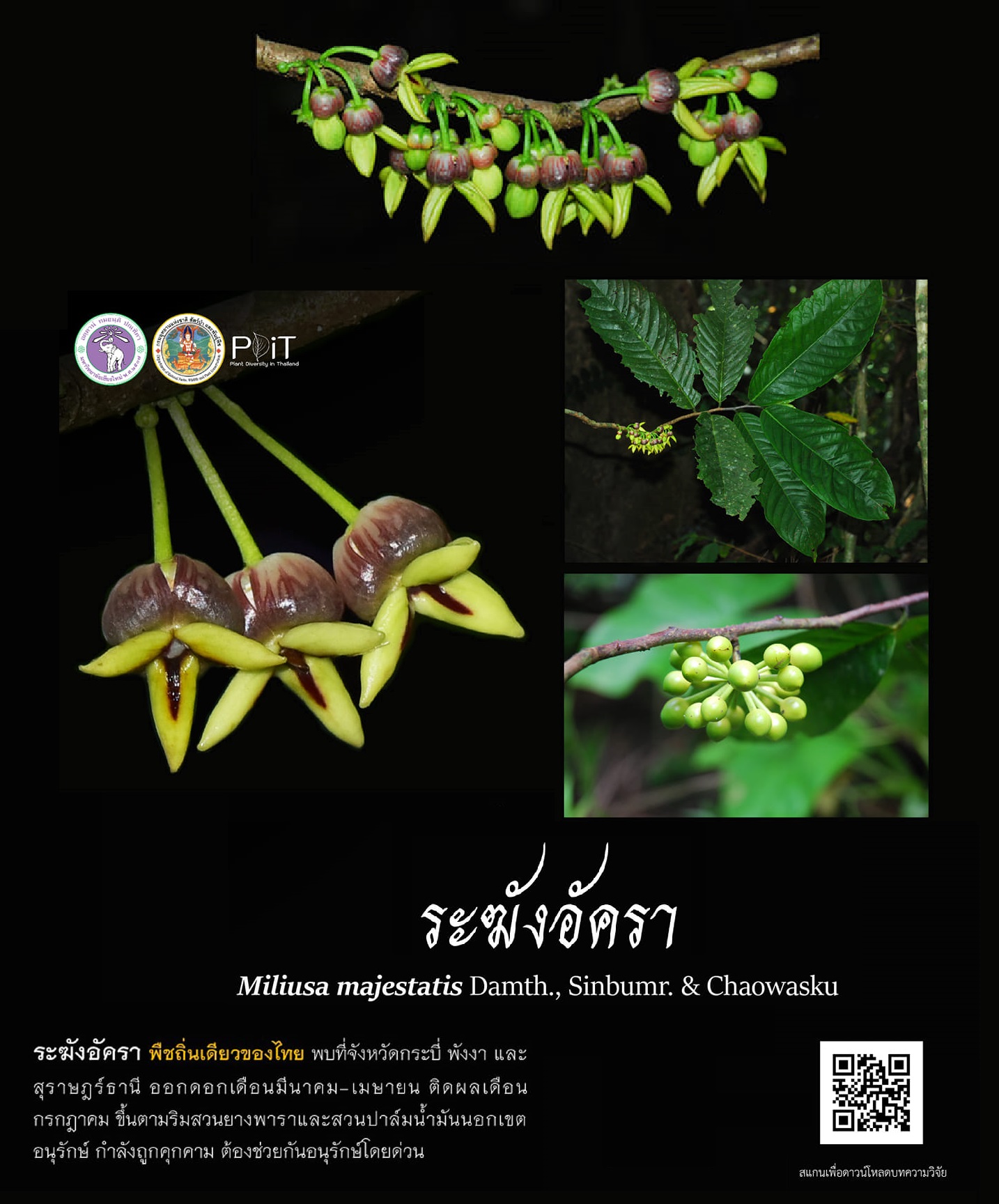
[Botany • 2023] Miliusa majestatis (Annonaceae) • A New Species from southern Thailand as evidenced by Molecular Phylogeny and Morphology


Miliusa majestatis Damth., Sinbumr. & Chaowasku, 

in Damthongdee, Sinbumroong, Rungrueng, Aongyong, Wiya, Saengpho et Chaowasku, 2023. 
ระฆังอัครา  ||  facebook.com/PlantDiversityinThailand

Miliusa majestatis Damth., Sinbumr. & Chaowasku (Annonaceae), a new species from southern Thailand, is described and illustrated. Based on molecular phylogenetic analysis using up to seven plastid DNA regions (matK, ndhF, rbcL and ycf1 exons; trnL intron; psbA-trnH and trnL-trnF intergenic spacers) and including, among others, 35 accessions (representing 34 species) of Miliusa, the new species belongs to one of the four unnamed major clades in the genus. Within that clade and in the genus in general, M. majestatis is unique in having constricted inner petals and small basal openings between adjacent inner petals. Its conservation status is provisionally assessed as Data Deficient (DD).


Miliusa majestatis Damth., Sinbumr. & Chaowasku 


Anissara Damthongdee, Aroon Sinbumroong, Apichat Rungrueng, Kithisak Aongyong, Chattida Wiya, Chanwut Saengpho, and Tanawat Chaowasku. 2023. Miliusa majestatis (Annonaceae), A New Species from southern Thailand as evidenced by Molecular Phylogeny and Morphology. Annales Botanici Fennici. 60(1); 151–160. 
  

นักวิจัย มช. และกรมอุทยานฯ ค้นพบ "ระฆังอัครา" กระดังงาดอกสวยชนิดใหม่ของโลกจากภาคใต้ 

 คณะผู้วิจัย นำโดยผู้ช่วยศาสตราจารย์ ดร.ธนวัฒน์ เชาวสกู สังกัดภาควิชาชีววิทยา คณะวิทยาศาสตร์ มหาวิทยาลัยเชียงใหม่ นางสาวอานิสรา ดำทองดี นักศึกษาระดับปริญญาเอก สาขาวิชาความหลากหลายทางชีวภาพและชีววิทยาชาติพันธุ์ พร้อมทั้งนายอรุณ สินบำรุง นักวิชาการป่าไม้ชำนาญการ สังกัดกรมอุทยานแห่งชาติ สัตว์ป่าและพันธุ์พืช และนักวิจัยอีกหลายท่าน ได้ร่วมกันดำเนินโครงการวิจัยเรื่อง “อนุกรมวิธานและวิวัฒนาการชาติพันธุ์ของพรรณไม้วงศ์กระดังงา (Annocaceae) ในประเทศไทยที่หายากและยังไม่เป็นที่รู้จัก เพื่อการอนุรักษ์และการใช้ประโยชน์อย่างยั่งยืน”  จากการวิจัยดังกล่าวได้พบพืชชนิดใหม่ของโลกในวงศ์กระดังงาจากจังหวัดกระบี่ พังงา และสุราษฎร์ธานี มีชื่อวิทยาศาสตร์ว่า Miliusa majestatis Damth., Sinbumr. & Chaowasku ชื่อไทย "ระฆังอัครา" ได้รับการตีพิมพ์ในวารสารวิชาการระดับนานาชาติ Annales Botanici Fennici ปีที่ 60 หน้าที่ 151-160 เมื่อวันที่ 7 สิงหาคม พ.ศ. 2566 

ทั้งนี้ คำระบุชนิด “majestatis” ได้ตั้งขึ้นเพื่อเฉลิมพระเกียรติสมเด็จพระนางเจ้าสิริกิติ์ พระบรมราชินีนาถ พระบรมราชชนนีพันปีหลวง “พระมารดาแห่งการคุ้มครองความหลากหลายทางชีวภาพ” ในโอกาสที่ทรงเจริญพระชนมพรรษาครบ ๙๐ พรรษา

Tuesday, April 11, 2023

[Botany • 2023] Friesodielsia lalisae (Annonaceae) • Molecular Phylogenetic and Morphological support for the Recognition of A New Species from southern Thailand


Friesodielsia lalisae Damth., Baka & Chaowasku,

in Damthongdee, Khunarak, Kaeokula, Saengpho, Wiya, Ue-aree, Baka, Aongyong et Chaowasku, 2023. 
บุหงาลลิษา  ||  DOI: 10.3372/wi.53.53103

Abstract  
Thirteen species of Friesodielsia Steenis (Annonaceae) and 11 representatives of related genera were included in molecular phylogenetic analyses using up to six plastid DNA regions (psbA-trnH, trnL-trnF intergenic spacers; trnL intron; matK, ndhF, rbcL exons). The results support the recognition of a new species, Friesodielsia lalisae Damth., Baka & Chaowasku from Narathiwat, S Thailand, as belonging to one of the two major clades of Friesodielsia. The members of this clade show outer petals that separate at anthesis and have a concave basal portion, while members in the other major clade exhibit outer petals that separate early during developmental stages and have a flat base. Friesodielsia lalisae is described and illustrated. It is most morphologically similar to F. argentea (J. Sinclair) Steenis and F. glauca (Hook. f. & Thomson) Steenis but differs from the two by having dissimilar sepal shape, higher proportion of inner petal to outer petal length and longer inner petals. The new species additionally differs from the former by having different leaf base and from the latter by having denser indumentum on young twigs and shorter flowering pedicels. Narathiwat, a province to which the new species is endemic, seems to be one of the most underexplored areas in Thailand as evidenced by a number of species described based on recent material. The conservation status of the new species is provisionally assessed as Critically Endangered.

KEYWORDS: Annonaceae, Friesodielsia, molecular phylogeny, Narathiwat, new species, systematics, taxonomy, Thailand, Uvarieae

Holotype of Friesodielsia lalisae: Aongyong & Baka 57 (CMUB).

Friesodielsia lalisae at type locality: Thailand, Narathiwat Province, Chanae District, May 2022
 A: flower bud; B: flower at anthesis;
both from Aongyong & Baka 57 (CMUB).
– Photographs taken by A. Baka.


Friesodielsia lalisae Damth., Baka & Chaowasku, sp. nov.  

Diagnosis — Friesodielsia lalisae is most morphologically similar to F. argentea and F. glauca. The new species differs from these two species by having a different sepal shape, longer inner petals and a higher proportion of inner petal to outer petal length. Furthermore, F. lalisae differs from F. argentea by having an obtuse to rounded (vs usually cuneate) leaf base and from F. glauca by having denser indumentum on young twigs and shorter flowering pedicels.

Etymology — The new species is named in honour of Lalisa Manobal, a famous Thai rapper, singer and dancer, whose motivation has greatly inspired the first author to overcome any obstacles during her Ph.D. study.  บุหงาลลิษา 


Anissara Damthongdee, Natthanon Khunarak, Suphaloek Kaeokula, Chanwut Saengpho, Chattida Wiya, Phasit Ue-aree, Abdulromea Baka, Kithisak Aongyong and Tanawat Chaowasku. 2023. Molecular Phylogenetic and Morphological support for the Recognition of Friesodielsia lalisae (Annonaceae), A New Species from S Thailand. Willdenowia. 53(1); 45-55. DOI: 10.3372/wi.53.53103