Showing posts with label QSBG. Show all posts

Tuesday, March 3, 2026

[Botany • 2026] Peliosanthes siamensis (Asparagaceae) • A New Species from northern Thailand


Peliosanthes siamensis Thammar. & Rakarcha, 

in Thammarong, La-ongsri, Tanming et Rakarcha. 2026. 
นางแลวสยาม  ||  DOI: doi.org/10.20531/tfb.2026.54.1.02 

Abstract 
Peliosanthes siamensis (Asparagaceae) is described from northern Thailand. A description, distribution, ecology, phenology, notes and illustration are provided. A provisional conservation status of the species in Thailand is also given.

 Keywords: conservation status, flora, limestone, threatened plant

Peliosanthes siamensis Thammar. & Rakarcha:
A. Habit; B. Flowers; C. Inflorescence; D. Adaxial leaf surface; E. Abaxial leaf surface.
Photos A–C. by W. Tanming; D–E. by W. Thammarong from Rakarcha et al. 1087 (QBG).

Peliosanthes siamensis Thammar. & Rakarcha sp. nov. 
นางแลวสยาม

Woranart Thammarong, Woranuch La-ongsri, Wattana Tanming and Sarayut Rakarcha. 2026. Peliosanthes siamensis (Asparagaceae), A New Species from northern Thailand. Thai Forest Bulletin (Botany). 54(1), 13–17. DOI: doi.org/10.20531/tfb.2026.54.1.02 

Wednesday, September 24, 2025

[Botany • 2025] Kaisupeea larsenii (Gesneriaceae) • A New Species from southern Thailand


Kaisupeea larsenii Triboun, Pansomboon & Bannajit,

in Triboun, Pansomboon, Bannajit et Middleton, 2025.
มณีไกรลาส || http://qsbg.or.th 

Abstract 
Kaisupeea larsenii Triboun, Pansomboon & Bannajit, a new species from southern Thailand is newly described. A description and illustration are provided.

Keywords: Kaisupeea, new to science, Ranong, taxonomic treatment, Thailand


Kaisupeea larsenii Triboun, Pansomboon & Bannajit, sp. nov. 


Pramote Triboun, Tossawat Pansomboon, Worapon Bannajit and David J. Middleton. 2025. Kaisupeea larsenii (Gesneriaceae), A New Species from Thailand. Thai Journal of Botany. วารสารพฤกษศาสตร์ไทย. 17: 31–34. 


Wednesday, November 6, 2024

[Botany • 2022] Curcuma lampangensis & C. sabhasrii (Curcuma subg. Ecomatae, Zingiberaceae: Zingibereae) • Two New Species from northern Thailand


Curcuma sabhasrii Saensouk, Maknoi, Wongnak & Rakarcha, 

in Rakarcha, S. Saensouk, Maknoi, Wongnak, Thammarong et P. Saensouk, 2022. 
Photographed by S. Rakarcha

Abstract
Curcuma lampangensis Saensouk, Maknoi & Rakarcha and C. sabhasrii Saensouk, Maknoi, Wongnak & Rakarcha, two new species of ginger family (Zingiberaceae) from northern Thailand, are described, illustrated and photographed. Additionally, the authors provide their detailed morphological descriptions, as well as illustrations, color photographs, distributions, ecology, etymology, phenology, vernacular, conservation status and its closely related species. The two new species are assignable to the Curcuma subgenus Ecomatae. Curcuma lampangensis and C. sabhasrii are endemic to Lampang and Phitsanulok provinces of northern Thailand, respectively. The morphological characteristics of C. lampangensis are compared to C. rhomba J. Mood & K. Larsen while C. sabhasrii is compared to C. peramoena Souvann. & Maknoi. Curcuma lampangensis is recognized by its glabrous on nearly all parts of the plant, creeping rhizome and the inflorescence usually arises from a new rhizome branch next to the existing pseudostem, flowers that are white to pale pink and white to pale yellow labellum with 2 dark yellow bands at the center and reddish tinge at the base. Curcuma sabhasrii is recognized by having 8-15 greenish to reddish-purple bracts, reddish-purple corolla lobes, white with reddish-purple mottling to reddish-purple staminodes and labellum which is reddish-purple with an embossed yellow path along the midrib from base to apex and reddish-purple mottling on yellow mid-band of lower half. A key to 24 species of Curcuma subgenus Ecomatae in Thailand is presented.


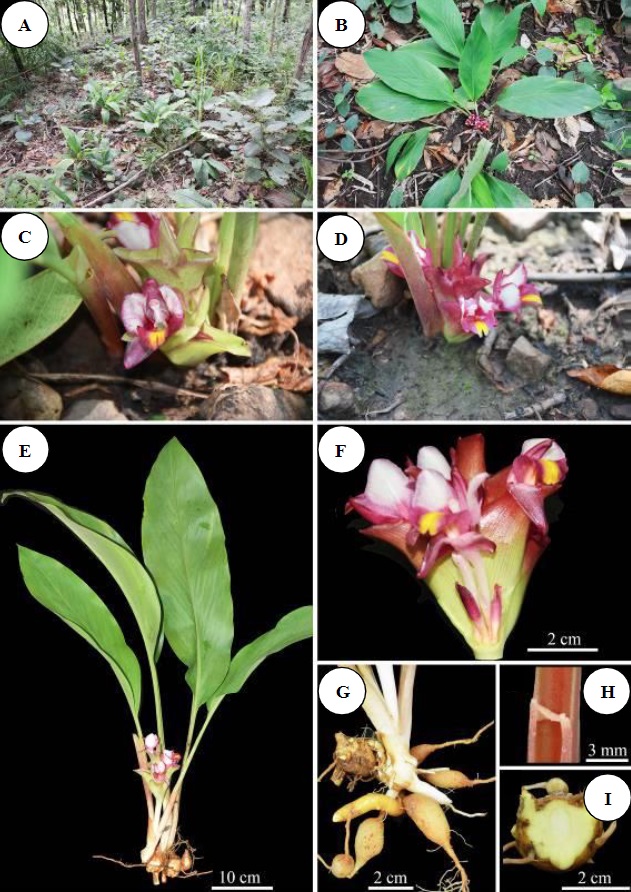
Curcuma sabhasrii Saensouk, Maknoi, Wongnak & Rakarcha:
A.–B. habitat; C.–D. inflorescences; E. habit; F. cincinnus with 4 flowers; G. rhizome and root tubers; H. ligule; I. colour of rhizome.
Photographed by S. Rakarcha


Curcuma lampangensis Saensouk, Maknoi & Rakarcha  
กระเจียวลำปาง

Curcuma sabhasrii Saensouk, Maknoi, Wongnak & Rakarcha,
 กระเจียวสรรพศรี


 Sarayut Rakarcha, Surapon Saensouk, Charun Maknoi, Mathee Wongnak, Woranart Thammarong and Piyaporn Saensouk. 2022.  Curcuma lampangensis and C. sabhasrii, Two New Species of the Family Zingiberaceae from northern Thailand. Biodiversitas. 23: 4448-4459. https://smujo.id/biodiv/article/view/11720

Sunday, November 26, 2023

[Botany • 2022] Paphiopedilum charlesworthii var. lannaense (Orchidaceae) • A New Slipper Orchid from Northern Thailand


Paphiopedilum charlesworthii var. lannaense W. Tongkham, S. Pumikong, N. Potapohn & W. Bundithya, 

in Tongkham, Pumikong, Potapohn et Bundithya, 2022. 
 
 Abstract
A new endemic slipper orchid in the family Orchidaceae from Northern Thailand was described according to morphological and molecular analyses. Morphological information specifies the new slipper orchid Paphiopedilum charlesworthii var. lannaense to be similar to Paphiopedilum charlesworthii (Rolfe) Pfitzer 1895, with the exception of its staminode being obovate-obcordate with yellow color, glittery and rough surface. Molecular analysis by AFLP technique indicates that Paphiopedilum charlesworthii var. lannaense can be included as a member of section Paphiopedilum and is closely related to Paphiopedilum coccineum Perner, H. & Herrmann, R. (2000) (syn. Paphiopedilum barbigerum var. coccineum), from which it differs morphologically by dorsal sepal and petal characters. The morphological and molecular evidence supported that Paphiopedilum charlesworthii var. lannaense is a new slipper orchid in the genus Paphiopedilum (Cypripedioideae, Orchidaceae).
 
Keywords: Monocots, Thai orchids, orchid dendrogram, lady’s slipper orchids, plant taxonomy


 Some flower variation of Paphiopedilum charlesworthii var. lannaense, whole plant and flower. (photos by W. Tongkham)
 
Paphiopedilum charlesworthii var. lannaense W. Tongkham, S. Pumikong, N. Potapohn & W. Bundithya, ssp. nov.

Distribution: —Endemic to Northern Thailand, Lampang province.

Habitat: —Grow on lightly shaded or vertical cliffs on limestone with its roots adhere in cracks or on narrow shelves of limestone.

Etymology: — lannaense describes the name of biggest ancient kingdom (Lanna) in Northern Thailand.

Notes: —This new slipper orchid is morphologically close to Paphiopedilum charlesworthii , from which it differs by its dorsal sepal character, smaller flower size, and its staminode is obovate-obcordate with yellow color, rough surface, glittery and raised yellow wart.


Wicharuj Tongkham, Supalak Pumikong, Nuttha Potapohn and Weenun Bundithya. 2022. Paphiopedilum charlesworthii var. lannaense, A New Slipper Orchid from Northern Thailand identified by morphological and AFLP analyses.  Phytotaxa. 531(1); 1-17. DOI: 10.11646/phytotaxa.531.1.1
facebook.com/SlipperOrchidsAustralia/photos/4966327486767542/
Researchgate.net/publication/357808406_Paphiopedilum_charlesworthii_var_lannaense_a_new_slipper_orchid_from_Northern_Thailand


Monday, October 18, 2021

[Botany • 2021] Curcuma aruna & C. pitukii • Two New Species of Curcuma L. (Zingiberaceae) from northern Thailand


Curcuma pitukii Maknoi, Saensouk, Rakarcha & Thammar.,
 
in Maknoi, Saensouk. ... et Thammarong, 2021.

Abstract
 Curcuma aruna and C. pitukii, two new species from northern Thailand, are described, illustrated, and photographed. They are endemic to Sukhothai and Lampang Provinces, northern Thailand, and the morphological characteristics of two new species are compared with their closest species, C. flaviflora, C. eburnea, and C. pierreana. Two new species, C. aruna and C. pitukii are assignable to Curcuma subgenus Ecomata. C. aruna is recognized by leaves ovate with thin chartaceous, fertile bracts 6–12, it’s glabrous on nearly all parts of the plant, flowers yellow and labellum yellow with 2 darker yellow bands in the center. C. pitukii is recognized by bracts 20–40 with purplish white to purple, corolla lobes purplish white to pale purple, staminodes white, and labellum white with an embossed yellow path along the midrib from base to apex. A detailed description, distribution, ecology, etymology, preliminary conservation status, and photographs of two new species are provided. A key to 20 species of Curcuma subgenus Ecomata in Thailand is presented.

Keywords: Curcuma flaviflora, C. eburnea, C. pierreana, Lampang, subgenus Ecomata, Sukhothai, taxonomy, Zingiberales


Curcuma aruna Maknoi & Saensouk:
A. and B. habit; C. inflorescence; D. flower in front view; E. flower in side view; F. flower dissection (from left: abaxial of bract, adaxial of bract, calyx, floral tube with stamen, ovary with epigynous gland, lateral staminode, labellum, dorsal and lateral corolla lobes).
 Photographed by C. Maknoi (A, C from type location); S. Rakarcha (B, D–F from cultivation)

Comparison of Curcuma aruna and C. flaviflora.
C. flaviflora: A. habit; B. inflorescence; C. corolla tube with ovary, calyx, and stamen; E. flower dissection (from left: lateral staminode, labellum, stamen in front view, and stamen in side view).
 C. aruna: D. corolla tube with ovary, calyx and stamen; F. flower dissection (from left: lateral staminode, labellum, stamen in front view and stamen in side view).
Photographed by W. Pongamornkul (A, B from Doi Ang Khang, Chiang Mai, N. Thailand); S. Rakarcha (C, E from Maknoi 356 (QBG); D, F from cultivation)

Curcuma aruna Maknoi & Saensouk, sp. nov. 
subgenus Ecomata 

This species is similar to C. flaviflora in early flowering habits, short peduncle, no coma and yellow flowers. The leaves of C. aruna are ovate and glabrous on both surfaces, instead of leaves elliptic to oblanceolate and pubescent on both surfaces in C. flaviflora. The length of the corolla tube of C. aruna is shorter than in C. flaviflora (2.3–2.8 cm long in C. aruna vs 3.8–4.2 cm in C. flaviflora). The staminodes of C. aruna are obovate, whilst those of C. flaviflora are ovate to elliptic. The staminodes of C. aruna are larger than those of C. flaviflora (2.2–2.6 × 1.4–1.6 cm in C. aruna vs 2.0 × 1.2 cm in C. flaviflora).

Etymology: The specific epithet of the new species is “aruna”, which means “dawn” in Thai, refer to flower color resemble the color of the dawn and name of God of the Dawn in Thai mythology. The name of the type locality province “Sukhothai” means the dawn of happiness also.
Vernacular name: Krachiao Arun - กระเจียวอรุณ 
(Krachiao in Thai means Curcuma and arun means dawn in Thai). 


Curcuma pitukii Maknoi, Saensouk, Rakarcha & Thammar.: 
A. habit; B. inflorescence; C. close up flowers; D. inflorescence (top view); E. rhizome and roots (inset: detail of rhizome and root tubers); F. leaf.
Photographed by S. Rakarcha.


Curcuma pitukii Maknoi, Saensouk, Rakarcha & Thammar., sp. nov. 
subgenus Ecomata 

Curcuma pitukii is most similar to Curcuma eburnea Škorničk., Suksathan & Soonthornk. by its terminal inflorescence, the number of bracts, without coma bracts, and small filiform anther spurs. The leaves of C. pitukii are densely puberulent on the adaxial surface, but the leaves of C. eburnea are glabrous on the adaxial surface. C. pitukii has purplish white to purple bracts, whilst C. eburnea has cream-white or pale greenish bracts. The length of the calyx of C. pitukii is longer than in C. eburnea (14–18 mm long in C. pitukii vs 8–10 mm long in C. eburnea). The length of the corolla tube of C. pitukii is shorter than in C. eburnea (2.2–3 cm long in C. pitukii vs 3.5 cm long in C. eburnea). The corolla lobes of C. pitukii are purplish white to pale purple and sparsely puberulent at the apex, but in C. eburnea they are pure white and glabrous. The length of the filament of C. pitukii is longer than in C. eburnea (5–8 mm long in C. pitukii vs 2 mm long in C. eburnea). The length of the anther of C. pitukii is shorter than in C. eburnea (2.5–4 mm long in C. pitukii vs 8–9 mm long in C. eburnea).

Etymology: The specific epithet “pitukii” is named in honor of “Mr. Pituk Punyajun”, a supporter and backup plant taxonomists in Thailand for over 25 years and who first found the plant.
Vernacular: Cho Muang Pituk - ช่อม่วงพิทักษ์ 
(Cho in Thai name means inflorescence, Muang means purple, and Pituk is the first name of Mr.Pituk Punyajun). 


Charun Maknoi, Surapon Saensouk, Piyaporn Saensouk, Sarayut Rakarcha and Woranart Thammarong. 2021. Two New Species of Curcuma L. (Zingiberaceae) from Thailand. Biodiversitas. 22; 3910-3921. DOI: 10.13057/biodiv/d220937


Wednesday, August 18, 2021

[Botany • 2021] Saraca thailandica (Leguminosae: Detarioideae) • A New Species from northern Thailand


Saraca thailandica Pongamornkul, Panyadee & Inta,

in Pongamornkul, Panyadee, Muangyen & Inta, 2021.
THAI JURNAL OF BOTANY. 13(1) 
โสกเหลือง, ตะนา  ||  QSBG.or.th/bot 
 
Abstract 
Saraca thailandica Pongamornkul, Panyadee & Inta, a new species from northern Thailand, is described and illustrated. This riparian species is distinguishable by its large bracteoles which erect and clasping the calyx tube. It also has 7 stamens which is rarely found in previous known Saraca species. Its flowering and fruiting period is August to September and December to March, respectively, which is different from S. dives and S. thaipingensis. The additional key for Saraca in Thailand is also provided.

 
Saraca thailandica Pongamornkul, Panyadee & Inta:
 A. habit; B. cauliflorous inflorescence; C. infl orescence on woody tubercle; D. leaves; E. flower side view with bracteole; F. flower front view.

Pods and seeds of Saraca thailandica Pongamornkul, Panyadee & Inta:
 A. immature pod; B. inside immature pod and seeds; C. inside mature pod and seeds; D. seeds prepared for cooking; E. local people is roasting the young pods.
 
Saraca thailandica Pongamornkul, Panyadee & Inta sp. nov. 

Similar to Saraca dives and S. thaipingensis but differed from those by its ± persistent, erect blackish brown in mature bracteoles. The number of stamens is mostly 7.


Etymology.— The specific epithet, thailandica, refers to Thailand.

Vernacular.— Sok lueang (โสกเหลือง), Ta Na (ตะนา) (Karen). 

Distribution.— Endemic to Thailand, possibly in Myanmar. 

Uses.— Seed edible and barks are used as red dye for textile by local people. 

 
Wittaya Pongamornkul, Prateep Panyadee, Nattee Muangyen and Angkhana Inta. 2021. Saraca thailandica (Leguminosae-Detarioideae), A New Species from Thailand. THAI JOURNAL OF BOTANY. 13(1); 29–36. qsbg.or.th/bot/journal/showarticle_en.aspx?type=article&id=334


Saturday, March 28, 2020

[Botany • 2019] A Taxonomic Revision of Globba subsect. Nudae (Zingiberaceae) including Three New Species: Globba aranyaniae, G. lithophila & G. macrochila


A. Globba aranyaniae Sangvir. & M.F.Newman sp. nov., B. G. expansa Wall. ex Horan., 
C. G. flagellaris K.Larsen., D. G. insectifera Ridl., 
E. G. lithophila Sangvir. & M.F.Newman sp. nov. and F. G. macrochila Sangvir. & M.F.Newman sp. nov.


in Sangvirotjanapat, Denduangboriphant & Newman, 2019.
 Photographs: S. Sangvirotjanapat  facebook.com/SunisaSang5

Abstract
Globba subsect. Nudae K.Larsen is revised. Seven species are recognised and three names are lectotypified. A key to the species and descriptions are provided. Three new species are described and illustrated: Globba aranyaniae Sangvir. & M.F.Newman sp. nov.G. lithophila Sangvir. & M.F.Newman sp. nov., and G. macrochila Sangvir. & M.F.Newman sp. nov. Four names based on types from Bangladesh, India and Myanmar remain doubtful. The morphological expression of andromonoecy in this group is described in detail. Provisional IUCN conservation assessments of all species are supplied.

Keywords: Andromonoecy; Globba; Nudae; taxonomic revision; Zingiberaceae

Fig. 2. Globba subsect. Nudae K.Larsen.
A. Globba aranyaniae Sangvir. & M.F.Newman sp. nov. (S. Sangvirotjanapat 785 leg.). B. G. expansa Wall. ex Horan. (M.F. Newman 2561 leg.). C. G. flagellaris K.Larsen (M.F. Newman and JLS 2048 leg.).
D. G. insectifera Ridl. (S. Sangvirotjanapat s.n. leg.). E. G. lithophila Sangvir. & M.F.Newman sp. nov. (M.F. Newman 2576 leg.). F. G. macrochila Sangvir. & M.F.Newman sp. nov. (S. Sangvirotjanapat 795 leg.).

Photographs: S. Sangvirotjanapat.  facebook.com/SunisaSang5

Class Magnoliopsida Brongn.

Order Zingiberales Griseb.
Family Zingiberaceae Martinov

Genus Globba L.
Section Nudae K.Larsen
Subsection Nudae K.Larsen

General morphology: The main distinguishing characteristics of G. subsect. Nudae are the lax conical inflorescence and flowers with four anther appendages. These differentiate this subsection clearly from G. sect. Globba and G. sect. Sempervirens, which also have four anther appendages, but have dense inflorescences with colourful, persistent bracts.

Habitat The substrate and ecological surroundings are found to relate to plant size. Plants in G. subsect. Nudae are mostly middle-sized, about 50–100 cm tall. Occasionally G. expansa Wall. ex Horan., found in mixed evergreen montane forest, can grow to 1.5 m tall while G. lithophila Sangvir. & M.F.Newman sp. nov., which grows on limestone, is a miniature plant, only 10 cm tall. The most variable species is G. insectifera Ridl., which is large or small depending on the conditions of the dry or the rainy season which determine the production of inflorescence shoots or leafy shoots.

Rhizome Small, globose, about 3–5 cm in diameter. In one growing season, 5–8 rhizomes can be produced in a moniliform arrangement. The root tubers are spindle-shaped or elongate and function in food storage during the dormant period.

Flower For reliable identification to species, the flower must be seen. Flower colour seems to be a variable character while, on the other hand, the yellow and orange tone of flowers in this subsection is clearly different and useful for classification in many cases. A red or brown spot on the labellum is quite common in other groups of Globba but, in G. subsect. Nudae, G. aranyaniae sp. nov. is unique in having a spot (Fig. 2A).


Globba aranyaniae Sangvir. & M.F.Newman sp. nov. 

Diagnosis: The main distinguishing character within G. subsect. Nudae is the red or brown spot on the labellum. Laotian and northern Thai populations resemble G. flagellaris and G. macrochila sp. nov. by their condensed cincinni, and orange-toned flowers with rather broad lateral staminodes (> 5 mm). Central and eastern Thai populations resemble G. expansa by their lax cincinni, orange-toned flowers, and ellipsoid fruits.

Etymology The epithet ‘aranyaniae’ derives from ‘Aranyani’ who is a princess in the myth relating to the name of the type locality, Pha Nang Khoy (‘Cave of the Lady who Waits’).

Distribution and habitat: Laos and Thailand, at 100–700 m a.s.l., on limestone in mixed evergreen forest or near streams.


Globba expansa Wall. ex Horan.
Prodromus Monographiae Scitaminearum Additis Nonnullis de Phytographia, de Monocotyleis et Orchideis: 19 (Horaninow 1862).

Synonyms: G. yeatsiana Craib, Bulletin of Miscellaneous Information, Royal Botanic Gardens, Kew 1912: 400 (Craib 1912). – Type: THAILAND • Northern, Chiang Mai, Doi Suthep-Pui National Park; 960 m a.s.l.; 12 Jun. 1910; A.F.G. Kerr 1214 leg.; K (lectotype, designated here), E E00097516 (isolectotype).
G. platystachya sensu Gagnepain, Flore Générale de l'Indo-Chine 6 (1): 33 (Gagnepain 1908), non Baker, The Flora of British India 6 (17): 206 (Baker 1890).

Distribution and habitat: Myanmar, Laos, Thailand, 174–1350 m a.s.l., growing in mixed evergreen forest along the trail under semi shade. Usually found as dense clump.


Globba flagellaris K.Larsen
Nordic Journal of Botany. 17: 119 (Larsen 1997).

Distribution and habitat: Chiang Mai, Mae Hong Son, and Nan provinces, Thailand, 450–1100 m a.s.l. It grows in dense populations in rather moist areas, often near streams.


Globba insectifera Ridl.
Journal of the Straits Branch of the Royal Asiatic Society 49: 42 (Ridley 1908). 

Synonyms: G. kerrii Craib, Bulletin of Miscellaneous Information, Royal Botanic Gardens, Kew 1912: 398 (Craib 1912). – Type: THAILAND • Chiang Mai, Doi Suthep-Pui National Park; 1200 m a.s.l.; 24 Jul. 1910; A.F.G. Kerr 1278 leg; E (lectotype, designated here), BM (isolectotype), E E00097477 (isolectotype), K (isolectotype, 2 sheets). 
G. nuda K.Larsen, Notes from the Royal Botanic Garden Edinburgh 31: 235 (Larsen 1972). – Type: THAILAND • Chiang Mai, Doi Suthep-Pui National Park; 850 m a.s.l.; 13 Apr. 1958; K. Larsen, B. Hansen and T.J. Sørensen 2678 leg.; AAU (holotype), C (isotype), BKF (isotype).

Distribution and habitat: Myanmar and Thailand, 240–1500 m a.s.l. Common in dipterocarp or grass forest in open areas. The plants grow over large areas but not covering the ground densely


Globba lancangensis Y.Y.Qian
 Acta Botanica Austro Sinica 9: 51 (Qian 1994).

Distribution and habitat: China (Yunnan), 1080–1350 m a.s.l.


Globba lithophila Sangvir. & M.F.Newman sp. nov. 

Diagnosis Similar to G. flagellaris and G. macrochila sp. nov. in its condensed cincinni and bright orange flowers, but differing from them by its clearly visible lateral corolla lobes, oblong and patent lateral staminodes, smaller size and ecological requirements, being found only in pockets of soil in cracks in limestone. 

Etymology: From the Greeklithos (stone) andphila(loving), reflecting its limestone habitat.

Distribution and habitat: Thailand, 450–800 m a.s.l., only found in small pockets of soil in or very near limestone.

Conservation status: Least Concern. Globba lithophila sp. nov. has a small AOO of 28 km2 and EOO of 2600 km2 , suggesting a status of Endangered but it grows in Lum Nam Pai Wildlife Sanctuary as well as ex situ in Queen Sirikit Botanic Garden so it is of Least Concern. It is a lithophyte which makes it sensitive to environmental factors so good management of protected areas is important to keep it in its natural habitat.

Notes: Globba lithophila sp. nov. has been compared closely to G. flagellaris, with which it is sympatric in north Thailand. Both species were cultivated in the same place at the Zingiberaceae nursery of Queen Sirikit Botanic Garden under controlled conditions. After two years of growth, the vegetative parts of the plants were larger than those of wild plants, while the floral parts and ratios of sizes remained the same. We conclude that these are two separate species and that G. lithophila sp. nov. is not merely a part of the variation of G. flagellaris.


Globba macrochila Sangvir. & M.F.Newman sp. nov. 

Diagnosis: Similar to G. flagellaris in its bright orange flowers, but differing by its much longer labellum, 19– 20 mm long (vs short labellum, 10–12 mm long) and growing in dry areas (vs moist areas). 

Etymology: Greek, ‘macros’ (large) and ‘-chila’ (-lipped), referring to its long labellum.

Distribution and habitat: Myanmar and Thailand, 100–350 m a.s.l., in rather dry forest.

Conservation status: Least Concern. Although this species has a small AOO of 32 km2 , the populations in Kanchanaburi province, where this species is commonest, are found in several protected areas. It is also grown in Queen Sirikit Botanic Garden.

 Notes Usually found in somewhat dry areas, such as bamboo forest. The labellum is remarkable, being longer than the lateral staminodes. It always covers the lateral corolla lobes. Plants were cultivated under more humid test conditions in Bangkok to find out the stability of the morphological characters. After growing for one season, the environmental factors affected only vegetative structures, i.e., leafy stem size, inflorescence size but did not influence the ratios of the floral parts.


Doubtful species of Globba subsect. Nudae

Globba pauciflora King ex Baker
Flora of British India 6: 205 (Baker 1890).

Globba rahmanii Yusuf
Journal of Economic and Taxonomic Botany 28: 88 (Yusuf 2004).

Globba subscaposa Collett & Hemsl.
Journal of the Linnean Society. Botany 28: 135 (Collett & Hemsley 1890).


 Sunisa Sangvirotjanapat, Jessada Denduangboriphant and Mark F. Newman. 2019. A Taxonomic Revision of Globba subsect. Nudae (Zingiberaceae).  European Journal of Taxonomy. 503; 1–37. DOI: 10.5852/ejt.2019.503

Thursday, August 31, 2017

[Botany • 2017] Bulbophyllum physometrum sect. Physometra • A New Species and New Section in Bulbophyllum (Orchidaceae; Epidendroideae; Malaxideae) from northern Thailand


Bulbophyllum physometrum J.J.Vermeulen, Suksathan & Watthana

สิงโตต่างหู  || DOI:  10.11646/phytotaxa.302.2.7 

In 2010, the second author found a possible new species of Bulbophyllum in Mae Hong Son Province, northern Thailand. Three years later, Pitak Panyachan (Queen Sirikit Botanic Garden) found the same species on a fallen tree some six km from the first locality. Living plants were collected and brought back to QSBG in Chiang Mai for further investigation. A year later, the plants flowered and proved to be a species of Bulbophyllum new to science.

Keywords: Orchidaceae, Bulbophyllum, Thailand, Monocots


FIGURE 2. Bulbophyllum physometrum; flowering inflorescense.
(origin: Thailand, Suksathan 4243). Photo by P. Suksathan.

Bulbophyllum sect. Physometra J.J.Vermeulen, Suksathan & Watthana, sect. nov. 

Bulbophyllum physometrum J.J.Vermeulen, Suksathan & Watthana, sp. nov.  

Etymology:— Physos (Gr.) = blister, metra (Gr.) = womb.

Vernacular name:— “Sing to tang hoo (สิงโตต่างหู)”, meaning “Dangle Earings ู Bulbophyllum”. 


Jaap J. Vermeulen, Piyakaset Suksathan and Santi Watthana. 2017. A New Species and New Section in Bulbophyllum (Orchidaceae; Epidendroideae; Malaxideae). 
Phytotaxa. 302(2); 174–180. DOI:  10.11646/phytotaxa.302.2.7


อ.ส.พ. พบกล้วยไม้ไทยชนิดใหม่ของโลก 
หวั่นสูญพันธุ์ในไม่ช้าหลังมีประกาศขายในเว็บชื่อดัง

ดร.ปิยเกษตร สุขสถาน รักษาการรองผู้อำนวยการองค์การสวนพฤกษศาสตร์ เปิดเผยว่า ทางองค์การสวนพฤกษศาสตร์ (อ.ส.พ.) ได้แถลงถึงการค้นพบกล้วยไม้ไทยหายาก สายพันธุ์ใหม่ของโลก “สิงโตต่างหู” ที่มีชื่อวิทยาศาสตร์ว่า Bulbophyllum physometrum J.J. Vermeulen, Suksathan, & Watthana ซึ่งค้นพบโดย ดร. ปิยเกษตร สุขสถาน นักพฤกษศาสตร์ขององค์การฯ และได้ตีพิมพ์ลงในวารสารสากล Phytotaxa ฉบับที่ 302(2) เดือนมีนาคม 2560 นี้ ร่วมกับผู้เชี่ยวชาญกล้วยไม้จากเนเธอร์แลนด์ Dr. Jaap Vermeulen และ ดร. สันติ วัฒฐานะ จากมหาวิทยาลัยเทคโนโลยีสุรนารี
กล้วยไม้ดังกล่าวเป็นกลุ่มกล้วยไม้สิงโตกลอกตา (Bulbophyllum) ขนาดเล็กที่เรียกกันว่า “มินิเอเจอร์ ออร์คิด” มีลำลูกกล้วยรูปร่างกลมแบนและเป็นร่องคล้ายซาลาเปาขนาดเพียง 1.2 – 1.4 เซนติเมตรเท่านั้น มีใบ 2 ใบ ช่อดอกผอมบางแทงออกจากใต้ลำลูกกล้วย ตอนปลายมีดอกเป็นกลุ่ม 5 – 9 ดอก ตัวดอกมีขนาดเล็กมาก มีเส้นผ่านศูนย์กลางราว 2 – 3 มิลลิเมตร ลักษณะพิเศษของสิงโตชนิดนี้คือ ส่วนรังไข่ของดอกปลายยอดที่เป็นหมันนั้นได้พัฒนาขยายตัวบวมพองออกจนมีขนาดใหญ่คล้ายโคมจีนหรือลูกบอลลูน เมื่อประกอบกับดอกปกติอื่นๆ โดยรอบจึงดูเหมือนตู้มหูหรือต่างหูที่มีตุ้มตรงปลายและแกว่งไกวไปมาได้เป็นอิสระ จึงเป็นที่มาของชื่อ “สิงโตต่างหู” ซึ่งมีการวิวัฒนาการของดอกเพื่อล่อแมลงในรูปแบบใหม่ที่ไม่เคยมีรายงานมาก่อนเลยในกล้วยไม้
กล้วยไม้ชนิดนี้เป็นพืชหายากถิ่นเดียวของไทย ซึ่งมีรายงานพบได้เฉพาะในจังหวัดแม่ฮ่องสอนเท่านั้น สถานภาพในธรรมชาติมีจำนวนน้อยมาก เนื่องจากถิ่นที่อยู่ในป่าดิบเขาของมันถูกทำลายจากกิจกรรมต่างๆ ของมนุษย์ รวมถึงการเปลี่ยนแปลงของสภาพภูมิอากาศโลก และเนื่องจากความแปลกประหลาดและหายากนี้เอง ทำให้มีความต้องการจากนักสะสมทั่วโลก กระทั่งมีการประกาศขายแล้วในเว็บไซต์ดังอย่าง eBay ซึ่งถือว่าผิดกฎหมายไซเตสอย่างแน่นอน จากปัจจัยร่วมดังกล่าวจึงน่าเป็นห่วงอย่างยิ่งว่า “สิงโตต่างหู” อาจลดจำนวนลงและสูญพันธุ์ไปจากธรรมชาติในไม่ช้า ทั้งนี้ทาง อ.ส.พ. กำลังทำการศึกษาวิจัยหาทางขยายพันธุ์อย่างเร่งด่วน แข่งกับการลดลงของสายพันธุ์ และกระแสความต้องการเพื่อเป็นหลักประกันความอยู่รอดในอนาคตของกล้วยไม้สุดพิเศษชนิดนี้

น่ายินดี! พบกล้วยไม้ไทยพันธุ์ใหม่ของโลก 'สิงโตต่างหู' มีแค่แม่ฮ่องสอน

Sunday, April 9, 2017

[Botany • 2014] Curcuma peramoena • A New Species (Zingiberaceae) from north Lao PDR


ຫວ້ານຫົວນ້ອຍ |  Curcuma peramoena  Souvann. & Maknoi


ABSTRACT
 Curcuma peramoena Souvann. & Maknoi, a new species from north of Laos is described and illustrated here.

KEYWORDS: Curcuma, Zingiberaceae, new species, Lao PDR


FIGURE 2. Curcuma peramoena Souvann. & Maknoi:   A. habit; B. rhizome with inflorescence; C. bract; D. flower lateral view; E. flower front view; F. calyx tube and detail calyx lobe; G. lateral corolla lobe; H. dorsal corolla lobe; I. staminodes; J. labellum; K. floral tube and anther lateral view; L. anthers front view. 
Scale bars A=5 cm; B, C=2 cm; D, E, G, H, I, J, K, L=1 cm; F=1.4 cm
 
Line drawing by K. Souvannakhoummane from P. Srisanga et al. L2-294. 

FIGURE 1. Flower of Curcuma peramoena Souvann. & Maknoi, from P. Srisanga et al. L2-294.
Photo by Kitthisack Phoutthavong. 


Etymology.— The specific epithet, peramoena, refers to its very beautiful flowers.
Vernacular  name.— ຫວ້ານຫົວນ້ອຍ (Wan Houa Noi).

Notes.— This species belongs to subgenus Ecomata Škorničk. & Šída f. (Záveská et al., 2012) because of the following characters: lack of coma bract, open flower, presence of epigynous glands and conical anther spur. ...


 Keooudone Souvannakhoummane and  Charun Maknoi. 2014. Curcuma peramoena (Zingiberaceae), A New Species from north Lao PDR. THAI JOURNAL OF BOTANY. 6(2); 125-130.