Showing posts with label Author: Triboun. Show all posts

Wednesday, September 24, 2025

[Botany • 2025] Kaisupeea larsenii (Gesneriaceae) • A New Species from southern Thailand


Kaisupeea larsenii Triboun, Pansomboon & Bannajit,

in Triboun, Pansomboon, Bannajit et Middleton, 2025.
มณีไกรลาส || http://qsbg.or.th 

Abstract 
Kaisupeea larsenii Triboun, Pansomboon & Bannajit, a new species from southern Thailand is newly described. A description and illustration are provided.

Keywords: Kaisupeea, new to science, Ranong, taxonomic treatment, Thailand


Kaisupeea larsenii Triboun, Pansomboon & Bannajit, sp. nov. 


Pramote Triboun, Tossawat Pansomboon, Worapon Bannajit and David J. Middleton. 2025. Kaisupeea larsenii (Gesneriaceae), A New Species from Thailand. Thai Journal of Botany. วารสารพฤกษศาสตร์ไทย. 17: 31–34. 


Sunday, August 17, 2025

[Botany • 2025] Microchirita maxima (Gesneriaceae) • A New Species from Thailand


Microchirita maxima Triboun, Thamwanna & Kaewkarn, 

in Triboun, Kaewkarn, Thamwanna, Khorngton et Middleton, 2025. 
หยาดไวยบุตร  ||  https://journal.NSM.or.th  

Abstract
A new species of Microchirita from Northern Thailand, Microchirita maxima Triboun, Thamwanna & Kaewkarn, is described and illustrated. It is diagnosed against the other species in Thailand with axillary bracteate inflorescences. Their seed morphologies are also provided.
 
Keywords: new species, limestone, Microchirita, Gesneriaceae, Thailand


Microchirita maxima Triboun, Thamwanna & Kaewkarn sp. nov.

Diagnosis: Microchirita maxima is similar to M. glandulosa C.Puglisi, M. involucrata (Craib) Yin Z.Wang and M. rupestris (Ridl.) A.Weber & Rafidah in having bracteate inflorescences. It differs from M. glandulosa and M. rupestris by having a generally taller stem, the bracts are free (vs joined across the stem at the very base in M. glandulosa and fused into a tube in M. rupestris), often longer pedicels (5–35 mm long in M. maxima vs 8–12 mm long in M. glandulosa and 0.1–15 mm long in M. rupestris), and a yellow stripe on the ventral surface of the corolla (vs lacking in M. glandulosa and M. rupestris). It also differs from Microchirita involucrata in the bract margin (serrate or serrulate in M. maxima vs entire in M. involucrata), wider calyx lobes (1.4–1.5 mm wide in M. maxima vs 0.7–1.4 mm in M.
involucrata) and the paler purplish flowers. 

Etymology. The specific epithet refers to the large size of the plant and the rather tall stem.
Vernacular. Yad wai ya but (หยาดไวยบุตร), name given here. 


Pramote Triboun, Theerawat Kaewkarn, Supitcha Thamwanna, Sirinan Khorngton and David J. Middleton. 2025. Microchirita maxima, A New Species of Microchirita (Gesneriaceae) from Thailand. Thailand Natural History Museum Journal. 19(1): 1–7. https://journal.NSM.or.th/en/node/262 


Thursday, January 19, 2023

[Botany • 2022] Elatostema kaweesakii, E. rubricaule, E. saxatile (Urticaceae) • Three New Species from Thailand


Elatostema kaweesakii Triyutth. & L.F.Fu, 
E. rubricaule Triyutth. & L.F.Fu,
E. saxatile Triyutth. & L.F.Fu,  

in Triyutthachai, Fu, Triboun, Wei & Pornpongrungrueng, 2022. 

Abstract
Three new species of Elatostema (Urticaceae) from Thailand, E. kaweesakii Triyutth. & L.F.Fu, sp. nov., E. rubricaule Triyutth. & L.F.Fu, sp. nov. and E. saxatile Triyutth. & L.F.Fu, sp. nov., are newly described and illustrated. These new species can be distinguished by the presence of rhizome. Elatostema kaweesakii is similar to E. atroviride. Elatostema kaweesakii is a lithophyte growing in limestone crevices. It differs from E. atroviride by its large swollen rhizome, glabrous stem, glabrous receptacle, number of tepal in staminate flower, absence of tepal in pistillate flower, presence of staminodes in pistillate flower and smooth achene. Elatostema rubricaule and E. saxatile are found on sandstone habitats. They have distinct flattened and disk-like rhizome. Elatostema rubricaule is distinguished by its distinct sulcate and reddish stem with flattened and disc-like rhizome and chartaceous leaves with entire margin. Elatostema saxatile resembles E. bulbiferum but differs by its flattened and disc-like rhizome, acute leaf apex, glabrous receptacle in pistillate inflorescences, presence of staminodes in pistillate flower, and its sandstone habitat. Descriptions, distribution, ecological and phenological data are provided.

Keywords: Flora of Thailand, limestone, nettle family, rhizomatous plant, Rosales, sandstone, taxonomy

Elatostema kaweesakii Triyutth. & L.F.Fu, sp. nov.
A habit B staminate inflorescence C staminate flower D pistillate inflorescence E pistillate flower F bracteole G achene
(Drawn by N. Triyutthachai).  

Elatostema kaweesakii Triyutth. & L.F.Fu, sp. nov.
A habit and habitat B pistillate inflorescence C staminate inflorescences (Photos A, C by K. Keeratikiat, B by Triyutth).

  Elatostema kaweesakii Triyutth. & L.F.Fu, sp. nov.
 
Diagnosis: Elatostema kaweesakii is similar to E. atroviride W.T. Wang but differed by its large swollen rhizome, staminate inflorescences with 2–7 cm long peduncle, receptacle rectangular, glabrous, staminate flower with 5 ovate tepals, pistillate inflorescences with 5–10 mm long peduncle, receptacle rectangular, glabrous, pistillate flower without tepals, staminode present and achene smooth (Table 1).

Etymology: This species is named in honor of Mr Kaweesak Keeratikiat, who first discovered the plants.


Elatostema rubricaule Triyutth. & L.F.Fu, sp. nov.
A habit and habitat B pistillate inflorescences C staminate inflorescence (Photos by Triyutth).

 Elatostema rubricaule Triyutth. & L.F.Fu, sp. nov.
 
Diagnosis: Elatostema rubricaule differs from other Thai Elatostema by its distinct sulcate and reddish stem with flattened and disk-like rhizome and chartaceous leaves with entire margin. It grows on seasonally moist sandstone rock (Table 1).

Etymology: Latin ruber, red, and caulus, stem, alluding to stem color of the new species.


Elatostema saxatile Triyutth. & L.F.Fu, sp. nov.
A habit and habitat B stem and rhizome C pistillate inflorescences D staminate inflorescence
(Photos by Triyutth).

Elatostema saxatile Triyutth. & L.F.Fu, sp. nov.
 
Diagnosis: Elatostema saxatile is similar to E. bulbiferum Kurz, but differs by its flattened and disk-like rhizome, receptacle of pistillate inflorescences glabrous, staminode in pistillate flower 5, acute leaf apex and its sandstone habitat (Table 1).

Etymology: The specific epithet refers to the habitat of this plant that dwelling on the rock. 


Natthawut Triyutthachai, Long-Fei Fu, Pramote Triboun, Yi-Gang Wei and Pimwadee Pornpongrungrueng. 2022. Three New Species of Elatostema (Urticaceae) from Thailand. PhytoKeys. 215: 37-50. DOI: 10.3897/phytokeys.215.94591

Wednesday, June 2, 2021

[Botany • 2021] Paraboea khaoyaica (Gesneriaceae) • A New Species from Khao Yai National Park, Thailand


Paraboea khaoyaica Kaitongsuk, Triboun & Sungkaew

in Kaitongsuk, Triboun, Suddee, Ue-Aree & Sungkaew, 2021. 
ชาฤๅษีเขาใหญ่ || DOI: 10.26492/gbs73(1).2021-09

ABSTRACT
 Paraboea khaoyaica Kaitongsuk, Triboun & Sungkaew, a new species from Southeastern Thailand, is described and illustrated and its conservation status is assessed. The species is currently only known from the type locality. 

Keywords. Asia, endangered, Khao Yai National Park

Paraboea khaoyaica Kaitongsuk, Triboun & Sungkaew.
A. Habit. B. Open flower and young fruits.
Drawn by Orathai Kerdkaew.

Paraboea khaoyaica Kaitongsuk, Triboun & Sungkaew.
 A–B. Habit. C. Inflorescence with open flowers (back view), flower buds and young fruits. D. Inflorescence with open flower (front view), flower buds and young fruits. E. Undersurface of leaves. F. Infructescence with young fruits.
(Photos: S. Kaitongsuk).


Paraboea khaoyaica Kaitongsuk, Triboun & Sungkaew, sp. nov. 

Paraboea khaoyaica is similar to Paraboea pubicorolla Z.R.Xu & B.L.Burtt in having 1–3 subterminal inflorescences, leaves that are elliptic or ovate and with narrow wings at the base of the petiole joining across the nodes, and, unusually for species in the genus, occurs in a similar sandstone habitat. It differs in having a glabrous and flatfaced campanulate corolla with tube 4–5 mm long (vs a glandular hairy and deeply campanulate corolla with tube c. 7 mm long in Paraboea pubicorolla), filaments 1.5–2 mm long and glabrous (vs c. 4 mm long and pubescent in P. pubicorolla), and capsules 1–1.5 cm long (vs 2.5–3 cm long in P. pubicorolla). Paraboea khaoyaica is also similar to P. chumphonensis Triboun in the similar size of leaves and its flatfaced campanulate corolla with tube c. 4 mm long. It differs, however, in having a glabrous ovary (vs pubescent ovary in Paraboea chumphonensis), slightly shorter and glabrous capsules 1–1.5 cm long (vs slightly longer capsules c. 1.8 cm long which are covered with glandular hairs in P. chumphonensis), and occurrence in a sandstone habitat (vs limestone habitat in P. chumphonensis). 

Distribution. Endemic to Southeastern Thailand.

 Ecology. Growing on sandstone rocks along a stream and on moist rocks in partial shade in bamboo and dry dipterocarp forest, alt. 100–150 m. 

Etymology. The specific epithet refers to Khao Yai National Park (the type locality). 
Vernacular name. Cha Rue Si Khao Yai (ชาฤๅษีเขาใหญ่).

 
Saksan Kaitongsuk, Pramote  Triboun, Somran Suddee, Phasit Ue-Aree and Sarawut Sungkaew. 2021. Paraboea khaoyaica (Gesneriaceae), A New Species from Thailand. Gardens’ Bulletin Singapore. 73(1); 203–207. DOI: 10.26492/gbs73(1).2021-09


Wednesday, March 15, 2017

[Botany • 2016] Zingiber sirindhorniae | ไอยริศ • A Remarkable New Species in Zingiber section Dymczewiczia (Zingiberaceae) from Thailand


ไอยริศ |   Zingiber sirindhorniae Triboun & Keerat.


ABSTRACT
 Zingiber sirindhorniae Triboun and Keerat., a new species from Thailand, is described and illustrated. It belongs to Zingiber section Dymczewiczia (Horan.) Benth. because of its terminal inflorescence which is rather rare in Zingiber.

KEY WORDS: new species, ZingiberDymczewiczia, Zingiberaceae, Thailand


Zingiber sirindhorniae Triboun and Keerat., sp. nov.

Diagnosis: Zingiber sirindhorniae belongs to Zingiber section Dymczewiczia (Horan.) Benth. due to the terminal infl orescence on the leafy shoot. It is most similar to Zingiber plicatum Škorničk. and Q.B. Nguyễ n in having terminal inflorescence and the limestone habitat, but they differ by the former having a short and small terminal inflorescence on a leafy stem and by the dark maroonish flowers.

Figure 2. Zingiber sirindhorniae Triboun and Keerat.:
A. habitat, B. habit, C. rhizomes, and D. inflorescence with opened flowers.

Photographed by Pramote Triboun. 

Distribution. Endemic to Thailand. So far known only from Loei Province. 

 Ecology. In humus among rocks in partially shaded dry evergreen forest on limestone hills, alt. 350-450 m. 

 Phenology. Flowering in June to August and fruiting in July to October. 

 Etymology. The specific epithet honours Her Royal Highness Princess Sirindhorn of Thailand who has taken a keen interest in the conservation of plants. Vernacular. Aiyarit (ไอยริศ), name given by Her Royal Highness Princess Sirindhorn.
  

Notes. Four Thai species of Zingiber produce a terminal inflorescence; the inflorescence is always terminal in Z. pellitum Gagnep. and Z. gramineum Blume, while Z. barbatum Wall. and Z. junceum Gagnep. occasionally produce a terminal inflorescence. These four species are taller (to 1 m tall or taller) and are terrestrial, while Z. sirindhorniae is rather slender and small (40-70 cm tall), and grows in humus in crevices on limestone cliffs. In habit Zingiber sirindhorniae is more like Z. plicatum Škorničk. and Q.B. Nguyễn. The inflorescence of the new species is rather fragile and delicate.


Pramote Triboun and Kaweesak Keeratikiet. 2016. Zingiber sirindhorniae, A Remarkable New Species in Zingiber section Dymczewiczia (Zingiberaceae) from Thailand.  The Thailand Natural History Museum Journal. 10(1); 1-6.  www.THNHMJournal.com


 ตราไปรษณียากร ชุด ปีใหม่ 2559 (ชุดที่ 1) ‘พืชตระกูลขิง’ 
Thailand • New Year 2016 Postage Stamps (1st Series) ‘Gingers (Zingiberaceae)’

Friday, March 25, 2016

[Botany • 2015] Paraboea chumphonensis, P. puglisiae & P. romklaoensis • Three New Species of Paraboea (Gesneriaceae) from Thailand


ABSTRACT

Three new species of Paraboea, P. chumphonensis Triboun, P. puglisiae Triboun & D.J.Middleton, P. romklaoensis D.J.Middleton & Triboun, are described. Conservation assessments are proposed for each species.

KEYWORDS: Paraboea; Chumphon; conservation; Kanchanaburi; limestone; Phitsanulok; taxonomy


Pramote Triboun and David J. Middleton. 2015. Three New Species of Paraboea (Gesneriaceae) from Thailand. THAI FOR. BULL. (BOT.) 43: 18–23.

[Botany • 2015] Paraboea maculata • A New Species of Paraboea (Gesneriaceae) from Thailand


Fig. 1. Paraboea maculata C.Puglisi.
A. Inflorescence. C. Corolla, front view. D. Corolla and calyx, side view.
(Photos: A, C, D: Lynsey Wilson)

ABSTRACT
A new species, Paraboea maculata C.Puglisi, is described. It is compared to similar species and the habitat on granite rocks, unusual for the genus, is highlighted.

Keywords. Gesneriaceae, Paraboea, Thailand


Paraboea maculata C.Puglisi, sp. nov. Differs from other Paraboea species in the Paraboea martinii group, i.e. those with opposite leaves, campanulate corolla, twisted fruit and a terminal inflorescence, by the combination of a predominantly white and laterally compressed corolla, the purple spots at the base of the tube, the sticky glandular secretion on the bracts and calyx, and the winged petioles.
– TYPE: Thailand, Chanthaburi, Khao Khitchakut, Khao Khitchakut National Park, Khao Phra Bhat, 12°50′14″N 102°10′3″E, 900 m, 27 August 2012, fr., Middleton, D.J., Karaket, P., Suddee, S. & Triboun, P. 5675 (holotype E; isotypes BK, BKF). (Fig. 1)


C. Puglisi, S. Suddee, P. Triboun and D.J. Middleton. 2015. A New Species of Paraboea (Gesneriaceae) from Thailand. Gardens’ Bulletin Singapore. 67(1): 101–106. DOI: 10.3850/S2382581215000113


Thursday, June 25, 2015

[Botany • 2014] Impatiens suksathanii | เทียนสุขสถาน • A New Species of Impatiens (Balsaminaceae) from Southwestern Thailand


เทียนสุขสถานImpatiens suksathanii Ruchis. & Triboun.

Abstract
Impatiens suksathanii Ruchis. & Triboun, a new species from a limestone area in Kanchanaburi Province in Southwestern Thailand, is described and illustrated. This endemic new species is clearly distinguished from the most similar I. namkatensis T.Shimizu by having sessile to very short petioles, linear, narrowly lanceolate to narrowly oblanceolate laminas, and pale pink flowers. Its conservation status is also assessed as Critically Endangered.

Key words: Kanchanaburi province, Semeiocardium, limestone, endemic species


FIGURE 1. Impatiens suksathanii Ruchis. & Triboun.
A. Habit in limestone crevices at the type locality; B. Detail of a branch with flowers.
Photos by Saroj Ruchisansakun | academia.edu

Taxonomy

 Impatiens suksathanii Ruchis. & Triboun, sp. nov.

 Impatiens suksathanii Ruchis. & Triboun is clearly distinguished from the most similar I. namkatensis T.Shimizu by having sessile to very short petioles, linear, narrowly lanceolate to narrowly oblanceolate laminas,and pale pink flowers.

Type :— THAILAND. Kanchanaburi: Thong Phaphum district, Wat Tha Khanun, on limestone rock, ca. 120 m elevation, 5 August 2008, Suksathan et al. 4325  (holotype BK, isotype QBG)


FIGURE 2. Impatiens suksathanii Ruchis. & Triboun.
A. Habit; B–C. Flowers; D. Outer lateral sepals; E. Lower sepal; F. Dorsal petal; G. Lateral united petals; H. Fruit (B–H. share the same scale bar).
Drawn by Saroj Ruchisansakun academia.edu

Phenology:— Flowering July to October.

Distribution:— Endemic to Southwestern Thailand (Kanchanaburi province).

Ecology:— Growing in crevices on open limestone cliffs, 100–400 m elevation.

Proposed IUCN conservation assessment:— Critically Endangered (CR B2 ab(iii,v)) following the criteria of IUCN (2012). This species is only known from two small populations from two localities, neither of which currently has any formal protected status. One locality is in the grounds of a temple in Thong Phaphum district that receives a lot of visitors and the other one is in the grounds of a university. Moreover, the entire population is estimated to contain fewer than 100 individuals.

Etymology:— The plant is named in a honour of Dr. Piyakaset Suksathan, an outstanding plant taxonomist from Queen Sirikit Botanic Garden in Thailand who has been working on the family Balsaminaceae for the Flora of Thailand for a decade. He also encouraged the first author to start his phylogenetic study on the genus Impatiens for his Master’s degree.


Saroj Ruchisansakun, Pramote Triboun and Thaya Jenjittikul. 2014. A New Species of Impatiens (Balsaminaceae) from Southwestern Thailand. Phytotaxa. 174(4): 237–241. DOI: 10.11646/phytotaxa.174.4.5


Sheng-Xiang Yu, Steven B. Janssens, Xiang-Yun Zhu, Magnus Lidén, Tian-Gang Gao and Wei Wang. 2015. Phylogeny of Impatiens (Balsaminaceae): integrating molecular and morphological evidence into a new classification. Cladistics.  DOI: 10.1111/cla.12119

Thursday, July 24, 2014

[Botany • 2014] A Key to the Genus Zingiber (Zingiberaceae) in Thailand with Descriptions of 10 New Taxa | พรรณพฤกษชาติ สกุลขิง ในประเทศไทย


FIGURE 11. A. Zingiber brachystachys Triboun & K. Larsen; B. Z. callianthus Triboun & K. Larsen; C. Z. chantaranothaii Triboun & K. Larsen; D.-E. Z. cornubracteatum Triboun & K. Larsen; F. Z. isanense Triboun & K. Larsen; G. Z. parishii Hook.f. subsp. phuphanense Triboun & K. Larsen, H.-I. Z. pyroglossum Triboun & K. Larsen; J. Z. sadakornii Triboun & K. Larsen; K. Z. tenuiscapus Triboun & K. Larsen; L. Z. vittacheilum Triboun & K. Larsen.

ABSTRACT
        A key to the genus Zingiber in Thailand is presented and 10 new taxa are described and illustrated: Z. brachystachys Triboun & K. Larsen, Z. callianthus Triboun & K. Larsen, Z.chantaranothaii Triboun & K. Larsen, Z. cornubracteatum Triboun & K. Larsen, Z. isanense Triboun & K. Larsen, Z. parashii Hook.f. subsp. phuphanense Triboun & K. Larsen, Z. pyroglossum Triboun & K. Larsen, Z. sadakornii Triboun & K. Larsen, Z. tenuiscapus Triboun & K. Larsen and Z. vittacheilum Triboun & K. Larsen.

KEYWORDS: new taxa, Zingiber, Zingiberaceae, Thailand


 PRAMOTE TRIBOUN, KAI LARSEN and PRANOM CHANTARANOTHAI. 2014. A Key to the Genus Zingiber (Zingiberaceae) in Thailand with Descriptions of 10 New Taxa. Thai Journal of Botany. 6(1): 53-77. 

Friday, January 31, 2014

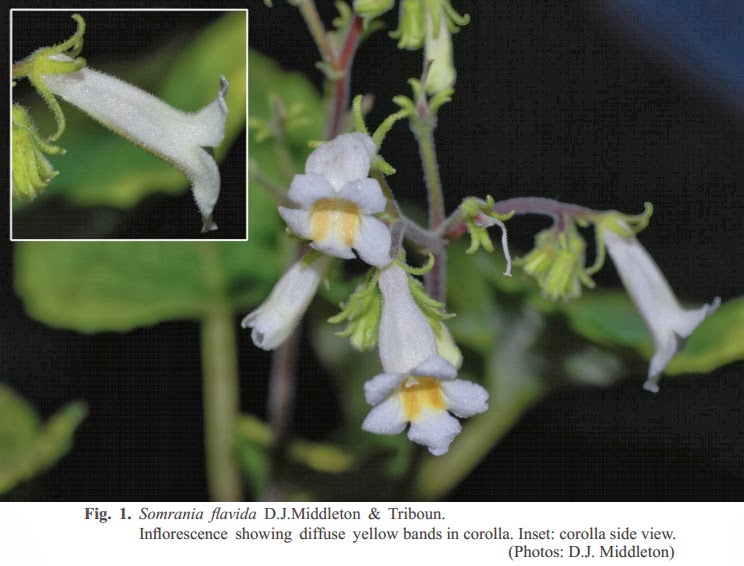
[Botany • 2013] Somrania flavida • A New Species of Somrania (Gesneriaceae) from Khao Sok National Park in Surat Thani, Peninsular Thailand


Somrania flavida D.J.Middleton & Triboun, sp. nov.

Abstract
 The new species Somrania flavida D.J.Middleton & Triboun, from Khao Sok National Park in Surat Thani Province, Thailand, is described. It is the third species in this genus which is restricted to karst limestone habitats in Thailand. A key to the species of Somrania is provided.

Keywords: New species, Somrania, Thailand 


David J. Middleton and Pramote Triboun. 2013. A New Species of Somrania (Gesneriaceae) from Thailand. Gardens’ Bulletin Singapore. 65(2): 181–184.  

Thursday, December 19, 2013

[Botany • 2013] New species of Microchirita (Gesneriaceae) from Thailand | เนตรม่วง Microchirita purpurea, บุหงาการะเกตุ M. karaketii, สุดดีดาว M. suddeei, ข้าวตอกโยนก M. albiflora, มาลัยฟ้อนเล็บ M. woodii


Abstract
 Five new species of Microchirita are described: Microchirita purpurea D.J.Middleton & Triboun, Microchirita karaketii D.J.Middleton & Triboun, Microchirita suddeei D.J.Middleton & Triboun, Microchirita albiflora D.J.Middleton & Triboun and Microchirita woodii D.J.Middleton & Triboun.
KEY WORDS: Gesneriaceae, Microchirita, new species, Thailand.


       รายละเอียดของพืชวงศ์ชาฤาษีชนิดใหม่ ดังนี้

        เนตรม่วง
 Microchirita purpurea ไมโครชิริตา พัวร์พูเรีย 
ไม้ล้มลุกปีเดียว สูง 0.25-1 ม. ใบเรียงตรงข้าม ช่อดอกเกิดบนใบ ดอกสีม่วงบานช่วงเดือนสิงหาคมถึงเดือนตุลาคม ค้นพบทางภาคตะวันออกเฉียงใต้ ในเขตจังหวัดจันทบุรี (อำเภอแก่งหางแมว) พบตามหน้าผาหินปูนแบบเปิดหรือบริเวณปากถ้ำ  

       บุหงาการะเกตุ  
Microchirita karaketii ไมโครชิริตา คาราเกติ  
 ไม้ล้มลุกปีเดียว สูงได้ถึง 60 ซม. ใบเรียงตรงข้าม ช่อดอกเกิดบนใบ ดอกสีขาวมีแต้มสีม่วงและสีเหลือง บานช่วงปลายเดือนสิงหาคมถึงเดือนพฤศจิกายน  ค้นพบทางภาคเหนือ ในเขตจังหวัดเชียงใหม่ (อำเภอเชียงดาว) พบตามป่าผลัดใบแบบผสม ตามภูเขาหินปูน ที่ความสูง 530-750 ม. จากระดับน้ำทะเล
 
       สุดดีดาว 
Microchirita suddeei ไมโครชิริตา สุดดีอิ 
ไม้ล้มลุกปีเดียว ตั้งตรง สูงได้ถึง 40 ซม. ใบเรียงตรงข้าม แผ่นใบบาง รูปไข่ ช่อดอกเกิดบนใบที่รอยต่อของก้านใบกับแผ่นใบ ดอกสีขาวนวลหรือสีมาวงอ่อนบานช่วงเดือนสิงหาคมถึงเดือนตุลาคม  ค้นพบทางภาคเหนือ ในเขตอ.ร้องกวาง จ.แพร่  และ อ.งาว อ.แจ้ห่ม และอ.บ้านสา จ.ลำปาง พบตามหินปูนในป่าดิบแล้งและป่าผลัดใบแบบผสม ที่ความสูง 200-600 เมตร จากระดับน้ำทะเล
        
       ข้าวตอกโยนก 
 Microchirita albiflora ไมโครชิริตา อัลบิฟลอรา
ไม้ล้มลุกปีเดียว ลำต้นฉ่ำน้ำ สีเขียวอ่อน ใบเรียงตรงข้าม ดอกสีขาวบานช่วงต้นเดือน ส.ค.-ปลายเดือน ต.ค. ค้นพบทางภาคเหนือ ในเขต อ.แม่ฟ้าหลวง และ อ.แม่สาย จ.เชียงราย  ที่ความสูง 500-1,000 เมตร จากระดับน้ำทะเล   
     
       มาลัยฟ้อนเล็บ
 Microchirita woodii ไมโครชิริตา วูดี 
ไม้ล้มลุกปีเดียว ลำต้นสูงได้ถึง 50 เซ็นติเมตร ใบเรียงตรงข้าม แผ่นใบรูปไข่ ช่อดอกเกิดบนใบ ดอกสีเหลืองอ่อนมีแต้มสีน้ำตาลแดง บานช่วงต้นเดือน ส.ค.ถึงปลายเดือน ต.ค. ค้นพบทางภาคเหนือ ในเขต อ.เมือง จ.น่าน ขึ้นตามเขาหินปูน ในป่าดิบแล้งและป่าผลัดใบ
   

D.J. Middleton and P. Triboun. 2013. New species of Microchirita (Gesneriaceae) from Thailand. THAI FOR. BULL. (BOT.). 41: 13–22.
http://web3.dnp.go.th/botany/PDF/TFB/TFB41/TFB41_03_Microchirita.pdf

เปิดตัวพืชไทย “วงศ์ชาฤาษี” พันธุ์ใหม่ 6 ชนิด

[Botany • 2013] Paraboea middletonii | เศวตแดนสรวง • a new species of Paraboea (Gesneriaceae) endemic to northern Thailand


Figure 1.  เศวตแดนสรวง  Paraboea middletonii Triboun:
A. Habitat; B. Habit; C. Inflorescence.
Photographed by Pramote Triboun.

ABSTRACT 
Paraboea middletonii Triboun, a new species from Thailand, is described and illustrated.

KEY WORDS: Gesneriaceae, new species, Paraboea, Thailand


       เศวตแดนสรวง 
 Paraboea middletonii พาราโยเอีย มิดเดิลโทนี 
ไม้ล้มลุกอายุหลายปี ขึ้นบนเกาะหิน ลำต้นตั้งตรง สูง 10-30 เซ็นติเมตร ใบเรียงตรงข้ามสลับตั้งฉาก ชิดติดกันบริเวณส่วนปลายของลำต้น ดอกสีขาวบานช่วงต้นเดือน ส.ค.-ต.ค. ค้นพบทางภาคเหนือ ในเขต จ.น่าน ขึ้นบนหินปูนในร่มรำไร ที่ความสูง 1,000 - 1,300 เมตร จากระดับน้ำทะเล

Distribution.— Endemic to Thailand | NORTHERN: Nan.
Ecology.— In shade on limestone rock, alt. 1,000–1,210 m.

Vernacular. — Sawet daen sruang (เศวตแดนสรวง) (coined by the author).
'middletonii' named in honour of Dr D. J. Middleton, a plant taxonomist from the Royal Botanic Garden Edinburgh and the leader of the Thai Gesneriaceae research team.

Proposed IUCN conservation assessment.— Critically Endangered (CR B1ab(iii)). This species is only known from the type locality, which is a small limestone outcrop right beside the road on the boundary of Doi Phu Kha National Park and with extensive agricultural areas beyond. The basal area of the outcrop shows considerable disturbance. There are estimated to be fewer than 500 plants in the population.
      

Triboun, P. 2013. Paraboea middletonii (Gesneriaceae), a new species from Thailand
THAI FOR. BULL. (BOT.). 4145–47.
http://web3.dnp.go.th/botany/PDF/TFB/TFB41/TFB41_07_Paraboea.pdf

เปิดตัวพืชไทย “วงศ์ชาฤาษี” พันธุ์ใหม่ 6 ชนิด

Friday, May 31, 2013

[Botany • 2012] Twenty new species of Paraboea (Gesneriaceae) from Thailand


Abstract

Twenty new species of Paraboea are described from Thailand: Paraboea arachnoidea Triboun, Paraboea axillaris Triboun, Paraboea bhumiboliana Triboun & Chuchan, Paraboea doitungensis Triboun & D.J.Middleton, Paraboea eburnea Triboun, Paraboea insularis Triboun, Paraboea lavandulodora Triboun, Paraboea monticola Triboun & D.J.Middleton, Paraboea nana Triboun & Dongkumfu, Paraboea nobilis Triboun & D.J.Middleton, Paraboea peninsularis Triboun & D.J.Middleton, Paraboea phanomensis Triboun & D.J.Middleton, Paraboea quercifolia Triboun, Paraboea rosea Triboun, Paraboea sangwaniae Triboun, Paraboea siamensis Triboun, Paraboea takensis Triboun, Paraboea tenuicalyx Triboun, Paraboea vachareea Triboun & Sonsupab and Paraboea xylocaulis Triboun. Full descriptions and conservation assessments are provided for all taxa.

Keywords. Gesneriaceae, IUCN conservation assessments, Paraboea, Thailand


Paraboea sangwaniae Triboun | CR | นครินทรา | Chiang Rai, Doi Tung
Paraboea doitungensis Triboun & D.J.Middleton | EN | ชาฤาษีดอยตุง | Chiang Rai

Paraboea bhumiboliana Triboun & Chuchan | ภูมิพลินทร์ | Lamphun, Li
Paraboea nana Triboun & Dongkumfu | LC | ชาฤาษีน้อย | Lamphun, Li, Mae Ping NP


Paraboea lavandulodora Triboun | NT | ชาฤาษีใบหอม | Bung Kan, Phu Tok

Paraboea quercifolia Triboun | CR | ชาฤาษีใบก่อ | Lopburi 

Paraboea axillaris Triboun | CR | ข้าวตอกฤาษี | Tak, Umphang
Paraboea siamensis Triboun | CR | ศรีสยาม | Tak, Um Phang
Paraboea takensis Triboun | CR | ข้าวตอกใหญ่ | Tak, Um Phang
Paraboea vachareea Triboun & Sonsupab | CR | วัชรีพรรณ | Tak, Um Phang

Paraboea tenuicalyx Triboun | VU | ข้าวตอกพระนเรศ | Kanchanaburi, Tung Yai Naresuan WS


Paraboea eburnea Triboun | CR | ชาฤาษีพระขยางค์ | Ranong, Kraburi

Paraboea arachnoidea Triboun | EN | ชาฤาษีใยแมงมุม | Krabi, Mu Koh Lanta
Paraboea rosea Triboun | VU | ดาวประดับผา | Krabi, Mu Koh Lanta

Paraboea insularis Triboun | VU | สุดสาคร | Phanggna-Krabi bay
Paraboea peninsularis Triboun & D.J.Middleton | EN | สินสมุทร | Krabi: Muang Krabi
Paraboea xylocaulis Triboun | CR | ชาหนุมาน | Krabi-Phangnga bay
Paraboea monticola Triboun & D.J.Middleton | VU | ชาพ่อตาฤาษี | Phangnga and Surat Thani


Paraboea nobilis Triboun & D.J.Middleton | EN | ศรีรัชประภา | Surat Thani, Ban Thakhun, Khao Sok NP
Paraboea phanomensis Triboun & D.J.Middleton | LC | ศรีสุราษฎร์ | Surat Thani, Khlong Phanom NP

_______________________


Paraboea arachnoidea Triboun | EN | ชาฤาษีใยแมงมุม | Krabi, Mu Koh Lanta
Paraboea axillaris Triboun | CR | ข้าวตอกฤาษี | Tak, Umphang
Paraboea bhumiboliana Triboun & Chuchan | ภูมิพลินทร์ | Lamphun, Li
Paraboea doitungensis Triboun & D.J.Middleton | EN | ชาฤาษีดอยตุง | Chiang Rai
Paraboea eburnea Triboun | CR | ชาฤาษีพระขยางค์ | Ranong, Kraburi
Paraboea insularis Triboun | VU | สุดสาคร | Phang-gna-Krabi bay
Paraboea lavandulodora Triboun | NT | ชาฤาษีใบหอม | Bung Kan, Phu Tok
Paraboea monticola Triboun & D.J.Middleton | VU | ชาพ่อตาฤาษี | Phangnga and Surat Thani
Paraboea nana Triboun & Dongkumfu | LC | ชาฤาษีน้อย | Lamphun, Li, Mae Ping NP
Paraboea nobilis Triboun & D.J.Middleton | EN | ศรีรัชประภา | Surat Thani, Ban Thakhun, Khao Sok NP
Paraboea peninsularis Triboun & D.J.Middleton | EN | สินสมุทร | Krabi: Muang Krabi
Paraboea phanomensis Triboun & D.J.Middleton | LC | ศรีสุราษฎร์ | Surat Thani, Khlong Phanom NP
Paraboea quercifolia Triboun | CR | ชาฤาษีใบก่อ | Lopburi 
Paraboea rosea Triboun | VU | ดาวประดับผา | Krabi, Mu Koh Lanta
Paraboea sangwaniae Triboun | CR | นครินทรา | Chiang Rai, Doi Tung
Paraboea siamensis Triboun | CR | ศรีสยาม | Tak, Um Phang
Paraboea takensis Triboun | CR | ข้าวตอกใหญ่ | Tak, Um Phang
Paraboea tenuicalyx Triboun | VU | ข้าวตอกพระนเรศ | Kanchanaburi, Tung Yai Naresuan WS
Paraboea vachareea Triboun & Sonsupab | CR | วัชรีพรรณ | Tak, Um Phang


Paraboea xylocaulis Triboun | CR | ชาหนุมาน | Krabi-Phangnga bay