Showing posts with label Datta-Roy (herpetologist). Show all posts

Tuesday, December 5, 2023

[Entomology • 2023] Aenictus kadalarensis • A New Species of Army Ant Genus Aenictus (Hymenoptera: Formicidae) from India


Aenictus kadalarensis
Sahoo, Ramakrishnaiah, Dharma Rajan & Datta-Roy, 2023


Abstract
A new species, Aenictus kadalarensis sp. nov., belonging to the army ant genus Aenictus Shuckard 1840, is discovered from Kerala, India. The species is described based on the worker caste, and it belongs to the Aenictus pachycerus group. This paper provides a detailed discussion of its morphology and the characteristics that distinguish this species from its closely related species within the A. pachycerus group.

Keywords: Western Ghats, Kerala, A. pachycerus species group, A. kadalarensis sp. nov.


Bikash Sahoo, Sahanashree Ramakrishnaiah, Priyadarsanan Dharma Rajan, Aniruddha Datta-Roy. 2023. A New Species of Army Ant Genus Aenictus (Hymenoptera: Formicidae) from India.  Journal of the Entomological Research Society. 25(3); 615–622. DOI: 10.51963/jers.v25i3.2504

Tuesday, March 30, 2021

[Herpetology • 2021] Subdoluseps nilgiriensis • A New Species of Asian Gracile Skink (Scincidae: Lygosominae: Subdoluseps) from the Rain-shadow Belts of Nilgiri hills, Western Ghats, India


 Subdoluseps nilgiriensis
Ganesh, Srikanthan, Ghosh, Adhikari, Kumar & Datta-Roy, 2021
 

Abstract
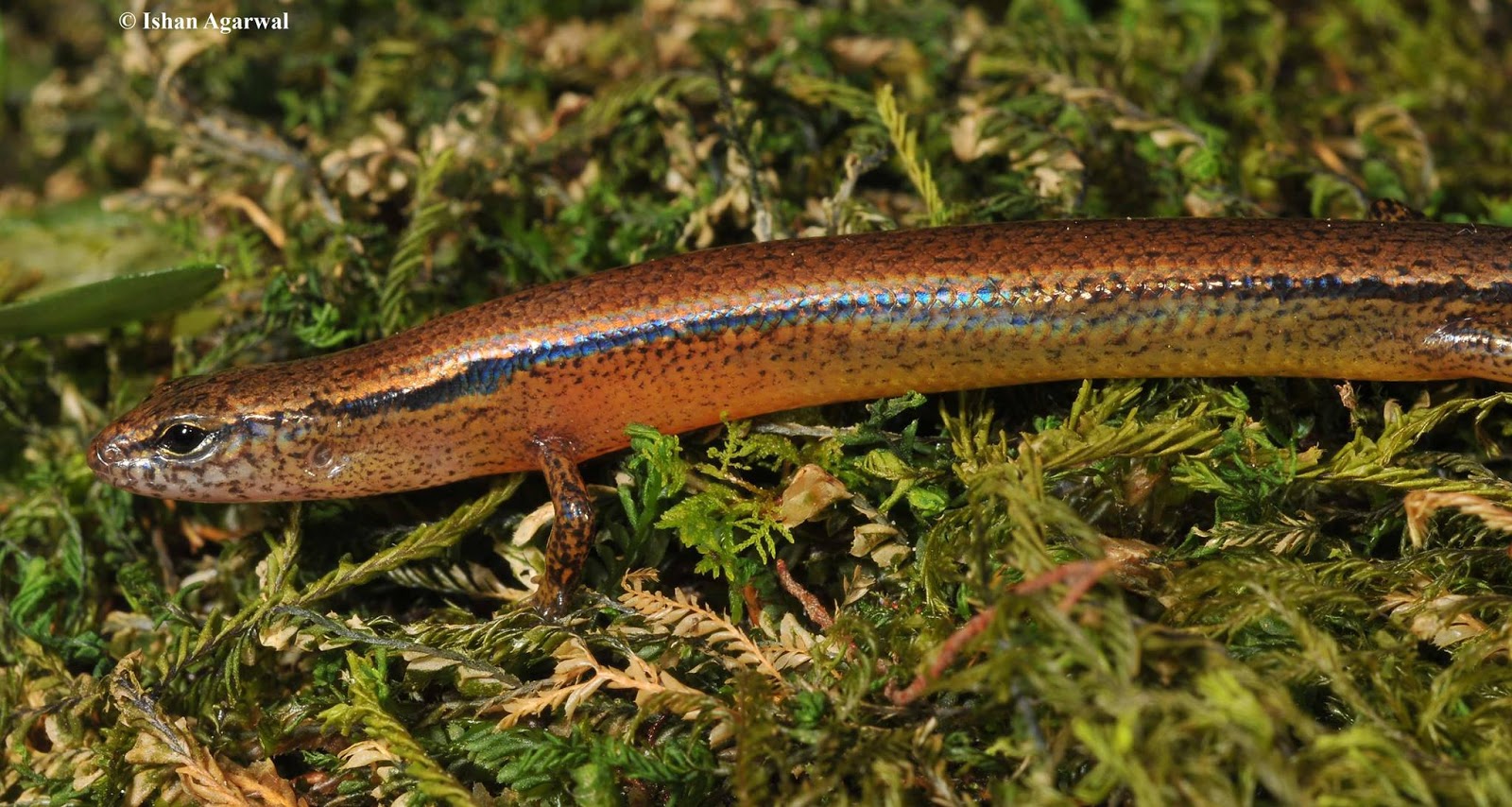
We describe a new species of Asian gracile skink from the dry leeward slopes of the Nilgiri hills, Tamil Nadu state, India which forms a part of the eastern, rain shadow escarpment of the Western Ghats in peninsular India. The new species, Subdoluseps nilgiriensis sp. nov., is characterized by: slender, small-sized body (47–67 mm); sandy brown above, with each scale tipped with black; a thick black lateral band from snout to tail; a distinct white labial streak; dirty white venter, with throat having mild black striations; 28–29 midbody scale rows; 71–74 mid ventral scales; 66–69 paravertebral scales. The new species is described based on external morphological characters, genetic data and geographical isolation. Based on two mitochondrial DNA genes, we show that the new species shares a sister relationship with Subdoluseps pruthi (Sharma, 1977) which is found in parts of the Eastern Ghats in peninsular India. The discovery of this new population raises two novel scenarios. Firstly, it renders the genus Subdoluseps evolutionarily polyphyletic with respect to the Indian species included in this genus. Secondly, it falsifies the notion that S. pruthi group skinks are restricted to the Eastern Ghats. Our results further indicate that the dry zone of peninsular India has unrealized skink diversity that needs to be further explored.

Keywords: Reptilia, Dry zone, Eastern Ghats, genetics, scalation, Subdoluseps nilgiriensis sp. nov., Subdoluseps pruthi, peninsular India


Subdoluseps nilgiriensis


S. R. Ganesh, Achyuthan N. Srikanthan, Avrajjal Ghosh, Omkar Dilip Adhikari, Shree Varsha Vijay Kumar and Aniruddha Datta-Roy. 2021. A New Species of Asian Gracile Skink (Scincidae: Lygosominae: Subdoluseps) from the Rain-shadow Belts of Nilgiri hills, Western Ghats, India. Zootaxa. 4950(2); 361–376. DOI: 10.11646/zootaxa.4950.2.7

Wednesday, August 16, 2017

[Herpetology • 2017] On The Taxonomic Status of Eurylepis poonaensis (Squamata: Scincidae): Resolving A Long-standing Conundrum


Eurylepis poonaensis (Sharma, 1970) 

SALAMANDRA. 53(3) 

Abstract

 The scincid genus Eurylepis was split off from the cosmopolitan genus Eumeces sensu lato, with Eurylepis taeniolatus being the type species, which is taxonomically poorly understood. The other nominate species in this genus is Eurylepis poonaensis, which was known only from its type locality and original description, and is the only known member of the subfamily Scincinae from near the Western Ghats. However, earlier studies raised doubts about its specific validity, often without examining type or other specimens. We collected fresh samples of this species from the type locality and nearby areas. Based on the examination of the holotype and the new material, we provide a detailed redescription of E. poonaensis, additional data on its skeletal structure, habitat, and natural history. We also provide a detailed redescription of E. taeniolatus based on the holotype to avoid further taxonomic ambiguity. 

Key words. Taxonomic resolution, species redescription, Eurylepis taeniolatus, India. 


Eurylepis Blyth, 1854
Eumeces Wiegmann, 1834 (in part).
Eurylepis Blyth, 1854. Type-species: E. taeniolatus Blyth, 1854.
Plestiodon Theobald, 1866, by synonymy of E. taeniolatus
Mabouia Anderson, 1871 (in part), by synonymy of E. taeniolatus

Figure 4. Eurylepis poonaensis (BNHS 2283) in life. Photograph by V. Giri. 

Redescription of Eurylepis poonaensis (Sharma, 1970) 
Eurylepis poonaensis (Sharma, 1970) 

Eumeces poonaensis Sharma, 1970 
Eurylepis poonaensis Griffith et al. 2000 
Eurylepis poonaensis Schmitz et al. 2004 

Holotype: ZSIK 21159. Type locality: Katrajghat, Poona (= Pune), Maharashtra, India.


Redescription of Eurylepis taeniolatus Blyth, 1854 
Eurylepis taeniolatus Blyth, 1854 

Eumeces taeniolatus Stoliczka, 1872 
Mabouia taeniolata Anderson, 1871 
Plestiodon scutatus Theobald, 1868 
Eumeces scutatus Boulenger, 1887 
Eumeces taeniolatus Smith 1935 
Eumeces taeniolatus Taylor 1936 
Eurylepis taeniolatus Griffith et al. 2000 
Eurylepis taeniolatus Schmitz et al. 2004 

Holotype: ZSI 2382. Type locality ‘Alpine Punjab’


Aniruddha Datta-Roy, Veerappan Deepak, R. Chaitanya, Channakeshva Murthy, Harshal Bhosale, Aparna Lajmi, Praveen Karanth, Krushnamegh Kunte and Varad Giri. 2017.   On The Taxonomic Status of Eurylepis poonaensis (Squamata: Scincidae): Resolving A Long-standing Conundrum.  SALAMANDRA. 53(3); 389–397. 


Tuesday, August 20, 2013

[Herpetology • 2013] Sphenomorphus apalpebratus • A Spectacled Sphenomorphus (Squamata: Scincidae), from the Sacred Forests of Mawphlang, Meghalaya, North-east India


Sphenomorphus apalpebratus  A new species of skink from the Northeastern region of India. This cool species differs from all other Sphenomorphus in showing a lack of movable eyelids and the presence of a spectacle (or 'brille') permanently covering the eye. Its found really high up on the Khasi hills (>1800 m).

Abstract
A new species of lygosomatine scincid lizard is described from the sacred forests of Mawphlang, in Meghalaya, northeastern India. Sphenomorphus apalpebratus sp. nov. possesses a spectacle or brille, an unusual feature within the Scincidae, and a first for the paraphyletic genus Sphenomorphus. The new species is compared with other members of the genus to which it is here assigned, as well as to members of the lygosomatine genera Lipinia and Scincella from mainland India, the Andaman and Nicobar Islands, and south-east Asia, to which it also bears resemblance. The new taxon is diagnosable in exhibiting the following combination of characters: small body size (SVL to 42.0 mm); moveable eyelids absent; auricular opening scaleless, situated in a shallow depression; dorsal scales show a line of demarcation along posterior edge of ventral pes; midbody scale rows 27–28; longitudinal scale rows between parietals and base of tail 62–64; lamellae under toe IV 8–9; supraoculars five; supralabials 5–6; infralabials 4–5; subcaudals 92; and dorsum golden brown, except at dorsal margin of lateral line, which is lighter, with four faintly spotted lines, two along each side of vertebral row of scales, that extend to tail base. The new species differs from its congeners in the lack of moveable eyelids, a character shared with several distantly related scincid genera.

Key words: Squamata, Sauria, Scincidae, Sphenomorphus, new species, phylogenetic relationships, Meghalaya, India

photo: Aniruddha Datta-Roy 

Datta-Roy, Aniruddha, Indraneil DAS, Aaron M. Bauer, Ronald K. L. Tron & Praveen Karanth. 2013. Lizard Wears Shades. A Spectacled  Sphenomorphus (Squamata: Scincidae), from the Sacred Forests of Mawphlang, Meghalaya, North-east India. Zootaxa. 3701 (2): 257-276. DOI: 10.11646/zootaxa.3701.2.7

Tuesday, June 11, 2013

[Herpetology • 2013] A Long-lost relic from the Eastern Ghats: Morphology, Distribution and Habitat of Sepsophis punctatus Beddome, 1870 (Squamata: Scincidae)


Abstract
Sepsophis punctatus Beddome 1870, the only species of a monotypic genus, was described based on a single specimen from the Eastern Ghats of India. We rediscovered the species based on specimens from Odisha and Andhra Pradesh state, India, after a gap of 137 years, including four specimens from close to the type locality. The holotype was studied in detail, and we present additional morphological characters of the species with details on natural history, habitat and diet. The morphological characters of the holotype along with two additional specimens collected by Beddome are compared with the specimens collected by us. We also briefly discuss the distribution of other members of the subfamily Scincinae and their evolutionary affinities.

Key words: Sepsophis, rediscovery, Peninsular India, Eastern Ghats, Scincidae


DATTA-ROY, A., MOHAPATRA, P.P., DUTTA, S. K., GIRI, V.B., VEERAPPAN, D., MADDOCK, S.T., RAJ, P., AGARWAL, I. & KARANTH, P. 2013. A long-lost relic from the Eastern Ghats: Morphology, distribution and habitat of Sepsophis punctatus Beddome, 1870 (Squamata: Scincidae). Zootaxa. 3670 (1): 055–062.
______________________________

LIMBLESS LIZARD OF the Genus SEPSOPHIS DISCOVERED FROM KHANDADHAR HILLS OF BONAI, SUNDARGARH, ORISSA

Limbless lizard belonging to the genus Sepsophis, in the forested region of Khandadhar near Raurkela in Orissa state, about 625 miles southeast of New Delhi, India.
photo: Pratyush P Mohapatra