Showing posts with label Lepidosauria. Show all posts

Thursday, September 11, 2025

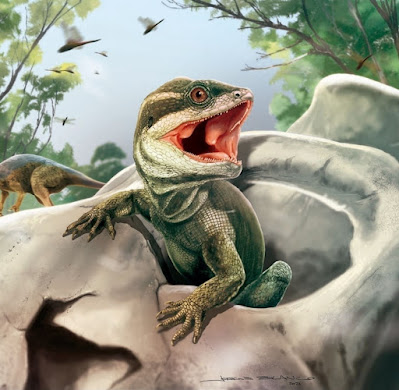
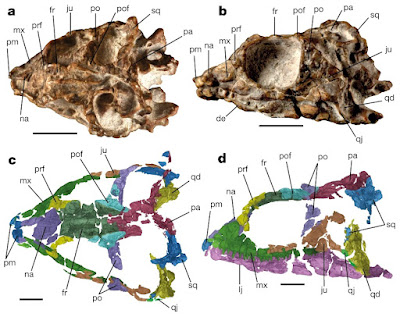
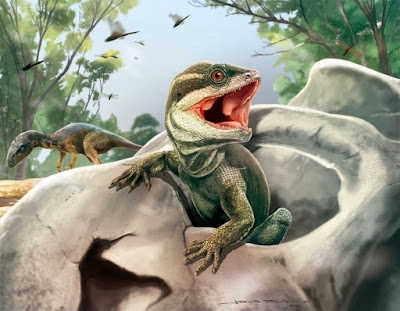
[Paleontology • 2025] Agriodontosaurus helsbypetrae • The Oldest Known lepidosaur and Origins of lepidosaur feeding adaptations


 Agriodontosaurus helsbypetrae
Marke, Whiteside, Sethapanichsakul, Coram, Fernandez, Liptak, Newham & Benton, 2025

Abstract

The Lepidosauria is the most species-rich group of land-dwelling vertebrates. The group includes around 12,000 species of lizards and snakes (Squamata) and one species of Rhynchocephalia, the tuatara Sphenodon punctatus from New Zealand. Squamates owe their success to their generally small size, but also to their highly mobile skull that enables them to manipulate large prey. These key features of lizard and snake skulls are not seen in Sphenodon, which makes it important to understand the nature of their common ancestor. Lepidosaurs originated in the Triassic 252–201 million years ago, but confusion has arisen because of incomplete fossils, many of which are generalized lepidosauromorphs, neither squamates nor rhynchocephalians. Here we report a reasonably complete skull and skeleton of a definitive rhynchocephalian from the Middle Triassic (Anisian) Helsby Sandstone Formation of Devon, UK that is around 3–7 million years older than the oldest currently known lepidosaur. The new species shows, as predicted, a non-mobile skull but an open lower temporal bar and no large palatine teeth, and it seems to have been a specialized feeder on insects. This specimen helps us understand the initial diversification of Lepidosauria as part of the Triassic Revolution, when modern-style terrestrial ecosystems emerged.

Systematic palaeontology
Lepidosauria Haeckel, 1866
Rhynchocephalia Günther, 1867
Sphenodontia Williston, 1925


Agriodontosaurus gen. nov.

 Agriodontosaurus helsbypetrae gen. et sp. nov.

Etymology. Agrio from the ancient Greek epithet of Dionysus, Agrionius, meaning ‘fierce’ and donto for ‘tooth’, which refers to the remarkably large teeth on parts of the dentary and maxilla, and saurus for ‘lizard’. Therefore, ‘fierce-toothed lizard’. The specific term ‘helsbypetrae’ refers to the Helsby Sandstone Formation (locally called the Otter Sandstone), the deposit in which the fossil was found; petrae is the genitive of petra, the latinized form of the ancient Greek word for rock.

Locality and age. The specimen is from the Helsby Sandstone Formation of Sidmouth, Devon, UK. It was excavated as a block by R.A.C. in 2015 from a temporarily exposed foreshore exposure beneath Peak Hill (UK National Grid Reference SY 109865), from the upper half of the formation, perhaps upper Anisian (244–241.5 Ma)15.

Diagnosis. Small rhynchocephalian with a body length of about 100 mm with a unique combination of the following 13 features: dentary and maxillary anterior teeth are simple and conical but robust; posterior teeth are more triangular with broad bases and set slightly en echelon; anterior maxillary and dentary teeth are acrodont and posterior teeth are pleuracrodont with a residual subdental shelf; maxilla with a pronounced anterior process and high facial process; lateral tooth row on the palatine absent; broad, flat parietal table composed of paired bones; ventral region of orbit bounded mainly by the jugal, which provides about 90% of the boundary and the maxilla the rest; jugal with a prominent, but short, posteroventral process that does not reach halfway in the ventral region of the lower temporal opening; quadrate with conch and large foramen; dentary extends posteriorly to underlie the glenoid of the lower jaw; fused prearticular, articular and surangular in the lower jaw; bicapitate ribs in the cervical and trunk regions; gastralia present; and bulb-shaped expansion of the posteriormost part of interclavicle.


Daniel Marke, David I. Whiteside, Thitiwoot Sethapanichsakul, Robert A. Coram, Vincent Fernandez, Alexander Liptak, Elis Newham and Michael J. Benton. 2025. The Oldest Known lepidosaur and Origins of lepidosaur feeding adaptations. Nature. DOI: doi.org/10.1038/s41586-025-09496-9 [10 September 2025]

Wednesday, July 2, 2025

[Paleontology • 2025] Sphenodraco scandentis • An arboreal rhynchocephalian from the Late Jurassic of Germany, and the importance of the appendicular skeleton for ecomorphology in lepidosaurs


 Sphenodraco scandentis
Beccari, Guillaume, Jones, Villa, Cooper  Regnault & Rauhut, 2025

artwork by Gabriel Ugueto  facebook.com/serpenillus 
 
Abstract
Here, we describe a new species of Jurassic rhynchocephalian from the Solnhofen Archipelago, Sphenodraco scandentis gen. et sp. nov., and highlight the importance of the postcranial anatomy for ecomorphological studies in the rhynchocephalian clade. The holotype of Sphenodraco scandentis is divided into a main slab, which has been mentioned in the literature and previously assigned to Homoeosaurus maximiliani, and a counterslab containing most of its skeletal remains. This new taxon shows an exclusive combination of osteological features that differs from previously described rhynchocephalians. Sphenodraco was recovered in our phylogenetic analysis as a component of a clade including Homoeosaurus and Kallimodon. To evaluate the ecomorphology of the new taxon, we compare fossil rhynchocephalians with the extant tuatara and squamates. We quantify the diversity of body proportions in lepidosaurs systematically, inferring lifestyle for extinct rhynchocephalians. Our analysis suggests that fossil rhynchocephalians had a diverse array of substrate uses, with some categorized as good climbers, and with Sphenodraco showing the extreme condition of limb elongation found in strictly arboreal lizards. This new taxon is here regarded as the first predominantly or even strictly arboreal rhynchocephalian. Furthermore, our analysis shows that the diversity of fossil rhynchocephalians might still be underestimated.

ecomorphology, Germany, Jurassic, Rhynchocephalia, sphenodontian, taxonomy, tuatara

Photograph of the holotype of Sphenodraco scandentis.
A, SMF R414, the main slab, containing some bone remains and the imprint of the skeleton.
B, NHMUK PV R 2741, the counterslab, containing most of the skeletal remains


Lepidosauria Haeckel, 1866,
Rhynchocephalia Günther, 1867,sensuDeMar et al. (2022),
Neosphenodontia Herrera-Flores et al., 2018
Sphenodraco gen. nov.
Derivation of name: The genus name combines the prefix spheno- (which composes the name Sphenodontia) and draco (Latin for ‘dragon’, but also in reference to the arboreal gliding lizards, whose limb proportions are similar to that of the new taxon) and translates to ‘the sphenodontian dragon’. The genus name is masculine.

Type species: Sphenodraco scandentis gen. et sp. nov., by monotypy.
 
Sphenodraco scandentis sp. nov.

Derivation of name: The species name comes from the Latin word scandens, meaning ‘climber’.

Diagnosis: Small rhynchocephalian with the following unique combination of traits: (i) maxillary dentition with posterior flanges decreasing in size posteriorly among the last three teeth; (ii) bases of the maxillary teeth are oblique to the tooth row (in labial view)*; (iii) short posterior process of the pleurapophysis of sacral vertebra 2; (iv) tall, funnel-shaped proximal epiphysis of the humerus; (v) tall acetabular region of the ilium, with posteriorly oriented iliac blade; (vi) short pubic process of the ilium*; (vii) slender stylopodia and zeugopodia, with the diameter being <.06 of the length between metaphyses; and (viii) metacarpal and metatarsal IV longer than III. An asterisk (*) represents autapomorphic features.

Living reconstruction of Sphenodraco scandentis in the Solnhofen Archipelago in Germany during the late Jurassic period. 
artwork by Gabriel Ugueto

 
Victor Beccari, Alexandre R. D. Guillaume, Marc E. H. Jones, Andrea Villa, Natalie Cooper, Sophie Regnault and Oliver W. M. Rauhut. 2025. An arboreal rhynchocephalian from the Late Jurassic of Germany, and the importance of the appendicular skeleton for ecomorphology in lepidosaurs. Zoological Journal of the Linnean Society. 204(3); zlaf073.  DOI: doi.org/10.1093/zoolinnean/zlaf073  [02 July 2025] 
Friday, November 8, 2024

[Paleontology • 2024] Notosphenos finisterre • Southernmost Lepidosaur (Reptilia: Lepidosauria) assemblage from the Late Cretaceous of Patagonia


Notosphenos finisterre
Agnolín, Rolando, Manabe, Tsuihiji & Novas, 2024


ABSTRACT
The aim of the present contribution is to describe new materials of lepidosaur reptiles coming from the late Cretaceous (Maastrichtian) Chorrillo Formation, at Santa Cruz province, Argentina. The lepidosaur assemblage is composed by four different snakes (belonging to basal snakes, madtsoiids, and ‘anilioids’) and a tuatara sphenodont. The latter is a new genus and species represented by an incomplete maxilla that shows strong ties to extant Sphenodon. The snakes are represented by isolated vertebrae that indicate they belong to basal forms. Both are very apomorphic and in all probability are the representatives of poorly known lineages. In contrast with recent claims, the fact that most members of this lepidosaur assemblage are highly apomorphic may be indicative of some biogeographical isolation from other Cretaceous lepidosaur associations reported from northern Patagonia.

KEYWORDS: Lepidosauria, sphenodontidae, “anilioidea”, madtsoiidae, basal snakes


Lepidosauria Dúmeril and Bibron, 1839
Rhynchocephalia Gray, 1842

Sphenodontidae Günther, 1867
Sphenodontinae Cope, 1871 (sensu Reynoso, 1996)

Notosphenos finisterre gen. et sp. nov.

Holotype: MPM-PV-23097, incomplete right maxilla preserving two completeand one partial teeth. The specimen comes from the ‘Monotremesite’ (Figure 2). 

Etymology: Notosphenos comes from the Greek. The word ‘Noto’ means ‘South’ and Sphenos’ means ‘Wedge’ but also refers to the general termsapplied to Tuatara (Sphenodon punctatus) and all its kin. The word finisterre, from the Latin, refers to the ‘end of the earth’. 


Federico Agnolín, Mauro Aranciaga Rolando, Makoto Manabe, Takanobu Tsuihiji and Fernando E. Novas. 2024. Southernmost Lepidosaur (Reptilia) assemblage from the Late Cretaceous of Patagonia. Historical Biology: An International Journal of Paleobiology. DOI: doi.org/10.1080/08912963.2024.2341850 
https://www.macnconicet.gob.ar/10147-2/

[Paleontology • 2024] Alamitosphenos mineri • New Small Reptile remains from the Late Cretaceous of Patagonia increase Morphological Diversity of sphenodontids (Lepidosauria)


Alamitosphenos mineri
Agnolín, Rolando, Chimento & Novas, 2024
 
 
Abstract
Sphenodontids are a group of reptiles that were diverse and global for much of the Mesozoic but today they are only represented by the New Zealand tuatara. Here we describe new sphenodontid remains coming from the Cretaceous (Maastrichtian) Los Alamitos Formation, at Río Negro province, Argentina. Previous reports in the stratigraphical unit included an indeterminate sphenodontid and the enigmatic Kawasphenodon. The new material here reported includes an isolated and incomplete dentary and a palatine bone. The dentary belongs to a small taxon having quadrangular teeth and an interlocked mandibular symphysis. The palatine shows compressed teeth and a fang-like canine. These specimens probably belong to two new taxa. These, together with Kawasphenodon, suggest that Maastrichtian sphenodontians from northern Patagonia were at least as diverse as those reported from Cenomanian beds. This contrasts with the poorer record of lizards in the same beds. However, the record of Maastrichtian sphenodonts in southern Patagonia is restricted to a single finding of a Sphenodontine sphenodontid. In Australasia the sphenodont record is also restricted to Cenozoic sphenodontines, very similar to extant Sphenodon species. The currently available fossil record suggests that northern Patagonian rhynchocephalians were more morphologically diverse than those of southern Patagonia and Australasia during the Cretaceous, probably reflecting another faunistic particularity of the 'Weddelian Bioprovince'.


Lepidosauria Dumeril and Bibron, 1839.
Sphenodontidae Günther, 1867.
Opisthodontia sensu Apesteguía and Novas, 2003.

Alamitosphenos mineri nov. gen. et nov. sp.

Holotype. MPMIK 1759/p/23, incomplete left dentary with three pre-served hatchling teeth (Fig. 2). The specimen was found by Mr Santiago Miner. 

Etymology. The name Alamitosphenos comes from the old name of the farm ('Los Alamitos') that yielded the materials here described, and 'Sphenos' means 'wedged' but also refers to the tuatara (Sphenodon punctatus) and all its kin. The specific epithet mineri honours Santiago Miner, a technician and the member of the crew that found the holotype specimen. 

 
Federico L. Agnolín, A. Mauro Aranciaga Rolando, Nicolás R. Chimento and Fernando E. Novas. 2024. New Small Reptile remains from the Late Cretaceous of Patagonia increase Morphological Diversity of sphenodontids (Lepidosauria). Proceedings of the Geologists' Association.  135(1); 36-44. DOI: doi.org/10.1016/j.pgeola.2023.09.007

Descubren fósiles de dos lagartos que habitaron la Patagonia hace 70 millones de años

Monday, March 6, 2023

[Paleontology • 2019] Patagosphenos watukuBridging the Gap: Sphenodont Remains (Lepidosauria: Sphenodontia) from the Turonian (Upper Cretaceous) of Patagonia


 Patagosphenos watuku
Gentil, Agnolin, Marsà, Motta & Novas, 2019


Abstract
Rhynchocephalians are a lepidosaur clade with a single living species. Here we report the first record of an eilenodontine sphenodontian from Turonian beds in South America. The new Turonian basal eilenodontine sphenodontian, Patagosphenos watuku gen. et sp. nov., is described. The specimen is represented by partial cranial and postcranial remains, being very similar to other eilenodontines such as Kaikaifilusaurus and Eilenodon. Moreover, the genus Kaikaifilusaurus is reported for the first time from Turonian beds. Furthermore, this genus is revalidated, being previously considered as a nomen dubium. Paleohistological analysis of Patagosphenos gen. nov reveals a similar bone microstructure to that of the living Sphenodon. We infer that physiological adaptations to survive in cold (freezing conditions) environments may constitute the key pre-adaptation that allowed Sphenodon to survive the Cretaceous-Palaeogene boundary.

Keywords: Rhynchocephalia, Huincul formation, Palaeohistology, Cretaceous-Palaeogene boundary


 Patagosphenos watuku


 Adriel R. Gentil, Federico L. Agnolin, Jordi A. Garcia Marsà, Matias J. Motta and Fernando E.Novas. 2019. Bridging the Gap: Sphenodont Remains from the Turonian (Upper Cretaceous) of Patagonia. Palaeobiological Inferences. Cretaceous Research. 98; 72-83. DOI: 10.1016/j.cretres.2019.01.016
 nationalgeographicla.com/exploradores/2019/02/restos-fosiles-de-una-nueva-especie-de-tuatara-ayudan-comprender-como-esta

Friday, September 16, 2022

[Paleontology • 2022] Opisthiamimus gregori • A nearly Complete Skeleton of A New Eusphenodontian from the Upper Jurassic Morrison Formation, Wyoming, USA, provides insight into the Evolution and Diversity of Rhynchocephalia (Reptilia: Lepidosauria)


Opisthiamimus gregori
DeMar, Jones & Carrano, 2022

Artwork by Julius Csotonyi  facebook.com/JuliusCsotonyi 

Abstract
We describe a new, small-bodied rhynchocephalian reptile, Opisthiamimus gregori gen. et sp. nov., from the Upper Jurassic Morrison Formation of Wyoming, USA. Whereas many fossil rhynchocephalians are based on isolated incomplete jaws, the holotype of O. gregori includes most of the skull and postcranium and therefore represents one of the most complete specimens of Rhynchocephalia known from North America. We used micro-computed tomography to examine its skeletal anatomy in detail and to develop a three-dimensional reconstruction of the skull. The skull of O. gregori is similar to that of several non-neosphenodontian rhynchocephalians such as Planocephalosaurus (e.g. large orbits) and Clevosaurus (e.g. parietal parasagittal crests) yet exhibits a suite of other features related to the proal shearing mechanism that becomes increasingly elaborated among more phylogenetically nested taxa such as Sphenodon (e.g. lateral palatine tooth row parallels maxillary tooth row along its entire length, pyramidal dentary teeth with mesial shearing crests). The postcranial skeleton of O. gregori exhibits characteristics typical of a terrestrial rhynchocephalian. Our phylogenetic analyses use a substantially updated data set of 118 characters and 46 taxa, and both maximum parsimony and Bayesian frameworks. Results place O. gregori inside Eusphenodontia but outside Neosphenodontia, and therefore in a key position for contributing to character polarity for more deeply nested clades such as Clevosauridae, Sphenodontidae and Pleurosauridae. We also erect Leptorhynchia taxon nov., composed primarily of aquatically adapted taxa (e.g. Pleurosaurus, Sapheosaurus), which is supported by both cranial and postcranial characters. Because O. gregori is not particularly closely related to the other named Morrison rhynchocephalians (e.g. Opisthias rarus), it increases both the alpha and beta taxonomic diversities within the formation. Similarly, major differences in body size and inferred diet of the Morrison taxa imply considerable concomitant palaeoecological diversity just prior to a major global decline in rhynchocephalian diversity around the close of the Jurassic.
 
Keywords: Rhynchocephalia, Eusphenodontia, Late Jurassic, Morrison Formation, phylogeny, diversity


Systematic palaeontology

Lepidosauria Haeckel, 1866 (sensu Evans 1984)
Rhynchocephalia Günther, 1867 (sensu Gauthier et al. 1988)

Sphenodontia Williston, 1925
Eusphenodontia Herrera-Flores, Stubbs, Elsler & Benton 2018

Opisthiamimus gen. nov.

Type and only species: Opisthiamimus gregori sp. nov.

Derivation of name: From Opisthias (a genus of the clade Rhynchocephalia) and the Greek ‘mimos’ (μῖμος, meaning mimic; latinized to mimus), referring to the morphological similarities of the dentary and dentary teeth between this taxon and Opisthias.

Derivation of name: The species epithet ‘gregori’ recognizes Joseph Gregor, a dedicated Smithsonian volunteer who skillfully prepared the holotype and referred specimens.

Diagnosis: Opisthiamimus gregori gen. et sp. nov. is a small-bodied (snout-vent length ∼85 mm) member of Rhynchocephalia based on the presence of four unambiguous synapomorphies: (1) jugal dorsal process extends posteriorly 33% or more of the anteroposterior length of the lower temporal fenestra; (2) lower temporal bar bowed laterally beyond the limit of the adductor chamber; (3) dentary posterior process elongate, reaching articular glenoid level; and (4) splenial absent. Opisthiamimus gregori is a member of Sphenodontia based on the presence of three unambiguous synapomorphies: (1) lacrimal absent; (2) distal marginal tooth attachment acrodont; and (3) weak overlap or imbrication between adjacent distal maxillary teeth. Opisthiamimus gregori is a member of Acrosphenodontia in possessing all 14 unambiguous character states of that major clade: (1) parietal parasagittal crest poorly developed; (2) dentary mentonian process poorly developed; (3) mandibular symphysis oval; (4) anterodorsal tip of dentary with conical, anterodorsally projected successional tooth that does not project beyond anterior margin angle of dentary; (5) mesial notch above dentary symphysis confluent with medial surface of subdental ridge/postsymphyseal lamina; (6) dentary symphysis not split by Meckelian canal; (7) pre-coronoid portion of dentary moderate in length and height; (8) coronoid process of dentary moderately tall; (9) mesial marginal tooth attachment acrodont; (10) distal maxillary teeth with small flanges; (11) mesiodistal length of distal dentary teeth greater than apicobasal height; (12 and 13) distal dentary teeth with a mesiolabial and mesiolingual crest; and (14) pterygoid with two tooth rows. Opisthiamimus gregori belongs to Eusphenodontia based on the presence of a single unambiguous synapomorphy: marginal dentition with conspicuous wear facets. Opisthiamimus gregori is the sister taxon to the Clevosauridae + Neosphenodontia in having a shorter fourth metacarpal relative to the third.


Opisthiamimus gregori 
Insect prey: Morrisonnepa jurassica.
Dinosaur in background guarding egg clutch: Allosaurus jimmadseni.
Yellow leaf litter in foreground: Ginkgoites. sp. Tall shrubs in background: Nilssonia sp. Trees in background: Araucaria sp.

  
David G. DeMar Jr., Marc E. H. Jones and Matthew T. Carrano. 2022. A nearly Complete Skeleton of A New Eusphenodontian from the Upper Jurassic Morrison Formation, Wyoming, USA, provides insight into the Evolution and Diversity of Rhynchocephalia (Reptilia: Lepidosauria). Journal of Systematic Palaeontology. 2093139. DOI: 10.1080/14772019.2022.2093139  


Saturday, December 4, 2021

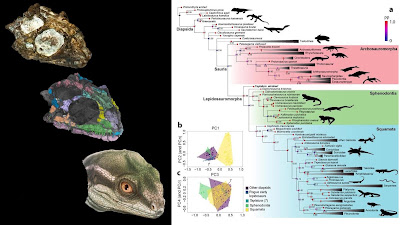
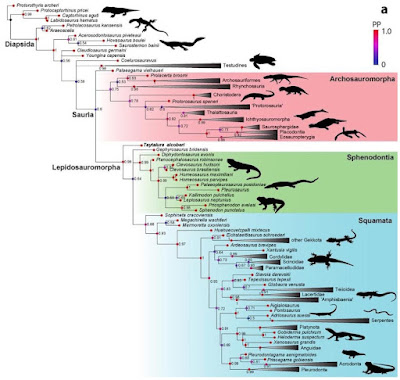
[Paleontology • 2021] Taytalura alcoberi • A Triassic Stem Lepidosaur (Reptilia: Lepidosauromorpha) illuminates the Origin of Lizard-like Reptiles


 Taytalura alcoberi 
Martínez, Simões, Sobral & Apesteguía, 2021

 
Abstract
The early evolution of diapsid reptiles is marked by a deep contrast between our knowledge of the origin and early evolution of archosauromorphs (crocodiles, avian and non-avian dinosaurs) to that of lepidosauromorphs (squamates (lizards, snakes) and sphenodontians (tuataras)). Whereas the former include hundreds of fossil species across various lineages during the Triassic period1, the latter are represented by an extremely patchy early fossil record comprising only a handful of fragmentary fossils, most of which have uncertain phylogenetic affinities and are confined to Europe. Here we report the discovery of a three-dimensionally preserved reptile skull, assigned as Taytalura alcoberi gen. et sp. nov., from the Late Triassic epoch of Argentina that is robustly inferred phylogenetically as the earliest evolving lepidosauromorph, using various data types and optimality criteria. Micro-computed tomography scans of this skull reveal details about the origin of the lepidosaurian skull from early diapsids, suggesting that several traits traditionally associated with sphenodontians in fact originated much earlier in lepidosauromorph evolution. Taytalura suggests that the strongly evolutionarily conserved skull architecture of sphenodontians represents the plesiomorphic condition for all lepidosaurs, that stem and crown lepidosaurs were contemporaries for at least ten million years during the Triassic, and that early lepidosauromorphs had a much broader geographical distribution than has previously been thought.


Lepidosauromorpha Benton, 1985 (sensu Gauthier et al., 1988)

Taytalura alcoberi gen. et sp. nov.

Etymology. Tayta, father (Quechua language, spoken by the Quechua peoples of the Andes in South America); lura, lizard (Kakán language, spoken by the Sherkai (or Diaguita) Nation of Northwestern Argentina). The species epithet refers to O. Alcober, for his sustained contribution to Late Triassic palaeontology.

Holotype. PVSJ 698, accessioned at Museo de Ciencias Naturales, Universidad Nacional de San Juan (PVSJ).


Ricardo N. Martínez, Tiago R. Simões, Gabriela Sobral and Sebastián Apesteguía. 2021. A Triassic Stem Lepidosaur illuminates the Origin of Lizard-like Reptiles. Nature. DOI: 10.1038/s41586-021-03834-3

Researchers describe a new fossil species representing the ancient forerunner of most modern reptiles
  

Monday, August 19, 2019

[Paleontology • 2019] Clevosaurus hadroprodon • A New Clevosaurid from the Triassic (Carnian) of Brazil and the Rise of Sphenodontians in Gondwana


Clevosaurus hadroprodon
 Hsiou, Nydam, Simões, Pretto, Onary, Martinelli, Liparini, Martínez, Soares, Schultz & Caldwell, 2019

 Reconstruction: Jorge Blanco.

Abstract
The early evolution of lepidosaurs is marked by an extremely scarce fossil record during the Triassic. Importantly, most Triassic lepidosaur specimens are represented by disarticulated individuals from high energy accretion deposits in Laurasia, thus greatly hampering our understanding of the initial stages of lepidosaur evolution. Here, we describe the fragmentary remains of an associated skull and mandible of Clevosaurus hadroprodon sp. nov.a new taxon of sphenodontian lepidosaur from the Late Triassic (Carnian; 237–228 Mya) of Brazil. Referral to Sphenodontia is supported by the combined presence of a marginal dentition ankylosed to the apex of the dentary, maxilla, and premaxilla; the presence of ‘secondary bone’ at the bases of the marginal dentition; and a ventrally directed mental process at the symphysis of the dentary. Our phylogenetic analyses recover Clevosaurus hadroprodon as a clevosaurid, either in a polytomy with the Late Triassic to Early Jurassic Clevosaurus and Brachyrhinodon (under Bayesian inference), or nested among different species of Clevosaurus (under maximum parsimony). Clevosaurus hadroprodon represents the oldest known sphenodontian from Gondwana, and its clevosaurid relationships indicates that these sphenodontians achieved a widespread biogeographic distribution much earlier than previously thought.


Figure 2 Type and referred specimens of Clevosaurus hadroprodon sp. nov.
Photograph (a) and outline (b) of holotype partial skull (MMACR PV-027-T). Photograph (c) and outline (d) of referred partial left dentary (MMACR PV-028-T). Photograph (e) and outline (f) of posterior view of section in box in c showing cross sectional view of tooth attachement.

Abbreviations: Lt Den, left dentary; Lt Mx, left maxilla; MeG, Meckel’s groove; Pmx, right premaxilla; Pmx Fac, premaxillary facet in maxilla; Rt Den, right dentary; Rt Mx, right maxilla; SB, secondary bone; D.V.Cr., dentary ventral crest; Sym, symphyseal region of dentary.

Systematic Palaeontology

Lepidosauria Dumeril and Bibron, 1839 sensu Evans, 1984
Rhynchocephalia Günther, 1867 sensu Gauthier et al., 1988
Sphenodontia Williston, 1925 sensu Benton, 1985

Clevosauridae Bonaparte and Sues, 2006 (sensu this study)

Clevosaurus hadroprodon sp. nov.

Etymology: Species epithet comes from a combination of ‘hadroprodon’ (from the Greek “hadros”-meaning large) and “protos”, meaning first (Greek), and “odous”, meaning tooth (Greek); in reference to the “big first tooth”, i.e. the large tusk-like tooth of the premaxilla and the anteriormost/first dentary tooth position.

Locality and horizon: Linha Bernardino locality, Candelária municipality, Rio Grande do Sul State, Southern Brazil (Fig. 1); Santa Maria Formation (Santa Maria Supersequence, Candelária Sequence), Rosário do Sul Group, Paraná Basin; Carnian, Late Triassic.  ..... 

Diagnosis: Small sphenodontian rhynchocephalian differing from all other known sphenodontians in possessing the following combination of features: (1) a large, blunt, tusk-like tooth in both premaxilla and first tooth position of dentary; (2) in having an angled, but nearly vertical mandibular symphysis and relatively deep dentary; (3) absence of an edentulous gap between the tusk-like tooth and the remaining dentition; (4) absence of a posterodorsal process of the premaxilla; (5) in lacking well-developed medial-posteromedial expansion of the posterior dentition; (6) and lacking flanges on the teeth, and (7) lacking labially expanded teeth. Feature 4 makes this new taxon different from many sphenodontians, including other species of Clevosaurus, Rebbanasaurus, Godavariasaurus, Priosphenodon, Sphenotitan, Paminzisaurus and Ankylosphenodon. Features 5 and 6 make this taxon different from all other described species of Clevosaurus [Clevosaurus hudsoni, C. bairdi, C. latidens, C. sectumsemper, C. cambrica, and Clevosaurus sp. (China)]


Figure 3 Phylogenetic analyses evidencing the position of Clevosaurus hadroprodon sp. nov. within Rhynchocephalia using two distinct optimality criteria. (a) Resultant topology of the strict consensus of eight most parsimonious tree (249 steps each) (CI = 0.43; RI = 0.69); (b) Majority-rule consensus tree derived from the Bayesian analysis. Nodes values represent posterior probabilities. (Note that Clevosauridae sensu Bonaparte and Sues, was not recovered as a monophyletic group in both analyses and the genus Clevosaurus was not recovered as monophyletic in the Bayesian topology).
 Abbreviations: “Cle”: Clevosauridae; Hom: Homeosauridae; Pleu: Pleurosauridae; Opi: Ophistodontia.

Figure 5 Life reconstruction of Clevosaurus hadroprodon.
 Reconstruction created by Jorge Blanco.


Annie S. Hsiou, Randall L. Nydam, Tiago R. Simões, Flávio A. Pretto, Silvio Onary, Agustín G. Martinelli, Alexandre Liparini, Paulo R. Romo de Vivar Martínez, Marina B. Soares, Cesar L. Schultz and Michael W. Caldwell. 2019. A New Clevosaurid from the Triassic (Carnian) of Brazil and the Rise of Sphenodontians in Gondwana. Scientific Reports. 9, 11821. nature.com/articles/s41598-019-48297-9

In the shadow of the dinosaurs eurekalert.org/e/9Q6y via @EurekAlert


Monday, December 11, 2017

[Paleontology • 2017] Vadasaurus herzogi • A New Rhynchocephalian (Reptilia: Lepidosauria) from the Late Jurassic of Solnhofen (Germany) and the Origin of the Marine Pleurosauridae


Vadasaurus herzogi
 Bever & Norell, 2017

DOI:  10.1098/rsos.170570  

Abstract

A new rhynchocephalian is described based on a recently discovered and well-preserved specimen from the Late Jurassic (Kimmeridgian) marine limestones of Solnhofen, Bavaria. Phylogenetic analysis recovers the new taxon as the sister group to Pleurosauridae, a small radiation of rhynchocephalians representing the oldest marine invasion of crown-clade Lepidosauria. The relatively strong evidence for this taxonomically exclusive lineage, within a generally volatile rhynchocephalian tree, places the new taxon in a position to inform the early history of the pleurosaur transition to the sea. The early steps in this transition are distributed throughout the skeleton and appear to increase hydrodynamic efficiency for both swimming and aquatic feeding. This early history may also have included a global truncation of plesiomorphic ontogenetic trajectories that left a number of skeletal features with reduced levels of ossification/fusion. The exact degree to which Vadasaurus had adopted an aquatic ecology remains unclear, but the insight it provides into the origin of the enigmatic pleurosaurs exemplifies the potential of Rhynchocephalia for generating and informing broad-based questions regarding the interplay of development, morphology, ecology and macroevolutionary patterns.

KEYWORDSBavaria, marine reptile, secondarily aquatic, skeletal development, sphenodon, tiatethys


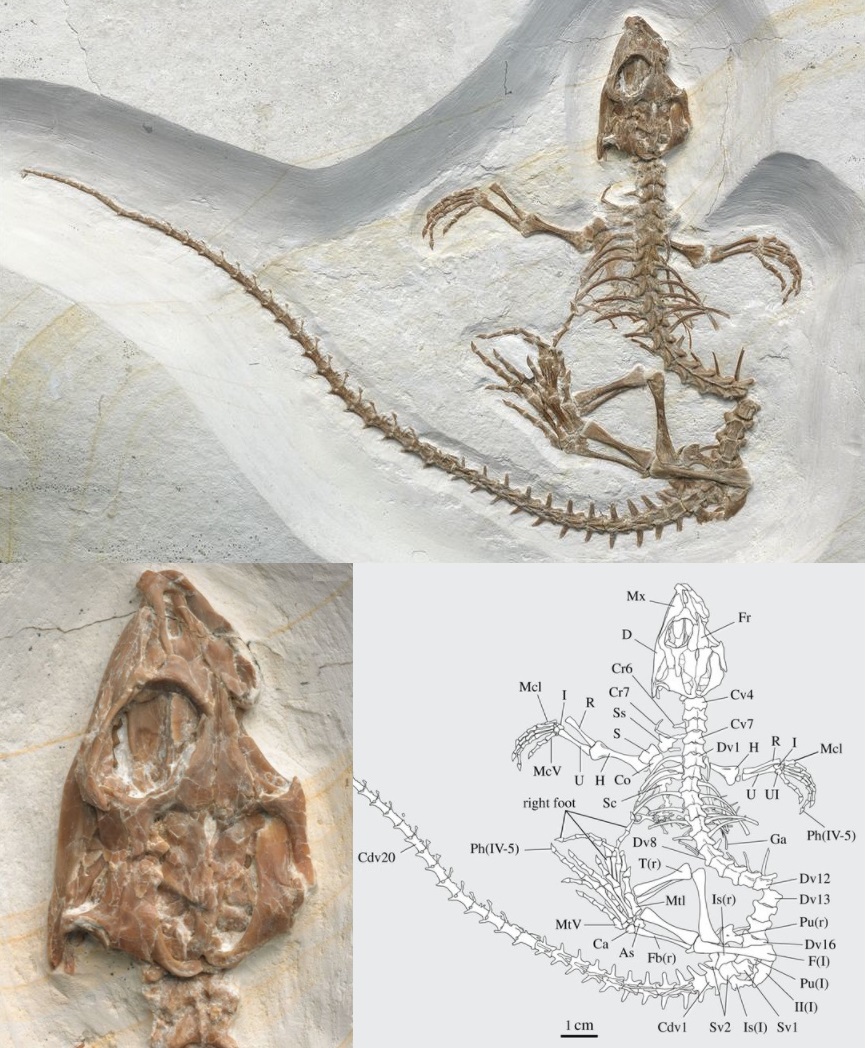
Figure 1. Holotype of Vadasaurus herzogi (AMNH FARB 32768) collected from the Late Jurassic marine limestones of Solnhofen, Bavaria. The skull, forelimbs, and first 18 presacral vertebrae and ribs are exposed in the dorsal or dorsolateral view. Posteriorly, the skeleton is rotated approximately 180°, making it visible largely in the ventral view. Left hindlimb is exposed in the dorsal view.
Anatomical abbreviations: As, astragalus; Ca, calcaneum; Cdv, caudal vertebra; Co, coracoid; Cr, cervical rib; Cv, cervical vertebra; D, dentary; Dv, dorsal vertebra; F, femur; Fb, fibula; Fr, frontal; Ga, gastralia; H, humerus; I, intermedium; Is, ischium; l, left; Mc, metacarpal; Mt, metatarsal; Mx, maxilla; Ph, phalanx; Pu, pubis; R, radius; r, right; S, scapula; Sc, sternal cartilage; Ss, suprascapular cartilage; Sv, sacral vertebra; T, tibia; U, ulna.

Figure 2. The skull of Vadasaurus herzogi (AMNH FARB 32768). Photographs in the dorsolateral (a) and lateral (b) views; labelled line drawing in the dorsolateral view (c); reconstructions of lateral and dorsal views (d).

Anatomical abbreviations: An, angular; Ar, articular; cp, cultriform process; Cv, cervical vertebra; D, dentary; dd, dentary dentition; Ecp, ectopterygoid; Ept, epipterygoid; exn, external naris; Fr, frontal; Hy, hyobranchial element; if, incisiform fang; Ju, jugal; mf, mandibular foramen; Mx, maxilla; Na, nasal; Pa, parietal; Pal, palatine; paf, parietal foramen; Pf, prefrontal; Pm, premaxilla; Po, postorbital; Pof, postfrontal; Pr, prootic; Pra, prearticular; Pt, pterygoid; Q, quadrate; Qj, quadratojugal; Sa, surangular; sof, suborbital fenestra; Sq, squamosal; Vo, vomer.


Systematic palaeontology

Lepidosauria Haekel, 1866 
Rhynchocephalia Günther, 1867 

Vadasaurus herzogi gen. et sp. no.

  Etymology: Generic name from the Latin vadare to go forth’, which is also the root of ‘to wade’—refers to the taxon's hypothesized phylogenetic position near the proximal end of a terrestrial-to-marine transformation series that produced the aquatic pleurosaurs—and saurus lizard’. The specific epithet honours the celebrated Bavarian film-maker Werner Herzog for his continuing exploration of the relationship between life and time.

Holotype: AMNH FARB 32768, a nearly complete and largely articulated skeleton (figures 1–3). Like most specimens preserved in lithographic limestone, it exhibits compressional effects that include the flattening and shearing of composite structures and the slight displacement of certain elements. Individual bones, however, are preserved largely in three dimensions.


Gabriel S. Bever and Mark A. Norell. 2017. A New Rhynchocephalian (Reptilia: Lepidosauria) from the Late Jurassic of Solnhofen (Germany) and the Origin of the Marine Pleurosauridae.  Royal Society Open Science. 4(11):170570  DOI:  10.1098/rsos.170570 


 The fossil was recovered from Kimmeridgian-aged (a subdivision of the Late Jurrasic) marine limestones in the Solnhofen municipality of Bavaria, Germany. They belong to an up until now unknown species dubbed Vadasaurus herzogi, and belongs to the Rhynchocephalia lizard order, a close relative of a small group of ancient reptiles called pleourosaurs (genus Pleurosaurus).
Fossilized ancient lizard shows how dinos evolved to live in the oceans 
zmescience.com/science/ancient-lizard-dino-evolve-ocean-0432/ @zmescience