Showing posts with label Channidae - Snakehead. Show all posts

Tuesday, December 16, 2025

[Ichthyology • 2025] Channa bhoi • A New Species of Snakehead (Teleostei: Channidae) from Meghalaya, Northeast India


Channa bhoi
 Praveenraj, Moulitharan, Ryndongsngi, Thackeray, Naveen & Kumar, 2025


 Abstract
Channa bhoi, a new species of snakehead fish, is described from the Ri-Bhoi district of Meghalaya, India. It belongs to the Gachua group and differs from all its related congeners in having a combination of the following characters: a unique color pattern consisting of a bluish-gray body with lateral scale rows possessing a single, minute black spot on each scale, visibly arranged as 8–9 horizontal rows of broken lines, more transverse scale rows from post-drop to anal fin, more pored lateral-line scales, and a grayish-yellow pectoral fin with 6–8 thin, ochre-yellow to cream bands appearing in a wavy pattern. It differs from all its related congeners by a genetic distance of 3.3–20.4% in the cox1 gene.


Jayasimhan Praveenraj, Nallathambi Moulitharan, Aristone M. Ryndongsngi, Tejas Thackeray, Ravi Shanthy Naveen and Annam Pavan Kumar. 2025. A New Species of Snakehead (Teleostei: Channidae) from Meghalaya, Northeast India. Ichthyology & Herpetology. 113(4); 712-722. DOI: doi.org/10.1643/i2024079  (11 December 2025) 


Thursday, March 27, 2025

[Ichthyology • 2025] Channa nachi • A New Species of Snakehead (Teleostei: Channidae) from Meghalaya, Northeast India


Channa nachi
Praveenraj, Moulitharan, Pavan-Kumar, Naveen, Thackeray, Yumnam & Gurumayum, 2025  

Farham's Snakehead  ||  DOI: doi.org/10.11646/zootaxa.5613.2.8 
 
Abstract
Channa nachi, a new species of snakehead from Meghalaya, Northeast India, is distinguished from its congeners by a creamish-yellow to pale-brown coloured anterior and bluish posterior half of body; sides with 10–12 obliquely-arranged, pale-brown, saddle-like bands; translucent orange pectoral fin with 2–3 faint orange or brown bands; and with a COI genetic divergence of 9.7–20.0%. We review the descriptions of C. melanostigma, C. pomanensis, and C. brahmacharyi, and find C. brahmacharyi to be conspecific with C. pomanensis. We provide additional data to distinguish C. melanostigma and C. pomanensis, and conclude that C. brahmacharyi is a junior synonym of C. pomanensis.

Pisces, Endemic, Channa liporChanna aurantipectoralisChanna brahmacharyi 


Jayasimhan PRAVEENRAJ, Nallathambi MOULITHARAN, Annam PAVAN-KUMAR, Ravi Shanthy NAVEEN, Tejas THACKERAY, Rameshori YUMNAM and Shantabala Devi GURUMAYUM. 2025. Channa nachi, A New Species of Snakehead (Teleostei: Channidae) from Meghalaya, Northeast India. Zootaxa. 5613(2); 337-350. DOI: doi.org/10.11646/zootaxa.5613.2.8 [2025-03-27]  facebook.com/PraveenRaj39750121/posts/9716428821728714

Monday, February 3, 2025

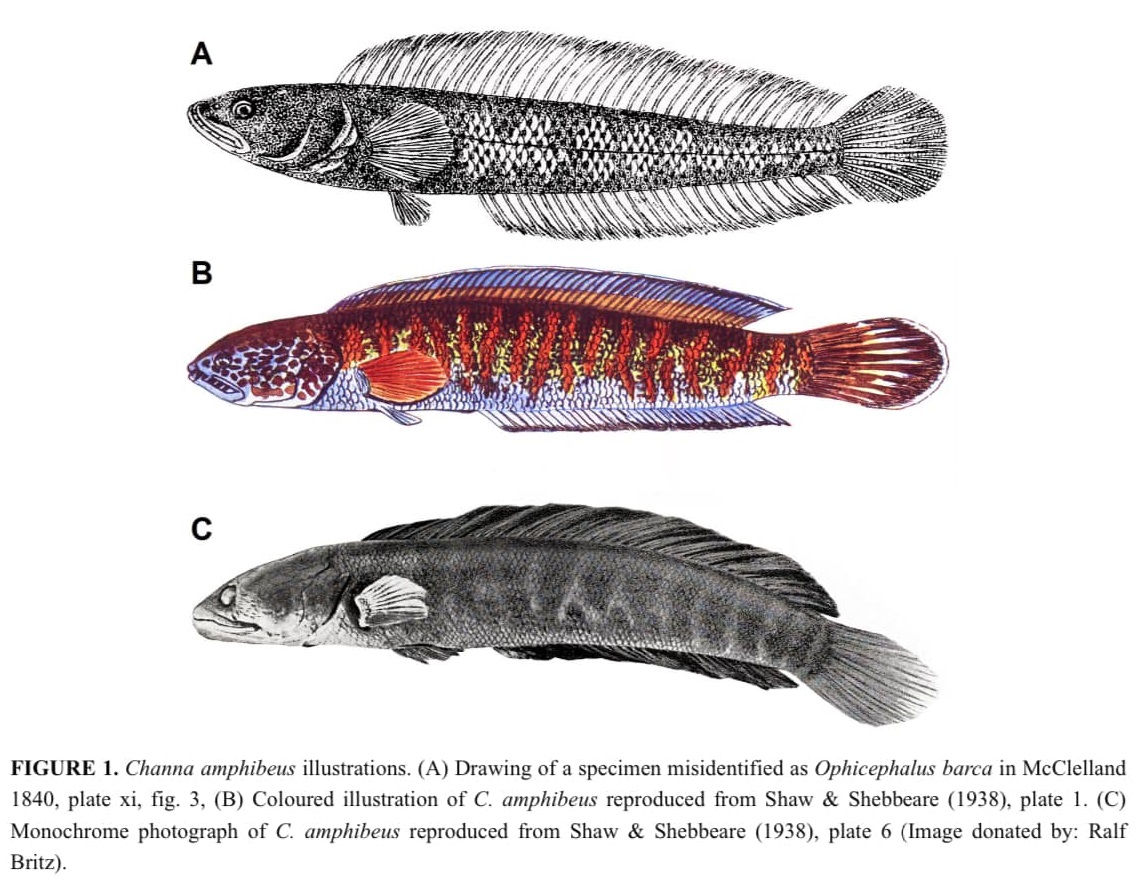
[Ichthyology • 2025] Lost for more than 85 years—Rediscovery of Channa amphibeus (McClelland, 1845) (Labyrinthici: Channidae), the World’s Most elusive Snakehead Species


Channa amphibeus (McClelland, 1845)

in Praveenraj, Thackeray, Moulitharan, Vijayakrishnan et Nanda, 2025. 
 
Abstract
The Chel Snakehead or Bora Chung, Channa amphibeus, is a large snakehead species endemic to the Himalayan region of India. Channa amphibeus was last recorded from specimens collected in the years between 1918 and 1933 (Shaw & Shebbeare 1938), leading to speculations that it may have gone extinct. Here, we report the re-discovery of the species after more than 85 years, based on three specimens collected in the year 2024, and additional photographic records. We also provide the first live image of C. amphibeus, along with biometric, and genetic data.

Pisces, Chel Snakehead, Bora Chung, Channa barca, potentially extinct, rare


Jayasimhan PRAVEENRAJ, Tejas THACKERAY, Nallathambi MOULITHARAN, Balaji VIJAYAKRISHNAN and Gourab Kumar NANDA. 2025.  Lost for more than 85 years—Rediscovery of Channa amphibeus (McClelland, 1845), the World’s Most elusive Snakehead Species (Teleostei, Labyrinthici, Channidae).  Zootaxa. 5583(1); 87-100. DOI: doi.org/10.11646/zootaxa.5583.1.4 

Tuesday, January 16, 2024

[Ichthyology • 2024] Channa rakhinica, C. rubora, C. coccinea & C. pyrophthalmus • Four New Species of Channa (Teleostei: Labyrinthici: Channidae) from Myanmar


Channa pyrophthalmus,
 Channa rakhinica,
Channa coccinea
 Britz, Tan & Lukas, 2024

Raffles Bulletin of Zoology. 72 

Abstract
We describe four new species of Channa from Myanmar, all members of the Gachua group. Channa rakhinica, new species, is a species endemic to west-flowing streams on the western slope of the Rakhine Yoma in Rakhine State; C. rubora, new species, occurs in mountain streams south of Mogaung, Kachin State; C. coccinea, new species, co-occurs with C. burmanica in streams north of Putao, also Kachin State, at the foothills of the Himalayas; and C. pyrophthalmus, new species, is found in streams in Tanintharyi Region at the southernmost tip of Myanmar, bordering Thailand. All four species are readily diagnosed by their colour pattern from other Gachua group taxa. They show genetic distances of 3.5–19.9% in the COI barcoding gene to other Myanmar members of the Gachua group. 

Key words. snakehead fishes, Channoidei, Indo-Burman ranges, Tenasserim ranges, Himalayan foothills

 Channa rakhinica, paratype, colouration in life, BMNH 2019.10.16.269–275, not measured, ca. 110 mm SL.
 Channa rubora, paratype, colouration in life, Myanmar, Kachin State, unnamed stream south of Mogaung,BMNH 2019.10.16.195–206, not measured, ca. 90 mm SL.

Channa rakhinica, new species 
 
Diagnosis. A member of the Gachua group readily distinguished from other Myanmar members by its colour pattern in life including reddish cheek, series of up to 5 semicircular concentric maroon pectoral bands wider than interbands, series of 6–7 saddle-like blotches, orange subdistal and white distal rim on dorsal- and caudal fins (vs. different colour pattern). It is further distinguished from C. stewartii by fewer dorsal-fin rays (34–38 vs. 39–41), and generally fewer anal-fin rays (23–25, rarely 22 or 26 vs. 26–27) and from C. burmanica by presence of pelvic fins (vs. absence). It also differs substantially from all Myanmar Gachua group snakeheads by a genetic distance of 12.9–18.5% in the COI gene.

Etymology. The species name is derived from the name of the area where it occurs, the Rakhine Yoma in western Myanmar, an adjective. 

Remarks. This species has been traded as an ornamental fish since at least 2012 under the name “Channa sp. mimetic pulchra” and has been referred to as Channa sp. Rakhine Yoma in Conte-Grand et al. (2017) and Rüber et al. (2020). Aquarium reports suggest that this is a mouthbrooding species.


  Channa rubora, new species

Diagnosis. A member of the Gachua group distinguished from all other Myanmar members except C. ornatipinnis, C. pulchra, and C. stewartii by the presence of numerous black spots on the head and body (vs absence). It differs from the latter by the size of the spots (tiny, a quarter of pupil size vs. almost pupil size or larger) and by its unique fin colouration in life, consisting of a pectoral fin with orange fin rays, a bluish proximal blotch and 3–6 brown distal semicircular concentric bands, of dorsal-, anal- and caudal-fins with a blue middle section of the fin membranes margined by a proximal dark brown and distal bright orange rim in the dorsal and caudal fins and white rim in the anal fin (vs different colour pattern). It also differs substantially from all Myanmar Gachua group snakeheads by a genetic distance of 11.6–19.3% in the COI gene.

Etymology. The species name, rubora, a noun in apposition, is derived from the Latin nouns ‘rubor’ for redness, and ‘ora’ for rim. The name was inspired by the orange-red rim of the dorsal and caudal fins. 

Remarks. This species has been traded as an ornamental fish since at least 2012 under the name “Channa sp. red fin” and has been referred to as Channa sp. Mogaung in Conte-Grand et al. (2017) and Rüber et al. (2020). Aquarium reports suggest that this is a mouthbrooding species, in which larvae and small juveniles are of a yellow colour. Among the Gachua group species in Myanmar, C. rubora is readily distinguished from all other species by its colour pattern, specifically the numerous tiny spots on the head and flanks. It is also clearly distinguished from C. burmanica by presence of pelvic fins (vs. absence). From the other three species described in this paper, C. coccinea, C. pyrophthalmus, and C. rakhinica, C. rubora also differs in lacking caniniform teeth on the palatine and dentary. 


Channa coccinea, colouration in life, ZRC 64932, 120.5 mm SL; Myanmar, Kachin State, unnamed stream near Putao.
Channa pyrophthalmus, colouration in life, ZRC 64934, 121.3 mm SL; Myanmar, Tanintharyi Region, Lon Phaw, tributary of Kra Buri.

Channa coccinea, new species

Diagnosis. Channa coccinea can be distinguished from all other Myanmar species of the Gachua group by its colour pattern consisting of oblique reddish saddle-like markings and lines (vs. different colour pattern). It can be distinguished from C. burmanica, which occurs in the same area, by presence of pelvic fins (vs absence). It also differs from all Myanmar Gachua group snakeheads by a genetic distance of 3.5–19.9% in the COI gene.

Distribution. The new species was found in streams near Putao, Kachin State, northern Myanmar. 

Etymology. The species name is derived from the Latin adjective ‘coccineus’, -a , -um, red, alluding to the reddish markings on the head and sides of the body.

Remarks. This species has been traded as an ornamental fish since early 2022 under the name “Channa sp. ignis”. Its reproductive mode is still unknown, but it is likely a mouthbrooder.


 Channa pyrophthalmus, new species (Figs. 14–16) 

Diagnosis. Channa pyrophthalmus is distinguished from other Myanmar species of the Gachua group by the colour pattern of its head consisting of a bright orange suborbital patch combined with steel blue lips. It is further distinguished from them by generally having fewer dorsal- (32–34 vs. 34–40) and anal-fin rays (20–22 vs. 22–27) and vertebrae (40–41 vs. 41–48). It also differs substantially from all Myanmar Gachua group snakeheads by a genetic distance of 10.1–18.8% in the COI gene.

Distribution. The new species is known from the area around Lon Phaw, Kra Buri River drainage, southern Tanintharyi Region, close to the border with Thailand. 

Etymology. The species name is derived from the Greek words πῦρ (pyr), fire, and ὀφθαλμός (ophthalmos), eye. It was inspired by the bright orange area under the eye, a colour reminiscent of that of glowing embers. Used as a noun in apposition.

Remarks. This species has been traded as an ornamental fish since 2009 under the name “Channa sp. ice & fire” or “Channa sp. fire and ice” and has been referred to as Channa sp. Tenasserim in Conte-Grand et al. (2017) and Rüber et al. (2020). Aquarium reports suggest that this is a mouthbrooding species. Among the Gachua group species in Myanmar, C. pyrophthalmus is readily distinguished from all other species by its colour pattern which includes a bright orange are around the eye combined with light blue lips and throat and a light blue margin of the anterior infraorbitals. Among Myanmar Gachua group snakehead fishes, it has the lowest dorsal- (32–34) and anal-fin ray (20–22), as well as vertebral counts (40–41).

 
Ralf Britz, Tan Heok Hui and Lukas. 2024. Four New Species of Channa from Myanmar (Teleostei, Labyrinthici, Channidae). Raffles Bulletin of Zoology. 72; Pp. 1–25.


Saturday, April 10, 2021

[Ichthyology • 2020] Channa kelaartii • A Valid Species of Dwarf Snakehead (Teleostei: Channidae) from Sri Lanka and southern peninsular India


 Coloration of Channa kelaartii in life. All from Sri Lanka.

in Sudasinghe, Pethiyagoda, ... et Britz, 2020. 

Abstract  
The dwarf snakehead Channa gachua (Hamilton, 1822) (type locality Bengal) has been reported from a vast range, from Iran to Taiwan, and northern India to Sri Lanka. Here, adopting an integrative taxonomic approach, we show that the Sri Lankan snakehead previously referred to as C. gachua is in fact a distinct species, for which the name C. kelaartii (Günther, 1861) is available. Widely distributed in streams and ponds throughout Sri Lanka's lowlands, and also recorded here from the east-flowing drainages of southern peninsular India, C. kelaartii is distinguished from all the other species of the C. gachua species group by the combination of head shape, dorsal-and anal-fin ray counts, scale counts, the presence of pelvic fins, and live adult coloration. Further, C. kelaartii is genetically distinct from topotypical C. gachua by an uncorrected pairwise distance of 7.9-8.8 % for the mitochondrial cytochrome c oxidase subunit 1 (cox1) gene.

Key words: Channa gachua, integrative taxonomy, DNA barcoding, biogeography, Western Ghats-Sri Lanka biodiversity hotspot.

 Coloration of Channa kelaartii in life. All from Sri Lanka.
A, juvenile, DZ 4073, 26.7 mm SL, Deraniyagala, Kelani River;
B, subadult, ~ 40 mm SL, Wellawaya, Kirindi Oya;
C, subadult, ~45 mm SL, Peradeniya, Mahaweli River;
D, adult, ~ 70 mm SL, Gurulupotha, Mahaweli River;
E, adult, ~ 90 mm SL, southwestern Sri Lanka.

Channa kelaartii (Günther, 1861)
 
Diagnosis. Channa kelaartii is distinguished from the other members of the Gachua group by the following combination of characters: pelvic fin present; lateral head profile pointed anteriorly as in Figure 2A; adults usually possessing 2 – 4, rarely 5 or 6, brown concentric bands in the pectoral fin; 38 –43 lateral-line scales; 5 –½5+1+6½ scales in transverse line on body; 24–28 circumpeduncular scales; 31 –35 dorsal-fin rays; 19 – 23 anal-fin rays; 39 – 42 vertebrae; and live adult coloration as in Figure 3.

Habitat, distribution and natural history. Channa kelaartii is a widely distributed fsh in Sri Lanka (Fig. 5B), occurring mostly in lotic waters such as streams and rivers but also in lentic habitats such as pools and ditches in the lowlands. It is usually associated with submerged roots, leaf debris and marginal vegetation during daytime, with adults being solitary or occurring as pairs. During the night, individuals can be more easily observed in open waters. Channa kelaartii and C. orientalis do occur in close proximity in south-western Sri Lanka, where their ranges overlap; they are occasionally encountered in syntopy. Channa kelaartii occurs even in highly modifed habitats such as concretized drains and canals in urban areas. The highest elevation at which we recorded C. kelaartii in Sri Lanka was ca 700 m asl at Lunugala, but Deraniyagala (1929) reported it from Diyatalawa, ca 1200 m asl. Channa kelaartii is not endemic to Sri Lanka and is reported in this study also from east-fowing drainages of southern peninsular India (Fig. 5A).

Channa gachua. The type locality of Channa gachua was given by Hamilton (1822) simply as ‘ponds and ditches in Bengal’, a vast area that includes Bangladesh and much of the Indian state of West Bengal (the illustration that accompanied the original description is reproduced in colour in Britz, 2019).
 ....


Hiranya Sudasinghe, Rohan Pethiyagoda, Madhava Meegaskumbura, Kalana Maduwage and Ralf Britz. 2020. Channa kelaartii, A Valid Species of Dwarf Snakehead from Sri Lanka and southern peninsular India (Teleostei: Channidae).  Vertebrate Zoology.  70(2); 157-170. DOI: 10.26049/VZ70-2-2020-05

Thursday, December 24, 2020

[Ichthyology • 2020] Channa aristonei • A New Species of Snakehead (Teleostei: Channidae) from East Khasi Hills, Meghalaya, Northeastern India


Channa aristonei 
Praveenraj, Thackeray, Singh, Uma, Moulitharan & Mukhim, 2020


Abstract
A new species of colorful snakehead from Meghalaya, northeastern India is distinguished from all its congeners by possessing a uniform bright blue to bluish-green body, bright-blue dorsal, anal, and caudal fins, submarginally black with white distal margin, series of brown to maroon-red, rounded, oblong or clover-shaped blotches or spots on dorsolateral, postorbital, and ventrolateral region of head, continued on body forming oblique pattern or randomly distributed. The new species superficially resembles C. pardalis and C. bipuli in appearance, but it can be distinguished from both in having brown to maroon-red, rounded, oblong or clover-shaped blotches or spots on head and sides of the body (vs. possession of well-defined, black to brown, rounded to oblong spots), fewer pre-dorsal scales (7 vs. 8–9), more caudal-fin rays (15 vs. 13), and more vertebrae (49 vs. 45). The new species differs from both C. pardalis and C. bipuli by Kimura's two-parameter (K2P) distance of 4.2–4.8 and 4.9–6.0% in the coxI gene sequence. A key to the snakehead Gachua group of the Eastern Himalayan region is provided herein.

Channa aristonei 
Holotype, BNHS FWF 1017, 136 mm SL 

Channa aristonei

Distribution and habitat.—Known from the streams at Puriang, East Khasi Hills, Meghalaya (Fig. 4). The habitat is a clear, slow-flowing hill stream, having rocky substrate, and Eriocaulon sp. as the only aquatic vegetation. The water temperature was 188C at the time of survey. Co-occurring species in the habitat were C. lipor, Danio meghalayensis, and Tor sp. 

Etymology.—This species is named after Aristone M. Ryndongsngi from Meghalaya, in recognition of his discovery of this new species and assistance to the authors during the field work.
 
 
Jayasimhan Praveenraj, Tejas Thackeray, Sadokpam Gojendro Singh, Arumugam Uma, N. Moulitharan, and Bankit K. Mukhim. 2020. A New Species of Snakehead (Teleostei: Channidae) from East Khasi Hills, Meghalaya, Northeastern India. Copeia. 108(4); 938-947. DOI: 10.1643/CI2020007


Thursday, October 1, 2020

[Ichthyology • 2020] Aenigmachannidae • A New Family of Snakehead Fishes (Teleostei: Channoidei) from Subterranean Waters of South India


Aenigmachanna gollum
Britz, Anoop, Dahanukar & Raghavan 2019

Aenigmachannidae 

Britz, Dahanukar, Anoop, Philip, Clark, Raghavan & Rüber, 2020
 Gollum Snakehead Fishes


Abstract
Pronounced organism-wide morphological stasis in evolution has resulted in taxa with unusually high numbers of primitive characters. These ‘living fossils’ hold a prominent role for our understanding of the diversification of the group in question. Here we provide the first detailed osteological analysis of Aenigmachanna gollum based on high-resolution nano-CT scans and one cleared and stained specimen of this recently described snakehead fish from subterranean waters of Kerala in South India. In addition to a number of derived and unique features, Aenigmachanna has several characters that exhibit putatively primitive conditions not encountered in the family Channidae. Our morphological analysis provides evidence for the phylogenetic position of Aenigmachanna as the sister group to Channidae. Molecular analyses further emphasize the uniqueness of Aenigmachanna and indicate that it is a separate lineage of snakeheads, estimated to have split from its sister group at least 34 or 109 million years ago depending on the fossil calibration employed. This may indicate that Aenigmachanna is a Gondwanan lineage, which has survived break-up of the supercontinent, with India separating from Africa at around 120 mya. The surprising morphological disparity of Aenigmachanna from members of the Channidae lead us to erect a new family of snakehead fishes, Aenigmachannidae, sister group to Channidae, to accommodate these unique snakehead fishes.


Aenigmachanna gollum.
(a) 60.6 mm individual alive (KUFOS 2019.8.226), green arrow marks position of vent; (b) CT scan image of skeleton of 90.2 mm holotype (BNHS FWF 966), green arrow marks position of vent and red arrow the first caudal vertebra; (c) CT scan image of head of holotype, yellow arrows mark postorbital process and posterior tip of greatly elongated maxilla; (d) CT scan image of caudal skeleton of holotype, note absence of Day’s bone and presence of distally bifurcated haemal spine (yellow arrow) on second preural centrum; (e) CT scan image of iodine stained 124.5 mm specimen (KUFOS 2019.8.225) in lateral view, swim bladder is shown in blue above the digestive system (green), note swim bladder ending at level of 8th postanal vertebra.

Head anatomy of a channid (Parachanna, left side) and Aenigmachanna (right side) in comparison. Neurocranium of Parachanna africana, (MTD-F39824, c&s, nasals not removed) 150 mm (a,c,e) and Aenigmachanna gollum, (KUFOS 2019.8.224) 81.8 mm in dorsal (a,b), lateral (c,d) and ventral (e,f) view. 
Cleared and stained jaws and hyopalatine arch in lateral view of 
(a) Aenigmachanna gollum, (KUFOS 2019.8.226) 60.6 mm, 
(b) Parachanna africana, (MTD-F39824) 150 mm 
and (c) Channa punctata, (MTD-F39825) 118 mm. 

Lateral views of skeleton of the generalized percomorph Lates (a), the anabantoid Ctenopoma (b), the aenigmachannid Aenigmachanna (c) and the channid Parachanna (d).
 Green arrow marks position of vent, red arrow position of first caudal vertebra (anterior most vertebra with haemal spine). Note more or less equal separation of vertebral column in Lates (a) and Ctenopoma (b) into abdominal and caudal vertebrae (a,b,d adapted from33) with position of vent and first caudal vertebra close to each other and caudal and postanal region of vertebral column of similar length. Note partial abdominalisation of postanal vertebral column in Aenigmachanna and almost complete abdominalisation in Parachanna.

Taxonomy
Aenigmachannidae new family 
 (Gollum snakehead fishes)
Type genus: Aenigmachanna Britz, Anoop, Dahanukar & Raghavan 2019

Diagnosis: A family of the acanthomorph clade Labyrinthici (Anabantiformes), as evidenced by the shared derived possession of a parasphenoid tooth patch (Fig. 2d,f). Aenigmachannidae are distinguished from all other Labyrinthici by the following autapomorphies: (a) a very long maxilla reaching caudally beyond the anterior margin of the preopercle (Figs. 1b,c, 3a), (b) presence of a prominent postorbital process on the maxilla (Figs. 1c, 3a), (c) the frontal suturing with the parasphenoid forming a complete interorbital septum (Fig. 2f), (d) the unique count of 29–32 abdominal and 29–31 caudal vertebrae (Fig. 1b), (e) a series of five median predorsal bones (supraneurals or rayless pterygiophores) in front of the dorsal fin (f) 83–85 scales in a lateral series, and (g) a high number of 40–44 anal-fin rays (Fig. 1a,b). It differs further from all Anabantoidei and Channidae by the swim bladder being short (Fig. 1e), not reaching the parhypural and by the absence of a suprabranchial cavity and organ (Fig. 2h,j). Aenigmachannidae share with Channidae long nasal tubes (Fig. 1a), cycloid scales, the absence of fin spines in dorsal- and anal-fins (Fig. 1a), an increase in the number of vertebrae, a single posterior swimbladder extension combined with abdominalisation of the anterior ten postanal vertebrae (Fig. 1), and five branchiostegal rays, but differ from them by the autosphenotic being excluded from the skull roof and the frontal broadly sutured only to the pterotic (Fig. 2a–f), prootic and basioccipital forming equal parts of the bulla for the sacculith (Fig. 2b,c), the presence of numerous caudal vertebrae and therefore the lack of an abdominalisation of the posterior vertebral column (Fig. 1b), and by absence of the uncinate process of the metapterygoid (Fig. 3a), absence of Day’s bone (Fig. 1d), and of a body lateral-line canal.


Phylogenetic relationships of Aenigmachannidae (marked in red) based on 46 morphological characters. Shown is the strict consensus tree of two most parsimonious trees (tree length = 64 steps, consistency index (CI) = 0.72, retention index (RI) = 0.89). Numbers at nodes correspond to bootstrap values (1000 replicates). Plesiomorphic character states of Aenigmachanna in relation to Channidae discussed in the text are shown on the tree with corresponding numbers.


Ralf Britz, Neelesh Dahanukar, V. K. Anoop, Siby Philip, Brett Clark, Rajeev Raghavan and Lukas Rüber. 2020.  Aenigmachannidae, A New Family of Snakehead Fishes (Teleostei: Channoidei) from subterranean waters of South India. Scientific Reports. 10, 16081. DOI: 10.1038/s41598-020-73129-6

Monday, March 2, 2020

[Ichthyology • 2020] Unexpected Species Diversity within Sri Lanka’s Snakehead Fishes of the Channa marulius Group (Teleostei: Channidae)


Channa marulius
C. cf. ara
C. ara

in Sudasinghe, Adamson, Ranasinghe, et al., 2020. 

Abstract
The taxonomic status of the large snakeheads of the Channa marulius group that occur in Sri Lanka is reviewed and clarified. Two species are recognized from the island, based on both morphological and molecular (cytochrome c oxidase subunit 1: cox1) differentiation: C. marulius Hamilton from the northern dry zone and C. ara Deraniyagala from the middle and lower regions of the Mahaweli basin. Channa ara is endemic to Sri Lanka and can be distinguished from its Marulius group congeners, C. marulius, C. aurolineata and C. auroflammea, by having fewer dorsal- and anal-fin rays, fewer lateral-line scales and fewer vertebrae; from C. marulioides by a different adult colour pattern; and from C. pseudomarulius by having more vertebrae. At the cox1 barcoding locus, Channa ara is at least 3.6% genetically different from C. marulius, and at least 8% different from the other described species in the group. Specimens collected from the southwestern wet zone in Sri Lanka are a puzzling third component of the Marulius group’s diversity, uncovered in this study, and identified here as C. cf. ara. Whilst genetically more similar to C. marulius, C. cf. ara possesses fewer dorsal- and anal-fin rays, fewer lateral-line scales and fewer vertebrae and is therefore morphologically more similar to C. ara. Channa ara can be distinguished from C. cf. ara, however, by differences in circumpeduncular scale count, adult colour pattern, and by an uncorrected pairwise genetic distance of 3.7% in cox1 sequences. A neotype is designated for Ophicephalus marulius ara Deraniyagala.

Keywords: Pisces, Channa ara, C. pseudomarulius, C. marulius, bullseye snakehead, integrative taxonomy, DNA barcoding, Western Ghats-Sri Lanka biodiversity hotspot

FIGURE 3. Live colouration of Channa ara.
A, juvenile, ~80 mm SL, Badulu Oya, Mahaweli River; B, large adult, ~650 mm SL, Victoria Reservoir, Mahaweli River, photo courtesy of Kumudu Wijesooriya.

Live colouration of Channa cf. ara.


Hiranya Sudasinghe, Eleanor A. S. Adamson, R.H. Tharindu Ranasinghe, Madhava Meegaskumbura, Chiho Ikebe and Ralf Britz. 2020.  Unexpected Species Diversity within Sri Lanka’s Snakehead Fishes of the Channa marulius Group (Teleostei: Channidae). Zootaxa. 4747(1); 113–132. DOI:  10.11646/zootaxa.4747.1.4  

Tuesday, October 15, 2019

[Ichthyology • 2019] Channa rara • A New Species of Snakehead Fish (Labyrinthici: Channidae) from the Western Ghats region of Maharashtra, India


Channa rara
Britz, Dahanukar, Anoop & Ali, 2019


Abstract

Channa rara, new species, is described from the Jagbudi River in Maharashtra, India. It belongs to the Gachua group and differs from all its members by the possession of one or more ocelli in the posterior part of the dorsal fin in adults (vs. ocelli absent or 1, rarely 2–3 ocelli in juveniles only). It is further distinguished from most species of the C. gachua group by having 6–7 dark concentric bands on the pectoral fins. We review recent descriptions of species of the genus Channa and conclude that C. royi is a synonym of Channa harcourtbutleri, that the diagnosis of C. shingon from C. harcourtbutleri is seriously flawed and that C. torsaensis is not sufficiently diagnosed from C. quinquefasciata. The recently described C. amari is a junior synonym of C. brunnea.

Keywords: Pisces, taxonomy, endemism, Western Ghats-Sri Lanka biodiversity hotspot

FIGURE 2. Channa rara, live colouration.
(A) BNHS FWF 1003, holotype, 87.6 mm SL, India: Maharashthra: Jagbudi River near Khopi Village, note series of small dark spots along base of dorsal fin, large ocellus-like blotch at posterior dorsal fin.
(B) juvenile, not preserved, ca. 30 mm SL, note numerous black blotches in dorsal, anal, and caudal fins.
(C) small juvenile released from mouthbrooding male, not preserved, ca. 12 mm SL.


FIGURE 3. Channa rara, variation of live colouration.
(A) BNHS FWF 1004-1005, paratypes, 90.3 mm SL (left) and 82.1 (right), note presence of two (left) and three (right) posterior ocellus-like dorsal-fin blotches.
(B) BNHS FWF 1004-1005, paratypes, 90.3 mm SL (left) and 82.1 (right) illustrating ventral head colouration.


Ralf Britz, Neelesh Dahanukar, V.K. Anoop and Anvar Ali. 2019. Channa rara, A New Species of Snakehead Fish from the Western Ghats region of Maharashtra, India (Teleostei: Labyrinthici: Channidae). Zootaxa. 4683(4); 589–600. DOI: 10.11646/zootaxa.4683.4.8


Wednesday, July 17, 2019

[Ichthyology • 2019] Aenigmachanna mahabali • A New Species of Troglophilic Snakehead (Pisces: Channidae) from Kerala, India


Aenigmachanna mahabali
 Kumar, Basheer & Ravi, 2019


Abstract
Aenigmachanna mahabali, a new species of troglophilic snakehead is described on the basis of a single specimen recovered from a well in Kerala, India, over 200km south of the type locality for the only known species in the genus. The new species can be distinguished from its congener in possessing fewer dorsal fin rays (53 vs 56-57), fewer total vertebrae (61 vs 64), fewer scales in lateral series (76 vs 83-85) and in the pectoral-fin rays being extended beyond the margin of the membrane into filaments.

Keywords: Pisces, Subterranean fish, troglomorph, anabantiform


Rahul G. Kumar, V.S. Basheer and Charan Ravi. 2019. Aenigmachanna mahabali, A New Species of Troglophilic Snakehead (Pisces: Channidae) from Kerala, India. Zootaxa. 4638(3); 410–418. DOI: 10.11646/zootaxa.4638.3.6


Thursday, June 27, 2019

[Ichthyology • 2019] Channa brunnea • A New Species of Snakehead (Teleostei: Channidae) from West Bengal, India


Channa brunnea  
Praveenraj, Uma, Moulitharan & Kannan, 2019


Abstract
Channa brunnea, a new species of snakehead fish lacking pelvic fins, from West Bengal, India, is distinguished from its pelvic fin-less congeners by possessing an uniform dark brown body, ochre to bright-orange blotches on the caudal fin, fewer dorsal and anal-fin rays (35–37 vs. 47–51 and 24 vs. 28–32, respectively), fewer vertebrae (43 vs. 45–57), and fewer lateral-line scales (43–46 vs. 51–63). Though Channa brunnea superficially resembles C. bleheri, it can be distinguished from the latter by possessing dark-brown oblique markings on the upper half of the body; transverse scale rows (4½–5½ vs. 3½); pre-anal scales (22–26 vs. 17–20); 2 rows of teeth in the fifth ceratobranchial, the outer row with 16 large conical teeth (vs. 3 rows of teeth, the outer row with 13 large conical teeth); dentary with 20 large, stout, conical teeth in the inner row (vs. 32 medium-sized conical teeth); and a Kimura’s two parameter (K2P) distance of 9.8–10.6%.

Keywords: Pisces, Channa bleheri, Channa andrao, cox1 gene, Eastern Himalaya, freshwater fish


Jayasimhan Praveenraj, Arumugam Uma, Nallathambi Moulitharan and Rajesh Kannan. 2019. Channa brunnea, A New Species of Snakehead (Teleostei: Channidae) from West Bengal, India. Zootaxa. 4624(1); 59–70. DOI: 10.11646/zootaxa.4624.1.4

Thursday, May 9, 2019

[Ichthyology • 2019] Aenigmachanna gollum • A New Genus and Species of Subterranean Snakehead (Teleostei: Channidae) from Kerala, South India


Aenigmachanna gollum
Britz, Anoop, Dahanukar & Raghavan, 2019


Abstract
Aenigmachanna gollum, new genus and species, is described from Kerala, South India. It is the first subterranean species of the family Channidae. It has numerous derived and unique characters, separating it from both the Asian Channa Scopoli and the African Parachanna Teugels & Daget. Uniquely among channids, A. gollum has a very slender (maximum body depth only 11.1–11.3% SL), eel-like body (head length 20.8–21.6% SL), large mouth (jaw length 60.4–61.1 % HL), 43–44 anal-fin rays, 83–85 scales in a lateral series, an unusual colour pattern and it lacks pored lateral-line scales on the body and body buoyancy. In addition, it is distinguished by its DNA barcode sequence, which is 15.8–24.2% divergent from other species of the family Channidae. Morphological modifications usually associated with a subterranean life, such as reduction of eyes and enhancement of non-visual senses (taste, smell, mechanosensory systems) are absent in A. gollum. However, it shares with subterranean fishes a slight reduction of its pigmentation in comparison to epigean channids.

Keywords: Western Ghats-Sri Lanka biodiversity hotspot, relict lineages, laterite, aquifer, Pisces


Ralf Britz, V.K. Anoop, Neelesh Dahanukar and Rajeev Raghavan. 2019. The Subterranean Aenigmachanna gollum, A New Genus and Species of Snakehead (Teleostei: Channidae) from Kerala, South India. Zootaxa. 4603(2); 377–388. DOI: 10.11646/zootaxa.4603.2.10