Showing posts with label Caryophyllaceae. Show all posts

Saturday, March 22, 2025

[Botany • 2025] Stellaria nagae (Caryophyllaceae) • A New Species from North-East India


Stellaria nagae  

in Arya, Vishnu et Kumar, 2025. 
 
Abstract
A new species of Stellaria (Stellaria nagae) is described. It resembles S. sikkimensis from which differs by the shape of sepal (oblong, exceeding the length of petals vs. ovate to lanceolate, equal or shorter than length of petal) , bract (linear, more than 4 mm vs. ovate-lanceolate, up to 8 mm), shape of capsule (oblong vs. ovate), seed surface architecture (tubercle spinulose vs. tubercle flat topped), and pollen morphology (visible frequency of pores 19 vs. visible frequency of pores 14). Detailed description of the new species along with original photographs and SEM images are provided.

Caryophyllales, North east India, Nagaland, S.pallida, Eudicots


Stellaria nagae sp. nov.


Sindu ARYA, Kalarikkal Walsan VISHNU and Venugopalan Nair Saradamma Anil KUMAR. 2025. A New Species of Stellaria (Caryophyllaceae) from North-East India.  Phytotaxa. 693(4); 270-276. DOI: doi.org/10.11646/phytotaxa.693.4.2 [2025-03-17] 


[Botany • 2024] Stellaria mcclintockiae (Caryophyllaceae) • A New Species from Kerala, India


Stellaria mcclintockiae V.S.A.Kumar, Sindhu Arya, V.Suresh, Sojan & Alen Alex, 

in Arya, Kumar, Sojan, Philip et Suresh, 2024. 
 
Abstract
A new species of Stellaria from the Nelliyampathy hills of Palakkad district (Kerala, SW-India) is described and illustrated. The new species can be considered as part of the S. media group but differs from the various species with respect to bracts, sepals, petals, pollen morphology and seed surface architecture. Molecular analyses (ITS) confirmed the validity of the new taxon.

Caryophyllales, Western Ghats, Kerala, Eudicots


Stellaria mcclintockiae V.S.A.Kumar, Sindhu Arya, V.Suresh, Sojan & Alen Alex, 


Sindhu Arya, Venugopalan Nair Saradamma Anil Kumar, Jose Sojan, Alen Alex Philip, Veerankutty Suresh. 2024. Stellaria mcclintockiae (Caryophyllaceae) A New Species from Kerala, India.  Phytotaxa 645(1); 55-65. DOI: doi.org/10.11646/phytotaxa.645.1.5
Researchgate.net/publication/379923618_Stellaria_mcclintockiae_a_new_species_from_Kerala_India


[Botany • 2021] Pseudostellaria wuyishanensis (Caryophyllaceae) • A New Species from Fujian, China


Pseudostellaria wuyishanensis X. Luo & Q.Y. Yang,  

Luo, Yang, Zhang, Zhu, Ma, X.-Y. Chen, Lin et S.-P. Chen, 2021.  

Abstract 
Pseudostellaria wuyishanensis, a new species from the Wuyishan National Park, Fujian, China, is described and illustrated. Morphologically, Pseudostellaria wuyishanensis resembles P. heterantha. However, the new species can be distinguished by presence of stolons, 1 line of hairs on the stem, smaller leaf blades, shorter pedicels, and ovary with 2 styles.

Keywords: Caryophyllaceae, Fujian, Pseudostellaria, Wuyishan National Park

Pseudostellaria wuyishanensis sp. nov.
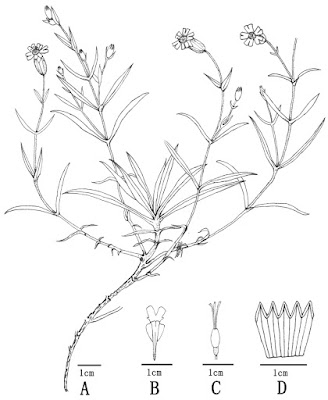
 A plant B stem with one line of hair C flower D flower in side view E calyx F petal G tuber H gynoecium of chasmogamous flower.

Pseudostellaria wuyishanensis X. Luo, Q.Y. Yang
A habitat B habit C tuber D plant E flowering plant F flower G all parts of flower.

Pseudostellaria wuyishanensis X. Luo & Q.Y. Yang, sp. nov.
 
Diagnosis: Pseudostellaria wuyishanensis can be distinguished from P. heterantha by several morphological features and distribution (Table 1). P. wuyishanensis has stolons (vs. no stolon in P. heterantha), 1–1.6 × 0.5–0.7 cm (vs. 2–2.5 × 0.8–1.2 cm in P. heterantha) leaf blade, ca. 2 cm long (vs. 3–3.5 cm long in P. heterantha) pedicel and is 6–7 cm tall with 1 line of hairs (vs. 8–15 cm tall with 2 lines of hairs in P. heterantha). P. wuyishanensis only distribute in Wuyishan National Park, Southeastern China (vs. Northern and Southwestern China in P. heterantha)


 Xiao Luo, Qi-Yi Yang, Zhe Zhang, Pan Zhu, Liang Ma, Xin-Yan Chen, Shu-Yi Lin and Shi-Pin Chen. 2021. Pseudostellaria wuyishanensis, A New Species of Caryophyllaceae from Fujian, China. PhytoKeys. 181: 21-28. DOI: doi.org/phytokeys.181.67436 


Friday, October 25, 2024

[Botany • 2024] Schiedea waiahuluensis (Caryophyllaceae) • An enigmatic New Species from Kaua'i, Hawaiian Islands and the first species discovered by a drone collection system


Schiedea waiahuluensis  W.L.Wagner, Weller, B.Nyberg, & A.K.Sakai,
  
in Wagner, Weller, Sakai, Nyberg et Wood, 2024. 

Abstract
During a survey by the National Tropical Botanical Garden drone team, an enigmatic Schiedea was observed in December 2021on steep, rocky cliff faces of the Waiahulu Valley in the Waimea Canyon of Kaua'i. Subsequently, another survey was conducted in March 2022 and, by use of a remotely controlled cutting device suspended below the drone, the first herbarium specimen was collected, as well as a seed collection of an undescribed cliff-dwelling species of Schiedea. Detailed study of the collections and plants grown at the University of California, Irvine greenhouse showed that it had enlarged, somewhat whitish sepals similar to those of cliff-dwelling S. attenuata (the sole species in sect. Leucocalyx), yet differed significantly from all other species in the genus. It also shares with S. attenuata a woody habit, hermaphroditic flowers, coloured nectar and styles 5 to 7 or 8. We describe it here as S. waiahuluensis given the only known localities are on the cliffs of this valley and place it in an enlarged sect. Leucocalyx. With the discovery of this new species, there are 36 species in this Hawaiian endemic genus.

Key words: Caryophyllaceae, conservation, drone exploration, Hawaiian Islands, Kaua'i, Schiedea

 
Schiedea waiahuluensis 
A drone collected specimen Nyberg BN 023 with endemic Mirid on upper right bud B habit of plant in native habitat Williams AMW820, photo by Ben Nyberg
C seed William AMW 821, photo by seedsofhawaii.org D flower of drone collected specimen, Nyberg BN 023, photo by KR Wood.

Collecting Schiedea waiahuluensis via drone
A population accessed on rope, with drone in background William AMW821, photo by Adam Williams B collecting arm hanging from drone, photo by Ben Nyberg C drone collecting arm with specimen, Nyberg BN023 photo by Ben Nyberg.

Schiedea waiahuluensis habitat
A Waiahulu branch of Waimea Canyon, drone photo, by Ben Nyberg
B non-collected individual, drone photo by Ben Nyberg.

 Schiedea waiahuluensis W.L.Wagner, Weller, B.Nyberg, & A.K.Sakai, sp. nov.

Etymology: Specific epithet refers to the Waiahulu cliff region of Waimea Canyon, Kaua'i, the only known location where the new species is found.


Warren L. Wagner, Stephen G. Weller, Ann K. Sakai, Ben Nyberg and Kenneth R. Wood. 2024. Schiedea waiahuluensis (Caryophyllaceae), An enigmatic New Species from Kaua'i, Hawaiian Islands and the first species discovered by a drone collection system. PhytoKeys. 247: 111-121. DOI: doi.org/10.3897/phytokeys.247.130241


Saturday, August 3, 2024

[Botany • 2024] Bufonia darvishii (Caryophyllaceae) • A Novel endemic Species from Zagros Mountains, Iran

 
Bufonia darvishii Zeraatkar,     

in Zeraatkar, 2024. 

Abstract
A new subalpine species of Bufonia sect. Longipedicellata from the Zagros Mountains in west Iran is described and illustrated here. It colonizes mountain slopes with gravelly, stony, and scree substrates in one locality of Chaharmahal and Bakhtiari province, preferably with a western and north-west orientation, at elevations between 2700 and 3100 m a.s.l. The new species, B. darvishii, is diagnosed against the morphologically similar B. macrocarpa. The two species share similarities such as filiform and long pedicels, a lax panicle-cyme inflorescence, distribution pattern of trichomes, and long peduncles. However, the new species stands out with semi-shrub life form, its greater height, retention of the previous year's stems, cymes bearing more flowers, orbicular petals, larger petals, a broadly ovate ovary, larger sepals with more pronounced nervation, shorter pedicels, larger flowers, etc. Bufonia darvishii is proposed to be Critically Endangered (CR) following the guidelines of the IUCN.

Keywords: alpine flora, Bakhtiari, endangered species, Mount Kallar, steno-endemic species

Bufonia darvishii sp. nov. in the wild (Mount Kallar).

Bufonia darvishii sp. nov. in the wild (Mount Kallar).
Habitat (Mount Kallar).
Flower parts in (a) Flower, (b) iInner sepal, (c) outer sepal, (d) stamens, (e) pistil, (f) petals.
 Scales: (b–d, f): 1 mm. (e): 0.5 mm. (a): 2 mm.

Bufonia darvishii Zeraatkar sp. nov.  

Diagnosis: A species related to Bufonia macrocarpa Ser. but exhibiting a significantly greater height (30–50 versus 20–35 cm), semi-shrub life form (versus erect chamaephyte), while retaining previous year's stems, longer leaves (up to 13 versus up to 10 mm), cymes bearing more flowers (10–25 versus mostly 3–10), orbicular petals (versus ovate or obovate), larger (3.0–3.5 mm in diameter, versus (1.5) 1.8–2.0 (3.0) × 1.5–2.0 mm), and broadly ovate ovary (versus elliptic or rounded) petals, different petal length/filament length ratio (shorter versus longer), larger sepals (2.5–3.0 × 1.0–1.6 versus 1.5–2.0 (3.0) × ca 0.8 mm) and with more pronounced nervature (7–9-veined versus 3–7-veined), shorter pedicels (up to 15 mm versus up to 30 mm), and possessing larger flower (ca 5–6 mm in diameter versus 3–4 mm).
 
Etymology: The specific epithet honors Mohammad Darvish, a desert researcher from the Research Institute of Forests and Rangelands, and an Iranian environmentalist who has made comprehensive and diverse efforts to preserve the environment in Iran. His environmental leadership includes the protection of ecosystems, plant and animal species, as well as the reduction of waste and pollution. He and like-minded associates are primarily directed towards recognizing and addressing how actions related to environmental protection can impact human health and well-being.


Amin Zeraatkar. 2024. Bufonia darvishii (Caryophyllaceae), A Novel endemic Species from Zagros Mountains, Iran. Nordic Journal of Botany. DOI: doi.org/10.1111/njb.04440

Tuesday, October 10, 2023

[Botany • 2019] Sagina hookeri (Caryophyllaceae) • A New endemic Species for the Flora of Île Amsterdam (French Southern and Antarctic Lands)


Sagina hookeri Timaná,

in Timaná, Lebouvier et Rouhan, 2019.  

Abstract
A new endemic species of Sagina L., Sagina hookeri Timaná, sp. nov. (Caryophyllaceae) is described for the flora of Île Amsterdam, in the southern Indian Ocean (French Southern and Antarctic Lands). Differences between this taxon and S. diffusa (Hook.f.) Timaná (endemic to the neighboring island of Saint-Paul) and S. procumbens L. (introduced in several circum-austral islands) are discussed, and an identification key to those three Sagina species occurring in Saint-Paul and Amsterdam islands is presented.


 A, Location of Île Amsterdam in the Southern Indian Ocean; B, locality details showing the two sites known for Sagina hookeri Timaná, sp. nov. (dashed frames).


  Living specimens and habitat of Sagina hookeri Timaná, sp. nov. in Île Amsterdam:
A, habit; B, fruit close-up; C, flower close-up; D, fruiting individual; E, habitat of type specimen at Point Del Cano, in the middle of ‘Terres Rouges’.
Photos: MNHN – Germinal Rouhan, 2016.

 
Martín E. Timaná, Marc Lebouvier and Germinal Rouhan. 2019. Sagina hookeri Timaná, sp. nov. (Caryophyllaceae), A New endemic Species for the Flora of Île Amsterdam (French Southern and Antarctic Lands) Adansonia. 41(1); 17-23. DOI: 10.5252/adansonia2019v41a2


Wednesday, June 7, 2023

[Botany • 2023] Silene isabellae (Caryophyllaceae) • A New Campion Species from Serpentine Soils of Albania


Silene isabellae Selvi & Bianchi, 

in Selvi, Gonnelli et Bianchi, 2023.

Abstract
The new species Silene isabellae is described and illustrated from the Skënderbëut mountain range of central Albania. It grows on the ultramafic mountain slopes around Qafë Shtamë, in the understorey of open Pinus nigra forests and in the rocky grasslands above the forest belt, at 1000–1600 m a.s.l. Silene isabellae is a serpentine endemic likely belonging to section Elisanthe (Fenzl ex Endl.) Ledeb. and shows affinities with the widespread European species S. noctiflora L. It is sharply distinct from the latter species in habit, stem and leaf pubescence, morphology, and biology of the flowers and length of the carpophore. Moreover, the ecology of the two taxa is also contrasting, being S. noctiflora a synanthropic-ruderal, mostly in lowlands. Weaker similarities were also observed with the south European subalpine taxa of the group of S. vallesia L. of section Auriculatae (Boiss.) Schischk., though these are not likely to reflect a real systematic affinity.

Key words: Albanian flora, morphology, new species, serpentine endemism, Silene, taxonomy

Silene isabellae
A whole plant B flower with calyx and corolla C fruiting calyx D capsule and carpophore E seed.
Original drawing by Laura Vivona. 

  Field photos of Silene isabellae
A habitat B, C whole plants in natural habitat D inflorescence with flowers and fruiting calyces E flower F basal leaves G flowers at late stage H seed.

 Silene isabellae Selvi & Bianchi, sp. nov.
 
Diagnosis: Silene isabellae differs from S. noctiflora by the perennial habit with stoloniferous stems forming thick mats (instead of annual), the sparsely and shortly glandular-pubescent stem (vs. densely hairy), the basal leaves of the sterile stems present and widely obovate-spathulate (vs. absent), the cauline leaves linear-lanceolate (3–5 mm vs. ovate-lanceolate 25–35 mm wide), with shortly ciliate margins (vs. densely pubescent on both surfaces), the longer calyx teeth (ca. 8.5 vs. 7.0 mm), the corolla unscented and open during daytime (instead of scented and opening at evening), the petal lobes dentate (vs. entire), the fruiting calyx with prominent longitudinal ribs and the longer carpophore (6–7 vs. 2–3 mm).
 
Etymology: This species is dedicated to the first author’s wife, for her continuous support and advice during many botanical trips across the Mediterranean and the Middle East.


Federico Selvi, Cristina Gonnelli and Elisabetta Bianchi. 2023. Silene isabellae (Caryophyllaceae), A New Campion Species from Serpentine Soils of Albania. PhytoKeys. 227: 123-134. DOI: 10.3897/phytokeys.227.100850
 

Sunday, April 30, 2023

[Botany • 2023] Silene ophioglossa (Caryophyllaceae: Sileneae) • A New Species from southwest China

 
Silene ophioglossa Huan C. Wang & Feng Yang,  

in Yang, Wang, Wang et Wang, 2023. 

Abstract
Silene ophioglossa Huan C. Wang & Feng Yang, a new species of Caryophyllaceae, is here described and illustrated based on morphological and molecular evidence. The new species was found in Sichuan and Yunnan provinces, southwest China. Phylogenetic analysis based on ITS sequences showed this new species belongs to section Cucubaloides. Morphologically, it resembles S. phoenicodonta and S. viscidula, which were also found in the southwest China, but clearly differs from the latter two species by having 5–7 mm long calyces with sparsely hirtellous and short glandular hairs, white petals, linear limbs and lobes, and absent or oblong-linear coronal scales. A distribution map and a table with morphological diagnostic characters of new species and its closest relatives are provided, as well as a preliminary conservation assessment of S. ophioglossa under the IUCN criteria.

Keywords: Conservation assessment, endemism, ITS sequence, Silene phoenicodonta, Silene sect. Cucubaloides

Silene ophioglossa sp. nov.
A habit B abaxial surface of leaf C adaxial surface of leaf D roots E dichasial cymes F flower (side view, showing the calyx) G flower (front view) H dissected flower (showing the androgynophore and claws) I pistil and androgynophore J petal (showing the claw, auricles and coronal scales) K immature capsule L seeds.
(Photographed by F. Yang) 

Silene ophioglossa sp. nov.
A habit B flower (front view) C adaxial surface of leaf D petal E pistil and androgynophore F seed.
 (Drawn by Tingting Wang) 

 Silene ophioglossa Huan C. Wang & Feng Yang, sp. nov.
  
Diagnosis: Silene ophioglossa is morphologically similar to S. phoenicodonta (Fig. 3), but clearly differs from the latter in having 5–7 mm (vs. 6–8 mm) long calyces sparsely hirtellous and short glandular hairs (vs. densely hirtellous and with short glandular hairs), white (vs. dark violet) petals, linear (vs. obovate) limbs and linear (vs. ovate or nearly band-shaped) lobes, absent or oblong-linear (vs. orbicular-linear) coronal scales.

Etymology: The specific epithet “ophioglossa” is derived from the Greek words “ophis” (meaning snake) and “glossa” (meaning tongue), which refer to the petal lobes of this new species which resemble the tongue of a snake.

 
 Feng Yang, Ting-Ting Wang, Yue-Hua Wang and Huan-Chong Wang. 2023. Silene ophioglossa (Caryophyllaceae, Sileneae), A New Species from southwest China. PhytoKeys. 225: 99-113. DOI: 0.3897/phytokeys.225.98247


Wednesday, August 17, 2022

[Botany • 2021] Polycarpaea palakkadensis (Caryophyllaceae) • A New Species from Kerala, South-West India


 Polycarpaea palakkadensis  V.S.A.Kumar, Sindhu Arya & V.Suresh, 

in Arya, Kumar, Nathanpillai, ... et Suresh, 2021. 

Abstract
Polycarpaea palakkadensis, a new species of Caryophyllaceae from the hillocks of Palakkad District (Kerala, India) is described and illustrated. P. palakkadensis is morphologically similar to P. rangaiahiana from which differs in having fused ovate bracts, capilliform bracteoles, linear stipules, ovate-cordate petals, filaments much shorter than anther, capsule with 1–2 ovoid elliptical seeds.
 
Keywords: Caryophyllales, Western Ghats, Palakkad gap, Eudicots

 Polycarpaea palakkadensis
a. habit; b. inflorescence; c. stipules; d. bract; e. flower f. & g. sepals; h. petal; i. stamen; j. gynoecium; k. fruit; l. seed
(pictures by A. Sindhu).

  
Sindhu Arya, Venugopalan Nair Saradamma Anil Kumar, Ambika Viswa Nathanpillai, Alen Alex Philip, Jose Sojan and Veerankutty Suresh. 2021. Polycarpaea palakkadensis (Caryophyllaceae), A New Species from Kerala, South-West India. Phytotaxa. 527(2); 151-157. DOI: 10.11646/phytotaxa.527.2.8 

Thursday, February 17, 2022

[Botany • 2022] Silene vanchingshanensis (Caryophyllaceae) • A New Species from Guizhou, southwest China


 Silene vanchingshanensis C.Y.Wu ex Huan C. Wang & Feng Yang, 

in Yang, Liu, Li et Wang, 2022. 

Abstract
Silene vanchingshanensis (Caryophyllaceae), a new species from Fanjingshan Mountain in Guizhou (southwest China) is described and illustrated. It is morphologically similar to S. morrisonmontana and S. hupehensis, from which it can be easily distinguished by having pubescent stems usually 10–15 cm long, linear-oblanceolate leaves 3–6 cm × 3–6 mm, often 2–5-flowered cymes, pink or violet petals and narrowly ovoid capsules.

Keywords: Endemism, Guizhou, Silene, Silene morrisonmontana, Silene hupehensis

 Silene vanchingshanensis C.Y.Wu ex Huan C. Wang & Feng Yang, 
A habit B petal C pistil D calyx.
(Drawn from the holotype by Jing-Li Liu) 

 Silene vanchingshanensis C.Y.Wu ex Huan C. Wang & Feng Yang, 
A habit B flower (front view) C basal leaves D cauline leaves and bracts E basal leaves F flower (side view, showing the calyx and pedicel) G dissected flower (showing the androgynophore and claws) H petal (showing the claw, auricles and coronal scales) I pistil and androgynophore J stamens, pistil and androgynophore K calyx after anthesis L immature capsule.


 Silene vanchingshanensis C.Y.Wu ex Huan C. Wang & Feng Yang, sp. nov.

Diagnosis: Silene vanchingshanensis is similar to S. morrisonmontana, from which it differs by its shape and size of leaves (linear-oblanceolate, 3–6 cm × 3–6 mm vs. linear, 2–7 cm × 2–3 mm), cymes (often 2–5-flowered vs. usually solitary) and colour of petals (pink or violet vs. white).

Etymology: The specific epithet vanchingshanensis is derived from the type locality “Vanchingshan”, a variant name for Fanjingshan Mountain.

Distribution and habitat: Silene vanchingshanensis is currently known only from locus classicus (Fanjingshan Mountain), a famous scenic resort in Guizhou, southwest China. The species grows on cliffs or rock crevices of the mountain summit at elevations of 2,100–2,500 m.


 Feng Yang, Jin-Li Liu, Ping-Ping Li and Huan-Chong Wang. 2022. Silene vanchingshanensis (Caryophyllaceae) A New Species from Southwest China. PhytoKeys. 189: 155-162. DOI: 10.3897/phytokeys.189.79631 

Friday, March 12, 2021

[Entomology • 2021] Three New Species of Ametrodiplosis (Diptera: Cecidomyiidae) from Japan, with A Key to the Japanese Species and A Molecular Phylogenetic Analysis


Ametrodiplosis spp.
Elsayed, Yukawa, Mochizuki, Tokuda & Kawakita, 2021
 

Abstract
Ametrodiplosis Rübsaamen (Diptera: Cecidomyiidae: Clinodiplosini) is a mostly Holarctic gall midge genus whose species are associated with a wide range of seed plant families, either as gall-inducers or inquilines. In this study, we describe three species of Ametrodiplosis from Japan: Ametrodiplosis adetos n. sp. feeding in the flowers of Tylophora aristolochioides Miq. (Apocynaceae); A. aeroradicis n. sp. inducing aerial root galls on Trachelospermum asiaticum (Sieb. et Zucc.) Nakai and T. gracilipes var. liukiuense (Apocynaceae); and A. stellariae n. sp. forming leaf bud galls on Stellaria uliginosa Murray var. undulata (Thunb.) Ohwi (Caryophyllaceae). A molecular phylogenetic analysis using mitochondrial COI and ribosomal 16S genes and nuclear ribosomal 28S gene were conducted for the three new Ametrodiplisis species and other clinodiplosine taxa sequences available in GenBank. The analysis supported the monophyly of Ametrodiplosis despite the variable life history of the three species. In addition, it indicated very low intraspecific genetic divergence among the individuals from different localities and/or host plants. A taxonomic key to the three new Japanese species of Ametrodiplosis is provided.

Keywords: Diptera, Gall midge, Clinodiplosini, Apocynaceae, Caryophyllaceae, DNA barcode


Ayman Khamis Elsayed, Junichi Yukawa, Ko Mochizuki, Makoto Tokuda and Atsushi Kawakita. 2021. Three New Species of Ametrodiplosis (Diptera: Cecidomyiidae) from Japan, with A Key to the Japanese Species and A Molecular Phylogenetic Analysis. Zootaxa. 4942(2); 151–172. DOI: 10.11646/zootaxa.4942.2.1

Wednesday, July 15, 2020

[Botany • 2020] Psammosilene tunicoides (Caryophyllaceae) A New Generic and Species Record for Thailand


กำลังช้างพลาย  ||  Psammosilene tunicoides W.C.Wu & C.Y.Wu

in Suddee, Phutthai, Tetsana, et al., 2020. 

A.–B. by W. Kiewbang; C., F. by T. Phutthai; D.–E. by N. Tetsana.n

ABSTRACT
Psammosilene tunicoides, a new generic and species record for Thailand, is reported. The new record was discovered on a degraded calcareous substrate mountain in the western part of Thailand near the Thai-Myanmar border. The species was previously reported to be endemic to SW China. This occurrence in Thailand greatly extends the distribution of the species. A lectotype is designated here.

Keywords: degraded calcareous substrate mountain, Doi Hua Mot, insufficiently known genus, lectotypification, medicinal plant, monotypic genus, taxonomy, Umphang District


Figure 2. Psammosilene tunicoides W.C.Wu & C.Y.Wu:
A. Habit; B. Root; C.–D. Inflorescence; E.–F. Flower.

A.–B. by W. Kiewbang; C., F. by T. Phutthai; D.–E. by N. Tetsana.

Psammosilene tunicoides W.C.Wu & C.Y.Wu


Somran Suddee, Thamarat Phutthai, Naiyana Tetsana, Theerawat Thananthaisong, Wittawat Kiewbang. 2020. Psammosilene tunicoides (Caryophyllaceae) A New Generic and Species Record for Thailand. THAI FOREST BULL., BOT. 48(2); 95–100. DOI: 10.20531/tfb.2020.48.2.02

กำลังช้างพลาย Psammosilene tunicoides W. C. Wu & C. Y. Wu พืชสมุนไพรในวงศ์ Caryophyllaceae จากอำเภออุ้มผาง จังหวัดตาก เป็นสกุลและชนิดรายงานการพบใหม่สำหรับประเทศไทย สกุล Psammosilene เป็นสกุล monotypic คือทั้งสกุลมีชนิดเดียว พืชชนิดนี้เคยมีรายงานการพบเฉพาะทางจีนตอนใต้และมีการนำรากมาใช้เป็นสมุนไพรอย่างแพร่หลายจนทำให้ประชากรในธรรมชาติลดลงอย่างมาก การพบในประเทศไทยเป็นการลดความเสี่ยงในการสูญพันธุ์จากธรรมชาติของพืชชนิดนี้ ตีพิมพ์ในวารสารนานาชาติ Thai Forest Bulletin (Botany) 48(2): 95–100. 2020 และได้ทำ lectotypification สำหรับตัวอย่างต้นแบบ