Showing posts with label Enantiornithines. Show all posts

Friday, May 29, 2026

[PaleoOrnithology • 2026] Plumadraco bankoorum • Hyperelongate Ornamental Tail Feathers in A New early Cretaceous enantiornithine Bird


Plumadraco bankoorum
Clark, O’Connor, X. Wang, Y. Wang, Pruett-Jones, Zhang, X.Wang, Zheng & Zhou, 2026 
 
Illustration: Ville Sinkkonen

Abstract
Bird diversity is reflected in the abundance and variety of extraordinary plumages. Some of these include elongate, ornamental tail feathers that are typically attributed to either intraspecific communication in monomorphic species or sexual selection in sexually-dimorphic ones. Enantiornithines (Aves: Ornithothoraces) were the most diverse group of birds during the Cretaceous. Importantly, some enantiornithine fossils preserve soft tissues, most often in the form of feathers surrounding the body. Unlike any living bird, many enantiornithine specimens lack tail feathers (rectrices) all together, with the tail region consisting entirely of contour feathers. However, when present, enantiornithine rectrices typically consist of a pair of elongate, ornamental feathers with unusually wide rachises, referred to as rachis-dominated feathers. Here we describe Plumadraco bankoorum gen. et sp. nov., a new bohaiornithid enantiornithine with a pair of exceptionally long rectrices. These tail feathers measure twice the individual’s body length, ending in proportionally small pennaceous rackets, thus adding to the growing diversity of these unusual feathers. The fine preservation of these tail feathers, in comparison to other enantiornithine rectrices, reveals previously unrecognized structural variation that hints at their potential function in courtship displays. Although ornamental feathers in enantiornithines are widely considered sexually dimorphic, determining the selection pressures that shaped them is difficult due primarily to limited soft tissue data. Enantiornithine rectrices are likely the result of an interplay between both sexual and naturally selective pressures, similar to the processes which produce analogous structures in birds today.


Plumadraco bankoorum. The skull of STM11−4.
(A) Photo of fossil specimen and (B) a corresponding line drawing. Well preserved bones are colored white, crushed or poorly preserved bones (or portions of bones) are grey, and preserved soft tissues are brown.
Abbreviations: at, atlas; cev, cervical vertebrae; dn, dentary; fe, feathers; fp, frontal process of the premaxilla; fe, feather; fr, frontal; l, left; mx, maxilla; ns, nasal; pmx, premaxilla; pr, parietal; r, right; su, surangular; to, tooth. 
Scale bar 10 mm.

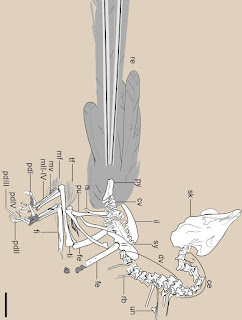
Plumadraco bankoorum. Specimen STM11−4 
(A) The holotype specimen of Plumadraco, (B) a closer view of the body and, (C) a line drawing of the same portion of the body shown in B. Well preserved bones are colored white, crushed or poorly preserved bones (or portions of bones) are grey, and preserved soft tissues are brown. The extent of the feather traces are denoted by the thin black outline around the body. Potential outline or crural feather present along the cranial face of the tibia.
Abbreviations: al, alula; cev, cervical vertebrae; co, coracoid; fm, femur; fu, furcula; hu, humerus; il, ilium; is, ischium; ma, manus; ph, phalanges (of the peds); pu, pubis; py, pygostyle; ri, rib(s); ra, radius; sc, scapula; sk, skull; sp, sternal plate; sy, synsacrum; tb, tibia; tmt, tarsometatarsus; tf, tail feathers; tv, thoracic vertebrae; ul, ulna. 
Scale bar (A, C) equals 50 mm.

Systematic paleontology
Aves Linnaeus, 1758
Pygostylia Chiappe et al., 2002  

Ornithothoraces Chiappe, 1995 
Enantiornithes Walker, 1981

Plumadraco bankoorum gen. et sp. nov.

Holotype. STM11−4 is a complete, articulated specimen preserved in a single slab primarily in dorsal aspect with feathers preserved around the head, body, wings, and tail.

Locality and horizon. Near Xiaotaizi Village, Jianchang County, Liaoning Province, Jiufotang Formation, 121 Ma (Lower Aptian). 

Diagnosis: Mid-sized [112–144 g, similar to some extant turdids (e.g., Cochoa, Turdus) and meliphagids (e.g., Anthochaera) enantiornithine (ventral margin of the furcula wider than dorsal margin; acrocoracoid, glenoid, and scapular cotyla omal-sternally aligned; minor metacarpal extending distally farther than the major metacarpal; metatarsal IV thinner than metatarsals II and III with the trochlea reduced to a single condyle; and a J-shaped metatarsal I), belonging to the family Bohaiornithidae (basally robust, apically tapered dentition; unforked dentary- surangular articulation; proportional width of the coracoid’s sternal margin; caudolateral projection of the sternal plate’s lateral trabeculae; well-developed abruptly terminating deltopectoral crest; robust pedal unguals), with the unique combination of the following features: corpus of the premaxillae dorsoventrally deeper than the dentaries; rostral ~80% of the dentary with parallel dorsal and ventral margins; tip of dentary is rostrodorsally tapered; at least nine sacral vertebrae; caudally-oriented lateral trabeculae of the sternum with asymmetrical, fan-shaped distal expansions; phalanx I of the manual digit craniocaudally thin; weakly curved pedal unguals; RDFs approximately twice body length.

Etymology. Pluma”, Latin for feather, and “draco”, Latin for dragon. In the theme of avian biology and evolution, the specific name, “bankoorum”, honors Winston E. and Paul C. Banko. Together, their momentous life-long efforts have significantly contributed to our understanding of avian biology and conservation, particularly across the Hawaiian archipelago. Plumadraco bankoorum, the Banko’s feather dragon.

 B) Finely-preserved structures present in the proximal portion of the right RDF of Plumadraco bankoorum, C) and the preserved racket showing the differentiated barbs and the reduction, and eventual complete termination, of the central support structures (i.e., ramus and medial stripe). (D) The unique, undifferentiated barbs of the occipital plumes of Pteridophora alberti (King-of-Saxony Bird-of-Paradise) (FMNH 280831) forming tab-like laminated sheets. These structures may be uniquely analogous to the lateral margins (ribbon-like sheets) of enantiornithine RDFs preceding the distal ornaments.
 (E) An in-life restoration of Plumadraco. Illustration by Ville Sinkkonen.

  Results of phylogenetic analyses suggest Plumadraco belongs to the diverse Bohaiornithidae.


 male and female Plumadraco bankoorum
Illustration: Ville Sinkkonen


 Alexander D. Clark, Jingmai K. O’Connor, Xiaoli Wang, Yan Wang, Stephen Pruett-Jones, Xiangyu Zhang, Xing Wang, Xiaoting Zheng and Zhonghe Zhou. 2026. Hyperelongate Ornamental Tail Feathers in A New early Cretaceous enantiornithine Bird. PLoS One 21(5): e0347641. DOI: doi.org/10.1371/journal.pone.0347641 [May 27, 2026]

Thursday, October 10, 2024

[PaleoOrnithology • 2024] Avisaurus darwini & Magnusavis ekalakaenis • New Enantiornithine Diversity in the Hell Creek Formation and the Functional Morphology of the avisaurid tarsometatarsus


Reconstruction of an avisaurid (e.g., Avisaurus  darwini). Morphology of the tarsometatarsus suggests that these large birds engaged in raptorial behavior and could carry proportionally large prey. 

 Clark, Atterholt, Scannella, Carroll & O’Connor, 2024
Illustration by Ville Sinkkonen.

Abstract
Enantiornithines were the most diverse group of birds during the Cretaceous, comprising over half of all known species from this period. The fossil record and subsequently our knowledge of this clade is heavily skewed by the wealth of material from Lower Cretaceous deposits in China. In contrast, specimens from Upper Cretaceous deposits are rare and typically fragmentary, yet critical for understanding the extinction of this clade across the K-Pg boundary. The most complete North American Late Cretaceous enantiornithine is Mirarce eatoni, a member of the diverse clade Avisauridae. Except for Mirarce, avisaurids are known only from isolated hindlimb elements from North and South America. Here we describe three new enantiornithines from the Maastrichtian Hell Creek Formation, two of which represent new avisaurid taxa. These materials represent a substantial increase in the known diversity of Enantiornithes in the latest Cretaceous. Re-examination of material referred to Avisauridae through phylogenetic analysis provides strong support for a more exclusive Avisauridae consisting of six taxa. Exploration of the functional morphology of the avisaurid tarsometatarsus indicates potential strong constriction and raptorial attributes. The lower aspect ratio of the tarsometatarsus facilitates a more biomechanically efficient lever system which in extant birds of prey equates to lifting proportionally heavier prey items. In addition, the proportional size and distal position of the m. tibialis cranialis tubercle of the tarsometatarsus is similar to the morphology seen in extant birds of prey. Together with the deeply-grooved metatarsal trochlea facilitating robust and likely powerful pedal digits, morphologies of the hindlimb suggest avisaurids as Late Cretaceous birds of prey.

Systematic paleontology
Aves Linnaeus, 1758
Pygostylia Chiappe, 2002

Ornithothoraces Chiappe, 1995
Enantiornithes Walker, 1981

The three fossil specimens (from left to right), Avisaurus  darwiniAvisaurus sp., and Magnusavis ekalakaensis, all of which are represented by a tarsometatarsus. They are all shown to scale with one another.  

Avisauridae Brett-Surman and Paul, 1985

Avisaurus Brett-Surman and Paul, 1985

Avisaurus darwini sp. nov.  

Etymology: The specific name “darwini” is in honor of Charles Darwin, whose momentous research and publications helped define the field of evolutionary biology. Avisaurus darwini, Darwin’s bird lizard.

Reconstruction of an avisaurid (e.g., Avisaurus  darwini). Morphology of the tarsometatarsus suggests that these large birds engaged in raptorial behavior and could carry proportionally large prey.
Illustration done by Ville Sinkkonen.


Magnusavis ekalakaenis gen. et sp. nov. 

Etymology: In Latin, “Magnus” meaning big, and “avis” meaning bird, and “ekalakaensis” in honor of the town of Ekalaka, Montana, close to where this specimen was discovered. Ekalaka is Lakota for “one who wanders”. Magnusavis ekalakaenis, Ekalaka’s big bird.

Phylogenetic placement of new Hell Creek enantiornithines based on cladistic analysis.
A) A subset of the strict consensus tree focusing on taxa around the Avisauridae, and B) the full 50% majority tree. In the majority tree, the newly diagnosed Avisauridae family is comprised of six taxa, two of which are described in this publication. C) A 1.8 m tall human to scale with A. darwini (maroon), the largest known Early Cretaceous enantiornithine Pengornis (black), a medium-sized early enantiornithine, Imparavis (white), and finally, a minuscule enantiornithine, Elektorornis (smaller inset black). The extant Buteo jamaicensis (Red-tailed Hawk) is shown in grey.


Alexander D. Clark, Jessie Atterholt, John B. Scannella, Nathan Carroll and Jingmai K. O’Connor. 2024. New Enantiornithine Diversity in the Hell Creek Formation and the Functional Morphology of the avisaurid tarsometatarsus. PLoS ONE. 19(10): e0310686. DOI: doi.org/10.1371/journal.pone.0310686


Thursday, September 12, 2024

[PaleoOrnithology • 2024] Direct Evidence of Frugivory in the Mesozoic Bird Longipteryx contradicts Morphological Proxies for Diet


 Longipteryx, a fossil bird with unusually strong teeth right at the tip of its beak.

in O’Connor, Clark, Herrera, Yang, Wang, Zheng, Hu et Zhou. 2024. 
Illustration by Ville Sinkkonen.

Highlights: 
• Unusual enantiornithine Longipteryx with an elongate rostrum predicted to be a faunivore
• Direct evidence indicates Longipteryx was a frugivore, eating gymnosperm “fruits”
• Like crown birds, morphological proxies fail to predict diet in early birds

Summary: 
Diet is one of the most important aspects of an animal’s ecology, as it reflects direct interactions with other organisms and shapes morphology, behavior, and other life history traits. Modern birds (Neornithes) have a highly efficient and phenotypically plastic digestive system, allowing them to utilize diverse trophic resources, and digestive function has been put forth as a factor in the selectivity of the end-Cretaceous mass extinction, in which only neornithine dinosaurs survived. Although diet is directly documented in several early-diverging avian lineages, only a single specimen preserves evidence of diet in Enantiornithes, the dominant group of terrestrial Cretaceous birds. Morphology-based predictions suggest enantiornithines were faunivores, although the absence of evidence contrasts with the high preservation potential and relatively longer gut-retention times of these diets. Longipteryx is an unusual Early Cretaceous enantiornithine with an elongate rostrum; distally restricted dentition; large, recurved, and crenulated teeth; and tooth enamel much thicker than other paravians. Statistical analysis of rostral length, body size, and tooth morphology predicts Longipteryx was primarily insectivorous. Contrasting with these results, two new specimens of Longipteryx preserve gymnosperm seeds within the abdominal cavity interpreted as ingesta. Like Jeholornis, their unmacerated preservation and the absence of gastroliths indicate frugivory. As in Neornithes, complex diets driven by the elevated energetic demands imposed by flight, secondary rostral functions, and phylogenetic influence impede the use of morphological proxies to predict diet in early-diverging avian lineages.

Keywords: trophics, gymnospermous disseminules, consumulites, stomach contents, Cretaceous, Enantiornithes, Aves/Avialae
 

 Longipteryx, a fossil bird with unusually strong teeth right at the tip of its beak.
Illustration by Ville Sinkkonen.

 
Jingmai O’Connor, Alexander Clark, Fabiany Herrera, Xin Yang, Xiaoli Wang, Xiaoting Zheng, Han Hu and Zhonghe Zhou. 2024. Direct Evidence of Frugivory in the Mesozoic Bird Longipteryx contradicts Morphological Proxies for Diet.  Current Biology.  DOI: doi.org/10.1016/j.cub.2024.08.012

Friday, May 3, 2024

[PaleoOrnithology • 2024] Synthetic Analysis of Trophic Diversity and Evolution in Enantiornithes with New insights from Bohaiornithidae


Life reconstruction of enantiornithine birds feeding.
Longipteryx (left), Bohaiornis (centre), and Pengornis (right) are pictured in the Early Cretaceous forests of northeastern China, roughly 120 million years ago.

in Miller, Bright, Wang, Zheng & Pittman. 2024.

Abstract
Enantiornithines were the dominant birds of the Mesozoic, but understanding of their diet is still tenuous. We introduce new data on the enantiornithine family Bohaiornithidae, famous for their large size and powerfully built teeth and claws. In tandem with previously published data, we comment on the breadth of enantiornithine ecology and potential patterns in which it evolved. Body mass, jaw mechanical advantage, finite element analysis of the jaw, and traditional morphometrics of the claws and skull are compared between bohaiornithids and living birds. We find bohaiornithids to be more ecologically diverse than any other enantiornithine family: Bohaiornis and Parabohaiornis are similar to living plant-eating birds; Longusunguis resembles raptorial carnivores; Zhouornis is similar to both fruit-eating birds and generalist feeders; and Shenqiornis and Sulcavis plausibly ate fish, plants, or a mix of both. We predict the ancestral enantiornithine bird to have been a generalist which ate a wide variety of foods. However, more quantitative data from across the enantiornithine tree is needed to refine this prediction. By the Early Cretaceous, enantiornithine birds had diversified into a variety of ecological niches like crown birds after the K-Pg extinction, adding to the evidence that traits unique to crown birds cannot completely explain their ecological success.

Life reconstruction of enantiornithine birds feeding.
Longipteryx (left), Bohaiornis (centre), and Pengornis (right) are pictured in the Early Cretaceous forests of northeastern China, roughly 120 million years ago.
Bohaiornis is depicted feeding on cypress (Cupressaceae, Ding et al., 2016) leaves after the findings in this work. Longipteryx is depicted feeding on the mayfly Epicharmeropsis hexavenulosus (Huang et al., 2007) after (Miller et al., 2022). Pengornis is depicted feeding on the fish Lycoptera davidi (Chang and Miao, 2004) after Miller et al., 2023.
 

Case Vincent Miller, Jen A. Bright, Xiaoli Wang, Xiaoting Zheng and Michael Pittman. 2024. Synthetic Analysis of Trophic Diversity and Evolution in Enantiornithes with New insights from Bohaiornithidae. eLife. DOI: 10.7554/eLife.89871.3

Wednesday, March 6, 2024

[PaleoOrnithology • 2024] Imparavis attenboroughi • First Edentulous Enantiornithine (Aves: Ornithothoraces) from the Lower Cretaceous Jehol Avifauna


Imparavis attenboroughi
  Wang, Clark, O'Connor, Zhang, Wang, Zheng & Zhou, 2024

Artwork: Ville Sinkkonen.

Abstract
Among Mesozoic birds, enantiornithines exhibit great morphological variation, which likely reflects their species diversity, range, and overall success throughout the Cretaceous. The majority of enantiornithines come from the Lower Cretaceous Jehol deposits (130–120 Ma) in northeastern China. In contrast to living birds, most enantiornithines were fully toothed. However, the rostral lengths, appendicular proportions, and pedal morphologies of extant birds can still inform on possible diet, flight mode, and ecology. Both partial (e.g., Longipterygidae) and complete tooth loss (e.g., Yuornis, Gobipteryx) are observed among enantiornithines, with edentulous rostra previously restricted to Upper Cretaceous taxa. Here, we describe the first edentulous enantiornithine from the Lower Cretaceous, Imparavis attenboroughi gen. et sp. nov., indicating a toothless beak evolved in this group 48 Ma earlier than previously recognized. Additionally, we reinterpret Chiappeavis as edentulous which together with the discovery of Imparavis indicates the complete loss of teeth in enantiornithines was not uncommon although still less frequent than observed in ornithuromorphs. The absence of gastroliths in all known enantiornithines suggests that the loss of teeth evolved under different pressures in these two ornithothoracine clades. Differences in rostral occlusion between Imparavis and Chiappeavis suggest they utilized different foraging strategies and possibly diet. Appendicular morphology in Imparavis suggest the capacity for relatively high wing beat frequency and powerful take-off capabilities. Together with the morphology of the hindlimb, we suggest Imparavis was primarily a terrestrial forager that could utilize sudden bursts of flight to escape into arboreal settings as a prey evasion strategy.

Illustration showing the fossil skeleton of Imparavis attenboroughi, alongside a reconstruction of the bird in life.
Artwork: Ville Sinkkonen.

Systematic paleontology
Aves Linnaeus, 1758
Pygostylia Chiappe, 2002

Ornithothoraces Chiappe, 1995
Enantiornithes Walker, 1981

Imparavis attenboroughi gen. et sp. nov.

Locality and horizon. Collected near the village of Toudaoyingzi, Jianchang County, Liaoning Province, PR China; Lower Cretaceous Jiufotang Formation, 120 Ma (Lower Aptian) (He et al., 2004; Pan et al., 2013).

Conclusions: 
Imparavis attenboroughi represents the first known edentulous enantiornithine from the Lower Cretaceous. The discovery of this taxon contributes to the multiple independent evolutionary occurrences of complete tooth loss among Mesozoic birds. The loss of teeth in enantiornithines may be linked to shifts in feeding behavior; however, as yet there is no evidence that this shift was driven by herbivory as is suggested for ornithuromorphs and non-avian dinosaurs. Rostral occlusion in Imparavis ....


Xiaoli Wang, Alexander D. Clark, Jingmai K. O'Connor, Xiangyu Zhang, Xing Wang, Xiaoting Zheng and Zhonghe Zhou. 2024. First Edentulous Enantiornithine (Aves: Ornithothoraces) from the Lower Cretaceous Jehol Avifauna. Cretaceous Research. 159, 105867. DOI: 10.1016/j.cretres.2024.105867
 

Saturday, December 18, 2021

[PaleoOrnithology • 2021] Brevirostruavis macrohyoideus • Novel Evolution of A Hyper-elongated Tongue in A Cretaceous Enantiornithine from China and the Evolution of the Hyolingual Apparatus and Feeding in Birds


Brevirostruavis macrohyoideus
Li, Wang, Stidham, Zhou & Clarke, 2021

 
Abstract
The globally distributed extinct clade Enantiornithes comprises the most diverse early radiation of birds in the Mesozoic with species exhibiting a wide range of body sizes, morphologies, and ecologies. The fossil of a new enantiornithine birdBrevirostruavis macrohyoideus gen. et sp. nov., from the Lower Cretaceous Jiufotang Formation in Liaoning Province, northeastern China, preserves a few important skeletal features previously unknown among early stem and extant birds, including an extremely elongate bony hyoid element (only slightly shorter than the skull), combined with a short cranial rostrum. The long hyoid provides direct evidence for the evolution of specialized feeding in this extinct species, and appears similar to the highly mobile tongue that is mobilized by the paired epibranchials present in living hummingbirds, honeyeaters, and woodpeckers. The likely linkage between food acquisition and tongue protrusion might have been a key factor in the independent evolution of particularly elongate hyobranchials in early birds.


Aves Linnaeus, 1758. 
Enantiornithes Walker, 1981. 

Photograph and line drawing of the skull of the holotype specimen of  Brevirostruavis macrohyoideus (IVPP V13266).

Brevirostruavis macrohyoideus gen. et sp. nov. 

Etymology: The genus name refers to its short rostrum (and bird), and the specific epithet refers to the particularly long hyoid apparatus

Locality and horizon: Xiaotaizi Village, Jianchang County, Liaoning Province, China; Jiufotang Formation, Lower Cretaceous. Age approximately 120 Ma (He et al., 2004).


 Brevirostruavis macrohyoideus with its mouth open to show its long tongue that was used to catch insects or obtain nectar from cone-bearing plants


Zhiheng Li, Min Wang, Thomas A. Stidham, Zhonghe Zhou and Julia Clarke. 2021. Novel Evolution of A Hyper-elongated Tongue in A Cretaceous Enantiornithine from China and the Evolution of the Hyolingual Apparatus and Feeding in Birds. Journal of Anatomy. DOI: 10.1111/joa.13588

Monday, September 20, 2021

[PaleoOrnithology • 2021] Yuanchuavis kompsosoura • An Early Cretaceous enantiornithine Bird with A Pintail


  Yuanchuavis kompsosoura 
Wang, O’Connor, Zhao, Pan, Zheng, Wang & Zhou, 2021

Illustration: Haozhen Zhang 

On the cover: An early Monday morning during the Early Cretaceous of Asia. A male Yuanchuavis is displaying and perching on the crest of a sleepy Sinotyrannus when they are suddenly interrupted by a flock of tiny, young Sinopterus (Nemicolopterus).
 In this issue, Wang et al. (pages 4845–4852) report a new Early Cretaceous enantiornithine bird, Yuanchuavis kompsosoura, with a rectricial fan combined with an elongated central pair of fully pennaceous rachis-dominated plumes, constituting a new tail plumage previously unknown among dinosaurs and Mesozoic birds but that strongly resembles the pintail in many living birds.

Highlights: 
• Wang et al. describe a new pengornithid enantiornithine from the Early Cretaceous
• The new enantiornithine specimen preserves a pintail indicative of sexual selection
• The exaggerated pintail of this fossil bird may arise from the handicap process
 • Mesozoic enantiornithines and ornithuromorphs show contrasting tail morphotype

Summary
Enantiornithes are the most successful group of Mesozoic birds, arguably representing the first global avian radiation, and commonly resolved as the sister to the Ornithuromorpha, the clade within which all living birds are nested. The wealth of fossils makes it feasible to comparatively test evolutionary hypotheses about the pattern and mode of eco-morphological diversity of these sister clades that co-existed for approximately 65 Ma. Here, we report a new Early Cretaceous enantiornithine, Yuanchuavis kompsosoura gen. et sp. nov., with a rectricial fan combined with an elongate central pair of fully pennaceous rachis-dominated plumes, constituting a new tail plumage previously unknown among nonavialan dinosaurs and Mesozoic birds but which strongly resembles the pintail in many neornithines. The extravagant but aerodynamically costly long central plumes, as an honest signal of quality, likely evolved in enantiornithines through the handicap process of sexual selection. The contrasting tail morphotypes observed between enantiornithines and early ornithuromorphs reflect the complex interplay between sexual and natural selections and indicate that each lineage experienced unique pressures reflecting ecological differences. As in neornithines, early avialans repeatedly evolved extravagant structures highlighting the importance of sexual selection in shaping the plumage of feathered dinosaurs, even early in their evolutionary history.

Keywords: Aves, dimorphism, Enantiornithes, feather, phylogeny, Mesozoic, Ornithuromorpha, sexual selection


  Yuanchuavis kompsosoura gen. et sp. nov.


 Min Wang, Jingmai K. O’Connor, Tao Zhao, Yanhong Pan, Xiaoting Zheng, Xiaoli Wang and Zhonghe Zhou. 2021. An Early Cretaceous enantiornithine Bird with A Pintail. Current Biology. In Press. DOI: 10.1016/j.cub.2021.08.044


Friday, October 25, 2019

[PaleoOrnithology • 2019] Gretcheniao sinensis • A New Bohaiornis-like Bird from the Early Cretaceous of China: Enantiornithine Interrelationships and Flight Performance


Gretcheniao sinensis 
Chiappe, Qingjin, Serrano, Sigurdsen, Min, Bell & Di, 2019


Abstract 
During the last decade, several Bohaiornis-like enantiornithine species—and numerous specimens—have been recognized from the celebrated Jehol Biota of northwestern China. In this paper, we describe the anatomy of another “bohaiornithid” species from the 125 million-year-old Yixian Formation of Liaoning Province, China. The new taxon differs from previously recognized “bohaiornithids” on a number of characters from the forelimb and shoulder girdle. We also provide a new phylogenetic framework for enantiornithine birds, which questions the monophyly of the previously recognized bohaiornithid clade and highlights ongoing challenges for resolving enantiornithine interrelationships. Additionally, we offer the first assessment of the flight properties of Bohaiornis-like enantiornithines. Our results indicate that while “bohaiornithids” were morphologically suited for flying through continuous flapping, they would have been unable to sustain prolonged flights. Such findings expand the flight strategies previously known for enantiornithines and other early birds.

Figure 1: Photo of the holotype of Gretcheniao sinensis (BMNHC Ph 829).


Systematic Paleontology
Aves Linnaeus, 1758
Pygostylia Chiappe, 2002

Ornithothoraces Chiappe, 1995
Enantiornithes Walker, 1981

Gretcheniao sinensis gen. et sp. nov.

Holotype. BMNH Ph 829 (Beijing Museum of Natural History, Beijing, China) (Fig. 1; Table 1). Nearly complete skeleton, largely exposed in ventral view, and contained in a single slab. Faint remnants of plumage are preserved as carbonized material, primarily around the neck and projecting from the distal portion of the left forelimb. A resin cast of the specimen is deposited in the collection of the Dinosaur Institute of the Natural History Museum of Los Angeles County under the number LACM 7917/156630.

Etymology. Gretcheniao in recognition of Mrs. Gretchen Augustyn and her support to the Dinosaur Institute of the Natural History Museum of Los Angeles County, and the Chinese character (niăo), meaning “bird”; sinensis from “sino,” a term generally used in reference to China.

Geographic and Stratigraphic Provenance. BMNH Ph 829 (Fig. 1) was recovered from strata belonging to the Early Cretaceous Yixian Formation in Jianchang County, near Huludao City in Western Liaoning, China. The fossiliferous beds of the Yixian Formation have been dated at approximately 125 million-year-old (Swisher et al., 2002; He et al., 2004, 2006), corresponding to the Barremian Epoch of the Cretaceous.

Differential Diagnosis. A medium-sized enantiornithine bird sharing the following traits with other “bohaiornithids”: robust rostrum with large subconical teeth that are gently recurved, caudolaterally directed lateral trabeculae of the sternum, and strongly curved and elongated pedal claws. The new species is distinguishable from other Bohaiornis-like enantiornithines in having a unique combination of characters including: humeral bicipital area scared by a large cranioventrally facing fossa; slightly tapered omal ends of the furcular rami; ventral tubercle at the convergence of the furcular rami; slender coracoid with a sternal margin that is slightly more than 1/3 the length of the bone and a straight lateral margin; significantly elongated carpometacarpus; and metacarpal II carrying a protuberance on its dorsal surface.

Conclusion: 
BMNH Ph 829 adds diversity to the overall anatomy of Bohaiornis-like enantiornithines (“bohaiornithids”) by providing morphological details previously unknown for these birds. The unique combination of skeletal traits of BMNH Ph 829 supports the recognition of a new species, Gretcheniao sinensis, which appears to represent an early divergence among these birds. Nonetheless, our extensive cladistic analyses show that despite the discovery of many well-preserved enantiornithines from the Jehol Biota (Chiappe & Meng, 2016), the interrelationships of these birds remain contentious. Our analyses do not recover a monophyletic clade of the six species that have been previously considered as “bohaiornithids”—only a subset of these are clustered in a monophyletic group. Further studies are needed to test whether these previously identified “bohaiornithids” constitute an evolutionary grade, sharing an overall morphology (largely symplesiomorphic characters) but lacking a single common ancestry. The degree to which these “bohaiornithids” may have shared a similar ecology needs to be further explored considering that some of them (e.g., Fortunguavis xiaotaizicus) have been interpreted as highly specialized (i.e., scansorial) (Wang, O’Connor & Zhou, 2014).

Our study also provides the first assessment of the flight properties of “bohaiornithid” enantiornithines. Key flight parameters inferred for these birds suggest ineffectiveness for performing intermittent flight (either flap-gliding or bounding) that was inferred for other enantiornithines (Liu et al., 2017, 2019; Serrano et al., 2017, 2018). Instead, these parameters indicate that Gretcheniao sinensis and other “bohaiornithids” were morphologically suited for flying through continuous flapping, although not able to perform prolonged flights. Our aerodynamic results thus expand the previously known aerial repertoire of the Cretaceous enantiornithines.


Luis M. Chiappe, Meng Qingjin, Francisco Serrano, Trond Sigurdsen, Wang Min, Alyssa Bell and Liu Di. 2019. New Bohaiornis-like Bird from the Early Cretaceous of China: Enantiornithine Interrelationships and Flight Performance. PeerJ. 7:e7846. DOI: 10.7717/peerj.7846


Friday, July 12, 2019

[PaleoOrnithology • 2019] Elektorornis chenguangi • A New Enantiornithine Bird with Unusual Pedal Proportions Found in Amber


 Elektorornis chenguangi 
Xing, O’Connor, Chiappe, McKellar, Carroll, Hu, Bai & Lei, 2019

Illustration: Zhongda Zhang

Highlights: 
• New fossil is first avian species recognized from amber
Elektorornis is distinct from all other birds based on the proportions of the foot
• Scutellae scale filaments on foot suggest probing function for elongated third toe


Summary
Recent discoveries of vertebrate remains trapped in middle Cretaceous amber from northern Myanmar have provided insights into the morphology of soft-tissue structures in extinct animals, in particular, into the evolution and paleobiology of early birds. So far, five bird specimens have been described from Burmese amber: two isolated wings, an isolated foot with wing fragment, and two partial skeletons. Most of these specimens contain the remains of juvenile enantiornithine birds. Here, we describe a new specimen of enantiornithine bird in amber, collected at the Angbamo locality in the Hukawng Valley. The new specimen includes a partial right hindlimb and remiges from an adult or subadult bird. Its foot, of which the third digit is much longer than the second and fourth digits, is distinct from those of all other currently recognized Mesozoic and extant birds. Based on the autapomorphic foot morphology, we erect a new taxon, Elektorornis chenguangi gen. et sp. nov. We suggest that the elongated third digit was employed in a unique foraging strategy, highlighting the bizarre morphospace in which early birds operated.

Keywords: Cretaceous, Cenomanian, Burma, Hukawng, stem Aves, Enantiornithes, ecology, feathers


 Tarsal with Integumentary Structures Preserved in Elektorornis chenguangi  HPG-15-2

Systematic Paleontology: 
Aves Linnaeus 1758 
Ornithothoraces Chiappe 1995 
Enantiornithes Walker 1981 

Elektorornis gen. nov. 

 Elektorornis chenguangi gen. et sp. nov.


Etymology: Elektorornis, ‘‘Elektor,’’ the word for amber; ‘‘-ornis,’’ Greek, meaning bird. The species name ‘‘chenguangi’’ is in honor of Chen Guang, a curator at the Hupoge Amber Museum.


 Lida Xing, Jingmai K. O’Connor, Luis M. Chiappe, Ryan C. McKellar, Nathan Carroll, Han Hu, Ming Bai and Fuming Lei. 2019. A New Enantiornithine Bird with Unusual Pedal Proportions Found in Amber. Current Biology. In Press.  DOI: 10.1016/j.cub.2019.05.077 

Bird with unusually long toes found fossilized in amber phys.org/news/2019-07-bird-unusually-toes-fossilized-amber.html via @physorg_com

Saturday, March 23, 2019

[PaleoOrnithology • 2019] Fully Fledged Enantiornithine Hatchling Revealed by Laser-Stimulated Fluorescence Supports Precocial Nesting Behavior


This  bird hatchling lived in a lake environment and may have been born on the ground like some other extinct enantiornithine birds.

in Kaye, Pittman, Marugán-Lobón, et al., 2019. 
 Illustration: Julius T. Csotonyi

Abstract
Laser-Stimulated Fluorescence (LSF) is used to identify fully fledged feathering in the hatchling enantiornithine bird specimen MPCM-LH-26189, supporting precocial nesting behavior in this extinct group. The LSF results include the detection of a long pennaceous wing feather as well as cover feathers around the body. The LSF technique showed improved detection limits over and above synchrotron and UV imaging which had both been performed on this specimen. The findings underscore the value of using a wide range of analytical techniques.


Figure 1 Spanish enantiornithine hatchling MPCM-LH-26189.
(A) White light image of the counterslab. (B) Laser-Stimulated Fluorescence (LSF) image of the slab and counterslab combined (composite image) reveals brown patches around the specimen. These comprise of clumps of elongate feathers associated with the neck and wings (upper arrows; see Figs 2 and 3 for close-up images) as well as a single long pennaceous feather associated with the left wing (lower arrow; see Fig. 2E,F for close-up image). (C) White light image of the slab. Scale = 5 mm.

A bird hatchling leaving its nest shortly after birth ~125 million years ago. This baby bird lived in a lake environment and may have been born on the ground like some other extinct enantiornithine birds.
 Illustration: Julius T. Csotonyi / HKU Vertebrate Palaeontology Laboratory. 


Thomas G. Kaye, Michael Pittman, Jesús Marugán-Lobón, Hugo Martín-Abad, José Luis Sanz and Angela D. Buscalioni. 2019. Fully Fledged Enantiornithine Hatchling Revealed by Laser-Stimulated Fluorescence Supports Precocial Nesting Behavior. Scientific Reports. 9, 5006. DOI: 10.1038/s41598-019-41423-7

Ancient birds out of the egg running  phys.org/news/2019-03-ancient-birds-egg.html via @physorg_com