Showing posts with label Dipnoi - Lungfish. Show all posts

Tuesday, August 6, 2024

[PaleoIchthyology • 2024] Ferganoceratodus edwardsi • A New Lungfish (Sarcopterygii: Dipnoi) from the Upper Triassic of the Mid-Zambezi Basin, Zimbabwe


Ferganoceratodus edwardsi
Challands, Cavin, Zondo, Munyikwa, Choiniere & Barrett, 2024

Geographic and stratigraphic distributions of Ferganoceratodus spp. and Ptychoceratodus serratus.


ABSTRACT
The lungfish, the extant sister group of the tetrapods, have an evolutionary history illustrated by a fossil record extending for ∼420 million years. The post-Paleozoic fossil record of the clade is almost exclusively restricted to sediments deposited in freshwater paleoenvironments and is characterized by an abundance of highly mineralized tooth plates, whereas cranial and postcranial remains are scarce. Here, we report a sample of isolated tooth plates found in the Upper Triassic Pebbly Arkose Formation of the Mid-Zambezi Basin, Zimbabwe. It consists of pterygoid and prearticular tooth plates from adult individuals, plus some dental plates referred to juvenile individuals, which we refer to a new species of Ferganoceratodus. This discovery provides an opportunity to review briefly the tooth plates of the ‘ptychoceratodontid morphotype’ reported from around the world. We discuss how various occurrences previously referred to Ptychoceratodus may be more appropriately referred, with caution, to Ferganoceratodus. We also describe the histology of the tooth plates of the new species and note similarities with other Mesozoic taxa. The scarcity of histological data for Mesozoic lungfish tooth plates compounds the problem of assigning isolated tooth plates to genus and species level. Ferganoceratodus and closely related taxa arose in the Early Triassic in southern Gondwana and diversified worldwide in the Late Triassic. The genus then became more common in Laurasia during the Jurassic and Early Cretaceous and declined thereafter with relict Late Cretaceous occurrences in Madagascar and South America.

 Ferganoceratodus edwardsi. A-E, upper tooth plates; F-J, lower tooth plates. A-B, NHMZ 2432(9), holotype in labial and occlusal views. Arrowhead indicates the surface for a potential symphyseal contact; C, NHMZ 2432(6); D, NHMZ 2432(13); E, NHMZ 2432(5); F, NHMZ 2432(1), juvenile; G, NHMZ 2432(2), juvenile; H, NHMZ 2432(12); I, NMHZ 2432(11); J, NHMZ 2432(14); K, NHMZ 2432(4), juvenile. Scale bars equal 10 mm.


Subclass SARCOPTERYGII Romer, Citation1955
Order DIPNOI Müller, Citation1845
Suborder CERATODONTOIDEI Nikolski, Citation1954 sensu Kemp et al., Citation2017

Family incertae sedis

Genus FERGANOCERATODUS Nessov and Kaznyshkin, Citation1985

FERGANOCERATODUS EDWARDSI sp. nov.

Etymology—Named in honor of Mr. Steve Edwards, discoverer of ‘The Dentists’ and other Late Triassic field sites in Matusadona National Park, who collected the specimens described herein.


Geographic and stratigraphic distributions of Ferganoceratodus spp. and Ptychoceratodus serratus.

 
Tom J. Challands, Lionel Cavin, Michel Zondo, Darlington Munyikwa, Jonah N. Choiniere and Paul M. Barrett. 2024. A New Lungfish from the Upper Triassic of the Mid-Zambezi Basin, Zimbabwe. Journal of Vertebrate Paleontology.  e2365391. DOI: doi.org/10.1080/02724634.2024.2365391  

Tuesday, May 3, 2022

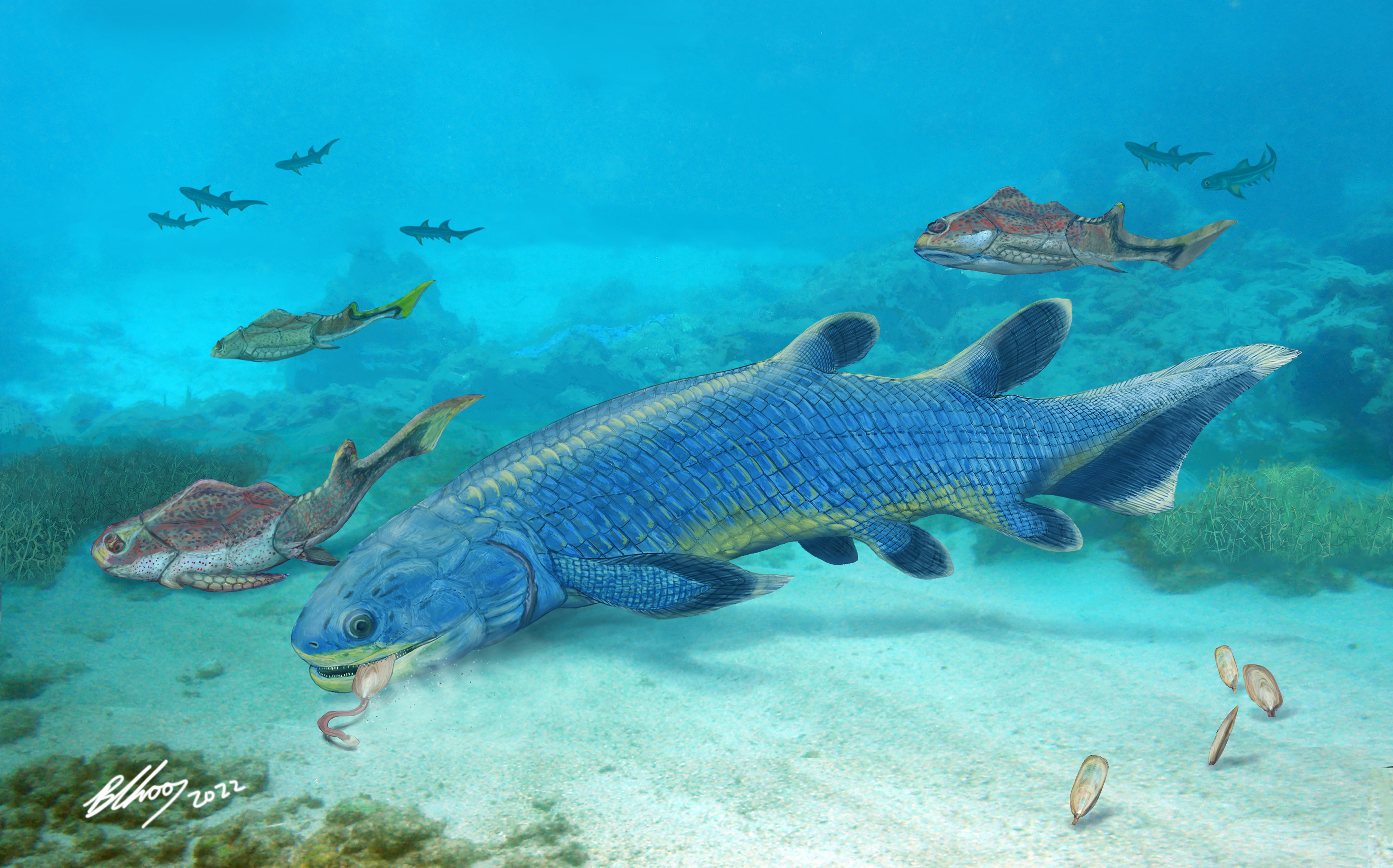
[PaleoIchthyology • 2022] The Rapid Evolution of Lungfish Durophagy


Youngolepis praecursor Chang & Yu, 1981
 
in Cui, Friedman, Qiao, et al., 2022. 
artwork by Brian Choo

Abstract
Innovations relating to the consumption of hard prey are implicated in ecological shifts in marine ecosystems as early as the mid-Paleozoic. Lungfishes represent the first and longest-ranging lineage of durophagous vertebrates, but how and when the various feeding specializations of this group arose remain unclear. Two exceptionally preserved fossils of the Early Devonian lobe-finned fish Youngolepis reveal the origin of the specialized lungfish feeding mechanism. Youngolepis has a radically restructured palate, reorienting jaw muscles for optimal force transition, coupled with radiating entopterygoid tooth rows like those of lungfish toothplates. This triturating surface occurs in conjunction with marginal dentition and blunt coronoid fangs, suggesting a role in crushing rather than piercing prey. Bayesian tip-dating analyses incorporating these morphological data indicate that the complete suite of lungfish feeding specializations may have arisen in as little as 7 million years, representing one of the most striking episodes of innovation during the initial evolutionary radiations of bony fishes.

  Youngolepis praecursor, specimen IVPP V28375 in dorsal view.

The palate and dorsal portion of the hyoid arch of Youngolepis praecursor.


Youngolepis praecursor Chang & Yu, 1981

Timing of divergences and rates of trait evolution in lungfishes and their close relatives.


Xindong Cui, Matt Friedman, Tuo Qiao, Yilun Yu and Min Zhu. 2022. The Rapid Evolution of Lungfish Durophagy. Nature Communications. 13: 2390. DOI: 10.1038/s41467-022-30091-3
 highlighting feeding innovations in Youngolepis, an Early Devonian stem lungfish from China (art: Brian Choo) @NatureComms @Friedman_Lab


Tuesday, December 22, 2020

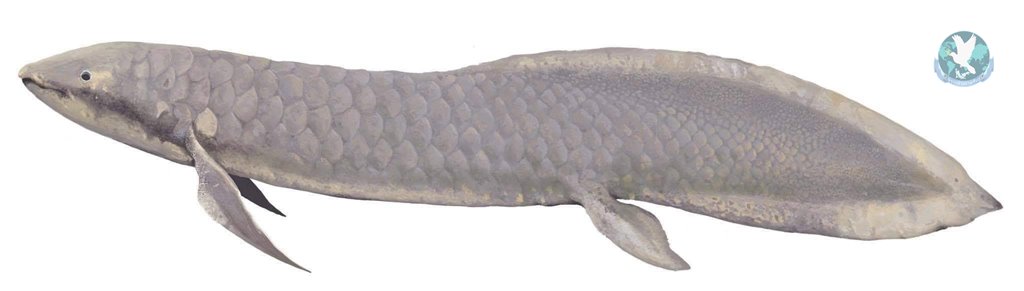
[Ichthyology • 2020] Evidence of Cryptic Speciation in South American Lungfish, Lepidosiren paradoxa


Lepidosiren paradoxa Fitzinger, 1837

in Carneiro, Dutra, Nobre, ... et Schneider. 2020. 

Abstract
For over a century, Lepidosiren paradoxa has been recognized as the single lungfish species in South America. Previous studies have failed to identify morphological differences in lungfish populations inhabiting the Amazon and Paraná–Paraguay River basins. Here, we report molecular evidence of cryptic speciation in South American lungfish. Our analysis of mitochondrial gene sequences from 56 L. paradoxa individuals collected in the Amazon and Paraná–Paraguay river systems revealed that genetic distances between individuals from different basins were on average 20 times greater than those obtained for individuals that occur in the same basin. Haplotype network did not uncover shared haplotypes between basins. Additionally, the species delimitation analysis showed that the posterior probability for the existence of distinct species is highly significant (PP = 0.99961). The phylogenetic analyses (BI and ML) recovered individuals from distinctive basins in reciprocally monophyletic clades. Our divergence time estimate suggests that the Lepidosiren in the Amazon basin are seven million years split from those that occur in the Paraná–Paraguay basin. On the other hand, in agreement with previous reports, our morphological comparison of 20 specimens from the Amazon and 14 specimens from the Paraná–Paraguay basins revealed no distinctive morphological features. The combined molecular and morphological results suggest that these two forms may represent cryptic species.

Keywords: Amazon basin, cryptic species, Lepidosiren, Paraná–Paraguay basin, species delimitation


Lepidosiren paradoxa Fitzinger, 1837


Jeferson Carneiro, Guilherme Moreira Dutra, Rodrigo Moreira Nobre, Luiz Marcelo de Lima Pinheiro, Pedro Andrés Chira Oliva, Iracilda Sampaio, Horacio Schneider and Igor Schneider. 2020. Evidence of Cryptic Speciation in South American Lungfish. Journal of Zoological Systematics and Evolutionary Research. DOI: 10.1111/jzs.12443

Friday, October 16, 2020

[PaleoIchthyology • 2020] Ferganoceratodus annekempae | เฟอร์กาโนเซราโตดัส แอนน์เคมเป • A New Lungfish (Sarcopterygii: Dipnoi) from the Jurassic of Thailand


Ferganoceratodus annekempae
Cavin, Deesri & Chanthasit, 2020

เฟอร์กาโนเซราโตดัส แอนน์เคมเป   || DOI: 10.1080/02724634.2020.1791895  
Reconstruction by Sakka Weerataweemat 

Ferganoceratodus annekempae sp. nov., holotype (all elements belong to a single individual), Upper Jurassic of Phu Noi, Tambon Din Chi, Kam Muang district, Kalasin province, northeastern Thailand.


SYSTEMATIC PALEONTOLOGY 
Subclass SARCOPTERYGII Romer, 1955 
Order DIPNOI Müller, 1845 
NEODIPNOI Agnolin, 2010 sensu Kemp, Cavin, and Guinot, 2017 
Suborder CERATODONTOIDEI Nikolski, 1954 sensu Kemp, Cavin, and Guinot, 2017 

Genus FERGANOCERATODUS Kaznyshkin and Nessov, 1985 (in Nessov and Kaznyshkin, 1985) 

Type Species— Ferganoceratodus jurassicus Kaznyshkin and Nessov, 1985. 

Referred Species— Ferganoceratodus szechuanensis (Young, 1942); Fmartini Cavin, Suteethorn, Buffetaut, and Tong, 2007. 

FERGANOCERATODUS ANNEKEMPAE, sp. nov.

Etymology— Species dedicated to Anne Kemp for her contribution to the study of lungfishes, past and present, and for her engagement in the protection of the Australian lungfish.

Locality and Horizon— Phu Noi, Tambon Din Chi, Kam Muang district, Kalasin province, northeastern Thailand. Lower part of the Upper Phu Kradung Formation, Upper Jurassic.


Lionel Cavin, Uthumporn Deesri and Phornphen Chanthasit. 2020. A New Lungfish from the Jurassic of Thailand. Journal of Vertebrate Paleontology. e1791895. DOI: 10.1080/02724634.2020.1791895  

นักวิจัย ค้นพบปลาปอดชนิดใหม่ของโลก จากแหล่งซากดึกดำบรรพ์ภูน้อย จ.กาฬสินธุ์ kalasinnews.com/news1/8-news/3220


Thursday, January 2, 2020

[PaleoIchthyology • 2019] Isityumzi mlomomde • A High Latitude Devonian Lungfish, from the Famennian of South Africa


Isityumzi mlomomde 
 Gess & Clement,​ 2019


Abstract 
New fossil lungfish remains comprising two parasphenoids, tooth plates and scales from the Famennian Witpoort Formation of South Africa are described. From the parasphenoid material, which bears similarity to Oervigia and Sagenodus but is nevertheless unique, a new genus, Isityumzi mlomomde gen. et sp. nov. is erected. Tooth plates and scales from the same locality may be conspecific but are not yet assigned until further material becomes available. The tooth plates closely resemble those of some taxa in the Carboniferous genus Ctenodus. The new taxon is significant as only the second Devonian lungfish described from the African continent, and for hailing from the high-latitude (polar) Waterloo Farm environment situated close to 70° south during the Famennian.


Palaeozoic Lungfish Parasphenoid Morphology. Isityumzi mlomomde n. gen. et sp.,
(A) partial parasphenoid (AM 4821); (B) and (C) part and counterpart of the holotype (AM 6501a/b); (D) interpretive drawing of the holotype. 

Figure 1: Palaeozoic Lungfish Parasphenoid Morphology. Isityumzi mlomomde n. gen. et sp., (A) partial parasphenoid (AM 4821); (B) and (C) part and counterpart of the holotype (AM 6501a/b); (D) interpretive drawing of the holotype.
Comparative parasphenoid outlines: (E) Oervigia nordica (Lehman, 1959, Fig. 27), (F) Soederberghia groenlandica (Lehman, 1959, Fig. 17), (G) Rhinodipterus kimberleyensis (Clement, 2012, Fig. 3), (H) Rhinodipterus secans (Gross, 1956, Fig. 20), (I) Ctenodus cristatus (Sharp & Clack, 2013, Fig. 16), (J) Sagenodus i(Schultze & Chorn, 1997, Fig. 22), (K) Andreyevichthys epitomus (Krupina, 1987, Fig. 2), (L) Uranolophus (Denison, 1968, Fig. 8), (M) Chirodipterus australis (Miles, 1977, Fig. 76), (N) igogoensis (Miles, 1977, Fig. 77), (O) Griphognathus i(Miles, 1977, Fig. 75), (P) isp. (Berman, 1976, Fig. 4), and (Q) Eoctenodus microsoma (Long, 1987, Fig. 3). Parasphenoids not drawn to scale, redrawn from references given within.

Systematic Palaeontology
OSTEICHTHYES Huxley, 1880
SARCOPTERYGII Romer, 1955
DIPNOMORPHA Ahlberg, 1991
DIPNOI Müller, 1844

Isityumzi mlomomde gen. et sp. nov.

Diagnosis. Lungfish with parasphenoid corpus and stalk equal in length, stalk narrow with parallel sides tapering to a single point. Corpus almost as wide as long and with a broad anterior angle of 90°.

Etymology/Derivation of name. Generic name ‘Isityumzi’, from isiXhosa language meaning a device for crushing (from ukutyumza, to crush). Specific name ‘mlomomde’ from isiXhosa meaning ‘long mouthed’.

Holotype. Complete parasphenoid, AM6501, Albany Museum, Grahamstown/Makhanda, Eastern Cape, South Africa.

Other material. AM 4821 (partial parasphenoid).

Horizon and type locality. Waterloo Farm, Grahamstown/Makhanda, South Africa; Witpoort Formation, Witteberg Group, Famennian, Late Devonian.

Note. The new taxon is erected from the parasphenoid material alone. Although we expect that the tooth plate and scale material are conspecific, we do not formally assign them to Isityumzi mlomomde gen. et sp. nov. here.


Conclusions: 
Isityumzi represents the only record of Late Devonian lungfish remains from western Gondwana (South America and Africa) and is described from its parasphenoid.
• The parasphenoid of Isityumzi bears similarity to Oervigia and Sagenodus but differs from those taxa in having a single pointed stalk (c.f. Oervigia) and the corpus and stalk being equal in length (c.f. Sagenodus).
• The lungfish tooth plates from the same horizon and locality are similar to the Carboniferous taxon Ctenodus cristatus.
• The new genus is the first Devonian lungfish described from a high-latitude environment, and the only lungfish known from the Witpoort Formation.
• It appears likely that Isityumzi conforms to a common morphotype for Famennian lungfishes in possessing a long head and tooth plates bearing radiating ridges.
Isityumi adds further evidence for the co-occurrence of lungfish with tetrapod taxa.


Robert W. Gess and Alice M. Clement​​. 2019. A High Latitude Devonian Lungfish, from the Famennian of South Africa. PeerJ. 7:e8073. DOI: 10.7717/peerj.8073