Showing posts with label Russian Journal of Herpetology. Show all posts

Monday, December 22, 2025

[Herpetology • 2025] Leptobrachella rubromammata • A New Species of Leptobrachella (Anura: Megophryidae) from Chu Yang Sin National Park, Dak Lak Province, Southern Vietnam


 Leptobrachella rubromammata 
Poyarkov, Nguyen, Duong, Le & Orlov, 2025

Cóc lá tý hon tuyêìn ngýc cam || Researchgate.net/publication/398787243

Abstract
A new species of Asian leaf litter toad of the genus Leptobrachella is described from montane evergreen forests of Chu Yang Sin National Park, Dak Lak Province, southern Vietnam, based on an integrative analysis of molecular and morphological data. The new species, Leptobrachella rubromammata sp. nov., is assigned to the Leptobrachella applebyi species group. Morphologically, it is most similar to L. maculosa, L. kalonensis, and L. bidoupensis but can be distinguished by its conspicuous orange supra-axillary and pectoral glands and a distinctive ventral coloration pattern. The new species is genetically divergent from all congeners, with uncorrected 16S rRNA gene distances ranging from 6.56% to 14.55%. Based on its restricted distribution and potential vulnerability to habitat disturbance, we propose that Leptobrachella rubromammata sp. nov. be listed as Vulnerable (VU) under the IUCN Red List Categories and Criteria.

Keywords: Leptolalax applebyi species group; molecular analyses; morphology; new species; taxonomy; Lang Bian Plateau

 Leptobrachella rubromammata sp. nov. in life:
 A, holotype ZMMU A-8300; B, paratype ZMMU A-5215.
Photographs by N. A. Poyarkov.


The maximum likelihood (ML) phylogeny of the Leptobrachella applebyi species group (left) and corresponding sampling localities used in this study (right). Icons adjacent to species clades match those shown on the map. The type locality of  Leptobrachella rubromammata sp. nov. in Chu Yang Sin National Park, Dak Lak Province, Vietnam, is indicated with a red star. Node values represent bootstrap support values (BS) and Bayesian posterior probabilities (BPP), respectively. Sequences of L. picta, L. pluvialis, and L. bourreti were used as outgroups.


Leptobrachella rubromammata sp. nov.

Etymology. The specific epithet “rubromammata”is a Latin adjective in the nominative case (feminine gender), derived from Latin “ruber” meaning “red” and“mamma” meaning “breast,” “bosom.” The name isgiven in reference to the characteristic pair of bright red-dish-orange pectoral glands resembling two reddish nip-ples. We recommend “Red-nippled Litter Toad” as thecommon English name, “Cóc lá tý hon tuyêìn ngýc cam”as the Vietnamese name, and “Krasnogrudaya malayachesnochnitsa” as the common name in Russian.

Typical habitat of  Leptobrachella rubromammata sp. nov. in the type locality: Chu Yang Sin NP, Dak Lak Province, Vietnam.
Photographs by: N. A. Poyarkov.


Nikolay A. Poyarkov, Tan Van Nguyen, Tang Van Duong, Son Xuan Le and Nikolai L. Orlov. 2025. A New Species of Leptobrachella (Anura: Megophryidae) from Chu Yang Sin National Park, Dak Lak Province, Southern Vietnam. Russian Journal of Herpetology. 32(4); 293-308

Wednesday, September 24, 2025

[Herpetology • 2025] Ingerophrynus wangyingyongi • A New Species of Ingerophrynus (Anura: Bufonidae) from Guangdong, China


Ingerophrynus wangyingyongi
R. Liu, Zhang, Ananjeva, Z. Liu, Hou & Orlov, 2025


Abstract
A new species of the genus Ingerophrynus is described based on seven specimens collected from northern Guangdong Province, China. The new species was previously confused with Ingerophrynus ledongensis, however, it can be distinguished from I. ledongensis and other congeners by a combination of morphological differences and genetic divergence. In addition, this study reveals that the taxonomic status of the populations previously considered to be Ingerophrynus galeatus from central and northern Vietnam and central Laos needs to be reassessed, and the species diversity of this genus may have been significantly underestimated.

Keywords: 12S; 16S; morphology; systematics; taxonomy; Tianjingshan


Ingerophrynus wangyingyongi sp. nov.


Shuo Liu, Liang Zhang, Natalia B. Ananjeva, Zhifa Liu, Mian Hou and Nikolai L. Orlov. 2025. A New Species of Ingerophrynus (Anura, Bufonidae) from Guangdong, China. Russian Journal of Herpetology. 32(2):85-95. DOI: doi.org/10.30906/1026-2296-2025-32-2-85-95 [June 2025] 

Friday, March 21, 2025

[Herpetology • 2023] Cyrtodactylus caixitaoi • A New Species of Cyrtodactylus Gray, 1827 (Squamata: Gekkonidae) from Yunnan, China


Cyrtodactylus caixitaoi 
 Liu, Rao, Hou, Wang & Ananjeva, 2023 


Abstract
A new species of the Cyrtodactylus chauquangensis species group is described from Yunnan Province, China, based on morphological and molecular data. The new species closely resembles C. wayakonei morphologically, but can be separated from the latter by having more white rings on original tail, more lamellae under finger IV and toe IV, less longitudinal ventral scale rows, and enlarged femoral scales. However, the new species is closely related to C. martini rather than C. wayakonei genetically. The new species differs from C. martini by genetic distance of 3.3% and from investigated other members of the C. chauquangensis species group by genetic distances of 6.4 – 17.8% in the COI gene.

Keywords: bent-toed gecko; China; systematics; taxonomy; Xishuangbanna; Yunnan

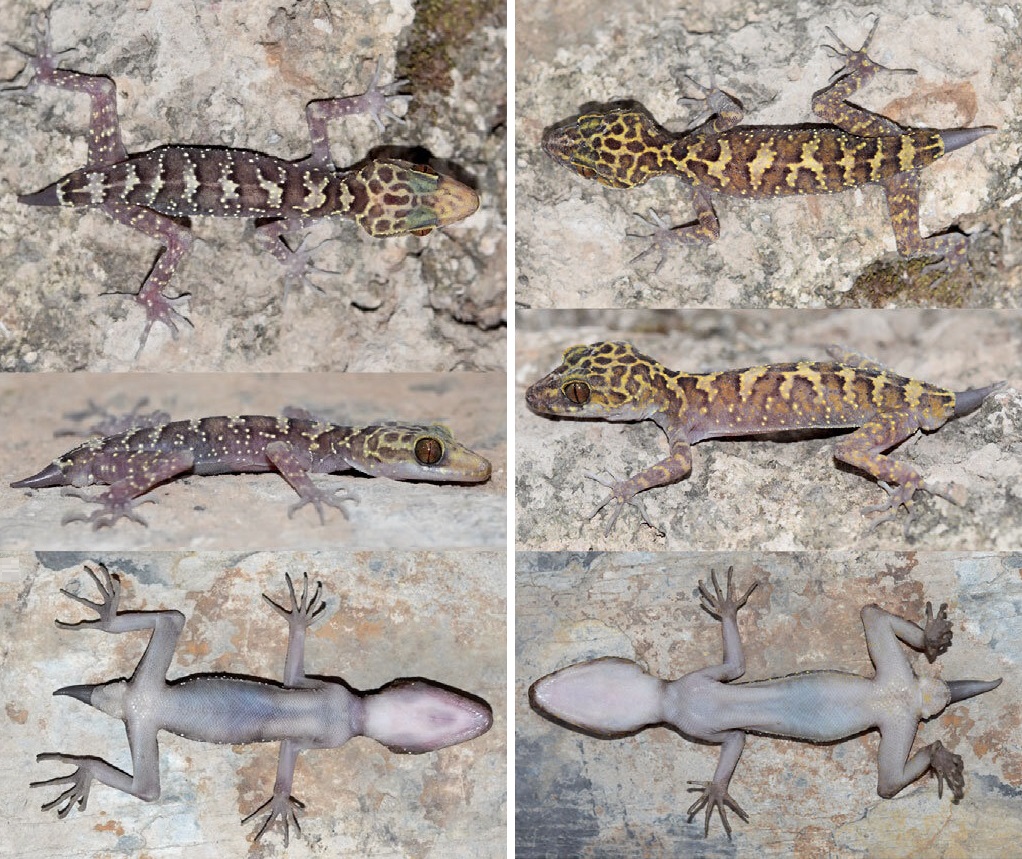
 The holotype (KIZ201904002) of Cyrtodactylus caixitaoi sp. nov. in life:
A, dorsal view; B, dorsolateral view; C, ventral view.

 The paratype (KIZ201904003) of Cyrtodactylus caixitaoi sp. nov. in life:
 A, dorsal view; B, lateral view; C, ventral view.

Cyrtodactylus caixitaoi sp. nov. 

Etymology. The epithet is in honor of Prof. Xitao Cai (1911 – 1981), who founded Xishuangbanna Tropical Botanical Garden in 1950s. We propose “Cai’s Bent-toed Gecko” for the English name ...


Shuo Liu, Dingqi Rao, Mian Hou, Qiaoyan Wang and Natalia Borisovna Ananjeva. 2023. A New Species of Cyrtodactylus Gray, 1827 (Squamata, Gekkonidae), previously confused with C. wayakonei Nguyen, Kingsada, Rösler, Auer et Ziegler, 2010. Russian Journal of Herpetology. DOI: doi.org/10.30906/1026-2296-2023-30-6-529-538

Sunday, January 26, 2025

[Herpetology • 2024] Leptobrachella aurantirosea • A New Leaf-Litter Frog of Leptobrachella (Anura: Megophryidae) from Tay Con Linh Mountain, Northern Vietnam


Leptobrachella aurantirosea 
 Ninh, T. T. Nguyen, L. T. H. Le, T. V. Nguyen, Quoc, Orlov, Bezman-Moseyko, M. V. Le, S. N. Nguyen et Ziegler, 2024.


Abstract
A new Leptobrachella species is described from Vietnam based on six specimens collected from Tay Con Linh Mountain, Ha Giang Province, Vietnam. Morphologically, the new species can be distinguished from its congeners based on the combination of the following characteristics: size medium (SVL 21.3 – 24.4 in males); skin on the entire dorsum relatively smooth with some small tubercles; webbing between toes and fingers absent with weak lateral fringes; dorsum orangish-yellow with pink pigments, a gray patch between eye in a triangle shape and a gray patch in Λ shape in the center of the back, in the posterior of dorsum with a pattern, which seems to connect with the bars on the upper side of thigh and tibia when the hindlimbs shrank; ventral side of body smooth, throat pinkish-white and chest cream white with some gray blobs on the belly and grayish blobs on the throat; lower jaw gray with white spots, iris bicolor. The genetic distance between the new species and other Leptobrachella species ranges from 8.15 to 10.43% (compared to L. namdongensis and L. puhoatensis, respectively).

Keywords: Leptobrachella; Ha Giang Province; phylogenetic relationship; taxonomy; diversity


Leptobrachella aurantirosea sp. nov. 
Color variation of four paratypes in life. 
(A, TCL.2023.75; B, TCL.2023.78; C, TCL.2023.78; D, TCL.2023.80)  

Leptobrachella aurantirosea sp. nov. 
Drawing showing the dorsal pattern of paratype (TCL.2023.75).

Leptobrachella aurantirosea sp. nov.

Etymology. The name refers to the orangish-pink dorsal ground coloration (Latin orange aurantiumpink =roseus).


Hoa Thi Ninh, Tao Thien Nguyen, Linh Tu Hoang Le, Thanh Vinh Nguyen, Huy Nguyen Quoc, Nikolai L. Orlov, Olga Bezman-Moseyko, Manh Van Le, Sang Ngoc Nguyen and Thomas Ziegler. 2024. A New Leaf-Litter Frog of Leptobrachella (Anura: Megophryidae) from Tay Con Linh Mountain, Northern Vietnam. Russian Journal of Herpetology. 31; 191–224. DOI: doi.org/10.30906/1026-2296-2024-31-4-191-224   

Monday, December 23, 2024

[Herpetology • 2024] Hidden on the Roof of the World: Mitochondrial Data Reveals Exceptional Genetic Diversity of Himalayan Ablepharine Skinks (Reptilia: Scincidae)


Diversity of the Asian Ablepharine skinks from mtDNA sequences:
Protoblepharus (blue), the Ablepharus sikkimensis group (yellow), the Ablepharus himalayanus group (red), and the Ablepharus ladacensis group (green).


in Bragin, Litvinchuk, Borkin, Melnikov, Skorinov, ...et Poyarkov, 2024. 

Abstract
Snake-eyed, or ablepharine skinks, are common residents of the highest mountain ranges on Earth, including the Himalayas, the Tibetan Plateau, Karakoram, Pamir, and Tian Shan, colloquially known as the Roof of the World. Historically, these skinks were alternatively assigned to the genera Scincella, Ablepharus, Asymblepharus, and Himalblepharus, but recent revisions proposed to group them in only two genera, namely Protoblepharus (the eastern Himalayan taxa) and Ablepharus (all other taxa). The taxonomy of this group yet remains in a state of flux due to the limited informativeness of available phylogenies (often with little material from the Himalayan region), discrepancies in morphological patterns of variation, and the potentially high yet unconsidered degree of diversity of the group. To shed some light, we assess the mitochondrial diversity and evolution of Himalayan snake-eyed skinks based on >200 individuals sampled across Pakistan, India, Nepal, and China, representing nine out of ten Himalaya currently recognized species. Phylogenetic relationships were inferred from 2998 bp of mitochondrial sequences (12S, 16S, ND2, cyt b). Our analyses reveal a remarkably high cryptic diversity, including 14 to 16 species-level lineages within Ablepharus and four species-level lineages within Protoblepharus, which would substantially increase the number of species by at least twofold. This hidden diversity highlights the Himalayas as a center of phylogeographic diversification and endemism, likely shaped by geological and climatic factors associated with orogenesis, which now houses over half of the ablepharine skink species.

Keywords: Ablepharus; biogeography; distribution; Himalaya; Himalblepharus; lizards; mtDNA barcoding; Protoblepharus; Sphenomorphinae

Distribution of the major clades of AblepharusProtoblepharus (blue), the Ablepharus sikkimensis group (yellow), the Ablepharus himalayanus group (red), the Ablepharus ladacensis group (green), and the ‘core’ Ablepharus with fully or partially fused eyelids (white).
Distribution of the Ablepharine skinks in the Himalaya: Protoblepharus (blue), the Ablepharus sikkimensis group (yellow), the Ablepharus himalayanus group (red), and the Ablepharus ladacensis group (green).


Andrey M. Bragin, Spartak N. Litvinchuk, Leo J. Borkin, Daniel A. Melnikov, Dmitriy V. Skorinov, Daniel Jablonski, Rafaqat Masroor, Hmar Tlawmte Lalremsanga, Zeeshan A. Mirza, Christophe Dufresnes and Nikolay A. Poyarkov. 2024. Hidden on the Roof of the World: Mitochondrial Data Reveals Exceptional Genetic Diversity of Himalayan Ablepharine Skinks (Reptilia: Scincidae). Russian Journal of Herpetology. 31(6); 351 – 368. DOI: doi.org/10.30906/1026-2296-2024-31-6-351-368

Tuesday, September 12, 2023

[Herpetology • 2023] Tetralepis fruhstorferiFound but Forgotten: On the Records, Misidentification, and Potential Rediscovery of the Rare Bromo Tengger Semeru Mountain Endemic Snake (Serpentes: Colubridae)


Tetralepis fruhstorferi   

in Septiadi, Idrus, Arroyyan, Fathoni, Erfanda, ... et Kurniawan, 2023. 

Abstract
Tetralepis fruhstorferi is a snake currently only known to be endemic to a single active volcano complex of Bromo Tengger Semeru National Park in East Java of Indonesia. Its taxonomic identity and natural history are poorly known, as the most recent collection was in 1978 and limited to only a few collection records. We investigated two recently published surveys that have misidentified this species. This may indicate that T. fruhstorferi is still present in its type locality and our future surveys would focus on finding this species to assess its taxonomy and population status.

Keywords: East Java; Indonesia; rediscovery; topotype


Luhur Septiadi, Meilinda Rodhiya Idrus, Ahmad Nauval Arroyyan, Muhammad Fathoni, Muhammad Prayogi Erfanda, Sandra Rafika Devi, Berry Fakhry Hanifa, Bagus Priambodo, Irvan Sidik and Nia Kurniawan. 2023. Found but Forgotten: On the Records, Misidentification, and Potential Rediscovery of the Rare Bromo Tengger Semeru Mountain Endemic Snake (Serpentes: Colubridae: Tetralepis fruhstorferi). Russian Journal of Herpetology.  30(4); 249-254. DOI: 10.30906/1026-2296-2023-30-4-249-254


Wednesday, September 6, 2023

[Herpetology • 2023] Darevskia arribasi • A New Species of the Genus Darevskia Arribas, 1999 (Sauria: Lacertidae) from South Ossetia


 Darevskia arribasi
 Tuniyev, Petrova & Lotiev, 2023


Abstract
A new species of rock lizards of the genus Darevskia Arribas, 1999 — Darevskia arribasi sp. nov. is described from vicinity of Ertso Lake in South Ossetia. In comparison of Darevskia arribasi sp. nov. with other species of the «saxicola-brauneri» complex [D. lindholmi (Szczerbak, 1962), D. saxicola (Eversmann, 1834), D. brauneri (Mehely, 1909) (including D. b. brauneri, D. b. myusserica Doronin, 2011, D. b. darevskyi (Szczerbak, 1962), and D. szczerbaki (Lukina, 1963)], the new species is characterized by the smallest body size among all representatives of this complex L♂♂ — 55 – 62 mm; ♀♀ — 58 – 63 mm. The number of scales around the middle of the body (Sq.) in D. arribasi sp. nov. (52 – 58, more often 54 – 56) also significantly less than for D. saxicola sensu lato in generally. Along the throat from ear to ear fold there are 36 – 42 scales, less than in D. saxicola sensu lato. Two large preanal shields present in front of the anal shield in half of the individuals examined; in a quarter of individuals on both sides of the small central preanal there are by one enlarged lateral preanal shield, in another quarter all preanal shields are of the same size. Central temporal (Massetericum) always developed; always six pair of mandibulars, three in contact; collar straight, extremely rarely slightly serrated; ribs on the caudal scales are expressed to some extent; rostral usually separated from frontonasal by nasal shields. The coloration of adult males is olive-lettuce, or olive-brown from above; adult females are grey-brown; juvenile coloration coffee-brown with the blue and black spots on the edge of the outer ventral shields at the middle of trunk. Taxonomical status of new species is well supported with result of analysis of the mitochondrial cytochrome b data.

Keywords: Caucasus; South Ossetia; Darevskia arribasi sp. nov.


Holotype of Darevskia arribasi sp. nov. (SNP No. 1928).


Boris S. Tuniyev, T. V. Petrova, K. Yu. Lotiev. 2023. A New Species of the Genus Darevskia Arribas, 1999 from South Ossetia (Reptilia: Sauria: Lacertidae). Russian Journal of Herpetology.  30(4); 237-248. DOI: 10.30906/1026-2296-2023-30-4-237-248

Tuesday, December 13, 2022

[Herpetology • 2022] Resurrection of Boiga ranawanei with Expanded Descriptions and Species Distribution Modelling of Some Indian Taxa of the B. ceylonensis Group (Reptilia: Colubridae)


 Boiga ranawanei Samarawickrama, Samarawickrama, Wijesena et Orlov, 2005
 
in Ganesh, Samarawickrama, Urs, Srikanthan & Adhikari, 2022. 

Abstract
We resurrect the nominal taxon Boiga ranawanei Samarawickrama, Samarawickrama, Wijesena et Orlov, 2005 as a valid species endemic to Sri Lanka. We uphold the view that B. ranawanei is conspecific with what was previously considered as the Sri Lankan population of ‘B. beddomei’. The revised concept of B. beddomei as a species endemic to the Western Ghats of India and altogether absent from Sri Lanka necessitated the Sri Lankan ‘B. beddomei’ population be conferred with the available nomen B. ranawanei. We also report on further specimens of the two Indian species closely associated with B. ranawanei B. beddomei that was associated in a nomenclatural sense and B. flaviviridis that is associated in a taxonomic sense. Here, we expand the descriptions of B. beddomei and especially that of B. flaviviridis based on many more additional specimens from several localities across Peninsular India. We again update the key to this group with the inclusion of B. ranawanei. We perform Species Distribution Modelling (SDM) to elaborate on the recorded and simulated distribution range envelopes of the Indian taxa (B. flaviviridis, B. beddomei, B. nuchalis, B. thackerayi) in the B. ceylonesis group. Thus we explain the geographical discontinuity among these taxa to further corroborate our findings on their taxonomic statuses.

Keywords: Boiga; distribution; head scalation; India; Kandy; MaxEnt; nomenclature; Sri Lanka; validity


 Boiga ranawanei Samarawickrama, Samarawickrama, Wijesena et Orlov, 2005 


S. R. Ganesh, V. A. M. P. K. Samarawickrama, Aishwarya J. Urs, Achyuthan N. Srikanthan and Omkar Dilip Adhikari. 2022. Resurrection of Boiga ranawanei Samarawickrama, Samarawickrama, Wijesena et Orlov, 2005, with Expanded Descriptions and Species Distribution Modelling of Some Indian Taxa of the B. ceylonensis Group (Reptilia: Colubridae). Russian Journal of Herpetology. 29(6);341-354. DOI: 10.30906/1026-2296-2022-29-6-341-354


Monday, September 26, 2022

[Herpetology • 2022] Xenopeltis intermedius • Integrative Taxonomy Reveals A New Cryptic Species of Xenopeltis Gray, 1831 (Ophidia: Macrostomata: Xenopeltidae) from Central Highlands, Vietnam


 Xenopeltis intermedius 
Orlov, Snetkov, Ermakov, Nguyen & Ananjeva, 2022  


Abstract
Herein, we describe a new cryptic snake species of the genus Xenopeltis from Central Highlands of Vietnam: Kon Plông District, Kon Tum Province based both on morphological and molecular data. Xenopeltis intermedius sp. nov. is distinguished from the two known species by a combination of the following morphological characters. Xenopeltis intermedius sp. nov. differs from X. unicolor and X. hainanensis by the number of ventrals and subcaudals. The skull is less elongated than in X. unicolor and somewhat more elongate than in X. hainanensis. X. intermedius demonstrates differences in size, shape proportions and relief of the parietal bone and the number of teeth from X. hainanensis and X. unicolor. We provide a COI-based estimation of diversity of the genus Xenopeltis. Genetic divergence (p-distance) between Xenopeltis sp. nov. from Kon Tum Province, Central Highlands region of Vietnam, and two other congeners was 5.7% (for X. hainanensis) and 12.9% (for X. unicolor). The new species is currently known only from one locality from Central Highland and was recorded from 1500 to 2500 m a.s.l. in the evergreen polydominant forests in the mountainous regions of Kon Tum Province. This is the third species of Xenopeltis from Vietnam.

Keywords: Xenopeltis intermedius sp. nov.; xenopeltid snakes; taxonomy; morphology; Central Highland; Vietnam; cytochrome c oxidase subunit I


 Paratype of Xenopeltis intermedius sp. nov. ZISP 30355 in life.

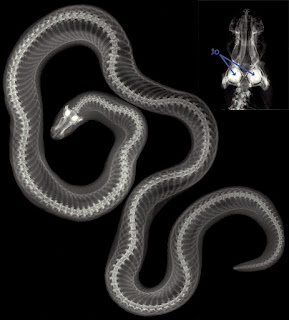
X-ray photo of the head of Xenopeltis intermedius sp. nov. ZISP 30357; ot, otoliths.

  Habitat of Xenopeltis intermedius sp. nov. at the type locality.

Xenopeltis intermedius sp. nov.

 
Nikolai L. Orlov, Pavel B. Snetkov, Oleg A. Ermakov, Tao Thien Nguyen and Natalia B. Ananjeva. 2022. Integrative Taxonomy Reveals A New Cryptic Species of Xenopeltis Gray, 1831 (Ophidia: Macrostomata: Pythonoidea: Xenopeltidae) from Central Highlands, Vietnam. Russian Journal of Herpetology. 29(4); 237-249. DOI: 10.30906/1026-2296-2022-29-4-237-249


Monday, January 31, 2022

[Herpetology • 2021] Vietnamophryne cuongi • A New Species of Vietnamophryne (Anura: Microhylidae) from northern Vietnam, with an Extended Description of Vietnamophryne orlovi

 
Vietnamophryne cuongi
Nguyen, Hoang, Jianping, Orlov, Ninh, Nguyen, Nguyen & Ziegler, 2021


Abstract
We describe Vietnamophryne cuongi sp. nov., a new species of microhylid frog from northern Vietnam, based on morphological and molecular differences. Although superficially similar to remaining Vietnamophryne members, the new species differs by a number of diagnostic morphological characters, such as body size, habitus, head dimensions, finger and toe morphology, skin texture, as well as colour pattern. Phylogenetic analyses based on a fragment of the mitochondrial 16S gene place the new species to be sister to V. orlovi, from which it differed by 2.4% genetic divergence. We also describe the first female known of V. orlovi, collected in the forest of Phia Oac-Phia Den National Park, Cao Bang Province. The latter species, for which we provide an extended description herein, was recently described based on the single male type specimen only from the same site in northern Vietnam. Vietnamophryne cuongi sp. nov. is only known from three specimens, two adult females and a juvenile, from the evergreen tropical forest of Ba Vi National Park, Hanoi. As such, it is likely to be at high risk of habitat loss. Considering its high ecological specialization and the small known distribution range of the new species, we propose Endangered as IUCN Red List status.

Keywords: Vietnamophryne; morphology; taxonomy; new species; Hanoi


Vietnamophryne cuongi


Thanh Vinh Nguyen, Chung Van Hoang, Jiang Jianping, Nikolai L. Orlov, Hoa Thi Ninh, Huy Quoc Nguyen, Tao Thien Nguyen and Thomas Ziegler. 2021. A New Species of Vietnamophryne with an Extended Description of Vietnamophryne orlovi. Russian Journal of Herpetology. 28(6); 355-368. RJH.folium.ru/index.php/rjh/article/view/1840

Wednesday, January 26, 2022

[Herpetology • 2020] Acanthosaura prasina • A New Species of Acanthosaura Gray, 1831 (Squamata: Agamidae) from Central Highlands, Vietnam


Acanthosaura prasina 
Ananjeva, Ermakov, Nguyen, Nguyen, Murphy, Lukonina & Orlov, 2020

 Russian Journal of Herpetology. 27(4);

Abstract
Herein, we describe a new agamid species of the genus Acanthosaura from Central Highlands of Vietnam: Gia Lai Province, Kon Chu Rang NR, and Kon Tum Province: Kon Plông and Ngoc Linh Mountain based on morphological and molecular data. Acanthosaura prasina sp. nov. is distinguished from all congeners by a combination of the following morphological characters. Acanthosaura prasina sp. nov. differs from A. capra, A. murphyi, and A. nataliae by the presence of a short spine on each side of the neck and a smaller body size. From the known species of «lepidogaster» complex and A. coronata it differs in the arrangement of dorsal crests with a distinct double row of vertebral scales, from A. brachypoda in a smaller body size, longer tail and limbs, fewer supra- and infralabials and coloration patterns with a white area on lips and shoulders; from A. lepidogaster by lacking a dark marking on the nape and the absence of a distinct diastema; from A. phongdienensis by lacking a dark marking on the nape. We provide a cyt b-based estimation of diversity of the genus Acanthosaura. A. prasina sp. nov. differs from A. phongdiensis, A. coronata, A. lepidogaster, A. armata, A. crucigera, A. nataliae, A. phuketensis, and Acanthosaura sp. SK in p-distances of 15.4, 24.5, 14.7, 14.6, 16.3, 14.6, 15.4, and 24.4%, respectively. The new species currently known from three localities from Central Highlands was recorded from 800 to 1700 m a.s.l. in the evergreen polydominant forests in the mountainous regions of Gia Lai and Kon Tum provinces. This is the 16th species of Acanthosaura and the ninth species of the genus from Vietnam.

Keywords: Acanthosaura prasina sp. nov.; agamid lizards, taxonomy; morphology; Central Highlands, Vietnam, cyt b


Acanthosaura prasina sp. nov.

 
Natalia Borisovna Ananjeva, Oleg A. Ermakov, Sang Ngoc Nguyen, Tao Thien Nguyen, Robert W. Murphy, Svetlana A. Lukonina and Nikolai L. Orlov. 2020. A New Species of Acanthosaura Gray, 1831 (Squamata: Agamidae) from Central Highlands, Vietnam. Russian Journal of Herpetology. 27(4);
Researchgate.net/publication/343567373_A_New_Species_of_Acanthosaura_Central_Highlands_Vietnam

Monday, May 3, 2021

[Herpetology • 2019] Rhacophorus vanbanicus • A New Species of Rhacophorus Genus (Anura: Rhacophoridae) from Van Ban District, Lao Cai Province, Northern Vietnam


Rhacophorus vanbanicus
Kropachev, Orlov, Ninh & Nguyen, 2019


Abstract
We describe a new species of the Rhacophorus genus, which differs from all species known in Asia by the combination of characters. It strongly differs also from small and middle-sized species of Rhacophorus sensu lato: Rhacophorus calcaneus Smith, 1924, Leptomantis cyanopunctatus (Manthey et Steiof, 1998), Rhacophorus hoabinhensis Nguyen, Pham, Nguyen, Ninh et Ziegler, 2017, Rhacophorus hoanglienensis Orlov, Lathrop, Murphy et Ho, 2001, Zhangixalus jarujini (Matsui et Panha, 2006), Rhacophorus laoshan Mo, Jiang, Xie et Ohler, 2008, Rhacophorus pardalis Günther, 1858, Rhacophorus rhodopus Liu et Hu, 1960, Rhacophorus robertingeri Orlov, Poyarkov, Vassilieva, Ananjeva, Nguyen, Sang, and Geissler, 2012, Leptomantis robinsonii (Boulenger, 1903), Rhacophorus spelaeus Orlov, Gnophanxay, Phimminith, and Phomphoumy, 2010, Rhacophorus translineatus Wu, 1977, Rhacophorus turpes Smith, 1940, Rhacophorus vampyrus Rowley, Le, Thi, Stuart et Hoang, 2010, Rhacophorus viridimaculatus Ostroshabov, Orlov et Nguyen, 2013 by having brown color with two green dorsolateral stripes starting at the groin level and connecting through the distal part of eyelid with green triangle on the head, slender body and head, lower ratio HW/HL 0.86, lower HW/SVL 0.28 and lower ratio HL/SVL 0.32.

Keywords: amphibians; rhacophorid frogs; Rhacophorus sp. nov.; Northern Vietnam

 
Rhacophorus vanbanicus


Ivan I. Kropachev, Nikolai L. Orlov, Hoa Thi Ninh and Tao Thien Nguyen. 2019. A New Species of Rhacophorus Genus (Amphibia: Anura: Rhacophoridae: Rhacophorinae) from Van Ban District, Lao Cai Province, Northern Vietnam. Russian Journal of Herpetology. 26(6);  325-334. DOI:  10.30906/1026-2296-2019-26-6-325-334

Monday, May 6, 2019

[Herpetology • 2019] Trimeresurus arunachalensis • A New Species of Pitviper (Serpentes: Viperidae: Trimeresurus Lacepède, 1804) from West Kameng District, Arunachal Pradesh, India


Trimeresurus arunachalensis

Abstract
A new species of pitviper, Trimeresurus arunachalensis sp. nov., is described based on a single specimen. It differs from all known congeners by the following combination of characters — 19:17:15 acutely keeled dorsal scale rows (except first row — keeled or smooth); overall reddish-brown coloration; white dorsolateral stripe on outer posterior edges of ventrals and sometimes first dorsal scale row; 7 supralabials; 6 – 7 scales between supraoculars; 145 ventrals; 51 paired subcaudals (excluding the terminal scale); single anal; a sharply defined canthus rostralis with the margin overhanging the loreal region; a distinctly concave rostral scale with the upper edge projecting well beyond its lower margin; an unforked, attenuate hemipenis that extends to the 8th subcaudal scale, and has no visible spines. DNA phylogenetic analysis indicates that the new species is distinct from congeners and nested well within the Trimeresurus clade. The closest relative based on available DNA data is T. tibetanus. The new species is presently known from a single locality — Ramda, West Kameng, Arunachal Pradesh, northeastern India.

Keywords: Crotalinae; snake; taxonomy; Trimeresurus arunachalensis sp. nov.; viper


Trimeresurus arunachalensis sp. nov. 

Photo: Rohan Pandit, 
Wangchu Phiang, and the Eaglenest Biodiversity Project 


Ashok Captain, V. Deepak, Rohan Pandit, Bharat Bhatt and Ramana Athreya. 2019. A New Species of Pitviper (Serpentes: Viperidae: Trimeresurus Lacepède, 1804) from West Kameng District, Arunachal Pradesh, India. Russian Journal of Herpetology. 26(2; 111-122. rjh.folium.ru/index.php/rjh/article/view/1423