Showing posts with label Muscicapidae - Old World flycatcher. Show all posts

Wednesday, January 3, 2024

[Ornithology • 2024] When colors Mislead: Genomics and Bioacoustics prompt re-classification of Asian Flycatcher Radiation (Aves: Muscicapidae: Niltavinae)


in Garg, Gwee, Chattopadhyay, Ng, Prawiradilaga, David, ... et Rheindt, 2024. 
 
Highlights
• Current classification of birds in the flycatcher subfamily Niltavinae based on plumage is misleading.
• Bioacoustics along with genome-wide data provide an accurate picture of diversification in this subfamily.
• Bird song can also be used to differentiate at the level of the genus.
• Extensive taxonomic revision of the flycatcher subfamily Niltavinae.

Abstract
Traditional classification of many animals, including birds, has been highly dependent on external morphological characters like plumage coloration. However, both bioacoustics and genetic or genomic data have revolutionized our understanding of the relationships of certain lineages and led to sweeping taxonomic re-organizations. In this study, we present a case of erroneous delimitation of genus boundaries in the species-rich flycatcher subfamily Niltavinae. Genera within this subfamily have historically been delineated based on blue versus brown male body plumage until recent studies based on a few mitochondrial and nuclear loci unearthed several cases of generic misclassification. Here we use extensive bioacoustic data from 43 species and genomic data from 28 species for a fundamental reclassification of species in the Niltavinae. Our study reveals that song is an important trait to classify these birds even at the genus level, whereas plumage traits exhibit ample convergence and have led to numerous historic misattributions. Our taxonomic re-organization leads to new biogeographic limits of major genera, such that the genus Cyornis now only extends as far east as the islands of Sulawesi, Sula, and Banggai, whereas Eumyias is redefined to extend far beyond Wallace’s Line to the islands of Seram and Timor. Our conclusions advise against an over-reliance on morphological traits and underscore the importance of integrative datasets.

Keywords: Niltavinae, bioacoustics, genome-wide data, taxonomic re-organization


Kritika M. Garg, Chyi Yin Gwee, Balaji Chattopadhyay, Nathaniel S. Ng, Dewi M. Prawiradilaga, Gabriel David, Jérôme Fuchs, Hung Le Manh, Jonathan Martinez, Urban Olsson, Vuong Tan Tu, Sophea Chhin, Per Alström, Fumin Lei and Frank E. Rheindt. 2024. When colors Mislead: Genomics and Bioacoustics prompt re-classification of Asian Flycatcher Radiation (Aves: Niltavinae). Molecular Phylogenetics and Evolution. In Press, 107999.  DOI: 10.1016/j.ympev.2023.107999

Friday, September 30, 2022

[Ornithology • 2022] Genome-wide SNPs confirm Plumage Polymorphism and Hybridisation within A Cyornis Flycatcher Species Complex


in Ng, Li, Zhang, Garg, ... et Lei, 2022. 

Abstract
Morphology has been a leading taxonomic guiding light to systematists for the last couple of hundred years. However, the genetic and – more recently – genomic revolution have produced numerous demonstrations of erroneous classifications that were based on labile morphological traits. We used thousands of genome-wide markers to shed light on evolutionary dynamics in a confusing and taxonomically obscure group of Asian Cyornis flycatchers. Using genomic data, we corroborated recent findings based on three mitochrondrial and five nuclear genes that the two taxa hainanus and klossi which were previously treated as separate species (Cyornis hainanus and Cyornis rubeculoides klossi, respectively) are genomically homogeneous and form a single species, C. hainanus. We also uncovered a novel case of interbreeding between C. hainanus and a non-sister species, C. glaucicomans, illustrating these flycatchers' ability to hybridise in marginal situations even after substantial times of divergence. Our study illustrates how genome-wide loci can shed light on complicated taxonomic problems, resulting in a better integration of phenotypic and genotypic data.

Keywords: Cyornis, ddRADseq, introgression, phylogenetics, species complex


(a) Distribution range of Cyornis rubeculoides and C. hainanus. Sampling localities are indicated by coloured circles, and the size of the circles is proportional to sample size. Approximate distributions of subspecies are indicated with dashed lines, but it should be noted that the subspecies distributions are poorly understood, especially the range of dialilaemus. Photographs of C. rubeculoides by Ashutosh Singh are reproduced here with permission from Singh et al. (2019).
(b) Maximum likelihood tree based on 21,283 SNPs, with bootstrap support indicated at major nodes. Colours represent different taxa: red, C. r. rubeculoides; orange, C. r. rogersi; blue, C. hainanus hainanus and C. h. klossi; green, C. glaucicomans; and pink, C. unicolor unicolor (outgroup). Plumage-type assignment for male C. hainanus is indicated by the squares, with typical hainanus in blue squares labelled with a h, typical klossi-type plumage in orange with a k and intermediate plumage types in both orange and blue squares and labelled with a h/k. Females have a brown square without any labels.
 (c) Species tree for all individuals generated with SNAPP


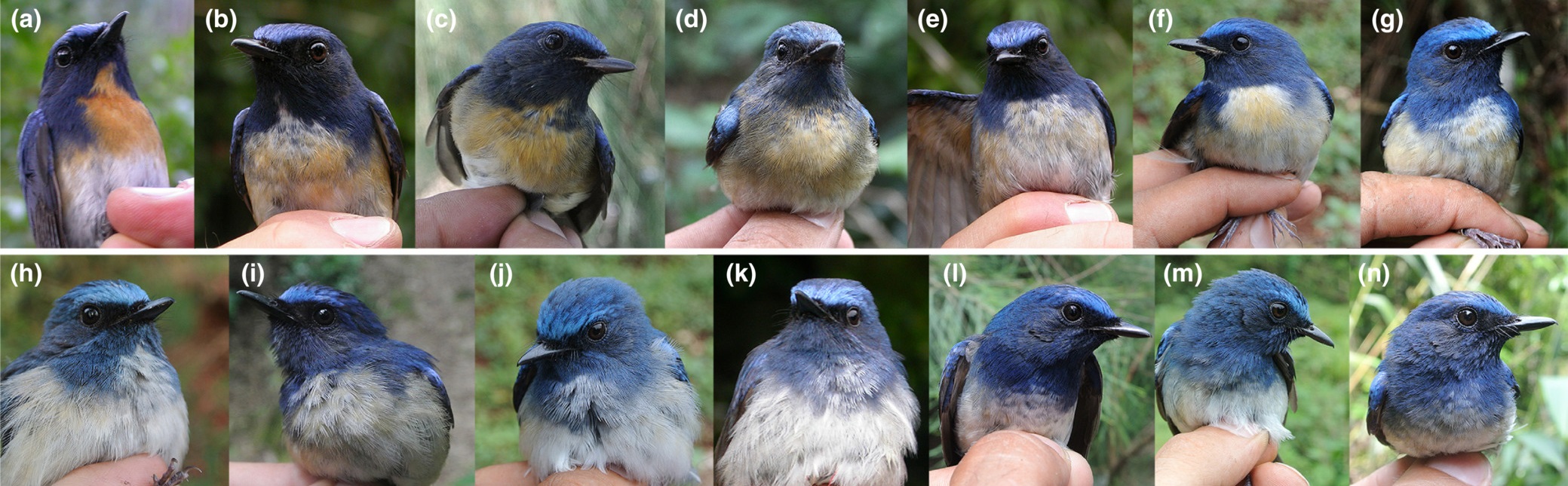
Photos of male Cyornis hainanus showing variability in breast coloration from typical C. h. klossi (a, o, p) to typical C. h. hainanus (l, m, n, s) and birds with intermediate characteristics in between. (a) Dakrong, Quang Tri, Vietnam, 25 March 2004; (b) Dakrong, Quang Tri, Vietnam, 4 April 2004; (c) Xitou, Guangdong, China, 29 September 2014 [IOZ-JM019]; (d) Leizhou, Guangdong, China, 24 October 2014 [IOZ-JM024]; (e) Dakrong, Quang Tri, Vietnam, 4 April 2004; (f) Leizhou, Guangdong, China, 13 November 2013; (g) Sanjia Shan, Guangdong, China, 20 April 2014 [IOZ-JM003]; (h) Weizhou Island, Guangxi, China, 15 April 2013; (i) Longtan, Guangxi, China, 01 June 2015; (j) Leizhou, Guangdong, China, 13 November 2013; (k) Vu Quang National Park, Ha Tinh, Vietnam, 13 March 2005; (l) Xitou, Guangdong, China, 27 September 2014 [JM013]; (m) Yunfu, Guangdong, China, 12 May 2014 [IOZ-JM005]; (n) Heweishan, Guangdong, China, 26 May 2014 [IOZ-JM006]; (o) Tra My, Quang Nam, Vietnam [AMNH833192]; (p) from left to right, Bolovens plateau, Thatèng, Xedong, Laos, 28 November 1931 [MNHN-ZO-MO-1933-72]; Quang Tri, Annam, Vietnam, 22 February 1924 [MNHN-ZO-MO-1924-665]; (q) Trakam, Laos, 29 April 1927 [MNHN-ZO-MO-1929-1100]; Bolovens plateau, Thatèng, Xedong, Laos, 28 November 1931 [MNHN-ZO-MO-1933-73]; Di Linh Plateau, Vietnam, 14 March 1927 [MNHN-ZO-MO-1928-385]; (r) Hainan, China, 9 October 1962 [GIABR-0275]; Ledong, Hainan, China 25 October 1962 [GIABR-0367]; Bawangling, Hainan, China 15 January 1964 [GIABR-2200]; (s) Paksé, Laos, 5 January 1932 [MNHN-ZO-MO-1933-74]; Siem Reap, Cambodia, 27 December 1927 [MNHN-ZO-MO-1929-1092]; Angkor, Siem Reap, Cambodia, December 1927 [MNHN-ZO-MO-1929-1093]; Angkor, Siem Reap, Cambodia, 4 February 1962 [MNHN-ZO-MO-61]. Photos in (a, b, e) by Peter Nilsson at Swedish Museum of Natural History; Photos in (c, d, f, g-j, l-n, p-s) by Jonathan Martinez; Photo in K by Ingrid Cederholm at the Swedish Museum of Natural History; Photo in (o) by Paul Sweet at the American Museum of Natural History. Abbreviations: AMNH – American Museum of Natural History, New York, USA; GIABR – Guangdong Institute of Applied Biological Resources; IOZ – Institute of Zoology, Beijing, China; MNHN – Muséum National d'Histoire Naturelle, Paris, France

Photos of male Cyornis hainanus showing variability in breast coloration from typical C. h. klossi (a, o, p) to typical C. h. hainanus (l, m, n, s) and birds with intermediate characteristics in between.

CONCLUSIONS: 
The classification of Cyornis flycatchers has undergone substantial change over the last two decades, resulting in taxonomic rearrangements, in particular the synonymisation of the genus Rhinomyias with Cyornis (Sangster et al., 2010; Zhang et al., 2016; Zuccon & Ericson, 2010). Our study demonstrates that population-genomic and phylogenomic methodologies can effectively be applied to disentangle the complicated evolutionary history of cryptic species complexes such as the Cyornis flycatchers. Our ddRADseq data set confirms the remarkable case of incongruence between plumage and genomic divergence that has misled previous taxonomists into erroneous classifications (Zhang et al., 2016). Our results also show a novel interbreeding event between two non-sister species.

 
Elize Y. X. Ng, Siqi Li, Dezhi Zhang, Kritika M. Garg, Gang Song, Jonathan Martinez, Le Manh Hung, Vuong Tan Tu, Jérôme Fuchs, Lu Dong, Urban Olsson, Yuan Huang, Per Alström, Frank E. Rheindt and Fumin Lei. 2022. Genome-wide SNPs confirm Plumage Polymorphism and Hybridisation within A Cyornis Flycatcher Species Complex. Zoologica Scripta. DOI: 10.1111/zsc.12568

• Using genome wide markers, our study confirmed that 𝘊𝘺𝘰𝘳𝘯𝘪𝘴 𝘩𝘢𝘪𝘯𝘢𝘯𝘶𝘴 𝘬𝘭𝘰𝘴𝘴𝘪 was the same species as 𝘊. 𝘩. 𝘩𝘢𝘪𝘯𝘢𝘯𝘶𝘴.
• Based on plumage alone, 𝘊. 𝘩. 𝘬𝘭𝘰𝘴𝘴𝘪 was historically placed in the same species as 𝘊. 𝘳𝘶𝘣𝘦𝘤𝘶𝘭𝘰𝘪𝘥𝘦𝘴. 
• Furthermore, in the same study, we also uncovered the first reported instance of hybridization between 𝘊. 𝘩𝘢𝘪𝘯𝘢𝘯𝘶𝘴 and 𝘊 𝘨𝘭𝘢𝘶𝘤𝘪𝘤𝘰𝘮𝘢𝘯𝘴

Sunday, July 10, 2022

[Ornithology • 2022] Cryptic Species in A Colorful Genus: Integrative Taxonomy of the Bush Robins (Aves, Muscicapidae, Tarsiger) suggests Two overlooked Species


in Wei, Sangster, Olsson, Rasmussen, ... et Liu, 2022. 

Highlights: 
• DNA and acoustic samples of all 11 subspecies of the six currently recognized bush robin species (Tarsiger spp.)
• An integrative taxonomic approach combining multilocus phylogenetic and acoustic analysis, as well as morphological differentiation.
• A coalescent-based species delimitation method suggests recognition of two further species, Gansu Bluetail T. albocoeruleus and Taiwan Bush Robin T. formosanus.

Abstract
Several cryptic avian species have been validated by recent integrative taxonomic efforts in the Sino-Himalayan mountains, indicating that avian diversity in this global biodiversity hotspot may be underestimated. In the present study, we investigated species limits in the genus Tarsiger, the bush robins, a group of montane forest specialists with high species richness in the Sino-Himalayan region. Based on comprehensive sampling of all 11 subspecies of the six currently recognized species, we applied an integrative taxonomic approach by combining multilocus, acoustic, plumage and morphometric analyses. Our results reveal that the isolated north-central Chinese populations of Tarsiger cyanurus, described as the subspecies albocoeruleus but usually considered invalid, is distinctive in genetics and vocalisation, but only marginally differentiated in morphology. We also found the Taiwan endemic T. indicus formosanus to be distinctive in genetics, song and morphology from T. i. indicus and T. i. yunnanensis of the Sino-Himalayan mountains. Moreover, Bayesian species delimitation using BPP suggests that both albocoeruleus and formosanus merit full species status. We propose their treatment as ‘Qilian Bluetail’ T. albocoeruleus and ‘Taiwan Bush Robin’ T. formosanus, respectively.
 
Keywords: Passerines, bioacoustics, multilocus phylogeny, morphometrics, disjunct distribution, Sino-Himalayas


 Map of breeding ranges of taxa in Tarsiger, with sampling sites indicated for songs (blue squares) and DNA (orange circles). Drawings of Tarsiger taxa are courtesy of Bai Xiao.

  A) Male Tarsiger cyanurus; B) Male T. albocoeruleus;
C) Male T. indicus; D) T. formosanus
(Photographed by A-Craig Brelsford/shanghaibirding.com, B-Xianting Wang, C\D-Vincent Wang)


Chentao Wei, George Sangster, Urban Olsson, Pamela C. Rasmussen, ... and Yang Liu. 2022. Cryptic Species in A Colorful Genus: Integrative Taxonomy of the Bush Robins (Aves, Muscicapidae, Tarsiger) suggests Two overlooked Species. Molecular Phylogenetics and Evolution. 107580, In Press. DOI: 10.1016/j.ympev.2022.107580

Saturday, November 26, 2016

[Ornithology • 2016] Resolving Taxonomic Uncertainty and Historical Biogeographic Patterns in Muscicapa Flycatchers and their allies


Highlights
• We use mitochondrial and nuclear genes to resolve relationships in Muscicapa and allies.
• We use our phylogenetic results to reconstruct biogeographic history in the group.
• We find several genera to be non-monophyletic.
• The group originated in Africa, and subsequently colonized Eurasia.
• The Congolian region of Africa is ancestral for one of the two major clades in the group.

Abstract
Muscicapa flycatchers and their allies (Bradornis, Dioptornis, Empidornis, Fraseria, Myioparus, Namibornis, and Sigelus) are widely distributed in Africa, Europe and Asia. This broad distribution and the wide variety of habitats occupied by the group, ranging from arid to tropical forests, presents an interesting opportunity to explore the evolution of biogeographic patterns and habitat associations. Sequence data (up to 3310 base pairs from two mitochondrial and two nuclear genes) were generated for 36 of 42 species which comprise the assemblage. Complementary data from an additional species was retrieved from GenBank, as was an additional gene which was available for 21 of our included taxa. Using model-based phylogenetic methods and molecular clock dating, we constructed a time-calibrated molecular phylogenetic hypothesis for the lineage. Ancestral area reconstructions were performed on the phylogeny using LaGrange and BioGeoBEARS. Our results indicate that BradornisFraseria, and Muscicapa are each non-monophyletic, with the latter being shown to comprise five separate clades each more closely related to other genera. Two new genera (Chapinornis Chapinia and Ripleyornis Ripleyia) are erected to account for these results. Muscicapa and allies originated c. 7.4 Ma, most likely in Africa given that their sister lineage is almost entirely from there, and rapidly achieved a Eurasian distribution by c. 7.1 Ma. A second divergence at c. 6.1 Ma resulted in two clades. The first is a largely Eurasian clade that subsequently recolonized Africa, perhaps as the result of the loss of migration. The second is an African clade, and ancestral reconstructions suggest a Congolian (e.g. tropical forest) origin for this clade, with several subsequent diversifications into more arid habitats. This is a unique result, as most tropical forest lineages are confined to that habitat. As with other studies of African bird lineages, Afrotropical forest dynamics appear to have played a significant role in driving diversification in Muscicapa and allies, and our results include just the second recorded case of southern to northern African colonization patterns.

Keywords: Africa; Eurasia; Historical biogeography; Muscicapa; Muscicapidae; Systematics


Molecular phylogeny and taxonomic implications

Using molecular data from 20 taxa, Sangster et al. (2010) defined Muscicapini as comprising the genera Muscicapa, Melaenornis and, Fraseria; they did not include Myioparus in their analysis but it is clearly also a member of Muscicapini ( Fig. 1). Other genera ascribed to Muscicapini historically were excluded by their results, which also indicated issues with the monophyly of each of the remaining three genera (Muscicapa, Melaenornis, and Fraseria; Sangster et al., 2010).

Our study represents the most extensively sampled molecular phylogenetic analysis of Muscicapini species to date. Overall, we included 37 of 42 Muscicapini species (see Section 2). Of the five taxa we are missing in our analyses, two are insular forms from Southeast Asia (Muscicapa randi – Philippines and Muscicapa segregata – Lesser Sundas), and both have been considered as conspecific with Muscicapa dauurica ( Taylor, 2006). The remaining three species have patchy or restricted ranges in Afrotropical rainforests (Muscicapa lendu, Muscicapa epulata, Melaenornis annamarulae). Our attempts to extract DNA from museum specimens of Muscicapa lendu and Muscicapa epulata were unsuccessful.

Although comprising just four species in recent taxonomy (e.g., Taylor, 2006), the genus Melaenornis has previously been considered to include species now ascribed to Empidornis, Sigelus, Dioptrornis, Bradornis, and Fraseria ( Mayr and Cottrell, 1986). Our results indicate, (1) that a larger Melaenornis (to include the aforementioned four genera) would be non-monophyletic (see also Sangster et al., 2010), (2) that Melaenornis (edolioides is the type) could be restricted to as little as three and perhaps four species (depending on the eventual systematic placement of annamarulae), and (3) that Melaenornis could be expanded to include Dioptrornis, Empidornis, Sigelus and Namibornis ( Fig. 1 and Fig. 2). Due to the morphological distinctiveness of the latter four genera (three of which are monotypic) relative to Melaenornis, which are all black or dark gray in color, we agree with the more strict usage of Melaenornis (e.g., Taylor, 2006).


Our results also indicate that Bradornis is non-monophyletic, with species falling into two distinct clades ( Fig. 1 and Fig. 2). The Bradornis type is mariquensis ( Mayr and Cottrell, 1986), and thus that genus should be applied to mariquensis, pumilus and microrhyncus. There is an available synonym, Haganopsornis, which was applied to infuscatus (Roberts, 1922 fide Mayr and Cottrell, 1986) and we suggest resurrecting that genus to include infuscatus and pallidus ( Fig. 1 and Fig. 2). The genus Fraseria is also non-monophyletic, with ocreata being more closely related to the genus Myioparus; our results conflict as to the phylogenetic position of cinerascens ( Fig. 1 and Fig. 2). Regardless, Fraseria would apply to ocreata ( Mayr and Cottrell, 1986). We find no synonym to apply to cinerascens, which then requires the designation of a new genus for that species which we propose as:


Chapinia, new genus Voelker & Bowie
Type species. – Chapinia cinerascens.

Diagnosis – A genus of muscicapid flycatcher differing from all other genera of the family Muscicapidae by the following combination of characters: large size, diagnostic white supra-loral spot, dark upperparts, and mottled gray underparts with dark but poorly demarcated crescents on the breast.

Etymology – This name honors Dr. James P. Chapin, for his extensive documentation of, and research on, the birds of the Belgian Congo.


Finally, the genus Muscicapa appears to have been a taxonomic dumping ground for any small to medium sized Muscicapini flycatcher, as our results show it to be comprised of five distinct lineages (Fig. 1). The type for the genus is striata, thus Muscicapa would apply to the large clade of 11 species (Fig. 1). There are several synonyms available for other clades. The genus Apatema could be applied to olivascens, and Cichlomyia or Butalis (it is unclear to us which has priority) could apply to the closely related caerulescens, and thus to tessmani as well (Fig. 1). For comitata, the genus Pedilorhynchus is available, and Artomyias is available for infuscata and thus also for the closely related ussheri (Fig. 1). Although sister to infuscata + ussheri, boehmi is highly distinct from them morphologically (Sinclair and Ryan, 2010). We therefore suggest applying the name Bradyornis to boehmi, following the original description of this species (Reichenow, 1884, fide Mayr and Cottrell, 1986). We find no available synonym for ruficauda, which is the first species to diverge within Muscicapini (Fig. 1). This requires the designation of a new genus for that species which we propose as:


Ripleyia, new genus Voelker & Bowie
Type species. – Ripleyia ruficauda.

Diagnosis – A genus of muscicapid flycatcher differing from all other genera of the family Muscicapidae by the following combination of characters: rufous uppertail-coverts and tail, faint supercilium, and entirely orange lower mandible.

Etymology – This name honors Dr. S. Dillon Ripley, former Secretary of the Smithsonian Institution, for his extensive work on the birds of India and southern Asia.


Gary Voelker, Jerry W. Huntley, Joshua V. Peñalba and Rauri C.K. Bowie. 2016. Resolving Taxonomic Uncertainty and Historical Biogeographic Patterns in Muscicapa Flycatchers and their allies. Molecular Phylogenetics and Evolution. 94, Part B; 618–625. DOI: 10.1016/j.ympev.2015.09.026


..................................


Abstract
  

Earlier this year, two of us (GV & RB) introduced the genus-group names Chapinia and Ripleyia (in Voelker et al. 2016) for two species of African flycatchers allied to Muscicapa. We recently became aware that both of these genus-group names are preoccupied within Animalia (Chapinia by Chapinia Ewing, 1927 [Insecta: Phthiraptera] and Ripleyia by Ripleyia Cossman, 1920 [Mollusca]), rendering them junior homonyms. Following Article 60 of the International Code of Zoological Nomenclature (ICZN 1999) we herein provide replacement names for the two generic names introduced in Voelker et al. (2016).

Keywords: ChapiniaRipleyia, Passeriformes, Muscicapidae, Aves


Chapinornisnew replacement name
Type species: Fraseria cinerascens Hartlaub, 1857

Etymology: A combination of the surname Chapin and the Greek ὄρνις (Ornis), a bird, and a common suffix for bird genera. This name honors James P. Chapin, for his extensive documentation of, and research on, the birds of the Belgian Congo. Gender masculine.

Remarks: Replacement name for Chapinia Voelker & Bowie in Voelker, Huntley, Peñalba & Bowie, 2016.

Ripleyornisnew replacement name
Type species: Muscicapa ruficauda Swainson, 1838

Etymology: A combination of the surname Ripley and the Greek ὄρνις (Ornis), a bird, and a common suffix for bird genera. This name honors S. Dillon Ripley, former Secretary of the Smithsonian Institution, for his extensive work on the birds of India and southern Asia. Gender masculine.

Remarks: Replacement name for Ripleyia Voelker & Bowie in Voelker, Huntley, Peñalba & Bowie, 2016.


 Gary Voelker, Rauri C K Bowie and Kevin W. Conway. 2016. Replacement names for Chapinia and Ripleyia (Aves: Passeriformes: Muscicapidae).
Zootaxa. 4107(4); 599. DOI:  10.11646/zootaxa.4107.4.9

Saturday, November 12, 2016

[Ornithology • 2016] Stiphrornis dahomeyensis, S. inexpectatus & S. rudderi • Three New Species of Stiphrornis (Aves: Muscicapidae) from the Afro-tropics, with A Molecular Phylogenetic Assessment of the Genus


[from top to bottom]    Stiphrornis rudderi, S. dahomeyensis &  S. inexpectatus  
 Voelker, Tobler, Prestridge, Duijm, Groenenberg, Hutchinson,
 Martin, Nieman, Roselaar & Huntley, 2016

 Abstract
We describe three new species of forest robin in the genus Stiphrornis; two from West Africa and one from the Congo Basin. Each species represents a distinct phylogenetic lineage based on genetic analysis. In addition to genetic differentiation, each new species is diagnosable from other Stiphrornis lineages by morphology, and by plumage. One of the new species [Stiphrornis inexpectatus] appears to be restricted to the Central and Brong-Ahafo Regions of Ghana, and another [Stiphrornis dahomeyensis] is restricted to Benin and the Central Region of Ghana. In Ghana, these two new species presumably come into contact with Stiphrornis erythrothorax (Western Region of Ghana and westward), and there is evidence that one of the new species has a distinguishably different song from erythrothorax. The distribution of the third new species [Stiphrornis rudderi] is primarily on the south bank of the Congo River, near the city of Kisangani. Recognition of these species provides additional evidence that Afrotropical forests are harbouring substantial cryptic diversity, and that our knowledge of the drivers of this diversity remains poorly documented across the region.


Key words: Africa, cryptic species, speciation, systematics, tropical forests,


Fig. 1. Visual comparisons of new Stiphrornis taxa and their closest relatives. Column (A) dorsal, lateral and ventral views of (from left to right): erythrothorax, the type specimen of inexpectatus (LSUMZ 168539), the type specimen of dahomeyensis (TCWC 15743) and gabonensis. Column (B) dorsal, lateral and ventral views of (from left to right): the type specimen of rudderi (TCWC 15204) and xanthogaster


Stiphrornis dahomeyensis sp. nov. 
Dahomey Forest Robin

ETYMOLOGY: Named after the Dahomey Gap, that separates the otherwise broadly distributed western and eastern expanses of Guineo-Congolian tropical forests, and in which the isolated Lama Forest is located. The Gap derives its name from the African kingdom of Dahomey, which lasted c. 300 years and was located in the area of what is now Benin.

DISTRIBUTION: The known distributional range of the new species is currently limited to one locality in Benin, the Lama Forest (6 57.61’N, 2 10.12’E) and a second locality from c. 30 km south of Assin Foso, Central Region, Ghana (5 19’59.88“N, 1 13’ 0.1194”E). 


Stiphrornis inexpectatus sp. nov. 
Ghana Forest Robin

ETYMOLOGY:  Named both for the unexpected nature of its distribution, being restricted to two provinces in Ghana, and the fact that there are no obvious geographic barriers that separate it from two other members of the genus.

DISTRIBUTION: The known distributional range of the new species is currently limited to three locations in Ghana, one 30 km south of Assin Foso, Central Region (5 20.300 N, 1 13.58’W), one in Kakum National Park, Central Region (5 210 3000N, 1 230 W) and another 26 km south-west of Goaso, Brong-Ahafo Region (6.71 N, 2.73 W). 


Stiphrornis rudderi sp. nov. 
Rudder’s Forest Robin

ETYMOLOGY: Named in honour of James Earl Rudder, who led the 2nd Ranger Battalion during the invasion of Normandy, and was later President of Texas A&M University; his presidency was a transformative steppingstone in driving A&M’s success.

DISTRIBUTION: The known distributional range of the new species is currently limited to two localities near the city of Kisangani, Democratic Republic of the Congo. The first is Yoko Forest Reserve, Ubundu District (0.29400 , 25.288917 ), on the south side of the Congo River. The second locality is Turumbu, c. 8 km N of Yelenge, Yawenda District (0.633483 , 25.073933 ), on the north side of the Congo River.

Rudder’s Forest Robin, Stiphrornis rudderi   


Gary Voelker, Michael Tobler, Heather L. Prestridge, Elza Duijm, Dick Groenenberg, Mark R. Hutchinson, Alyssa D. Martin, Aline Nieman, Cees S. Roselaar and Jerry W. Huntley. 2016. Three New Species of Stiphrornis (Aves: Muscicapidae) from the Afro-tropics, with A Molecular Phylogenetic Assessment of the Genus.  Systematics and Biodiversity.  DOI: 10.1080/14772000.2016.1226978

Team discovers three new bird species in Africa http://phy.so/397725009 via @physorg_com

Friday, August 31, 2012

[Ornithology • 2008] Olive-backed Forest Robin | Stiphrornis pyrrholaemus • A new species of African Forest Robin from Gabon (Passeriformes: Muscicapidae)


Olive-backed Forest Robin | Stiphrornis pyrrholaemus

Abstract
We describe a new species of forest robin from the Gamba Complex in southwest Gabon. This common bird, Stiphrornis pyrrholaemus sp. nov., inhabits primary lowland forest and forages on or near the ground like the other members of the genus Stiphrornis of central and western Africa. Unique phenotypic features of the new species include the male’s bright orange chin, throat, and breast, creamy yellow belly, olive green back and rump, and gray flanks. Mitochondrial sequence divergence corroborates our assessment based on its distinct physical characteristics that this is a new species, and suggest that Stiphrornis erythrothorax is likely the most closely related congener. 

Key words: African forest robin, Stiphrornis pyrrholaemus, Gamba Complex, Moukalaba–Doudou National Park

Schmidt, Brian K, Jeffrey T. Foster, George R. Angehr, Kate L. Durrant & RC Fleischer. 2008. A new species of African Forest Robin from Gabon (Passeriformes: Muscicapidae: Stiphrornis). Zootaxa. 1850: 27–42.

NEW SPECIES: New bird species discovered in Gabon, Africa http://wp.me/paGo0-p2 via @buckdenton


[Ornithology • 1999] Sangha Forest Robin | Stiphrornis sanghensis • Speciation in African forest robins (Stiphrornis); with a new species from the southwest Central African Republic


Adult male and Juvenile male Stiphrornis sanghensis, photographed in in Dzanga-Sangha Dense Forest Reserve, CAR, June 1998. Photograph by J. Cracraft.


Abstract
The monotypic genus Stiphrornis (Aves: Turdidae) is revised under a phylogenetic species concept to include four species, one of which, from the southwest Central African Republic, is new. Mitochondrial DNA sequence data are analyzed to explore the phylogenetic relationships within Stiphrornis. These data indicate relatively high levels of sequence divergence among the species and corroborate their recognition as diagnosable taxa, a conclusion also supported by morphological evidence. These findings, along with the allopatric distributions of the species, compel attention to their phylogenetic and spatial history, which was not explored when this group was ascribed to a single ‘‘biological’’ species.

Data reviewed here also suggest that the northwest Congo Basin forest, where the new species was discovered, is more zoogeographically complex than has been previously suspected. In addition, application of a phylogenetic species concept emphasizes the narrow endemism of S. gabonensis and S. sanghensis, along with its implications for conserving their threatened habitats.

The findings of this paper also reinforce the notion that patterns of geographic variation in the lowland forests of West and Central Africa are still incompletely understood and that the impact of environmental and geological history on the diversification of the forest avifauna has not yet been fully explored.


Fig. 4. Distributions of species of Stiphrornis (after Keith et al. (1992) and material examined in this study). Range limits of taxa in the western Congo Basin are poorly known at present, therefore it is uncertain whether parapatry exists between S. gabonensis and S. erythrothorax.


Stiphrornis e. gabonensis, Gabon Forest Robin (top) and 
Stiphrornis e. erythothorax, Western Forest Robin (bottom)
Source: Catalogue of the birds in the British Museum. Volume 7. 1883
Author: Joseph Smit (1836–1929) | http://en.wikipedia.org/wiki/File:StiphrornisSmit.jpg

Beresford, P. & Cracraft, J. 1999. Speciation in African forest robins (Stiphrornis): species limits, phylogenetic relationships, and molecular biogeography. American Museum Novitates. 3270: 1–22.