Showing posts with label Selachimorpha - Shark. Show all posts

Sunday, November 23, 2025

[PaleoIchthyology • 2025] Pseudocorax heteroserratusPseudocorax (Chondrichthyes: Lamniformes: Pseudocoracidae) in the Upper Maastrichtian Phosphates of Khouribga Province, Morocco


Pseudocorax heteroserratus
Egli, Goode, Rempert & Rego, 2025


Abstract
A new species of Pseudocorax (Lamniformes, Pseudocoracidae), Pseudocorax heteroserratus n. sp., is described from the upper Maastrichtian phosphates of Morocco. This novel taxon is recognized by a large sample of isolated teeth collected from the upper Couche III layer at the Sidi Chennane quarry in the Oulad Abdoun Basin, Khouribga Province, Morocco. P. heteroserratus is differentiated from other Pseudocorax species by bearing a mesiodistally elongated tooth base, broad crown, and highly variable serrations. The variability in number and extent of serrations along the carinae ranges from completely absent to fully serrated and finely to coarsely serrated, raising speculation on broader Pseudocorax phylogenetics and as to whether the genesis of serrations within Pseudocorax occurred in a singular progressive event or rather from two distinct events. The morphological variability within the new species highlights the importance of large sample sizes in selachian odontological studies using isolated teeth.

Systematic paleontology
Class Chondrichthyes Huxley, Reference Huxley, 1880
Subclass Elasmobranchii Bonaparte, Reference Bonaparte, 1838

Cohort Euselachii Hay, Reference Hay, 1902
Subcohort Neoselachii Compagno, Reference Compagno, 1977

Order Lamniformes Berg, Reference Berg, 1958
Family Pseudocoracidae Cappetta, Reference Cappetta, 2012

Genus Pseudocorax Priem, Reference Priem, 1897

Type species: Pseudocorax affinis (Münster in Agassiz, Reference Agassiz1843), from the upper Maastrichtian, Netherlands.

 Upper anterior Pseudocorax heteroserratus n. sp. 
 (1–5) MMNS VP-12820 (holotype), upper left anterior tooth in (1) lingual, (2) basal, (3) apical, (4) profile, and (5) labial views.
(6–10) MMNS VP-12827.01, upper left anterior tooth in (6) lingual, (7) basal, (8) apical, (9) profile, and (10) labial views. Scale bars = 5 mm.

Pseudocorax heteroserratus new species 

Diagnosis: Crown and tooth base mesiodistally expanded, especially along upper and lower jaw anterior teeth. Mesial shoulder generally more prominent along basal crown, extending further apically. Variable serrations, from absent to full and coarse to fine, regardless of jaw position or potential ontogenetic stage. Deep basal margin on tooth base with variable tooth base lobe morphology.

Occurrence: Upper Couche III layer of the Oulad Abdoun Basin, Sidi Chennane quarry, near Oued Zem, Khouribga Province, Morocco.
 
Etymology: Hetero-”, Latin for “different”, and “serratus” for “serrations,” highlighting the variability in the presence and size of serrations along the crown.

 Upper lateroposterior Pseudocorax heteroserratus n. sp. teeth.
(1–5) MMNS VP-12823 (paratype), upper left lateroposterior tooth in (1) lingual, (2) basal, (3) apical, (4) profile, and (5) labial views. (6–10) MMNS VP-12827.05, (?) upper right lateroposterior tooth in (6) lingual, (7) basal, (8) apical, (9) profile, and (10) labial views.
(11–15) MMNS VP- 12827,06, (?) upper left lateroposterior tooth in (11) lingual, (12) basal, (13) apical, (14) profile, and (15) labial views. (16–20) MMNS VP-12827.07, upper left lateroposterior tooth in (16) lingual, (17) basal, (18) apical, (19) profile, and (20) labial views.
(21–25) MMNS VP-12827.08, upper right lateroposterior tooth in (21) lingual, (22) basal, (23) apical, (24) profile, and (25) labial views. (26–30) MMNS VP-12827.09, upper left lateroposterior tooth in (26) lingual, (27) basal, (28) apical, (29) profile, and (30) labial. Scale bars = 5 mm.


Hunter Chase Egli, Benjamin Goode, Trevor Rempert and Christopher Rego. 2025. Pseudocorax (Chondrichthyes, Lamniformes, Pseudocoracidae) in the Upper Maastrichtian phosphates of Khouribga Province, Morocco. Journal of Paleontology. Journal of Paleontology. DOI: doi.org/10.1017/jpa.2025.10183  [21 November 2025]
 
Non-technical Summary: A new species of extinct shark, Pseudocorax heteroserratus n. sp., has been identified through isolated teeth from fossil-rich Cretaceous rock in Morocco. Unlike previously known Pseudocorax species, this new species is distinguishable through its broad crown, elongated tooth base, and unusually variable serrations. These serrations range from unserrated to coarsely serrated and provide new insights into Pseudocorax evolutionary history. It raises the question of whether serrations in this lineage evolved gradually in a continuous process or from multiple independent origins. The findings of this study emphasize how large sample sizes of shark teeth are critical in palaeoichthyology, especially when species are known only from their teeth.

Thursday, October 16, 2025

[PaleoIchthyology • 2026] A large lamniform shark from the Aptian of Villa de Leiva (Boyacá, Colombia), based on the first Lower Cretaceous shark specimen preserving both teeth and vertebrae


 Protolamna ricaurtei  

in Benavides-Cabra, Páramo-Fonseca, Narváez-Rincón et Pomar, 2026. 
artwork by Renzo Garavito x.com/R_o_XIII

Highlights: 
• Protolamna ricaurtei was a gigantic lamniform shark that lived during the Early Cretaceous.
• Not all macrophagous lamniform sharks with large bodies have large teeth.
• Protolamna ricaurtei was a relatively slow but active swimmer who fed on small preys.

Abstract
We describe a new specimen of a lamniform shark from the upper Aptian of the Arcillolitas abigarradas Member of the Paja Formation of Villa de Leiva (Colombia). It represents the first lamniform shark specimen from the Lower Cretaceous with both teeth and vertebrae preserved. The specimen consists of several disarticulated but well-preserved teeth and well-preserved partially articulated vertebral centra, denticles and soft tissues. We refer the specimen to Protolamna ricaurtei, a species recently erected from a specimen found in the same formation. It is a lamniform shark characterized by proportionally small tearing-type teeth with small triangular main cusp, two pairs of small triangular lateral cusplets, and massive bilobated roots. The specimen represents a mature individual to be 6.65 m in total length, making it the oldest record of a gigantic lamniform. This specimen is the first evidence that not all macrophagous lamniforms follow the linear function relating crown height to total body length. Our taphonomic analysis indicates that the specimen must have rapidly reached an anoxic bottom, with low benthic activity, gentle currents, and with microbial mats that facilitated the rapid phosphatization of the soft tissues. Based on the preserved anatomy, we propose that Protolamna ricaurtei was a relatively slow but active swimmer feeding in tropical near-shore areas over small preys such as bony fishes, small sharks, squids, and crustaceans.

the taphonomic history of specimen CFSTA090318, from its sinking and burial to its fossilization, along with the remains of an associated turtle.
artwork by Renzo Garavito x.com/R_o_XIII

Protolamna ricaurtei 


Cristian D. Benavides-Cabra, María E. Páramo-Fonseca, José A. Narváez-Rincón and Daniel E. Pomar. 2026. A large lamniform shark from the Aptian of Villa de Leiva (Boyacá, Colombia), based on the first Lower Cretaceous shark specimen preserving both teeth and vertebrae. Cretaceous Research. 178, 106211. DOI: doi.org/10.1016/j.cretres.2025.106211 

Thursday, April 25, 2024

[PaleoIchthyology • 2024] Exceptionally preserved Shark Fossils from Mexico elucidate the Long-standing Enigma of the Cretaceous Elasmobranch Ptychodus (Lamniformes: Ptychodontidae)


 Ptychodus Agassiz, 1834

in Vullo, Villalobos-Segura, Amadori, Kriwet, Frey, González, Gutiérrez, Ifrim, Stinnesbeck et Stinnesbeck, 2024.
 
Abstract
The fossil fish Ptychodus Agassiz, 1834, characterized by a highly distinctive grinding dentition and an estimated gigantic body size (up to around 10 m), has remained one of the most enigmatic extinct elasmobranchs (i.e. sharks, skates and rays) for nearly two centuries. This widespread Cretaceous taxon is common in Albian to Campanian deposits from almost all continents. However, specimens mostly consist of isolated teeth or more or less complete dentitions, whereas cranial and post-cranial skeletal elements are very rare. Here we describe newly discovered material from the early Late Cretaceous of Mexico, including complete articulated specimens with preserved body outline, which reveals crucial information on the anatomy and systematic position of Ptychodus. Our phylogenetic and ecomorphological analyses indicate that ptychodontids were high-speed (tachypelagic) durophagous lamniforms (mackerel sharks), which occupied a specialized predatory niche previously unknown in fossil and extant elasmobranchs. Our results support the view that lamniforms were ecomorphologically highly diverse and represented the dominant group of sharks in Cretaceous marine ecosystems. Ptychodus may have fed predominantly on nektonic hard-shelled prey items such as ammonites and sea turtles rather than on benthic invertebrates, and its extinction during the Campanian, well before the end-Cretaceous crisis, might have been related to competition with emerging blunt-toothed globidensine and prognathodontine mosasaurs.

Keywords: Chondrichthyes, Lamniformes, Ptychodontidae, ecomorphology, Late Cretaceous, Vallecillo fossil Lagerstätte


Romain Vullo, Eduardo Villalobos-Segura, Manuel Amadori, Jürgen Kriwet, Eberhard Frey, Margarito A. González González, José M. Padilla Gutiérrez, Christina Ifrim, Eva S. Stinnesbeck and Wolfgang Stinnesbeck. 2024. Exceptionally preserved Shark Fossils from Mexico elucidate the Long-standing Enigma of the Cretaceous Elasmobranch Ptychodus Proc. R. Soc. B. 291: 20240262. DOI: 10.1098/rspb.2024.0262


Thursday, August 18, 2022

[PaleoIchthyology • 2022] The Extinct Shark Otodus megalodon was A Transoceanic Superpredator: Inferences from 3D Modeling


Otodus megalodon   

in Cooper, Hutchinson, Bernvi, et al. 2022. 

Abstract
Although shark teeth are abundant in the fossil record, their bodies are rarely preserved. Thus, our understanding of the anatomy of the extinct Otodus megalodon remains rudimentary. We used an exceptionally well-preserved fossil to create the first three-dimensional model of the body of this giant shark and used it to infer its movement and feeding ecology. We estimate that an adult O. megalodon could cruise at faster absolute speeds than any shark species today and fully consume prey the size of modern apex predators. A dietary preference for large prey potentially enabled O. megalodon to minimize competition and provided a constant source of energy to fuel prolonged migrations without further feeding. Together, our results suggest that O. megalodon played an important ecological role as a transoceanic superpredator. Hence, its extinction likely had large impacts on global nutrient transfer and trophic food webs.


Jack A. Cooper, John R. Hutchinson, David C. Bernvi, Geremy Cliff, Rory P. Wilson, Matt L. Dicken, Jan Menzel, Stephen Wroe, et al. 2022. The Extinct Shark Otodus megalodon was A Transoceanic Superpredator: Inferences from 3D Modeling.  SCIENCE ADVANCES. 8(33); DOI: 10.1126/sciadv.abm9424
 twitter.com/PimientoGroup/status/1559964642595803136

Monday, January 31, 2022

[Ichthyology • 2021] Squatina mapama • A New Cryptic Species of Angel Shark (Elasmobranchii: Squatiniformes: Squatinidae) from the southwestern Caribbean Sea


Squatina mapama
 Long, Ebert, Tavera, Acero P. & Robertson, 2021

Small-crested Angelshark | angelote de cresta pequeña || DOI: 10.5281/zenodo.5806693 

Integrating both morphological and genetic data, we describe Squatina mapama, a new species of the angel shark genus Squatina, found on the upper continental slope off the Caribbean coast of Panamá. Distinguishing characters of S. mapama include a wider pectoral and pelvic span; a shorter head length; a narrower mouth; short fringed nasal flaps and barbels; a few large denticles on top of the head; a single dorsal midline row of slightly enlarged denticles from the level of the posterior insertion of the pelvic fin to the first dorsal fin and continuing past the first dorsal fin to the second dorsal-fin origin; and the presence of smaller scattered spots in males, which, in combination, allow separation of this new species from the closely related and sympatric species Squatina david. The new species can be distinguished from all other currently recognized Squatina species by meristic and morphometric measures, as well as by sequence differences in the mtDNA COI marker. Phylogenetic analysis shows Squatina mapama n. sp. to be a basal member of a small clade of western Atlantic Squatina species that includes Squatina occulta, Squatina guggenheim, and S. david, which likely evolved in the late Oligocene or Miocene period. We also report a western range extension of S. david from Colombia to the western Caribbean coast of Panamá.

Key words: taxonomy, ichthyology, fishes, Atlantic Ocean, Panama, phylogenetics, clades, DNA barcodes


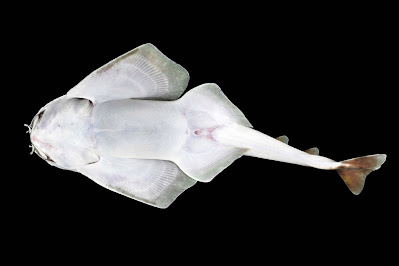
Squatina mapama, fresh holotype, USNM 400784, 400 mm TL male, Caribbean Panama
(D.R. Robertson).

Squatina mapama, fresh holotype, ventral view, USNM 400784, Caribbean Panama
 (D.R. Robertson).

Squatina mapama, fresh holotype detail of nasal flaps, USNM 400784, Caribbean Panama
(D.R. Robertson).

Squatina mapama, n. sp. 
Small-crested Angelshark; angelote de cresta pequeña

Diagnosis. A Squatina species with a combination of: a single row of slightly enlarged dermal denticles along dorsal midline extending between level just anterior of posterior insertion of pelvic fins and anterior base of first dorsal fin and continuing rearwards along dorsal ridge of tail between first and second dorsal fins; a few large denticles on top of head; nasal flap squared with a fine fringe on ventral edge; two short lateral barbels bluntly rounded also with a fine fringed margin; males with a dorsal color pattern of small, scattered, dark spots distributed over a uniform light-brown background; pectoral-fin span 52.0–58.1% TL; pelvic-fin span 30.7–31.0 % TL; pre-pectoral-fin length 19.4–19.8% TL; trunk width 18.1–19.5% TL; head length 16.5–17.5% TL; spiracle length 2.2–2.3% TL; eye-to-spiracle length 2.2–5.0 % TL; mouth width 10.5–12.1% TL; nostril width 1.6–2.3% TL; snout-to-pectoral distance 19.4–19.8%; spiracle width 2.2–2.3% TL; pectoral-fin inner margins 17.5–18.3%.


Etymology. The specific epithet mapama refers to the acronym MAPAMA, the Ministerio de Agricultura y Pesca, Alimentación y Medio Ambiente, which is the Spanish governmental organization that operates the R/V Miguel Oliver. This name recognizes the support of MAPAMA for the research cruises to Central and South America that facilitated the capture of this angelshark, and other new species of deepwater fishes on both sides of the Central American isthmus (Vázquez et al. 2015, Concha et al. 2016, Robertson et al. 2017). 
Suggested common name of Small-crested Angelshark or angelote de cresta pequeña is in reference to the short and narrow median line of small dermal denticles

 
 Douglas J. Long, David A. Ebert, Jose Tavera, Arturo Acero P. and Ross Robertson. 2021. Squatina mapama n. sp., A New Cryptic Species of Angel Shark (Elasmobranchii: Squatinidae) from the southwestern Caribbean Sea Journal of the Ocean Science Foundation, 38, 113-130. DOI: 10.5281/zenodo.5806693

Tuesday, February 27, 2018

[Ichthyology • 2018] Resurrection of the Sixgill Shark Hexanchus vitulus Springer & Waller, 1969 (Hexanchiformes, Hexanchidae), with Comments on Its Distribution in the northwest Atlantic Ocean


Hexanchus vitulus Springer & Waller, 1969

in Daly-Engel, Baremore, Grubbs, et al., 2018. 

Abstract 
The sixgill sharks of the genus Hexanchus (Hexanchiformes, Hexanchidae) are large, rarely encountered deep-sea sharks, thought to comprise just two species: the bluntnose sixgill Hexanchus griseus (Bonaterre, 1788) and the bigeye sixgill Hexanchus nakamurai (Teng, 1962). Their distribution is putatively worldwide in tropical and temperate waters, but many verified records for these species are lacking, and misidentification is common. Taxonomic uncertainty has long surrounded H. nakamurai in particular, with debate as to whether individuals from the Atlantic constitute a separate species. Using 1,310 base pairs of two mitochondrial genes, COI and ND2, we confirm that bigeye sixgill sharks from the Atlantic Ocean (Belize, Gulf of Mexico, and Bahamas) diverge from those in the Pacific and Indian Oceans (Japan, La Reunion, and Madagascar) with 7.037% sequence divergence. This difference is similar to the genetic distance between both Atlantic and Indo-Pacific bigeye sixgill sharks and the bluntnose sixgill shark (7.965% and 8.200%, respectively), and between the entire genus Hexanchus and its sister genus Heptranchias (8.308%). Such variation far exceeds previous measures of species-level genetic divergence in elasmobranchs, even among slowly-evolving deep-water taxa. Given the high degree of morphological similarity within Hexanchus, and the fact that cryptic diversity is common even among frequently observed shark species, we conclude that these results support the resurrection of the name Hexanchus vitulus Springer and Waller, 1969 for bigeye sixgill sharks in the northwest Atlantic Ocean. We propose the common name “Atlantic sixgill shark” for H. vitulus, and provide new locality records from Belize, as well as comments on its overall distribution.

Keywords: Systematics, Mitochondrial DNA, Phylogenetics, Speciation, Elasmobranchs 


An adult Atlantic sixgill shark swims in the waters off Belize.
photo: Ivy Baremore/Maralliance


Toby S. Daly-Engel, Ivy E. Baremore, R. Dean Grubbs, Simon J. B. Gulak, Rachel T. Graham and Michael P. Enzenauer. 2018. Resurrection of the Sixgill Shark Hexanchus vitulus Springer & Waller, 1969 (Hexanchiformes, Hexanchidae), with comments on its distribution in the northwest Atlantic Ocean. Marine Biodiversity.  DOI: 10.1007/s12526-018-0849-x

New species of shark discovered through genetic testing phy.so/438254250 via @physorg_com

Saturday, January 27, 2018

[Ichthyology • 2018] Conserving the Evolutionary History of Sharks, Rays and Chimaeras (Chondrichthyes)


A representative taxon-complete tree with phylogenetic distribution of molecular data coverage.

Stein, Mull, Kuhn, et al. 2018.  

Abstract
In an era of accelerated biodiversity loss and limited conservation resources, systematic prioritization of species and places is essential. In terrestrial vertebrates, evolutionary distinctness has been used to identify species and locations that embody the greatest share of evolutionary history. We estimate evolutionary distinctness for a large marine vertebrate radiation on a dated taxon-complete tree for all 1,192 chondrichthyan fishes (sharks, rays and chimaeras) by augmenting a new 610-species molecular phylogeny using taxonomic constraints. Chondrichthyans are by far the most evolutionarily distinct of all major radiations of jawed vertebrates—the average species embodies 26 million years of unique evolutionary history. With this metric, we identify 21 countries with the highest richness, endemism and evolutionary distinctness of threatened species as targets for conservation prioritization. On average, threatened chondrichthyans are more evolutionarily distinct—further motivating improved conservation, fisheries management and trade regulation to avoid significant pruning of the chondrichthyan tree of life.


A representative taxon-complete tree with phylogenetic distribution of molecular data coverage. Clades are shaded according to molecular data coverage within each order, and those species with molecular data are indicated by outer ticks. Red dots highlight nodes defining orders, with the paraphyletic order Rhinopristiformes delimited by two highly supported nodes. 


R. William Stein, Christopher G. Mull, Tyler S. Kuhn, Neil C. Aschliman, Lindsay N. K. Davidson, Jeffrey B. Joy, Gordon J. Smith, Nicholas K. Dulvy and Arne O. Mooers. 2018. Global Priorities for Conserving the Evolutionary History of Sharks, Rays and Chimaeras. Nature Ecology & Evolution. 2; 288–298. DOI: 10.1038/s41559-017-0448-4

Saving sharks with trees: researchers aim to save key branches of shark and ray tree of life phy.so/436013572   @physorg_com

Tuesday, May 31, 2016

[PaleoMammalogy • 2016] Fragilicetus velponi • A New Mysticete Genus and Species and Its Implications for the Origin of Balaenopteridae (Cetacea, Mysticeti)


Fragilicetus velponi 
Bisconti & Bosselaers, 2016

Figure 14. Artistic interpretation of possible interaction between a large shark and Fragilicetus velponi gen. et. sp. nov. as suggested by the shark bite marks on the skull of the holotype specimen. 
The human in the upper right corner serves as a size reference. Illustration by Mark Bosselaers.
 
 DOI: 10.1111/zoj.12370

Abstract
A new extinct genus, Fragilicetus gen. nov., is described here based on a partial skull of a baleen-bearing whale from the Early Pliocene of the North Sea. Its type species is Fragilicetus velponi sp. nov. This new whale shows a mix of morphological characters that is intermediate between those of Eschrichtiidae and those of Balaenopteridae. A phylogenetic analysis supported this view and provided insights into some of the morphological transformations that occurred in the process leading to the origin of Balaenopteridae. Balaenopterid whales show specialized feeding behaviour that allows them to catch enormous amounts of prey. This behaviour is possible because of the presence of specialized anatomical features in the supraorbital process of the frontal, temporal fossa, glenoid fossa of the squamosal, and dentary. Fragilicetus velponi gen. et sp. nov. shares the shape of the supraorbital process of the frontal and significant details of the temporal fossa with Balaenopteridae but maintains an eschrichtiid- and cetotheriid-like squamosal bulge and posteriorly protruded exoccipital. The character combination exhibited by this cetacean provides important information about the assembly of the specialized morphological features responsible for the highly efficient prey capture mechanics of Balaenopteridae.  

Keywords: Belgium; feeding behavior; Fragilicetus; phylogeny; Pliocene


Figure 14. Artistic interpretation of possible interaction between a large shark and Fragilicetus velponi gen. et. sp. nov. as suggested by the shark bite marks on the skull of the holotype specimen shown in Figure 3.
The human in the upper right corner serves as a size reference. Illustration by Mark Bosselaers. 

Systematic Palaeontology

Class Mammalia Linnaeus, 1758
Order Cetacea Brisson, 1762
Suborder Mysticeti Cope, 1891
Chaeomysticeti Mitchell, 1989
Balaenomorpha Geisler & Sanders, 2003

Superfamily Thalassotherii Bisconti, Lambert & Bosselaers, 2013
Epifamily Balaenopteroidea Flower, 1864

Family Balaenopteridae Gray, 1864

Fragilicetus gen. nov.

Diagnosis: The diagnosis of Fragilicetus includes the presence of eschrichtiid-like and balaenopterid-like features in the same individual. Fragilicetus is distinguished from the other nonbalaenopterid mysticete families based on the presence, in the same individual, of a squamosal bulging into the temporal fossa; posterior projection of the posterolateral corner of the exoccipital; anterior placement of the posterior apex of the lambdoidal crest; squamosal cleft present and v-shaped (turning ventrally at its lateral end); abruptly depressed and flat supraorbital process of the frontal; anterior portion of temporal crest transversely elongated and forming a dorsal roof to the anterior portion of the temporal fossa; very short intertemporal region; infraorbital region of the frontal exposed dorsally between the ascending processes of the maxillae; anterior end of the parietal located more anteriorly than the posterior ends of the ascending process of the maxilla; descending suprameatal surface from the central portion of the periotic to the superior rim of the internal acoustic meatus; endocranial opening of the facial canal separated from the internal acoustic meatus by a thick crista transversa but not prolonged into a groove; triangular anterior process of the periotic; anterior process of the periotic and central portion of periotic on the same plane; groove for VII cranial nerve in posterior process reduced; anteroposteriorly short and flattened posterior process of the periotic.


Etymology: Fragilis, Latin, fragile, in reference to the extreme fragility of the holotype skull. Cetus, Latin, whale.

Type species: Fragilicetus velponi sp. nov. This is currently the only included species.


Figure 5. Holotype skull of Fragilicetus velponi gen. et. sp. nov. in lateral view. A, photographic representation; B, interpretative representation.
Abbreviations: eam, external acoustic meatus; exo, exoccipital; fr, frontal; max, maxilla; opt, optic channel; par, parietal; pgl, postglenoid process of squamosal; ppp, posterior process of the periotic; pt, pterygoid; soc, supraoccipital; sop, supraorbital process of the frontal; sq, squamosal; sqc, squamosal cleft; vom, vomer; zyg, zygomatic process of the squamosal. Scale bar = 300 mm.

Fragilicetus velponi sp. nov.

Holotype: Item no. NMR 999100007727, housed at the Natuurhistorisch Museum Rotterdam, The Netherlands (hereinafter, NMR).

Type locality: The specimen was found along the south-west border of the Deurganckdock, approximately 12 km north-west of Antwerp city centre and 4 km north of the village of Kallo (Fig. 1). The Deurganckdock is an artificial excavation located on the left side of the Scheldt River. The geographical coordinates of the discovery site are 51°17′05″N, 4°15′30″E.

Etymology: Velpon is the brand of the glue used in the preparation of the holotype skull.


Figure 6. Skull of Fragilicetus velponi gen. et. sp. nov. in anterior view. A, photo; B, line drawing.
Abbreviations: bocc, basioccipital; bs, basisphenoid; desc sop, descending part of supraorbital process of the frontal; fm, foramen magnum; fr, frontal; max, maxilla; par, parietal; pt, pterygoid; soc, supraoccipital; sop, supraorbital process of the frontal; sq, squamosal; sqc, squamosal cleft; vom, vomer. Scale bar = 300 mm.

Figure 3. Localizations and orientations of shark bite marks on the holotype skull of Fragilicetus velponi gen. et. sp. nov. as seen from the anterior view. The shark bite marks are in solid black. The skull is in anterior view; only the right side of the skull is shown because it is that part that bears the shark bite marks.
 Abbreviations: ali, alisphenoid; fr, frontal; pal, palatine; par, parietal; pgl, postglenoid process of squamosal; pt, pterygoid; soc, supraoccipital; sq, squamosal; sqc, squamosal cleft; sq-par, squamosal–parietal suture; sq-pt, squamosal-pterygoid suture; tc, temporal crest; vom, vomer; zyg, zygomatic process of the squamosal. Scale bar = 100 mm.

Figure 14. Artistic interpretation of possible interaction between a large shark and Fragilicetus velponi gen. et. sp. nov. as suggested by the shark bite marks on the skull of the holotype specimen shown in Figure 3.
The human in the upper right corner serves as a size reference. Illustration by Mark Bosselaers.

Conclusions
The new genus Fragilicetus is established based on the new fossil species F. velponi. Fragilicetus is the sister group of later Balaenopteridae; Eschrichtiidae is the sister group of the Balaenopteridae clade. Fragilicetus velponi shares several characters with Eschrichtiidae, e.g. the prominent bulge of the squamosal into the temporal fossa and the posterior protrusion of the posterolateral corner of the exoccipital; it shares with later Balaenopteridae the shape of the abruptly depressed supraorbital process of the frontal, details of the articulation of the rostrum with the frontal, and the shape of the supraoccipital. A phylogenetic analysis revealed that F. velponi is closer to Balaenopteridae than to Eschrichtiidae. The phylogenetic analysis also revealed high levels of homoplasy in the Balaenopteroidea clade but these did not prevent the construction of a highly resolved strict consensus tree. However, the high levels of homoplasy prevent unambiguous diagnoses of the internal nodes of Balaenopteridae. The morphological characters observed in F. velponi showed that the appearance of a wide and flat, abruptly depressed supraorbital process of the frontal and an anteriorly constricted supraoccipital preceded the loss of the squamosal bulge and the loss of strong attachment sites for neck muscles in the evolutionary process leading to the balaenopterid lineage. These characters have functional implications respectively related to the anterior placement of the attachment for the temporalis muscle and to the preservation of a mobile head in the earliest phases of balaenopterid evolution.

Finally, the fossil described in the present paper is a demonstration of direct interaction between sharks and mysticetes in the Pliocene; an illustration of this interaction is shown in Figure 14.


Michelangelo Bisconti and Mark Bosselaers. 2016. Fragilicetus velponi: A New Mysticete Genus and Species and Its Implications for the Origin of Balaenopteridae (Mammalia, Cetacea, Mysticeti). Zoological Journal of the Linnean Society. 177(2); 450–474.  DOI: 10.1111/zoj.12370

Monday, February 8, 2016

[PaleoIchthyology • 2016] The First Articulated Specimen of the Cretaceous Mackerel Shark Haimirichia amonensis gen. nov. (Haimirichiidae fam. nov.) reveals A Novel Ecomorphological Adaptation within the Lamniformes (Elasmobranchii)


Haimirichia amonensis
Vullo, Guinot & Barbe, 2016

Figure 1.
General view of the articulated specimen (UM AGT 1) of Haimirichia amonensis from Agoult, Morocco.
  A, ventral part in dorsal view (slab UM AGT 1a) and interpretative line drawing; B, dorsal part in ventral view (counterslab UM AGT 1b) and interpretative line drawing.
Scale bar = 10 cm.  DOI:  10.1080/14772019.2015.1137983  

Abstract

The first shark from the early Late Cretaceous Konservat Lagerstätte of Agoult (south-eastern Morocco) is described. The specimen consists of the anterior part of an articulated skeleton including the cephalic and branchial regions, anterior vertebrae and one pectoral fin. The well-preserved dentition of this specimen indicates that it corresponds to the fossil lamniform originally described as Odontaspis amonensis Cappetta & Case, 1975, a purported odontaspidid species of unclear affinities. The new material provides crucial anatomical data for this taxon, such as head shape, cranial structure, tooth formula, organization of the ampullary system and type of vertebra. Based on these features, this short-snouted, broad-headed shark is confirmed as a member of Lamniformes but is clearly not assignable to any of the known living and fossil genera, and is thus described as Haimirichia amonensis gen. nov. Moreover, this unique set of features, including several autapomorphies, differs sufficiently from those of odontaspidids and other lamniform families (both living and extinct) that it requires the erection of the family Haimirichiidae fam. nov. The articulated specimen of H. amonensis reveals a novel ecomorphological specialization within the Lamniformes, adding to the high disparity observed within this order. During the Cenomanian, H. amonensis was a common, widely distributed species that likely had a lifestyle similar to that of some living medium-sized coastal pelagic carcharhiniform sharks with a comparable overall morphology, such as the whitetip reef shark Triaenodon obesus.

Keywords: lamniform sharks, Haimirichiidae fam. nov., Haimirichia gen. nov., ecomorphology, Upper Cretaceous, Morocco


Conclusions
The lamniform shark Haimirichia amonensis was previously known only from isolated teeth and was thought tobelong to the lamniform family Odontaspididae (sandtiger sharks). By revealing unique morphological features, anatomical study of the new, articulated specimen of H. amonensis demonstrates that this species is not an odontaspididmember and must be assigned to a new genus andfamily within the order Lamniformes. The shape and positionof the orbital processes and the specialized type of dermal denticle directly associated with the electrosensory ampullary system are two of the peculiar, autapomorphic features of Haimirichia.

The new articulated specimen shows that H. amonensis was one of the major components of the mid-Cretaceous morphological and ecological lamniform diversification. Haimirichia represents a novel, unique ecomorphotype within lamniforms, and reaffirms the high disparity observed within this order through Late Cretaceous and Cenozoic time (Cappetta 2012, p. 33). The morphological features and occurrences of H. amonensis suggest that this tropical-subtropical shark had life habits and a feeding behaviour similar, at least in part, to those of some extant carcharhiniforms such as Triaenodon obesus and Sphyrna tiburo. As with the extinct anacoracid Squalicorax and the extant carcharhinids Carcharhinus and Galeocerdo (Cappetta 2012, pp. 33, 246), this is another case of parallel evolution between a Cretaceous lamniform taxon and Cenozoic and/or living carcharhiniforms.


 Romain Vullo, Guillaume Guinot and Gérard Barbe. 2016.The First Articulated Specimen of the Cretaceous Mackerel Shark Haimirichia amonensis gen. nov. (Haimirichiidae fam. nov.) reveals A Novel Ecomorphological Adaptation within the Lamniformes (Elasmobranchii). Journal of Systematic Palaeontology .  DOI:  10.1080/14772019.2015.1137983     

Friday, September 6, 2013

[Ichthyology • 2013] Hemiscyllium halmahera • A New Species of Bamboo Shark (Hemiscylliidae) from Ternate, Halmahera, the Maluku Islands, (eastern) Indonesia


Halmahera Epaulette Shark | Hemiscyllium halmahera
Allen, Erdmann & Dudgeon, 2013

Abstract
Hemiscyllium halmahera new species is described from two specimens, 656-681 mm TL, collected at Ternate, Halmahera, Indonesia. The new species is clearly differentiated on the basis of colour pattern. Its features include a general brown colouration with numerous clusters of mainly 2-3 dark polygonal spots, widely scattered white spots in the matrix between dark clusters, relatively few (< 10), large dark spots on the interorbital/snout region, a pair of large dark marks on the ventral surface of the head, and a fragmented post-cephalic mark consisting of a large U-shaped dark spot with a more or less continuous white margin on the lower half, followed by a vertical row of three, smaller clusters of 2-3 polygonal dark marks. The new species is most similar in general appearance to H. galei from Cenderawasih Bay, West Papua, which differs in having 7-8 large, horizontally elongate dark spots on the lower side between the abdomen and caudal-fin base, a cluster of solid dark post-cephalic spots, and usually about 25 dark spots on the upper surface of the head.

Gerald R. Allen, Mark V. Erdmann and Christine L. Dudgeon. 2013. Hemiscyllium halmahera, a new species of Bamboo Shark (Hemiscylliidae) from Indonesia. aqua, International Journal of Ichthyology19 (3): 123-136. 

__________________________

Hemiscyllium halmahera: New Species of ‘Walking’ Shark from Indonesia
Dr Gerald Allen, a research associate at the Western Australian Museum, and his colleagues from Australia have described a new species of shark from eastern Indonesian waters.

Halmahera epaulette shark, a rare species of bamboo shark from Indonesia, photographed in the Ternate sea in Maluku, Indonesia. || The week in wildlife – in pictures http://gu.com/p/46tym/stw#img-17

[Ichthyology • 2010] Hemiscyllium michaeli | Milne Bay epaulette shark • a new species of Bamboo Shark (Hemiscyllidae) from Papua New Guinea


Hemiscyllium michaeli G. R. Allen & Dudgeon, 2010
Milne Bay epaulette shark
photo by Scott W. Michael | http://gobiestogrizzlies.blogspot.com

Holotype: USNM 218602, female, 610 mm TL, coral reef in Harvey Bay, east of Oro Bay, Papua New Guinea, 0-10 m, T. Roberts, 6-7 August 1975. 

Diagnosis: A species of bamboo shark belonging to the genus Hemiscyllium, distinguished from related species by a unique colour pattern, particu-larly the combination of dense leopard-like spotting on the body and a large black ocellate spot on the middle of the side, just behind the head. It lacks diagnostic colour pattern features that typify the other known species in the genus including: black hood or face-mask marking on the head (H. strahani), large intensely black ovate spots on body (H. hallstromi), ocellate shoulder spot and numerous small black spots on body (H. ocellatum), ocellate shoulder spot with two curved black marks on posterior edge and numerous diffuse dark spots on head body and fins (H. trispeculare), row of 7-8 large, horizontally ovate spots on lower side between abdomen and caudal-fin base (H. galei), "double-ocellus" shoulder marking (H. henryi) and a fragmented or diffuse shoulder marking and sparse spot pattern on dorsal surface of snout (H. freycineti). 

Distribution and habitat: The new species is known only from eastern Papua New Guinea (Fig. 1) with observation and collecting records from Samarai Island, Milne Bay (vicinity of Alotau and Sullivan Patches), vicinity of Harvey Bay (Oro Province), and the Trobriand Islands. It is typically encountered on coastal fringing reefs and patch reefs while diving at night, although it is sometimes seen during the day, sheltering under rocky outcrops or tabular corals. The known depth range is approximately 2-20 m. 

Etymology: The species is named H. michaeli in honour of Scott W. Michael, who first brought the difference between this species and H. freycineti to our attention. In addition, he has contributed a wealth of information, including valuable photographs, for the first author's research on Indo-Pacific fishes. 


Allen & Dudgeon. 2010. Hemiscyllium michaeli, a new species of Bamboo Shark (Hemiscyllidae) from Papua New Guinea. Aqua International Journal of Ichthyology. 16 (1): 19–30.

[Ichthyology • 2008] Hemiscyllium galei & H. henryi • Two new species of bamboo sharks (Orectolobiformes: Hemiscylliidae) from the Bird’s Head region of western New Guinea (Papua Barat Province, Indonesia)


Hemiscyllium henryi G. R. Allen & Erdmann, 2008

Abstract
Two new species of hemiscylliid sharks are described from the Bird’s Head region of western New Guinea (Papua Barat Province, Indonesia). They differ from congeners on the basis of both colour patterns and DNA composition. Hemiscyllium galei is described from two specimens, 542.5-567.5 mm TL, collected at Cenderawasih Bay. The species is similar in appearance to H. freycineti, reported from areas immediately westward including the Raja Ampat Islands. The new species differs from H. freycineti in possessing white lines and spots along the margin of the large, dark dorsal saddles as well as scattered white spots, mainly on the upper side. In addition, H. galei is characterised by a row of about seven well-defined, horizontally-ovate, dark spots on the lower side between the abdomen and caudal-fin base. Hemiscyllium henryi is described from three specimens, 564.0-815.0 mm TL, collected in the vicinity of Triton Bay. It is most similar in general appearance to H. ocellatum from northern Australia, but differs in the structure of the postcephalic ocellus (usually a pair of merged “twin-ocelli” with a poorly defined white halo) and possesses well-defined dark brown saddles/bars along the back and dorsal margin of the caudal fin as well as a dark spot at the origin of the pectoral and pelvic fins. A final difference concerns the presence of numerous small brown spots on the dorsal fins of H. ocellatum, in contrast to the mainly spotless pattern on the dorsal fins of H. henryi.

Fig. 1. Map of western New Guinea (Papua Barat Province, Indonesia) showing collection locations (star symbols) of new species of Hemiscyllium.
Abbreviations as follows: BH = Bird’s Head Peninsula, CB = Cenderawasih Bay, and RA = Raja Ampat Islands.
NASA satellite images.

 Hemiscyllium galei G. R. Allen & Erdmann, 2008
compared to H. freycineti (lower), reported from areas immediately westward including the Raja Ampat Islands

Holotype: NCIP 6324, male, 567.5 mm TL, reef near Rumberpon Village, western Cenderawasih Bay, Papua Barat Province, Indonesia, 3-4 m, collected by hand, M. and A. Erdmann, 19 February 2007.


Diagnosis: A species of bamboo shark belonging to the genus Hemiscyllium, distinguished by its unique colour pattern, particularly the combination of white lines/spots along the margin of the large, dark saddles on the back, scattered white spots (mainly on upper side), and a row of 7-8 well-defined, horizontally-ovate, dark spots on the lower side between the abdomen and caudal-fin base.

Distribution and habitat: The new species is apparently confined to Cenderawasih Bay, Papua Barat Province, Indonesia. The habitat typically consists of shoreline fringing reefs or shallow patch reefs. The three individuals reported to date have all been encountered at night at depths between 2-4 m. They were usually seen resting on the bottom, but occasionally were observed while slowly swimming or “walking” over the bottom with the pectoral and pelvic fins. Presumably it is sedentary during daylight hours, sheltering under rocky outcrops or tabular corals, which is typical for other family members.

Etymology: The new species is named galei in honour of Jeffrey Gale, an avid underwater photographer, shark enthusiast, and benefactor of the marine realm. Mr. Gale successfully bid to support the conservation of this species at the Blue Auction in Monaco on 20 September 2007 and has given generously to support Conservation International’s Bird’s Head Seascape marine conservation initiative.

Hemiscyllium henryi G. R. Allen & Erdmann, 2008

Holotype: NCIP 6323, male, 783 mm TL, small bay in northwestern portion of Selat Iris, immediately south of Triton Bay, Papua Barat Province, Indonesia, 3-4 m, collected by hand, M. V. Erdmann and M. Allen, 24 April 2006.

Diagnosis: A species of bamboo shark belonging to the genus Hemiscyllium, distinguished by its unique colour pattern, particularly the combination of small scattered spots on the head, body and fins including 13-18 spots on interorbital/dorsal snout region and 6-18 spots on dorsal surface of pectoral fins, and a unique “double-ocellus” marking on middle of side, just behind the head.

Distribution and habitat: The new species is known only from western New Guinea (Papua Barat Province, Indonesia) in the vicinity of Triton Bay in the southern Bird’s Head region. It has been observed/collected both in the bay and at nearby Selat Iris, a narrow channel between the mainland and Aiduma Island. Unlike other parts of the Bird’s Head Peninsula such as Cenderawasih Bay and the Raja Ampat Islands, there is almost no shallow, fringing reef habitat due to the unique geomorphology of the area. Hence, the typical habitat for this shark extends into deeper water (at least 30 m), although it has also been sighted in depths less than 4 m. It is usually seen resting on the bottom, but occasionally is observed while slowly swimming or “walking” over the bottom with the pectoral and pelvic fins. During the day it is generally sedentary, sheltering under rocky outcrops or tabular corals.
Etymology: The species is named H. henryi in honour of Wolcott Henry of Washington D.C., who has generously supported Conservation International’s marine initiatives, including taxonomy of western New Guinea fishes.


Allen & Erdmann. 2008. Two new species of bamboo sharks (Orectolobiformes: Hemiscylliidae) from Western New Guinea. aqua (Miradolo Terme) 13 (3-4): 93–108.