Showing posts with label African Amphibian. Show all posts

Sunday, November 30, 2025

[Herpetology • 2025] Arthroleptis mamiwakisaraensis • An Update on the Amphibian Assemblage of the Ukaguru Mountains, Tanzania, with the Description of A New giant Arthroleptis species (Amphibia: Anura)


Arthroleptis mamiwakisaraensis 
Lyakurwa, Liedtke, Mollel, Bittencourt-Silva, Jehle, Loader & Ngalason, 2025
 
 
Abstract
Effective conservation measures require accurate and complete species inventories, which are however often missing for particularly biodiverse regions of concern. The montane forests of the Eastern Arc Mountains (EAM) in East Africa represent fragmented relics of unique habitats that harbour remarkable levels of plant and animal diversity, including many endemic and threatened species most of which are poorly known. The present study focuses on the Ukaguru Mountains, an important mountain block in the central EAM, and expands on a recent study that summarized data from 30 years of amphibian surveys. Using systematic sampling (2022–2024) in localities that are less heavily impacted by anthropogenic activities than previously surveyed sites, we increase the number of documented amphibian species from 17 to 19, adding Xenopus cf. victorianus and a newly described species (see below). Among the three Ukaguru-endemic toads which have not been recorded since more than two decades, we re-discovered Nectophrynoides laticeps and N. paulae but failed to record the enigmatic Churamiti maridadi, which according to a dedicated extinction model has an updated probability of only 47.6% of still being extant. Based on genetic, morphological and bioacoustic evidence, we also describe a new large-bodied species of Arthroleptis (Arthroleptis mamiwakisaraensis sp. nov.), shedding further light into the evolution of ‘giant’ congeners which inhabit other mountain blocks in the EAM. Given the rapid deforestation of the EAM for which the Ukagurus are no exception, our findings give rise to concerns regarding current and future extinction risks within unique mountain amphibian assemblages, also affecting species which potentially still await description. 

Key words: Afromontane, biogeography, Churamiti, Eastern Arc Mountains, Nectophrynoides


 Arthroleptis mamiwakisaraensis sp. nov.


John Lyakurwa, H. Christoph Liedtke, Pius Mollel, Gabriela B. Bittencourt-Silva, Robert Jehle, Simon P. Loader and Wilirk Ngalason. 2025. An Update on the Amphibian Assemblage of the Ukaguru Mountains, Tanzania, with the Description of A New giant Arthroleptis species (Amphibia: Anura). Systematics and Biodiversity.  23(1); 2561124. DOI: doi.org/10.1080/14772000.2025.2561124 [03 Nov 2025]

Friday, September 20, 2024

[Herpetology • 2024] Cacosternum cederbergense • A New Species of Dainty Frog (Anura: Pyxicephalidae: Cacosternum) and the first endemic anuran to the Cederberg Region of South Africa


Cacosternum cederbergense 
Angus, Telford, Ping & Conradie, 2024

Cederberg Dainty Frog or Cederberg Caco  || DOI: 10.11646/zootaxa.5512.1.1
 
Abstract
Within the genus Cacosternum, the species C. capense and C. namaquense form a clade defined by their robust morphology, large size, and distinct dorsolateral glands. In this study, we describe a third member of the group endemic to the Cederberg region of South Africa. Specimens from this area have historically been assigned to C. karooicum, but here we show that this population is genetically unrelated. Using a combination of molecular, morphological, and acoustic data, we provide evidence to show that the Cederberg population of C. karooicum represents an undescribed species within the C. capense group. The new species can be diagnosed from its closest phylogenetic relatives, C. capense and C. namaquense, by the absence of a dark streak running downwards from the pupil into the iris, the presence of large rictal glands that form an uninterrupted arc with the angle of the jaw, heart-shaped palmar tubercles, and an advertisement call with a dominant frequency below 2 kHz. We further discuss their natural history, distribution, and conservation.

Amphibia, endemic, conservation, arid, southwestern Cape


Oliver Angus, Nicolas Telford, Tyrone Ping and Werner Conradie. 2024. A New Species of Dainty Frog (Anura: Pyxicephalidae: Cacosternum) and the first endemic anuran to the Cederberg Region of South Africa.  Zootaxa. 5512(1); 1-21. DOI: doi.org/10.11646/zootaxa.5512.1.1

Monday, March 25, 2024

[Herpetology • 2024] Pyxicephalus beytelli • A New Bullfrog (Anura: Pyxicephalidae, Pyxicephalus Tschudi, 1838) from southern Africa


 Pyxicephalus beytelli
 du Preez, Netherlands, Rödel & Channing, 2024


ABSTRACT
Four species of African bullfrogs are currently recognised. We describe a new species from southern Africa, which can be distinguished on the basis of morphology, advertisement call and DNA sequences. Morphologically it differs from other bullfrogs by a combination of characteristics including a tympanum that is smaller or equal in size to the eye, and smaller in diameter than the space between eye and tympanum, presence of a white dot on the tympanum, longitudinal skin ridges with speckling between dorsal mottles, pale vertebral line usually present, absence of cream coloured lateral stripes, absence of a pale interorbital-bar, upper jaw-barring absent or faint. It has been confirmed from north-eastern Namibia, southern Angola and north-western Botswana. Three further undescribed species are recognised but not formally named, pending further investigation. We confirm the genetic distinctiveness of P. angusticeps.

KEYWORDS: 16S rRNA, tyrosinase exon 1, advertisement calls, Khaudum National Park, new species, Pyxicephalus beytelli sp. nov., taxonomy


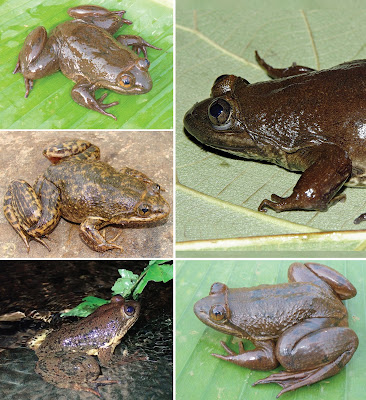
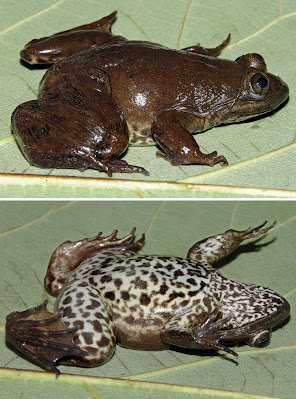
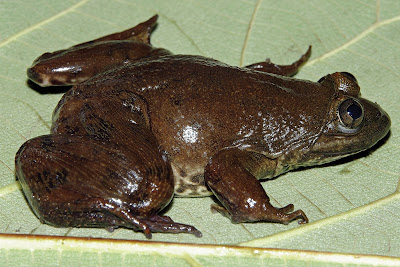
  (A) Male Holotype of Pyxicephalus beytelli, NMNW R11398. (B) Right foot. (C) Right hand. Scales both 10 mm.

  Colour pattern variation in  Pyxicephalus beytelli: (A) male specimen from the Okavango, Botswana; (B) from Khaudum National Park, Namibia
(Photos L du Preez).

Pyxicephalus beytelli sp. nov. 
Beytell's bullfrog

Diagnosis: 
The new species is similar to all other species of bullfrogs in morphology and burrowing behaviour. We assign it to the genus Pyxicephalus based on the presence of teeth on the maxilla, two large sharp projections on the lower jaw, the inner metatarsal tubercle strongly flanged, no outer metatarsal tubercle, the outer metatarsals bound into the sole, and the presence of vomerine teeth, all characters that distinguish the genus Pyxicephalus from other pyxicephalids (Poynton Citation1964).

Pyxicephalus beytelli is a large frog, maximum SVL 208 mm. The large size distinguishes it from P. angusticeps (maximum SVL 78.7 mm), P. edulis (maximum SVL 103 mm) and P. sp 2. (maximum SVL 120 mm). It has strongly developed dorsal skin ridges, differing from the oval dorsal warts of P. angusticeps and P. obbianus. There is speckling between the dorsal mottles separating it from P. angusticeps and P. obbianus which ...

 Pyxicephalus beytelli male. (A) Widely-spaced recurved teeth. (B) Open mouth showing teeth and odontoids.


Etymology: We have the pleasure in naming this species for the late Mr Ben Beytell, Director of Parks and Wildlife Management in Namibia. He was instrumental in the proclamation of the Khaudum National Park, Namibia.

 type locality of  Pyxicephalus beytelli, Khaudum National Park, Namibia.

 
Louis H du Preez, Edward C Netherlands, Mark-Oliver Rödel and Alan Channing. 2024. A New Bullfrog from southern Africa (Pyxicephalidae, Pyxicephalus Tschudi, 1838). African Journal of Herpetology.  DOI: 10.1080/21564574.2023.2296654 

Tuesday, November 14, 2023

[Herpetology • 2023] Poyntonophrynus fernandae & P. nambensis • Two New Poyntonophrynus Species (Anura: Bufonidae) highlight the importance of Angolan Centers of Endemism


Poyntonophrynus fernandae 
Baptista, Vaz Pinto, Keates, Lobón-Rovira, Edwards & Rödel, 2023
  
Namba pygmy toad | sapo pigmeu da Namba ||  DOI: 10.3897/vz.73.e103935

The pygmy toad genus Poyntonophrynus is endemic to southern Africa. The morphology of these small toads is conserved. They are usually dully colored, and are predominately adapted to arid conditions. During recent surveys in Angola we found Poyntonophrynus specimens that were not assignable to known species. Using an integrative approach, based on mitochondrial and nuclear DNA, morphology, osteology, biogeography and ecology, we identified three new lineages, and describe two of them as new species. All three lineages are closely related to P. pachnodes, an Angolan endemic species, but they are geographically isolated from it. The new species are morphologically distinguishable, and are associated with two of the most important Angolan centers of endemism: the western escarpment and the central highlands. In order to get a more comprehensive understanding of the osteology of the genus, we also provide an osteological characterization of P. dombensis, which was not available to date. Our findings i) increase the number of earless species in the genus Poyntonophrynus, ii) emphasize southwestern Africa as the cradle of diversification in this genus, iii) report the occurrence of Poyntonophrynus in humid environments, thus showing that these toads are ecologically more variable than previously thought, and iv) underline the importance of further biodiversity studies in Angolan centers of endemism.

Keywords: Amphibia, Angolan escarpment, Angolan highlands, character displacement, pygmy toad, sexual dichromatism, speciation, syntopy

Poyntonophrynus habitats.
A, B Habitat of Poyntonophrynus fernandae sp. nov. at Congulo forest, Cuanza-Sul Province.
C, D Habitat of P. cf. fernandae and P. nambensis sp. nov. at Namba highlands, Cuanza-Sul Province.
E, F Habitat of P. pachnodes at Serra da Neve, Namibe Province.
Photos by K. Luchansky (A) and W.R. Branch (D).

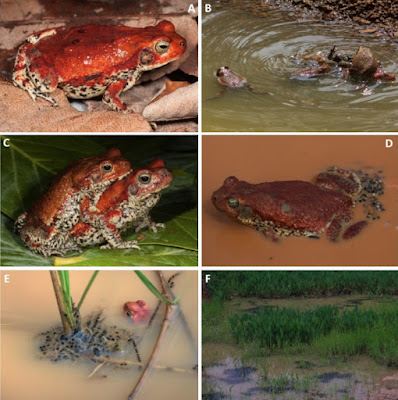
Pictures of live Poyntonophrynus fernandae sp. nov.
 A Female holotype (ZMB 91791). B, C Male paratype (ZMB 91790) with yellow color when collected, and with fading coloration after three days. D Female paratype (BMNH 2021.7534), darker individual collected in forest. E Female paratype (FKH-1086) collected on red gravel, typical of Cuanza-Sul Province ferralitic soils. F Pair in axillary amplexus from Gabela (not collected).
Photos by L. Verburgt (E) and N.T. Ngan Thanh (F).

Poyntonophrynus fernandae sp. nov.

Diagnosis: Poyntonophrynus fernandae sp. nov. sensu lato differs from all Poyntonophrynus species except P. pachnodes in lacking a tympanum and a columella. It differs from P. pachnodes in having a better-developed neopalatine. Males differ from P. pachnodes and P. nambensis sp. nov. in dorsal coloration (partially or plain bright yellow vs. complex dull patterns in P. pachnodes, and P. nambensis sp. nov.). It differs from P. nambensis sp. nov. in being smaller, less sturdy, and having relatively longer fore and hindlimbs, in ventral coloration (speckles vs. nearly immaculate). It differs from P. beiranus in parotoid glands conspicuousness (conspicuous, with clearly demarcated margins vs. inconspicuous). It differs from P. damaranus in ventral patterning (speckles vs. immaculate). It differs from P. dombensis in tympanum (not visible vs. conspicuous), and ventral patterning (speckles vs. immaculate). It differs from P. fenoulheti in parotoid glands width (thinner or around same width of eye diameter vs. wider than eye diameter). It differs from P. grandisonae in tympanum (not visible vs. conspicuous) and skin texture (rough vs. leathery). It differs from P. grindleyi in pale occipital and sacral patches (present vs. absent) and dorsal spines (small vs. large). It differs from P. hoeschi in ventral patterning (speckles vs. immaculate). It differs from P. jordani in shape of parotoid glands (kidney-shaped vs. a cluster of glands) and pale occipital patch (present vs. absent). It differs from P. lughensis in conspicuousness of parotoid glands (conspicuous vs. inconspicuous) and tympanum (not visible vs. conspicuous). It differs from P. kavangensis in foot webbing (non-serrated vs. serrated), dorsal patterning (absent vertebral line vs. present), and ventral patterning (speckles vs. immaculate). It differs from P. parkeri in ventral patterning (speckles vs. immaculate). It differs from P. vertebralis in dorsal patterning (vertebral line absent vs. present), and conspicuousness of parotoid glands (conspicuous vs. inconspicuous).

Etymology: The specific epithet fernandae (Pt.) is a tribute to Fernanda Lages, a researcher and professor of Genetics based in Lubango, Angola. Her continuous investment in capacity building over the last decades and dedication to various research projects and international collaborations gave opportunities and transformed the professional paths of several young Angolan biologists, and thus of research in Biology in the country. The name, built in the feminine singular genitive, also pays homage to women in science. We suggest “Fernanda’s pygmy toad” and “sapo pigmeu da Fernanda” as English and Portuguese common names, respectively.


Pictures of live Poyntonophrynus nambensis sp. nov. A Female paratype (FKH-0458) with greyish coloration. B, C Female holotype (ZMB 91787) with dorsal and ventral coloration, respectively. D Pair in axillary amplexus [female (CHL0326), and male (BMNH 2021.7540) paratypes]. E Female paratype (BMNH 2021.7539) with brighter shades of brown and orange. F Eggs (CHL0472). Photos by W.R. Branch (B–F).

Poyntonophrynus nambensis sp. nov.

Diagnosis: Poyntonophrynus nambensis sp. nov. differs from P. pachnodes and P. fernandae sp. nov. sensu lato in having a columella. It differs from P. pachnodes in having a better-developed neopalatine. Differs from P. fernandae sp. nov. sensu lato in ventral patterning (few speckles along midline of chest, and dark line in front of arm insertion vs. scattered speckles at least on the chest), and dorsal coloration (dorsal pale hourglass-shaped blotch almost always present vs. absent), and breeding male coloration (dulls, similar to females vs. partially or completely bright yellow). It differs from P. beiranus in parotoid glands conspicuousness (conspicuous, elevated, with clearly demarcated margins vs. inconspicuous), and dorsal patterning (vertebral line absent vs. present). It differs from P. damaranus in ventral patterning (few dark speckles along midline of chest, and dark line in front of arm insertion vs. immaculate). It differs from P. dombensis in tympanum size (when visible, between 0.5 and 0.6 times internarial distance, vs. conspicuous and around 0.7 times internarial distance), and ventral patterning (few speckles along midline of chest, and dark line in front of arm insertion vs. immaculate). It differs from P. fenoulheti in parotoid glands width (thinner or around same width of eye diameter vs. wider than eye diameter). It differs from P. grandisonae in tympanum size (when visible, between 0.5 and 0.6 times internarial distance, vs. same width or wider than internarial distance) and skin texture (rough vs. leathery). It differs from P. grindleyi in pale occipital and sacral patches (present vs. absent), dorsal spines (small vs. large), and ventral coloration (few dark speckles along midline of chest, and dark line in front of arm insertion vs. dark thick ventral marbling). It differs from P. hoeschi in ventral patterning (few speckles along midline of chest, and dark line in front of arm insertion vs. immaculate). It differs from P. jordani in shape of parotoid glands (kidney-shaped vs. a cluster of glands) and pale occipital patch (present vs. absent). It differs from P. lughensis in conspicuousness of parotoid glands (conspicuous vs. inconspicuous). It differs from P. kavangensis in foot webbing (non-serrated vs. serrated), dorsal patterning (absent vertebral line vs. present), and ventral patterning (few speckles along midline of chest, and dark line in front of arm insertion vs. immaculate). It differs from P. parkeri in development of parotoid glands (elevated vs. flattened). It differs from P. vertebralis in dorsal patterning (absent vertebral line vs. present), ventral patterning (few speckles along midline of chest, and dark line in front of arm insertion vs. distinct thick dark blotches), and conspicuousness of parotoid glands (conspicuous vs. inconspicuous).

Etymology: The specific epithet nambensis (Pt.) is a reference to the Namba mountains. This is the largest and more preserved relic of Afromontane forest and montane grasslands in Angola. However, it lacks official protection. We suggest “Namba pygmy toad” and “sapo pigmeu da Namba” as English and Portuguese common names respectively.
 
Ninda L. Baptista, Pedro Vaz Pinto, Chad Keates, Javier Lobón-Rovira, Shelley Edwards and Mark-Oliver Rödel. 2023. Two New Poyntonophrynus Species (Anura: Bufonidae) highlight the importance of Angolan Centers of Endemism. Vertebrate Zoology. 73: 991-1031. DOI: 10.3897/vz.73.e103935


Resumo: O sapo-pigmeu do género Poyntonophrynus é endémico da África Austral. A morfologia destes pequenos sapos é pouco variável. Estes têm uma coloração geralmente parda, e estão predominantemente adaptados a ambientes áridos. Durante pesquisas recentes em Angola, encontrámos Poyntonophrynus que não correspondiam a nenhuma espécie conhecida. Usando uma abordagem integrativa baseada em DNA mitocondrial e nuclear, morfologia, osteologia, biogeografia e ecologia, identificámos três novas linhagens, duas das quais foram descritas como espécies novas. As três linhagens estão geneticamente próximas de P. pachnodes, uma espécie endémica de Angola, mas estão geograficamente isoladas desta espécie. As novas espécies são morfologicamente distintas, e estão associadas a dois dos mais importantes centros de endemismo angolanos: a escarpa e as terras altas. Para contribuir para o conhecimento da osteologia do género, fizemos também uma caracterização osteológica de P. dombensis, inexistente até à data. Os nossos resultados i) aumentam o número de espécies sem aparelho auditivo no género Poyntonophrynus, ii) reforçam o sudoeste de África como o centro de diversificação deste género, iii) relatam a ocorrência de Poyntonophrynus em floresta húmida, revelando que estes sapos são ecologicamente mais variáveis do que se pensava, e iv) realçam a importância de estudos mais aprofundados nos centros de endemismo angolanos.

Palavras-chave:Amphibia, deslocamento de caracteres, dicromatismo sexual, escarpa de Angola, especiação, sapo pigmeu, sintopia, terras altas de Angola

Monday, November 13, 2023

[Herpetology • 2023] Arthroleptis nyungwensis • A New Miniature Species of Arthroleptis (Anura: Arthroleptidae) from Nyungwe National Park, Rwanda


Arthroleptis nyungwensis
 Dehling, 2023

 
Abstract
A new, very small-sized species of Arthroleptis is described from western Rwanda. The new species occurs locally endemic in Nyungwe Forest and Cyamudongo Forest, where it inhabits the leaf litter of montane forests between 1800 and 2200 m a.s.l. It differs from all other members of the genus by a unique combination of morphological characters, including size (SVL of adult males 16.0–16.5 mm), skin texture, length of hindlimbs, and ventral colour pattern; by characteristics of its advertisement call that consists of a single note lasting 17.4 ± 6.4 [11–32] ms and has a dominant frequency of 5861 ± 188 [5531–6029] Hz; and also in the sequence of the 16S rRNA gene that differs from available homologous sequences of other species of the genus by an uncorrected p-distance of at least 4.6%. Details of the natural history as well as two additional call types are described.

Keywords: amphibians; diversity; bioacoustics; phylogenetics; Arthroleptis schubotzi; Nyungwe Forest; Cyamudongo Forest

Arthroleptis nyungwensis sp. nov.
(A) Dorsolateral view and (B) ventral view of the holotype (ZFMK 104075) in life.
(C) Dorsolateral view and (D) ventral view of an adult male (JMD 599) in life.
(E) Dorsolateral view and (F) ventral view of one of the subadult paratypes (SMNS 15743) in life.

Arthroleptis nyungwensis sp. nov.
Nyungwe Squeaker

Diagnosis: The species is assigned to the genus Arthroleptis for exhibiting the following morphological characteristics [28]: pedal webbing absent, median dorsal skin raphe present, third finger elongate in adult males, dermal spines present on third finger. The new species differs from all other members of the genus by the combination of the following characteristics: small size (SVL of adult males 16.0–16.5 mm); dorsal surfaces of head, trunk, and limbs and lateral surfaces of trunk finely shagreened; tympanum well visible externally; median lingual process absent; legs long, tibiotarsal joint reaching to eye; tibiofibular length equal to foot length; tip of third finger and tips of toes slightly enlarged; inner metatarsal tubercle very small and rounded, outer metatarsal tubercle absent; ventral colour reddish to orange with two slightly concave longitudinal yellow stripes and white dots; advertisement call consisting of single note, lasting 17.4 ± 6.4 [11–32] ms and dominant frequency at 5861 ± 188 [5531–6029] Hz; sequence of the 16S rRNA gene differing from available homologous sequences of other species by uncorrected p-distance of at least 4.6%.

Etymology: The species is named after Nyungwe Forest in southern Rwanda.


 J. Maximilian Dehling. 2023. A New Miniature Species of Arthroleptis (Anura: Arthroleptidae) from Nyungwe National Park, Rwanda.  Diversity. 15(10); 1104. DOI: 10.3390/d15101104

Sunday, March 19, 2023

[Herpetology • 2023] Amnirana parvaThe smallest of its kind: Description of A New Cryptic Amnirana Species (Anura: Ranidae) from West African Rainforests

 
Amnirana parva
Griesbaum, Jongsma, Penner, Kouamé, Doumbia, Gonwouo, Hillers, Glos, Blackburn & Rödel, 2023


Abstract
The distribution of the White-Lipped Frog Amnirana albolabris was long assumed to extend from eastern-central to western African rainforests. However, recent molecular phylogenetic analyses revealed that this taxon likely represents several undescribed species. Because the name-bearing types were collected in Gabon, the distantly related West African populations clearly represent an undescribed species that partly occurs in sympatry with Amnirana fonensis. Based on an integrative taxonomic approach, including molecular, morphological, and acoustic data, we describe the ‘albolabris’ populations from the Upper Guinean Forest Zone as a new species, and redescribe the morphologically similar A. fonensis on the bases of a larger series of genotyped individuals, including the first known females. We also provide new biological information for A. fonensis, including their advertisement call, habitat, and reproductive data. The new species is sister to A. fonensis and the two species differ by 5.8% in the mitochondrial 16S ribosomal RNA gene. Morphologically, males of the new species are smaller and have relatively smaller humeral glands. Females of the new species seem to have shorter legs than A. fonensis. In comparison to A. fonensis, the advertisement call of the new species has a higher dominant frequency and more pronounced frequency modulation. The two species differ in their distribution and habitat preferences, as revealed by environmental niche modelling. Whereas the new species is restricted to the Upper Guinean forests and thus is a true lowland-rainforest inhabitant, A. fonensis lives predominantly in Guinean montane forests in the forest-savanna mosaic zone.
 
Keywords: Amphibia, Amnirana albolabris, Amnirana fonensis, biodiversity hotspot, biogeography, conservation, integrative taxonomy, Upper Guinean Forest Zone


Amnirana parva


also provided a redescription of Amnirana fonensis.
Males of this species show bright yellow colors during mating season.


Frederic Griesbaum, Gregory F.M. Jongsma, Johannes Penner, N'Goran Germain Kouamé, Joseph Doumbia, Nono L. Gonwouo, Annika Hillers, Julian Glos, David C. Blackburn and Mark-Oliver Rödel. 2023. The smallest of its kind: Description of A New Cryptic Amnirana Species (Amphibia, Anura, Ranidae) from West African Rainforests. Zootaxa. 5254(3); 301-339. DOI: 10.11646/zootaxa.5254.3.1


Sunday, November 13, 2022

[Herpetology • 2022] Leptopelis shebellensis & L. xeniaeGenetic and Morphometric Analyses of Historical Type Specimens Clarify the Taxonomy of the Ethiopian Leptopelis gramineus Species Complex (Anura, Arthroleptidae)


Leptopelis shebellensis & Leptopelis xeniae
Goutte, Reyes-Velasco, Kassie & Boissinot, 2022


Abstract
Frogs of the genus Leptopelis have diversified in the Ethiopian Highlands to occupy forests and montane grasslands both east and west of the Great Rift Valley. Genetic studies revealed that the endemic species Leptopelis gramineus (Boulenger, 1898) comprises multiple unnamed taxa. A careful examination of historical type specimens is, however, needed to fully resolve the taxonomy of the group. Here we use mitochondrial DNA and morphological analyses on a large sample of recently-collected Ethiopian Leptopelis, as well as century-old type specimens to demonstrate that the recently resurrected L. montanus Tiutenko & Zinenko, 2021 (previously Pseudocassina ocellata Ahl, 1924) is a junior synonym of L. rugosus (Ahl, 1924) and corresponds to the taxon found west of the Great Rift Valley, not east as previously thought. Our results show that populations inhabiting the mountains and plateaus east of the Rift constitute a distinct and undescribed species. We provide a re-description of L. rugosus and describe two new species inhabiting the Highlands east of the Great Rift Valley. We provide an identification key, as well as a description of the calls of the members of the Leptopelis gramineus species complex.

Keywords: African treefrogs, Afromontane, historical DNA, integrative taxonomy, Leptopelis shebellensis sp. nov., Leptopelis xeniae sp. nov., museomics, new species

 Leptopelis rugosus (Ahl, 1924)
Diagnosis: A large (male (n = 22) SVL 38.7 ± 2.7 mm, female (n = 2) SVL 52.4 ± 0.2 mm) species of the Leptopelis gramineus species complex (Figs 5, 6). Robust, semi-fossorial form. It differs from other members of the Leptopelis gramineus species complex by the following combination of characters: (1) large tympanum (male TD/ED 0.57 ± 0.11, female TD/ED 0.54), (2) long snout (male SL/HL 0.25 ± 0.02, female SL/HL 0.27 ± 0.01), (3) well-developed metatarsal tubercle (male MTL/FL 0.17 ± 0.02, female MTL/FL 0.18 ± 0.02), (4) ventrum lacking any brown spots, (5) yellow colouration on the side of the ventrum and the inner thighs almost always present.


 Leptopelis shebellensis Goutte, Reyes-Velasco, Kassie & Boissinot, sp. nov.
 Common name: Shebelle River burrowing African treefrog.

Diagnosis: Medium to large (male (n = 21) SVL 35.9 ± 3.5 mm, female (n = 5) SVL 53.4 ± 5.3 mm), robust semi-fossorial species of the Leptopelis gramineus species complex (Fig. 7). It differs from other members of the Leptopelis gramineus species complex by the following combination of characters: (1) short and robust hind-limbs (male TL/SVL 0.33 ± 0.03, female TL/SVL 0.30 ± 0.02), (2) well-developed metatarsal tubercle (male MTL/FL 0.17 ± 0.03, female MTL/FL 0.16 ± 0.02), (3) longer snout (male SL/HL 0.23 ± 0.03, female SL/HL 0.24 ± 0.02), (4) toe and fingertips not enlarged and (5) ventrum often with dark brown spots and/or yellowish sides.

Etymology: The specific name refers to the Shebelle River, as the distribution range of the species appears restricted to the Shebelle River Basin, with populations found both north and south of the source of the river (Fig. 1).


 Leptopelis xeniae Goutte, Reyes-Velasco, Kassie & Boissinot, sp. nov.
 Common name: English: Xenia’s African treefrog.
 
Diagnosis: Small to medium-sized (male (n = 20) SVL 27.6 ± 2.0 mm, female (n = 2) SVL 43.5 ± 5.7 mm), robust arboreal species of the Leptopelis gramineus species complex (Fig. 8). It differs from other members of the Leptopelis gramineus species complex by the following combination of characters: (1) thin, elongated hind-limbs (male TL/SVL 0.36 ± 0.02, female TL/SVL 0.37 ± 0.03), (2) small metatarsal tubercle (male MTL/SVL 0.07 ± 0.01, female MTL/SVL 0.06 ± 0.00) (2) inter-orbital distance very short (male IOD/ED 0.88 ± 0.16, female IOD/ED 0.69 ± 0.12), (3) dorsal skin always smooth, except in females where it may be slightly rugose, (4) absence of yellow colouration on the ventrum or inner thighs.

Etymology: Leptopelis xeniae sp. nov. is named after Xenia Freilich, who conducted her doctoral research on Ethiopian anurans, including the Leptopelis gramineus complex.


 Sandra Goutte, Jacobo Reyes-Velasco, Abeje Kassie and Stéphane Boissinot. 2022. Genetic and Morphometric Analyses of Historical Type Specimens Clarify the Taxonomy of the Ethiopian Leptopelis gramineus Species Complex (Anura, Arthroleptidae). ZooKeys. 1128: 63-97.  DOI: 10.3897/zookeys.1128.82176 

Wednesday, January 26, 2022

[Herpetology • 2022] Conraua kamancamarai • A New Slippery Frog (Anura: Conrauidae: Conraua Nieden, 1908) from the Fouta Djallon Highlands, west-central Guine


Conraua kamancamarai
Neira-Salamea, Doumbia, Hillers, Sandberger-Loua, Kouamé, Brede, Schäfer, Blackburn, Barej & Rödel, 2022

‘Kaman Camara’s Slippery Frog’ | ‘la grenouille glissante de Kaman Camara’ 
|| ‘Tôti bhowroundi de Kaman Camara’ 

Abstract
We describe a new species of the genus Conraua from the Fouta Djallon Highlands in Guinea. The species is recognised as distinct from nominotypical C. alleni, based on morphological evidence and is supported by a recent species delimitation analysis, based on DNA sequence data. The new species is distinguished from its congeners by the unique combination of the following characters: medium body size, robust limbs, only one instead of two palmar tubercles, the first finger webbed to below the first subarticular tubercle, presence of a lateral line system, indistinct tympanum, two subarticular tubercles on fingers III and IV, venter in adults white with dark brown spots or dark brown with grey or whitish spots. The new species differs from all congeners by more than 6% in the DNA sequence of mitochondrial ribosomal 16S. We discuss isolation in Pliocene and Pleistocene forest refugia as a potential driver of speciation in the C. alleni complex. We also emphasise the importance of conserving the remaining forest fragments in the Fouta Djallon Region for the preservation of both its unique biodiversity and its valuable water sources for local people.

Key Words: Anura, conservation, forest refugia, Upper Guinea forest zone, West Africa


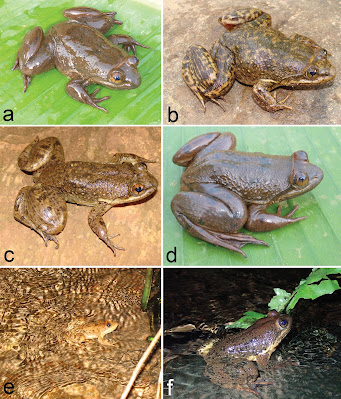
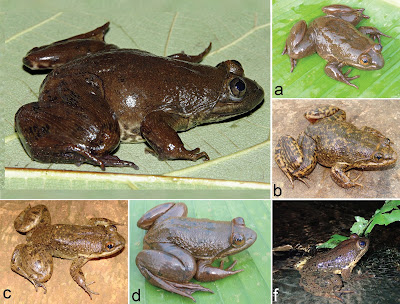
Conraua kamancamarai sp. nov., female holotype (ZMB 78432) in life.


Colouration of life Conraua kamancamarai sp. nov. from the Fouta Djallon and surrounding region, Guinea, illustrating variation in colour pattern and skin texture.
a. From Dubreka, River Bindinbandan (10°22'21.9"N, 13°9'16.8"W, 199 m a.s.l.); b. From Dalaba, Chute de Ditinn; c. From Hörè Binti; d. From Dubreka, River Bindinbandan (10°22'21.9"N, 13°9'16.8"W, 199 m a.s.l.); e. From Dalaba, Chute de Ditinn; f. From Télimélé, locality Kourakoto, river Didounpouriguè (10°55'30.4"N, 13°47'39.4"W, 238 m a.s.l.); frogs in lower row in typical calling position, sitting in shallow water; specimens either not collected or not assignable to a voucher specimen, whereas the frogs from Hörè Binti and Chute de Ditinn can be assigned to Conraua kamancamarai sp. nov. without doubt; the other frogs may represent an undescribed Conraua.


Conraua kamancamarai sp. nov.
  
Diagnosis: The new species resembles other members of the genus Conraua Nieden, 1908. Conraua kamancamarai sp. nov. is an aquatic frog with the following traits: smooth dorsal skin, covered with scattered small, rounded warts on back and longitudinal ridges on dorsal part of hind legs; venter skin smooth; three odontoid projections on lower jaw, one at symphysis and one to each side on dentary; vocal sacs absent; fully webbed feet, i.e. to end of last phalanx of toe. Conraua kamancamarai sp. nov. is closely related to a clade including C. alleni sensu stricto, C. derooi and C. sagyimase (see Blackburn et al. 2020). Genetic distances between the new species and all other Conraua species were higher than 6% in the examined part of the 16S gene.

Etymology: This species is dedicated to Kaman Camara, our long-term field assistant and friend, who started working with MOR in 2002 on a survey to the Simandou Range that was organised by Conservation International (Rödel and Bangoura 2004). From 2007 until his recent death, Kaman was a member of our Guinean team, investigating the amphibians of the Nimba Mountains and other Guinean areas. Kaman had outstanding skills in detecting and catching frogs, and, more importantly, an unswerving positive attitude. A day could be completely exhausting and frustrating, but with a simple joke from Kaman all was good again! Kaman was born and lived in a remote village at the western foothills of the Simandou Range. He never received any formal education. Still, he repeatedly rejected other better paying job offers from mining companies, preferring instead to work with his frog team whenever it was possible. Kaman died in June 2020 after a short severe disease. These frogs shall be a permanent memory to an outstanding person! 
We suggest ‘Kaman Camara’s Slippery Frog’ as the English common name, ‘la grenouille glissante de Kaman Camara’ in French and in the local language Poular: ‘Tôti bhowroundi de Kaman Camara’.

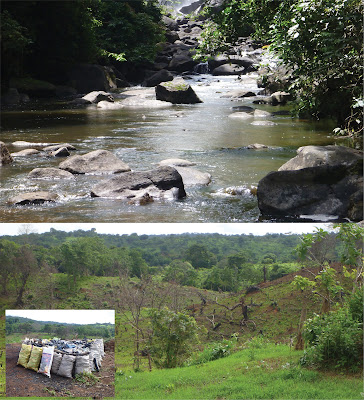
 The type locality of Conraua kamancamarai sp. nov. near Konkouré Fetto, Fouta Djallon, Guinea (10°20'28.21"N, 12°10'16.82"W, 650 m a.s.l.). The frogs live in clear, fast flowing streams, with riverine forest. The surroundings are heavily degraded by agriculture, cattle grazing and charcoal production (inset figure).


The Fouta Djallon, Guinea and habitats of Conraua kamancamarai sp. nov. Hörè Binti landscape (upper photo) and typical river habitats.  


 Karla Neira-Salamea, Joseph Doumbia, Annika Hillers, Laura Sandberger-Loua, N’Goran G. Kouamé, Christian Brede, Marvin Schäfer, David C. Blackburn, Michael F. Barej and Mark-Oliver Rödel. 2022. A New Slippery Frog (Amphibia, Conrauidae, Conraua Nieden, 1908) from the Fouta Djallon Highlands, west-central Guinea. Zoosystematics and Evolution. 98(1): 23-42. DOI: 10.3897/zse.98.76692

Resumé: Nous décrivons une nouvelle espèce du genre Conraua des hauts plateaux du Fouta Djallon en Guinée. L'espèce est reconnue comme distincte du C. alleni nominotypique, sur la base de preuves morphologiques et est soutenue par une analyse récente de délimitation des espèces, basée sur des données de séquence d'ADN. La nouvelle espèce se distingue de ses congénères par la combinaison unique des caractères suivants: taille moyenne du corps, membres robustes, un seul tubercule palmaire au lieu de deux, premier doigt palmaire jusqu'en dessous du premier tubercule subarticulaire, présence d'un système de lignes latérales, tympan indistinct, deux tubercules subarticulaires sur les doigts III et IV, ventre blanc avec des taches brun foncé ou brun foncé avec des taches gris ou blanchâtre chez les adultes. La nouvelle espèce diffère de ses congénères avec plus de 6% de sa séquence d'ADN du ribosome mitochondrial 16S. Nous discutons de l'isolement dans les refuges forestiers du Pliocène et du Pléistocène comme facteur potentiel de spéciation dans le complexe C. alleni. Nous soulignons également l'importance de conserver les fragments de forêt restants dans la région du Fouta Djallon pour préserver à la fois sa biodiversité unique et ses sources d'eau précieuses pour les populations locales.


Thursday, December 16, 2021

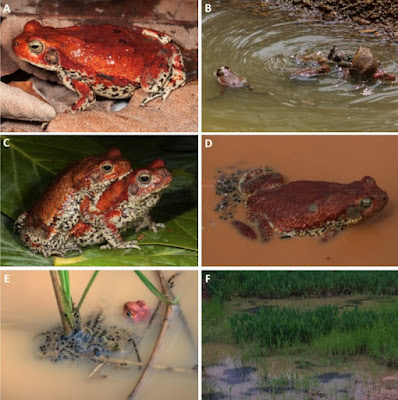
[Herpetology • 2021] Schismaderma branchi • A New Species of Red Toad, Schismaderma Smith, 1849 (Anura: Bufonidae), from central Angola

Schismaderma branchi
 Baptista, Pinto, Keates, Edwards, Rödel & Conradie, 2021

 
Abstract
A new species of red toad, from the previously monotypic genus Schismaderma, is described. The new species was found in Malanje Province, and seems endemic to central Angola, occurring approximately 500 km west of the closest known records of Schismaderma carens. Unusual adult colouration and geographical distance to remaining S. carens populations suggested specific differentiation. In an integrative approach, we compared the red toads from central Angola with S. carens from across the entire range, including molecular data, morphology of adults and tadpoles, and male advertisement calls. Phylogenetic analysis based on mitochondrial (12S, 16S, COI) and nuclear (CXCR4, RAG1) markers, retrieved the Angolan clade as monophyletic, and revealed intra-specific substructuring among the remaining Schismaderma. Genetic distances supported specific differentiation of the central Angolan material compared with other S. carens. Adults from the new Angolan species have bolder ventral patterning and smaller body size than S. carens. No obvious differences were detected between the tadpoles and the advertisement calls of the two Schismaderma species. This discovery adds to the knowledge of the herpetofauna of the Angolan Miombo woodlands, a poorly understood ecoregion, and likely more biodiverse than previously assumed. The result of past river basin dynamics in central Angola likely led to the evolution of this new species of Schismaderma.
Keywords: Amphibia, allopatric speciation, cryptic diversity, endemism, integrative taxonomy, Angolan Miombo woodlands.


Ninda L. Baptista, Pedro Vaz Pinto, Chad Keates, Shelley Edwards, Mark-Oliver Rödel and Werner Conradie. 2021. A New Species of Red Toad, Schismaderma Smith, 1849 (Anura: Bufonidae), from central Angola. Zootaxa. 5081(3); 301-332. DOI: 10.11646/zootaxa.5081.3.1

Friday, September 10, 2021

[Herpetology • 2021] Phylogeny of African Long-Fingered Frogs (Arthroleptidae: Cardioglossa) reveals Recent Allopatric Divergences in Coloration


Cardioglossa leucomystax 2

in Blackburn, Nielsen, Ghose, ... et Rödel, 2021. 
photo: Brian Freiermuth, DOI: 10.7479/3yje-r341 
 
Abstract
The African anuran genus Cardioglossa contains 19 described species, most of which are distinguished from one another by striking patterns and colors. We present a well-resolved phylogeny based on analyses of mitochondrial and nuclear loci for 18 species of Cardioglossa. This provides the basis for species-delimitation analyses and interpreting historical biogeography in the genus. Whereas much of the diversification within the genus occurred among Central African lineages during the Miocene following the origin of Cardioglossa in the latest Oligocene or earliest Miocene, most species-pairs in the genus diverged more recently during the Plio-Pleistocene. The two most geographically peripheral species—C. cyaneospila in the Albertine Rift Mountains and C. occidentalis in the Upper Guinean Forests of West Africa—both diverged from other lineages during the mid-late Miocene. Because our analyses do not support C. manengouba and C. oreas as distinct species, we recognize these geographically separate and phenotypically distinct populations as subspecies of C. oreas that diverged subsequent to the origin of Mount Manengouba during the past 1.5 million years. In contrast, we find that C. leucomystax likely represents two species found in the Lower Guinean and Congolian forests, respectively. We find recent divergences between several allopatric lineages (either species or populations) that differ in coloration and pattern, including in C. nigromaculata which varies in color across its range in Central Africa and Bioko Island. These recent divergences among allopatric lineages with distinctive coloration and pattern raise new questions about the significance of these traits in this genus for which little is known of its natural history and biology.


Maximum likelihood phylogeny of Cardioglossa based on the multilocus concatenated, partitioned dataset of mitochondrial and nuclear data. A black dot at each node indicates high support (e.g., Bayesian posterior probability >0.95, maximum likelihood bootstrap >70). Tip labels of individuals used for divergence time analysis are indicated in boldface. Photographs are not scaled to size.

(Photo credits: David C. Blackburn.: C. melanogaster, C. oreas manengouba, C. pulchra, C. schioetzi; Marius Burger: C. annulata, C. escalerae, C. leucomystax 1; Brian Freiermuth: C. leucomystax 2, C. oreas oreas; Eli Greenbaum: C. congolia, C. cyaneospila; Václav Gvoždík: C. alsco; Mareike Hirschfeld: C. nigromaculata, C. venusta; Greg Jongsma: C. gracilis; Patrick J. McLaughlin: C. nigromaculata ‘Bioko'; Dan Portik: C. elegans, C. occidentalis; Mark-Oliver Rödel: C. gratiosa, C. trifasciata.
 

David C. Blackburn, Stuart V. Nielsen, Sonia L. Ghose, Marius Burger, LeGrand Nono Gonwouo, Eli Greenbaum, Václav Gvoždík, Mareike Hirschfeld, Marcel T. Kouete, Chifundera Kusamba, Dwight Lawson, Patrick J. McLaughlin, Ange-Ghislain Zassi-Boulou and Mark-Oliver Rödel. 2021. Phylogeny of African Long-Fingered Frogs (Arthroleptidae: Cardioglossa) Reveals Recent Allopatric Divergences in Coloration. Ichthyology & Herpetology. 109(3); 728-742. DOI: 10.1643/h2020165