Showing posts with label Iridaceae. Show all posts

Wednesday, March 18, 2026

[Botany • 2026] Iris cariciformis (Iridaceae) • A New Species from China


Iris cariciformis Z.Z.Zhang & G.X.Zhang, 

in Z.Z. Zhang et G.X. Zhang, 2026. 

Abstract
Iris cariciformis Z.Z.Zhang & G.X.Zhang, sp. nov. from China is described and illustrated. This species grows on cliff faces or open slopes in the central Qinling Mountains. Morphologically, I. cariciformis is similar to I. dabashanensis but can be distinguished by its longer perianth tube and ellipsoidal capsules with a long beak. Furthermore, this study facilitates the valid publication of Iris fujianensis. Phylogenetic analysis based on chloroplast DNA sequences confirms the placement of the former within I. series Chinenses, while the latter is inferred as sister to I. speculatrix. Simultaneously, a new combination, Iris valida (S.S.Chien) Z.Z.Zhang, H.T.Li & T.Y.Zuo, comb. et stat. nov., is proposed.

Key words: Chloroplast genome, Iris, new species, phylogeny
 
Iris cariciformis Z.Z.Zhang & G.X.Zhang, sp. nov.
A. Habitat; B. Plant; C. Sepals, petals and stamens; D. Bracts; E. Pedicel, ovary and pistil; F. Flower; G. Inflorescence (Photos A, B, C. author; C–G Xiaoqiang Shen).

Iris cariciformis Z.Z.Zhang & G.X.Zhang, sp. nov.
 
Diagnosis. Morphologically similar to I. dabashanensis, but differs by the longer perianth tube (1.6–2.5 cm vs 0.2–0.5 cm) and ovoid capsules with a prominent beak (vs globose and beakless).

Etymology: The new species grows in clusters and has slender leaves, resembling plants of the Carex L. that inhabit the same environment, hence the specific epithet “cariciformis” was chosen.


 Zhongzheng Zhang and Gexiang Zhang. 2026. Descriptions of A New Species, Validation of a name, and Elevation of a variety in Iris (Iridaceae) from China. PhytoKeys. 271: 299-312. DOI: doi.org/10.3897/phytokeys.271.176663 [16 Mar 2026]

Monday, April 28, 2025

[Botany • 2025] Iris longnanensis (Iridaceae) • A New Species in Iris section Pseudoregelia from Gansu, China


Iris longnanensis Z.F.Bai, Y.E.Xiao, F.Y.Yu, 

in Yu, Bai, Chen et Xiao, 2025. 
 
Abstract
Iris longnanensis Z.F.Bai, Y.E.Xiao, F.Y.Yu (Iridaceae: Iris subg. Iris sect. Pseudoregelia), a novel herbaceous species native to the arid and thermal valleys of Longnan city, Gansu Province, China, is described and illustrated here. Morphologically akin to I. leptophylla Lingelsheim, I. longnanensis is distinguished by its dense, persistent foliage and notably short new leaves (6.6–15.1 cm) during the blooming season, along with its distinctive purplish-brown flowering stem. Phylogenetic analyses based on chloroplast DNA sequences corroborate the classification of I. longnanensis within the section Pseudoregelia, highlighting the significance of this new species discovery for understanding the evolution and diversity within the genus.

Keywords: Longnan, plastid DNA, Iris longnanensis, section Pseudoregelia


Iris longnanensis Z.F.Bai, Y.E.Xiao, F.Y.Yu sp. nov. 
 

Feng-yang Yu, Zengfu Bai, Xuelin Chen and Yuee Xiao. 2025. A New Species in Iris section Pseudoregelia (Iridaceae) from Gansu, China. Nordic Journal of Botany. DOI: doi.org/10.1111/njb.04515 [13 February 2025]

Monday, December 9, 2024

[Botany • 2024] Iris cangshanensis (Iridaceae) • A New Species from southwest China


Iris cangshanensis  

in Jiang, Yang, Liu et Xie, 2024. 

Abstract
A new species of IrisIris cangshanensis, was discovered in Cangshan Nature Reserve, Dali City, Yunnan Province, China. Morphologically, I. cangshanensis shares several key features with species in Iris subg. Crossiris, including prominent crests and stout rhizomes, but it is easily distinguished from other Iris species by its unique crest, dark purple spots on the falls, erect standards recurved to the style branches, and slightly fimbriate tips of the style branches. Phylogenetic analysis including 115 related species based on matk/trnk and trnL-F sequences indicates that I. cangshanensis forms a distinct clade, and reveals a strong genetic connection between I. cangshanensis, the Iris tectorum complex and Iris latistyla. Overall, both morphological and phylogenetic evidence strongly support the classification of I. cangshanensis as a newly discovered species. A comprehensive description of this species is provided, including a detailed illustrations and photographs, geographical distribution, habitat and ecology, as well as its IUCN conservation status.

Keywords: Iris cangshanensis, Iris, new species, phylogeny, subgenus Crossiris


Xianfeng Jiang, Ying Yang, Jinfeng Liu and Yanping Xie. 2024. Iris cangshanensis (Iridaceae), A New Species from southwest China. Nordic Journal of Botany. DOI: doi.org/10.1111/njb.04400 
 

Sunday, April 21, 2024

[Botany • 2024] Gladiolus oreophilus (Iridaceae: Crocoideae) • A New Species from southern Anatolia, Turkey


Gladiolus oreophilus  Eker & Sağıroğlu,

in Sağıroğlu et Eker, 2024
Amanos Kılıçotu  ||   facebook.com/IsmailEker946

Gladiolus oreophilus Eker & Sağıroğlu sp. nova (Iridaceae) is described as a new species from the Hatay Province, Turkey. It resembles G. kotschyanus, G. alanyensis and G. adanus, but it clearly differs from these three species by capsule size, flower colour, number and width of leaves, seed shape and ornamentation, and shapes of periclinal cell walls and testa epidermal cells. Herein, we provide the morphological features, distribution, habitat characteristics, conservation assessment, and micromorphological characteristics of seeds of G. oreophilus.


Gladiolus oreophilus Eker & Sağıroğlu
"Amanos Kılıçotu"


Sağıroğlu M. & Eker İ. 2024. Gladiolus oreophilus (Iridaceae, Crocoideae), A New Species from southern Anatolia, Turkey. — Ann. Bot. Fennici. 61: 111–117.


Sunday, March 31, 2024

[Botany • 2023] Ainea conzattii (Iridaceae: Tigridieae) revisited: Description of A New Variety


A. Flower, front view of Ainea conzattii var. conzattii; B. C. Flower, front view of A. conzattii var. macropetala; D. Flower dorsal view of A. conzattii var. macropetala.
Photo credits: A. Guadalupe Munguía; B., C., D. Carlos Martorell.

Abstract
A new variety of Ainea conzattii is described and illustrated, a key to recognize the two varieties of the species and a distribution map of both taxa are included.
Coixtlahuaca, Oaxaca, Tepelmeme Villa  de Morelos, Monocots


 Ainea conzattii var. macropetala Martorell, Espejo & López-Ferr., var. nov. 

Nova varietas ab originali varietate differt in illis quae tepalis internis (petalis) similibus in forma et magnitudine tepalis externis (sepalis) vs. tepalis internis multo minora quam externis.

 
Carlos Martorell, Ana Rosa López-Ferrari, Adolfo Espejo-Serna, Diego García-Meza and Rupert Clayton. 2023. Ainea conzattii (Iridaceae: Tigridieae) revisited: Description of A New Variety.  Phytotaxa. 600(1); 1-6. DOI: 10.11646/phytotaxa.600.1.1

Saturday, March 23, 2024

[Botany • 2024] Gladiolus adanus (Iridaceae: Crocoideae) • A New Species from Türkiye


Gladiolus adanus Eker & Sağıroğlu, 
  
in Eker et Sağıroğlu. 2024. 
 Adana Kılıçotu  || DOI: 10.11646/phytotaxa.641.3.3 
 
Abstract
Gladiolus adanus is introduced to the scientific world as a new species from Adana/Tufanbeyli/Türkiye. In this study, description and illustration, diagnostic morphological characters, habitat, distribution, ecological characteristics, conservation status, seed micromorphological characters (LM and SEM) and comparisons with close species are given.

Adana, Anatolia, Gladiolus kotschyanus, Gladiolus alanyensis, new taxon, seed, taxonomy, Monocots


İsmail Eker and Mehmet Sağıroğlu. 2024. Gladiolus adanus (Iridaceae, Crocoideae), A New Species from Türkiye. Phytotaxa. 641(3); 210-21. 8DOI: doi.org/10.11646/phytotaxa.641.3.3

Monday, March 18, 2024

[Botany • 2024] Gladiolus alucraensis (Iridaceae) • A New Species from NE Turkey


Gladiolus alucraensis Sağıroğlu & Eker,  

 in Sağıroğlu, 2024. 
Alucra Kılıçotu  ||  DOI: 10.5735/085.061.0108 

Abstract  
Gladiolus alucraensis Sağıroğlu & Eker sp. nova (Iridaceae) is described and illustrated from Alucra District of Giresun Province in northern Anatolia, Turkey. It is morphologically close to G. aladagensis and G. kotschayanus, but differs from them by numerous macromorphological flower characters and micromorphological seed characters. The diagnostic morphological features, distribution, habitat, and conservation assessment of the new species are presented. The micromorphological characteristics of the seeds of G. alucraensis, G. aladagensis and G. kotschyanus mericarps were examined using LM and SEM analyses.


Gladiolus alucraensis Sağıroğlu & Eker sp. nova


 Mehmet Sağıroğlu. 2024. Gladiolus alucraensis (Iridaceae), A New Species from NE Turkey. Annales Botanici Fennici. 61(1); 47-53. DOI: 10.5735/085.061.0108 

Wednesday, October 25, 2023

[Botany • 2016] Iris koyuncui (Iridaceae, sect. Scorpiris) • A New Species from Hakkâri Province, Turkey


Iris koyuncui Fırat, 

in Fırat, 2016.

Abstract
Iris koyuncui, a new species of subgenus Scorpiris, is described and illustrated from Hakkâri Province, Turkey. From the morphological point of view, Iris koyuncui appears to be similar to Iris pseudocaucasica Grossh., but from which it differs in several morphological features including plant height, leaf size/number and flower colour/size. A comprehensive description of this species is provided, including detailed illustrations and photographs, geographical distribution, habitat and ecology, vernacular name and IUCN conservation status.

Keywords: Endemic plants, Irano-Turanian Region, Juno irises, Monocots, taxonomy

Iris koyuncui Fırat 
A) Habit; B) bract, C) fall; D(1?4) standard; E) stamen; F) style branch
(illustrated from a flowering specimen in cultivation, coll. M. Fırat 27309).


  Iris koyuncui. A-B) habit; C-D) flower.
Iris pseudocaucasica. E) habit; G) flower.
Iris aucheri. F) habit; H) flower.

Iris koyuncui Fırat sp. nov.  

Diagnosis:—Iris koyuncui clearly differs from I. pseudocaucasica in its height: 15–30 cm; bulb diameter: 2–5 cm; number of leaves:4–7(–9); width of leaves: 2–4 cm; number of flowers: 1–2(–3); flower colour: purple to coppery. 

Eponymy:—The new species is named after my dear teacher the Turkish botanist Prof. Dr. Mehmet Koyuncu, anexpert on bulbous plants.

Vernacular name: Iris koyuncui is called “Belalêzik” in Kurdish by the local people of Hakkâri Province.


Mehmet Fırat. 2016. Iris koyuncui (Iridaceae), A New Species from Hakkâri Province (Turkey) belonging to subgenus Scorpiris.  Phytotaxa. 263(1):51-57. DOI: 10.11646/phytotaxa.263.1.5


Wednesday, September 21, 2022

[Botany • 2022] Geissorhiza seracina (Iridaceae: Crocoideae) • A New High-altitude Species from the Langeberg in southwestern Western Cape, South Africa


  Geissorhiza seracina Goldblatt & J.C.Manning, 

in Goldblatt, Manning et du Preez, 2022. 

Highlights: 
 Geissorhiza seracina is described.
• It is a local endemic of the eastern Langeberg.
• It is illustrated by colour photographs.
• It is distinguished from G. altimontana by a longer perianth tube and filaments.

Abstract
The new species Geissorhiza seracina Goldblatt & J.C.Manning (Iridaceae: Crocoideae) is known from a single locality on the central Langeberg Mountains in Western Cape, South Africa. Discovered in December 2021, G. seracina is restricted to high altitude seepages in peaty soils. The soft corm tunics and moderately large, deep pink flowers suggest that it is allied to another Langeberg endemic, G. altimontana Goldblatt & J.C.Manning of subg. Weihea sect. Weihea, but it differs from that species in lacking fibrous leaf bases, in its mostly fewer leaves, and in its flowers, which have a longer perianth tube 18–23 mm long, with longer filaments, 11–12 mm long, inserted well below the mouth of the tube. It is illustrated by colour photographs. In addition, re-examination of collections of the poorly collected G. outeniquensis Goldblatt necessitates that the recorded length of the perianth tube for that species be significantly extended. Originally recorded as 10–13 mm long, the perianth tube in G. outeniquensis is now determined to be (10–)13–20 mm long.
 
Keywords: Cape Flora, New taxa, Taxonomy, Systematics


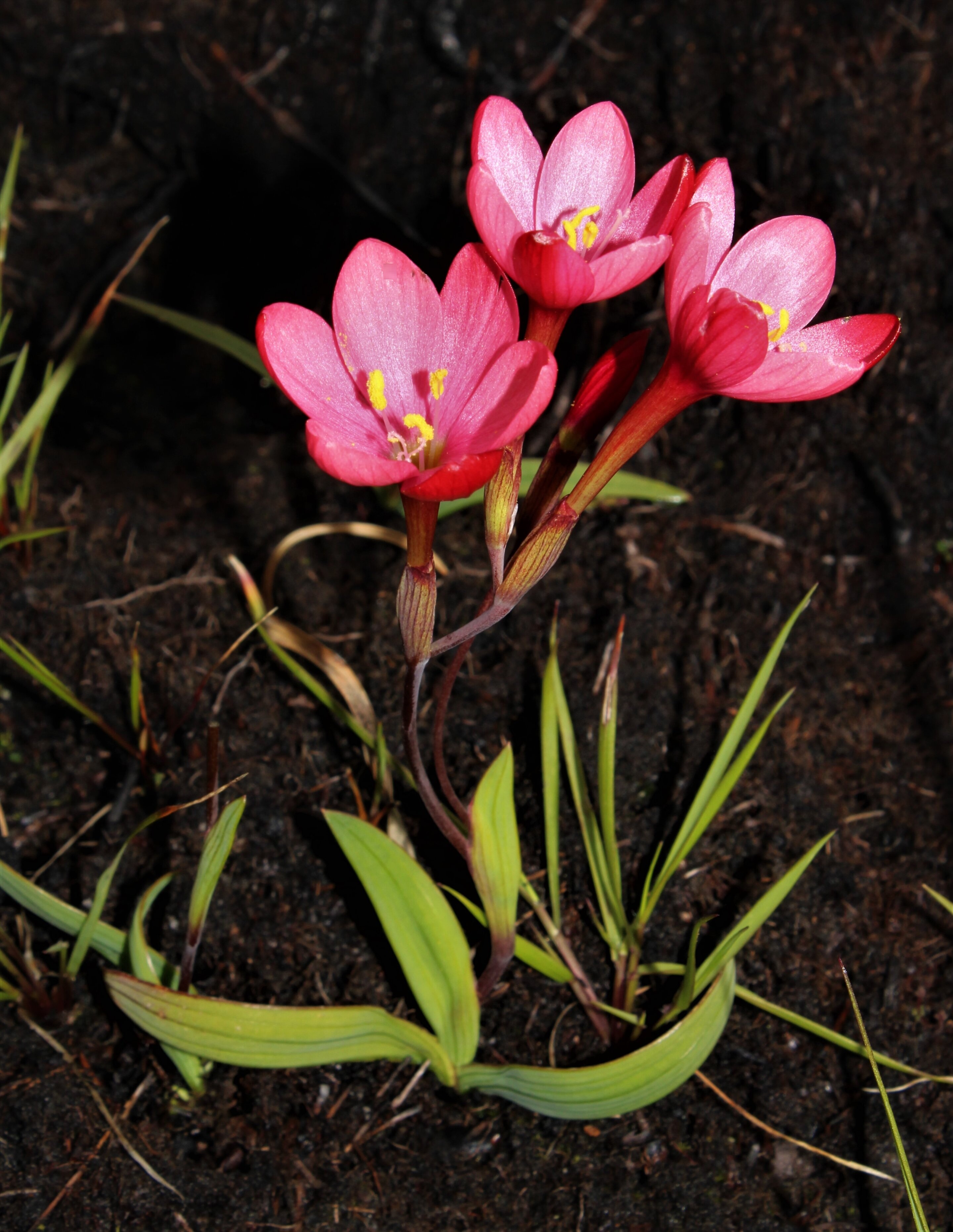
  Geissorhiza seracina.
Western Cape, Langeberg, Boosmansbos Wilderness.
 
  Geissorhiza seracina Goldblatt & J.C.Manning

Etymology: Geissorhiza seracina is named for the cherry-pink flowers.

 
P. Goldblatt, J.C. Manning and B. du Preez. 2022. Geissorhiza seracina (Iridaceae: Crocoideae), A New High-altitude Species from the Langeberg in southwestern Western Cape, South Africa, with notes on G. outeniquensis. South African Journal of Botany. 150; 1022-1025. DOI: 10.1016/j.sajb.2022.09.014 

Thursday, August 18, 2022

[Botany • 2021] Gladiolus izzet-baysalii (Iridaceae: Crocoideae) • A New Species from Turkey


 Gladiolus izzet-baysalii  

in Eker & Sağıroğlu, 2021. 

 h: G. illyricus, j: G. hamzaoglui
 
Abstract
Gladiolus izzet-baysalii is described and illustrated as a new species from Karaman province in Southern Anatolia. Gladiolus izzet-baysalii is not morphologically close to any of the species of Gladiolus in Turkey. Although it has some similarities with G. illyricus and G. hamzaoglui in terms of habitus, G. izzet-baysalii differs significantly in tunic structure, number of leaves, inflorescence, perianth, anther, style, capsule and seed features. In this study, the diagnostic morphological features, distribution, conservation status, habitat and ecological characteristics of the new species are discussed. Micromorphological characteristics of G. izzet-baysalii, G. illyricus and G. hamzaoglui seeds are also examined and compared using stereomicroscope and SEM analyses.

Keywords: Gladiolus illyricusGladiolus hamzaoglui, Anatolia, Göktepe, Sarıveliler, seed, taxonomy, Tribe Gladioleae, Monocots

 Gladiolus izzet-baysalii.
 A: habit (1. lower part, 2. upper part), B: front view of flower, C: dissected perianth parts, D: stilus and stigma, E: stamen, F: capsule, G: seed
 [illustrated by F. Şen 81; Collection no: İ. Eker 13199 (in flower), M. Sağıroğlu 7032 (in fruit)].

Habitat, inflorescence and flower characteristics of the investigated Gladiolus species;
a-e: Gladiolus izzet-baysalii, f-h: G. illyricus, i-j: G. hamzaoglui
(a-e photographed by İ. Eker, f-h photographed by H.Yıldırım, i-j photographed by H. Duman).


İsmail Eker and Mehmet Sağıroğlu. 2021. Gladiolus izzet-baysalii (Iridaceae, Crocoideae), A New Species from Turkey. Phytotaxa. 527(2); 97-106. DOI: 10.11646/phytotaxa.527.2.2 

Wednesday, March 30, 2022

[Botany • 2022] Iris calcicola (Iridaceae) • A New Species from Limestone Areas of northern Guangxi, China based on Morphological and Molecular Evidence


Iris calcicola Z.C.Lu, Z.P.Huang & Yan Liu, 

in Lu, Huang, Yang & Liu, 2022. 
岩生鳶尾  || taiwania.NTU.edu.tw 

Abstract
Iris calcicola Z.C.Lu, Z.P.Huang & Yan Liu, a new species of Iris sect. Lophiris was found from limestone areas of Guangxi, China. Iris calcicola is similar to Iris japonica Thunb., but differs by its inflorescence simple; flowering stems ascendent, with 2–5 branches; spathes 2, narrowly lanceolate, 2–3.8 cm long, 1–2 (3)-flowered, apex acuminate; flower segments obliquely ascending, not spreading when blooming; pedicel enveloped by spathes or subequal to spathes; outer segments elliptic, with prominent, irregular, yellow crest.

Keyword: Iris japonica, Iris formosana, Iris sect. Lophiris, ITS, molecular phylogeny, taxonomy, trnL-F


Iris calcicola Z.C.Lu, Z.P.Huang & Yan Liu: 
A. Habitat, B. Habit with flowers, C. Habit with fruits.
D. Flower frontal view, E. Flower lateral view, F. Fruit.

Iris calcicola Z.C.Lu, Z.P.Huang & Yan Liu, sp. nov. 
岩生鳶尾 

Diagnosis: Iris calcicola is similar to Iris japonica Thunb., but differs from the latter species in its inflorescence simple; flowering stems ascendent, with 2–5 branches; spathes 2, narrowly lanceolate, 2–3.8 cm long, 1–2 (3)-flowered, apex acuminate; flower segments obliquely ascending, not spreading when blooming; pedicel enveloped by spathes or subequal to spathes; outer segments elliptic, with prominent, irregular, yellow crest.


Iris calcicola Z.C.Lu, Z.P.Huang & Yan Liu: 
A1. Outer segment, A2. Inner segment, A3. Style branch, A4. Perianth tube and stamens,
B. Stamens frontal view and dorsal view, C. Opened fruit show seeds, D. Fresh seeds, E. Dry seeds.


Etymology: The specific epithet ‘calcicola’ refers to the limestone habitats of this new species.

  Distribution and habitat: Iris calcicola has only been collected from limestone areas of northern Guangxi, China (Fig. 5). It grows in the near foot of limestone forests or shrubs, at an elevation of 300–500 m.  


Zhao-Cen Lu, Zhang-Ping Huang, Ping Yang and Yan Liu. 2022. Iris calcicola (Iridaceae), A New Species from Limestone Areas of northern Guangxi, China based on Morphological and Molecular Evidence.   Taiwania. 67(2); 211-216. DOI: 10.6165/tai.2022.67.211

Wednesday, October 2, 2019

[Botany • 2019] Crocus keltepensis (Iridaceae) • A New Crocus Species from the Highest Part of the Samanlı Mountains, North-western Turkey


Crocus keltepensis Yüzb.

in Yüzbaşıoğlu, 2019. 

Abstract
Crocus keltepensis (Iridaceae) is described as a new endemic species from Kocaeli province in north-western Turkey. Diagnostic morphological characters, a full description, and detailed illustrations are given herein. Crocus keltepensis is distributed in a restricted area in the highest part of the Samanlı Mountains. According to its morphological features, it belongs to C. sect. Nudiscapus ser. Biflori. It shows morphological similarities with C. pulchricolor, which belongs to the same series. However, these two species are separated from each other by flower color, corm tunics, leaf and seed macromorphological characteristics.

Keywords: endemic, geophyte, Keltepe, Turkish flora, Monocots


FIGURE 1. Crocus keltepensis.
 A: habit. B: flower. C: leaf cross-section and ribs in lateral channels. D: coriaceous corm tunic with toothed rings at base. E: mature capsule. F: seeds.

Crocus keltepensis Yüzb. sp. nov.

Etymology:—The species epithet is derived from Keltepe, where the new species was discovered.


Sırrı Yüzbaşıoğlu. 2019. Crocus keltepensis (Iridaceae): A New Crocus Species from the Highest Part of the Samanlı Mountains, NW Turkey. Phytotaxa. 418(2); 230–236. DOI: 10.11646/phytotaxa.418.2.8

Sunday, June 16, 2019

[Botany • 2019] Gladiolus mariae (Iridaceae) • A New Species from Fire-free Shrubland in the Kounounkan Massif, Guinea


Gladiolus mariae Burgt

in van der Burgt, Konomou, Haba & Magassouba, 2019.

Abstract
Gladiolus mariae Burgt (Iridaceae), a new species from Guinea, West Africa, is described and illustrated. The new species is placed in Gladiolus sect. Decorati Goldblatt and compared with the nine species already known from that section. Flowering plants stand 28–160 cm high with 1–6 bright orange flowers, opening one at a time. The ecology of the new species is discussed in detail, and a description of the vegetation in the region is provided. Gladiolus mariae is at present known only from two uninhabited sandstone table mountains in the Kounounkan Massif, Forécariah Prefecture. About 210 plants were found, on rocky soils at altitudes of 650–1100 m. The majority of plants, about 160, were found in fire-free shrubland, in five patches of 1–4 ha each, dominated by fire-sensitive plant species, but grasses are infrequent. Gladiolus mariae seems vulnerable to grassland fires. The area of occupancy is 28 km2. The species is assessed to the IUCN category Endangered.

 Fig. 2. Gladiolus mariae – A: flowering plant; B: detail of leaf; C: base of plant showing corm and 3 cataphylls; D: upper part of plant with an open flower and a flower bud; E: upper part of fruiting plant with 5 mature fruits; F: mature, open fruit with seeds; G: detail of dotted epidermis of fruit; H: seeds. – Origin: A–D from Burgt & Haba 2012 (type gathering); E–H from Burgt 2161. – Drawing by Lucy T. Smith.

Fig. 1. Gladiolus mariae – A: habit of flowering plant; B: flowers; C: fruiting plant; D: fruit. – Origin: A from Burgt & Haba 2012 (type gathering); B from Burgt 2207; C, D from Burgt 2161. – All photographs by Xander van der Burgt. 


Gladiolus mariae Burgt, sp. nov.  

Holotype: Guinea, Forécariah Prefecture, southern plateau of Kounounkan Massif, ..., fl., 25 Sep 2016, X. M. van der Burgt & P. M. Haba 2012 (K001243991; isotypes: HNG, P, PRE, WAG).

Diagnosis — Gladiolus mariae morphologically resembles G. sudanicus Goldblatt. Gladiolus mariae plants are 28–160 cm tall with 7–11 foliage leaves and 1–6 flowers (vs 15–20 cm tall with 4 or 5 leaves and 2 or 3 flowers in G. sudanicus). The outer bract of the flower is 40–110 mm long (vs 20–25 mm long in G. sudanicus). The perianth tube is 39–50 mm long (vs 16–20 mm long in G. sudanicus); the tepals are 28–36 mm long and bright orange (vs 16–24 mm long and pale to deep pink in G. sudanicus).
...

Distribution — Gladiolus mariae is at present known only from two uninhabited sandstone table mountains in the Kounounkan Massif in Forécariah Prefecture, Guinea (Fig. 3). Sandstone plateaus elsewhere in the region are inhabited by farmers and cattle herders, and most of the original vegetation there has been modified by fire. If the species originally occurred elsewhere in the sandstone plateaus region, then it may still survive there, in rock crevices on vertical sandstone cliffs.

Habitat and ecology — Gladiolus mariae occurs on sandstone, on rocky soils; altitude 650–1100 m, in three vegetation types. Most plants were found in open fire-free shrubland vegetation (Fig. 4, 5). The species was also found in rock crevices on vertical sandstone cliffs; and occasionally in sparsely wooded submontane grassland, in sheltered sites where dry-season fires do not occur every year (Fig. 6).
...

Eponymy — Gladiolus mariae is named after Maria Alvarez Aguirre, the wife of XvdB.

Fig. 6. Submontane wooded grassland vegetation in the Kounounkan Massif. Gladiolus mariae was collected on this 1020 m high hill and was also observed there, growing on vertical sandstone cliffs. In some years the vegetation on the hill is not subject to the annual dry season fires because it is separated from the main plateau by a narrow, 350 m long canyon. – Photograph taken on 7 Feb 2019 by Xander van der Burgt.

Fig. 5. Inside the submontane shrubland vegetation of Fig. 4. Gladiolus mariae occurs abundantly in this vegetation type. The vegetation is dominated by shrubs that are not resistant to fire: Cailliella praerupticola (in flower), Dissotis leonensis (both Melastomataceae) and Microdracoides squamosa (Cyperaceae). Grasses (Poaceae) are infrequent; the only grass visible is Rhytachne perfecta, front and centre right. – Photograph taken on 27 Nov 2017 by Xander van der Burgt. 


Xander M. van der Burgt, Gbamon Konomou, Pepe M. Haba and Sékou Magassouba. 2019. Gladiolus mariae (Iridaceae), A New Species from Fire-free Shrubland in the Kounounkan Massif, Guinea. Willdenowia.  49(1);117-126. DOI: 10.3372/wi.49.49112

Saturday, July 29, 2017

[Botany • 2017] Geosiris australiensis • First Record of Geosiris (Iridaceae: Geosiridoideae) from Australasia : A New Record and A New Species from the Wet Tropics of Queensland, Australia


Geosiris australiensis   B. Gray & Y.W. Low


Geosiris Baill. is a small genus of achlorophyllous, mycoheterotrophic herbs that until now consisted of only two species, Geosiris albiflora Goldblatt & J.C. Manning and Geosiris aphylla Baill., the latter being the type species of the genus. Prior to this study, the genus was known only from two islands off the southeast coast of Africa, Madagascar and Mayotte. A recent discovery in Australia reported here expands its geographic range to the Pacific. The Australian taxon represents a species distinct from the two African taxa based on the key morphological characters for species distinction in the genus, namely stigma characteristics. Geosiris albiflora has a somewhat club-like stigma with three coherent lobes, Geosiris aphylla with a stigma terminates in three fringed broad and flat stigmatic lobes, and the Australian Geosiris has a truncate stigma with a short fimbriate margin. Hence, the Australian taxon is formally described here as Geosiris australiensis B. Gray & Y.W. Low.

Keywords: Iridaceae, Geosiris, Australia, Queensland, Taxonomy, Mycoheterotrophy, New generic record, New species


Geosiris australiensis B. Gray & Y.W. Low, spec. nova

Etymology. – The species epithet refers to Australia, as it is the first generic record for the continent.

Distribution and habitat. – Geosiris australiensis is only known from the tropical rainforests of north-east Queensland, Australia. The only known specimens were growing on a moist forest floor covered with thick organic litter under shaded conditions in the Daintree National Park, a UNESCO World Heritage site.


Bruce Gray and Yee Wen Low. 2017. First Record of Geosiris (Iridaceae: Geosiridoideae) from Australasia : A New Record and A New Species from the Wet Tropics of Queensland, Australia. Candollea. 72(2); 249-255.  DOI: 10.15553/c2017v722a2
ResearchGate.net/publication/317880313_First_record_of_Geosiris_Iridaceae_Geosiridoideae_from_Australasia_a_new_record_and_a_new_species_from_the_Wet_Tropics_of_Queensland_Australia

Scientists in a spin over discovery of new flower species in Daintree