Showing posts with label Iraq. Show all posts

Sunday, January 4, 2026

[Entomology • 2025] Igoria parwanae, Colotois shabazherica, ... • Four new ennomine Moths (Lepidoptera: Geometridae) from Iraqi Kurdistan


  Igoria parwanae gen. n. et sp. n. 
Colotois shabazherica sp. n. 
 Khudhur & Axel Hausmann, 2025 


Abstract
In this paper, we describe a new genus, three new species, and one new subspecies of moths from the Kurdistan Region of Iraq: Aleucis orientalis suleimana ssp. n., Pseudopanthera kurdistanica sp. n., Colotois shabazherica sp. n., and Igoria parwanae gen. n. et sp. n. We provide detailed differential diagnoses along with images of adult specimens and both male and female genitalia. Analysis of the mitochondrial COI gene (barcoding region) reveals genetic divergences ranging from 2.45% to 7.35% between these newly described taxa and their closest related congeners.
 
Keywords: Aleucis, Pseudopanthera, Colotois, Igoria gen. nov., Middle East 

Aleucis orientalis suleimana ssp. n.
 Pseudopanthera kurdistanica sp. n.


 Colotois shabazherica sp. n.


Igoria parwanae gen. n. et sp. n. 


Farhad A. Khudhur & Axel Hausmann. 2025. Four new ennomine Moths from Iraqi Kurdistan (Lepidoptera: Geometridae). Zoology in the Middle East. 71(3); 339-350. DOI: doi.org/10.1080/09397140.2025.2535148 [23 Jul 2025]

Wednesday, March 5, 2025

[Entomology • 2025] Eupithecia anfala & E. kurdistanica • New geometrid Species of the Genus Eupithecia (Lepidoptera: Geometridae) from Iraqi Kurdistan


Eupithecia anfala & E. kurdistanica
 Khudhur, Mironov & Hausmann, 2025


Abstract
Based on the newly collected geometrid moths in Iraqi Kurdistan, two new geometrid species are described: Eupithecia anfala sp. n., and Eupithecia kurdistanica sp. n. Differential diagnoses and images of adult moths, male and female genitalia are presented. The status of E. kurdica Prout, 1938 has been elevated from the subspecies of E. irriguata (Hübner, 1813) to species rank based on both morphological and molecular evidences. Additionally, morphological and genetic data are presented to clarify the taxonomy of the species complex around E. unedonata Mabille, 1868.
 
Keywords: Genetic data, macro-moths, new taxa, pug moth
 

Eupithecia anfala sp. n.
Eupithecia kurdistanica sp. n. 


Farhad A. Khudhur, Vladimir Mironov and Axel Hausmann. 2025. New geometrid Species of the Genus Eupithecia from Iraqi Kurdistan (Lepidoptera: Geometridae). Zoology in the Middle East. DOI: doi.org/10.1080/09397140.2025.2459502 

Saturday, February 22, 2025

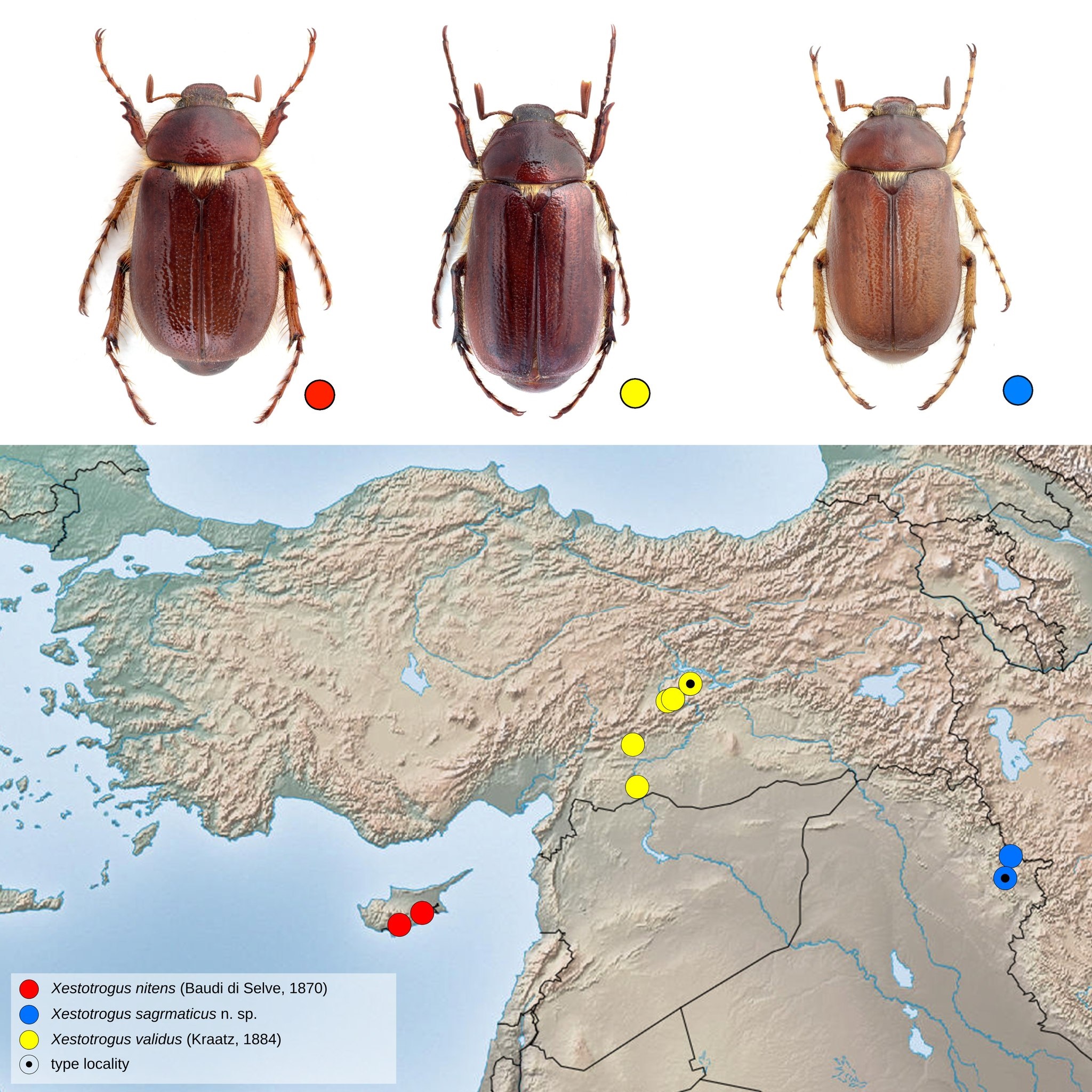
[Entomology • 2025] Xestotrogus sagrmaticus • A Revision of the Taxonomic Status of Xestotrogus Reitter, 1902 and related taxa (Coleoptera: Scarabaeidae: Melolonthinae), with the Description of A New Species from Iraqi Kurdistan


Xestotrogus sagrmaticus 
Uliana & Khudhur, 2025 

 
Abstract
An undescribed species of Rhizotrogini recently collected in Iraqi Kurdistan evidenced the unclear diagnosis of the genus-level taxa to which it could be attributed, prompting their revision. As a result, the currently monotypic subgenus Xestotrogus Reitter, 1902 is removed from subgeneric rank under the genus Xanthotrogus Reitter, 1902, treated as a valid genus and re-diagnosed. Cyprotrogus Nikolajev, 2004, also monotypic, is recognized as its junior subjective synonym. The new species, the third known of the genus, is then described as Xestotrogus sagrmaticus Uliana & Khudhur, new species. External morphology, aedeagus and endophallus of each species are illustrated.

Coleoptera, rhizotrogini, Middle East, Kurdistan, endophallus, new species, revision


Xestotrogus sagrmaticus Uliana & Khudhur, sp. nov.


Marco ULIANA and Farhad A. KHUDHUR. 2025. A Revision of the Taxonomic Status of Xestotrogus Reitter, 1902 and related taxa, with the Description of A New Species from Iraqi Kurdistan (Coleoptera: Scarabaeidae: Melolonthinae).  Zootaxa. 5575(3); 477-490. DOI: doi.org/10.11646/zootaxa.5575.3.8  [2025-01-24] 
 facebook.com/MSNve/posts/1363500857946840

Sunday, December 15, 2024

[Entomology • 2024] Lulavia mahwii, Idaea medianocturna walaila & Protorhoe drechseli nebuloides • New geometrid Moths (Lepidoptera: Geometridae: Sterrhinae, Larentiinae) from Iraqi Kurdistan


Lulavia mahwii 
Khudhur & Hausmann, 2024


Abstract
A large number of geometrid moths was collected by the first author in Iraqi Kurdistan including several undescribed species and subspecies. In this paper we describe three new geometrid taxa: Idaea medianocturna walaila ssp. nov., Lulavia mahwii sp. nov. and Protorhoe drechseli nebuloides ssp. nov. We present differential diagnoses and images of adult moths and genitalia.

Lepidoptera, Idaea, Lulavia, Protorhoe, fauna
 
Lulavia mahwii sp. nov., paratype, male. 


Lulavia mahwii Khudhur & Hausmann, sp. nov.
 
Differential diagnosis: In wing coloration and pattern no significant difference from Israeli Lulavia multipunctata (Staudinger, 1898). Male genitalia are very similar to those of L. multipunctata, but transtilla sclerites of the latter rounded towards the centre, less projecting, cornutus (bundle of microspinules) shorter: 0.3–0.4 mm.

 Etymology: The species is named after Mahwi who was one of the most prominent classical Kurdish poet and Sufis from Kurdistan. Mahwi was always using “Parwana – in Kurdish” meaning “Moth” as moth and flame metaphor in his poems.

 
Farhad A. Khudhur and Axel Hausmann. 2024. New geometrid Moths from Iraqi Kurdistan (Lepidoptera, Geometridae: Sterrhinae, Larentiinae).  Zootaxa. 5543(3); 423-432. DOI: doi.org/10.11646/zootaxa.5543.3.7

Thursday, August 22, 2024

[Arachnida • 2024] Dysdera kurdistanica, Palpimanus garmiyanus, Zelotes hazarmerdensis, etc. • New Data on Spiders (Araneae) of Iraqi Kurdistan, with New Species and Records


Dysdera kurdistanica
Dysdera goyzha 

Zamani, Khudhur & Marusik, 2024

Abstract
Based on a series of specimens collected between 2021 and 2023, this study presents new data on spiders of Iraqi Kurdistan. Despite the small size of the collection (i.e., 74 specimens), the material was found to include five species new to science, which are described and illustrated in this paper: Dysdera goyzha sp. n. (♂♀; Sulaymaniyah) [Dysderidae], D. kurdistanica sp. n. (♂; Sulaymaniyah) [Dysderidae], Palpimanus garmiyanus sp. n. (♂; Sulaymaniyah) [Palpimanidae], Tegenaria sorani sp. n. (♂; Erbil) [Agelenidae], and Zelotes hazarmerdensis sp. n. (♀; Sulaymaniyah) [Gnaphosidae]. Two families (Cheiracanthiidae; Zoropsidae), eleven genera (Agalenatea Archer, 1951 [Araneidae]; Cheiracanthium C.L. Koch, 1839 [Cheiracanthiidae]; Drassodes Westring, 1851 [Gnaphosidae]; Gibbaranea Archer, 1951 [Araneidae]; Mesiotelus Simon, 1897 [Liocranidae]; Micrommata Latreille, 1804 [Sparassidae]; Porrhoclubiona Lohmander, 1944 [Clubionidae]; Rhysodromus Schick, 1965 [Philodromidae]; Steatoda Sundevall, 1833 [Theridiidae]; Trochosa C.L. Koch, 1847 [Lycosidae]; Zoropsis Simon, 1878 [Zoropsidae]) and 18 species are recorded in Iraq for the first time, and five species are newly reported from the Kurdistan Region.

Araneae, erbil, halabja, Mesopotamia, Sulaymaniyah


 five species new to science:
 [Dysderidae] Dysdera goyzha sp. n. (♂♀; Sulaymaniyah), D. kurdistanica sp. n. (♂; Sulaymaniyah), 
[Palpimanidae] Palpimanus garmiyanus sp. n. (♂; Sulaymaniyah), 
[Agelenidae] Tegenaria sorani sp. n. (♂; Erbil), 
[Gnaphosidae] Zelotes hazarmerdensis sp. n. (♀; Sulaymaniyah)  


Alireza Zamani, Farhad A. Khudhur and Yuri M. Marusik. 2024. New Data on Spiders (Arachnida: Araneae) of Iraqi Kurdistan, with New Species and Records.  Zootaxa. 5492(2); 260-278. DOI: doi.org/10.11646/zootaxa.5492.2.6 

پێنج جۆری نوێی جاڵجاڵۆكە دۆزرانەوەو ناوی کوردییان لێنرا
 

Wednesday, May 8, 2024

[Entomology • 2024] Hoplitis (Hoplitis) onosmaevae • A New osmiine Bee (Hymenoptera: Anthophila: Megachilidae) with a spectacular Geographic Disjunction


Hoplitis onosmaevae
Aubert, Müller & Praz, 2024


Abstract
A new osmiine bee speciesHoplitis (Hoplitis) onosmaevae sp. nov. (Megachilidae), is described. So far, this species is exclusively known from the Mercantour National Park in the southwestern French Alps and from mountainous ranges in Turkey and northern Iraq, two areas separated by at least 2000 km. Phylogenetic analyses based on mitochondrial and nuclear genes revealed that H. onosmaevae is closely related to H. adunca (Panzer, 1798), H. benoisti (Alfken, 1935) and H. manicata (Morice, 1901). Hoplitis onosmaevae is presumably narrowly oligolectic and harvests pollen only on flowers of Onosma L. (Boraginaceae). It has a particularly long proboscis, which is probably an adaptation to collect nectar from the long-tubed flowers of this plant genus. The females collect pollen by buzzing the Onosma flowers, a rare behavior in megachilid bees. The species nests in insect burrows in dead wood, similar to H. adunca and H. manicata but unlike other closely related representatives of the subgenus Hoplitis, suggesting a single origin of nesting in dead wood and hollow stems in this lineage. In France, H. onosmaevae inhabits alpine steppe-like habitats close to forests and appears to be extremely local, since only two populations are currently known. The conservation status of this extremely rare bee species in Europe is discussed.

Key Words: Anthophila, Apiformes, Hoplitis, Onosma, osmiine bees, buzzing, conservation, France, Iraq, Turkey

Hoplitis onosmaevae sp. nov., foraging habitat and behaviour (France, Saint-Dalmas-le-Selvage, 23.6.2020). 15. Foraging habitat with patch of the host plant, Onosma tricerosperma subsp. fastigiata; 16. Male resting on stone between two patrolling flights, with unfolded proboscis; 17. Male resting on stone between two patrolling flights; 18. Female on a flower of Onosma tricerosperma subsp. fastigiata; 19. Female concentrating nectar with widely open mandibles.

Hoplitis (Hoplitis) onosmaevae Aubert, sp. nov.

Diagnosis: In most species of Hoplitis (Hoplitis), the length of the proboscis is at most one-third as long as the body. Only H. linguaria, H. holmboei, H. homalocera and H. semilinguaria have a longer proboscis, which reaches about half of the body length. Hoplitis onosmaevae possesses an even longer proboscis, which is approximately as long as the body (Fig. 3). In both sexes of H. holmboei and H. homalocera, the vertex is comparatively short (ocelloccipital distance less than two ocellar diameters) and, when seen in front view, not elevated behind ocelli, but regularly rounded across its width; in H. onosmaevae the vertex is longer (ocelloccipital distance about ...


Etymology: The species epithet onosmaevae refers to the assumed close association with plants of the genus Onosma (see section on pollen hosts below) and to Maëva Gardenat, to whom the first author wishes to dedicate this species.


 Matthieu Aubert, Andreas Müller and Christophe Praz. 2024. A New osmiine Bee with a spectacular Geographic Disjunction: Hoplitis (Hoplitisonosmaevae sp. nov. (Hymenoptera, Anthophila, Megachilidae). Alpine Entomology. 8: 65-79. DOI: 10.3897/alpento.8.118039

Résumé: Une nouvelle espèce d’abeille appartenant à la tribu des Osmiini, Hoplitis onosmaevae sp. nov. (Megachilidae), est décrite. Elle est à ce jour connue du Parc national du Mercantour dans le Sud des Alpes françaises et de zones montagneuses de Turquie et du Nord de l’Irak, deux aires distantes de plus de 2000 km. Des analyses phylogénétiques de gènes mitochondriaux et nucléaires indiquent que cette nouvelle espèce est apparentée à H. adunca (Panzer, 1798), H. benoisti (Alfken, 1935) et H. manicata (Morice, 1901). Hoplitis onosmaevae est certainement oligolectique, spécialisée pour la récolte du pollen sur les fleurs d’Onosma L (Boraginaceae). Elle est caractérisée notamment par un proboscis très allongé, qui est probablement une adaptation à la collecte du nectar dans les fleurs de ce genre botanique. Les femelles en exploitent le pollen en les faisant vibrer («buzzing»), comportement rare au sein de la famille des Megachilidae. Il a été observé que cette nouvelle espèce nidifie dans des galeries existantes dans le bois mort, à l’instar de H. adunca et de H. manicata, mais contrairement à d’autres représentants du sous-genre Hoplitis, ce qui suggère une origine unique de l’emploi du bois mort et des tiges creuses en tant que substrat de nidification au sein de ce groupe. En France, H. onosmaevae semble extrêmement localisée : elle n’a été trouvée que sur deux stations, correspondant à des habitats d’altitude d’affinité steppique, non loin de boisements. Son statut de conservation en Europe est discuté.

Sunday, October 29, 2023

[Botany • 2022] Nepeta iraqo-iranica (Lamiaceae) • A New Species from the Border of Iraq and Iran


Nepeta iraqo-iranica  

in Bordbar, Haloob, Qader et Mirtadzadini, 2022. 

Abstract
Nepeta iraqo-iranica, a new species is described and illustrated from NE of Iraq, Sulaimaniya Province, and W of Iran, Kurdistan Province, NW of Bâne. A table of morphological comparison and detailed discussion with morphologically close species is given. The species is considered Critically Endangered (CR) according to IUCN criteria.

Keywords: Eudicots, Critically Endangered, Nepeta iraqo-iranica, new species, Kurdistan

 Nepeta iraqo-iranica sp. nov.
A) habitat of plants in Iran, B) habit, C) basal leaves, D) inflorescence, E) close-up of inflorescence in flowering time, F) close-up of inflorescence in fruiting time, G) close-up of corolla, H) nutlets, adaxial (left) and abaxial surface (right).
Photographs: A and E, M. Mirtadzadini; B, C, D, F, G and H, K.O.Qader. 
Scale bar = 1 mm.


Firouzeh Bordbar, Ali Haloob, Karzan Omar Qader and Mansour Mirtadzadini. 2022. Nepeta iraqo-iranica (Lamiaceae), A New Species from the Border of Iraq and Iran. Phytotaxa. 550(2); 195–200. DOI: 10.11646/phytotaxa.550.2.8 

Tuesday, July 4, 2023

[Botany • 2023] Ornithogalum harbrum (Asparagaceae: Scilloideae) • A New Species from Iraq


Ornithogalum harbrum Haloob & Qader, 

in Qader et Haloob. 2023. 

Summary

Ornithogalum harbrum is described as a new species from Sulaimaniyah province, Kurdistan of Iraq. The morphological characteristics of the new species are given and those of the closely similar species O. sanandajense and O. arcuatum are discussed. Notes on the ecology and conservation status of O. harbrum are provided.

Key Words: Asia, endemic, Kurdistan, morphology, Sulaimaniyah

Ornithogalum harbrum.
A habit; B inflorescence; C flower with pedicel and bract; D tepal (inner and outer sides); E, F androecium (showing the longer and shorter stamens); G gynoecium; H capsule; J seed; K habitat.

Ornithogalum harbrum Haloob & Qader sp. nov. 

ETYMOLOGY. Named after the Harbr village in Penjwen NE of Sulaimaniya Province in NE Iraq.


Karzan Omar Qader and Ali Haloob. 2023. Ornithogalum harbrum (Asparagaceae: Scilloideae), A New Species from Iraq. Kew Bulletin. DOI: 10.1007/s12225-023-10111-1

Wednesday, March 8, 2023

[Botany • 2020] Euphorbia shehbaziana (Euphorbiaceae) • A New Species from Kurdistan Iraq


Euphorbia shehbaziana S.A. Hama & S.A. Ahmad, 

in Hama & Ahmad, 2020.

 Abstract 
Euphorbia shehbaziana is described and illustrated as a new species from Kurdistan Iraq, and its distinguishing characters from its nearest relatives, E. denticulata and E. craspedia, are discussed.

KEYWORDS: Euphorbia, Iraq, Gmo Mt., Kurdistan

Euphorbia shehbaziana S.A. Hama & S.A. Ahmad.
A, plant; B, cyathium; C, fruit; D, seed with caruncle. Photographs by Saman A. Ahmad based on the holotype.


Euphorbia shehbaziana S.Y. Hama and S.A. Ahmad, sp. nov.

 Euphorbia shehbaziana is readily distinguished from its nearest woody relatives by having entire leaves, 3- to 5-rayed umbels, denticulate glands, bracteate male flowers, and rugose seeds.

Etymology: Euphorbia shehbaziana is named in honor of our mentor and friend Dr. Ihsan A. Al-Shehbaz (MO) in recognition of his devotion to promoting botany in Kurdistan Iraq.


Sakar Y. Hama and Saman A. Ahmad. 2020. Euphorbia shehbaziana (Euphorbiaceae), A New Species from Kurdistan Iraq. Harvard Papers in Botany. 25(1); 73-74. DOI:  10.3100/hpib.v25iss1.2020.n9

Thursday, December 14, 2017

[Herpetology • 2017] Hemidactylus kurdicus • A New Species of Hemidactylus (Squamata: Gekkota: Gekkonidae) from Qara Dagh Mountains, Kurdistan Region, with A Key to the Genus in Iraq


Hemidactylus kurdicus 
Safaei-Mahroo, Ghaffari, Ghafoor & Amini, 2017


Abstract

We describe a new species of gecko of the genus Hemidactylus from the oak woodlands of Zagros Forest Steppe of Qara Dagh Mountains, Sulaimani, northeastern Iraq, based on morphological and molecular characteristics. Hemidactylus kurdicus sp. nov. is distinguished from all other related Arid clade Hemidactylus species in the Middle East by having a single pair of postmental scales; it differs H. turcicus, H. robustus, H. ulii, H. sinaitus, H. shihraensis and H. yerburii based on the number of lamellae under the first and fourth toes of pes. Mitochondrial DNA including CytB and 12S identify a consistent divergence between H. kurdicus and H. persicus. An identification key to the genus Hemidactylus in Iraq is presented.

Keywords: Hemidactylus kurdicus sp. nov., morphology, phylogeny, taxonomy, Geckoes, habitat, Zagros Mountains forest steppe, Qara-Dagh Mountain, Reptilia


Hemidactylus kurdicus sp. nov.

Etymology. The generic nomen kurdicus is derived from the word “Kurd” which refers to the name for the Kurdish nation (Kurdistan Region), the location where the new species was found.


Barbod Safaei-Mahroo, Hanyeh Ghaffari, Aram Ghafoor and Saywan Amini. 2017. A New Species of Hemidactylus (Squamata: Gekkota: Gekkonidae)  from Qara Dagh Mountains, Kurdistan Region, with A Key to the Genus in Iraq.  Zootaxa. 4363(3); 377–392. DOI:  10.11646/zootaxa.4363.3.4
ResearchGate.net/publication/321755775_A_new_species_of_Hemidactylus_Squamata_Gekkonidae_from_Qara_Dagh_Mountains_Kurdistan_Region_Iraq

BBC Persian - کشف گونه‌ای جدید از مارمولک در سلیمانیه
bbc.com/persian/science-42325127
facebook.com/105035939599143/photos/1127525137350213
facebook.com/MarcAbuys/posts/10212848275695950

Monday, November 14, 2016

[Ichthyology • 2016] Eidinemacheilus proudlovei • A New Subterranean Loach (Teleostei; Nemacheilidae) from Iraqi Kurdistan


Eidinemacheilus proudlovei  
Freyhof, Abdullah, Ararat, Ibrahim & Geiger. 2016

FIGURE 4. Eidinemacheilus proudlovei, alive, not preserved, 45 mm SL; Iraqi Kurdistan: Ephemeral spring in Tabeen Gorge.
photo: Younis Sabir Abdullah.   DOI:  10.11646/zootaxa.4173.3.2 

Abstract

Eidinemacheilus proudlovei, new species, is described from subterranean waters in the Little Zab River drainage in Iraqi Kurdistan. After the discovery of E. smithi in 1976, E. proudlovei is the second troglomorphic nemacheilid loach found in the Middle East and the second species placed in Eidinemacheilus. Eidinemacheilus proudlovei is distinguished from E. smithi by having 8+8 or 8+7 branched caudal-fin rays, no adipose keel on the caudal peduncle, enlarged jaws and a fully developed head canal system. It furthers differs substantially in its DNA barcode (>8% K2P distance) from all other nemacheilid loaches in the Middle East, Europe and Western India. 

Keywords: Pisces, Freshwater fish, Middle East, Kurdistan, Iraq, troglomorphic, new species, DNA barcoding, cave fishes, subterranean fishes


Eidinemacheilus proudlovei is the name given by researchers from IGB and ZMFK to the new species of fish they described together with colleagues from Kurdistan.
photo: Younis Sabir Abdullah 

Etymology. Named for Graham Proudlove (Manchester Museum, the University of Manchester), a world expert on subterranean fishes, for his continuous efforts documenting the diversity of troglomorphic fishes. 


Freyhof, J., Younis S. Abdullah, Korsh Ararat, Hamad Ibrahim & Matthias F. Geiger. 2016. Eidinemacheilus proudlovei, A New Subterranean Loach from Iraqi Kurdistan (Teleostei; Nemacheilidae). Zootaxa. 4173(3): 225–236.  DOI:  10.11646/zootaxa.4173.3.2

Blind species of fish discovered by chance in Kurdistan
http://phy.so/397819038 via @physorg_com


Thursday, June 16, 2016

[Herpetology • 2016] Dolichophis mesopotamicus • A New Species of Genus Dolichophis Gitstel (Serpentes; Colubridae) from the upper Mesopotamian Plain-Iraq


Dolichophis mesopotamicus 
Afrasiab, Mohammad & Hussein, 2016

Abstract
The Whip snakes of the genus Dolechophis in Iraq are distributed in various habitats. Two species of jagularis species group was known in Iraq. Depending on great variation in color pattern and ventral scale count, a new form discovered, because of its distribution along the upper Mesopotamia we named it Dolichophis mesopotamicus sp. nov. The study supported by figures and distribution map.

Key Words: Dolichophis mesopotamicus, Whip snake, Iraq, Colubridae, Serpentes.


Habitat and distribution: Bushes and vegetation around the rivers, manmade lakes and ponds for fish cultures. It is sympatric with Dolichophis jugularis asiana in most of the known distribution for Iraq.

 Behavior: These diurnal snakes have interesting behavior in their capability of moving the eyes anterior and posterior, up and down.


 Saman R. Afrasiab, Mohammad K. Mohammad and Amer M. Hussein. 2016. Description of A New Species of Genus Dolichophis Gitstel from the upper Mesopotamian Plain-Iraq (Reptilia; Serpentes; Colubridae). J. Bio. Env. Sci. 8(4), 15-19.  http://www.innspub.net/jbes/description-of-a-new-species-of-genus-dolichophis-gitstel-from-the-upper-mesopotamian-plain-iraq-reptilia-serpentes-colubridae/

Friday, April 10, 2015

[Herpetology • 2015] Varanus nesterovi • A New Species of Desert Monitor Lizard (Varanidae: Varanus: Psammosaurus) from the Western Zagros region (Iraq, Iran)

Varanus (Psammosaurusnesterovi
 Böhme, Ehrlich, Milto, Orlov & Scholz, 2015

ABSTRACT
We describe a new species of desert monitor lizard from the western and southwestern foothills of the Zagros Mountains. From Varanus griseus and its nominal subspecies V. g. griseus, V. g. caspius, and V. g. koniecznyi it is easily distinguishable by its stout head shape, the shape and position of the nostril, an extremely rough and spiny neck scalation, a laterally compressed tail with a double-keeled dorsal crest throughout its length, a nearly uniformly colored dorsum and an unpatterned light yellowish distal half of tail. Geographically, the new species seems to be restricted to the western and southwestern margin of the Zagros Mountain range and seems to prefer medium altitudes between 500 and 1100 m a.s.l. The new species renders the current subgenus Psammosaurus as consisting of more than one single living species.


Wolfgang Böhme, Klaus Ehrlich, Konstantin D. Milto, Nikolay Orlov and Sebastian Scholz. 2015. A New Species of Desert Monitor Lizard (Varanidae: Varanus: Psammosaurus) from the Western Zagros region (Iraq, Iran). Russian Journal of Herpetology. 22(1): 41-52.


Wednesday, May 15, 2013

[Paleontology • 2013] Malawania anachronus • A basal thunnosaurian from Iraq reveals disparate phylogenetic origins for Cretaceous ichthyosaurs | Fossil saved from mule track revolutionizes understanding of ancient dolphin-like marine reptile


Malawania anachronus,
the Jurassic-style Cretaceous ichthyosaur from Iraq.


Illustrations by Robert Nicholls, paleocreations.com;
coloring by C. M. Kosemen, cmkosemen.com

Abstract

Cretaceous ichthyosaurs have typically been considered a small, homogeneous assemblage sharing a common Late Jurassic ancestor. Their low diversity and disparity have been interpreted as indicative of a decline leading to their Cenomanian extinction. We describe the first post-Triassic ichthyosaur from the Middle East, Malawania anachronus gen. et sp. nov. from the Early Cretaceous of Iraq, and re-evaluate the evolutionary history of parvipelvian ichthyosaurs via phylogenetic and cladogenesis rate analyses. Malawania represents a basal grade in thunnosaurian evolution that arose during a major Late Triassic radiation event and was previously thought to have gone extinct during the Early Jurassic. Its pectoral morphology appears surprisingly archaic, retaining a forefin architecture similar to that of its Early Jurassic relatives. After the initial latest Triassic radiation of early thunnosaurians, two subsequent large radiations produced lineages with Cretaceous representatives, but the radiation events themselves are pre-Cretaceous. Cretaceous ichthyosaurs therefore include distantly related lineages, with contrasting evolutionary histories, and appear more diverse and disparate than previously supposed.

Keywords: Parvipelvia, Baracromia, Malawania anachronus, Early Cretaceous


Figure 1. Holotype specimen of Malawania anachronus gen. et sp. nov., NHMUK PV R6682.

Fossil saved from mule track revolutionizes understanding of ancient dolphin-like marine reptile
| An international team of scientists have revealed a new species of ichthyosaur (a dolphin-like marine reptile from the age of dinosaurs) from Iraq, which revolutionises our understanding of the evolution and extinction of these ancient marine reptiles.

Fischer V, Appleby RM, Naish D, Liston J, Riding JB, Brindley S and Godefroit P. 2013. A basal thunnosaurian from Iraq reveals disparate phylogenetic origins for Cretaceous ichthyosaurs. Biology Letters, 9: 20130021. DOI: 10.1098/rsbl.2013.0021