Showing posts with label Author: Bauer. Show all posts

Tuesday, September 30, 2025

[Herpetology • 2025] Pachydactylus namibensis & P. ovahimba • Two New Species of Pachydactylus (Squamata: Gekkonidae) from the Kaokoveld


Parrinha, Marques, Picelli, Jordaan, Bishop-Schouster, Heinicke, Bauer & Ceríaco, 2025


 Abstract 
Recent surveys in southwestern Angola uncovered cryptic diversity within Pachydactylus caraculicus. Phylogenetic analyses of nuclear and mitochondrial DNA recover three distinct lineages. Two of these lineages, characterized by their typical banded dorsal pattern, show clear geographic structuring: a “northern” lineage corresponding to true P. caraculicus, and a distinct “southern” lineage extending into neighboring Namibia. The third lineage, sister to the clade of banded caraculicus, comprises morphologically divergent specimens resembling P. punctatus. All three lineages within the P. caraculicus complex are diagnosable based on morphological and coloration characters. We formally describe the two unnamed lineages of P. caraculicus as new species and discuss these findings in the biogeographic context of the Kaokoveld's lizard fauna.


Pachydactylus namibensis, new species 
Namibe Thick-Toed Gecko 
Osga de Dedos Grossos do Namibe 

Etymology.—The specific epithet namibensis is here applied as a substantive in apposition and is given in reference to the known distribution of the species in Namibe Province, Angola. We suggest “Namibe Thick-Toed Gecko” and “Osga de Dedos Grossos do Namibe” as the English and Portuguese common names, respectively. 


Pachydactylus ovahimba, new species  
Himba Thick-Toed Gecko 
Osga de Dedos Grossos Himba

Etymology.—The specific epithet ovahimba is a noun in apposition, given in honor of the dominant ethnolinguistic group in the region where the species is known from. The OvaHimba are a semi-nomadic Herero people who inhabit the Kaokoveld of northwestern Namibia and southwestern Angola, a harsh and rugged region that roughly corresponds to the distribution of the newly described species. The name is given in recognition of the support and enthusiasm received from the Himba people during fieldwork. We suggest “Himba Thick-Toed Gecko” and “Osga de Dedos Grossos Himba” as the English and Portuguese common names, respectively.


Diogo Parrinha, Mariana P. Marques, Amanda M. Picelli, Adriaan Jordaan, Lacey J. Bishop-Schouster, Matthew P. Heinicke, Aaron M. Bauer and Luis M. P. Ceríaco. 2025. Two New Species of Pachydactylus (Squamata: Gekkonidae) from the Kaokoveld. Ichthyology & Herpetology. 113(3); 412-432. DOI: doi.org/10.1643/h2024108 (8 August 2025)

Tuesday, May 13, 2025

[Herpetology • 2025] Sepsina caluandaBuried in the Sands of Time: A New Species of Sepsina Bocage, 1866 (Squamata: Scincidae), from Angola


 Sepsina caluanda
 Parrinha, Marques, De Sousa, Bauer & Ceríaco, 2025


 Abstract
Burrowing skinks of the genus Sepsina Bocage, 1866 (Squamata: Scincidae) have a complex taxonomic history and are particularly diverse, although poorly known, in Angola. With elongated bodies and reduced limbs, the five recognized species of the genus can be diagnosed based on the presence or absence of forelimbs and the number and relative size of digits. Sepsina bayonii (Bocage, 1866) is the most distinctive species of the genus, being the only taxon without forelimbs and a single digit on the hind limbs. Revision of historical material from the collections of the California Academy of Sciences revealed the presence of two specimens without forelimbs, but differing from S. bayonii in the number of digits on each hind limb. Considering this unique combination of morphological diagnostic characters, we herein describe a new species from Angola, Sepsina caluanda. This discovery highlights the importance of natural history collections and the revision of historical material for the description of biodiversity and alerts to the threat of habitat loss due to rapid urban growth.

KEYWORDS: Africa, Endemism, herpetofauna, Luanda, natural history collections, taxonomy


 Sepsina caluanda sp. nov. 


Diogo Parrinha, Mariana P. Marques, Ana Carolina Andrade De Sousa, Aaron M. Bauer and Luis M.P. Ceríaco. 2025. Buried in the Sands of Time: A New Species of Sepsina Bocage, 1866, from Angola (Squamata: Scincidae). Annals of Carnegie Museum. 90(3); 183-193. DOI: doi.org/10.2992/007.090.0302 (10 January 2025) 

Tuesday, July 30, 2024

[Herpetology • 2024] Panaspis ericae & P. mundavamboA Treasure Trove of Endemics: Two New Species of Snake-eyed Skinks of the Genus Panaspis Cope, 1868 (Squamata: Scincidae) from the Serra da Neve Inselberg, southwestern Angola


 Panaspis ericae  
 Marques, Parrinha, Lopes-Lima, Tiutenko, Bauer & Ceríaco, 2024

photos by Arthur Tiutenko.

 Abstract
Four species of the genus Panaspis P. cabindae, P. wahlbergii, P. maculicollis and P. mocamedensis – are currently known from Angola. The analysis of recently collected specimens from Serra da Neve Inselberg, an isolated mountain located in northern Namibe Province, revealed unexpected taxonomic diversity in the group. Using an integrative taxonomy approach based on morphological and DNA sequence data, with both mitochondrial (16S) and nuclear (RAG-1) genes, we were able to distinguish two distinct populations, described here as two new species, Panaspis ericae sp. nov. and P. mundavambo sp. nov. Both species are assumed to be endemic to the inselberg. This reinforces our notion of southwestern Angola as a hotspot of skink diversity, and highlights the urgent need for the conservation of Serra da Neve.

Key Words: Reptiles, integrative taxonomy, Africa, herpetofauna, cryptic species


Live photos of Panaspis ericae sp. nov. 
the holotype (MUNHAC/MB03-001525) from vicinity of Catchi, Serra da Neve.  
 the paratype (MUNHAC/MB03-001531) from vicinity of Maylowe, Serra da Neve.
photos by Arthur Tiutenko.

 Panaspis ericae sp. nov.

Etymology: The specific epithet “ericae” is formed in the genitive singular and is feminine. It is given in honor of Erica Tavares (1997–), an Angolan biologist and conservationist. Through her work in the Angolan environmental platform “Eco Angola” (of which Erica is a co-founder), Erica has revolutionized the Angolan conservation and ecological discourse, providing opportunities for members of the Angolan civil society, students, and young researchers to learn, debate and contribute to environmental causes. We suggest “Erica’s Snake-Eyed Skink” and “Lagartixa da Manta-Morta de Erica” as the English and Portuguese common names, respectively, for this species.


 Panaspis mundavambo sp. nov.

Etymology: The specific epithet “mundavambo” refers to the Mukwando (local tribe) name for Serra da Neve Inselberg (Opunda Mundavambo), to which the species is endemic, and is applied here as a substantive in apposition. We propose the English vernacular name “Serra da Neve Snake-Eyed Skink” and the Portuguese vernacular name of “Lagartixa da Manta-Morta da Serra da Neve”.

 
Mariana P. Marques, Diogo Parrinha, Manuel Lopes-Lima, Arthur Tiutenko, Aaron M. Bauer and Luis M. P. Ceríaco. 2024. A Treasure Trove of Endemics: Two New Species of Snake-eyed Skinks of the Genus Panaspis Cope, 1868 (Squamata, Scincidae) from the Serra da Neve Inselberg, southwestern Angola. Evolutionary Systematics. 8(2): 167-182. DOI: doi.org/10.3897/evolsyst.8.121103

Friday, May 10, 2024

[Herpetology • 2024] Trachylepis attenboroughi, T. ovahelelo, T. vunongue, ... • The Trachylepis (Squamata: Scincidae) of Angola : An Integrative Taxonomic Review with the Description of Seven New Species

 
 1. Trachylepis albilabris; 2. T. albopunctata; 3. T. ansorgii.
4. Trachylepis attenboroughi, sp. nov.8. Trachylepis bouri, sp. nov.13. T. hilariae, sp. nov.;
18. T. ovahelelo, sp. nov.; 19. T. suzanae, sp. nov.
 22. T. vunongue, sp. nov.; 25. T. wilsoni, sp. nov. 
Ceríaco,  Marques, Parrinha, Tiutenko, Weinell, Butler & Bauer, 2024

Drawings by Arthur Tiutenko.

Abstract
The genus Trachylepis is currently represented by 21 species in Angola, most of them part of nomenclaturally and taxonomically challenging species complexes. In this study we present an integrative taxonomic revision of the genus in Angola and describe seven new speciesTrachylepis attenboroughi, sp. nov., Trachylepis bouri, sp. nov., Trachylepis hilariae, sp. nov., Trachylepis ovahelelo, sp. nov., Trachylepis suzanae, sp. nov., Trachylepis vunongue, sp. nov., and Trachylepis wilsoni, sp. nov. As result of our taxonomic revisions, 25 valid Trachylepis species are now confirmed from Angola. A phylogenetic analysis using a combination of mitochondrial (16S, ND2) and nuclear (RAG1) markers, as well as morphological data, supports the recognition of the new species. In addition, data support the revalidation of Trachylepis albopunctata (Bocage, 1867), Trachylepis notabilis (Peters, 1879), and Trachylepis ansorgii (Boulenger, 1907). We also provide a redefinition of Euprepes anchietae Bocage, 1866, which we synonymize with Trachylepis maculilabris (Gray, 1845). Given that the type material for Trachylepis albopunctata, T. angolensis, and T. anchietae has been lost or destroyed, we designate neotypes for the purpose of nomenclatural stability. The description of the new species and the revision and revalidation of previously described Angolan species contribute to a better understanding of the taxonomy and biogeography of the genus, as well as to the general biogeographic patterns and evolution of the Angolan fauna.
 
Keywords: Skinks, Angola, Classification, Squamata, Trachylepis attenboroughi, Trachylepis bouri, Trachylepis hilariae, Trachylepis ovahelelo, Trachylepis suzanae, Trachylepis vunongue, Trachylepis wilsoni


 1. Trachylepis albilabris; 2. T. albopunctata; 3. T. ansorgii.
4. Trachylepis attenboroughi, sp. nov.; 5. T. bayonii; 6. T. binotata; 7. T. bocagii.
8. Trachylepis bouri, sp. nov.; 9, T. chimbana; 10. T. damarana; 11. T. hoeschi; 12. T. huilensis; 13. T. hilariae, sp. nov.; 14. T. laevis
Drawings by Arthur Tiutenko.

  15. Trachylepis maculilabris; 16. T. notabilis.  
17. Trachylepis occidentalis; 18. T. ovahelelo, sp. nov.; 19. T. suzanae, sp. nov.; 20. T. punctulata; 21. T. raymondlaurenti.  
 22. T. vunongue, sp. nov.; 23. T. sulcata; 24. T. wahlbergi; 25. T. wilsoni, sp. nov. 
Drawings by Arthur Tiutenko.


Luis M. P. Ceríaco, Mariana P. Marques, Diogo Parrinha, Arthur Tiutenko,  Jeffrey L. Weinell, Brett O. Butler and Aaron M. Bauer. 2024. The Trachylepis (Squamata: Scincidae) of Angola : An Integrative Taxonomic Review with the Description of Seven New Species. Bulletin of the American Museum of Natural History. 465. hdl.handle.net/2246/7345


Sunday, November 12, 2023

[Herpetology • 2019] Hemidactylus kolliensis, H. chikhaldaraensis & H. sankariensis • An Expanded ND2 Phylogeny of the brookii and prashadi Groups with the Description of Three New Indian Hemidactylus Oken (Squamata: Gekkonidae)


 Hemidactylus kolliensis,
H. chikhaldaraensis &
 H. sankariensis
 Agarwal, Bauer, Giri & Khandekar, 2019

Abstract  

We present an expanded ND2 phylogeny of the brookii and prashadi groups of Indian Hemidactylus. While relationships within the clades are not well resolved, we recover many well supported subclades and a number of deeply divergent lineages within each clade. We use morphological data to describe three of these divergent lineages as new speciesHemidactylus kolliensis sp. nov., a member of the prashadi group from high elevation in the Kollimalai Massif in Tamil Nadu, Hemidactylus chikhaldaraensis sp. nov. and Hemidactylus sankariensis sp. nov., both members of the brookii group, are described from high elevation of the Satpuras in Maharashtra and low elevation of Tamil Nadu, respectively. The three new species exhibit >15% divergence for the ND2 gene from their phylogenetic sisters and differ in a number of morphological characters from all Indian congeners. The discovery of three more endemic Hemidactylus species from rocky habitats suggests that many more remain to be discovered across India.

Keywords: Reptilia, peninsular India, rupicolous, Satpuras, taxonomy


Ishan Agarwal, Aaron B. Bauer, Varad B. Giri and Akshay Khandekar. 2019. An Expanded ND2 Phylogeny of the brookii and prashadi Groups with the Description of Three New Indian Hemidactylus Oken (Squamata: Gekkonidae). Zootaxa. 4619(3); 431–458. DOI:  10.11646/zootaxa.4619.3.2


Friday, September 22, 2023

[Herpetology • 2023] Acontias mukwando • A New Species of African Legless Skink, Genus Acontias Cuvier, 1816 “1817” (Squamata: Scincidae) from Serra da Neve Inselberg, south-western Angola


 Acontias mukwando
Marques, Parrinha, Tiutenko, Lopes-Lima, Bauer & Ceríaco, 2023

 
ABSTRACT
During a recent survey of the Serra da Neve inselberg in south-western Angola, a population of legless skinks of the genus Acontias was found. Only three species of this genus have been recorded for the country so far – A. occidentalis, A. kgalagadi and A. jappi. Using an integrative approach and combining molecular and morphological data we found that the Serra da Neve population represents a new species, closely related to species such as A. percivali and some members of the A. occidentalis species complex. In this paper, we describe this population as a new species, Acontias mukwando sp. nov. and provide brief comments on its conservation and biogeography.

KEYWORDS: Acontinae, taxonomy, endemism, speciation, systematics


Mariana P. Marques, Diogo Parrinha, Arthur Tiutenko, Manuel Lopes-Lima, Aaron M. Bauer and Luis M. P. Ceríaco. 2023. A New Species of African Legless Skink, Genus Acontias Cuvier, 1816 “1817” (Squamata: Scincidae) from Serra da Neve Inselberg, south-western Angola. African Journal of Herpetology. DOI: 10.1080/21564574.2023.2246487

RESUMO: No decorrer de um levantamento herpetológico da ilha-montanha da Serra da Neve no sudoeste de Angola, descobriu-se uma população de escincos-lança do género Acontias. Apenas três espécies deste género foram até agora registadas para Angola - A. occidentalis, A. kgalagadi and A. jappi. Adotando uma abordagem integrativa e combinando dados morfológicos e moleculares, os nossos resultados indicam que a população da Serra da Neve representa uma nova espécie, com relações próximas a outras espécies rupícolas tais como A. percivali e membros do complexo de espécies A. occidentalis. Neste artigo descrevemos esta população como uma nova espécie, Acontias mukwando sp. nov. e apresentamos breves comentários sobre a sua conservação e biogeografia.

Wednesday, March 30, 2022

[Herpetology • 2022] Cnemaspis matahari, C. sirehensis, et C. lagang • Three New Species of Cnemaspis (Sauria: Gekkonidae) from Sarawak, East Malaysia, Borneo


Cnemaspis matahari   C. lagang 

Nashriq, Davis, Bauer & Das, 2022
 
Abstract
Three new species of Cnemaspis are described from karst regions of Sarawak, Malaysia, on the island of Borneo. These are Cnemaspis matahari sp. nov. and C. sirehensis sp. nov. from limestone hills located in the Serian Division of western Sarawak, and C. lagang sp. nov. from Gunung Mulu, Miri Division, in northern Sarawak. All can be distinguished from congeners using mitochondrial DNA as well as an enlarged metatarsal scales on the first toe. Individually, each species can be diagnosed by differences in subcaudal scale morphology: Cnemaspis lagang sp. nov. lacks enlarged subcaudals; Cnemaspis matahari sp. nov. has keeled subcaudals bearing an enlarged median row of smooth scales; and Cnemaspis sirehensis sp. nov. has an enlarged median row of weakly keeled scales. The discovery of these species suggests that additional unrecognized species may exist within the genus on Borneo, especially in association with karst formations. High endemism and species diversity notwithstanding, these karst formations are under severe pressure from limestone extraction and deforestation.

Keywords: Reptilia, Cnemaspis, taxonomy, new species, ecology, conservation, endemic, karst, Sarawak


Cnemaspis lagang sp. nov.
North Sarawak Day Gecko; Cicak Gua Mulu

 Etymology. The epithet lagang is a noun in apposition derived from the paratype locality of Lagang Cave, within Gunung Mulu National Park.


Cnemaspis matahari sp. nov.
White Rock Gecko; Cicak Batu Putih

Etymology. The epithet matahari is Malay for sun, in reference to the yellowish tint on the species. It is usedas a noun in apposition.

Cnemaspis sirehensis sp. nov.
Blue Day Gecko; Cicak Gua Sireh

Etymology. The epithet sirehensis comes from the type locality, Gua Sireh (Sireh Cave), Kampung Bantang,Serian and translates to betel in Malay. Betel is a type of plant of the family Piperaceae, consumed as betel quid orin ‘paan’. Gua Sireh is also known as an important archaeological site in south-western Sarawak. 
 

Izneil Nashriq, Hayden R. Davis, Aaron M. Bauer and Indraneil Das. 2022. Three New Species of Cnemaspis (Sauria: Gekkonidae) from Sarawak, East Malaysia, Borneo. Zootaxa. 5120(1); 1-29. DOI: 10.11646/zootaxa.5120.1.1

 Izneil Nashriq and Indraneil Das. 2021. Underestimated Diversity of Cnemaspis Strauch, 1887 (Sauria: Gekkonidae) on Karst Landscapes in Sarawak, East Malaysia, Borneo. Journal of Threatened Taxa. 13(7); 18792–18799. DOI: 10.11609/jott.7195.13.7.18792-18799


Tuesday, February 22, 2022

[Herpetology • 2022] Acanthocercus ceriacoi All in All It’s Just Another Branch in The Tree: A New Species of Acanthocercus Fitzinger, 1843 (Squamata: Agamidae), from Angola


Acanthocercus ceriacoi
Marques, Parrinha, Santos, Bandeira, Butler, Sousa, Bauer & Wagner, 2022

 
Abstract
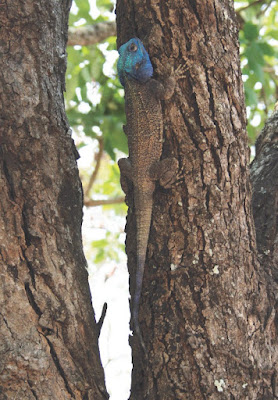
Recent integrative taxonomic studies of the agamid genus Acanthocercus Fitzinger, 1843 have shown that Angola harbors three different taxa, all within the Acanthocercus atricollis (Smith, 1849) species complex—A. cyanocephalus (Falk, 1925) in the northeastern parts of the country, A. margaritae Wagner et al. 2021 in the southern regions, and an unnamed species in the central and northwestern parts of Angola. Using the previously published molecular data as evidence of phylogenetic support and newly collected morphological, meristic and coloration data, we here describe this unnamed lineage as a new species. The new species is morphologically very similar to A. cyanocephalus, but it can easily be differentiated from the latter by the coloration pattern of displaying males, with a blue coloration restricted to the head region, and by its inferior scale counts compared to other species of the A. atricollis complex group. As reported in other studies in this group, male breeding coloration is an effective trait for diagnosing these morphologically conserved species. This description raises the number of Acanthocercus species recognized to 15 and is another contribution revealing the rich but still incompletely described herpetological diversity of Angola.

Keywords: Reptilia, Africa, taxonomy, new species, morphology, coloration pattern, tree agama


Acanthocercus ceriacoi


Mariana P. Marques, Diogo Parrinha, Bruna S. Santos, Suzana Bandeira, Brett O. Butler, Ana Carolina A. Sousa, Aaron M. Bauer and Philipp Wagner. 2022. All in All It’s Just Another Branch in The Tree: A New Species of Acanthocercus Fitzinger, 1843 (Squamata: Agamidae), from Angola.  Zootaxa. 5099(2); 221-243. DOI: 10.11646/zootaxa.5099.2.4

Monday, November 8, 2021

[Herpetology • 2021] Acanthocercus margaritae • A New Species of the Acanthocercus atricollis complex (Squamata: Agamidae) from Namibia and Angola


 displaying males Acanthocercus margaritae: 
 (A) from Onesi, Omusati Region, Namibia; (B) from near Ondjiva, Cunene Province, Angola.

Wagner, Butler, Ceríaco & Bauer, 2021

SALAMANDRA.  57(4)

 (A) photo by Jukka Jantunen iNaturalist.org/observations/19637354.
 (B) photo by Pedro Martins iNaturalist.org/observations/19293652.

Abstract
 We describe a new species of the agamid genus Acanthocercus from Namibia and Angola, based on morphological and molecular evidence. The phylogenetic analysis of a fragment of the mitochondrial 16S rRNA gene suggests that the new species is closely related to the other taxa from southern Africa and is distinct from species from eastern and northeastern Africa. The new species is characterized by its high scale counts (mean scale rows around midbody 136, mean dorsal scale rows 103, mean ventral scale rows 101) and displaying males showing a blue coloration of the head, forelimbs, flanks of the anterior part of the body and distal half of the tail; a very distinct pale vertebral stripe between the blue flanks and enlarged yellowish dorsal scales on the posterior part of the body. In Namibia the species is restricted to a small area of grassland with mopane and Maklani palms in northern Ovamboland, but its distribution in Angola spans a diversity of habitats. We also recognize a potential new species from northern Angola and discuss the preliminary distribution of Acanthocercus in Angola. 

Key words. Acanthocercus sp. n., Africa, Namibia, Angola. 


Images of displaying males of Acanthocercus margaritae sp. n.
 (A) from Onesi, Omusati Region, Namibia (-17.478164 N, 14.650651 E).
Photo by Jukka Jantunen iNaturalist.org/observations/19637354.
(B) from near Ondjiva, Cunene Province, Angola [-17.674433 N, 15.799167].
Photo by Pedro Martins [7 December 2018] iNaturalist.org/observations/19293652.


Acanthocercus margaritae sp. n.

Diagnosis. The new species is included in the genus Acanthocercus because of the combination of a heterogeneous body scalation and a tail that is segmented in distinct whorls. Within this genus, the heterogeneous body scalation refers it to the cyanogaster/atricollis group and the high density of enlarged scales in combination with a black patch on the shoulders places it into the A. atricollis complex. Acanthocercus margaritae sp. n. is a medium sized lizard (mean SVL 112 mm [96–129 mm], mean total length 258 mm [217–299 mm]) of its genus and overall is very similar in morphology to A. atricollis and A. cyanocephalus. However, it is distinct from all other species of the complex in its meristic characters. The new species is characterized by its high numbers of scale counts (mean scale rows around midbody 136, mean dorsal scale rows 103, mean ventral scale rows 101). Displaying males are characterized by a blue coloration of the head, forelimbs, flanks of the upper part of the body and second half of the tail; a pale vertebral band, very distinct between the blue flanks and enlarged yellowish dorsal scales on the lower part of the body.

Habitat of  Acanthocercus margaritae sp. n. 
in area of Maklani palms (Hyphaene petersiana) near the Calueque-Oshakati canal system south of Oshikango, Namibia.
at the Matunto Post, Bicuar National Park, Huila, where paratype MHNCUP_REP 422 was collected.

Ecology. Acanthocercus margaritae sp. n. is a tree dweller as is typical for most of the taxa of the species complex (Reaney & Whiting 2002, Wagner et al. 2018). In Namibia it occupies areas on the interior plain of northern Ovamboland at elevations around 1100 m corresponding roughly to the Cuvelai River drainage. The area receives about 400 mm of rain per year, falling mostly in late summer (January through April). Vegetation is characterized by grasslands mixed with open mopane (Colophospermum mopane) woodlands with stands of Maklani palms (Hyphaene petersiana) (Fig 9). However, the area is the most densely populated region in Namibia with significant small-scale agriculture, many villages, and some larger urban centers. Acanthocercus is often seen on both native trees and ornamental trees and shrubs in gardens, as well as on the walls of buildings, although it seems to avoid areas of high human activity. In Angola the species occurs in considerably different habitats (see e.g., Fig. 10), from miombo forest areas to open mopane woodlands (Grandvaux-Barbosa 1970) and anthropogenically transformed landscapes such as farms or even within major urban areas such as Lubango. 

Etymology. The species epithet ‘‘margaritae’’ is formed as a genitive Latin noun to honor the Greek scientist Dr. Margarita Metallinou (1985 –2015) whose promising career was tragically cut short on the 2nd of July 2015 by a wildlife encounter in Zambia. This new species is a special tribute to her memory from all the authors of this publication to recognize her enthusiasm, passion and dedication to herpetology.


Philipp Wagner, Brett O. Butler, Luis M. P. Ceríaco and Aaron M. Bauer. 2021. A New Species of the Acanthocercus atricollis complex (Squamata: Agamidae). SALAMANDRA.  57(4); 449–463. 

Resumo. Descrevemos neste artigo uma nova espécie de Agamídeo do género Acanthocercus da Namíbia e de Angola, com base em evidências morfológicas e moleculares. A análise filogenética de um fragmento do gene mitocondrial 16S rRNA sugere que a nova espécie é relacionada com outros taxa do sul de África e distinta das espécies do leste e nordeste de África. A nova espécie é caracterizada pelo seu maior número de escamas (média de escamas à volta do corpo de 136, média de escamas em fiada dorsal 103, média de escamas em fiada ventral 101) e pelos machos em coloração exibitiva apresentarem um cor azulada na cabeça, braços, flancos da parte anterior do corpo e parte segunda metade distal da causa; uma linha vertebral pálida bem marcada entre os flancos azuis e as escamas dorsais amareladas presentes no parte posterior do corpo. Na Namíbia a espécie encontra-se restrita a uma pequena área de pradaria com Mutiate e palmeiras Malklani no norte da Ovambolãndia, mas a sua distribuição em Angola engloba uma maior diversidade de habitats. Reconhecemos também a existência de uma potencial nova espécie no norte de Angola e discutimos uma potencial e preliminar distribuição do género Acanthocercus em Angola.
 Palavras-chave. Acanthocercus sp. n., África, Namíbia, Angola.

Wednesday, April 28, 2021

[Herpetology • 2021] Pedioplanis branchi & P. mayeri Lizards of A Different Stripe: Phylogenetics of the Pedioplanis undata Species Complex (Squamata, Lacertidae), with the Description of Two New Species


Pedioplanis branchi & Pedioplanis mayeri  
Childers, Kirchhof & Bauer, 2021

   DOI: 10.3897/zse.97.61351  

Abstract
The lacertid genus Pedioplanis is a moderately speciose group of small-bodied, cryptically-colored lizards found in arid habitats throughout southern Africa. Previous phylogenetic work on Pedioplanis has determined its placement within the broader context of the Lacertidae, but interspecific relations within the genus remain unsettled, particularly within the P. undata species complex, a group largely endemic to Namibia. We greatly expanded taxon sampling for members of the P. undata complex and other Pedioplanis, and generated molecular sequence data from 1,937 bp of mtDNA (ND2 and cyt b) and 2,015 bp of nDNA (KIF24, PRLR, RAG-1) which were combined with sequences from GenBank resulting in a final dataset of 455 individuals. Both maximum likelihood and Bayesian analyses recover similar phylogenetic results and reveal the polyphyly of P. undata and P. inornata as presently construed. We confirm that P. husabensis is sister to the group comprising the P. undata complex plus the Angolan sister species P. huntleyi + P. haackei and demonstrate that P. benguelensis lies outside of this clade in its entirety. The complex itself comprises six species including P. undata, P. inornata, P. rubens, P. gaerdesi and two previously undescribed entities. Based on divergence date estimates, the P. undata species complex began diversifying in the late Miocene (5.3 ± 1.6 MYA) with the most recent cladogenetic events dating to the Pliocene (2.6 ± 1.0 MYA), making this assemblage relatively young compared to the genus Pedioplanis as a whole, the origin of which dates back to the mid-Miocene (13.5 ± 1.8 MYA). Using an integrative approach, we here describe Pedioplanis branchi sp. nov. and Pedioplanis mayeri sp. nov. representing northern populations previously assigned to P. inornata and P. undata, respectively. These entities were first flagged as possible new species by Berger-Dell’mour and Mayer over thirty years ago but were never formally described. The new species are supported chiefly by differences in coloration and by unique amino acid substitutions. We provide comprehensive maps depicting historical records based on museum specimens plus new records from this study for all members of the P. undata complex and P. husabensis. We suggest that climatic oscillations of the Upper Miocene and Pliocene-Pleistocene era in concert with the formation of biogeographic barriers have led to population isolation, gene flow restrictions and ultimately cladogenesis in the P. undata complex.

Key Words: Biogeography, molecular phylogeny, phylogenetics, southern Africa, species description, taxonomy


Figure 8. Life photographs of representative individuals of  Pedioplanis branchi sp. nov. highlighting color pattern variation within the species.
 (a.) Lateral and (b.) dorsal whole body images of an adult specimen from the Chuos Mountains (Chuosberg) (SK376.2014; not included in study), note the dense, dark speckling on the dorsum, and bold dark lateral markings.
(c.) Dorsal and (d.) lateral whole body images of an adult specimen (SK402.2014; not included in study) from the northward extension of the Swakop River Canyon, note the more uniformly gray and red dorsum lacking speckling and fainter yellow spots along the flanks. Lateral
 (e.) head and (f.) whole body images of an adult specimen from the northward extension of the Swakop River Canyon; note the black, vertical bar beneath the lower eyelid, the bold, dark lateral markings on the body, and the distinct longitudinal row of yellow spots along the flanks.

Pedioplanis inornata “South”/P. inornata “Central”
The type series of Eremias inornata Roux, 1907 comprises eight specimens collected from “Oranje-Fluß, Kl.-Namaqualand” [the Orange River, Little Namaqualand, Northern Cape, Province, South Africa]. Syntype ZMA11049 (Zoological Museum Amsterdam) was subsequently designated as the lectotype (Daan and Hillenius 1966). The ZMA collections have subsequently been incorporated into those of the Naturalis Biodiversity Center in Leiden (RMNH). The geographic origin of the specimens and the relatively detailed description and accompanying plate, clearly tie the name-bearing lectotype of Pedioplanis inornata to the P. inornata “South” clade. No other nomina are currently within the synonymy of Pedioplanis inornata and none are available for application to the P. inornata “Central” clade, which is here described as:

 Pedioplanis branchi sp. nov.  

Etymology: The specific epithet is a patronym formed in the genitive singular honoring our friend and colleague, the British-born South African herpetologist, William Roy Branch (1946–2018), in recognition of his many contributions to African herpetology and in remembrance of many happy trips in the field together.

Distribution: Pedioplanis branchi sp. nov. is endemic to the Erongo Region in Namibia. Its range stretches from just south of the Swakop River in the South, where it occurs in parapatry with P. husabensis, through the pro-Namib, to the Ugab River and the Brandberg in the north and Mount Erongo and Otjimbingwe in the east, probably occurring in parapatry with P. mayeri all along its northeastern border (see Fig. 6 for map of locality records).

Figure 9. Habitat of Pedioplanis branchi sp. nov. 
 (a.) Collection site for ZMB 89310 (Farm Friedhelm Sack, Erongo Region, Namibia) from the extended Swakop River Canyon on a marble/calc silicate slope with sparse grass cover and isolated shrubs. (b.) Collection site for ZMB 89612 (not included in study) from a small hill slope in the Tsiseb conservancy in the Pro-Namib, 20 km south of the Brandberg (visible in the background) depicting a sparsely vegetated scree slope with a Commiphora shrub.


Figure 4. Life photographs of representative individuals of Pedioplanis mayeri sp. nov. highlighting color pattern variation within the species.
(a.) Dorsal and (b.) lateral whole body images of an adult possessing bold dorsal stripes collected at the type locality (Farm Omandumba, Erongo Region, Namibia), note the row of yellow spots along the flanks;
 (c.) Dorsal image of an adult from the Kamanjab area depicting fainter, medium-brown dorsal stripes; (d.) An adult female collected from Gobabis (ZMB 80391; see also Fig. 5a) with dorsal striping of varying boldness and a more grayish-brown hindbody compared to the more reddish hindbody observed in other individuals.

Pedioplanis undata “South”/P. undata “North”
Mayer and Böhme (2000) examined the type material of Lacerta undata Smith, 1838 and noted that the rediscovered syntype specimens in the National Museums of Scotland collection were, in fact, representatives of the taxon long associated with the name Pedioplanis lineoocellata pulchella (Gray, 1845) and now, based on the findings of Edwards (2013), considered as P. lineoocellata (Duméril & Bibron, 1839). They proposed to conserve the current usage of names within Pedioplanis by calling on the ICZN in Case 3085 to set aside the original type designation and recognize the designation of a neotype for L. undata. Opinion 1992 of the ICZN (Anonymous 2002) accepted this solution and thus the neotype was fixed as Naturhistorisches Museum Wien (NMW) 31886 from “near Windhoek, Namibia.” This links the name P. undata to the P. undata “South” clade. The assignment of the name Pedioplanis undata to the more restricted, southern clade is notable in that the predominant concept of the species based on previous studies of P. undata is largely affiliated with populations and representative specimens from the more broadly distributed northern clade (Branch 1998; Makokha et al. 2007; Conradie et al. 2012). In these cases the presence of bold dorsal stripes was considered diagnostic for the species, however based on our results this character is now largely applicable to the unnamed northern clade, and is exhibited inconsistently and with variation among true P. undata. No other nomina are currently within the synonymy of Pedioplanis undata and none are available for application to the P. undata “North” clade, which we describe as:

Pedioplanis mayeri sp. nov. 

Etymology: The specific epithet is a patronym formed in the genitive singular honoring our friend and colleague, the Austrian lacertid specialist Werner Mayer (1943–2015), who first recognized the distinctiveness of his namesake species and whose contributions to the study of Pedioplanis have been seminal.

Distribution: Pedioplanis mayeri sp. nov. is endemic to northern Namibia and occurs from south of the Kunene River and east of the Namib Desert along the eastern side of the escarpment, thence throughout the eastern Kunene Region, entering the northeastern parts of the Erongo Region and east through the Otjozondjupa Region, reaching at least as far east as Oshikango (TM17028) in the north, Gobabis (Omaheke Region) in the south-east, and Nauchas in the south. It does not enter the Kalahari dune fields, and is possibly absent from the Khomas Hochland, where it is replaced by P. undata (see Fig. 6 for map of locality records).


Figure 5. Habitat of Pedioplanis mayeri sp. nov.  
(a.) Collection site near Gobabis for ZMB 80389–80392 in open savannah woodland, with tall, dense grasses and introduced Opuntia. (b.) Collection site for ZMB 89350 (29 km N of Palmwag, Kunene Region, Namibia) in stony Pro-Namib habitat with sparse vegetation dominated by Euphorbia damarana (center).


Jackie L. Childers, Sebastian Kirchhof and Aaron M. Bauer. 2021. Lizards of A Different Stripe: Phylogenetics of the Pedioplanis undata Species Complex (Squamata, Lacertidae), with the Description of Two New Species. Zoosystematics and Evolution. 97(1): 249-272.  DOI: 10.3897/zse.97.61351