Showing posts with label Journal of Herpetology. Show all posts

Friday, April 25, 2025

[Ichthyology • 2025] Psalidodon pessalii • A New Species of Psalidodon (Characiformes: Acestrorhamphidae) from the Upper Rio São Francisco Basin, Brazil, with Comments on Hasemania


Psalidodon pessalii
 Teixeira, Salvador, Mirande & Lima, 2025 
 

Abstract  
A new species of Psalidodon without an adipose fin and with an interrupted lateral line and scaleless caudal fin is described from a marshland area in headwater tributaries of Rio Paraopeba, Rio São Francisco basin, Minas Gerais, Brazil. The new species can be promptly distinguished from all members of the Acestrorhamphidae by the presence of an ossified canal segment on the dorsal portion of the preopercular laterosensory canal running across the posterodorsal tip of the fourth infraorbital and posterior portion of the fifth infraorbital (vs. preopercular laterosensory canal lacking an ossified canal segment in the fourth and fifth infraorbitals). The new species fits the classical definition of the genus Hasemania; however, a comprehensive phylogenetic analysis carried out herein to assess its phylogenetic relationships revealed it as the sister group of Psalidodon crenuchoides, new combination. Further, both species are deeply nested within the genus Psalidodon, as recently redefined, which led to the generic reallocation of the latter. Comments on the phylogenetic position of the new species, as well as its conservation status, are presented.

Psalidodon pessalii.
(A) Preserved holotype, ZUEC 18283, male, 41.5 mm SL;
(B) freshly collected paratype, ZUEC 6387, SL uncertain.

Psalidodon pessalii, new species 

Etymology.—The specific epithet honors our fellow ichthyologist Tiago Casarim Pessali. With the constant support of his family, he has contributed in many ways to the knowledge of the Brazilian freshwater fishes, especially those occurring in the coastal drainages of eastern Brazil in the State of Minas Gerais. A noun in the genitive case.

 
Tulio F. Teixeira, Gilberto N. Salvador, Juan Marcos Mirande and Flávio C. T. Lima. 2025. A New Species of Psalidodon (Characiformes: Acestrorhamphidae) from the Upper Rio São Francisco Basin, Brazil, with Comments on HasemaniaIchthyology & Herpetology. 113(1); 131-142. DOI: doi.org/10.1643/i2024065 (3 April 2025)

Uma nova espécie de Psalidodon sem nadadeira adiposa, com linha lateral interrompida e nadadeira caudal sem escamas é descrita de áreas pantanosas de afluentes de cabeceira do rio Paraopeba, bacia do rio São Francisco, Minas Gerais, Brasil. A nova espécie pode ser prontamente distinguida de todos os membros de Acestrorhamphidae por apresentar um segmento de canal ossificado da porção dorsal do canal laterossensorial pré-opercular passando pela extremidade póstero-dorsal do quarto infraorbital e porção posterior do quinto infraorbital (vs. canal laterossensorial pré-opercular sem um segmento de canal ossificado no quarto e quinto infraorbitais). A nova espécie se enquadra na definição clássica do gênero Hasemania, no entanto, uma análise filogenética abrangente realizada para avaliar suas relações filogenéticas revelou tratar-se do grupo irmão de Psalidodon crenuchoides, nova combinação, e que ambas espécies estão profundamente aninhadas dentro do gênero Psalidodon, como recentemente redefinido, o que levou à realocação genérica da última. Comentários sobre a posição filogenética da nova espécie, bem como seu status de conservação, são apresentados.

Tuesday, October 8, 2024

[Herpetology • 2024] Erythrolamprus darwinnunezi • A New Species of Erythrolamprus (Serpentes: Dipsadidae) from the Andes of Ecuador


Erythrolamprus darwinnunezi 
Torres-Carvajal, Hinojosa & Paucar, 2024

DOI: 10.1670/2237051  
 
 Abstract  
We describe a new species of Erythrolamprus from the eastern slopes of the Tropical Andes in Ecuador. The most similar species in morphology and color patterns are E. fraseri and E. lamonae. However, this new species differs in dorsal and ventral color patterning, as well as scale count and hemipenial morphology. Previous molecular phylogenies strongly support monophyly of the new species described herein and its sister taxon relationship with E. fraseri from the western slopes of the Andes of Ecuador and northern Peru. An identification key for species of Ecuadorian Erythrolamprus formerly assigned as subspecies of E. epinephelus is provided.

Holotype of Erythrolamprus darwinnunezi sp. nov. (female, QCAZ 9972) in preservative.
Dorsal (A) and ventral (B) views of the body (374 mm SVL), and dorsal (C), lateral (D), and ventral (E) views of the head.
 Scale bar (C, D, E) = 10 mm.

General view of specimens of Erythrolamprus darwinnunezi sp. nov. in life.
QCAZ 10001, male, 215 mm SVL (A) and QCAZ 18245, male, 281 mm SVL (B).
Photographs by author Diego A. Paucar.

Erythrolamprus darwinnunezi sp. nov.
  
Diagnosis.—E. darwinnunezi sp. nov. differs from all other known congeners by the following combination of characters: (1) dorsal scales in 17–17–15 rows; (2) eight supralabials, with fourth and fifth contacting orbit; (3) 8–10 infralabials, with anterior five or six contacting chinshields; (4) one preocular; (5) two postoculars; (6) 1 + 2 temporals; (7) one or two preventrals; (8) 143–154 ventrals in males, 138–159 in females; (9) 55–66 divided subcaudals in males, 56–66 in females; (10) two pairs of black longitudinal stripes from about midbody to tip of tail, and the ventrolateral stripe is wider, extending over dorsal scale rows II and III, and the dorsal stripe forms a thin line between dorsal rows VI and VII; and (11) yellowish venter, with scattered dark, hill-shaped marks, with the hill base on the proximal border of the ventral scale, except on the tail.

Etymology.—The specific epithet darwinnunezi is a noun in the genitive case and is a patronym for Darwin Núñez, Ecuadorian herpetologist, in recognition for his extensive field collections that have contributed to science and conservation of the herpetofauna of Ecuador. In addition to the present description, Núñez has collected type specimens of several species of amphibians and reptiles described in recent years, such as Hyloscirtus hillisi (Ron et al., 2018), Pristimantis anaiae (Ortega et al., 2022), Pholidobolus condor, and P. fascinatus (Parra et al., 2020).


Omar Torres-Carvajal, Katherin C. Hinojosa and Diego A. Paucar. 2024. A New Species of Erythrolamprus (Serpentes: Dipsadidae) from the Andes of Ecuador. Journal of Herpetology. 58 (2), 198-208. DOI: doi.org/10.1670/2237051  

Wednesday, January 3, 2024

[Herpetology • 2023] Pseudopaludicola javae • A New Species of Pseudopaludicola Miranda-Ribeiro, 1926 (Anura: Leptodactylidae) from Tocantins State, Brazil


Pseudopaludicola javae
Silva, Andrade, Neto, Dantas, Haga & Garda, 2023


Abstract
The number of described species of Pseudopaludicola has increased at unprecedented rates over the past two decades. This increase was mainly driven by the sampling effort in regions historically neglected and the use of evidence from bioacoustic, genetic, and morphological datasets combined. Here, we describe a new species of Pseudopaludicola from a transitional zone between Amazonia and Cerrado in western Tocantins State as revealed through morphological, molecular, and bioacoustic analysis. Pseudopaludicola javae sp. nov. is distinguished from its congeners by its small size; knobbed terminal phalanges; smooth upper eyelids and heel; relatively short hind limbs; smooth, whitish, and subgular inflated vocal sac with few melanophores around the jaw; and advertisement call composed of an irregular series of multipulsed notes with 10–17 nonconcatenated pulses separated by intervals of 3–55 ms, emitted at a rate of 27–51 pulses/sec. The new species occurs in four Tocantins municipalities, all in the Araguaia–Tocantins interfluve. We also provide the first records of Pseudopaludicola jazmynmcdonaldae outside the type locality (Caseara Municipality, Tocantins State), extending its distribution nearly 245 km southward from Caseara. Pseudopaludicola javae sp. nov. is the second species of Pseudopaludicola described recently from western Tocantins.


 Variation in life of Pseudopaludicola javae sp. nov.
(A) Male CHUFPB31055 (SVL = 13.8), (B) holotype male CHUFPB31044 (SVL = 15.1), (C) male CHUFPB31056 (SVL = 13.2), (D) unvouchered male,
(E) male CHUFPB31043 (SVL = 14.3), (F) male CHUFPB31059 (SVL = 15.4), (G) male CHUFPB31062 (SVL = 14.0), and (H) female CHUFPB31042 (SVL = 14.8).
Specimens A, D, and E are from Lagoa da Confusã o; the remaining specimens are from Marianópolis Municipality, all Tocantins State.

Pseudopaludicola javae sp. nov.

Etymology.—The Javaé are an ethnic group that has been historically present in the regions surrounding the middle Araguaia River, primarily on the world’s largest fluvial island, Bananal Island. This island is flanked on its west side by the Araguaia River and to the east by the Javaés River, which is an anabranch of the Araguaia, also known as ‘‘Braço Menor do Araguaia.’’ Besides the Javaé, Bananal Island is also home to two other indigenous groups, as follows: Karaja ́ and Xambioa ́ . The Javaé people refer to themselves as Iñy, meaning ‘‘human being.’’More than 10 Javaé villages are present on Bananal Island, and the closest village to the type locality is ‘‘Boto Velho’’ village (Inãwébohona in the Iñy language), about 100 km away. Thus, the specific name is in recognition of this singular Brazilian ethnic group that historically occupied the region where the new speciesis found.

 
Leandro Alves Silva, Felipe Silva De Andrade, Ennio Painkow Neto, Silionamã Pereira Dantas, Isabelle Aquemi Haga and Adrian Antonio Garda. 2023. A New Species of Pseudopaludicola Miranda-Ribeiro, 1926 (Anura, Leptodactylidae) from Tocantins State, Brazil. J. of Herpetology. 57(3):297-314. DOI: 10.1670/22-062 
O número de espécies de Pseudopaludicola descritas cresceu a taxas sem precedentes nas últimas duas décadas. Esse aumento foi impulsionado principalmente pelo esforço de amostragem em regiões historicamente negligenciadas e pelo uso de evidências bioacústicas, genéticas e morfológicas. Nós descrevemos uma nova espécie de Pseudopaludicola de uma zona de transição entre a Amazônia e o Cerrado no oeste do estado do Tocantins revelada através de análises morfológicas, moleculares e bioacústicas. Pseudopaludicola javae sp. nov. é diagnosticada de seus congêneres por seu pequeno tamanho, falanges terminais simples, pálpebras superiores e calcanhar lisos, membros posteriores relativamente curtos, saco vocal subgular, liso e esbranquiçado quando inflado com poucos melanóforos ao redor da mandíbula, e canto de anúncio composto por séries irregulares de notas com 10–17 pulsos não concatenados separados por intervalos de 3–55 ms, emitidos a uma taxa de 27–51 pulsos/s. A nova espécie ocorre em quatro municípios do Tocantins, todos no interflúvio Araguaia-Tocantins. Também fornecemos aqui os primeiros registros de P. jazmynmcdonaldae fora da localidade tipo (município de Caseara, estado do Tocantins), estendendo sua distribuição em cerca de 245 km em linha reta ao sul de Caseara. Pseudopaludicola javae sp. nov. é a segunda espécie de Pseudopaludicola descrita para o oeste do Tocantins nos últimos anos.

Monday, August 7, 2023

[Herpetology • 2021] Selvasaura almendarizae • A New Species of Microtegu Lizard Genus Selvasaura (Gymnophthalmidae: Cercosaurinae) from Amazonian Ecuador


Selvasaura almendarizae
Torres-Carvajal, Parra, Sales Nunes & Koch, 2021 

 DOI:  10.1670/20-142

ABSTRACT
We describe a new species of Microtegu lizard (Selvasaura) from the Amazonian slopes of the Andes in Ecuador. Among other characters, the new species differs from the only other known species of Selvasaura, namely, Selvasaura brava from Peru, in having more femoral pores in males and a unilobed hemipenis. We present the first description of the skull of Selvasaura, along with a molecular phylogeny of Cercosaurinae and genetic distances as additional evidence supporting delimitation of the new species.

Specimens of Selvasaura almendarizae sp. nov. in life.
 (A, B) paratype QCAZ 9140, SVL = 39.73 mm; (C, D) uncollected specimens from Bigal River Biological Reserve, Napo Province (see map in Fig. 9).
Photographs by S. R. Ron (A, B), A. Anker (C), and T. Garcia (D).

Selvasaura almendarizae sp. nov.  
 Proposed standard English name: Almendáriz's Microtegus 
Proposed standard Spanish name: Microtegúes de Almendáriz

Diagnosis.—The new species belongs to Selvasaura as defined by Moravec et al. (2018). However, in the absence of morphological synapomorphies defining Selvasaura, the new species is assigned to Selvasaura based on phylogenetic evidence (Fig. 8; see also Moravec et al., 2018). Selvasaura almendarizae sp. nov. differs from S. brava (Table 1) in having more femoral pores in males (9– 12 vs. 7–9, respectively), fewer gular collar scales (7–9 vs. 9–11), fewer transverse rows of dorsals (25–32 vs. 33–36), fewer scales around midbody (29–32 vs. 32–34), and fewer lateral scale rows (5 vs. 6–7). The new taxon can be further distinguished from S. brava and other Cercosaurinae species in having a unilobed hemipenis, which among microteiids has been reported only in a few species within Gymnophthalminae (Calyptommatus sp., Nothobachia ablephara, and Scriptosaura catimbau) and Alopoglossidae (Alopoglossus brevifrontalis, Alopoglossus festae, Alopoglossus kugleri, Alopoglossus myersi, and Alopoglossus plicatus; Nunes, 2011; Herna´ndez Morales et al., 2020). 

Etymology.—The specific name is a noun in the genitive case and is a patronym for Ana Almendáriz former curator of Herpetology in the Museo de Historia Natural Gustavo Orce´s at Escuela Polite´cnica Nacional del Ecuador. Ana Almendáriz is an Ecuadorian herpetologist who has made important contributions to the study of amphibians and reptiles from Ecuador including more than a dozen species descriptions. For more than three decades, she also has trained many young herpetologists


Omar Torres-Carvajal; Vanessa Parra; Pedro M. Sales Nunes and Claudia Koch. 2021. A New Species of Microtegu Lizard (Gymnophthalmidae: Cercosaurinae) from Amazonian Ecuador. Journal of Herpetology. 55(4); 385–395. DOI:  10.1670/20-142
RESUMEN.—Describimos una especie nueva de lagartija microtegu (Selvasaura) de las estribaciones amazo´nicas de los Andes del Ecuador. Aparte de otras caracterı´sticas, la especie nueva difiere de la u´nica otra especie conocida de Selvasaura, Selvasaura brava del Peru´, por poseer ma´s poros femorales en los machos y un hemipene unilobado. Presentamos por primera vez la descripcio´n del cra´neo de Selvasaura, junto con una filogenia molecular de Cercosaurinae y distancias gene´ ticas como evidencia adicional para la delimitacio´n de la especie nueva.

Thursday, March 30, 2023

[Herpetology • 2023] Cyrtodactylus chengodumalaensis • A New Spotted Species of the Cyrtodactylus (Geckoella) collegalensis (Beddome, 1870) (Reptilia: Gekkonidae) Complex from Coastal Kerala, Southwestern India


Cyrtodactylus (Geckoellachengodumalaensis 
 Agarwal, Umesh, Das, Bauer & Khandekar, 2023

DOI: 10.1607/21-075  

 Abstract  
We describe a new spotted species of ground-dwelling gecko of the genus Cyrtodactylus (Geckoella) from coastal Kerala, southwestern India, by using an integrative taxonomic approach. The new species is a member of the C. collegalensis species complex, with 10.0–13.5% uncorrected mitochondrial sequence divergence from the other six members of the C. collegalensis complex. The new species is also recognized in tree-based delimitation methods and can be morphologically diagnosed by a spotted dorsal pattern of four to six pairs of spots (occasionally fused into figure 8–shaped markings) from the banded species C. speciosus, C. rishivalleyensis, and C. yakhuna and from the spotted C. collegalensis, C. srilekhae, and C. varadgirii by the presence of a few scattered enlarged dorsal scales. This is the only Indian member of the C. collegalensis complex with a relatively broad distribution at low elevations, other than C. varadgirii from western India (distributed in Maharashtra, southern Gujarat, and western Madhya Pradesh). The sister species to the new species is the Sri Lankan C. yakhuna, which is a banded form from low elevations. The new species is the second gecko to have been described from Chengodumala and endemic to northern and central Kerala, highlighting the importance of this area, which is under increasing anthropogenic pressure. We also provide notes on the dorsal pholidosis of C. rishivalleyensis, which was overlooked in its original description.


Cyrtodactylus (Geckoellachengodumalaensis 
 Coastal Kerala Geckoella

Ishan Agarwal, P. K. Umesh, Sandeep Das, Aaron M. Bauer and Akshay Khandekar. 2023. A New Spotted Species of the Cyrtodactylus (Geckoella) collegalensis (Beddome, 1870) (Reptilia: Squamata) Complex from Coastal Kerala, Southwestern India. Journal of Herpetology. 57(1); 75-86. DOI: 10.1607/21-075
   

Monday, September 26, 2022

[Herpetology • 2022] Boana guarinimirim • A New Cryptic Species of Boana (Hylidae: Hylinae: Cophomantini) of the B. polytaenia Clade from the Brazilian Atlantic Forest


Boana guarinimirim
Marinho, Bang, Vidigal & Giaretta, 2022

 
Abstract
A recent systematic revision pointed out that the name Boana polytaenia has been applied to a nonmonophyletic assemblage because populations identified as Bpolytaenia from the northern Mantiqueira and southern Espinhaço mountain ranges are not closely related with the species' nominal clade. In this sense, specimens from these two biogeographic regions were recovered within two clades named Boana sp. 3 and Boana sp. 4, respectively. Here we characterized and compared external morphologies, calls, and DNA of specimens of the clade of B. polytaenia and from the two candidate species (Boana sp. 3 and Boana sp. 4). From these comparisons we herein describe a new cryptic species. Boana guarinimirim sp. nov. differs from its closely related species by the presence of a supracloacal crest, calcar appendage, and conspicuous discs on toes. Nevertheless, the new species could not be completely discriminated from its distantly related taxon B. polytaenia. We applied the new name to the clade distributed throughout the northern Mantiqueira range (Boana sp. 3), but the new name could also be applied to the clade from southern Espinhaço range (Boana sp. 4). Additional sampling efforts and new sources of evidence, such as larvae morphology and chromosomal features, should evaluate whether the lineages are conspecifics.

  Color variation of Boana guarinimirim sp. nov. in life.
Dorsolateral view of the paratypes AAG-UFU 6773 (top left), AAG-UFU 6800 (top right), AAG-UFU 6772 (bottom left), and dorsal view of AAG-UFU 6774. Scratch markings produced during aggressive interactions can be noticed on the dorsum of specimens.

 Holotype (CFBH 46043) of Boana guarinimirim sp. nov. in life.
 (A) Dorsolateral; (B) ventral and (C) dorsolateral view showing the coloration of hidden surfaces of thighs.

 
Pedro Marinho, Davi L. Bang, Izadora Vidigal and Ariovaldo A. Giaretta. 2022. A New Cryptic Species of Boana (Hylinae: Cophomantini) of the B. polytaenia Clade from the Brazilian Atlantic Forest. J. of Herpetology, 56(3):278-293. DOI: 10.1670/21-045
 

Saturday, September 24, 2022

[Herpetology • 2022] Rediscovery of Luperosaurus sorok Das, Lakim, & Kandaung, 2008 (Squamata: Gekkonidae) With Notes on Its Taxonomy and Natural History


Luperosaurus sorok Das, Lakim, and Kandaung, 2008

in Fukuyama, Hossman & Nishikawa, 2022. 


Abstract
Gekko (Rhacogekkosorok is a small gecko species that was described in 2008 based on a single specimen from Borneo. We rediscovered multiple specimens of this species in the Lambir Hills National Park, Malaysian Borneo. The specimens constitute the second record of the species and the first record from Sarawak State. We describe the specimens and validate the taxonomic status of the species, which was formerly treated as Luperosaurus until recently and is now placed within the genus Gekko (Rhacogekko). Molecular phylogenetic analysis revealed that G. sorok is nested within a clade that includes Luperosaurus sensu stricto and is strongly supported as the sister lineage to L. joloensis. We tentatively propose that this species not be treated as Gekko (Rhacogekkosorok, but rather as Luperosaurus sorok. We also comment on the natural history of this rare species and suggest that it is a high canopy dweller.


Ibuki Fukuyama, Mohamad Yazid Hossman and Kanto Nishikawa. 2022. Rediscovery of Luperosaurus sorok Das, Lakim, and Kandaung, 2008 (Squamata, Gekkonidae) With Notes on Its Taxonomy and Natural History. J. of Herpetology. 56(2); 241-248. DOI: 10.1670/21-043
Researchgate.net/publication/362587005_Rediscovery_of_Luperosaurus_sorok

Wednesday, April 6, 2022

[Herpetology • 2021] Hemidactylus gramineus • A New Species of Ground-Dwelling Hemidactylus (Squamata: Gekkonidae) from Southwestern Democratic Republic of the Congo


Hemidactylus gramineus
Ceríaco, Bauer, Kusamba, Agarwal & Greenbaum, 2021


Abstract
A recent taxonomic revision of geckos of the genus Hemidactylus Goldfuss, 1820 uncovered cryptic diversity within the Congolese population of H. nzingae Ceríaco, Agarwal, Marques and Bauer, 2020. Herein, we describe an unnamed southern Congolese lineage of H. nzingae as a new species. We base our description on previously published molecular evidence and newly collected morphological, meristic, and coloration data. Members of the group share a conservative morphology, and the newly described species is very similar to H. nzingae from which it differs mostly on the basis of coloration and tubercle scale rows. Our description is the first new species of gecko described from Democratic Republic of the Congo in nearly 7 decades and reinforces the already strong evidence that the country is a hotspot of reptile diversity.


Luis M. P. Ceríaco, Aaron M. Bauer, Chifundera Kusamba, Ishan Agarwal and Eli Greenbaum. 2021. A New Species of Ground-Dwelling Hemidactylus (Squamata: Gekkonidae) from Southwestern Democratic Republic of the Congo. Journal of Herpetology. 55(2); 105-111. DOI: 10.1670/20-094

Sunday, March 20, 2022

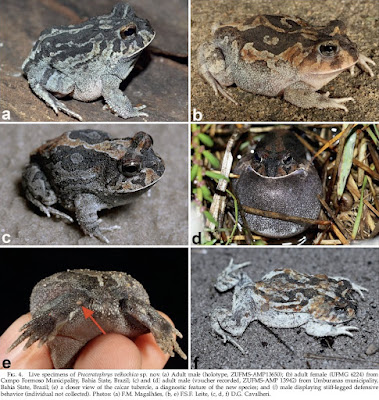
[Herpetology • 2022] Proceratophrys velhochico • A New Species of Proceratophrys (Anura: Odontophrynidae) from Boqueirão da Onça, Northern Bahia State, Brazil


Proceratophrys velhochico

Mângia, de M. Magalhães, Leite, Cavalheri & Garda, 2022

Abstract
The genus Proceratophrys currently comprises 40 species, of which five are distributed within the Caatinga domain and associated phytophysiognomies along northeastern Brazil. During field surveys at high altitudinal sites in Boqueirão da Onça region, northern Bahia state, we collected individuals of Proceratophrys that could not be assigned to any species currently known to occur within the Caatinga, which we describe herein. The new species can be diagnosed from remaining congeners based on vocalization, adult and tadpole morphology, and is also supported by molecular data (mitochondrial 16S, cytochrome b, and nuclear rhodopsin). We recovered the new species nested in the clade composed of species distributed within the Caatinga domain and associated phytophysiognomies, exhibiting a minimum of 7% of genetic divergence for the 16S gene in comparison to all its congeners. The new species seems to be restricted to high altitude locations (above 800 m) at the Boqueirão da Onça region, which represents the largest remaining contiguous Caatinga remnant (∼986,000 ha) being classified as of extreme biological importance.


Proceratophrys velhochico


Sarah Mângia, Felipe de Medeiros Magalhães, Felipe Sá Fortes Leite, Diego Gomiero Cavalheri and Adrian Antonio Garda. 2022. A New Species of Proceratophrys (Anura: Odontophrynidae) from Boqueirão da Onça, Northern Bahia State, Brazil. J. of Herpetology. 56(1); 120-136. DOI: 10.1670/20-070
    

Monday, June 21, 2021

[Herpetology • 2021] Metlapilcoatlus borealis • Molecular Phylogenetics and Morphometrics Reveal A New Endemic Jumping Pitviper (Serpentes: Viperidae: Crotalinae) from the Sierra Madre Oriental of Mexico


Metlapilcoatlus borealis
Tepos-Ramírez, Flores-Villela, Velasco, Lara, Rubio & Jadin, 2021


Abstract
The jumping pitvipers of the genus Metlapilcoatlus are generally associated with montane environments and are widely distributed from central and southern Mexico to Panama. In this study, we analyzed the phylogenetic position and compared the morphology of a population from the Sierra Madre Oriental, within the Sierra Gorda Biosphere Reserve, to other species of jumping pitvipers. We implemented two mtDNA gene fragments (cyt b and ND4) of 50 specimens of the five Metlapilcoatlus species for phylogenetic reconstruction using Bayesian inference and maximum likelihood. We used a linear discriminant analysis and comparative statistics of external and hemipenial characters to assess the morphological differences among Metlapilcoatlus lineages. Our analyses support a strong genetic and morphological distinction of Metlapilcoatlus nummifer populations established to the north of the Trans-Mexican Volcanic Belt (Hidalgo, Northern Veracruz, and Querétaro) from other Metlapilcoatlus taxa. Based on this evidence we describe the populations from the north as a new species.


the holotype of Metlapilcoatlus borealis [MZFC-35381]
from the locality of San Juan de los Durán, in Jalpan de Serra, Querétaro. 
 
  Photographs by Óscar Flores-Villela (A) and Mauricio Tepos Ramírez (B and C).


Metlapilcoatlus borealis sp. nov. 
 
Etymology.— The specific epithet, borealis, references the northernmost distribution of this taxon with respect to the other taxa of Metlapilcoatlus.


Mauricio Tepos-Ramírez, Oscar Flores-Villela, Julián A. Velasco, Carlos Pedraza Lara, Oscar R. García Rubio and Robert C. Jadin. 2021. Molecular Phylogenetics and Morphometrics Reveal A New Endemic Jumping Pitviper (Serpentes: Viperidae: Metlapilcoatlus) from the Sierra Madre Oriental of Mexico. Journal of Herpetology. 55(2); 181-191. DOI: 10.1670/20-028

Monday, May 25, 2020

[Herpetology • 2020] Pristimantis rupicola • A New Rupicolous Species of the Pristimantis conspicillatus Group (Anura: Craugastoridae) from Central Bahia, Brazil


Pristimantis rupicola
Taucce, Nascimento, Trevisan, Leite, Santana, Haddad & Napoli, 2020

DOI: 10.1670/19-114   

Abstract
We describe a new frog species of the megadiverse genus Pristimantis from the Chapada Diamantina, a regional designation of the Espinhaço mountain range in the state of Bahia, northeastern Brazil. We assign the new species to the genus Pristimantis, P. conspicillatus group, based on its phylogenetic position. This is the second rupicolous species of Pristimantis and the fourth species inhabiting northeastern Brazil. The new species is characterized by the following combination of characters: 1) dorsum background color light brown to yellowish-brown, maculated with blackish-brown marks, resembling a granite rock surface; 2) dorsum granular; 3) venter areolate; 4) dentigerous process of the vomer ovoid; 5) snout rounded or truncate in dorsal view; 6) snout rounded in profile; 7) dorsolateral folds absent; 8) finger fringes absent; 9) toe fringes weakly developed; 10) double, poorly developed nuptial pads; 11) vocal slits present in the male; 12) advertisement call composed of one note; 13) call duration 0.011–0.086 s; 14) dominant frequency varying from 2.41 to 3.49 kHz; and 15) decreasing amplitude modulation from the beginning to the end of call. We recovered the new species outside the clade containing the other three nominal species of Pristimantis from northeastern Brazil, as the sister species of P. gaigei, a species from Costa Rica, Panama, and Colombia. The new species seems to be restricted to the high-elevation areas (870–1,800 m a.s.l.) of the Chapada Diamantina, Central Bahia, Brazil. Both the genus Pristimantis and the P. conspicillatus group still lack morphological synapomorphies, and a thorough systematic review based on a stringent phylogenetic hypothesis is necessary for a better understanding of the evolution of these important lineages of Neotropical frogs.

Pristimantis rupicola sp. nov. in life.
Individual lying on a rock and showing its highly camouflaged dorsal pattern (not collected).

 Photo: F. Leal. 

Pristimantis rupicola sp. nov. in life.
 Paratypes  (MZFS-DAR 4460–4461, adult male and adult female, respectively) showing the bluish-tone eye present in some specimens.
 Photo: D. J. Santana. twitter.com/DiegoJSantana 


Pristimantis rupicola sp. nov. 

Etymology.— The specific name is derived from the Latin ‘‘rupes,’’ ‘‘rupis,’’ meaning rock, and ‘‘cola,’’ meaning dweller. The name is used in reference to the habits of the new species, which is commonly found among rocks of the Campo Rupestre environment of the Chapada Diamantina. 

Distribution.— Pristimantis rupicola sp. nov. occurs in the highlands of the Chapada Diamantina, state of Bahia, Brazil, from ~870 to almost 1,800 m of elevation, in the municipalities of Ipupiara, Piatã, and Rio de Contas (Fig. 5).

Advertisement call of Pristimantis rupicola sp. nov. recorded in the municipalities of Rio de Contas and Ipupiara, state of Bahia, Brazil, on 12 January 2010 and 12–15 December 2017. Spectrogram (above), power spectrum (right side) featuring the dominant frequency of the call, and oscillogram (below) of (A) one call (= one short note) without pulses (FSFL 11, adult male); (B) one call (= one short note) having four pulses (FSFL 4); and (C) one call (= one long note) having pulses of irregular duration (FSFL 10).


Pedro P. G. Taucce, Jamile S. Nascimento, Camila C. Trevisan, Felipe S. F. Leite, Diego J. Santana, Célio F. B. Haddad and Marcelo F. Napoli. 2020. A New Rupicolous Species of the Pristimantis conspicillatus Group (Anura: Brachycephaloidea: Craugastoridae) from Central Bahia, Brazil.  J. of Herpetology. 54(2); 245-257. DOI: 10.1670/19-114 


Sunday, October 6, 2019

[Herpetology • 2019] Gloydius huangi • A New Species of Plateau Pit Viper (Serpentes: Viperidae: Gloydius) from the Upper Lancang (=Mekong) Valley in the Hengduan Mountain Region, Tibet, China


Gloydius huangi 
Wang, Ren, Dong, Jiang, Shi, Siler & Che, 2019

Lancang Plateau Viper || DOI: 10.1670/18-126  

Abstract
The Plateau Pit Viper, Gloydius strauchi, from southwest and central China has long been considered a single, widespread species despite suspicion that it represents a potential complex of distinct evolutionary lineages. Although series of works were published on the G. strauchi species complex over the last 10 yr, species boundaries and diagnostic features of different members of the complex have remained poorly understood. Combining both morphological and genetic data, we re-evaluate taxonomic statuses of populations of G. strauchi in southwest China and describe the eastern Tibetan populations as a new species. The new species is most closely related to G. monticola phylogenetically, and it differs from all congeners by having a matte dorsal body scale texture, oval and robust head shape, distinct body ornamentation and coloration, and unique hemipene morphology. In addition, we provide the first updated diagnostic key to all recognized members of the G. strauchi species complex, and discuss ongoing taxonomic problems associated with cryptic diversity within the genus in China.

Holotype of  Gloydius huangi sp. nov. in life (adult female, KIZ 027654)

 Gloydius huangi sp. nov.  

Gloydius strauchi Hu et al., 1987: 143. Zhao et al., 1999: 413–419. 
Zhao, 2006: 127–129. Li et al., 2010: 153–155

Etymology.— The specific name is derived from the surname of Chinese herpetologist Dr. Song Huang from Huangshan University, who has made continuous contributions to research on Chinese snakes in Tibet and the HMR. We suggest ... (Pinyin: Lan Cang Fu) as the Chinese common name of the new species, and Lancang Plateau Viper as its English common name, in the hope of promoting habitat conservation of the Lancang River Basin where the species is native.


Kai Wang, Jinlong Ren, Wenjie Dong, Ke Jiang, Jingsong Shi, Cameron D. Siler and Jing Che. 2019. A New Species of Plateau Pit Viper (Reptilia: Serpentes: Gloydius) from the Upper Lancang (=Mekong) Valley in the Hengduan Mountain Region, Tibet, China. J. of Herpetology.  53(3); 224-236. DOI:  10.1670/18-126