Showing posts with label Author: Matsui. Show all posts

Wednesday, February 11, 2026

[Herpetology • 2026] Leptobrachium widianai • A New Species of Leptobrachium Tschudi, 1838 (Anura: Megophryidae) from Bali and East Java, Indonesia


 Leptobrachium widianai
 Fauzan, Smith, Amarasinghe, Farajallah, Racho, Matsui & Hamidy, 2026 

Widiana’s Litter Frog | Katak Serasah Widiana  || 
RAFFLES BULLETIN OF ZOOLOGY. 74

Abstract
The fauna of Indonesia's Lesser Sunda and eastern Java areas harbour lineages of Leptobrachium that have been historically assigned to L. hasseltii Tschudi, 1838. Here, using an integrative dataset—mtDNA (12S–tRNA^Val–16S; 1,979 bp), adult and larval morphology, and advertisement calls—we delimit and describe a new species from Buleleng (Bali) and Kediri (East Java). Phylogenetic analyses (ML/Bayesian) recover two well-supported clades within L. hasseltii sensu lato: (1) West–Central Java and southern Sumatra (true L. hasseltii) and (2) Bali–East Java (new species), with 16S uncorrected p-distance 3.2–5.2% to L. hasseltii. Morphologically, the new species differs from L. hasseltii by the combination of brown iris with a light-blue scleral arc (eye fully open), very large oval femoral glands (dark edged), no vomerine teeth and rictal glands, distinctive dorsal pattern (dark blotches with paired transverse bars) and ventral patterning, and tadpoles having LTRF 7(1–6)/5(1–4) versus 5(1–4)/5(1–4) in L. hasseltii. The advertisement call is an elongated series of short barks followed by low-frequency squawks and differs markedly in temporal structure from L. hasseltii. We discuss biogeographic implications and provide an IUCN preliminary assessment following current guidelines. 

Key words. Amphibia, bioacoustics, Leptobrachium hasseltii, morphology, phylogeny

Two species of Bali and Javan Leptobrachium in life.
(A, B) Adult male Leptobrachium widianai, new species, from Buleleng, Bali (MZB Amph. 33320, 32734); (C) adult male from Kediri, East Java (MZB Amph. 26959); (D) juvenile (MZB Amph. 32735);
(E) adult male L. hasseltii from Mt. Slamet, Central Java (MZB Amph. 32743); (F) adult male L. hasseltii from Cisarua, West Java (MZB Amph. 32735).

Leptobrachium widianai, new species 

Diagnosis. A medium-sized Leptobrachium (adult male SVL 36.2 mm; adult female SVL to 54.1 mm) assigned to the Leptobrachium hasseltii group (subgenus Leptobrachium sensu Matsui et al., 2010) based on iris colour pattern, femoral gland morphology, and absence of upper lip spines. Distinguished from all congeners by the following combination of characters: (1) Iris and sclera: iris uniformly brown in adults with a narrow light blue scleral arc visible when the eye is fully open (juveniles with distinctive white spot-ring on iris); (2) Femoral glands: very large, oval (occasionally circular), conspicuous, with dark surrounding pigmentation; (3) Humeral glands: present, circular, flat; (4) Dentition and projections: vomerine teeth absent; snout without projections; no dermal palpebral projection; no rictal glands; ventrolateral glandular ridges absent; no upper lip spines. (5) Digital morphology: inner palmar tubercle circular, not extending along first metacarpal; subarticular tubercles reduced, replaced by low callous pads; fingers and toes with rounded, swollen tips, lacking circummarginal grooves; toe webbing poorly developed (I 0–2+, II 0–3+, III 2+–4, IV 4–2 V); (6) Dorsal pattern: typically dark brown with large irregular blotches and paired transverse bars; sometimes with orange vertebral line or orange dots; interorbital–parietal region with darker markings; (7) Lateral and ventral pattern: lateral surfaces dark grey with scattered white granules and a distinct black spot between axilla and groin; ventrum grey to light grey, throat darker, chest densely granular with white spots; (8) Call structure: elongated series of short “barks” followed by low-frequency “squawks,” temporally and structurally distinct from L. hasseltii; (9) Larvae: LTRF 7(1–6)/5(1–4) (vs. 5(1–4)/5(1–4) in L. hasseltii), marginal papillae conical and acute.

Etymology. The specific epithet honours Mr. I Made Widiana Darma Santosa, Director of the Bali Reptile Park, whose longstanding dedication to the conservation of Indonesian reptiles and amphibians — particularly those of Bali — has significantly advanced both in-situ and ex-situ conservation awareness. The name is formed as a genitive singular noun.

 Proposed English name: Widiana’s Litter Frog; 
Proposed Indonesian name: Katak Serasah Widiana.


Muhammad F. FAUZAN, Eric N. SMITH, A. A. Thasun AMARASINGHE, Achmad FARAJALLAH, Asrael RACHO, Masafumi MATSUI and Amir HAMIDY. 2026. A New Species of Leptobrachium Tschudi, 1838 (Anura: Megophryidae) from Bali and East Java, Indonesia. RAFFLES BULLETIN OF ZOOLOGY. 74; 62–86. 

Thursday, August 14, 2025

[Herpetology • 2025] Limnonectes meratusensis • Unveiling A New Species of Fanged Frog (Anura: Dicroglossidae) from southeastern Borneo, Indonesia


Limnonectes meratusensis 
Gonggoli, Shimada, Nishikawa, Matsui, Larson, Smith & Hamidy, 2025   


Abstract
We describe a new species of anuran in the species complex of Limnonectes kuhlii (Tschudi, 1838) from the Meratus Mountain Range of Borneo Island, Indonesia. Mitochondrial DNA analysis places the new species as a sister of L. cintalubang Matsui, Nishikawa, and Eto, 2014. The new taxon differs from all other recognized species of L. kuhlii complex by a large genetic distance and a combination of morphological, bioacoustic, and larval characteristics. This discovery provides new insights into the taxonomic diversity of the L. kuhlii complex in Borneo, particularly within the Meratus Mountain Range, and highlights the importance of conserving this unique and understudied region.

Keywords: Limnonectes, new species, Meratus Mountain Range, mitochondrial DNA, molecular phylogeny

Dorsolateral, dorsal, and ventral views of Limnonectes meratusensis sp. nov.,
male holotype, MZB Amph 33611 (A–C), and female paratype, MZB Amph 33612 (D–F).
Scale: 10 mm. Photographs by Tomohiko Shimada.

Limnonectes meratusensis sp. nov. in life.
A, Non-vouchered specimens; B, holotype male, MZB Amph 33611, from Mt. Halauhalau, South Kalimantan;
C, female paratype, MZB Amph 31570; D, juvenile non-type, MZB Amph 31582, both from Mt. Lumut, East Kalimantan.
The green arrows indicate a distinctive double band pattern on the dorsum. Photographs by Tomohiko Shimada (A, B), Misbahul Munir, and Thornton Larson (C, D).


Ade Damara Gonggoli, Tomohiko Shimada, Kanto Nishikawa, Masafumi Matsui, Thornton Larson, Eric N. Smith and Amir Hamidy. 2025. Unveiling A New Species of Fanged Frog (Amphibia: Anura: Dicroglossidae) from southeastern Borneo, Indonesia. Species Diversity. 30(2); 177-191. DOI: doi.org/10.12782/specdiv.30.177 

Thursday, March 6, 2025

[Herpetology • 2025] Nidirana shyhhuangi • A New Music Frog (Anura: Ranidae: Nidirana) critically endangered in Taiwan


Nidirana shyhhuangi 
C.-F. Lin, Chang, Matsui, Shen, Tominaga & S.-M. Lin, 2025 
 

Abstract
Nidirana okinavana (Boettger, 1895) is a small-sized ranid species belonging to the East Asian genus Nidirana Dubois, 1992. Previous studies have indicated that this species was exclusively distributed on Ishigaki and Iriomote islands in the southern Ryukyus, as well as two extremely small wetland habitats in central Taiwan. Such a restricted distribution makes it one of the most endangered frog species in both Taiwan and Japan. By using molecular, morphological, and acoustic analyses, our study reveals significant divergence between the Taiwanese and Japanese clades, supporting the recognition of the Taiwanese clade as a distinct species, described herein as Nidirana shyhhuangi sp. nov. Compared to Nidirana okinavana sensu stricto from the southern Ryukyus, the Nidirana shyhhuangi sp. nov. is characterized by a significantly smaller and non-overlapping body size, relatively longer forelimbs and hindlimbs, smaller internostril and interorbital distances, with a higher number of cross bands on thigh and shank. Acoustic analyses reveal that the Nidirana shyhhuangi sp. nov. produces calls with a rapid tempo and higher pulse number, with a higher dominant frequency compared to the Japanese clade. Due to the extremely limited distribution of this species to two small sites on Taiwan, and continuing decline in quality of its habitat, we propose that it should be classified as Critically Endangered (CR) under the IUCN criteria. Immediate and comprehensive in situ and ex situ conservation actions are necessary to ensure the sustainable viability of the population.

Key words: Acoustic analysis, Iriomote Island, Ishigaki Island, morphology, Nidirana okinavana


Nidirana shyhhuangi sp. nov. in life
A an adult male with a pale yellowish-brown glandular ridge behind the base of the forelimb, which is diagnostic of the sexes B an adult female, with a more grayish coloration C a first-year juvenile, with a reddish lower iris color D a male calling in the nest showing its subgular vocal sac.
Photographed by Chun-Fu Lin (A–C) and Chunwen Chang (D).

 Nidirana shyhhuangi sp. nov.

Diagnosis. Nidirana shyhhuangi sp. nov. is characterized by a combination of the following characters: (1) a small-sized ranid, body moderately slender; (2) SVL of preserved specimens in adult males 31.6–36.5 mm (mean ± SD = 33.8 ± 1.2 mm, n = 15), females 33.7–38.3 mm (35.9 ± 1.9 mm, n = 4); (3) head triangular, slightly longer than wide; (4) snout comparatively long, triangular in dorsal view with a slightly obtuse tip, moderately pointed in profile; (5) canthus rostralis distinct, contacting with the upper margin of nostril; (6) loreal region dark brown, extending posteriorly over eye and beyond tympanum; (7) upper lip pale white, white line extending posteriorly, forming a white stripe from below nostril to base of forelimb; (8) iris golden above canthus rostralis, dark brown below; (9) tympanum dark brown and conspicuous, dark zone extending posteriorly forming a trapezoid shape; (10) males with a single subgular vocal sac; (11) dorsum brown or yellowish-brown, sometimes ...

Etymology. The specific epithet of the new species shyhhuangi is a Latinized patronymic noun in genitive case. It is dedicated to Prof. Shyh-Huang Chen, a herpetologist and arachnologist who first discovered this species in the early 1980s. We propose the common name “Yuchi music frog” in English to demonstrate the only two sampling sites of the species in Yuchi (meaning the “fish pond”) Township, or “魚池琴蛙” (pronounced as Yú-Chí-Qín-Wā) in Mandarin for this species.

A type locality of Nidirana shyhhuangi sp. nov. in Lienhuachih (23.__°N, 120.__°E), Yuchi Township, Nantou County, Taiwan
B a mud nest with an opening diameter of ~ 0.8 cm. The white arrow indicates the position of the opening.
Photographed by Chun-Fu Lin.


Chun-Fu Lin, Chunwen Chang, Masafumi Matsui, Chin-Chia Shen, Atsushi Tominaga and Si-Min Lin. 2025. Description of A New Music Frog (Anura, Ranidae, Nidirana) critically endangered in Taiwan. ZooKeys. 1229: 245-273. DOI: doi.org/10.3897/zookeys.1229.139344  

Friday, September 27, 2024

[Herpetology • 2024] Limnonectes batulawensis, L. penerisanensis, L. separatus, etc. • Revision of the Limnonectes kuhlii-Like Fanged Frogs (Anura: Dicroglossidae) from Malaysian Borneo


 Limnonectes tawauensis Matsui, Nishikawa & Shimada; 
 L. barioensis Matsui & Nishikawa;  
 L. separatus Matsui, Nishikawa & Shimada; 
 L. penerisanensis Matsui, Nishikawa & Shimada; 
 L. abanghamidi Matsui; 
L. batulawensis Matsui, Nishikawa & Eto, 

in Matsui, Nishikawa, Shimada, Eto, Hamidy, Sudin, Hossman, Gumal et Vairappan, 2024. 

Abstract  
A group of fanged frogs from Southeast and East Asia has long been considered a single widespread species Limnonectes kuhlii, but occurrence in this group of many cryptic species has recently been demonstrated mainly in the continent through molecular phylogenetic analyses. This led to similar analyses of populations from other parts of the known range, and phylogenetic relationships inferred for frogs from the island of Borneo through mitochondrial and nuclear DNA resulted in the presence of nearly 20 distinct lineages. We studied morphological variation in 13 of these lineages from the Malaysian part and confirmed their taxonomically distinct statuses. We applied existing names to three of them, L. conspicillatus, L. kong, and L. mocquardi, and described 10 remaining ones as new species.

KEYWORDS: Borneo, cryptic species, new species, phylogeny, taxonomy


  Limnonectes tawauensis Matsui, Nishikawa et Shimada sp. nov.
[English name: Tawau Fanged Frog]

Limnonectes barioensis Matsui et Nishikawa sp. nov.
[English name: Bario Fanged Frog]

Limnonectes lambirensis Matsui et Nishikawa sp. nov.
[English name: Lambir Fanged Frog]

Limnonectes penerisanensis Matsui, Nishikawa et Shimada sp. nov.
[English name: Penrissen Fanged Frog]

 Limnonectes paginatanensis Matsui, Nishikawa et Shimada sp. nov.
[English name: Paginatan Fanged Frog]

male paratype of Limnonectes tawauensis sp. nov. (BOR 09232, A, B); 
female holotype of L. barioensis sp. nov. (SFC-GRB-00599 [=former KUHE 53065], C, D).  
  male holotype of Limnonectes penerisanensis sp. nov. (SFC-GRB-00604 [=former KUHE 54427], A, B) and L. paginatanensis sp. nov. (BOR 22492, C, D). 

 holotype of Limnonectes separatus sp. nov. (BOR 23415, A, B);
male L. lanjakensis sp. nov. (SFC-GRB-00608 [=former KUHE 17483], C, D).  
female holotype of Limnonectes abanghamidi sp. nov. (SFC-GRB-00610 [=former KUHE 17484], A, B) and female of L. batulawensis sp. nov. (KUHE 53536, C, D). 
Scale bar=10 mm.

Limnonectes separatus Matsui, Nishikawa et Shimada sp. nov.
[English name: Separated Fanged Frog]

Etymology: The specific epithet separatus refers to the disjunct distribution of the species in the mountain ranges of the Crocker in Sabah and Mulu in Sarawak


 Limnonectes lanjakensis Matsui et Nishikawa sp. nov.
[English name: Labang's Fanged Frog]

 Limnonectes abanghamidi Matsui sp. nov.
[English name: Abang's Fanged Frog]

 Limnonectes batulawensis Matsui, Nishikawa et Eto sp. nov.
[English name: Sarawak Mountain Fanged Frog]

Limnonectes paulyambuni Matsui, Nishikawa et Shimada sp. nov.
[English name: Paul's Fanged Frog]


Masafumi Matsui, Kanto Nishikawa, Tomohiko Shimada, Koshiro Eto, Amir Hamidy, Ahmad Sudin, Mohamad Yazid Hossman, Melvin Gumal and Charles Santhanaraju Vairappan. 2024. Revision of the Limnonectes kuhlii-Like Fanged Frogs from Malaysian Borneo (Amphibia: Anura: Dicroglossidae). Current Herpetology. 43 (2); 226-277. DOI: doi.org/10.5358/hsj.43.226 

Thursday, October 19, 2023

[Herpetology • 2023] Rana matsuoi • A New Brown Frog from the Goto Islands, Japan with Taxonomic Revision on the Subspecific Relationships of Rana tagoi (Anura: Ranidae)


Rana matsuoi
 Eto & Matsui, 2023

 
Abstract
Recent molecular analyses cast doubt on the subspecific relationships of Japanese brown frogs Rana tagoi tagoi, R. t. okiensis, and R. t. yakushimensis. Many samples of R. tagoi from three main islands, i.e., Honshu, Shikoku, and Kyushu tend to form a genetic unit with rich variation. On the other hand, R. t. okiensis, R. t. yakushimensis, and some insular samples are clearly isolated from R. t. tagoi and each other. Thus, we propose to treat each subspecies of R. tagoi as full species and describe part of the Goto Islands populations as Rana matsuoi sp. nov. The new species and R. tagoi show a complicated distributional pattern within the Goto Islands but the former is distinguishable from the latter by their smaller male body size, relatively longer limbs, more developed toe webs, nuptial pad formation in breeding male, and advertisement call with repetition of short notes.

KEYWORDS: Goto Islands, Oki Islands, Rana matsuoi new species, taxonomy, Yakushima Island

Dorsal, lateral, and ventral view of holotype of Rana matsuoi sp. nov. (top, scale=10 mm), a male paratype KMNH 2023419VR-KE2056 in life (bottom left, not scaled), and tadpoles (bottom right, scale=10 mm).

Rana matsuoi sp. nov.
Suggested English name: Goto Tago's brown frog
Suggested Japanese name: Goto-tago-gaeru 

Synonymy: Rana t. tagoi: Matsuo et al., 2011, p. 11 (part); Sueyoshi et al., 2013, p. 17 (part)
Rana t. tagoi (lineage A-9c): Eto et al., 2012, p. 666; Eto & Matsui 2014, p. 234
 
Diagnosis: A medium- to small-sized form of the genus (adult males 36.1–40.3 mm, females 38.9–46.7 mm in SVL after fixation); reddish-, dark-, or pale-brown dorsally; a dark mask covering tympanum; a dark shoulder chevron of inverted V shape present but indistinct and interrupted; dorsal and lateral skin nearly smooth with minute granules; supratympanic and dorsolateral fold present; brown mottling present in throat, chest, and ventrolateral area of trunk; usually dark dots present in flunks and ventral side of leg; heels overlapping when limbs are held at right angles to body; tibiotarsal articulation of adpressed limb beyond nostril; tip of digit blunt, slightly dilated but not grooved; toe web developed moderately; males with internal vocal sacs; larvae small, poorly-pigmented. The new species is similar to the other members of the Rana tagoi species complex but can be distinguished from them by the combination of the following characters: small adult body size; relatively long limbs; moderately developed toe webs; and advertisement call with high dominant frequency and repetition of short notes.

Etymology: The specific epithet is dedicated to Mr. Takanori Matsuo, who is a pioneer of herpetofaunal study in the insular regions of Nagasaki Prefecture including the Goto Islands.


Koshiro Eto and Masafumi Matsui. 2023. A New Brown Frog from the Goto Islands, Japan with Taxonomic Revision on the Subspecific Relationships of Rana tagoi (Amphibia: Anura: Ranidae). Current Herpetology. 42(2): 191-209. DOI: 10.5358/hsj.42.191

Thursday, March 2, 2023

[Herpetology • 2023] Leptobrachella korifi & L. sinorensis • Two New Species of Leptobrachella (Anura: Megophryidae) from Northern Thailand


Leptobrachella sinorensis
 Matsui, Panha & Eto, 2023


Abstract  
Phylogenetic analyses using mtDNA gene sequences revealed the presence of two genetic clades in the genus Leptobrachella (former Leptolalax) from northern Thailand. One formed a clade including L. ventripunctata and L. aerea, while another included L. bourrreti and L. laoi. The first clade contained L. cf. minima from Doi Suthep, while the second clade contained L. murphyi and two undescribed species, one from Doi Inthanon, at a high altitude of 2,300 m asl, and another from Mae Hong Son, at Myanmar border. These form a clade, that is sister to L. murphyi. Morphologically, the first species is generally similar to L. murphyi, while the second species resembles L. cf. minima. However, they are clearly distinguished from those described species by great genetic differences, and we describe them as L. korifi sp. nov. and L. sinorensis sp. nov., respectively.

KEYWORDS: Lalos, Leptobrachella korifi sp. nov, Leptobrachella sinorensis sp. nov, Leptolalax, MtDNA phylogeny, Thailand


Leptobrachella korifi sp. nov.

 Diagnosis: A small-sized form of the genus Leptobrachella; adult female 22.7 mm in SVL (n=1); ventral side dusty; tibiotarsal articulation reaching anterior corner of eye; pectoral gland very large; lateral fringe on toes weak.

Etymology: The specific epithet, korifi, is from the Greek “koreefee,” meaning summit, in reference to the high elevation of the habitat [Doi Inthanon, Chiang Mai Province] of the new species.
อึ่งกรายอ่างกา อึ่งกรายยอดดอย(อ่างกา)
เป็นชนิดที่เดิมเคยถูกจำแนกไว้เป็น Leptobrachella bourreti


Dorsolateral view of a male paratype of Leptobrachella sinorensis sp. nov. (KUHE 19809).

Leptobrachella sinorensis sp. nov.
 
Diagnosis: A medium-sized form, adult males 26.6–27.1 mm in SVL (n=3); tibiotarsal articulation reaching center of eye; pectoral gland indistinct; ventral side of head and body creamy white.

Etymology: The specific epithet, sinorensis, is from the Greek “seenoro,” meaning border, in reference to the type locality [Mae Hong Son Province], which lies near the Myanmar border of Thailand.
อึ่งกรายหนังปุ่มแม่ฮ่องสอน อึ่งกรายชายขอบ
มีลักษณะคล้ายกับ อึ่งกรายหนังปุ่มพม่า L. pelodytoides ที่พบในพม่า และ อึ่งกรายหนังปุ่มอินทนนท์ L. murphyi


Masafumi Matsui, Somsak Panha and Koshiro Eto. 2023. Two New Species of Leptobrachella from Northern Thailand (Amphibia, Anura, Megophryidae). Current Herpetology. 42(1); 83-97. DOI: 10.5358/hsj.42.83 
 facebook.com/100088301342746/posts/142909801995731

Monday, August 8, 2022

[Herpetology • 2022] Glandirana reliquia • Genetic and Morphological Variation Analyses of Glandirana rugosa (Anura, Ranidae) with Description of A New Species


Glandirana reliquia Shimada, Matsui, Ogata et Miura, 

in Shimada, Matsui, Ogata, ... et Eto, 2022. 
 
Abstract
Glandirana rugosa is known to include several geographic groups differing in sex chromosomes, and has been proven to be paraphyletic in mitochondrial phylogeny with respect to G. susurra. By analyzing genetic and morphological variation in a large number of individuals of Glandirana, we studied their taxonomic relationships. A mitochondrial DNA phylogeny, with the G. tientaiensis as outgroup, revealed two major lineages containing respectively (1) the East group of G. rugosa, G. susurra, and the Central and Southeast-Kyushu groups of G. rugosa; and (2) G. emeljanovi, and the North and West groups of G. rugosa. In contrast, in a nuclear DNA phylogeny based on SNP data, lineages of (1) G. susurra and East group, and (2) the remaining groups of G. rugosa and G. emeljanovi, were split, indicating a distinct status of the East group among G. rugosa. In adult morphology, there were only minor differences between the East group and the remaining groups of G. rugosa, but in larvae, the East group had significantly more sparse skin glands than the others. The exact type locality of G. rugosa is most probably in western Japan, not including the range of the East group. From these results, we describe the East group as a new species, Glandirana reliquia, distinct from the remaining groups of G. rugosa. The new species with sexually homomorphic chromosomes is thought to represent a basic stock of Japanese Glandirana, which existed far before G. rugosa originated.

Keywords: Amphibia, Eastern Japan, Glandirana rugosa, larval ventral glands, Mitochondrial DNA phylogeny, Nuclear DNA phylogeny
 
Dorsal (A) and ventral (B) views of the whole body and ventral view of left hand (C) and foot (D) of the male holotype of Glandirana reliquia sp. nov. (KUHE 64088). Scale bar = 20 mm (A, B);5 mm (C, D).
A lateral view of a nearly topotypic male in life (AUEZ 0843: Kamogawa City, Chiba Prefecture) is shown as well (E).


Glandirana reliquia Shimada, Matsui, Ogata et Miura sp. nov.
(English name:  Proto wrinkled frog)
(Japanese name:  Mukashi-Tsuchi-gaeru ムカシツチガエル )

Diagnosis. A moderate-sized species of the genus Glandirana, with adult SVL 31–54 mm in females and 29–43 mm in males. From G. rugosa, this new species is differentiated morphologically in only in several morphometric characters relative to SVL in metamorphs, but is fairly different in development of larval skin glands, and definitely differs from them in nuclear genome characters. It differs from G. susurra and G. emeljanovi, in ratios of morphometric characters and ventral coloration, from G. tientaiensis by less flat dorsal ridges and more granulated ventral skin, and from G. minima by larger body and much well developed toe webbing. Diploid chromosomes are homomorphic, i.e., not sexually dimorphic unlike most of G. rugosa.

Etymology. The specific epithet is from a Latin noun denoting relic, alluding to the facts that the species represents a basic stock of Japanese Glandirana existing far before the western G. rugosa was derived and leaves a part of its own genome within the heteromorphic sex chromosomes of G. rugosa (Miura et al. 1998; Miura 2007; Mawaribuchi et al. 2016).


Tomohiko Shimada, Masafumi Matsui, Mitsuaki Ogata, Ikuo Miura, Mai Tange, Mi-Sook Min and Koshiro Eto. 2022. Genetic and Morphological Variation Analyses of Glandirana rugosa with Description of A New Species (Anura, Ranidae). Zootaxa. 5174(1); 25-45. DOI: 10.11646/zootaxa.5174.1.2
新種・ムカシツチガエルを発見 

Thursday, March 3, 2022

[Herpetology • 2022] Onychodactylus pyrrhonotus • A New Salamander of the Genus Onychodactylus (Caudata: Hynobiidae) from Central Honshu, Japan


Onychodactylus pyrrhonotus
Yoshikawa & Matsui, 2022

 Fireback Clawed Salamander | ホムラハコネサンショウウオ || DOI: 10.5358/hsj.41.82 
 
Abstract
The number of species of salamanders of the genus Onychodactylus in Japan has increased from one to six nominal species over the past decade, by taxonomic studies based not only on morphological but also molecular phylogenetic data. However, the presence of an additional cryptic species has been suggested by a series of previous studies. Here, we describe a new species, Onychodactylus pyrrhonotus sp. nov., from the Kinki, Chubu and Hokuriku Districts of central Honshu, Japan, based on morphological and genetic evidence. It belongs to the O. japonicus species complex and is the sister species of O. kinneburi from Shikoku Island and westernmost part of Honshu with 5.5% sequence divergence in the mitochondrial cytochrome b gene. The range of the new species completely overlaps with that of O. japonicus sensu stricto, and they are syntopic in at least six known localities. As shown in a previous study, reproductive isolation between these sympatric species is substantial. The new species is morphologically most easily distinguished from congeners by coloration, a sharply defined scarlet to pinkish dorsal stripe or mottling on a black background and dusty white dots on the venter.

KEYWORDS: Central Honshu, Japan, Onychodactylus japonicus, Onychodactylus pyrrhonotus new species, Salamander, sympatry, taxonomy


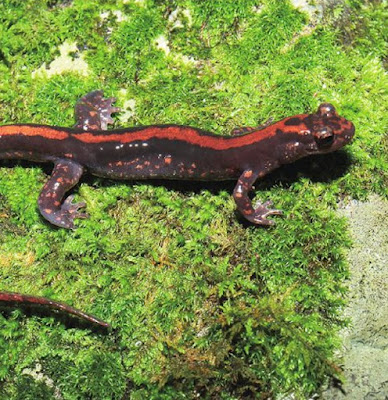
Male holotype of Onychodactylus pyrrhonotus sp. nov. (NSMT-H 13600) in life.

Onychodactylus pyrrhonotus sp. nov. 
Dorsal and ventral views of the male holotype (A and B; NSMT-H 13600, SVL=67.9 mm)
and a female paratype (C and D; KUHE 47970, SVL=72.8 mm).
 Scale bar indicates 10 mm.

Dorsal views of Onychodactylus pyrrhonotus sp. nov. showing variation in dorsal coloration. Discontinuous spots (A: KUHE 38273) and continuous series of blotches (B: KUHE 40002). Dorsal coloration varies the scarlet (A), light orange (B), yellow (C: KUHE 47969) and pink (KUHE 41526).
Scale bar indicates 10 mm.

Onychodactylus pyrrhonotus sp. nov.
(Suggested English name: Fireback Clawed Salamander)
(Suggested Japanese name: Homura-hakonesanshou-uwo
「ホムラハコネサンショウウオ」)

Diagnosis: The new species is a member of the genus Onychodactylus and is diagnosed by the following characters: lungs absent; black horny claws present on tips of fingers and toes of larvae and breeding adults in both sexes; vomerine teeth in two short, transverse, arch-shaped series; larvae with skin folds on posterior edges of limbs; nuptial males with dermal flaps on posterior edge of hindlimb; black tubercles and asperities on palm and sole in nuptial males and on sole in nuptial females; breeding in flowing water under the ground; eggs large, pigmentless, small in number. It is further assigned to a member of the O. japonicus species complex by the genetic evidence and presence of a distinct dorsal stripe or marking. Onychodactylus pyrrhonotus sp. nov. is most similar to O. kinneburi, but differs in morphology (smaller body, fewer presacral vertebrae, wide internarial distance relative to head width) and coloration (scarlet, orange or pink dorsal stripe or marking on purplish black background; purplish gray ventrum with dusty white dots). Body size moderate with mean SVL (±1 SD) of 65.7±3.2 mm and 70.7±5.2 mm in males and females, respectively; tail longer than SVL in both sexes; snout relatively short; pair of dark marking on chest absent or indistinct; presacral vertebrae including atlas usually 18; costal grooves 12–13.
 
Etymology: The specific epithet, combination of ancient Greek words “pyrrho-” (fire-colored) and “-notus” (back), is derived from the beautiful scarlet dorsal coloration of the new species, and is also inspired from the coloration like the venter of the Japanese fire-bellied newt, Cynops pyrrhogaster
The suggested English name is after the specific epithet. The suggested Japanese name is derived from a Japanese word “Homura (flame)” 「火の色の背中」.

Range: Onychodactylus pyrrhonotus sp. nov. is currently known from Kyoto, Mie, Nara, and Shiga Prefectures of the Kinki District, Ishikawa and Fukui Prefectures of the Hokuriku District, and Gifu Prefecture of the Chubu District, all in central Honshu (Fig. 1). To date, the new species is not known from Wakayama Prefecture in the southern Kii Peninsula, but it probably occurs in the area. The geographic range of the new species overlaps entirely with the entire geographic range of O. japonicus, and they are sympatric in at least six localities (Fig. 1).


Natsuhiko Yoshikawa and Masafumi Matsui. 2022. A New Salamander of the Genus Onychodactylus from Central Honshu, Japan (Amphibia, Caudata, Hynobiidae). Current Herpetology41(1); 82-100. DOI: 10.5358/hsj.41.82

Thursday, February 11, 2021

[Herpetology • 2020] Buergeria choui • A New Species of Buergeria (Amphibia: Rhacophoridae) from the Southern Ryukyus and Northwestern Taiwan


Buergeria choui 
Matsui & Tominaga, 2020


Abstract
Buergeria japonica, long thought to be a single species widely occurring on the Ryukyu Archipelago and Taiwan, proved to include three genetically differentiated clades, (1) the Northern and Central Ryukyu, (2) the Southern Ryukyu and Northern Taiwan, and (3) the Southern Taiwan clades. The Southern Taiwan clade has already been split from the others as a distinct species. A distinct heterospecific relationship of the Southern Ryukyu and Northern Taiwan clade from the Northern and Central Ryukyu clade was also clear from genetic evidence. Morphological comparison between specimens from the Yaeyama (the Southern Ryukyu and Northern Taiwan clade) and Amamioshima, the type locality of B. japonica (the Northern and Central Ryukyu clade), confirmed genetic differences and corroborate their independent species status. Thus, we describe the Northern Taiwan and Southern Ryukyu clade as Buergeria choui sp. nov.

KEYWORDS: Buergeria choui sp. nov., mitochondrial DNA phylogeny, morphometry, Northern Taiwan, Southern Ryukyu


Dorsal (A) and ventral (B) views of male holotype of Buergeria choui sp. nov. (RUMF-ZH-01032). Scale bar = 5 mm.

Buergeria choui sp. nov.
[Japanese name: Yaeyama-Kajika-Gaeru]
[English name: Yaeyama Kajika Frog]
 
Polypedates japonicus: Van Denburgh, 1912, p. 205 (part); Okada, 1930, p. 192 (part); Okada, 1931, p. 207 (part); Okada, 1966, 178 (part).
Rhacophorus japonicus Inger, 1947, p. 346 (part); Nakamura and Uéno, 1963, p. 67 (part).
Buergeria japonica: Utsunomiya, 1979, p. 168 (part).
Buergeria japonica Northern Taiwan +Southern Ryukyu (NT/SR) clade: Tominaga et al., 2015, p. 240.
Buergeria japonica Japanese clade: Wang et al., 2017, p. 7.

Diagnosis: The new species is placed in Buergeriinae Channing, 1989, with distal end of the third metacarpal scarcely flattened, lacking a bony knob. It is assigned to a member of the genus Buergeria by having small body, becoming slender posteriorly; dorsum yellow to gray brown, never changing to green; pupil horizontally ellipsoid; tympanum evident; vomerine teeth degenerated; webs well developed among toes, but absent among fingers; digital disks with circummarginal grooves; tips of distal digits T-shaped, not forked clearly; skin scattered with irregular tubercles without dorsolateral fold, but with supratympanic fold; ventral surface covered with rough circular tubercles; and a single vocal sac in males. Buergeria choui sp. nov. is very similar to B. japonica but is differentiated by morphometric characteristics and number and arrangements of dark spots on lower lips. It also is similar to B. sp. ST but differs in morphometric characteristics and markings on the thighs. Also, B. choui sp. nov., as well as B. japonica, lacks a long call unique to B. sp. ST. See Comparisons below for further details.

Etymology: The specific name is dedicated to Dr. Wen-Hao Chou, Professor of the National Museum of Natural Science, Taichung, Taiwan, who first paid attention to the variation and taxonomy of B. japonica (sensu lato) at the beginning of 1990s.


Masafumi Matsui and Atsushi Tominaga. 2020. A New Species of Buergeria from the Southern Ryukyus and Northwestern Taiwan (Amphibia: Rhacophoridae). Current Herpetology. 39(2); 160-172. DOI: 10.5358/hsj.39.160

Friday, September 18, 2020

[Herpetology • 2020] Microhyla kuramotoi • Distinct Species Status of A Microhyla (Anura, Microhylidae) from the Yaeyama Group of the Southern Ryukyus, Japan


Microhyla kuramotoi 
Matsui & Tominaga, 2020

 
Abstract
A Japanese microhylid, Microhyla okinavensis, originally described from Okinawajima Island, middle Ryukyus, was long synonymized with M. ornata from India. However, molecular phylogenetic studies revealed its distinct species status from M. ornata, and more recent phylogenetic study revealed the population from the Yaeyama Group of the southern Ryukyus to be a sister taxon to Chinese M. mixtura and not to populations from the remaining group of the Ryukyus, that are sister to another Chinese species, M. beilunensis. The Yaeyama and the remaining Ryukyu populations greatly differ phylogenetically, although less clearly morphologically. From these data, we consider the Yaeyama population as a species distinct from M. okinavensis from the middle Ryukyus.

KEYWORDS: Microhyla beilunensis, Microhyla fanjingshanensis, Microhyla mixtura, Microhyla okinavensis, new species, Yaeyama Group


Dorsal (A) and ventral (B) views of male holotype of Microhyla kuramotoi sp. nov. (RUMF-ZH-01017). Scale bar = 5 mm.

Systematics
Microhyla kuramotoi sp. nov.
[Japanese name: Yaeyama-Himeama-Gaeru]
[English name: Yaeyama Narrow-Mouthed Toad]


Microhyla okinavensis Stejneger, 1907, p. 89, (part); Parker, 1934, p. 138, (part); Okada, 1966, p. 42 (part).
Microhyla fissipes Okada, 1930, p. 63 (part); Okada, 1931, p. 71 (part).
Microhyla ornata Gressitt, 1938, p. 164, (part); Inger, 1947, p. 324 (part); Nakamura and Uéno, 1963, p. 66 (part).

Diagnosis: A member of the Microhyla fissipes species group of Garg et al. (2019), which is distinguished from other Microhyla groups by; small to medium-sized adults; nostrils placed towards the lateral sides of the snout; finger and toe tips rounded; terminal phalanges of toes knobbed or T-shaped; inner metatarsal tubercle present, elongate; outer metatarsal tubercle small, rounded; webbing between toes rudimentary; dorsal skin shagreened to sparsely granular; a narrow mid-dorsal line extending from tip of the snout to the vent.

Etymology: The specific name is dedicated to Dr. Mitsuru Kuramoto, Emeritus Professor of the Fukuoka University of Education, for his great contributions to Asian amphibian biology, including the fauna of the southern Ryukyus.


Map of East Asia (A) and Ryukyu Islands (B), showing distribution of Microhyla species. Open circle and obliquely hatched area: Microhyla kuramotoi sp. nov., reverse triangle and vertically hatched area: M. okinavensis, closed circle: M. beilunensis, closed triangle: M. fanjingshanensis, closed square and finely dotted area: M. mixtura, horizontally hatched area: M. fissipes.


Range: Yaeyama Islands of Southern Ryukyus, Okinawa Pref., Japan: Ishigakijima Is., Taketomijima Is., Kohamajima Is., Iriomotejima Is., and Haterumajima Is. Artificially introduced into Kuroshima Is.

Natural history: Microhyla kuramotoi sp. nov. occurs from lowlands to montane regions, and lives on the ground among leaf litter and grasses. The breeding season extends almost the entire year, but is usually intensive from February to October. Film-like egg mass is laid on the surface of various bodies of still waters including ponds, rice fields, temporary pools, and sometimes slowly flowing small streams. Eggs are dark yellowish brown in the animal hemisphere. Females collected from Iriomotejima Is. and Kohamajima Is., respectively, contained 624–1207 (mean=916.9) and 271–890 (528.9) mature ova of 1.0–1.3 (mean=1.2) mm in diameter (Matsui and Ota, 1984 as M. ornata). Larvae form a cohort, swimming slowly in the middle and upper layers of water sucking in plankton.


Masafumi Matsui and Atsushi Tominaga. 2020. Distinct Species Status of a Microhyla from the Yaeyama Group of the Southern Ryukyus, Japan (Amphibia, Anura, Microhylidae). Current Herpetology. 39(2); 120-136. DOI: 10.5358/hsj.39.120 
 

Thursday, January 2, 2020

[Herpetology • 2019] Kurixalus absconditus • A New Tree Frog of the Genus Kurixalus Ye, Fei & Dubois, 1999 (Anura: Rhacophoridae) from West Kalimantan, Indonesia


Kurixalus absconditus 
Mediyansyah, Hamidy, Munir & Matsui, 2019
  
 Photographs by Mediyansyah || facebook.com/AmirHamidy7

ABSTRACT
Kurixalus absconditus sp. nov., a new species of tree frog of the genus Kurixalus, described from West Kalimantan on the basis of molecular phylogenetic and morphological evidence. The new species can be distinguished from its congeners by a combination of following morphological characters: havingsmaller body size, more prominent of mandibular symphysis, skin smooth on throat, vomerine odontophores two oblique series touching anterior corner of choanae and widely separated, vomerine teeth thick, buccal cavity narrow and deep, choanae with teardrop shaped, single vocal slit, weakly crenulated dermal fringe on fore-and hindlimbs. 

Keywords: Kurixalus absconditus sp. nov., new species, West Kalimantan


Figure 4. (A & B) Adult male holotype of Kurixalus absconditus sp. nov. (MZB Amph 21862) in life;
(C & D) juvenile paratype MZB Amph 21860–21861. Not to scale.
(Photographs by Mediyansyah).

Kurixalus absconditus sp. nov.

Etymology. The specific epithet “absconditus” is derived from a Latin word, ”disguised, concealed or hidden”. The name is an adjective in concordance with the previous undetected status of this species within K. appendiculatus group.

Suggested English common name. Piasak-frilled Swamp Treefrogs.
Suggested Indonesia common name. Katak-renda piasak.

Diagnosis. The new species is assigned to the genus Kurixalus based on molecular  analysis, and following morphological characters: asmall-sized rhacophorid(SVL<50 mm);tips of fingers dilated into round disks having circummarginal grooves; snout tip pointed; finger webbing poorlydeveloped; toe webbing moderately developed; dermalfringespresentonforearmand tarsus; narrow flap on heel and crenulate dermal projection on vent; dorsum brown with saddle-shaped or X-shaped marking (Nguyen et al., 2014a; Yu et al., 2017b, 2018). Kurixalus absconditus sp. nov. can bedistinguished from all known congeners by a combination of following morphological characters: (1)smaller body size of an adult male; (2) more prominent mandibular symphysis; (3) skin smooth on throat; (4) vomerine odontophores two oblique series touching anterior corner of choanae and widely separated; (5) vomerine teeth thick, short with oval-shaped; (6) narrow and deep buccal cavity; (7) choanae teardropshaped; (8) weakly crenulated dermal fringe on outer edges of fore-and hindlimb; (9) hindlimb slightly short, tibio-tarsal articulation of adpressed limb reaches center of the eye.

Figure 8. (A) Non–vouchered adult male of Kurixalus absconditus sp. nov.
(B) adult male of K. chaseni from Bukit Batikap, Central Kalimantan Province; (C) adult male of K. chaseni from Lahat, South Sumatra Province; (D) adult male of K. chaseni from Ketapang, West Kalimantan Province; (E) adult male of K. chaseni from Sungai Wain, East Kalimantan Province; (F) adult male of K . chaseni from Grand Forest Park (TAHURA) Sultan Adam, South Kalimantan Province; (G) adult male of K. chaseni from Terengganu, Peninsular Malaysia;
(H) adult male of K. appendiculatus from the Philippines. 


Not to scale. Photographs by Mediyansyah (A, B, C, D); Amir Hamidy (E); Zainudin. B. Akar (F); Evan Quah (G); Arvin C. Diesmos (H).

Map of the Kalimantan, Indonesian Borneo showed the type locality of Kurixalus absconditus sp. nov. (red circle)

Distribution and Natural history. Kurixalus absconditus sp. nov. currently is known only from the type locality. The holotype and juvenile paratypes were collected in the shrub swamp habitat close to secondary swamp forest (Fig. 9). The holotype was found clinging to the trunk of a tree 70 cm above the ground and the juvenile paratypes were found perched on leave 100–190 cm above the ground. The tadpoles, eggs, and female individual were not found. The advertisement call of this species is unknown. Associated frog species observed in the collection site were Amnirana nicobariensis (Stoliczka), Chalcorana raniceps (Peters), Hylarana erythraea (Schlegel), Polypedates colletti (Boulenger), Pulchrana baramica (Boettger), and Limnonectes paramacrodon (Inger).


Mediyansyah, Amir Hamidy, Misbahul Munir and Masafumi Matsui. 2019.  A New Tree Frog of the Genus Kurixalus Ye, Fei & Dubois, 1999 (Amphibia: Rhacophoridae) from West Kalimantan, Indonesia. Treubia. 46; 51–72. DOI: 10.14203/treubia.v46i0.3790