Showing posts with label Rosaceae. Show all posts

Friday, August 14, 2026

[Botany • 2026] Rubus kashmiricus (Rosaceae) • A New Species from Kashmir Himalaya, India


Rubus kashmiricus   

in Sofi, Khuroo, Lateef, Moochi et Wani, 2026. 
 
Abstract
Rubus kashmiricus (Rosaceae), is described here as a new species from the Kashmir Himalaya, India. The species is distinct from its closely allied species R. niveus in possessing pedately-pinnate leaves on primocanes, 7–9-foliate with an obovate terminal leaflet, inflorescence paniculiform, flower larger (13–20 mm diam.), sepals reflexed at or after anthesis, petals spreading and non-overlapping, nearly equal in length to the sepals, stamens shorter than petals as well as carpels, ovary glabrous with a few hairs only at apex and fruit comprising 1–4 drupelets. Detailed photographic illustrations and comparison of its diagnostic characters with the allied taxa are provided to aid accurate identification.

Eudicots, Rosales, Species discovery, Systematic, Taxonomy


SAMEER A. SOFI, ANZAR AHMAD KHUROO, SHAGUFTA LATEEF, SHAKIR A. MOOCHI, AIJAZ A. WANI. 2026. Rubus kashmiricus (Rosaceae), A New Species from Kashmir Himalaya, India.  Phytotaxa. 770(1); 20-28. DOI: doi.org/10.11646/phytotaxa.770.1.2 [2026-08-14] 

Wednesday, December 17, 2025

[Entomology • 2025] Batophila alishanensis, B. chungi, B. tsoui, B. wusheensis ... • The Genus Batophila Foudras, 1860 (Coleoptera: Chrysomeliae: Galerucinae) in Taiwan, with Descriptions of 11 New Species


A. Rubus taitoensis var. aculeatiflorus (Rosaceae); B. Adult of Batophila chungi sp. nov. on underside of leaf of R. taitoensis var. aculeatiflorus; 
C. Adult of B. houjayi sp. nov. resting on underside of leaf of Persicaria chinense (Polygonaceae); D. Adults of B. tsoui sp. nov. resting on underside of leaf of Rubus wallichianus (Rosaceae); 
E. Otanthera scaberrima (Melastomataceae); F. Adults of B. tsoui sp. nov. feeding on underside of leaf of O. scaberrima
Lee, 2025
 

Abstract
The Taiwanese species of the genus Batophila Foudras, 1860 are revised. Batophila acutangula Heikertinger, 1921 is removed from the list of Taiwanese fauna. Batophila taiwanica Döberl, 2010 is recognized and redescribed. Additionally, eleven new species from Taiwan are described: B. alishanensis sp. nov., B. choui sp. nov., B. chungi sp. nov., B. houjayi sp. nov., B. huangi sp. nov., B. jungchani sp. nov., B. meihuai sp. nov., B. tsoui sp. nov., B. wusheensis sp. nov., B. yehi sp. nov., and B. yuae sp. nov. The species descriptions include illustrations of aedeagi, antennae, gonocoxae, abdominal ventrite VIII, and spermathecae.

Key words: Host plant, leaf beetles, Melastomataceae, Polygonaceae, Rosaceae, Rubus, taxonomy

Field photographs of Batophila species
A. Rubus taitoensis var. aculeatiflorus (Rosaceae); B. Adult of Batophila chungi sp. nov. on underside of leaf of R. taitoensis var. aculeatiflorus;
C. Adult of B. houjayi sp. nov. resting on underside of leaf of Persicaria chinense (Polygonaceae); D. Adults of B. tsoui sp. nov. resting on underside of leaf of R. wallichianus (Rosaceae);
E. Otanthera scaberrima (Melastomataceae); F. Adults of B. tsoui sp. nov. feeding on underside of leaf of O. scaberrima


 Chi-Feng LEE. 2025. The Genus Batophila Foudras, 1860 (Coleoptera, Chrysomeliae, Galerucinae, Alticitae) in Taiwan, with Descriptions of 11 New Species. ZooKeys. 1258: 73-118. DOI: doi.org/10.3897/zookeys.1258.163900 [03 Nov 2025]

Saturday, December 6, 2025

[Botany • 2025] Rubus tianmuensis (Rosaceae) • A New Species from southeastern Anhui Province, China


Rubus tianmuensis K. Zhang & Yong F. Yin, 

in Yin, Yi et Zhang, 2025. 
天目悬钩子 | DOI: doi.org/10.11646/phytotaxa.732.2.6
 
Abstract
Rubus tianmuensis, a newly discovered species belonging to the genus Rubus and Rosaceae family, is native to the Tianmu Mountains in southeastern Anhui Province. Genetically, it is related closely to R. chingii; however, several key morphological features position R. tianmuensis apart from R. chingii. Morphological analysis indicated that R. tianmuensis is characterized by persistently pedate leaves (vegetative and reproductive) with differentiated terminal leaflets on distinct petiolules, a trait consistently observed in both wild populations and cultivated specimens under under standard growth conditions. Additionally, the pedicels exhibit dense pubescence comprising short glandular trichomes and recurved prickles. Phylogenetic analysis based on ITS sequences confirmed the distinctiveness of this new species from R. chingii.

Rubus tianmuensis, Flora of China, Rosaceae, Rubus, Eudicots

Rubus tianmuensis K. Zhang & Yong F. Yin.
 A. Flowering branch (showing the flowering leaf shape). B. Vegetative branch (showing leaf shape during the vegetative period). C. Upper part of the pedicel (showing the glandular and pubescent hairs). D. Lower part of the pedicel (showing the prickle). E. Stipules of flowering branches. F. Flower.
Drawn by LiMing Zhang.

Rubus tianmuensis K. Zhang & Yong F. Yin.
A. Habitat. B. Leaf shape. C. Flowering branch. D. Flower. E. Upper part of the pedicel (showing the glandular and pubescent hairs). F. Fruit branch. G. Fruit. H. Seed. I. Stipules on flowering branches. J. Vegetative plant. K. Vegetative branch (showing leaf shape during the vegetative period). L. Local close-up of a leaf on the vegetative branch (showing the petiolule).

Rubus tianmuensis K. Zhang & Yong F. Yin, sp. nov.
 (天目悬钩子)  

 Type:—CHINA. Anhui Province: Jixi County, Qingliangfeng National Nature Reserve, at the edge of the hillside forest, 30°__N, 118°__E, alt. 778m, March, 28, 2019, K. Zhang & Yong F. Yin, R190328001 (holotype, ACM! ACM1903280011; isotype, ACM! ACM1903280012). 

Diagnosis:—Rubus tianmuensis differs from R. chingii in several key morphological features. R. chingii has simple, palmately lobed leaves with five deep lobes, whereas the new species has compound, pedately divided leaves, with the terminal leaflet having a distinct petiolule. Additionally, the leaves of R. chingii are either hairy only along the veins or nearly glabrous on both sides, whereas the new species’ leaves are slightly pubescent on both sides. The stipules of R. chingii are linear lanceolate, whereas the stipules of the flowering branches in the new species are lanceolate, wider than those of R. chingii, and distinctly hairy. Furthermore, R. chingii has glabrous pedicels, whereas the pedicels of the new species are covered with distinct hairs, short glandular hairs, and hooked spines. These distinguishing features clearly delineate the two species.

Etymology:—Species name is derived from the mountain Tianmu where Rubus tianmuensis was discovered (天 目悬钩子).


Yongfei YIN, Shanyong YI and Ke ZHANG. 2025. Rubus tianmuensis (Rosaceae), A New Species from southeastern Anhui Province, China. Phytotaxa. 732(2); 193-202. DOI: doi.org/10.11646/phytotaxa.732.2.6 [2025-12-04] 

Wednesday, November 19, 2025

[Botany • 2025] Rubus semiplenus (Rosaceae) • A New Species with naturally occurring semi-double flowers from Hunan, China


Rubus semiplenus Huan C. Wang, Ming Hong Li & T. T. Wang,
 
in T.-T. Wang, Li, Kuang, Xia, Q.-P. Wang et H.-C. Wang, 2025. 

Abstract  
The semi-double (semiplenus) floral trait is highly valued in the field of horticulture, yet it remains exceptionally rare in wild plants. Rubus semiplenus, a new species with naturally occurring semi-double flowers, is described and illustrated. This new species was discovered in the Nanyue Hengshan National Nature Reserve, Hunan Province, China. It is distinguished by its herbaceous to dwarf subshrub habit, simple suborbicular leaves (0.7–2.5 × 0.7–2.5 cm), and semi-double flowers with dicyclic petals (10–12). Molecular phylogenetic analyses based on ITS and rbcL + matK sequences consistently confirmed that R. semiplenus belongs to Sect. Rosaefolii as defined by Focke and is closed to R. hirsutus.

Key words: Endemism, Hengshan Mountains, morphology, phylogeny, Section Rosaefolii, taxonomy

Rubus semiplenus sp. nov. 
A habit B adaxial surface of leaf C abaxial surface of leaf D flower.


Rubus semiplenus sp. nov.
A habit B adaxial surface of leaf C abaxial surface of leaf D flower E calyx F infructescence G fruit.

 Rubus semiplenus Huan C. Wang, Ming Hong Li & T. T. Wang, sp. nov.

Diagnosis. Rubus semiplenus is most closely related to Rubus hirsutus Thunb., but clearly distinguished morphologically from the latter by its habit herbs or dwarf subshrubs (vs. shrubs in R. hirsutus), stems villous hairs (vs. soft and glandular hairs), leaves simple (vs. imparipinnate, 3–5 foliolate), suborbicular (vs. ovate or broadly ovate), sepals ovate-orbicular (vs. ovate-lanceolate or triangular-lanceolate), petals dicyclic, semi-doubled flowers, with 10–12 (vs. petals 5).

Etymology. The specific epithet “semiplenus” is derived from the Greek words “semi” (meaning half) and “plenus” (meaning double), which refer to this new species with semi-double flowers.


 Ting-Ting Wang, Ming-Hong Li, Dai-Yong Kuang, Jiang-Lin Xia, Qiu-Ping Wang and Huan-Chong Wang. 2025. Rubus semiplenus (Rosaceae), A New Species with naturally occurring semi-double flowers from Hunan, China. PhytoKeys. 257: 79-93. DOI: doi.org/10.3897/phytokeys.257.150519

Sunday, October 19, 2025

[Botany • 2025] Polylepis yanesha (Rosaceae) • A New Species from the Oxapampa-Asháninka-Yánesha Biosphere Reserve, Perú


Polylepis yanesha L. Valenz. & T. Boza,

in Valenzuela Gamarra et Boza Espinoza, 2025. 

Abstract
A new species of Polylepis from the humid Puna in the Oxapampa-Asháninka-Yánesha Biosphere Reserve (BIOAY), Pasco Region, Perú, is described and illustrated. This species was found between 3700–3850 m elevation, on Rocky Mountains, in small patches or relict forests of the buffer zone of Yanachaga Chemillén National Park. Polylepis yanesha is similar to P. rocio-rojasii but differs because the leaves have much smaller oblong-elliptic leaflets, the abaxial surface is densely lanuginose with scattered filiform glandular trichomes of golden yellow resin, shorter and thinner petioles, the inflorescence is short, axillary, pendulous, 4.0–8.0 cm long with 5–8 flowers, a greater number of stamens, 17–23; the fruits are much smaller, rounded-ovoid to cylindrical achenes, with short, blunt-tipped spines. We also present details on its geographic distribution, ecological notes, a key to differentiating species of the genus Polylepis sect. Sericeae, a comparative table of characteristics between similar species, and an assessment of the conservation status of the new species.

Achene, Central Amazonian Peruvian, Ecosystem, Protected areas, Rhytidome, Tropical Andes, Sericeae, Eudicots


Polylepis yanesha L. Valenz. & T. Boza sp. nov. 


Luis VALENZUELA GAMARRA and Tatiana Erika Boza ESPINOZA. 2025. A New Species of Polylepis (Rosaceae) from the Oxapampa-Asháninka-Yánesha Biosphere Reserve, Perú. Phytotaxa. 712(3); 255-267. DOI: doi.org/10.11646/phytotaxa.712.3.3 [2025-08-01]

Wednesday, May 7, 2025

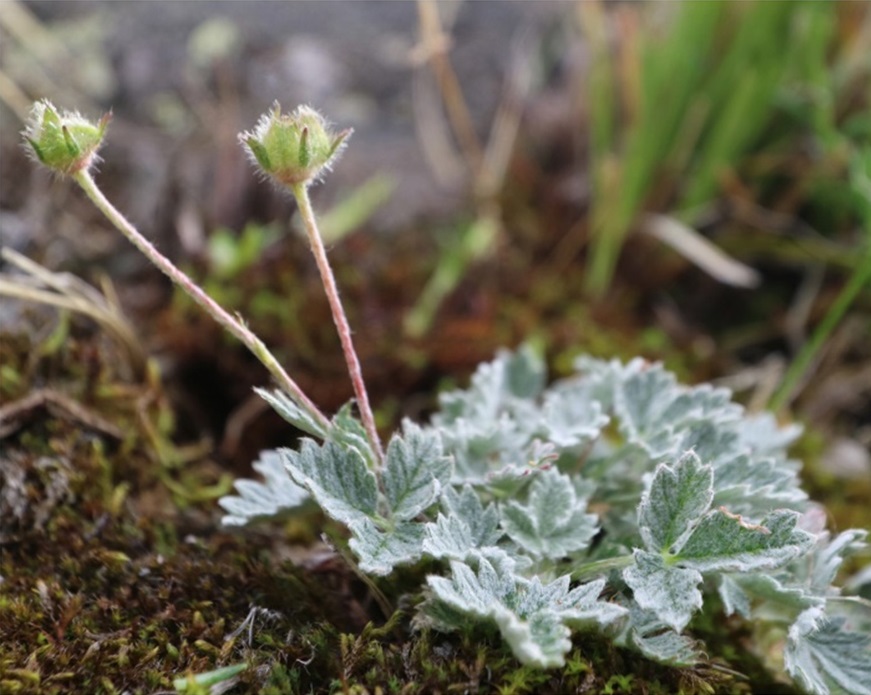
[Botany • 2025] Potentilla sanczirii (Rosaceae) • A New Species from high Mountain Range in Western Mongolia


Potentilla sanczirii V. Gundegmaa., G. Onolragchaa & M.Urgamal, 

in Gundegmaa, Onolragchaa , Javzandolgor, Dashmaa, Munkh-Erdene et Urgamal, 2025. 
 
Abstract
The genus Potentilla L. is one of the genus with controversial taxonomic position in family Rosaceae, and show a rich species diversity, adapting in mountains hills, high-altitude mountains and arid communities in Palearctic region. Potentilla sanczirii is described and illustrated as new species from Western Mongolian high mountain range. We used conventional morphometric and molecular phylogeny methods to describe new species. With this new contribution, we added a species to the genus Potentilla. L, which makes it with 79 elements in Mongolia. It is morphologically similar to P. nivea, such as, basal leaves ternate, Lower leaflet surface covered with whitish or grayish tomentose. However, differs in multiple caudex covered with dark-brown remains of decayed stipules, and the upper surface of its leaves is adorned with long, silky hairs (light grey). This species' mature nuts (achenes) are light green, approximately 1.0 mm long, and have a smooth surface.A Bayesian Inference tree was reconstructed to further understand the phylogenetic relationships within the genus, and a time-calibrated phylogenetic tree of the subtribe Potentillinae, including 15 species of Pot entilla from Mongolia. The time-calibrated phylogenetic tree suggests that the newly discovered P. sanczirii originated approximately 6.50 million years ago during the late Miocene.

Phylogenetic analysis, Taxonomy, Western Mongolia, Eudicots


Potentilla sanczirii V. Gundegmaa., G. Onolragchaa & M.Urgamal sp. nov.


GUNDEGMAA Vanjil, ONOLRAGCHAA Ganbold, JAVZANDOLGOR Chuluunbat, DASHMAA Tsogtbayar, MUNKH-ERDENE Tovuudorj and URGAMAL Magsar. 2025. Potentilla sanczirii (Rosaceae), A New Species from high Mountain Range in Western Mongolia. Phytotaxa. 691(3); 293-300. DOI: doi.org/10.11646/phytotaxa.691.3.6 [2025-03-07]


Wednesday, April 30, 2025

[Botany • 2025] Prunus luxurians (Rosaceae) • A new cherry species from south-western Ecuador


Prunus luxurians Pérez-Zab., Á.J.Pérez, Romol. & N.Albán,  
  
in Pérez, Pérez-Zabala, Romoleroux, Espinel-Ortiz, Romoleroux et Albán-Vallejo. 2025. 

Abstract
Prunus luxurians, a new species from Buenaventura Reserve at El Oro province in Ecuador is described and illustrated. Additionally, notes on its geographical distribution, ecology, conservation status, and taxonomic affinities are documented. Prunus luxurians has some vegetative and floral similarities with other Andean species, but the unique combination of oblong-lanceolate leaves with prominent secondary and tertiary veins, densiflorous floriferous shoots less than 5 cm long, sepals with two marginal glands and flowers with turbinate hypanthium clearly differentiates it from the rest. This is the first species of Prunus described from the western flank at elevation below 1500 m, and particularly from a humid spot surrounded by dry areas (Tumbesian influence). Other taxonomic novelties of Prunus on this flank can be expected, so further botanical exploration is needed to better understand the diversity of the genus in the region.

Key words: Buenaventura Reserve, El Oro, Neotropics, plant taxonomy

Prunus luxurians Pérez-Zab., Á.J.Pérez, Romol. & N.Albán 
A habit B branch with leaves and floriferous shoots C flowers.
 Photos by Á.J. Pérez.

Prunus luxurians Pérez-Zab., Á.J.Pérez, Romol. & N.Albán 
A habit B floriferous shoot C leaf lower surface D, E leaf glands F flower G petal lower surface H petal upper surface I detail of petals and sepals (notice marginal glands).
 A–I based on Á.J. Pérez et al. 11743 (QCA). Illustrations by Natasha Albán.

 Prunus luxurians Pérez-Zab., Á.J.Pérez, Romol. & N.Albán, sp. nov.
 
Diagnosis. Prunus luxurians has a unique combination of leaves oblong lanceolate, cernuous in posture, around three times longer than wider, with prominent secondary and tertiary veins, secondary veins curved toward the margin and apparently eucamptodromous but becoming brochidodromous distally, base rounded to subcordate, floriferous shoots erect, densiflorous, less than 5 cm long, sepals with 2 marginal glands and flowers with turbinate hypanthium. Prunus integrifolia (Presl.) Walp. share with the new species the leaf shape and transverse posture, number of secondary veins, erect floriferous shoots and anthers of similar size; but, the new species has leaves shorter than 14 cm (vs. more than 15 cm.), chartaceous (vs. coriaceous), with conspicuous venation (vs. relatively obscure), glands submarginal and separated from the midrib (vs. attached to the midrib), turbinate hypanthium (vs. wide turbinate) and erect pedicels (vs. recurved) (Fig. 4).
 

 Álvaro J. Pérez, Jorge Andrés Pérez-Zabala, Katya Romoleroux, David A. Espinel-Ortiz, Chaquira Romoleroux, Natasha Albán-Vallejo. 2025. A new cherry species (Prunus, Rosaceae) from south-western Ecuador. PhytoKeys. 255: 23-34. DOI: doi.org/10.3897/phytokeys.255.151041 

Resumen: Se describe e ilustra Prunus luxurians, una nueva especie de la Reserva Buenaventura en la provincia de El Oro en Ecuador. Además, se documentan notas sobre su distribución geográfica, ecología, estado de conservación y afinidades taxonómicas. Prunus luxurians comparte algunas similitudes vegetativas y florales con otras especies andinas, pero la combinación única de hojas oblongo-lanceoladas con venas secundarias y terciarias prominentes, brotes floríferos densifloros de menos de 5 cm de largo, sépalos con dos glándulas marginales y flores con hipanto turbinado la diferencian fácilmente del resto. Esta es la primera especie de Prunus descrita del flanco occidental a una altitud inferior a 1500 m, y particularmente de un lugar húmedo rodeado de zonas secas (influencia tumbesina). Se espera que existan otras novedades taxonómicas de Prunus en este flanco, por lo que es necesaria una mayor exploración botánica para comprender mejor la diversidad del género en la región.

Tuesday, April 8, 2025

[Botany • 2025] Pyrus zhaoxuanii (Rosaceae) • A New pear Species from Danxiashan Mountain, Guangdong, China


Pyrus zhaoxuanii  X.W.Yi, B.B.Liu & Q.Fan,

 in Yi, Wu, Fan, F. Chen, Z.-X. Chen, Liu et Huang, 2025. 
 
Abstract
Pyrus zhaoxuanii is described as a new species from Guangdong Province, China, within the genus Pyrus, specifically under P. subg. Pashia. Although it shares morphological similarities with P. calleryana, P. zhaoxuanii can be distinguished by its uniquely small, obovate, leathery leaves, which have an obtuse apex and short petioles. A phylogenetic analysis based on single nucleotide polymorphisms (SNPs) indicated that P. zhaoxuanii forms an independent branch within Pyrus and is categorized in the Oriental clade, P. subg. Pashia. Currently, this species has only been recorded in the Danxiashan National Nature Reserve. Considering its potential distribution and population size, we recommend classifying this species as Least Concern (LC) according to the IUCN Red List classifications and criteria.

Key words: Danxia landscape, new species, phylogeny, Pyrus

Line drawing of Pyrus zhaoxuanii
A flowering plant B fruiting plant C flower D appearance of fruit E leaf F pistil G longitudinal section of flower H longitudinal and cross section of fruit I bud scales J stamens.
Scale bars: 5 cm (A, B); 1 cm (C, D, E, F, G); 2 cm (H); 2 mm (I); 5 mm (J). 
Illustrated by Si-Rui Pan.

Flower and pome of  Pyrus zhaoxuanii
A frontal dissection of the flower B stamens C longitudinal section of the flower D front view of the entire flower E cross and longitudinal sections of the fruit F cross-section of the ovary.
Scale bars: 1 cm (A, E); 5 mm (B, C, D, F).

 Pyrus zhaoxuanii
A plant, stem with many branches and thorn B habitat, growing on the edge of cliffs or steep slopes C branches with many subdivisions and thorns D lenticels on young branches E surface of the stem F, G leaves during the fruiting period H, I leaf buds and bud scales with hair J, K flowers L, M fruits
N, O comparison of P. zhaoxuanii(left) and P. calleryana (right). 

 Pyrus zhaoxuanii X.W.Yi, B.B.Liu & Q.Fan, sp. nov.
 Chinese name. 昭璇梨
 
Diagnose. Pyrus zhaoxuanii is similar to P. calleryana, but can be differentiated by its small, obovate leaves, short petioles, pronounced stem thorns, and shrubby habit.

Etymology. Pyrus zhaoxuanii is named in honor of Prof. Zhao-Xuan Zeng (1921–2007), a famous geographer of South China Normal University, who made significant contribution to the study of danxia landscape.


Xiao-Wei Yi, Ying-Yu Wu, Qiang Fan, Fang Chen, Zai-Xiong Chen, Bin-Bin Liu and Cui-Ying Huang. 2025. Pyrus zhaoxuanii (Rosaceae), A New pear Species from Danxiashan Mountain, Guangdong, China. PhytoKeys. 254: 161-173. DOI: doi.org/10.3897/phytokeys.254.138039

Monday, March 3, 2025

[Botany • 2025] Rubus tingzhouensis (Rosaceae) • A New Species from Fujian, China


Rubus tingzhouensis C. An & G. C. Lin,
  
in Chen, G.-C. Lin, Wang, Zhuang, Yao, Yang, Qin, Y.-X. Lin et An, 2025. 
红毛木莓  ||  DOI: doi.org/10.3897/phytokeys.249.138951 

 Abstract 
Rubus tingzhouensis C.An & G.C.Lin, a newly-defined species within the family Rosaceae from Fujian Province, China, is formally described and illustrated here. R. tingzhouensis is morphologically similar to R. swinhoei, but can be distinguished by several key characteristics, such as long, reddish-purple stipitate glands, soft bristles, light yellow short trichomes (vs. shortly grey tomentose at the early stage, glabrescent) and scattered epidermal prickles (vs. few to many curved prickles). Furthermore, the stipules are pinnately deeply laciniate, measuring 1–1.5 cm (vs. ovate-oblong to ovate-lanceolate, 0.5–0.8 cm). Phylogenetic analyses, based on partial sequences and the complete plastome data, provide robust support for a close relationship between R. tingzhouensis and R. swinhoei, while also highlighting distinct genetic differentiation between these two species. The chloroplast genome of R. tingzhouensis is 156,311 bp in length and comprises 132 unique genes, including 86 protein-coding genes, 37 transfer RNAs, eight ribosomal RNAs and one pseudogene.

Key words: Biodiversity, classification, floristic survey, morphology, new taxon

Rubus tingzhouensis C. An & G. C. Lin
A plant in natural habitat B leaf (adaxial surface) C leaf (abaxial surface) D, E, F flower and inflorescence G androecium H stamen I stigma J petal K stipule.

Illustration of Rubus tingzhouensis C. An & G. C. Lin
A habit B petal C longitudinal section of flower D free lobes of calyx E stamen F pistil G flower H stipule I bract J margin and trichome of leaf K trichome of abaxial leaf L section of leafed stem.
Drawn by Yunxiao Liu.

 Rubus tingzhouensis C.An & G.C.Lin, sp. nov. 
Chinese name: 红毛木莓
 
Diagnosis: This species is similar to R. swinhoei in its growth habit, with ovate to oblong-lanceolate leaf blades and botryoid inflorescences that may be terminal or axillary. However, R. tingzhouensis can be distinguished by its dense indumentum of long, reddish-purple stipitate glands, soft setae and light yellow short trichomes on the plant surface. It also has scattered epidermal prickles, adding to its distinct appearance. Additionally, it has deeply laciniate stipules measuring 1–1.5 cm in length, which are significantly more divided than those of related species, making them a key distinguishing feature.

Etymology: The specific epithet ‘tingzhouensis’ refers to the ancient region Tingzhou (汀州) in south-western Fujian, China, where this species was discovered. The Chinese name, “红毛木莓” (hong mao mu mei), reflects the plant’s dense covering of reddish-purple long hairs. 


Ming Chen, Gui-Can Lin, Tao Wang, Yi-Xue Zhuang, Yi-Xin Yao, Cheng-Zi Yang, Yuan Qin, Yan-Xiang Lin and Chang An. 2025. Rubus tingzhouensis (Rosaceae), A New Species from Fujian, China. PhytoKeys. 249: 251-267. DOI: doi.org/10.3897/phytokeys.249.138951 

Sunday, July 7, 2024

[Botany • 2024] Polylepis rocio-rojasii (Rosaceae) • A New Species from the Bosque de Proteccion Pui-Pui, Peru


Polylepis rocio-rojasii
  
in Gamarra et Valdivia, 2024.
 
Abstract
A new species of Polylepis (Rosaceae) from the Humid Puna of the Bosque de Proteccion Pui-Pui in Junin, Peru, is described and illustrated. The new species was found at 3800 m elevation, in small patches or forest relicts of the natural protected area, growing in open areas highly exposed to wind and abundant fog, along with other shrubby species, mainly Chusquea tessellata (Poaceae). It is very similar to Polylepis canoi but differs by trifoliolate leaves with larger leaflets, lanuginose abaxially, and rounded to ovoid achenes, smaller than those of P. canoi. We also present details on its geographic distribution, ecological notes, and an assessment of the conservation status of the new species.

Exfoliating rhytidomes, Geological formations, National Service of Protected Natural Areas, Tropical Andes, Sericeaee, Sericeus, Stipular sheath, Eudicots


Polylepis rocio-rojasii


Luis Valenzuela Gamarra and María Isabel Villalba Valdivia. 2024. A New Species of Polylepis (Rosaceae) from the Bosque de Proteccion Pui-Pui, Peru.  Phytotaxa. 655(1); 97-104. DOI: 10.11646/phytotaxa.655.1.8

Monday, June 10, 2024

[Botany • 2023] Prunus quanzhouensis (Prunus subg. Cerasus, Rosaceae ) • A New Species from northeastern Guangxi, China


 Prunus quanzhouensis Jian L. Li, S.H. Liang & R.H. Jiang, 

in Liang, Qin, Huang, Tang, Zhang, C. Li, He, Jiang et J.-L. Li. 2023.
 
Abstract
Prunus quanzhouensis is a new species of Rosaceae discovered in Guangxi, China, which is here described and illustrated. Despite its morphological similarities to P. campanulata, P. conradinae and P. xueluoensis, it can be distinguished from them by being shrubs or small trees, with 1.5–3.0 m tall, leaves with 10–13 pairs of lateral veins, abaxially glabrous involucral bracts, adaxially appressed villous bracts, flowers measuring 1–1.2 cm in diameter, tubular hypanthium with about 9×3 mm, oblique sepals, 30–35 stamens, and a style that is villous and longer than the stamens. Less than six populations of this new species have been found in the type locality, with approximately 130 mature individuals, which accounted for more than 95% of the total population. Based on direct observation in the field and the IUCN Red List Categories and Criteria, P. quanzhouensis is classified as Endangered (EN).

Eudicots, Endangered, new species, Quanzhou Tianhu National Wetland Park, systematics, taxonomy


全州樱花 
Prunus quanzhouensis Jian L. Li, S.H. Liang & R.H. Jiang


Sheng-Hua Liang, Bo Qin, Yao-Heng Huang, Li-Ming Tang, Zhan-Jiang Zhang, Cui Li, Ying-Hui He, Ri-Hong Jiang and Jian-Ling Li. 2023. Prunus quanzhouensis: a newly discovered species of Prunus subgen. Cerasus (Rosaceae) from northeastern Guangxi, China.  Phytotaxa. 622(4); 252-259. DOI: 10.11646/phytotaxa.622.4.2
www.gxlky.com.cn/g/7478.html

Wednesday, November 29, 2023

[Botany • 2023] Cotoneaster densiflorus (Rosaceae) • A New Species from western Sichuan, China


Cotoneaster densiflorus M.W. Li, Q. Fan & W. B. Liao, 
 
in Li, Li, Lu, Mo, Ding, Chen, Lai, Zhang, Liao et Fan, 2023. 

Abstract
Cotoneaster densiflorus, a new species of Rosaceae from western Sichuan, China, is described and illustrated. Morphologically, we inferred that the new species belongs to Cotoneaster Ser. Salicifolii sensu Yü et al. (1974) in the Flora of China and Fryer and Hylmö (2009). This species is most similar to C. salicifolius, but differs in its leaf blade of ovate-lanceolate to obovate shape (vs. elliptic-oblong to ovate-lanceolate), smaller length-width ratio of 2.37 ± 0.31 (vs. 3.17 ± 0.32), slightly conduplicate (vs. not conduplicate), less lateral veins of 6–8 pairs (vs. 12–16 pairs), upper surface slightly rugose (vs. rugose), leaf margin plane (vs. revolute), lower surface densely grey tomentose (vs. grey tomentose, with bloom), greater corolla diameter of 7–9 mm (vs. 5–6 mm), styles 2 (vs. 2–3), pyrenes 2 (vs. 2–3), larger pollen grains P/E values of 2.05 ± 0.12 (vs. 1.19 ± 0.05) and leaf epidermis type W (vs. type I). Based on phylogenetic analysis of the whole chloroplast genome, C. densiflorus is sister to C. rhytidophyllus, but distantly related to C. salicifolius.

Key words: Anatomical, chloroplast genome, leaf epidermis, palynological, Ser. Salicifolii

Cotoneaster densiflorus sp. nov.
A habit B leaf, adaxial surface C leaf, abaxial surface D flowers E vertical section of flower F petals G stamens H styles I fruiting branch J pome K transverse section of pome L pyrenes.
Illustration by Zhengmeng Yang based on living field-collected materials (Q. Fan & M.W. Li 14925, M.W. Li 20230617007).

Cotoneaster densiflorus sp. nov.
A habitat B habit C branchlets D petal, stamen, style, and vertical section of flower E ovate-lanceolate to obovate shape of leaves F leaf, abaxial surface G 2 pyrenes per fruit H inflorescence I fruiting branch.

 Cotoneaster densiflorus M.W. Li, Q. Fan & W. B. Liao, sp. nov.
 

Diagnosis: Morphologically, Cotoneaster densiflorus is similar to C. salicifolius, but differs in its leaf blade of ovate-lanceolate to obovate shape (vs. elliptic-oblong to ovate-lanceolate), smaller length-width ratio of 2.37 ± 0.31 (vs. 3.17 ± 0.32), slightly conduplicate (vs. not conduplicate), fewer lateral veins of 6–8 pairs (vs. 12–16 pairs), upper surface slightly rugose (vs. rugose), leaf margin plane (vs. revolute), lower surface densely grey tomentose (vs. grey tomentose, with bloom), greater corolla diameter of 7–9 mm (vs. 5–6 mm), styles 2 (vs. 2–3) and pyrenes 2 (rarely 3). Although there is a closer phylogenetic relationship between the new species and C. rhytidophyllus, it is easy to distinguish them by the indumentum color of branchlets, leaves and inflorescences, rugose leaf upper surface, fruit shape and pyrenes number. See Table 2, Figs 1, 2 for a detailed comparison.

Etymology: The specific epithet refers to the compact compound corymbs with (5–)10– to 50–(61)-flowered per inflorescence.


Mingwan Li, Dan Li, Mengfei Lu, Shuangfeng Mo, Shen Ding, Yuanyuan Chen, Yong Lai, Dangquan Zhang, Wenbo Liao and Qiang Fan. 2023. A New Species of Cotoneaster (Rosaceae) from western Sichuan, China. PhytoKeys. 236: 39-52. DOI: 10.3897/phytokeys.236.111819


Monday, September 18, 2023

[Botany • 2023] Sorbus erythrosepala (Rosaceae) • A New Species from Yunnan, China


 Sorbus erythrosepala  Kainul., Sjöman & Aldén,

in Kainulainen, Sjöman et Aldén, 2023. 

Sorbus erythrosepala sp. nov. from Napa Hai in north-western Yunnan is here described and illustrated. It belongs to the white to crimson fruited Sorbus subgenus Albocarmesinae and is superficially similar to the sympatric Sorbus filipes Hand.-Mazz., but it can be distinguished from that species by the stouter shoots, the larger leaves with pubescent, dull and more numerous leaflets, and in the coloration of the fruits.

KEYWORDS: Rosaceae, Sorbus, rowan, China, Yunnan, new species


 Sorbus erythrosepala sp. nov., photos of cultivated material (KGB 71) at Gothenburg Botanical Garden:
A, flower buds; B, open flowers; C, branch with immature fruits; D, ripe fruits; E, buds; F, shrub in autumn colours with pendulous infructescenses. Photographs: K. Kainulainen.
 
Sorbus erythrosepala Kainul., Sjöman, Aldén, sp. nov.
 
Sorbus erythrosepala sp. nov. is morphologically similar to S. filipes Hand. -Mazz. in having lax inflorescences with pink flowers; longpedunculate and ± pendulous infructescences and white to pink fruits, but it differs from the latter in having leaves that are sparsely pubescent and dull (vs glabrous and glossy), and leaflets that are longer (to c. 35 mm vs c. 20 mm) and more numerous (up to 15 vs 8-13). Furthermore, its mature fruits are usually white (sometimes with pink blotches and usually with pink to crimson calyx lobes) whereas fruits of Sorbus filipes are usually pinkish.

ETYMOLOGY. — The specific epithet refers to the red sepals, which are distinctly contrasting on the otherwise white fruits.


Kent Kainulainen, Henrik Sjöman and Björn Aldén. 2023. Sorbus erythrosepala Kainul., Sjöman, Aldén, sp. nov. (Rosaceae), A New Rowan from Yunnan, China.  ADANSONIA. 45(21); 337-342. 
  twitter.com/Publi_MNHN/status/1702306780687008006