Showing posts with label David Attenborough. Show all posts

Wednesday, May 7, 2025

[Crustacea • 2016] Kingsleya attenboroughi • A New and Endangered Species of Kingsleya Ortmann, 1897 (Decapoda: Brachyura: Pseudothelphusidae) from Ceará, northeastern Brazil


Kingsleya attenboroughi
 Pinheiro & Santana, 2016
 

Abstract
A new species of freshwater crab, Kingsleya attenboroughi n. sp., from the Arajara district, Ceará state, Brazil, is described and illustrated. The new species differs from congeners by having a short apical plate in the first gonopod, with anteriorly directed lobes and proximally angular; proximal lobe of the apical plate with conspicuous semicircular protuberance in mesial and sternal views; marginal process protruded, projecting mesially in sternal view and subquadrate in mesial view; and field of apical spines narrow, tapering distally, with small spines concentrated proximally. Opportunity is taken to illustrate K. gustavoi Magalhães, 2005, the closest allied species of K. attenboroughi n. sp. A key for the species of Kingsleya Ortmann, 1897 is provided.

Keywords: Crustacea, Amazon Basin, freshwater crabs, Kingsleyini, IUCN Red list, species diversity


Taxonomy
Family Pseudotelphusidae
Tribe Kingsleyini Bott, 1970

Kingsleya Ortmann, 1897

Type species: Kingsleya latifrons (Randall, 1840) [Potamia] by monotypy, gender feminine.

Included species with genera of the original combination indicated in brackets: Kingsleya attenboroughi n. sp.; K. besti Magalhães, 1990; K. castrensis Pedraza, Martinelli-Filho & Magalhães, 2015; K. celioi Pedraza & Tavares, 2015; K. gustavoi Magalhães, 2005; K. hewashimi Magalhães & Türkay, 2008; K. junki Magalhães, 2003; K. latifrons (Randall, 1840) [Potamia]; K. siolli (Bott, 1967) [Potamocarcinus (Kingsleya)]; K. ytupora Magalhães, 1986.


Kingsleya attenboroughi n. sp. 

Etymology. 
This new species is named in honor of the English naturalist Sir David Attenborough, a devoted naturalist and communicator of science that promotes environmental education and protection, including in the Chapada do Araripe, from where this species appears to be endemic


Allysson P. Pinheiro and William Santana. 2016. A New and Endangered Species of Kingsleya Ortmann, 1897 (Crustacea: Decapoda: Brachyura: Pseudothelphusidae) from Ceará, northeastern Brazil. Zootaxa. 4171(2): 365–372. DOI: doi.org/10.11646/zootaxa.4171.2.9  


Thursday, February 20, 2025

[Funga • 2025] Gibellula attenboroughii (Hypocreales: Cordycipitaceae) •The araneopathogenic genus Gibellula in the British Isles, including A New Zombie Species on Orb-weaving Cave Spiders (Tetragnathidae: Metainae)


Gibellula attenboroughii, habitat and paratype, on Meta menardi.
 
Evans, Fogg, Buddie, Yeap, & Araújo, 2025 
 
Abstract  
The genus Gibellula (Cordycipitaceae: Hypocreales) comprises species pathogenic on and specific to spider hosts. Here, we report on the occurrence of a novel species infecting cave-dwelling, orb-weaving spiders of the sub-family Metainae (Tetragnathidae) in the British Isles. The new species, Gibellula attenboroughii is described and illustrated and its ecology is discussed; leading to the conclusion that infected spiders exhibit behavioural changes similar to those reported for zombie ants. The hidden diversity of the genus Gibellula in the British Isles is further highlighted based on fungarium records and literature searches. Two spider pathogens, previously assigned to the genus Torrubiella, are now transferred to the genus Gibellula, based on their Granulomanus synasexual morphs, in accordance with the one fungus-one name initiative: Gibellula albolanata comb. nov. and G. aranicida comb. nov.

Keywords: Gibellula attenboroughii; entomopathogenic fungi; host manipulation; new taxa; systematics

 
Gibellula attenboroughii, habitat and paratype IMI 507598, on Meta menardi.
A. Whitefathers’ Caves, showing the dark zone above the River Barran, County Cavan, Republic of Ireland. B. Entrance and twilight zone. C. Infected spider in situ, on cave ceiling, showing early infection with immature synnemata on compact, white subiculum, the specimen was found immediately above the figure in the centre. D. Dried specimen, showing creamish-yellow subiculum covering ventral abdomen.
 Scale bars: C = 0.5 mm; D = 0.25 mm.


  Evans, H.C.; Fogg, T.; Buddie, A.G.; Yeap, Y.T. and Araújo, J.P.M. 2025. The araneopathogenic genus Gibellula (Cordycipitaceae: Hypocreales) in the British Isles, including A New Zombie Species on Orb-weaving Cave Spiders (Metainae: Tetragnathidae).  Fungal Systematics and Evolution. DOI: doi.org/10.3114/fuse.2025.15.07 


Wednesday, July 17, 2024

[Botany • 2024] Cattleya attenboroughiana (Orchidaceae: Laeliinae) • A New Species from the Diamantina Plateau, Minas Gerais, Brazil


Cattleya attenboroughiana E.L.F.Menezes, Giordani & R.A.Pinheiro, 

in Menezes, Giordani, Pinheiro et Gonella. 2024. 

Summary
A new species of Cattleya ser. Parviflorae (Orchidaceae) is here described from the campos rupestres of the Diamantina Plateau, part of the Espinhaço Range, Minas Gerais, SE Brazil. The new species is named Cattleya attenboroughiana and it is here compared to the most similar taxa and illustrated with photographs. The new species is likely a microendemic but the available data is insufficient for a precise conservation status assessment, so we consider it Data Deficient (DD), reinforcing the need for further exploration in the Diamantina Plateau.

Key Words: Campos rupestres, endemism, Espinhaço Range, orchid


Cattleya attenboroughiana E.L.F.Menezes, Giordani & R.A.Pinheiro sp. nov.  

ETYMOLOGY. The specific epithet is dedicated to Sir David Frederick Attenborough, a British anthropologist, naturalist, and documentary filmmaker who is an inspiration for new generations of scientists dedicated to the Natural Sciences, such as the authors of this work.


Euler L. F. Menezes, Samuel C. O. Giordani, Rodrigo A. Pinheiro and Paulo M. Gonella. 2024. Cattleya attenboroughiana (Orchidaceae: Laeliinae): A New Species from the Diamantina Plateau, Minas Gerais, Brazil. Kew Bulletin. DOI: 10.1007/s12225-024-10198-0

Friday, May 10, 2024

[Herpetology • 2024] Trachylepis attenboroughi, T. ovahelelo, T. vunongue, ... • The Trachylepis (Squamata: Scincidae) of Angola : An Integrative Taxonomic Review with the Description of Seven New Species

 
 1. Trachylepis albilabris; 2. T. albopunctata; 3. T. ansorgii.
4. Trachylepis attenboroughi, sp. nov.8. Trachylepis bouri, sp. nov.13. T. hilariae, sp. nov.;
18. T. ovahelelo, sp. nov.; 19. T. suzanae, sp. nov.
 22. T. vunongue, sp. nov.; 25. T. wilsoni, sp. nov. 
Ceríaco,  Marques, Parrinha, Tiutenko, Weinell, Butler & Bauer, 2024

Drawings by Arthur Tiutenko.

Abstract
The genus Trachylepis is currently represented by 21 species in Angola, most of them part of nomenclaturally and taxonomically challenging species complexes. In this study we present an integrative taxonomic revision of the genus in Angola and describe seven new speciesTrachylepis attenboroughi, sp. nov., Trachylepis bouri, sp. nov., Trachylepis hilariae, sp. nov., Trachylepis ovahelelo, sp. nov., Trachylepis suzanae, sp. nov., Trachylepis vunongue, sp. nov., and Trachylepis wilsoni, sp. nov. As result of our taxonomic revisions, 25 valid Trachylepis species are now confirmed from Angola. A phylogenetic analysis using a combination of mitochondrial (16S, ND2) and nuclear (RAG1) markers, as well as morphological data, supports the recognition of the new species. In addition, data support the revalidation of Trachylepis albopunctata (Bocage, 1867), Trachylepis notabilis (Peters, 1879), and Trachylepis ansorgii (Boulenger, 1907). We also provide a redefinition of Euprepes anchietae Bocage, 1866, which we synonymize with Trachylepis maculilabris (Gray, 1845). Given that the type material for Trachylepis albopunctata, T. angolensis, and T. anchietae has been lost or destroyed, we designate neotypes for the purpose of nomenclatural stability. The description of the new species and the revision and revalidation of previously described Angolan species contribute to a better understanding of the taxonomy and biogeography of the genus, as well as to the general biogeographic patterns and evolution of the Angolan fauna.
 
Keywords: Skinks, Angola, Classification, Squamata, Trachylepis attenboroughi, Trachylepis bouri, Trachylepis hilariae, Trachylepis ovahelelo, Trachylepis suzanae, Trachylepis vunongue, Trachylepis wilsoni


 1. Trachylepis albilabris; 2. T. albopunctata; 3. T. ansorgii.
4. Trachylepis attenboroughi, sp. nov.; 5. T. bayonii; 6. T. binotata; 7. T. bocagii.
8. Trachylepis bouri, sp. nov.; 9, T. chimbana; 10. T. damarana; 11. T. hoeschi; 12. T. huilensis; 13. T. hilariae, sp. nov.; 14. T. laevis
Drawings by Arthur Tiutenko.

  15. Trachylepis maculilabris; 16. T. notabilis.  
17. Trachylepis occidentalis; 18. T. ovahelelo, sp. nov.; 19. T. suzanae, sp. nov.; 20. T. punctulata; 21. T. raymondlaurenti.  
 22. T. vunongue, sp. nov.; 23. T. sulcata; 24. T. wahlbergi; 25. T. wilsoni, sp. nov. 
Drawings by Arthur Tiutenko.


Luis M. P. Ceríaco, Mariana P. Marques, Diogo Parrinha, Arthur Tiutenko,  Jeffrey L. Weinell, Brett O. Butler and Aaron M. Bauer. 2024. The Trachylepis (Squamata: Scincidae) of Angola : An Integrative Taxonomic Review with the Description of Seven New Species. Bulletin of the American Museum of Natural History. 465. hdl.handle.net/2246/7345


Wednesday, March 6, 2024

[PaleoOrnithology • 2024] Imparavis attenboroughi • First Edentulous Enantiornithine (Aves: Ornithothoraces) from the Lower Cretaceous Jehol Avifauna


Imparavis attenboroughi
  Wang, Clark, O'Connor, Zhang, Wang, Zheng & Zhou, 2024

Artwork: Ville Sinkkonen.

Abstract
Among Mesozoic birds, enantiornithines exhibit great morphological variation, which likely reflects their species diversity, range, and overall success throughout the Cretaceous. The majority of enantiornithines come from the Lower Cretaceous Jehol deposits (130–120 Ma) in northeastern China. In contrast to living birds, most enantiornithines were fully toothed. However, the rostral lengths, appendicular proportions, and pedal morphologies of extant birds can still inform on possible diet, flight mode, and ecology. Both partial (e.g., Longipterygidae) and complete tooth loss (e.g., Yuornis, Gobipteryx) are observed among enantiornithines, with edentulous rostra previously restricted to Upper Cretaceous taxa. Here, we describe the first edentulous enantiornithine from the Lower Cretaceous, Imparavis attenboroughi gen. et sp. nov., indicating a toothless beak evolved in this group 48 Ma earlier than previously recognized. Additionally, we reinterpret Chiappeavis as edentulous which together with the discovery of Imparavis indicates the complete loss of teeth in enantiornithines was not uncommon although still less frequent than observed in ornithuromorphs. The absence of gastroliths in all known enantiornithines suggests that the loss of teeth evolved under different pressures in these two ornithothoracine clades. Differences in rostral occlusion between Imparavis and Chiappeavis suggest they utilized different foraging strategies and possibly diet. Appendicular morphology in Imparavis suggest the capacity for relatively high wing beat frequency and powerful take-off capabilities. Together with the morphology of the hindlimb, we suggest Imparavis was primarily a terrestrial forager that could utilize sudden bursts of flight to escape into arboreal settings as a prey evasion strategy.

Illustration showing the fossil skeleton of Imparavis attenboroughi, alongside a reconstruction of the bird in life.
Artwork: Ville Sinkkonen.

Systematic paleontology
Aves Linnaeus, 1758
Pygostylia Chiappe, 2002

Ornithothoraces Chiappe, 1995
Enantiornithes Walker, 1981

Imparavis attenboroughi gen. et sp. nov.

Locality and horizon. Collected near the village of Toudaoyingzi, Jianchang County, Liaoning Province, PR China; Lower Cretaceous Jiufotang Formation, 120 Ma (Lower Aptian) (He et al., 2004; Pan et al., 2013).

Conclusions: 
Imparavis attenboroughi represents the first known edentulous enantiornithine from the Lower Cretaceous. The discovery of this taxon contributes to the multiple independent evolutionary occurrences of complete tooth loss among Mesozoic birds. The loss of teeth in enantiornithines may be linked to shifts in feeding behavior; however, as yet there is no evidence that this shift was driven by herbivory as is suggested for ornithuromorphs and non-avian dinosaurs. Rostral occlusion in Imparavis ....


Xiaoli Wang, Alexander D. Clark, Jingmai K. O'Connor, Xiangyu Zhang, Xing Wang, Xiaoting Zheng and Zhonghe Zhou. 2024. First Edentulous Enantiornithine (Aves: Ornithothoraces) from the Lower Cretaceous Jehol Avifauna. Cretaceous Research. 159, 105867. DOI: 10.1016/j.cretres.2024.105867
 

Friday, April 21, 2023

[Herpetology • 2023] Liolaemus attenboroughi • A New Lizard Species of the Liolaemus kingii group (Squamata: Liolaemidae) from northwestern Chubut Province, Argentina


Liolaemus attenboroughi 
Sánchez, Morando & Avila, 2023


Abstract
We describe Liolaemus attenboroughi sp. nov., a lizard distributed in the northwestern Patagonian Steppe of Chubut province (Argentina) previously confused with L. kingii (Bell 1843). Recent studies based on molecular evidence supports its evolutionary independence. Here we provide a morphological diagnosis of this lineage, comparisons between three molecular species delimitation methods, and an updated phylogeny of the L. kingii group. Based on current knowledge of its distribution, this new species is allopatric with geographically close species of the L. kingii group.

Keywords: Reptilia, Patagonia, Liolaemus attenboroughi sp. nov., Integrative Taxonomy,


Kevin I. Sánchez, Mariana Morando and Luciano J. Avila. 2023. A New Lizard Species of the Liolaemus kingii group (Squamata: Liolaemidae) from northwestern Chubut Province (Argentina). Zootaxa5264(2); 235-255. DOI: 10.11646/zootaxa.5264.2.5

Sunday, September 4, 2022

[Botany • 2022] Lepanthes attenboroughii (Orchidaceae: Pleurothallidinae) • A Remarkable New Lepanthes hidden in Plain Sight


(B) Lepanthes attenboroughii Baquero & Yeager, 
(A) Lepanthes caprimulgus Luer, 

in Yeager, Iturralde, ... et Baquero, 2022.
 
Abstract
Here we describe a charismatic miniature orchid species, Lepanthes attenboroughii which for many years has been commonly found in private and public collections, misidentified as its related species, L. caprimulgus. The new proposed species, L. attenboroughii has inflated flowers with stripes similar to L. caprimulgus. Nevertheless, L. attenboroughii shows rounder flowers when compared to the longer, tubular flowers with a narrowing of the sepaline cup towards the middle of L. caprimulgus with flowers reminiscent of a peanut. Also, the hidden petals and lip are consistently different when the two species are compared in detail. Most remarkable in this new species are the inflated flowers with the free reflexed portion of the synsepal extending significally farther than the middle of the total length of the sepaline cup.

Keywords: Ecuador, subgenus Marsipanthes, new miniature orchid species, Peru 


Comparison of inflorescences and flowers between Lepanthes caprimulgus Luer (A) and Lepanthes attenboroughii Baquero & Yeager (B).
Photos by Ron Parsons.
 
Lepanthes attenboroughii Baquero & Yeager, sp. nov.

Etymology:— Lepanthes attenboroughii is named in honor of Sir David Attenborough whose life has been dedicated to educating and inspiring generations of naturalists and conservationists, and most recently been a vocal advocate with his fervent call to action in response to global climate change.


Justin Yeager, Gabriel A. Iturralde, Luis Ocupa Horna, Abel Huayta Baltazar and Luis E. Baquero R. 2022. A Remarkable New Lepanthes (Orchidaceae: Pleurothallidinae) hidden in Plain Sight. Phytotaxa. 560(3); 285-294. DOI: 10.11646/phytotaxa.560.3.3

Resumen: Se describe una especie de orquídea miniatura y carismática, Lepanthes attenboroughii, que por muchos años ha sido común en colecciones privadas y públicas, pero erróneamente identificada como su especie hermana L. caprimulgus. Lepanthes attenboroughii tiene flores en forma de bolsa con rayas, similares a L. caprimulgus. Sin embargo, L. attenboroughii tiene flores más infladas y redondeadas que las flores tubulares que se angostan hacia la mitad de la copa sepalina de L. caprimulgus con flores que recuerdan a las de un manì. Adicionalmente, los pétalos y labelo escondidos a simple vista son consistentemente diferentes cuando las dos especies son comparadas. Lo más notable de esta nueva especie es la parte libre y reflexa del synsépalo que se extiende considerablemente más allá de la mitad de la longitud total de la copa sepalina. 


Thursday, August 6, 2020

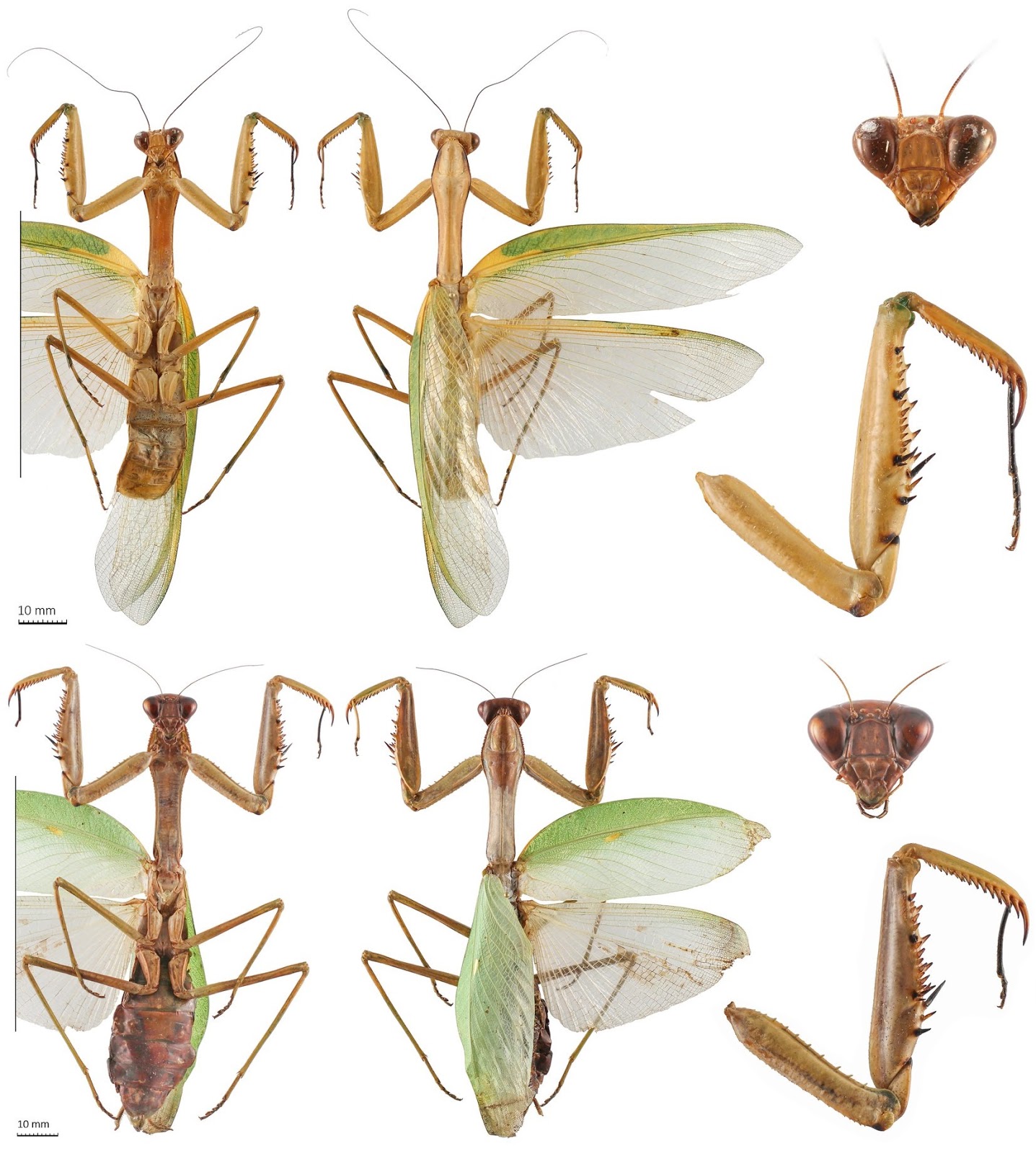
[Entomology • 2020] Titanodula gen. nov. • A New Genus of Giant Oriental Praying Mantises (Mantodea: Mantidae: Hierodulinae)


Titanodula attenboroughi 
 Vermeersch, 2020


Belgian Journal of Entomology. 100

Abstract
 Recent taxonomic expeditions that were made possible within the framework of the Global Taxonomic Initiative project “A step further in the entomodiversity of Vietnam” resulted in the collecting of large and robust Hierodula-like praying mantises with a unique morphology of the male genitalia for which the new genus Titanodula gen. nov. is created. All collected specimens were very similar in external morphology, but an in-depth analysis of the male genitalia revealed the existence of two distinct species in Vietnam. One species was matched with Hierodula fruhstorferi Werner 1916, previously only known by the holotype female, hereby transferring it to Titanodula gen. nov. The other species is new to science, endemic to the Annamite mountain range in the Vietnamese Central Highlands, and is described as Titanodula attenboroughi sp. nov. in tribute to Sir. David Attenborough. Additionally, two other Oriental species, Hierodula grandis Saussure, 1870 and Hierodula formosana GiglioTos, 1912 are discussed and transferred to Titanodula gen. nov.

 Keywords: Annamite mountains, Global Taxonomic Initiative, Hierodula, Vietnam 


Taxonomy
Order Mantodea Burmeister, 1838
Family Mantidae Burmeister, 1838
Subfamily Hierodulinae Brunner von Wattenwyl, 1893

Genus Titanodula gen. nov.

Type species: Titanodula attenboroughi by present designation.

DIFFERENTIAL DIAGNOSIS. Titanodula gen. nov. can be distinguished from all other genera within Mantidae by the combination of the following characters:
1) Large and robust praying mantis.
2) Lower frons with two vertical margins within, interrupted in the middle, forming two small but distinct tubercles at its anterior margin.
3) Ventral coxal lobe darkened or black ventrad.
4) Darkened or black spots at the base of 2nd, 10th and 15th profemoral AvS.
5) All protarsal segments black anteriorly.
6) Male genitalia as described below.

ETYMOLOGY. The genus name is derived from the ‘Titans’ in Greek mythology, who were a mythological race of giants, thus emphasizing the large size and strength of the species belonging to this genus. The second part of the genus name “-dula” is a reference to the genus Hierodula in which some species were previously described. 

DISTRIBUTION. Titanodula gen. nov. has a confirmed presence in Bangladesh, Southern China, Taiwan and Vietnam. It appears that the genus has a wide distribution across the Oriental region but remains limited to suitable forested habitats, making these giant praying mantises vulnerable to habitat loss and deforestation as a result of expanding human activities. 

SPECIES INCLUDED: Titanodula attenboroughi sp. nov., Titanodula formosana (Giglio-Tos, 1912) comb. nov., Titanodula fruhstorferi (Werner, 1916) comb. nov. and Titanodula grandis (Saussure, 1870) comb. nov. 


Fig. 3. Titanodula attenboroughi gen. nov. et sp. nov., live photographs of holotype ♂ (A, B, C) and paratype ♀ [PT1] (D, E) at Kon Chu Rang N.R., VII. 2018.

Fig. 1. Titanodula attenboroughi sp. nov., holotype ♂ (RBINS). A, habitus, dorsal view. B, habitus, ventral view. C, head, frontal view. D, left prothoracic leg, anterior view. C, D not to scale.

Titanodula attenboroughi sp. nov.

 DIAGNOSIS. Very large and robust praying mantis. Head triangular, antennae filiform. Long but robust pronotum, with smooth dorsal surface. Pronotum very finely denticulate along the margins of the prozone in female, without denticulations in the metazone, entirely smooth edges in males. Spinal formula: F = 4DS/15AvS/4PvS; T = 13−14AvS/10PvS. Ratios ♂: MzL/PzL: 3.2; ♀: MzL/PzL: 2.9. With black spots on the anterior side of the profemora located at the base of the 2nd, 10th and 15th anteroventral spine. Protarsus (all segments) entirely black on the anterior side. Both sexes macropterous. Phalloid apophysis (afa) with two sclerotised processes, anterior process (aafa) small and tubercle-shaped, broad and dome-like at the base with a smaller rounded projection on top of it, located posteriorly from the middle. Posterior process (pafa) spear-shaped, with weakly developed base, almost straight, long and heavily sclerotised, projecting straight or slightly diagonally posteriad.


ETYMOLOGY. The species epithet is a patronym dedicated to Sir David Attenborough, one of the world's most beloved naturalists, in acknowledgment for his life-long endeavours to disseminate knowledge on all the beings that are part of the natural world and to advocate for their protection and conservation. 

DISTRIBUTION. Titanodula attenboroughi sp. nov. appears to be an endemic of undisturbed forests in the Vietnamese Annamite mountains. However, forests in the known distribution area are highly threatened and continue to disappear at an alarming rate. More distribution data are needed to evaluate the conservation status according to the IUCN Red Lists assessment guidelines, in the meanwhile the species is considered DD (Data Deficient).


 Xavier H.C. Vermeersch. 2020. Titanodula gen. nov., A New Genus of Giant Oriental Praying Mantises (Mantodea: Mantidae: Hierodulinae). Belgian Journal of Entomology. 100: 1–18.


Saturday, February 29, 2020

[Entomology • 2020] Ten New Species of Parasitoid Wasps Mnioes Townes, 1946 (Hymenoptera: Ichneumonidae: Banchinae) described from Peru


Mnioes attenboroughi Alvarado. 2020


Abstract
Mnioes Townes is a predominantly Neotropical genus of the family Ichneumonidae, mainly documented from Central America and, until now, with no described species from South America. In this paper, ten new species are described from Peru: Mnioes attenboroughi sp. nov., M. huk sp. nov., M. iskay sp. nov., M. kinsa sp. nov., M. pisqa sp. nov., M. poncei sp. nov., M. pusaq sp. nov., M. qanchis sp. nov., M. soqta sp. nov., and M. tawa sp. nov. A key to the Peruvian species and maps of their geographical distribution are also presented.

Keywords: Hymenoptera, Ichneumonoidea, taxonomy, parasitoids, wasps, Neotropical

Lateral habitus of Mnioes attenboroughi sp. nov. (paratype): female and male.


Mabel Alvarado. 2020. Ten New Species of Parasitoid Wasps Mnioes Townes, 1946 (Hymenoptera: Ichneumonidae: Banchinae) described from Peru. Zootaxa. 4743(2); 181–199. DOI: 10.11646/zootaxa.4743.2.3

Friday, April 20, 2018

[Plankton • 2018] Syracosphaera azureaplaneta sp. nov. and Revision of Syracosphaera corolla Lecal, 1966


Syracosphaera azureaplaneta
 Young, Bown, Cros, Hagino & Jordan, 2018

 Abstract 
Here we show that the extant coccolithophore Syracosphaera corolla Lecal, 1966 comprises two consistently different non-intergrading morphotypes characterised respectively by exothecal coccoliths with wide and narrow central-areas. These are interpreted as separate species and so a new species is described, Syracosphaera azureaplaneta, and a revised description is given for S. corolla.

Keywords Coccolithophores, Syracosphaera, extent


Syracosphaera azureaplaneta sp. nov.

Synonymy: Syracosphaera corolla (Lecal, 1966); Okada & McIntyre, 1977, pl. 6, figs 1-2; Nishida, 1979, pl.6, fig. 4; Winter & Siesser, 1994, fig. 107; Young et al., 2003, pl. 19, figs 14-15; Malinverno et al., 2008, fig. 76.
Umbellosphaera corolla (Lecal, 1966) Gaarder in Heimdal & Gaarder, 1981, pl. 6, figs 53, 57.
Gaarderia corolla (Lecal, 1966) Kleijne, 1993, pl.6, fig. 3-5; Cros & Fortuño, 2002 fig. 29 A. 

Derivation of name: From Latin azureusblue (adjective, feminine form azurea), and planetaplanet (noun, feminine). Named for the BBC documentary series Blue Planet in recognition of its work and that of its presenter, Sir David Attenborough, in promoting understanding of the marine realm. 

Distribution. Sazureaplaneta has a very broad distribution occurring from the tropics to the sub-arctic and in all the major oceans.

Jeremy R. Young, Paul R. Bown, Lluisa Cros, Kyoko Hagino and Richard W. Jordan. 2018. Syracosphaera azureaplaneta sp. nov. and Revision of Syracosphaera corolla Lecal, 1966. J. Nannoplankton Res. 38(1),  
New ocean plankton species named after BBC's Blue Planet series https://shar.es/1L9BQ0 via @uclnews

Tuesday, January 23, 2018

[Herpetology • 2018] Sitana attenboroughii • A New Species of Fan-throated Lizard of the Genus Sitana Cuvier, 1829 from coastal Kerala, southern India


 Sitana attenboroughii 
Sadasivan, Ramesh, Palot, Ambekar & Mirza, 2018


Abstract

We here describe Sitana attenboroughii sp. nov.a new species of fan-throated lizard of the genus Sitana Cuvier, 1829 from coastal Kerala in southern India. The new species morphologically is closer to Sitana visiri Deepak, 2016 (in Deepak et al. 2016a), however, differs in having higher numbers of ventral scales and a comparatively short but richly colored dewlap. Genetically the new species shows affinity to Sitana marudhamneydhal Deepak, Khandekar, Varma & Chaitanya, 2016 from which it differs in an uncorrected pairwise sequence divergence of 2.2% for a fragment of mitochondrial Nicotinamide adenine dinucleotide dehydrogenase (NADH) subunit 2 gene.

Keywords: Reptilia, taxonomy, India, molecular phylogeny, mitochondrial DNA, Kerala

 Sitana attenboroughii sp. nov. in life, holotype male (BNHS 2481)

Sitana attenboroughii sp. nov.


Etymology. The specific epithet is a noun honoring the celebrated naturalist and broadcaster Sir David Frederick Attenborough for his contribution towards natural history documentation and wildlife conservation.

Suggested common name. Attenborough’s fan-throated lizard.


 Kalesh Sadasivan, M. B. Ramesh, Muhamed Jafer Palot, Mayuresh Ambekar and Zeeshan A. Mirza. 2018. A New Species of Fan-throated Lizard of the Genus Sitana Cuvier, 1829 from coastal Kerala, southern India. Zootaxa. 4374(4); 545–564. DOI: 10.11646/zootaxa.4374.4.5
ResearchGate.net/publication/322637530_A_new_species_of_fan-throated_lizard_of_the_genus_Sitana_from_coastal_Kerala_southern_India

Sunday, November 12, 2017

[Herpetology • 2017] Describing the Smaller Majority: Integrative Taxonomy Reveals Twenty-Six New Species of Tiny Microhylid Frogs (Genus Stumpffia) from Madagascar


S. angeluciS. huwei, S. iharanaS. larinki, S. maledicta, S. mamitikaS. sorata, S. yannikiS. meikeaeS. obscoenaS. davidattenboroughi,  S. nigrorubraS. achilleiS. diutissimaS. pardus, S. edmondsiS. fuscaS. jeannoeliS. spandeiS. garraffoiSanalanjirofoS. miovaova, S. makiraSbetamponaSdolchi & Scontumelia 

Rakotoarison, Scherz, Glaw, Köhler, Andreone, Franzen, Glos, Hawlitschek, Jono, Mori, Ndriantsoa, Raminosoa, Riemann, Rödel, Rosa, Vieites, Crottini & Vences. 2017

  Vertebrate Zoology. 67(3); 271–398.   

Abstract
 The genus Stumpffia Boettger, 1881 currently contains 15 named, small to miniaturized frog species, classified in the endemic Malagasy subfamily Cophylinae of the family Microhylidae. Stumpffia are terrestrial frogs with a largely unknown biology, probably due to their small size and secretive habits. Previous studies have suggested a large proportion of undescribed diversity in the genus. We revise the genus on the basis of a combination of molecular, bioacoustic, and morphological data and describe 26 new species that are all genetically divergent, almost all of them with high pairwise genetic divergences > 4% p-distance in a segment of the mitochondrial 16S rRNA gene and concordant differentiation in a segment of the nuclear Rag-1 gene. The majority of the new species can also be distinguished by the structure of their advertisement calls (where bioacoustic data are available), and in most comparisons the species can also be distinguished morphologically. Furthermore, a molecular phylogeny reconstructed from DNA sequences of one nuclear and four mitochondrial gene segments revealed that in many cases, morphologically similar species are not each other’s closest relatives, thus confirming their identity as independent evolutionary lineages and revealing repeated phenotypic divergence and convergence among and within clades. The phylogeny distinguishes four main clades in the genus: Clade A containing 17 species (Stumpffia be, S. hara, S. megsoni, S. staffordi, S. psologlossa, S. analamaina, S. gimmeli, S. madagascariensis, S. pygmaea, S. angeluci sp. nov.S. huwei sp. nov., S. iharana sp. nov.S. larinki sp. nov., S. maledicta sp. nov., S. mamitika sp. nov.S. sorata sp. nov., and S. yanniki sp. nov.) mostly from northern and northwestern Madagascar, generally characterized by limited digital reduction and divided in subclades of comparatively large, small, and miniaturized body size, respectively; Clade B with four species (S. mieryS. meikeae sp. nov.S. obscoena sp. nov., and S. davidattenboroughi sp. nov.) morphologically ranging from miniaturized with strong digital reduction to comparatively large-sized; Clade C with 18 species (S. grandis, S. kibomena, S. roseifemoralis, S. tetradactyla, S. nigrorubra sp. nov.S. achillei sp. nov.S. diutissima sp. nov.S. pardus sp. nov., S. edmondsi sp. nov., S. fusca sp. nov., S. jeannoeli sp. nov., S. spandei sp. nov., S. garraffoi sp. nov., S. analanjirofo sp. nov., S. miovaova sp. nov., S. makira sp. nov., S. betampona sp. nov., and S. dolchi sp. nov.) mostly distributed in eastern and northeastern Madagascar, containing species of comparatively large size as well as small-sized species, many of which are characterized by a moderate degree of digital reduction; and Clade D with two miniaturized species (S. tridactyla and S. contumelia sp. nov.) with strong digital reduction, which form the sister group of all other Stumpffia. Two of the newly described species (S. angeluci and S. maledicta) are not separated by the 4% threshold in the 16S gene but occur in sympatry and do not share Rag-1 haplotypes. To achieve a comprehensive review of this species-rich genus, we provide simplified differential diagnoses and descriptions and abbreviated descriptions of morphological variation. Despite the large number of Stumpffia species newly described herein, we identify several additional candidate species with currently insufficient data to warrant formal description, and highlight that some species such as S. analanjirofo, S. gimmeli, S. kibomena, S. madagascariensis, S. roseifemoralis and S. obscoena are composed of two or more deep mitochondrial lineages that might also turn out to be distinct taxa after in-depth study. We confirm Stumpffia as a genus of highly microendemic frogs with many species apparently restricted to very small ranges, and provide evidence that two of the new species (S. achillei and S. davidattenboroughi) do not construct foam nests but lay their eggs in wet places in the leaf litter, or in cavities such as empty snail shells. We propose a conservation status for all the described species according to IUCN Red List Criteria, but also discuss several problems applying these criteria to such microendemic and poorly known frogs. 

Key words: Amphibia; Anura; Microhylidae; diversity; systematics; bioacoustics; molecular genetics; morphology; microendemism


 Andolalao Rakotoarison, Mark D. Scherz, Frank Glaw, Jörn Köhler, Franco Andreone, Michael Franzen, Julian Glos, Oliver Hawlitschek, Teppei Jono, Akira Mori, Serge H. Ndriantsoa, Noromalala Rasoamampionona Raminosoa, Jana C. Riemann, Mark-Oliver Rödel, Gonçalo M. Rosa, David R. Vieites, Angelica Crottini and Miguel Vences. 2017. Describing the Smaller Majority: Integrative Taxonomy Reveals Twenty-Six New Species of Tiny Microhylid Frogs (Genus Stumpffia) from Madagascar.   Vertebrate Zoology. 67(3); 271–398.  

A swathe of Stumpffia: 26 new frog species  markscherz.com/archives/3441 @MarkScherz