Showing posts with label Homalopsidae. Show all posts

Tuesday, March 18, 2025

[Herpetology • 2025] Notes on the rare Pahang Mud Snake (Kualatahan pahangensis) (Tweedie 1946) (Squamata: Homalopsidae) endemic to Peninsular Malaysia with comments on its taxonomy and a range extension for the species


Pahang Mud Snake Kualatahan pahangensis (Tweedie 1946) 

in Quah, Syafiq, Wood, Grismer, Badli-Sham et Ahmad, 2025. 
 
Abstract
The Pahang Mud Snake (Kualatahan pahangensis) (Tweedie 1946) is a rare species of homalopsid known only from four specimens. In this study we report on a relatively recently collected specimen from Merapoh, Pahang, Peninsular Malaysia, compared with previously collected material. Variations in pholidosis and colour pattern were noted and discussed. The species is morphologically similar in body shape and colour pattern to the sympatric Hypsiscopus plumbeus, for which additional data is presented for Peninsular Malaysian specimens to clarify possible taxonomic confusions. The new record represents a range extension for the species of ~ 47 km to the west and is the third report of the species from the state of Pahang.

 Reptilia, reptile, Serpentes, Enhydris, conservation, endemic, biodiversity, Herpetology, herpetofauna


Evan S.H. QUAH, Muhamad F. SYAFIQ, Perry L. WOOD Jr., L. Lee GRISMER, Baizul H. BADLI-SHAM and Amirrudin AHMAD. 2025. Notes on the rare Pahang Mud Snake (Kualatahan pahangensis) (Tweedie 1946) (Squamata: Homalopsidae) endemic to Peninsular Malaysia with comments on its taxonomy and a range extension for the species.  Zootaxa. 5588(1); 161-173. DOI: doi.org/10.11646/zootaxa.5588.1.7 [2025-02-13] 


Saturday, September 7, 2024

[Herpetology • 2024] Incorporating New Datatypes to Enhance Species Delimitation: A Case Study in Rice Paddy Snakes (Homalopsidae: Hypsiscopus)


Hypsiscopus Rice Paddy Snakes 

in Bernstein, Murphy, Lathrop, Nguyen, Orlov et Stuart. 2024. 
 
Abstract
Homalopsids (Old World Mud Snakes) include 59 semiaquatic species in Asia and Australasia that display an array of morphological adaptations, behaviors, and microhabitat preferences. These attributes make homalopsids an ideal model system for broader questions in evolutionary biology, but the diversity of this understudied group of snakes is still being described. Recognized species diversity in rice paddy snakes (Hypsiscopus) has recently doubled after nearly 200 years of taxonomic stability. However, the evolutionary distinctiveness of some populations remains in question. In this study, we compare mainland Southeast Asian populations of Hypsiscopus east and west of the Red River Basin in Vietnam, a known biogeographic barrier in Asia, using an iterative approach with molecular phylogenetic reconstruction, machine-learning morphological quantitative statistics, and ecological niche modeling. Our analyses show that populations west of the Red River Basin represent an independent evolutionary lineage that is distinct in genetics, morphospace, and habitat suitability, and so warrants species recognition. The holotype of H. wettsteini, a species originally described in error from Costa Rica, grouped morphometrically with the population at the Red River Basin and eastward, and those west of the Red River Basin are referred to the recently described H. murphyi. The two species may have diversified due to a variety of geological and environmental factors, and their recognition exemplifies the importance of multifaceted approaches in taxonomy for downstream biogeographic studies on speciation scenarios.

Reptilia, China, east Asia, mud snakes, phylogenetics, systematics, red river, Vietnam


Justin M. Bernstein, Robert W. Murphy, Amy Lathrop, Sang Ngoc Nguyen, Nikolai L. Orlov and Bryan L. Stuart. 2024. Incorporating New Datatypes to Enhance Species Delimitation: A Case Study in Rice Paddy Snakes (Homalopsidae: Hypsiscopus).  Zootaxa. 5501(1); 39-55. DOI: doi.org/10.11646/zootaxa.5501.1.2 

Thursday, March 14, 2024

[Herpetology • 2024] Myrrophis dakkrongensis • A New Species of Mud Snake (Serpentes: Homalopsidae: Myrrophis) from southern Vietnam


Myrrophis dakkrongensis 
Nguyen, Le, Lathrop, Vo, Murphy & Che, 2024

 Dak Krong mud snake | Rắn bồng đắk krông  ||  DOI: 10.3897/vz.74.e116992

Abstract
Homalopsid snakes of the genus Myrrophis include only two species distributed in southern China and northern Vietnam. Here, we describe a third species from southern Vietnam based on morphological data and nucleotide sequences from the mitochondrial gene cyt b. Myrrophis dakkrongensis sp. nov. is diagnosed by the following morphological characters: Medium-sized mud snake (largest total length 452 mm); internasal single and distinctly separated from loreals; dorsal scales smooth, in 23 rows at midbody, reduced to 19 or 20 rows before vent; ventrals 133–138; subcaudals 34–42, paired; cloacal plate divided; supralabials 8, fourth entering orbit; second pair of chin-shields small and oblique; maxillary teeth 17 or 18; gland-like tubercles present in the cloacal region; hemipenis short, forked and spinose, reaching 7th subcaudal; dorsum dark brown to black; and a white or yellow to orange lateroventral stripe present. The new species differs from its congeners by an uncorrected p distance in cyt b sequences of at least 10.5%.

Key words: Dak Nong Province, Gyiophis, hemipenis, Mekong River, mitochondrial DNA, Myanophis, Myrrophis bennettii, Myrrophis chinensis, Myrrophis dakkrongensis

Holotype of Myrrophis dakkrongensis sp. nov. (ITBCZ 6695) in life.

Holotype of Myrrophis dakkrongensis sp. nov. (ITBCZ 6695).
A–C Dorsal, ventral, and lateral views of head, respectively; D ventral view; E cloacal region showing three yellow gland-like tubercles on both sides; F lateral view of right maxillary teeth.

Paratypes of Myrrophis dakkrongensis sp. nov. and habitats of the new species.
A Paratype ITBCZ 6694; B, C paratype ITBCZ 6700 and its hemipenes; D rubber plantation where the holotype was collected; E wetland in forest where paratype ITBCZ 6700 was collected.

Myrrophis dakkrongensis sp. nov.

Diagnosis: Myrrophis dakkrongensis sp. nov. is distinguished from all of its congeners by the unique combination of the following morphological characters: medium-sized mud snake (largest TL 452 mm in adult female); internasal single and not in contact with loreals; dorsal scale rows 23-23-19 or 23-23-20, smooth; tail short (TaL/TL ratio 0.15–0.16 in males and 0.14 in female); ventrals 134–138 in males and 133 in female; subcaudals 39–42 in males and 34 in female; 8 supralabials, fourth entering orbit; second pair of chin-shield small, oblique, and in contact with two infralabials; 17 or 18 maxillary teeth; hemipenis short, forked and spinose, reaching 7th subcaudal; cloacal plate divided; gland-like tubercles present in the cloacal region; dorsum dark brown to black; and white or yellow to orange lateroventral stripe present.

Etymology: The specific epithet dakkrongensis is a toponym derived from the Dak Krong River system where the new species was discovered. We recommend “Dak Krong mud snake” and “Rắn bồng đắk krông” as the common English and Vietnamese names of the new species, respectively.


Sang Ngoc Nguyen, Manh Van Le, Amy Lathrop, Thi-Dieu-Hien Vo, Robert W. Murphy and Jing Che. 2024. A New Species of Mud Snake (Squamata: Homalopsidae: Myrrophis) from southern Vietnam. Vertebrate Zoology. 74: 221-233. DOI: 10.3897/vz.74.e116992

Sunday, July 16, 2023

[Herpetology • 2023] Hypsiscopus indonesiensis • A New Species of Water Snake Genus Hypsiscopus (Serpentes: Homalopsidae) from Sulawesi, Indonesia


Hypsiscopus indonesiensis
Hamidy, Zakky, Fitriyana & Endarwin, 2023


Abstract
We describe a new species of water snake genus Hypsiscopus that was formerly placed in the genus Enhydris from Towuti Lake, South Sulawesi, based on six specimens collected in 2003 and a specimen collected in 2019. The new species has several significant differences from other species in the genus Hypsiscopus (H. matannensis, H. plumbea, and H. murphyi) in possessing laterally compressed tail, higher number of scale rows in mid body, higher number of ventral scales, lower number of subcaudal scales, and distinct color pattern. The new species is likely distributed only in the Towuti Lake, and has higher level endemicity compared to H. matannensis. Further studies on the population and distribution are needed to evaluate its conservation status.

Keywords: Hypsiscopus, Lake Towuti, new species, Sulawesi, water snakes


Hypsiscopus indonesiensis sp. nov.

Diagnosis. The new species is assigned to the genus Hypsiscopus based on possession of several morphological characters, small body size (SVL <700 mm), internasal(s) do not contact loreal, upper labials 2–3 or 2–4 usually contact with loreal, lower labials 1–5 usually contact the anterior chin shields, relatively short tails (10–17 % of SVL) (Murphy & Voris, 2014) and molecularly nested in the genus Hypsiscopus (Bernstein et al., 2021; Fukuyama et al., 2022). Hypsiscopus indonesiensis sp. nov. is diagnosable from all congeners by having laterally compressed tail, high number of scale rows (24–25 in the neck, 25–27 in the mid body, 20–22 in near the vent), high number of ventral scales (152–159), blotched pattern on the dorsum and mottled pattern on the ventrum.

Distribution. The species was found only from Towuti Lake, South Sulawesi. Although Matano Lake, Towuti Lake, and Mahalona Lake are relatively nearby, Hypsiscopus indonesiensis sp. nov. is only recorded from Towuti Lake.
 
Comparison of dorsal color pattern:
A. Hypsiscopus indonesiensis sp. nov., B. Hypsiscopus matannensis, C. Hypsiscopus plumbea.


 Amir Hamidy, Quraisy Zakky, Nurul Fitriyana and Wempi Endarwin. 2023. A New Species of Water Snake Genus Hypsiscopus (Serpentes: Homalopsidae) from Sulawesi, Indonesia. Treubia. 50(1); 21–38. DOI: 10.14203/treubia.v50i1.4511

Saturday, October 15, 2022

[Herpetology • 2022] Hypsiscopus murphyi • Undescribed Diversity in A Widespread, Common Group of Asian Mud Snakes (Serpentes: Homalopsidae: Hypsiscopus)


Hypsiscopus murphyi
Bernstein, Voris, Stuart, Phimmachak, Seateun, Sivongxay, Neang, Karns, Andrews, Osterhage, Phipps & Ruane, 2022

Murphy’s Mud Snake  ||  DOI: 10.1643/h2022015

Abstract
Mud snakes (Serpentes: Homalopsidae) are a morphologically diverse family of aquatic snakes distributed from eastern Pakistan, eastward through South Asia, mainland and maritime Southeast Asia, and extending to New Guinea and northern Australia. Some species of homalopsids represent the most abundant tetrapods in aquatic systems in tropical Asia, but with few evolutionary studies investigating their diversity with dense geographic and taxonomic sampling. The genus Hypsiscopus includes two named species that inhabit freshwater systems throughout most of Southeast Asia: H. matannensis of Sulawesi, and the widespread H. plumbea found in rivers, lakes, and rice paddies in the remainder of Southeast Asia. We use a multilocus dataset of two mitochondrial and three nuclear genes with dense sampling of H. plumbea to elucidate the evolutionary history of this genus. We find that H. plumbea is paraphyletic with respect to H. matannensis, with populations around and north of Central Thailand's Khorat Plateau phylogenetically outside of a clade containing H. matannensis and H. plumbea south of the Khorat Plateau. This lineage differs morphologically and genetically from H. plumbea sensu stricto (south of the Khorat Plateau) and H. matannensis. We describe this lineage as a third species of Hypsiscopus based on its phylogenetic position and meristic and color pattern data. This study exemplifies the need to investigate widespread, abundant taxa to better understand the evolutionary histories of aquatic snakes in Southeast Asia.


Hypsiscopus murphyi, new species
Murphy’s Mud Snake

Etymology.—The specific epithet is a patronym for John C. Murphy, who has dedicated decades of his research career to investigating and describing homalopsid snakes. 

Distribution.—Hypsiscopus murphyi is distributed from Taiwan and southern China (Zhejiang Province) at its northernmost limit (but see Discussion), extending southward into China (including Hainan Island), into Vietnam, Laos, Cambodia, and Thailand. The southern limit of this species based on our sampling occurs in Phetchaburi, Thailand. Specimens from adjacent and nearby islands will need to be identified pending future molecular and morphological comparisons (e.g., Andaman Islands and other parts of India and Myanmar [Murphy, 2007; Murphy and Voris, 2014]).


Justin M. Bernstein, Harold K. Voris, Bryan L. Stuart, Somphouthone Phimmachak, Sengvilay Seateun, Niane Sivongxay, Thy Neang, Daryl R. Karns, Heather L. Andrews, Jennifer Osterhage, Elizabeth A. Phipps, and Sara Ruane. 2022. Undescribed Diversity in A Widespread, Common Group of Asian Mud Snakes (Serpentes: Homalopsidae: Hypsiscopus). Ichthyology & Herpetology. 110(3); 561-574. DOI: 10.1643/h2022015

Saturday, January 23, 2021

[Herpetology • 2021] Myanophis thanlyinensis • A New Genus and Species of Mud Snake (Serpentes, Homalopsidae) from Myanmar


Myanophis thanlyinensis
Köhler, Khaing, Than, Baranski, Schell, Greve, Janke & Pauls, 2021


Abstract
Based on two male and two female individuals, we describe a new genus and species of mud snake, Myanophis thanlyinensis gen. nov., sp. nov., from the vicinity of the campus of East Yangon University, Yangon, Thanlyin, Myanmar. This species differs from every other homalopsid species by the following combination of characters: (1) dorsal scales smooth, row formula 21–21–19 or 21–21–17; (2) tail short, ratio tail length/SVL 0.185–0.204 in males, 0.160–0.167 in females; (3) nasal scales separated; (4) 125–126 ventral scales in males, 120–122 in females; (5) 38–39 subcaudal scales in males, 32–34 in females; and (6) hemipenis bilobed. Its matrilineal genealogy (based on analyses of 16S and cytochrome b sequences), associates Myanophis thanlyinensis gen. nov., sp. nov. most closely with species of the genera Myrrophis and Gyiophis. The new taxon differs from the species of Myrrophis and Gyiophis by having a bilobed hemipenis (vs. unilobed). Myanophis thanlyinensis gen. nov., sp. nov. differs further from the species of Myrrophis by having 125–126 ventral scales in males and 120–122 in females (vs. 137–162 and 137–164, respectively), and 38–39 subcaudal scales in males and 32–34 in females (vs. 39–55 and 37–52, respectively). Myanophis thanlyinensis gen. nov., sp. nov. differs further from the species of Gyiophis by lacking dark blotches along flank (vs. present), and by having 21 dorsal scales rows at midbody (vs. 25). We provide an identification key to the homalopsid species known to occur in Myanmar. As a novelty to the classic holotype description and characterization, the individual has been genome sequenced by Illumina short-read technology and its genome has been assembled into a draft nuclear genome and a complete, annotated mitochondrial genome. This innovative approach comprehensively and permanently characterizes the genomic variation of the holotype.

Keywords: Reptilia, Cryptic diversity, DNA barcoding; genome, Myanophis thanlyinensis gen. nov. sp. nov.


 Gunther Köhler, Khin Pa Pa Khaing, Ni Lar Than, Damian Baranski, Tilman Schell, Carola Greve, Axel Janke and Steffen U. Pauls. 2021. A New Genus and Species of Mud Snake from Myanmar (Reptilia, Squamata, Homalopsidae). Zootaxa. 4915(3); 301–325. DOI:  10.11646/zootaxa.4915.3.1


Thursday, November 29, 2018

[Herpetology • 2018] On the Taxonomy and Phylogeny of the Rare Selangor Mud Snake Raclitia indica Gray (Serpentes, Homalopsidae) from Peninsular Malaysia


Raclitia indica Gray, 1842 

in Quah, Wood, Grismer & Anuar, 2018.
 Photo by Evan Quah. facebook.com/EvanQuah

Abstract
The taxonomic position of the rare Selangor Mud Snake (Raclitia indica) Gray to other species of homalopsids has remained uncertain due to the scarcity of specimens in collections and the lack of genetic material for comparison. Here we report the first molecular phylogenetic examination of this species based on recently acquired material. The study recovered R. indica nested within the clade of advanced, fanged homalopsids and the sister species to Erpeton tentaculatus Lácèpede. We also present notes on variation observed in the new specimens as well as range extensions for the species.

Keywords: Reptilia, Reptile, Squamata, Enhydris, conservation, endemic, biodiversity


 Raclitia indica from Lubuk Yu, Pahang, Peninsular Malaysia.
 Photo by Evan Quah.


Evan S.H. Quah, Perry L. Jr. Wood, L. Lee Grismer and Shahrul Anuar Mohd Sah. 2018. On the Taxonomy and Phylogeny of the Rare Selangor Mud Snake (Raclitia indica) Gray (Serpentes, Homalopsidae) from Peninsular Malaysia.  Zootaxa. 4514(1); 53–64. DOI:  10.11646/zootaxa.4514.1.4

Wednesday, March 8, 2017

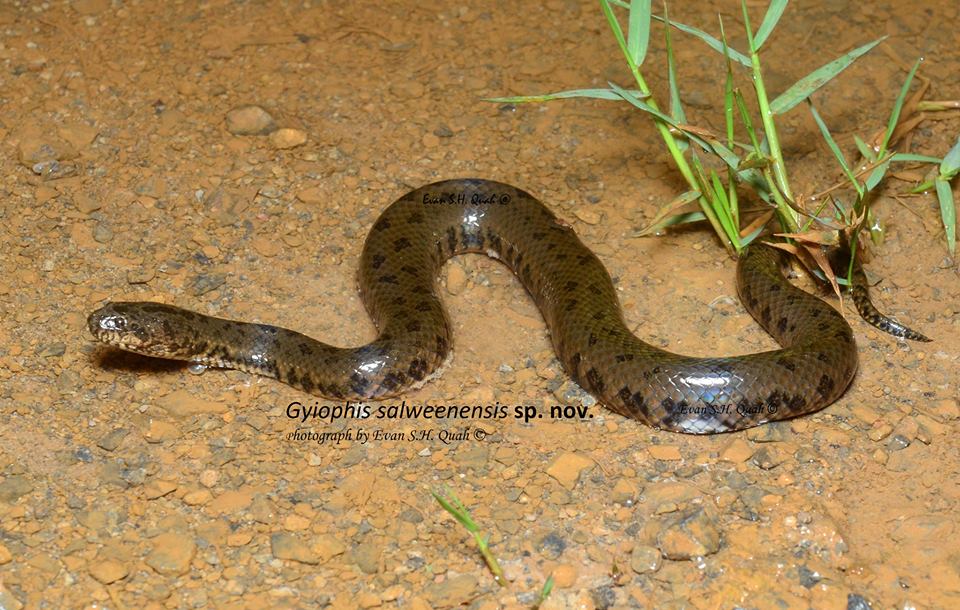
[Herpetology • 2017] Gyiophis salweenensis • A New Species of Mud Snake (Serpentes, Homalopsidae, Gyiophis Murphy & Voris, 2014) from Myanmar with A First Molecular Phylogenetic Assessment of the Genus


Gyiophis salweenensis
Quah, Grismer, Wood, Thura, Zin, Kyaw, Lwin, Grismer & Murdoch, 2017
Salween River Basin Mud Snake  |   DOI: 10.11646/zootaxa.4238.4.5  

Abstract

A newly discovered species of homalopsid snake from the genus Gyiophis Murphy & Voris is described from the lowlands of Mawlamyine District in Mon state, southeastern Myanmar. Gyiophis salweenensis sp. nov. is presumed to be closely related to G. maculosa Blanford and G. vorisi Murphy based on the similarities in pholidosis and patterning but can be separated from G. maculosa by the shape of its first three dorsal scale rows that are square, ventral scale pattern that lacks a central spot, and a faint stripe on dorsal scale rows 1–4. It can be further distinguished from G. vorisi by its lower number of ventral scales (129 vs. 142–152), lower number of subcaudals (30/29 vs. 41–58), narrow rostral scale, and having more rows of spots on the dorsum (four vs. three). A preliminary molecular analysis using 1050 base pairs of cytochrome b (cytb) recovered G. salweenensis sp. nov. as the sister species to the Chinese Mud Snake (Myrrophis chinensis). G. maculosa and G. vorisi were unavailable for the analysis. The discovery of G. salweenensis sp. nov. highlights the need for more surveys into the herpetological diversity of eastern Myanmar which remains very much underestimated.

Keywords: Reptilia, phylogeny, Enhydris, homalopsid, conservation, endemic biodiversity, Burma


 Holotype of Gyiophis salweenensis sp. nov. in life.
Photograph by Evan Quah. 


Etymology. The specific epithet salweenensis is in reference to area where the holotype was found which is close to the vicinity of the Salween River near the city of Mawlamyine. The suffix ensis is a Latin derivation meaning “from” or “inhabiting.” It renders the specific epithet an adjective that must be in grammatical accord with the gender of Gyiophis.

Distribution:  Gyiophis salweenensis sp. nov. is only known from the type locality near Sanpel Cave, Mon State, Myanmar. It is expected to be wider ranging throughout the Salween River Basin and found wherever appropriate habitat occurs. 

Natural history: The holotype was found at approximately 1930 hours crossing a narrow dirt road between flooded fields that we presume to be its natural habitat. The weather was overcast and it rained later that night. Many other species of homalopsids are semiaquatic and commonly found in streams, rivers, ponds, and flooded rice fields (Murphy 2007a; Stuebing et al. 2014). Gyiophis salweenensis sp. nov. is expected to share a similar life history and the valvular nostrils located dorsally on the snout indicate this species probably spends a large part of its life in the water. Homalopsid snakes such as Enhydris enhydris, Homalopsis buccata (Linnaeus, 1758) and Hypsiscopus plumbea have been observed crawling on land and crossing roads during wet weather (Voris & Karns 1996; Lim & D’Rozario 2009; EQSH personal obs.) and the holotype of G. salweenensis sp. nov. could have been dispersing to a new area as well. The holotype also had a puncture wound on its back which might have come from an encounter with a predator such as a heron.


Quah, Evan S. H., L. L. Grismer, P. L. Wood, Jr., Myint K. Thura, Thaw Zin, Htet Kyaw, Ngwe Lwin, Marta S. Grismer & M. L. Murdoch. 2017. A New Species of Mud Snake (Serpentes, Homalopsidae, Gyiophis Murphy & Voris, 2014) from Myanmar with A First Molecular Phylogenetic Assessment of the Genus. Zootaxa. 4238(4): 571–582.  DOI: 10.11646/zootaxa.4238.4.5


Sunday, September 28, 2014

[Herpetology • 2014] A Checklist and Key to the Homalopsid Snakes (Reptilia, Squamata, Serpentes), with the Description of New Genera


TABLE 2. Homalopsid species are grouped based on morphological and molecular work.
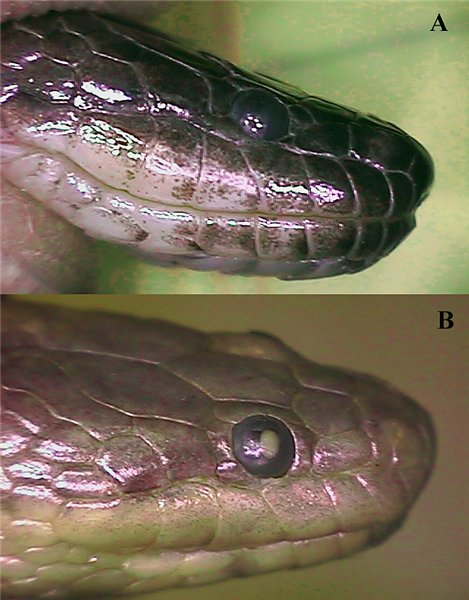
 The Fangless Indonesian Group was recently recognized and placed within the Homalopsidae by Murphy et al. (2011). (Photo A Brachyorrhos raffrayi by J.C.M.) Alfaro et al. (2008) recognized four clades. Their clade A corresponds with our Plumbea Group, containing a highly aquatic undescribed species from Lake Towuti, Sulawesi. (Photo B Hypsiscopus plumbea by Daryl R. Karns.) The South China Group is linked by similar morphology, and was long considered to be part of Enhydris. Kumar et al. (2012) found Myrrophis chinensis to be the sister to the southwest Indian Dieurostus dussumierii (also previously considered part of Enhydris). (Photo C Myrrophis chinensis by Steve Mackessy.) The two species in the Fossorial-Aquatic Group share similar morphology and geography but remain unconfirmed by molecular studies. (Image D Miralia alternans from Jan & Sordelli, 1860–1881.) Similarly, most members of the South Asian Group have not been included in molecular studies. The group shares some morphology and geography. (Photo E Dieurostus dussumierii by Biju Kumar.) The Pahang Mud Snake, Kualatahan pahangensis, is of uncertain relationship. It may be allied with the South Asian Group or the Enhydris Group. The Enhydris Group is centered in Indochina, they use freshwater habitats, and group membership of all but Enhydris chanardi has been supported with molecular and morphological data (Alfaro et al., 2008; Karns et al., 2010a). (Photo F Enhydris enhydris by J.C.M.) The Punctata Group is centered on the Sunda Shelf and shares similar morphology. Only Phytolopsis punctata has been included in molecular studies. (Photo G Homalophis doriae by Daryl R. Karns.) The Saltwater Group has been well documented with molecular data (Alfaro et al., 2008). (Photo H Cantoria violacea by J.C.M.) The Australasian Group is well supported by a close genetic relationship between Pseudoferania and Myron (Alfaro et al., 2008; Kumar et al., 2012; Pyron et al., 2013) and shared morphology and geography with the other members of the group. (Photo I Pseudoferania polylepis by J.C.M.) The Sunda Group is at best tentative, Alfaro et al. (2008) found a sister relationship between Erpeton and Subsessor bocourti, while Murphy et al. (2011) found Erpeton to be the sister to Bitia, and Subsessor to be the sister to the Homalopsis and Cerberus groups; and Kumar et al. recovered Subsessor as the sister to Homalopsis. (Photo J Subsessor bocourti by J.C.M.) The Homalopsis Group is linked by similar morphology. (Photo K Homalopsis mereljcoxi by J.C.M.) The Cerberus Group has three of the five species linked with molecular data (Alfaro et al., 2004) and is strongly supported by Alfaro et al. (2008). (Photo L Cerberus dunsoni by J.C.M.)

Abstract
The colubroid snake family Homalopsidae contained 10 genera and 34 species of rear-fanged semi-aquatic and aquatic snakes in 1970 with the publication of Gyi's monograph. In 2007 Murphy had updated Gyi's work and the family held the same 10 genera with 37 species plus two genera with uncertain status (Anoplohydrus, Brachyorrhos). Molecular studies published in the first decade of the 21st century demonstrated that while the Homalopsidae is monophyletic, the species-rich genus Enhydris is polyphyletic. Molecular analysis also found Brachyorrhos to be the most basal member of the clade, confirming an earlier hypothesis that it was a fangless homalopsid. Subsequently, two other fangless genera of homalopsids were discovered. We revalidate the genera: Homalophis Peters, Hypsiscopus Fitzinger, Miralia Reuss, Phytolopsis Gray, and Raclitia Gray. Also, we describe five new genera for species lacking available names: Gyiophis, Kualatahan, Mintonophis, Sumatranus, and Subsessor. The new arrangement for homalopsid names resolves the problem of the formerly polyphyletic genus Enhydris. For all species, we provide a synonymy, information on types and type localities, a diagnosis, as well as remarks on taxonomic and nomenclatural problems and a dichotomous key. Recent evidence suggests homalopsids show high levels of endemism and cryptic speciation.

Keywords: aquatic snakes, mud snakes, Homalopsidae, terrestrial–aquatic transition, geographic distribution, taxonomy


CoverEnhydris jagorii Peters from the Bung Ka Lo wetland in Thailand’s Central Plain. This is the only confirmed extant population of this snake. Enhydris jagorii inhabits a marshy wetland with a shallow central lake bordered by rice paddy.
Photo by J.C.M.

John C. Murphy and Harold K. Voris. 2014. A Checklist and Key to the Homalopsid Snakes (Reptilia, Squamata, Serpentes), with the Description of New Genera. Fieldiana Life and Earth Sciences. 8 :1-43. doi: http://dx.doi.org/10.3158/2158-5520-14.8.1

Friday, November 23, 2012

[Herpetology • 2012] Differences among Populations of the Mekong Mud Snake Enhydris subtaeniata (Serpentes: Homalopsidae) in Indochina


 This study examines between-population variation of the Mekong Mud Snake,  Enhydris subtaeniata (Bourret, 1934) in Thailand, Cambodia, Laos, and Viet Nam, and relates the observed patterns to previously published patterns based on molecular data.  Enhydris subtaeniata were collected from six representative locations throughout its range that encompassed three important river drainage basins: the Chao Phraya, the Middle Mekong and the Lower Mekong.  Data on size, sexual size dimorphism, scalation,
reproductive biology and diet were used to explore biogeographical patterns revealed by a previously published phylogenetic and population genetic analysis. In several cases the size and reproductive characteristics mirrored the genetic differences and habitat differences associated with the sampled locations.

Keywords: Freshwater snake, biogeography, sea levels, Mekong River, Chao Phraya River, Khorat Basin


2012. Differences among Populations of the Mekong Mud Snake (Enhydris subtaeniata: Serpentes: Homalopsidae) in Indochina
http://www.biology.sc.chula.ac.th/TNH/TNH%2012_2/5-HAROLD%20K.pdf
http://www.biology.sc.chula.ac.th/TNH/vol12%20no2.html


Lukoschek, V., Osterhage, J. L., Karns, D. R., Murphy, J. C. and Voris, H. K. 2011, Phylogeography of the Mekong mud snake (Enhydris subtaeniata): the biogeographic importance of dynamic river drainages and fluctuating sea levels for semiaquatic taxa in Indochina. Ecology and Evolution. doi:

Karns, D. R., Lukoschek, V., Osterhage, J., Murphy, J, C., and Voris, H. K. 2010 Phylogeny and biogeography of the Enhydris clade (Serpentes: Homalopsidae). Zootaxa, 2452. 18-30. http://www.mapress.com/zootaxa/2010/f/z02452p030f.pdf
http://herpnation.com/hn-blog/the-mekong-mud-snake

[Herpetology • 2007] Enhydris vorisi • A review of Enhydris maculosa (Blanford, 1879) and the description of a related species (Serpentes, Homalopsidae) from Ayeyarwady River Delta. Myanmar


Enhydris vorisi
A homalopsid snake endemic to the Ayeyarwady River Delta.


Murphy, John C. 2007. A review of Enhydris maculosa (Blanford, 1879) and the description of a related species (Serpentes, Homalopsidae). Hamadryad 31 (2): 281-287

[Herpetology • 2005] Enhydris gyii | Kapuas Mud Snake • A new species of Enhydris (Colubridae: Homalopsinae) from the Kapuas River System, West Kalimantan, Indonesia


Kapuas Mud Snake
Enhydris gyii Murphy, Voris & Auliya, 2005

Abstract
A new species of homalopsine water snake of the genus Enhydris is described from Kalimantan, Indonesia on the basis of three specimens. It differs from its close relative Enhydris doriae (Peters, 187 1) in the number of scale rows at midbody, a higher number of lower labials and ventral scales, plate like temporal scales, and a distinctive color pattern.

Etymology: Named after the late Burmese herpetologist Ko Ko Gyi, Professor at Rangoon University, and the first zoologist to revise the entire subfamily Homalopsinae in the 20th century.

 Murphy, J.C.; H.K. Voris & Auliya, M. 2005. A new species of Enhydris (Serpentes: Colubridae: Homalopsinae) from the Kapuas River System, West Kalimantan, Indonesia. Raffels Bulletin of Zoology. 53 (2): 271-275 http://archive.fieldmuseum.org/research_collections/zoology/pdf/murphy_voris_auliya_2005.pdf


 ‘Chameleon' snake can turn white in minutes 
A new species of snake capable of rapidly changing colour has been discovered deep in the forests of Borneo. Two specimens of the Kapuas mud snake (Enhydris gyii) were discovered in the swampy forests of Indonesia's Betung Kerihun National Park.

The half-metre-long venomous snake is normally brown with an iridescent sheen, but can turn white. It is not yet known whether the snake can become other colours too, or what exactly causes the change.


Tuesday, February 28, 2012

[Herpetology • 2012] Homalopsis mereljcoxi • The Masked Water Snakes of the Genus Homalopsis Kuhl & van Hasselt, 1822 (Serpentes, Homalopsidae), with the Description of A New Species


Homalopsis mereljcoxi sp. nov. from the Khorat Basin, near Khon Kaen, Thailand (~16°01” N, 102°35’ E). Photograph by JCM. The high contrast, evenly spaced, pale colored bands outlined in black that extend across the dorsum help distinguish this species from H. buccata which often have more irregular bands with less contrast. 

Homalopsis mereljcoxi photo: Michael Cota


Abstract
Masked water snakes of the genus Homalopsis are abundant in the wetlands of Southeastern Asia. Currently, two species are recognized, the widespread H. buccata Linnaeus and the Mekong drainage endemic H. nigroventralis Deuve. On the basis of morphology we resurrect H. hardwickii Gray and H. semizonata Blyth and describe a new species from Indochina. We establish a neotype for Coluber buccatus Linnaeus and examine the status of other names associated with this species. Homalopsis species can be distinguished from each other on the basis of dorsal scale row counts, the scales in the ocular ring, and other head scale architecture. The new species, Homalopsis mereljcoxi, is distinguished from all others by its one postocular and one postsubocular scale, and a higher dorsal scale row count (40–47 scale rows at midbody) that are reduced to more than 30 scale rows at the body’s posterior. The new species is heavily exploited for the skin trade at Tonle Sap, Cambodia. Homalopsis likely contains other cryptic species that have evolved in the changing aquatic habitats of Southeast Asia. A key to the species of Homalopsis is provided.

Key words: Homalopsis buccata, cryptic species, Homalopsis hardwickiiHomalopsis mereljcoxiHomalopsis nigroventralisHomalopsis semizonata, Southeast Asia, systematics, taxonomy


FIGURE 7. A. Homalopsis buccata from East Kalimantan 
| B. Homalopsis mereljcoxi sp. nov. from the Khorat Basin, near Khon Kaen, Thailand 
| C. Homalopsis nigroventralis from an unknown locality in Thailand. 
| D. Homalopsis semizonata from Myanmar: Tanintharyi Division


Homalopsis mereljcoxi sp. nov.

Holotype. A female, FMNH 263756 from Thailand, Nakhon Ratchasima Province, Wang Nam Khieo, Udon Sap (subdistrict), Ban Badan Reservoir (14°31’04” N, 101°58’25” E); collected 16 June 2004 by Daryl R. Karns and John C. Murphy.

Etymology. This new species is named in in honor of Merel “Jack” Cox, for his years of dedication to the study of the snakes of Thailand.

Distribution. Homalopsis mereljcoxi is known from lowland localities in Thailand, Cambodia, and Vietnam. On the western edge of its known range it is found as far north as Bung Cho, Uttaradit Province, Phichai District (~12°N, 104°E), Thailand and as far south as Lake Songkhla (~7°N, 100°E), Thailand. In Vietnam it is found at least as far east as Can Tho Province (~10°N, 105°E) and as far south as Vinh Thuan District Town in Kien Giang Province (~9°N, 105°E). It is present in Cambodia’s Tonle Sap, and it most likely occurs throughout the lower elevations of the Chao Phraya and Mekong drainages. It is possible, but unclear, if this species inhabits Myanmar. Gyi (1970) reports Myanmar Homalopsis with 39–43 middorsal scale rows, Homalopsis semizonata Blyth, 1855 inhabits the area on both side of the Gulf of Martaban and the Ayeyarwady delta and it has 38-43 scale rows which overlap the range of scale rows for H. mereljcoxi.

Natural history. Many authors have discussed the natural history of this species (Saint Girons 1972; Brooks et al. 2007, 2010; Karns et al. 2005, 2010) under the name Homalopsis buccata. The morphology of this species agrees well with the Cambodia specimens described by Saint Girons (1972), however his data included ventral counts of 154–180, a range with some specimens below the lower end of the range observed in our sample. Cambodian specimens with ventral counts lower than 160 (unpublished data) likely belong to one or more cryptic species. 
In Thailand, the habitat used by Homalopsis mereljcoxi includes small reservoirs, ditches, ponds, streams, and shallow wetlands (Karns et al. 2005; 2010). Snakes were primarily obtained from fishers’ gill nets, one specimen was hand collected from a pond at night while it floated near the surface in an ambush posture. Saint Girons (1972) described similar habitats in Cambodia: streams, rivers, irrigation canals, marshes, reservoirs and the banks of lakes and rivers; he also reports it in shallow water at night and describes it resting in burrows or crevices in the bank during the day, noting that specimens move very little while on land. Individuals released into shallow water escaped without hesitation, but placed in a river with steep banks, the snakes immediately sought refuge along the shore.


Murphy, J.C. et al. 2012: The masked water snakes of the genus Homalopsis Kuhl & van Hasselt, 1822 (Squamata, Serpentes, Homalopsidae), with the description of a new species.
Zootaxa, 3208: 1–26.

[Herpetology • 2011] Djokoiskandarus new genus for Cantoria annulata • The nomenclature and systematics of some Australasian Homalopsid snakes (Squamata: Serpentes: Homalopsidae)


Banded mangrove snake, Djokoiskandarus annulatus 

Abstract
 The external morphology and systematics of Australasian homalopsid snakes are examined against the background of recent molecular work. Two new species (Myron karnsi and Myron resetari) in the genus Myron Gray 1849 are described using the external morphology commonly applied to snake species. Cantoria annulata Jong 1926 and Hypsirhina polylepis Fisher 1886 represent endemic Australasian genera; Cantoria annulata is assigned a new genus, and the genus Pseudoferania Ogilby 1891 is resurrected for Enhydris polylepis. The zoogeography of the Australasian homalopsid clade is discussed.
Key words:– homalopsids, MyronCantoriaEnhydris,  Heurnia, nomenclature, new genus, new species.


Djokoiskandarus, new genus
Type species. – Cantoria annulata Jong, 1926 by monotypy.
Etymology. – The genus is named in honour of Indonesian herpetologist Djoko Iskandar. Gender of genus is masculine.
Distribution. – Southern coast of New Guinea.
Morphological Diagnosis. – Dorsal scale rows 21 at mid body; internasal separates prefrontal and nasals scales; frontal’s contact with the internasal makes this species readily distinguishable from all other homalopsids, including Cantoria violacea which has 19 scale rows at mid body and the prefrontal scales in broad contact. A number of species of Enhydris have 21 scale rows at mid body, but all of them have the nasal scales in contact. D. annulatus also has keeled scales in the fi rst three dorsal scale rows just anterior to the vent. A male is 578 mm in total length with a 108 mm tail; four females were 277–548 mm in total length. See Murphy (2007) for a more exhaustive description. 

Djokoiskandarus annulatus, new combination
Type Locality. – Prins Hendrik-eiland (Yos Sudarso), New Guinea, Indonesia (about 7º56'S and 138º21'E).
Distribution. – Southern coastal New Guinea.


Murphy, John C. 2011. The nomenclature and systematics of some Australasian Homalopsid snakes (Squamata: Serpentes: Homalopsidae). The Raffles Bulletin of Zoology, 59(2):229-236.

[Herpetology • 2011] Myron karnsi & M. resetari • Two new dwarf homalopsid snakes (Homalopsidae) from eastern Indonesia and western Australia


Two new dwarf homalopsid snakes of the genus Myron described in 2011. A. Myron karnsi from the Aru Islands in eastern Indonesia. B. Myron resetari from Western Australia. Both species have been long confused with Myron richardsonii, a species from northern Australia.These are small (less than 400 mm), coastal species that probably hunt fish in marine environments. They are two of a small number of snakes, other than true sea snakes and file snakes, that have been able to adapt to saltwater. M. karnsi is known from a single specimen, M. resetari was known from two specimens when described, but other specimens have been found in the last few months. JCM


Abstract
 The external morphology and systematics of Australasian homalopsid snakes are examined against the background of recent molecular work. Two new species (Myron karnsi and Myron resetari) in the genus Myron Gray 1849 are described using the external morphology commonly applied to snake species. Cantoria annulata Jong 1926 and Hypsirhina polylepis Fisher 1886 represent endemic Australasian genera; Cantoria annulata is assigned a new genus, and the genus Pseudoferania Ogilby 1891 is resurrected for Enhydris polylepis. The zoogeography of the Australasian homalopsid clade is discussed.
Key words:– homalopsids, Myron, Cantoria, Enhydris,  Heurnia, nomenclature, new genus, new species.


Myron karnsi, new species
Holotype: SMF 19569. 
Type Locality: Indonesia Aru, Kobroor, Selrutti (about 5º46'S and 134º31'E).
1917 Myron richardsoni — Rooij, 2:192

Etymology. – This species is named in honour of Daryl R. Karns, Hanover College and the Division of Amphibians and Reptiles, Field Museum of Natural History for his contributions to herpetological research and work with homalopsid snakes.
Distribution. – Known only from the type locality.


Myron resetari, new species
Holotype: QM J52861. 
Type locality: Broome, Western Australia (about 17º58'S and 122º14'E).
1970 Myron richardsonii — Gyi, pages 172–174, Fig. 28.

Etymology. – The specifi c name is in honour of Alan Resetar of the Division of Amphibians and Reptiles, Field Museum of Natural History for his life long dedication to herpetology and his behind the scenes contributions to homalopsid snake research.
Distribution. – Known only from the type locality, Broome, Western Australia; but it may be more widespread. Given Myron’s use of mangroves and mudfl ats it seems likely this snake is from the Roebuck Bay area of the Dampier Peninsula.


Murphy, John C. 2011. The nomenclature and systematics of some Australasian Homalopsid snakes (Squamata: Serpentes: Homalopsidae). The Raffles Bulletin of Zoology, 59(2):229-236.