Showing posts with label hybrids. Show all posts

Monday, July 21, 2025

[Botany • 2021] Cymbidium weishanense (Orchidaceae: Epidendroideae) • A New Species from Yunnan, China: evidence from morphology and molecular data


Cymbidium weishanense X.Yu & Z.J.Liu,  

in Yu, Zeng, G.-Z. Chen, Xu, Bi, J.-T. Chen, Wang, Hu, Zhang et Liu, 2021.

Abstract
A new species of Cymbidium (Orchidaceae), Cymbidium weishanense, from Yunnan Province, China, is illustrated and described based on morphological and molecular evidence. Morphological comparison indicates that C. weishanense is similar to C. concinnum but differs in several floral characteristics. Molecular analyses based on nuclear ribosomal (ITS) and plastid DNA (matK and rbcL) support the status of C. weishanense as a new species. Due to the low support for nrITS, it is possible that this is a natural hybrid of C. concinnum with C. insigne or another related species.

Keywords: Cymbidium concinnum, Cymbidium insigne, Cymbidium subgenus Cyperorchis, Cymbidiinae, Chinese orchids, Monocots


Cymbidium weishanense (A),
C. concinnum (B) and C. insigne (C).

Cymbidium weishanense X.Yu & Z.J.Liu sp. nov. 


Xia YU, Meng-Yao ZENG, Gui-Zhen CHEN, Xin-Yu XU, Yuan-Yang BI, Jia-Ting CHEN, Qian-Qian WANG, Wen-Qi HU, Di-Yang ZHANG and Zhong-Jian LIU. 2021. Cymbidium weishanense (Orchidaceae; Epidendroideae), A New Species from China: evidence from morphological and molecular data. Phytotaxa. 500(1); 45–50. DOI: doi.org/10.11646/phytotaxa.500.1.6 


Thursday, February 27, 2025

[Botany • 2022] Cymbidium ×shangrilaense (Orchidaceae: Epidendroideae) • A New natural hybrid from Yunnan, China: evidence from morphology and molecular analyses


[A-F] Cymbidium ×shangrilaense S.Ke, Q.H.Zhang & S.R.Lan, 
[G] C. tracyanum. [H] C. gaoligongense 

in Ke, Zhu, Zhao, Liu, Li, Huang, Zhang, Liu et Lan, 2022.

Abstract
A new natural hybrid of Cymbidium (Orchidaceae), C. ×shangrilaense, from Yunnan Province, China, is illustrated and described. This entity may be a natural hybrid between C. tracyanum and C. gaoligongense. Morphologically, it differs from former by epidermal stripes and column and lip midlobe morphology and from the latter by its flower veins and lip morphology. Molecular analysis based on nuclear (ITS) DNA clearly indicated a relationship of the natural hybrid to group of Cymbidium species, whereas the plastid DNA (matK and rbcL) tree confirmed the natural hybrid as sister to C. tracyanum, C. subgenus Cyperorchis.

CymbidiumCyperorchisCymbidium subgenus Cyperorchis, Chinese orchids, natural hybrids, Monocots

Cymbidium ×shangrilaense S.Ke, Q.H.Zhang & S.R.Lan. A. Flowering plant. B. Flower, front view. C. Lip and column, sideview. D. inflorescence. E. Structure of the flower. F. Lip, upper view.
G. C. tracyanum flower. H. C. gaoligongense flower. 

Cymbidium ×shangrilaense S.Ke, Q.H.Zhang & S.R.Lan, hybr. nat. nov. 
(香格里拉兰) 


Shijie KE, Meng-Jia ZHU, Xuewei ZHAO, Ding-Kun LIU, Yuanyuan LI, Jie HUANG, Qing-Hai ZHANG, Zhong-Jian LIU and Siren LAN. 2022. Cymbidium ×shangrilaense (Orchidaceae; Epidendroideae), A New natural hybrid from China: evidence from morphology and molecular analyses.  Phytotaxa. 561(2); 183-190. DOI: doi.org/10.11646/phytotaxa.561.2.6 [2022-09-08]


Wednesday, February 19, 2025

[Entomology • 2025] Papilio solstitius • A cryptic New Species of Tiger Swallowtail (Lepidoptera: Papilionidae) from eastern North America


Papilio solstitius  
DeRoller, Wang, Dupuis & Schmidt, 2025 

 
Abstract
In the eastern Great Lakes region of North America, two tiger swallowtail species have previously been recognized, Papilio glaucus Linnaeus, 1758 and Papilio canadensis Rothschild & Jordan, 1906. A third entity, the Midsummer Tiger Swallowtail, has been treated as a P. glaucus × canadensis hybrid, and exhibits a mosaic of both intermediate and unique morphological and biological traits. Here we demonstrate that rather than being a localized, historically recent hybrid phenomenon, the Midsummer Tiger Swallowtail maintains its morphological and physiological distinctness over a large geographic region in the absence of one or both putative parental species, and was first documented in the literature nearly 150 years ago. Papilio solstitius sp. nov. is physiologically unique in delaying post-diapause development, which results in allochronic isolation between the spring flights of P. glaucus and P. canadensis, and the late summer flight of P. glaucus. Similarly, the geographic range of Papilio solstitius spans the region between the northern terminus of P. glaucus and southern limits of P. canadensis, remaining distinct in areas of sympatry. Defining the taxonomic identity of this unique evolutionary lineage provides an important baseline for further inquiry into what has served as an exemplary species group in evolutionary study.

Key words: cryptic species, hybrid, Papilio glaucus, Papilionidae, Pterourus, speciation

Papilio solstitius
a dorsum of male, holotype, ventrum on right. Long Swamp, Old Almonte Rd., Ottawa, Ontario, CAN. CNC voucher # CNCLEP00342771
b dorsum of female allotype, ventrum on right. Vanalstine Lake, Frontenac Co., Ontario, CAN; ovipositing on Prunus serotina.
Scale bar:10 mm.

 Papilio solstitius sp. nov.

Etymology: The epithet solstitius is derived from solstitium, the Latin term for solstice. The species’ unique midsummer flight period commences near the summer solstice.

Differential diagnosis. Papilio solstitius is closely related to P. glaucus, P. canadensis and P. appalachiensis, but differs from all in a suite of characters (Table 1). The most significant differences are apparent in developmental biology and phenology. Papilio solstitius is unique in its long post-diapause emergence delay, with adult eclosion beginning in late June to early July, compared to May for all other species (Fig. 2). Unlike the facultatively multivoltine P. glaucus, P. solstitius is obligately univoltine (like P. canadensis and P. appalachiensis). In the northern part of its range, P. solstitius overlaps with P. canadensis, and in the south with P. glaucus; it is not known to overlap with P. appalachiensis (Fig. 1). Identification difficulties are therefore largely limited to confusion with either P. canadensis or P. glaucus. In combination with location and date, the comparative morphological characters summarized in Table 1 and discussed in the “Comparative Morphology” section below will serve to identify most specimens.

 
Charles J. DeRoller, Xi Wang, Julian R. Dupuis, B. Christian Schmidt. 2025. A cryptic New Species of Tiger Swallowtail (Lepidoptera, Papilionidae) from eastern North America. ZooKeys. 1228: 69-97. DOI: doi.org/10.3897/zookeys.1228.142202

Thursday, June 23, 2022

[Botany • 2022] Nepenthes pudica (Nepenthaceae) First Record of Functional Underground Traps in A Pitcher Plant: A New Species from North Kalimantan, Borneo


Nepenthes pudica Dančák & Majeský, 

 iDančák, Majeský, Čermák, ... et Tjiasmanto, 2022.
Photographs by M. Dančák.

Abstract
Nepenthes pudica, a new species from North Kalimantan, Indonesia, is described and illustrated. The species belongs to the N. hirsuta group (sensu Cheek and Jebb 1999) but exhibits some characters that are unique within the group or even within the genus. Above all, it produces underground, achlorophyllous shoots with well-developed, ventricose lower pitchers that form in soil cavities or directly in the soil. No lower pitchers are formed above ground. The main part of its prey are ants, besides other litter- and soil-inhabiting species of invertebrates. A number of infaunal species were found in both aerial and underground pitchers, mainly Diptera and nematodes. Nepenthes pudica is known only from a few neighbouring localities in the Mentarang Hulu district of North Kalimantan, where it grows on ridgetops at an elevation of 1100–1300 m. Its discovery underlines the natural richness of Borneo’s rainforest and the necessity to preserve this important ecosystem with its enormous and still undiscovered biodiversity.

Keywords: Borneo, carnivorous plant, Caryophyllales, Mentarang Hulu, prey composition, taxonomy, underground trap

Nepenthes pudica Dančák & Majeský, 
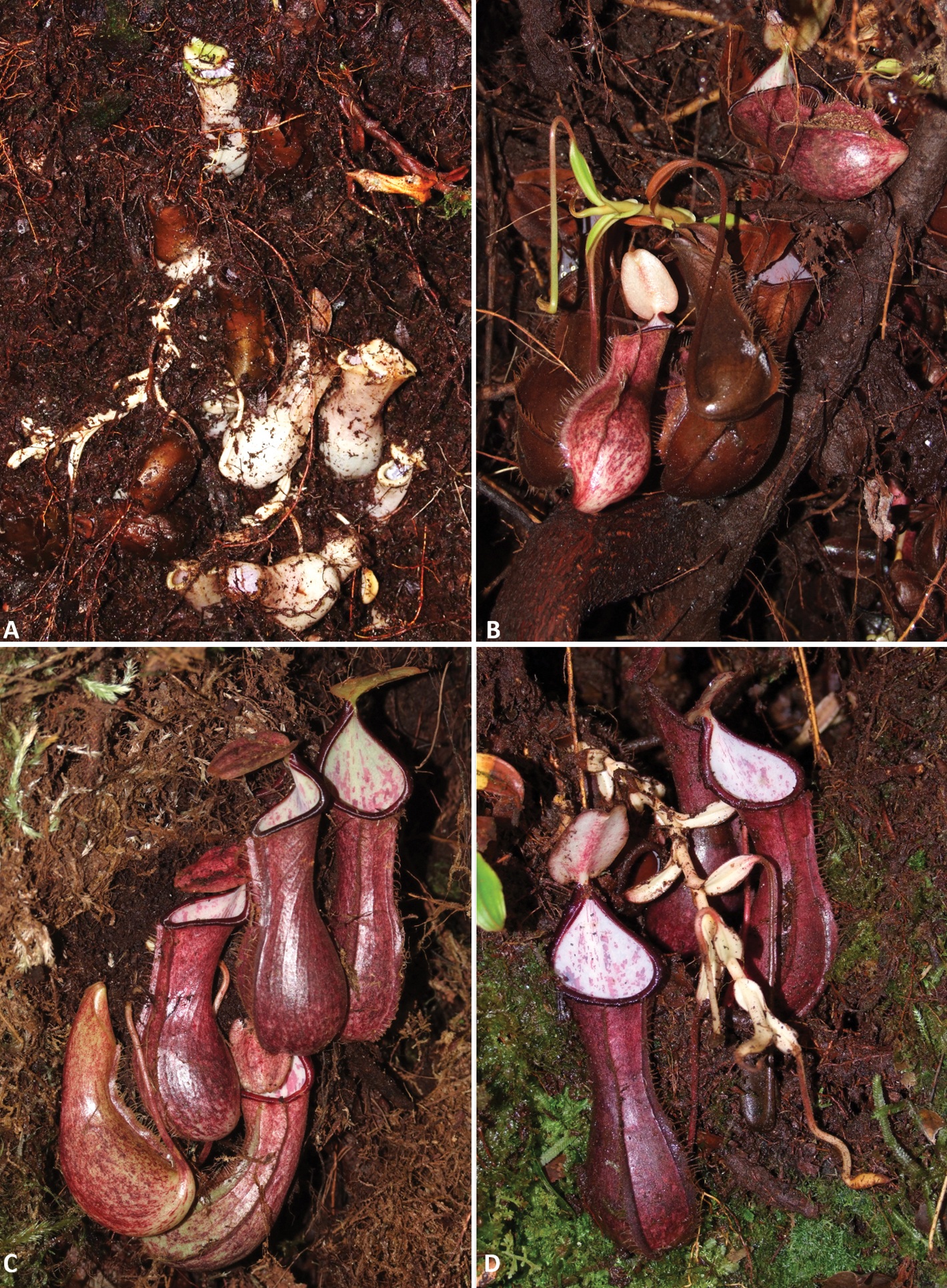
 A juvenile rosette pitcher B upper pitchers (4 on the right; each from a different plant), intermediate pitcher (1 on the left) C habitat with mature plant D habitat with lower pitchers excavated from the soil.
Photographs by M. Dančák.

Nepenthes pudica Dančák & Majeský, 
 A detail of lower pitchers excavated from the soil B lower pitchers in a cavity under tree roots–note greening of phyllodia formed in presence of low light C lower pitchers revealed under a moss mat D lower pitchers extracted from a cavity–note achlorophyllous shoot and reduced phyllodia formed in total darkness.
 Photographs by M. Dančák.

Nepenthes pudica Dančák & Majeský, 
A habit B lower pitcher C infructescence D male inflorescence E detail of climbing stem with a leaf.
Drawn by Kateřina Janošíková.

Nepenthes pudica Dančák & Majeský, 
A male flowers B male plant with inflorescence C infructescence D female plant with infructescence.
Photographs by M. Dančák.


 Nepenthes pudica Dančák & Majeský, sp. nov.
 
DiagnosisNepenthes pudica differs from N. hispida Beck in producing short basal underground (vs. aboveground) shoots; ± glabrous (vs. hairy) stems; petiolate (vs. sessile) climbing shoot leaves with auriculate, shortly decurrent (vs. decurrent-amplexicaul) bases; rare (vs. common) upper pitchers; red (vs. green or red blotched) lower pitchers; ± glabrous (vs. hairy) mature pitchers; ventricose (vs. ovoid-ellipsoid) lower pitchers; infundibular (vs. subcylindrical, tapering) upper half of the lower pitcher; 3–5.5 cm (vs. 1.5–3 cm) wide lower pitchers; male flowers in pairs (vs. single or rarely in pairs) and androphore c. 4 mm (vs. 1.5–2 mm) long.

  Distribution: The species is known only from a few adjoining localities in the western part of the Mentarang Hulu district of North Kalimantan, Indonesia. The exact locations have been withheld in order to prevent poaching by unscrupulous commercial collectors.

Etymology: The specific epithet pudica (bashful, shy), is a feminine adjective and alludes to the fact that lower pitchers remain concealed from direct view.


Martin Dančák, Ľuboš Majeský, Václav Čermák, Michal R. Golos, Bartosz J. Płachno and Wewin Tjiasmanto. 2022. First Record of Functional Underground Traps in A Pitcher Plant: Nepenthes pudica (Nepenthaceae), A New Species from North Kalimantan, Borneo. PhytoKeys. 201: 77-97. DOI: 10.3897/phytokeys.201.82872


Wednesday, April 27, 2022

[Mammalogy • 2022] Is Malaysia’s “Mystery Monkey” A Hybrid between Nasalis larvatus and Trachypithecus cristatus? An Assessment of Photographs


“mystery monkey”  evidence for a possible hybridization event between Nasalis larvatus and Trachypithecus cristatus

in Lhota, Yap, Benedict, ... et Ruppert, 2022.

Abstract
Interspecific hybridization in primates is common but hybridization between distantly related sympatric primate species is rarely observed in the wild. We present evidence for a possible hybridization event between Nasalis larvatus and Trachypithecus cristatus in the Lower Kinabatangan Wildlife Sanctuary, Sabah, through assessment of photographs. We used a set of categorical characters and metric measurements to compare the putative hybrid with the likely parent species. Nonmetric comparison showed that this “mystery monkey” is intermediate in several characters. Measurements of limb proportions on photographs showed that the brachial, humerofemoral, and intermembral indexes are above 100 for N. larvatus and below 100 for T. cristatus on all photographs, whereas the crural index is higher than 100 in both species and the distributions of this index in the two species overlap. Brachial and intermembral indices of the putative hybrid were similar to those of N. larvatus. Crural and humerofemoral indices were closer to the values for T. cristatus than those of N. larvatus. Multiple observers confirmed the occurrence of mixed-species groups in the area, and interspecific mating has been photographed. The putative hybrid is now an adult female and was last photographed in September 2020 with an infant and swollen breast, suggesting lactation. We propose further noninvasive fecal sampling for genetic analyses to confirm the origins of this “mystery monkey.” This case of hybridization may be related to anthropogenic changes to the landscape, whereby expansion of oil palm plantations confines N. larvatus and T. obscurus to narrow riverine forest patches along the Kinabatangan. This observation therefore also may have conservation implications, indicating limited mate access and dispersal opportunities for these threatened primates.
 
Keywords: Hybrid, Hybridization, Colobines, Proboscis monkey, Silvery lutung, Silvery langur, Interspecies interactions, Sabah


A. Juvenile “mystery monkey” near Kampung Bilit, Kinabatangan, Sabah, groomed by adult female Trachypithecus cristatus (likely the mother) (photo by Ken Ching, June 19, 2017). B. Subadult “mystery monkey,” alone (photo by Ben Duncan Angkee, November 17, 2018). In this photo, the individual may appear younger, because the phone camera had an automatic softening filter activated.

C. Subadult “mystery monkey,” alone, feeding
(photo by Bob Shaw, November 17, 2018). D. Subadult “mystery monkey” with juvenile T. cristatus (in color change phase), adult female T. cristatus, and another T. cristatus individual while grooming (photo by Ken Ching, November 22, 2018).

 E. Adult male Nasalis larvatus mating with adult female T. cristatus in the same area
(photo by Jean-Jay Mao, September 10, 2017). F. Adult putative hybrid now clearly identifiable as female with swollen breasts, holding an infant, which appears to be her offspring (photo by Nicole Lee, September 7, 2020)


Stanislav Lhota, Jo Leen Yap, Mark Louis Benedict, Ken Ching, Bob Shaw, Ben Duncan Angkee, Nicole Lee, Vendon Lee, Jean-Jay Mao and Nadine Ruppert. 2022. Is Malaysia’s “Mystery Monkey” A Hybrid between Nasalis larvatus and Trachypithecus cristatus? An Assessment of Photographs. International Journal of Primatology. DOI: 10.1007/s10764-022-00293-z
 

Thursday, July 8, 2021

[Botany • 2021] Nepenthes longiptera (Nepenthaceae) • A New Species of Nepenthes and Its Natural Hybrids from Aceh, Sumatra, Indonesia


 Nepenthes longiptera Victoriano

in Victoriano,. 2021.

 A new species of Nepenthes (Nepenthaceae) from Aceh Province, Indonesia, Nepenthes longiptera  Victoriano is herein described and illustrated. The species is unique among all other Nepenthes in  Sumatra by the presence of wings on its upper pitchers. Comprehensive description, photographs,  geographical distribution and preliminary IUCN conservation assessment are provided for the new species. Hybrids of this  new taxon with other species are also reported in this paper.  

Keywords: Nepenthes, carnivorous plant, Aceh, Sumatra, new species

Nepenthes longiptera Victoriano spec. nov.
 A. Lower pitcher, mostly bright in colour, ranging from red to orange, or red with speckles. B. Intermediate pitcher, the transition from lower to upper pitcher, usually still retains the colouration of lower pitchers. C. Upper pitcher, with its unique characteristic that still has wings which mostly reduced to ribs in other species, the colour is pure green when mature. 
 Photos by Malcolm Victoriano.

Nepenthes longiptera Victoriano spec. nov. 
Vining plant with upper pitcher in locus classicus.  

Nepenthes longiptera Victoriano

Nepenthes longiptera is similar to N. tobaica but differs in having larger habit, with well developed upper pitcher wings (N. tobaica: reduced to ribs); rhomboid stem in cross-section (N. tobaica: obtusely triangular); and the presence of an appendage under the lid (N. tobaica: absent).

Etymology. From Latin longus means long and Latinised Greek pteron means wing; referring to the presence of a relatively long pair of wings of the upper pitchers, it runs down from below the peristome to the apex of the tendril. It is resembling the fins of Long-Finned Prickleback fish, Xenolumpenus longipterus Shinohara & Yabe

CONCLUSION: 
Nepenthes longiptera is a new species from Aceh, Sumatra, Indonesia. It is similar to N. tobaica but differs in having larger habit, with well developed wings on upper pitcher (N. tobaica: reduced to ribs); rhomboid stem in cross-section (N. tobaica: obtusely triangular); and the presence of an appendage under the lid (N. tobaica: absent). This new species is probably endemic to Aceh province and only known from Nagan Raya and Central Aceh Regency. It has several putative natural hybrids with other Sumatran species which are never been recorded in Aceh before. Some Acehense species such as N. lavicola, N. mikei and N. tobaica are abundant in highland forests but these species had been recorded with no hybrid with other species in this area (McPherson, 2009).


 Malcolm Victoriano. 2021. A New Species of Nepenthes (Nepenthaceae) and Its Natural Hybrids from Aceh, Sumatra, Indonesia. Reinwardtia. 20(1); 17-26. DOI: 10.14203/reinwardtia.v20i1.3932


Monday, May 3, 2021

[Botany • 2021] Spiranthes bightensis (Orchidaceae) • A New and Rare Cryptic Hybrid Species Endemic to the U. S. Mid-Atlantic Coast


Spiranthes bightensis M.C. Pace

in Pace, 2021. 
Atlantic Ladies Tresses || facebook.com/425278 

Abstract
Recognizing species diversity is challenging in genera that display interspecific similarity and intraspecific variation; hybridization and the evolution of cryptic hybrid species amplifies these challenges. Recent molecular and morphological research focused on the systematics of Spiranthes (Orchidaceae) support hybrid speciation as an important driver of species diversity, particularly within the S. cernua species complex. Working under an integrated history-bound phylogenetic species concept, new molecular and morphometric data provide evidence for a new and rare cryptic hybrid species resulting from the ancient hybridization of S. cernua × S. odorata, here described as Spiranthes bightensis. Although S. bightensis is regionally sympatric with S. cernua it does not co-occur with that species, and it is allopatric with respect to S. odorata. Endemic to a narrow region extending from the Delmarva Peninsula to Long Island, New York, this new species occurs in the shadow of the Northeast megalopolis and appears to have undergone a major population decline over the last 200 years. By recognizing this distinct evolutionary lineage as a new species, this research is the first step towards developing conservation protocols for this rare species and highlights the importance of the North American Geologic Coastal Plain for biodiversity conservation and evolution.

Keywords: evolutionary phylogenetics, North American Geologic Coastal Plain, Northeast megalopolis, Spiranthes cernua, Spiranthes odorata, species complex, Monocots


Line drawing of Spiranthes bightensis M.C. Pace.
A. Habit and leaf detail. B. Inflorescence. C. Inflorescence detail. D. Floral bract and flower. E–M. Dissected flower. E. Dorsal sepal. F. Dorsal petal. G. Lateral sepal. H. Labellum, flattened. I. Labellum and column in natural position. J. Column, profile view. K. Column, ventral and dorsal view. L. Anther. M. Pollinia.
Drawn from Austin s.n. barcode 01392822 (NY) and Pace 608 (NY) by Bobbi Angell.

Spiranthes bightensis M.C. Pace, sp. nov. 
[ancient S. cernua × S. odorata].
—Type: U. S. A. Maryland: Worcester County, Bainbridge Park pond, Ocean Pines, off of Beaconhill Rd., ca. 3.5 km west of Isle of Wight Bay, 23 October 2013, 
Pace 608 (holotype: NY, isotypes: K, US).

Diagnosis. Spiranthes bightensis is most similar to S. cernua, from which it can be distinguished by its stoloniferous roots (vs. non-stoloniferous), typically longer and wider, more lanceolate leaves (vs. linear-lanceolate, 15–21.4 × 1.4–1.7 cm vs. 8.7–20 × 0.4–1.1 cm, Fig. 3, 4, Table 1) commonly fragrant flowers (vs. typically lacking fragrance), and slightly thickened central labellum (vs. centrally membranous). Spiranthes bightensis can be distinguished from S. odorata by its truncate column to rostellum transition zone, vs. lanceolate, and shorter and narrower leaves (15.0–21.4 × 1.4–1.7 cm vs. 13–51.7 × 1.8–2.7 cm).
...

Etymology:— From the Old English / Anglo-Saxon ‘byht’, meaning bend or bay, a bight is a shallowly curved coastline or extremely wide bay; its use here refers to the Mid-Atlantic and New York Bights, which stretches from the Nantucket Shoals off southern New England southward to Cape Lookout, North Carolina. Spiranthes bightensis is endemic to the central region of this bight. Atlantic Ladies Tresses is the suggested common name. 

Distribution map of Spiranthes bightensis, highlighting population loss over time.
A. Collections made pre-1890’s–present (the hypothesized original distribution of S. bightensis). B. 1900–present. C. 1950–present. D. 2000–present.
Prepared by Elizabeth Gjieli, NYBG GIS Lab.


Matthew C. Pace. 2021. Spiranthes bightensis (Orchidaceae), A New and Rare Cryptic Hybrid Species Endemic to the U. S. Mid-Atlantic Coast. Phytotaxa. 498(3); 159–176. DOI: 10.11646/phytotaxa.498.3.2


Tuesday, April 27, 2021

[Botany • 2021] Saxifraga × klimesii (Saxifragaceae) • A New Natural Hybrid in Saxifraga sect. Porphyrion Tausch from Himalaya


Saxifraga ×klimesii Hajman, Horák & Hroneš

in Horák, Hajman, Hroneš & Pavelka, 2021.

Abstract
A new natural hybrid Saxifraga ×klimesii Hajman, Horák & Hroneš from Ladakh (NW India) is described and illustrated. This hybrid resulted from cross between Saxifraga meeboldii Engler & Irmscher and Saxifraga pulvinaria Harry Smith. The morphology of the hybrid plants and its parental taxa was evaluated using morphometric analysis of both living plants and herbarium specimens. An artificial cross was also made to compare its morphology with spontaneous hybrids. Ploidy level and relative genome size was established using flow cytometry. Saxifraga ×klimesii is intermediate in morphology and relative genome size between both parents. It differs from S. meeboldii by shorter and wider rosette leaves and lighter yellow, larger and wider petals and from S. pulvinaria by larger rosettes, often more than one pore on leaves and usually yellow coloured petals. A lectotype is selected for S. pulvinaria.

Keywords: Alpine flora, hybridisation, Ladakh, taxonomy, typification, Saxifraga


Saxifraga ×klimesii Hajman, Horák & Hroneš
 

David Horák, Martin Hajman, Michal Hroneš and Mojmír Pavelka. 2021. A New Natural Hybrid in Saxifraga sect. Porphyrion Tausch (Saxifragaceae). Phytotaxa. 498(1); 25–34. DOI:  10.11646/phytotaxa.498.1.3

Its parents are Saxifraga meeboldii and Saxifraga pulvinaria. It occurs in Ladakh, Himalaya and it is named in honor of czech botanist Leoš Klimeš who was probably its first observer.

Tuesday, February 23, 2021

[Botany • 2021] Crassula × mortii (Crassulaceae: Crassuloideae) • A New Natural Hybrid Between C. perforata and C. rubricaulis from South Africa’s southern Cape


Crassula ×mortii

in Smith & Crouch, 2021. 

In terms of species-level diversity, the genus Crassula Linnaeus (1753: 282) is by far the most diverse in the Crassulaceae within the Flora of Southern Africa region [Namibia, Botswana, Eswatini (formerly Swaziland), Lesotho, South Africa] (Tölken 1977a, b, 1985). In this region diversity is highest in the Fynbos and Succulent Karoo Biomes, both of which straddle the southern Cape, an area represented in the Western and Eastern Cape provinces.

Keywords: taxonomy, Crassula, nothospecies, Eudicots


Gideon F. Smith and Neil R. Crouch. 2021. Crassula ×mortii (Crassulaceae subfam. Crassuloideae), A New Natural Hybrid Between C. perforata and C. rubricaulis from South Africa’s southern Cape. Phytotaxa. 487(1); 97–102. DOI: 10.11646/phytotaxa.487.1.9

Tuesday, July 23, 2019

[Botany • 2019] Origin of Rosa × binaloudensis (Rosaceae), A New Natural Hybrid Species from Iran


Rosa × binaloudensis 

in Vaezi, Arjmandi & Sharghi, 2019. 

Abstract
Rosa x binaloudensis, a new natural hybrid between R. beggeriana and R. persica is described and characterized after analyzing a set of morphological and molecular data. The putative hybrid with a small population occurs in the mountainous area of northeastern Iran. This taxon resembles R. beggeriana in having white corolla and pinnately compound leaves but its petals have red blotch at the base of each more similar to R. persica. In the morphological study we performed both the univariate and multivariate analyses. Results of Mann-Whitney U test show that among 62 vegetative and floral morphological traits used, 37 (59%) of the hybrid characters are parental-like, 14 (23%) traits are intermediate and 11 (18%) appear to be transgressive (both new and extreme characters). Multivariate analyses (PCoA) generally show that the hybrid is intermediate between its putative parents. In the molecular study we amplified, cloned, and sequenced ribotypes (nuclear rDNA-ITS region) of the hybrid, its putative parents and all members of the subgenus Rosa to detect their possible involvement in the hybridization. In addition to phylogenetic tree reconstruction, due to low molecular resolution among the ITS ribotypes, a phylogenetic network was also provided. Both the phylogenetic tree and haplotype network analysis confirmed the occurrence of the hybridization between the proposed parental species, R. beggeriana and R. persica. By using the chloroplastic trnL-F sequences, our phylogenetic reconstruction revealed that R. persica has played as a maternal role in the hybridization.

Keywords: Rosaceae, hybridization, morphology, molecular phylogeny, network, Eudicots


Rosa x binaloudensis


Jamil Vaezi, Ali Asghar Arjmandi and Hamid Reza Sharghi. 2019. Origin of Rosa x binaloudensis (Rosaceae), A New Natural Hybrid Species from Iran. Phytotaxa. 411(1); 23–38.  DOI:  10.11646/phytotaxa.411.1.2

Wednesday, January 2, 2019

[Botany • 2018] Bruguiera × dungarra (Rhizophoraceae) • A New Hybrid between Mangrove Species B. exaristata and B. gymnorhiza recently discovered in north-east Australia


Bruguiera × dungarra  N.C.Duke & Hidetoshi Kudo
in Duke & Kudo, 2018. 

Abstract
Bruguiera × dungarra (Rhizophoraceae), a previously undescribed hybrid species between B. exaristata and B. gymnorhiza is recorded from north-east Australia. Eight taxa are currently recognised in this Indo West Pacific genus, including three putative hybrids. The newly described hybrid is widely occurring, and it is described here with notes provided on typification, phenology, distribution and habitat. A revised identification key to all Bruguiera taxa is presented, along with a table of comparative diagnostic characters.

Keywords: Bruguiera × dungarra; Rhizophoraceae; hybrid; identification key; intermediate; mangrove; taxonomy


Fig. 4 Bruguiera × dungarra N.C.Duke & Kudo, hybrid nov. a. Foliage with inflorescences; b. trunk and exposed roots; c. habit; d. bark; e. leaves upper and lower surfaces; f. open and closed flower buds; g. leafy rosette with flower buds and mature propagule; h. mature hypocotyl; l. leaf scar node; j. colleter at inner base of interpetiolar stipule; k. petal dehisced and open; l. calyces of mature propagule, expended flower and closed flower bud; m. diagram of open petal (bar length = 10 mm); n. sectioned flower bud showing petals and style. — Collection field reference images for Hidetoshi Kudo & Brian Venables, HK190916A, (CNS!), Cairns, Machans Beach.

Bruguiera × dungarra N.C.Duke & Hidetoshi Kudo, hybrid nov.

Etymology. The location of the type of this new hybrid occurs on the ancestral lands of the Yirrganydji people. For these traditional custodians of the narrow coastal strip from Cairns to Port Douglas, the epithet Dungarra means, ‘belonging to Machans Beach area’.

Distribution — Type location is Machans Beach, near Cairns in Queensland,Australia. Other localities include Holloways Beach also near Cairns in Queensland, Australia, south to around Hinchinbrook Channel and Shoalwater Bay, and further north to the Marrett River estuary in Princess Charlotte Bay. Distribution elsewhere is likely, although possibly restricted to the zone of overlap of putative parents (Fig. 3). Putative parent species co-occur in eastern Indonesia, Timor Leste, southern New Guinea and northern Australia. In Australia, B. × dungarra is likely to occur from Darwin Harbour in the Northern Territory to Port Curtis in Queensland. 

Ecology & Local influences — Uncommon hybrid in the midhigh intertidal zone of intermediate estuarine position (sensu Duke 2006). Often in proximity of stands of higher intertidal B. exaristata, and mid-high intertidal B. gymnorhiza.


Norm C. Duke and Hidetoshi Kudo. 2018. Bruguiera × dungarra, A New Hybrid between Mangrove Species B. exaristata and B. gymnorhiza (Rhizophoraceae) recently discovered in north-east Australia. Blumea - Biodiversity, Evolution and Biogeography of Plants.  DOI:  10.3767/blumea.2018.63.03.03


A Cairns-based citizen scientist has made yet another remarkable discovery. 

Monday, June 18, 2018

[Ornithology • 2018] Discovery of A Rare Hybrid Specimen Known as Maria’s Bird of Paradise at the Staatliches Naturhistorisches Museum in Braunschweig


Figure 1. Plate of the male hybrid bird of paradise Paradisaea maria from Reichenow (1897). 

Figure 2. Plates of Paradisaea guilielmi (upper) and P. raggiana augustaevictoriae (lower),
the presumed parental species of P. maria, related to the original descriptions by Cabanis (1888).  

Reproduced from the Biodiversity heritage library (biodiversitylibrary.com). 
in Koch, 2018.   DOI: 10.3897/zse.94.25139 

Abstract
The discovery of a rare hybrid specimen of Maria’s bird of paradise (Paradisaea maria, i.e., P. guilielmi × P. raggiana augustaevictoriae) in the ornithological collection of the Staatliches Naturhistorisches Museum in Braunschweig (SNMB) is reported. Until today only six male specimens (deposited in the natural history museums in Berlin and New York) and presumably one female have been identified in collections world-wide. The male specimen in Braunschweig corresponds well in its plumage colouration with an historical illustration and photographs of the original type specimen from the 19th century housed at the Berlin collection. It shows intermediate characteristics between both parental species, viz. the Emperor bird of paradise (P. guilielmi) and the Raggiana bird of paradise (P. raggiana augustaevictoriae). In addition, we try to elucidate the circumstances how this rare specimen of hybrid origin, which formerly belonged to the natural history collection of the factory owner Walter Behrens from Bad Harzburg, came to the SNMB. Our unexpected discovery highlights the importance to maintain, support and study also smaller private natural history collections, since they may house historical voucher specimens of high scientific value.

Key Words: Paradisaea maria, Ornithology, Natural history collections, New Guinea, Type specimens, Hybridisation, Private collector, Walter Behrens, Haus der Natur

 André Koch. 2018. Discovery of A Rare Hybrid Specimen Known as Maria’s Bird of Paradise at the Staatliches Naturhistorisches Museum in Braunschweig. Zoosystematics and Evolution. 94(2): 315-324.  DOI: 10.3897/zse.94.25139

Zusammenfassung: Es wird über die Entdeckung eines seltenen Exemplars des Hybrid-Paradiesvogels Paradisaea maria (d.h. Paradisaea guilielmi × P. raggiana augustaevictoriae), in der ornithologischen Sammlung des Staatlichen Naturhistorischen Museums in Braunschweig (SNMB) berichtet. Bis heute sind lediglich sechs männliche (aus den Museen in Berlin und New York) und vermutlich ein weibliches Exemplar in internationalen Naturkundesammlungen bekannt geworden. Das männliche Exemplar aus Braunschweig entspricht in seiner Gefiederfärbung einer historischen Abbildung und Fotos des ursprünglichen Typusexemplars aus dem 19. Jahrhundert, das sich im Berliner Museum befindet. Es zeigt deutlich intermediäre Merkmalsausprägungen zwischen den beiden Elternarten, dem Kaiserparadiesvogel (P. guilielmi) und dem Raggi-Paradiesvogel (P. raggiana augustaevictoriae). Die Umstände, wie dieser seltene Hybrid-Paradiesvogel, der ehemals Teil der Sammlung des Fabrikanten Walter Behrens aus Bad Harzburg war, in die SNMB-Sammlung gelangte, werden erläutert. Unsere unerwartete Entdeckung unterstreicht die Bedeutung, auch kleinere private naturkundliche Sammlungen zu bewahren, zu erhalten und zu erforschen, da sie historische Belegexemplare von hoher wissenschaftlicher Bedeutung enthalten können.

Wednesday, May 17, 2017

[Entomology • 2017] Melitaea acentria • A New Species of Melitaea from Israel, with Notes on Taxonomy, Cytogenetics, Phylogeography and Interspecific Hybridization in the Melitaea persea complex (Lepidoptera, Nymphalidae)


Melitaea acentria Lukhtanov, 2017

Photos by V. Lukhtanov    DOI: 10.3897/CompCytogen.v11i2.12370 

Abstract
Specimens with intermediate morphology are often considered to be the result of ongoing interspecific hybridization; however, this conclusion is difficult to prove without analysis of chromosomal and/or molecular markers. In the butterfly genus Melitaea, such an intermediacy can be detected in male genitalia, and is more or less regularly observed in localities where two closely related, presumably parental species are found in sympatry. Here I analyze a high altitude Melitaea population from Mt. Hermon in north Israel and show that its male genitalia are clearly differentiated from those found in phenotypically similar M. persea and M. didyma, but in some aspects intermediate between them. This hybrid-like population is unique because, although M. didyma is present on Mt. Hermon, the true, low-altitude M. persea has never been reported from Israel. Cytogenetic analysis revealed no apomorphic chromosomal characters to distinguish the Mt. Hermon population from other known taxa of the M. persea and M. didyma species groups. At the same time, DNA barcode-based phylogeographic study showed that this population is ancient. It was estimated to originate 1–1.6 million years ago in the Levantine refugium from a common ancestor with M. persea. Generally, the data obtained are incompatible with interpretation of the studied population as a taxon conspecific with M. persea or M. didyma, or a swarm of recent hybrids between M. persea and M. didyma, although the possibility of ancient homoploid hybrid speciation cannot be ruled out. I also argue that the name Melitaea montium assigned to butterflies from north Lebanon cannot be applied to the studied taxon from Mt. Hermon. Here I describe this morphologically and ecologically distinct entity as a new species Melitaea acentria sp. n., and compare it with other taxa of the M. persea complex.

Keywords: Chromosomes, COI, DNA barcoding, genitalia, homoploid hybrid speciation, interspecific hybridization, Middle East, Melitaea casta, Melitaea eberti, Melitaea higginsi, Melitaea deserticola, Melitaea trivia, morphology, nomenclature, taxonomy

Figure 2. Melitaea acentria sp. n.
  
holotype, male, 17949_A06, Israel, Mt. Hermon; upperside holotype, male; underside male, 25453_E09, Israel, Mt. Hermon d paratype, female, 25453_E11, Israel, Mt. Hermon  
Photos by V. Lukhtanov    DOI: 10.3897/CompCytogen.v11i2.12370

Melitaea acentria Lukhtanov, sp. n.

 Holotype: (Fig. 2a, b), male, BOLD process ID BPAL2191-13, field # CCDB-17949_A06, GenBank accession number # KY777529; Israel, Mt. Hermon, 2050 m, 01 June 2013, A. Novikova leg., deposited in the Zoological Institute of the Russian Academy of Science (St. Petersburg).

Figure 3. Melitaea acentria in nature. Female. Israel, Mt. Hermon, 1800 m, 07 May 2016.
Photos by V. Lukhtanov
 
 DOI: 10.3897/CompCytogen.v11i2.12370 

Figure 13. Melitaea acentria and its habitat. Israel, Mt. Hermon, 2040 m, 22 June 2013.  

Distribution: Melitaea acentria is known to occur at high altitudes (1730–2060 m above the sea level) of Mt. Hermon (Fig. 11). Within these altitudes it is sympatric and syntopic with M. trivia syriaca, M. deserticola and M. cinxia. At the altitudes 1730–1780 m there is an essential overlapping of the M. acentria and M. didyma liliputana ranges where both species were found to fly together in early May 2016. Two other Melitaea species known from Mt. Hermon, M. collina and M. telona, were found to fly mostly at lower altitudes 1000–1600 m.

Etymology: The name acentria is a noun of the feminine gender. This name originates from the Greek prefix “a” that means “not” and from the Latin word “centrum” (centre) derived from the Greek “κέντρον” (kentron, a sharp point). Acentria is the Internet nickname of Asya Novikova who collected the samples initiated this research.This name indicates also the peripheral position of the new species within the distribution range of the M. persea species complex.

Figure 2. Melitaea acentria sp. n. and M. persea persea.
Macentria sp. n., holotype, male, sample 17949_A06, Israel, Mt. Hermon; upperside Macentria sp. n., holotype, male, sample 17949_A06, Israel, Mt. Hermon; underside Macentria sp. n., paratype, male, sample 25453_E09, Israel, Mt. Hermon Macentria sp. n., paratype, female, sample 25453_E11, Israel, Mt. Hermon
e M. persea persea, male, 17966_A10, Iran, Fars prov., Fasa area, 20 km W Estahban, 2200 m, 9-11 May 2007, B. Denno coll., MGCL accession # 2010-20 f M. persea persea, female, 17951_B01, Iran, Fars prov., 20 km N Darab, 2100-2300 m, 24.05.1999, leg. P. Hofmann, MGCL g M. persea persea, male, 17966_A11, Iran, Fars prov., Fasa area, 20 km W Estahban, 2200 m, 9–11.05.2007, MGCL accession # 2008-43 h M. persea persea, male, 17951_B02, Iran, Char Mahall-o-Bahtiyari, Umg. Shahr-e-Kord, 2000 m, 28 May 2002, leg. P. Hofmann, MGCL.

Scale bar corresponds to 10 mm in all figures. 
Photos by V. Lukhtanov    DOI: 10.3897/CompCytogen.v11i2.12370

Figure 10. Melitaea persea persea, presumptive hybrid between M. interrupta and M. persea, M. persea paphlagonia, M. higginsi, M. didyma liliputana and M. interrupta.
a Melitaea persea persea, female, 17951_B03, Iran, Esfahan, Kuh-e-Marsenan, near Zefre, 2000 m, 26 May 2002, leg. Hofmann, MGCL b presumptive hybrid female between M. interrupta and M. persea, 17966_F12, Armenia, Zhangezur Range, Megri district, Litchk, 1800 m, 23 July 1999, A. Dantchenko leg., MGCL c M. persea paphlagonia, male, 17951_F11, Iran, Khorasan, Kuh-e-Binalut, 15 km SW Zoshk, 2300–2500 m, 7 June 1999, leg. P. Hofmann, MGCL d M. persea paphlagonia, male, 17951_F11, Iran, Khorasan, Kuh-e-Binalut, 15 km SW Zoshk, 2300-2500 m, 7 June 1999, leg. P. Hofmann, MGCL e M. higginsi, male, 17966_A12, Afghanistan, Hindukush, Panchir Valley, 20 June 2004, M.J.Simon collection, MGCL f M. higginsi, female, 17950_H10, Afghanistan, Badakhshan, Mt. Yamak N of Anjuman Pass, 3500-4000 m, 1-25 July 2004 M.J.Simon collection, MGCL g M. didyma liliputana, male, 17968_E10, Israel, Mt. Hermon h M. interrupta, male, 17966_F11, Armenia Armenia, Zhangezur Range, Kadjaran, 2500 m, 21–22 July 1999, leg. A. Chuvilin, MGCL; the wing underside is with black scales along the veins.
Scale bar corresponds to 10 mm in all figures. Photos by V. Lukhtanov    DOI: 10.3897/CompCytogen.v11i2.12370

Conclusion
The Melitaea persea species complex consists of the following taxa:

• M. persea Kollar, 1849
M. persea persea Kollar, 1849 (East Turkey, Armenia, Azerbaijan, Daghestan in Russian Caucasus, western, central and nothern parts of Iran)
M. persea paphlagonia Fruhstorfer, 1917 (NE Iran, probably also S. Turkmenistan)

• M. eberti Koçak, 1980 (N. Iran)

• M. higginsi Sakai, 1978 (Afghanistan)

• M. acentria Lukhtanov sp. n. (Mt. Hermon in Israel, definitely also the neighboring territories of Syria and Lebanon)

The identity and taxonomic status of the M. persea-similar samples from north Lebanon, Jordan, Iraq, Pakistan, and Afghanistan remain still unclear. The populations from Lebanon characterized by the mitochondrial haplogroup P2 (Fig. 9) could actually represent (i) a distinct subspecies of M. persea, (ii) an undescribed subspecies of M. acentria, or even (iii) an undescribed species. Further morphological, molecular and chromosomal studies are required to select between these hypotheses.


 Vladimir A. Lukhtanov. 2017. A New Species of Melitaea from Israel, with Notes on Taxonomy, Cytogenetics, Phylogeography and Interspecific Hybridization in the Melitaea persea complex (Lepidoptera, Nymphalidae). Comparative Cytogenetics. 11(2); 325-357.  DOI: 10.3897/CompCytogen.v11i2.12370

New butterfly species discovered in Israel for the first time in 109 years http://blog.pensoft.net/2017/05/09/new-butterfly-species-discovered-in-israel-for-the-first-time-in-109-years/