Showing posts with label Ornithuromorpha. Show all posts

Saturday, November 13, 2021

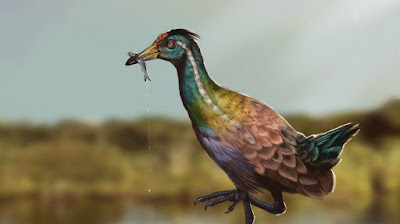
[PaleoOrnithology • 2021] Kaririavis mater • A New Ornithuromorph Bird from the Lower Cretaceous of South America


Kaririavis mater
Carvalho, Agnolin, Rozadilla, Novas, Andrade & Xavier-Neto, 2021


ABSTRACT
The fossil record of Early Cretaceous birds in South America has been restricted to members of Enantiornithes from the Crato Formation (Aptian) of Brazil. Here we describe a new genus and species of bird discovered at Pedra Branca Mine, Nova Olinda County, Ceará State, Brazil, which adds to the avian fossil record from the Crato Formation. The specimen is represented by an isolated foot that is exposed in plantar view. A plantarly displaced metatarsal III with a well-developed hypotarsus supports its referral to Ornithuromorpha, representing the oldest member of the clade reported for Gondwana. Its unique foot conformation indicates that it may belong to an unknown ornithuromorph clade with some cursory similarities to extant flightless ratites. The presence of Early Cretaceous ornithuromorphs in Brazil indicates that the clade was widespread in Gondwana during the Mesozoic.


Kaririavis mater

 
Ismar de Souza Carvalho, Federico L. Agnolin, Sebastián Rozadilla, Fernando E. Novas, José A. Ferreira Gomes Andrade and José Xavier-Neto. 2021. A New Ornithuromorph Bird from the Lower Cretaceous of South America. Journal of Vertebrate Paleontology. e1988623. DOI: 10.1080/02724634.2021.1988623

"Kaririavis mater": nova espécie de pássaro cearense dá pistas sobre origem das aves
O fóssil da "Kaririavis mater" coloca o Ceará como uma das possíveis regiões de origem das aves modernas, antes limitada à Ásia


Monday, September 20, 2021

[PaleoOrnithology • 2021] Yuanchuavis kompsosoura • An Early Cretaceous enantiornithine Bird with A Pintail


  Yuanchuavis kompsosoura 
Wang, O’Connor, Zhao, Pan, Zheng, Wang & Zhou, 2021

Illustration: Haozhen Zhang 

On the cover: An early Monday morning during the Early Cretaceous of Asia. A male Yuanchuavis is displaying and perching on the crest of a sleepy Sinotyrannus when they are suddenly interrupted by a flock of tiny, young Sinopterus (Nemicolopterus).
 In this issue, Wang et al. (pages 4845–4852) report a new Early Cretaceous enantiornithine bird, Yuanchuavis kompsosoura, with a rectricial fan combined with an elongated central pair of fully pennaceous rachis-dominated plumes, constituting a new tail plumage previously unknown among dinosaurs and Mesozoic birds but that strongly resembles the pintail in many living birds.

Highlights: 
• Wang et al. describe a new pengornithid enantiornithine from the Early Cretaceous
• The new enantiornithine specimen preserves a pintail indicative of sexual selection
• The exaggerated pintail of this fossil bird may arise from the handicap process
 • Mesozoic enantiornithines and ornithuromorphs show contrasting tail morphotype

Summary
Enantiornithes are the most successful group of Mesozoic birds, arguably representing the first global avian radiation, and commonly resolved as the sister to the Ornithuromorpha, the clade within which all living birds are nested. The wealth of fossils makes it feasible to comparatively test evolutionary hypotheses about the pattern and mode of eco-morphological diversity of these sister clades that co-existed for approximately 65 Ma. Here, we report a new Early Cretaceous enantiornithine, Yuanchuavis kompsosoura gen. et sp. nov., with a rectricial fan combined with an elongate central pair of fully pennaceous rachis-dominated plumes, constituting a new tail plumage previously unknown among nonavialan dinosaurs and Mesozoic birds but which strongly resembles the pintail in many neornithines. The extravagant but aerodynamically costly long central plumes, as an honest signal of quality, likely evolved in enantiornithines through the handicap process of sexual selection. The contrasting tail morphotypes observed between enantiornithines and early ornithuromorphs reflect the complex interplay between sexual and natural selections and indicate that each lineage experienced unique pressures reflecting ecological differences. As in neornithines, early avialans repeatedly evolved extravagant structures highlighting the importance of sexual selection in shaping the plumage of feathered dinosaurs, even early in their evolutionary history.

Keywords: Aves, dimorphism, Enantiornithes, feather, phylogeny, Mesozoic, Ornithuromorpha, sexual selection


  Yuanchuavis kompsosoura gen. et sp. nov.


 Min Wang, Jingmai K. O’Connor, Tao Zhao, Yanhong Pan, Xiaoting Zheng, Xiaoli Wang and Zhonghe Zhou. 2021. An Early Cretaceous enantiornithine Bird with A Pintail. Current Biology. In Press. DOI: 10.1016/j.cub.2021.08.044


Monday, March 2, 2020

[PaleoOrnithology • 2020] Khinganornis hulunbuirensis • A New Advanced Ornithuromorph Bird from Inner Mongolia documents the northernmost Geographic Distribution of the Jehol Paleornithofauna in China


Khinganornis hulunbuirensis
Wang, Cau, Kundrát, Chiappe, Ji, Wang, Li & Wu, 2020

ABSTRACT
We describe a new taxon of advanced ornithuromorph bird, Khinganornis hulunbuirensis gen. et sp. nov., from the previously unreported Pigeon Hill locality of the Lower Cretaceous Longjiang Formation in the northern Greater Khingan Range area of Inner Mongolia, China. A cladistics analysis resolves K. hulunbuirensis as the sister group of a clade formed by Changzuiornis and Iteravis among ornithuromorphs. The osteohistological analysis indicates that K. hulunbuirensis is the first ornithuromorph that maintained an uninterrupted growth during a longer period characterised by slow deposition of low-vascularised and terminal avascular bone tissue. The relatively long hindlimbs and elongate pedal digits with long proximal phalanges suggest a wading and amphibious ecology for the new bird. The discovery of K. hulunbuirensis represents the first occurrence of Jehol birds in the Greater Khingan Range and documents the northernmost known geographic distribution of the celebrated avifauna in China. The new record implies more extended palaeogeographic range for the early diversification of Mesozoic birds on the eastern side of Laurasia.

KEYWORDS: Early Cretaceous, Longjiang formation, Jehol Biota, Ornithuromorpha, growth strategy

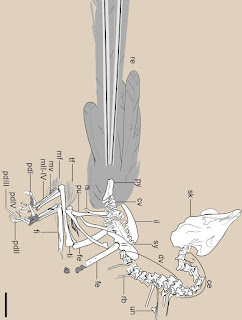
the holotype of Khinganornis hulunbuirensis gen. et sp. nov., SGM-AVE-2017001. A, slab-A; B, slab-B.
Abbreviations: ce, cervical vertebrae; co, coracoid; cv, caudal vertebrae; f, femur; fu, furcula; h, humerus; il, ilium; is, ischium; lr, left radius; lu, left ulna; ma, manus; pd, pedal digits; pu, pubis; rr, right radius; ru, right ulna; s, scapula; sk, skull; st, sternum; t, tibiotarsus; tm, tarsometatarsus. 
Scale bar = 2 cm.

Systematic palaeontology 
Class: Aves Linnaeus, 1758 
Pygostylia Chiappe, 2002 
Ornithothoraces Chiappe, 1995 
Ornithuromorpha Chiappe, 2002 

Genus: Khinganornis gen. nov.
 Type species: Khinganornis hulunbuirensis sp. nov. 

Derivation of name: The genus name is derived from the Greater Khingan Range in northeastern China, referring to the first fossil bird uncovered from the Greater Khingan Range at the time of publication. 

Khinganornis hulunbuirensis sp. nov.

Derivation of name: The species name refers to the fossil site located in Hulunbuir City.


Xuri Wang, Andrea Cau, Martin Kundrát, Luis M. Chiappe, Qiang Ji, Yang Wang, Tao Li and Wenhao Wu. 2020. A New Advanced Ornithuromorph Bird from Inner Mongolia documents the northernmost Geographic Distribution of the Jehol Paleornithofauna in China. Historical Biology: An International Journal of PaleobiologyDOI: 10.1080/08912963.2020.1731805 

Thursday, December 28, 2017

[PaleoOrnithology • 2017] Maaqwi cascadensis • A Large, Marine Diving Bird (Avialae: Ornithurae) from the Upper Cretaceous of British Columbia, Canada


Maaqwi cascadensis
McLachlan, Kaiser & Longrich, 2017


Abstract

Mesozoic bird fossils from the Pacific Coast of North America are rare, but small numbers are known from the Late Cretaceous aged sediments of Hornby Island, British Columbia. Most are unassociated fragments that offer little information, but additional preparation of a large coracoid has revealed more details of its structure, as well as three associated wing bones. Phylogenetic analysis suggests that Maaqwi cascadensis, gen. et sp. nov. represents a derived crown or near-crown member of Ornithurae, and specifically suggests affinities with Vegaviidae. M. cascadensis is characterized by large size, and regressions based on dimensions of the coracoid suggest a large bird, with an estimated body mass of approximately 1.5 kilograms. The bones are robust, with thick walls, suggesting that M. cascadensis was a bird adapted for diving, similar to modern loons and grebes. The wings are short, while the coracoid is unusually short and broad, similar to modern loons. Along with the Ichthyornithes and Hesperornithes, M. cascadensis and Vegaviidae appear to represent a third clade of bird that evolved to exploit marine habitats in the Late Cretaceous, one specialized for foot-propelled diving and rapid cruising flight over water.

Fig 2. Photographs and schematic illustrations of Maaqwi cascadensis holotype RBCM.EH2008.011.01120 depicting wing bone orientation. (A, B) dorsal face of right coracoid and partial humerus. 

 acrocoracoid, partial humerus, ulna and radius. Shading denotes preserved cortical bone (white), exposed trabecular bone (light grey), and matrix (dark grey). c = coracoid. h = humerus. u = ulna. r = radius. Scale bar = 1 cm. 

Systematic paleontology

Avialae Gauthier 1986
Ornithothoraces Chiappe and Calvo 1994
Ornithuromorpha Chiappe and Walker 2002

Ornithurae Haeckel 1866 sensu Chiappe
Vegaviidae Agnolín et al. 2017

Maaqwi cascadensis gen. et sp. nov.

Etymology: The generic name, Maaqwi, is derived from “ma’aqwi”, the Coast Salish word meaning “water bird”. The specific name, cascadensis, reflects provenance in the Cascadia region of western North America.

Holotype: RBCM.EH2008.011.01120 consists of a concretionary mudstone nodule containing a right coracoid, as previously described by Dyke et al. [18]. However, at the time of initial description, the specimen had not been prepared and only the dorsal face of the coracoid was visible [18, Fig 2A]. The acrocoracoid appeared to be missing and only the broken ends of the three associated long bones were visible. Subsequent mechanical preparation of the coracoid revealed that its head was everted ventrally and had been buried within the matrix. Further preparation revealed central portions of three wing elements; a humerus, ulna and radius (Fig 2). The specimen is housed within the RBCM.

Locality: RBCM.EH2008.011.01120 was recovered from a coastal outcrop of the upper Campanian Northumberland Formation exposed on the northwestern shore of Hornby Island, British Columbia.

Diagnosis: Coracoid compact, polygonal in profile, with the omal portion approximately one third of the medial length. Coracoid shaft a stout, flat bar. Coracoid and humerus robust, highly pachyostotic.


Conclusions
Maaqwi cascadensis appears to represent a lineage of Cretaceous marine birds distinct from either Ichthyornithes or Hesperornithiformes. Instead, it appears to be closely allied with—or perhaps part of—crown Aves. The wings are reduced, inconsistent with soaring, and instead suggest a bird specialized for fast cruising flight over water. The thickness of the walls of the bones suggest that it was a diver but the wings are not modified for underwater propulsion. Instead, it was most likely a foot-propelled diver, although it may have made occasional use of its wings for steering underwater. Phylogenetic analysis suggests affinities with Vegavis iaai, which has recently been reinterpreted as a foot-propelled diver, taking its place along side other advanced ornithurines specialized for foot-propelled diving within the Vegaviidae including Australornis lovei, Neogaeornis wetzeli, and Polarornis gregrorii. Clearly, additional fossil material is needed to better understand the affinities and ecology of these Late Cretaceous–early Paleogene marine birds.

Sandy M. S. McLachlan, Gary W. Kaiser and Nicholas R. Longrich. 2017.   Maaqwi cascadensis: A Large, Marine Diving Bird (Avialae: Ornithurae) from the Upper Cretaceous of British Columbia, Canada. PLoS ONE. 12(12); e0189473.  DOI: 10.1371/journal.pone.0189473

Thursday, August 10, 2017

[PaleoOrnithology • 2017] Chupkaornis keraorum • The Oldest Asian Hesperornithiform from the Upper Cretaceous of Japan, and the Phylogenetic Reassessment of Hesperornithiformes


Chupkaornis keraorum
 Tanaka, Kobayashi, Kurihara, Fiorillo & Kano, 2017

 DOI: 10.1080/14772019.2017.1341960  

Abstract
Asian hesperornithiforms are extremely rare in contrast to the much more abundant record from North America. In Asia, these fossil birds are only known from fragmentary materials from Mongolia. Here we describe the skeletal remains of a new hesperornithiform Chupkaornis keraorum gen. et sp. nov. from the Upper Cretaceous Kashima Formation (Coniacian to Santonian) of the Yezo Group in Mikasa City, Hokkaido, Japan. This is the best-preserved hesperornithiform material from Asia and it is the first report of hesperornithiforms from the eastern margin of the Eurasian continent. Chupkaornis has a unique combination of characters: finger-like projected tibiofibular crest of femur, deep, emarginated lateral excavation with a sharply defined edge of the ventral margin of the thoracic vertebrae, and the heterocoelous articular surface of the thoracic vertebrae. Our new phylogenetic analysis revises the phylogenetic relationships of Hesperornithiformes. In contrast to previous studies, Enaliornis is assigned as the most basal taxon and Baptornis is positioned as more derived than Brodavis. Chupkaornis is a sister taxon to the clade of Brodavis and higher taxa. Parahesperornis and Hesperornis are positioned within Hesperornithidae, the derived Hesperornithiformes. Many of the skeletal character changes are concentrated at the base of Hesperornithidae (Parahesperornis and more derived taxa), and involve the modification of the pelvic girdle and hind limb morphology (e.g. dorsal directed antitrochanter of pelvis, short and sprawled femur, including probable lobe-toed feet suggested by the specialized distal articular surface of first digit of fourth toe, and predominantly robust digit IV phalanges). These skeletal modifications are likely adaptations for foot-propelled diving behaviour.

Keywords: Hesperornithiformes, diving birds, fossil birds, Late Cretaceous, new species


 Japan's first and oldest fossil diving bird,  Chupkaornis keraorum.
Life reconstruction by Masato Hattori 

Systematic palaeontology
Avialae Gauthier, 1986
Ornithuromorpha Chiappe, 2002a
Hesperornithiformes Fürbringer, 1888

Chupkaornis gen. nov.

Etymology. Chupkaornis, from the combination of the Ainu word ‘chupka’, meaning ‘eastern’, and the Greek ‘ornis’ for bird.

Chupkaornis keraorum sp. nov.

Etymology. Named after Masatoshi and Yasuji Kera, who discovered the specimen and contributed greatly to the Mikasa City Museum. 
Holotype. MCM.A773; a partial skeleton of a single individual including four cervical and two thoracic vertebrae, the distal ends of the left and right femora, and the middle part of the right fibula. 

Locality and age. Kumaoi Creek, one branch off Lake Katsurazawa, Mikasa City, Hokkaido, Japan; Kashima Formation (Coniacian to Santonian), Upper Cretaceous Yezo Group.


 Conclusions:
A new hesperornithiform, Chupkaornis keraorum gen. et sp. nov. (MCM.A773) from the Late Cretaceous of Japan, is the first record of the group from the eastern margin of the Eurasian continent and the oldest record for this avian group from Asia. The new material is the best-preserved Asian hesperornithiform specimen recovered thus far, and provides new palaeobiogeographical insights for the broad taxonomic group as well as significant new anatomical data. Chupkaornis keraorum is diagnosed by a unique combination of characters from thoracic vertebrae and femur. 

A phylogenetic analysis suggests that C. keraorum is a basal hesperornithiform. The new taxon is more derived than Pasquiaornis and more basal than Brodavis. The present analysis also suggests new phylogenetic relationships within the Hesperornithiformes; Enaliornis is the most basal hesperornithiform, and Baptornis advenus is a more derived taxon than Brodavis. The evolutionary rate calculation indicates that the rate of change is much higher within basal members of the Hesperornithidae compared to later branches. This rate change suggests that the most important morphological changes for highly foot-propelled diving adaptation are concentrated at the base of the Hesperornithidae.


Tomonori Tanaka, Yoshitsugu Kobayashi, Ken'ichi Kurihara, Anthony R. Fiorillo and Manabu Kano. 2017. The Oldest Asian Hesperornithiform from the Upper Cretaceous of Japan, and the Phylogenetic Reassessment of Hesperornithiformes. Journal of Systematic Palaeontology. DOI: 10.1080/14772019.2017.1341960 

Amateur collectors in Japan discover country's first and oldest fossil diving bird  phy.so/421422532 via @physorg_com

Monday, May 1, 2017

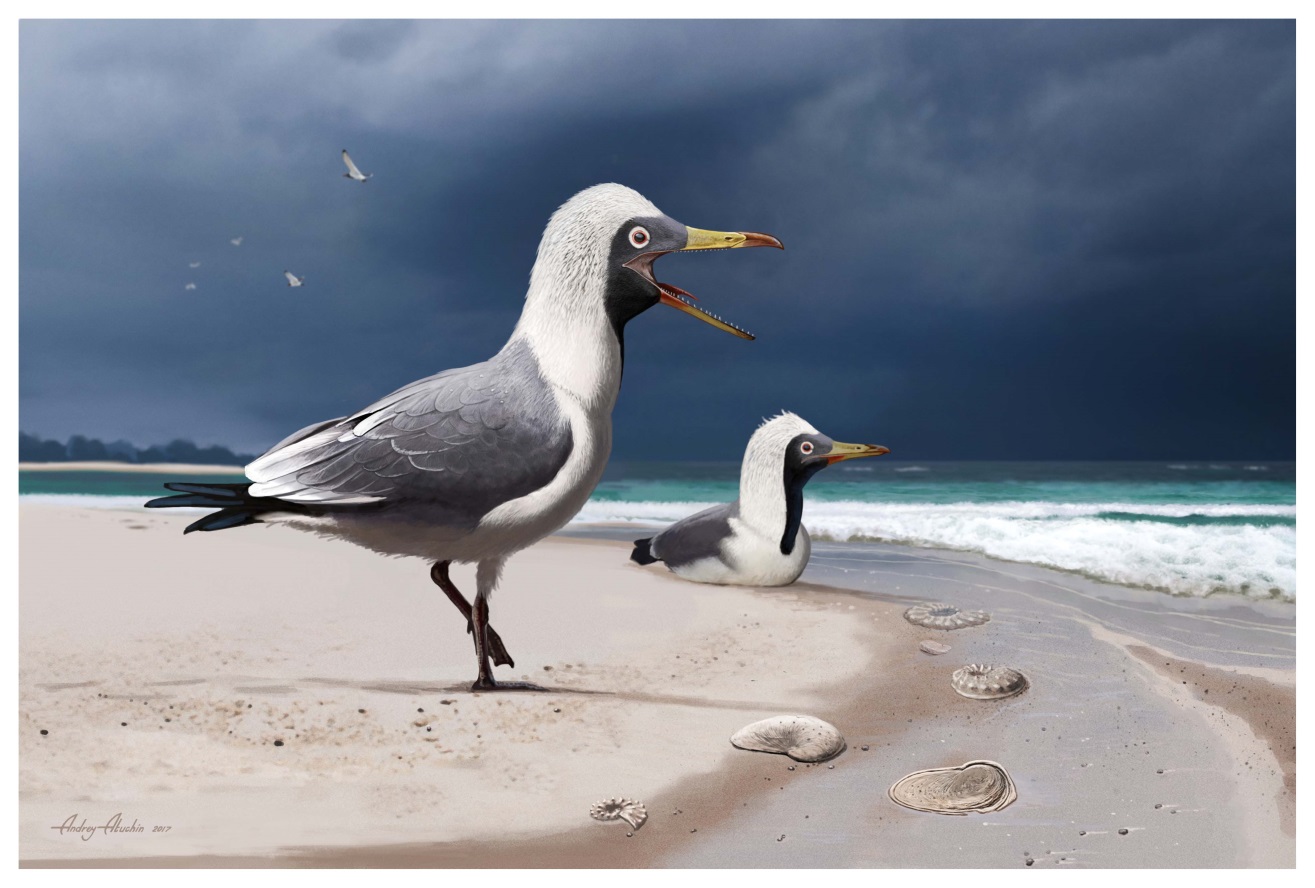
[PaleoOrnithology • 2017] An Ichthyornis-like bird from the earliest Late Cretaceous (Cenomanian) of European Russia


An Ichthyornis-like bird from the earliest Late Cretaceous (Cenomanian) of European Russia. 
Zelenkov, Averianov & Popov, 2017

elementy.ru   Illustration: Andrey Atuchin 

Abstract
Ornithuromorph birds (the clade which includes modern avian radiation) first appeared in the Early Cretaceous in Asia and achieved a great diversity during the latest ages of the Late Cretaceous (Campanian and Maastrichtian). The evolutionary history of orithuromorphs during the first 17 MYAs of the Late Cretaceous (Cenomanian to Santonian ages) remains very poorly known, as the fossil record for this time interval is largely restricted to several isolated finds of the classic avian genus Ichthyornis in North America. Here we describe an isolated distal tibiotarsus of an evolutionary advanced bird, morphologically similar to Ichthyornis, from the middle Cenomanian of Saratov Province, European Russia. This is the first documentation of an Ichthyornis-like bird in the Old World. The find further constitutes only the second pre-Campanian record of the Late Cretaceous Ornithuromorpha in Eurasia, the second record of Cenomanian birds in Russia. This discovery shows that Ichthyornis-like birds enjoyed a wide geographical distribution as early as the beginning of the Late Cretaceous. Given that the earliest and the most primitive ornithuromorph birds are known from Asia, the new find supports a Eurasian origin for Ichthyornithidae.

Keywords: Cenomanian; East Europe; Ornithuromorpha; Palaeobiogeography


Systematic paleontology
Aves Linnaeus 1758
Ornithuromorpha Chiappe et al. 1999
Ornithurae Haeckel 1866
?Ichthyornithidae Marsh 1873

Gen. et sp. indet.

Material. Specimen PIN 5554/1, distal fragment of a right tibiotarsus.

Locality and horizon. Site SNB-2a, Nizhnyaya Bannovka, Krasnoarmeisk District, Saratov Province, Russia; Middle Member, Melovatka Formation, middle Cenomanian, lower Upper Cretaceous.


Fig. 2. Specimen PIN 5554/1, distal tibiotarsus of an Ichthyornis-like bird from the middle Cenomanian of European Russia. A, lateral view; B, cranial view; C, medial view; D, caudal view; E, proximal view; F, distal view; G, interpretative drawing of the cranial view.
Abbreviations: cl, condylus lateralis; cm, condylus medialis; conc, concavity; csic, concavities within sulcus intercondylaris; ?dep, depression; em, epicondylus medialis; sic, sulcus intercondylaris; se, sulcus extensorius; tub, tuberosity. 


Conclusions
A partial tibiotarsus from the middle Cenomanian of the Nizhnyaya Bannovka locality in Saratov Province (European Russia) belongs to an evolutionary advanced ornithuromorph bird, similar in size and morphology to the North American Ichthyornis. This is the first reliable documentation of Ichthyornis-like birds in the Old World, because previously referred specimens indeed belong to Enantiornithes. This discovery confirms a wide geographic distribution of Ichthyornis-like birds already in the beginning of the Late Cretaceous and supports the Eurasian origin of Ichthyornithidae. The new specimen is further the first pre-Campanian Late Cretaceous ornithuromorph bird in Eurasian known from postcranial material.


Nikita V. Zelenkov, Alexander O. Averianov and Evgeny V. Popov. 2017. An Ichthyornis-like bird from the earliest Late Cretaceous (Cenomanian) of European Russia.
 
Cretaceous Research. 75; 94–100. DOI: 10.1016/j.cretres.2017.03.011


Поволжский ихтиорнис • Никита Зеленков • Научная картинка дня на «Элементах» • Палеонтология https://elementy.ru/kartinka_dnya/307/Povolzhskiy_ikhtiornis

Friday, March 31, 2017

[PaleoOrnithology • 2017] Exceptional Preservation of Soft Tissue in A New Specimen of Eoconfuciusornis and Its Biological Implications


Figure 1. Photograph of Eoconfuciusornis indet. STM7-144, preserved in right lateral view; scale bar equals 20 mm
Figure 5. In vivo reconstruction of a male and female pair of Eoconfuciusornis. Artwork by Michael Rothman.


Abstract
We report on an exceptional specimen of Eoconfuciusornis preserving rare soft-tissue traces of the ovary and wing. Ovarian follicles preserve a greater hierarchy than observed in Jeholornis and enantiornithines, suggesting confuciusornithiforms evolved higher rates of yolk deposition in parallel with the neornithine lineage. The preserved soft tissues of the wing indicate the presence of a propatagium and postpatagium, whereas an alular patagium is absent. Preserved remnants of the internal support network of the propatagium bear remarkable similarity to that of living birds. Soft tissue suggests the confuciusornithiform propatagium could maintain a cambered profile and generate lift. The feathers of the wing preserve remnants of their original patterning; however, this is not strongly reflected by observable differences under scanning electron microscopy (SEM). The tail plumage lacks elongate rectrices, suggesting that the earliest known confuciusornithiforms were sexually dimorphic in their plumage.

Keywords: Huajiying, Jehol Biota, Aves, Confuciusornithiformes, propatagium, feathers


Figure 1. (a) Photograph of Eoconfuciusornis indet. STM7-144, preserved in right lateral view; scale bar equals 20 mm.
Inset SEM images (all scale bars equal 2 μm); (b) left-wing coverts (sample 2_2) preserving black eumelanosomes; (c) coronal feathers (sample 2_1) preserving grey eumelanosomes; (d) dark spot of secondaries (sample A) preserving black eumelanosomes; (e) light part of secondaries (sample C) preserving grey mouldic eumelanosomes; (f) tail feathers (sample 2_3) preserving black eumelanosomes; (g) crural feathers (sample 2_4) preserving grey eumelanosomes; (h) submalar feathers (sample G) preserving phaeomelanosomes. Yellow dots indicate location of each sample. 


Figure 2. (a) Interpretative drawing of Eoconfuciusornis indet. STM7-144; (b) ovarian follicles; (c) remnants of the internal structure of the propatagium with underlying feathers; (d) preserved pattern in the greater coverts; (e) secondary remiges. Scale bar equals 10 mm in (a) and 5 mm in all insets. Anatomical abbreviations: al, alular metacarpal; ca, caudal vertebrae; ce, cervical vertebrae; cm, carpometacarpus; co, coracoid; cv, wing coverts; de, dentary; dv, dorsal vertebrae; f, frontal; fe, femur; g, gastralia; gc, greater coverts; hu, humerus; il, ilium; is, ischium; l, left; lc, lesser coverts; ma, major metacarpal; mc, marginal coverts; mi, minor metacarpal; mt, metatarsal; p1-3, manual phalanges; pb, pubis; pm, premaxilla; pp, postpatagium; prp, propatagium; py, pygostyle; ra, radius; ri, ribs; s, synsacrum; sc, scapula; sl, scleral ossicles; sr, secondary remiges; st, sternum; tbt, tibiotarsus; tmt, tarsometatarsus; ul, ulna; u, uncinate process. Yellow indicates preserved remnants of maturing ovarian follicles; dermal and epidermal tissue remnants are indicated in tan; remains of collagen fibres are brown. Dark grey indicates body feathers and the dorsal layer of wing coverts; light grey indicates the greater coverts and secondaries with preserved patterning. White dashed boxes represent areas enlarged in insets. 

Figure 5. In vivo reconstruction of a male and female pair of Eoconfuciusornis.
Artwork by Michael Rothman. 

Xiaoting Zheng, Jingmai K. O’Connor, Xiaoli Wang, Yanhong Pan, Yan Wang, Min Wang and Zhonghe Zhou. 2017. Exceptional Preservation of Soft Tissue in A New Specimen of Eoconfuciusornis and Its Biological Implications. National Science Review. nwx004. DOI: 10.1093/nsr/nwx004

Scientists make new discovery about bird evolution
 Summary: A team of scientists has described the most exceptionally preserved fossil bird discovered to date, in a newly published article. The new specimen from the rich Early Cretaceous Jehol Biota (approximately 131 to 120 million years old) is referred to as Eoconfuciusornis, the oldest and most primitive member of the Confuciusornithiformes, a group of early birds characterized by the first occurrence of an avian beak.


Tuesday, February 7, 2017

[PaleoOrnithology • 2017] Cruralispennia multidonta • A Bizarre Early Cretaceous Enantiornithine Bird with Unique Crural Feathers and An Ornithuromorph Plough-shaped Pygostyle


Cruralispennia multidonta 
Wang, O’Connor, Pan & Zhou, 2017  

DOI: 10.1038/ncomms14141 

Abstract
Enantiornithes are the most successful clade of Mesozoic birds. Here, we describe a new enantiornithine bird, Cruralispennia multidonta gen. et sp. nov., from the Protopteryx-horizon of the Early Cretaceous Huajiying Formation of China. Despite being among the oldest known enantiornithines, Cruralispennia displays derived morphologies that are unexpected at such an early stage in the evolution of this clade. A plough-shaped pygostyle, like that of the Ornithuromorpha, evolved convergently in the Cruralispennia lineage, highlighting the homoplastic nature of early avian evolution. The extremely slender coracoid morphology was previously unknown among Early Cretaceous enantiornithines but is common in Late Cretaceous taxa, indicating that by 131 million years ago this clade had already experienced considerable morphological differentiation. Cruralispennia preserves unusual crural feathers that are proximally wire-like with filamentous distal tips, a new morphotype previously unknown among fossil or modern feathers, further increasing the known diversity of primitive feather morphologies.

Systematic palaeontology

Aves Linnaeus 1758

Ornithothoraces Chiappe 1995
Enantiornithes Walker 1981

Cruralispennia multidonta gen. et sp. nov.

 Etymology. The generic name is derived from Latin ‘Cruralis’ and ‘penna’, referring to the unique feathers on the tibiotarsus; the specific name is derived from Latin ‘mult’ and ‘donta’, referring to the numerous dentary teeth.

 Holotype. IVPP 21711 (housed at the Institute of Vertebrate Paleontology and Paleoanthropology), a nearly fully articulated partial skeleton with associated feathers preserved on a single slab.


Locality and horizon. The new specimen is collected from the Protopteryx-horizon of the Huajiying Formation at the Sichakou Basin, Fengning County, Hebei Province, northeastern China. Four other birds are reported from the same horizon, EoconfuciusornisProtopteryxEopengornis and Archaeornithura. Stratigraphic correlation and isotopic dating place this horizon at 130.7 Myr ago, late Early Cretaceous.

 Diagnosis. A small enantiornithine with the following unique features: 14 dentary teeth; abbreviated, plough-shaped pygostyle with a pygostyle/tarsometatarsus length ratio of about 0.28; coracoid mediolaterally narrow with the sternal margin measuring only one-quarter of the proximo-distal length; sternum bearing a V-shaped caudal margin and two pairs of subequal caudal trabeculae; manus shorter than the humerus; postacetabular process of the ilium short and strongly ventrally directed; dorsal process of the ischium more distally placed; and pubis without a distal expansion.

Figure 1: Cruralispennia multidonta holotype (IVPP V21711).
 (a) Photograph; (b) line drawing. ca, caudal vertebra; cv, cervical vertebra; il, ilium; is, ischium; lad, left alular digit; lco, left coracoid; lde, left dentary; lfe, left femur; lhu, left humerus; lmd, left major digit; lpd; left pedal digits; lra, left radius; lta, left tarsometatarsus; lti, left tibiotarsus; lul, left ulna; pu, pubis; py, pygostyle; qu, quadrate; rco, right coracoid; rfe, right femur; rhu, right humerus; rmd, right major digit; rpd, right pedal digits; rra, right radius; rsc, right scapula; rta, right tarsometatarsus; rti, right tibiotarsus; rul, right ulna; sk, skull; st, sternum; sy, synsacrum; tv, thoracic vertebra. The white circles (numbered 1–5) and box indicate the locations of the feather and histological samples, respectively. Scale bar, 10 mm. 

Figure 7: Major transitions of fibula and tail morphology across Mesozoic birds.
 The tree, simplified from the strict consensus tree produced by our phylogenetic analysis, is time-scaled using the ‘minimal branch length’ method with a minimum branch length of 1 Myr (see Supplementary Fig. 5 for complete result and node support values). The thick lines indicate the temporal range of fossil taxa. An elongated fibula (in red) is developed in non-ornithothoracine Aves, and the most basal enantiornithines Protopteryx and Pengornithidae; a reduced fibula is convergently evolved in the Ornithuromorpha and derived enantiornithines. Cruralispennia preserves a plough-shaped pygostyle (in pink), which has long been considered unique to Ornithuromorpha (the pink branches). The apparent absence of tail fanning in Cruralispennia indicates that the plough-shaped pygostyle and tail fanning is evolutionarily decoupled in this lineage (the silhouettes were from ref. 47; the reconstruction of tail feathers is on basis of refs 3, 30). 

Min Wang, Jingmai K O’Connor, Yanhong Pan and Zhonghe Zhou. 2017. A Bizarre Early Cretaceous Enantiornithine Bird with Unique Crural Feathers and An Ornithuromorph Plough-shaped Pygostyle. Nature Communications. 8, 14141.  DOI: 10.1038/ncomms14141


Sunday, April 3, 2016

[PaleoOrnithology • 2016] Chiappeavis magnapremaxillo • An Enantiornithine with a Fan-Shaped Tail, and the Evolution of the Rectricial Complex in Early Birds


Chiappeavis magnapremaxillo
 O’Connor, Wang, Zheng, Hu, Zhang & Zhou, 2016
DOI:  10.1016/j.cub.2015.11.036

Highlights
• O’Connor et al. name a new pengornithid enantiornithine honoring Dr. Luis Chiappe
• The new specimen preserves strong evidence that an aerodynamic tail is present
• These new data suggest that Shanweiniao had ornamental feathers
• The unique pengornithid pygostyle may possess simple rectricial bulbs

Summary
The most basal avians Archaeopteryx and Jeholornis have elongate reptilian tails. However, all other birds (Pygostylia) have an abbreviated tail that ends in a fused element called the pygostyle. In extant birds, this is typically associated with a fleshy structure called the rectricial bulb that secures the tail feathers (rectrices). The bulbi rectricium muscle controls the spread of the rectrices during flight. This ability to manipulate tail shape greatly increases flight function. The Jehol avifauna preserves the earliest known pygostylians and a diversity of rectrices. However, no fossil directly elucidates this important skeletal transition. Differences in plumage and pygostyle morphology between clades of Early Cretaceous birds led to the hypothesis that rectricial bulbs co-evolved with the plough-shaped pygostyle of the Ornithuromorpha. A newly discovered pengornithid, Chiappeavis magnapremaxillo gen. et sp. nov., preserves strong evidence that enantiornithines possessed aerodynamic rectricial fans. The consistent co-occurrence of short pygostyle morphology with clear aerodynamic tail fans in the Ornithuromorpha, the Sapeornithiformes, and now the Pengornithidae strongly supports inferences that these features co-evolved with the rectricial bulbs as a “rectricial complex.” Most parsimoniously, rectricial bulbs are plesiomorphic to Pygostylia and were lost in confuciusornithiforms and some enantiornithines, although morphological differences suggest three independent origins.

Keywords: Pengornis, rectrix, tail, Enantiornithes, Pygostylia, Jehol, Cretaceous


Jingmai K. O’Connor, Xiaoli Wang, Xiaoting Zheng, Han Hu, Xiaomei Zhang and Zhonghe Zhou. 2016.  An Enantiornithine with a Fan-Shaped Tail, and the Evolution of the Rectricial Complex in Early Birds. Current Biology.  26(1); 114–119. 

New enantiornithine bird with an aerodynamic tail found in China
http://phy.so/371119857 via @physorg_com

Saturday, April 2, 2016

[PaleoOrnithology • 2015] Juehuaornis zhangi • Discovery of A New Ornithuromorph Genus, Juehuaornis gen. nov. from Lower Cretaceous of western Liaoning, China


Fig. 1  Juehuaornis zhangi gen. et sp. nov. (holotype, No. SJG 00001)

Abstract
 Here we report on a new basal ornithuromorph bird, Juehuaornis zhangi gen. et sp. nov., based on a nearly complete and articulated subadult skeleton from the Lower Cretaceous Jiufotang Formation in Lingyuan of western Liaoning, China. It displays ornithomorph synapomorphies, such as a synsacrum composed of 12 sacral vertebrae, a short pygostyle, long and curved scapula, U - shaped furcula without a hypocleidum, coracoid with a developed procoracoid process and a concaved lateral margin, a keel extended along the full length of sternum, major and minor metacarpals fused proximally and distally, and proximal phalanx of digit II expanded caudally. The new specimen is distinguishable from other known ornithuromorphs by some unique features including a long rostrum
for approximately 70% the total length of the skull, cranial end of upper jaw hooked, and cranial end of lower jaw straight. The new specimen provides new important morphological information regarding Ornithomorpha, and it represents a new ecotype of this group.

Key words: Ornithuromorpha; Juehuaornis zhangi; Lower Cretaceous; Jiufotang Formation; Lingyuan; western Liaoning


Fig. 1  Juehuaornis zhangi gen. et sp. nov.  ( left: holotype, No. SJG 00001; right: Paratype, No. SJG 00001A)


Ren-fei Wang, Yan Wang and Dong-Yu Hu, 2015. Discovery of A New Ornithuromorph Genus, Juehuaornis gen. nov. from Lower Cretaceous of western Liaoning, China. Global Geology. 2015(1): 7–11