Showing posts with label Tettigoniidae - Katydids. Show all posts

Wednesday, August 20, 2025

[Entomology • 2025] Metallacantha aculeataThe Sertão Leaf Katydid – A New Genus of Pterochrozinae Walker, 1870 (Orthoptera: Tettigoniidae) from the Caatinga in Northeastern Brazil


Metallacantha aculeata Engelking, Ghirotto, Fianco, Sobral, Silva-Neto & Mendes, 

in Ghirotto, Engelking, Fianco, Martins, Sobral, Silva-Neto et Mendes, 2025.

Abstract
Pterochrozinae are katydids endemic to the Neotropics, commonly known as peacock or leaf katydids. Several areas in the Neotropical are poorly sampled for leaf katydids, and there are few experts working with this group. Most of Pterochrozinae diversity occurs in rainforests, while only a single genus occurs in the savannic Cerrado, and no Pterochrozinae is known for the Caatinga, a semi-arid biome. Here, we present a new Pterochrozinae genus and speciesMetallacantha aculeata Engelking, Ghirotto, Fianco, Sobral, Silva-Neto & Mendes gen. and sp. nov., from the Caatinga. The new genus can be distinguished from all other Pterochrozinae by its robust body, enlarged legs, large and flat hind tibial spines, and extremely shortened hind wings. We describe the new genus and species based on three adult females, three adult males, and one nymph from different areas in the Southern Sertanejo Depression of the Caatinga biome, Brazil, also presenting notes on its biology, acoustics, and behavior. Furthermore, we present discussions on the relationship of some Pterochrozinae genera.

Keywords: New species, taxonomy, peacock-katydid, South American dry diagonal, Brazilian fauna

Class Insecta Linnaeus, 1758
Order Orthoptera Olivier, 1789

Family Tettigoniidae Krauss, 1902
Subfamily Pterochrozinae Walker, 1870

Holotype ♂ of Metallacantha aculeata Engelking, Ghirotto, Fianco, Sobral, Silva-Neto & Mendes gen. et sp. nov. (DZUP), from Santa Teresinha, Bahia, Brazil.
A. Habitus in lateral view. B. Body in lateral view. C. Habitus in dorsal view.

Metallacantha Engelking, Ghirotto, Fianco, Sobral, Silva-Neto & Mendes gen. nov. 

Live holotype ♂ of Metallacantha aculeata Engelking, Ghirotto, Fianco, Sobral, Silva-Neto & Mendes gen. et sp. nov. (DZUP), from Santa Teresinha, Bahia, Brazil.
A–D, F. Different positions. E. Male raising hind leg after being handled. Image not to scale.

Live ♀ of Metallacantha aculeata Engelking, Ghirotto, Fianco, Sobral, Silva-Neto & Mendes gen. et sp. nov. from Anagé, Bahia, Brazil (not deposited). A. In situ, when found. B. Female raising hind leg after being handled. C–D. Habitus of the same female. Image not to scale.

Diagnosis: The new genus can be differentiated in both sexes from all other known Pterochrozinae by the broad pronotum that is wider than long; the very reduced hind wings not extending more than two tergites in length; the very robust, large legs in relation to the body (the whole third leg being 1.9–2.1× longer than the body); the large, widened and dorsoventrally flattened spines on hind tibiae; the conical spines on the dorsal surface of hind femora. For females, the wide and short subgenital plate that is wider than long also readily differs the new genus from the females of all other Pterochrozinae.

Furthermore, other characteristics that can help differentiate the new genus, but are not exclusive of it, are the short tegmina that do not or barely surpass the end of the abdomen (shared with Asbolomma and Tanusiella); a white band running through the lateral region of the head, the middle of the eyes, the lateral edge of the pronotum, lateral region of the thorax, and dorsal edge of the tegmina (shared with Paracycloptera);  the  unspotted  hind  wing  (shared  with  Celidophylla, CyclopteraMimetica, Paracycloptera, Typophyllum, and Roxelana); hind femora with two ventral rows of conical spines (Metallacantha gen. nov. presents rows both in the dorsal and ventral surfaces of the hind femora, while other genera, such as Paracycloptera, bear only ventral rows); fore wings with R and M veins not conjoined in lateral view, running parallel and very closely apart, side by side (shared with several other genera such as Paracycloptera).

Etymology: Taken in reference to the large and wide spines with a metallic iridescent shine present on the metatibiae that readily distinguishes the new genus from other Pterochrozinae genera. The name is derived from the Latin words “metallicus” (= metallic) and “acanthus” (= spines). The gender is feminine.


  Metallacantha aculeata 
Engelking, Ghirotto, Fianco, Sobral, Silva-Neto & Mendes gen. et sp. nov. 

Etymology: From Latin aculeata, meaning “spiny” in reference to the many distinct spines of this katydid, especially the enlarged ones on its hind legs.


Victor M. Ghirotto, Phillip W. Engelking, Marcos Fianco, Samuel M. Martins, Rafael Sobral, Alberto M. da Silva-Neto and Diego M. de Mello Mendes. 2025. The Sertão Leaf Katydid – A New Genus of Pterochrozinae Walker, 1870 (Insecta, Orthoptera) from the Caatinga in Northeastern Brazil. European Journal of Taxonomy. 1007(1); 279-310. DOI: doi.org/10.5852/ejt.2025.1007.3013  


Saturday, August 16, 2025

[Entomology • 2025] Nigrimacula laminoprotubera & N. dentiprotubera • Two New Species of the Genus Nigrimacula Shi, Bian & Zhou, 2016 (Orthoptera: Tettigoniidae: Meconematinae) from China


Nigrimacula laminoprotubera
N. dentiprotubera 
Ren, Xu, Zhu & Chang, 2025


Abstract
This paper reports two new species of the genus Nigrimacula Shi, Bian & Zhou, 2016 from China, i.e. Nigrimacula laminoprotubera sp. nov. and Nigrimacula dentiprotubera sp. nov. In addition, we provide the morphological photographs. All type specimens are preserved in the Museum of Hebei University.

Orthoptera, Meconematini, Nigrimacula, new species, China

Nigrimacula laminoprotubera sp. nov., male:
A–B. head and pronotum: A. dorsal view; B. lateral view;
C–F.apex of abdomen: C. ventral view; D, F. dorso-lateral view; E. dorsal view.

Nigrimacula dentiprotubera sp. nov., male:
A–B. head and pronotum: A. dorsal view; B. lateral view;
C–F. apex of abdomen: C. ventro-lateral view;
D, F. dorso-lateral view; E. dorsal view.

Nigrimacula laminoprotubera sp. nov.
片突斑背螽
Etymology. The name of new species is derived from male cercus with a narrow lamellate expansion near the middle of dorsal inner margin, from Latin ‘lamino-’ (lamellate) and ‘protuber-’(process).


 Nigrimacula dentiprotubera sp. nov. 
齿突斑背螽
Etymology. The name of new species is derived from apical and subapical dentoid processes on the internal surface of the male cercus, from Latin ‘denti-’ (dentoid) and ‘protuber-’ (process).

 
Bibgyu REN, Hao XU, Qidi ZHU and Yanlin CHANG. 2025. Two New Species of the Genus Nigrimacula Shi, Bian & Zhou, 2016 (Orthoptera: Tettigoniidae: Meconematinae) from China.  Zootaxa. 5679(3); 447-450. DOI: doi.org/10.11646/zootaxa.5679.3.9 [2025-08-14]

Wednesday, March 26, 2025

[Entomology • 2023] Acosmetura compressa • A New Species of the Genus Acosmetura (Orthoptera: Tettigoniidae: Meconematinae) from Hunan, China


 Acosmetura compressa 
Chen, Xu & Shi, 2023 

 
Abstract
This paper reports one new species of the genus Acosmetura Liu, 2000, i.e., Acosmetura compressa sp. nov. from Hunan, China. In addition, morphological photographs of the new species and a distribution map of the known species of the genus are provided. The type specimens are deposited in the Museum of Hebei University.

Orthoptera, Meconematinae, Acosmetura, new species, Hunan, China

  Acosmetura compressa sp. nov.,
male: A-B. head and pronotum: A. lateral view; B. dorsal view; C-G. apex of abdomen: C. dorsal view; D. lateral view; E. dorso-lateral view; F. apico-lateral view; G. ventral view;
female: H. subgenital plate in ventral view; I. ovipositor in lateral view.
Abbreviation: g. genitalia.

 Habitus lateral view of  Acosmetura compressa sp. nov.: A. male; B. female.

Acosmetura compressa sp. nov.


Chun CHEN, Hao XU and Fuming SHI. 2023. One New Species of the Genus Acosmetura (Orthoptera: Tettigoniidae: Meconematinae) from Hunan, China. Zootaxa. 5369(3); 446-450. DOI: doi.org/10.11646/zootaxa.5369.3.8 [2023-11-10] 

[Entomology • 2025] Tapiena dimidia & T. munae • New Species, New Locality Records and Descriptions of Calling Songs of Phaneropterinae (Orthoptera: Tettigoniidae) from Sabah


 Tapiena munae 
Tan, Damit, Japir, Chung & Robillard, 2025


Abstract
Based on recent sampling of orthopterans in Maliau Basin and Meligan (including near Long Pasia and Sinipung Hill), Sabah, Borneo, we present here notes on some of the katydids from the subfamily Phaneropterinae. Two new species were discovered and are described: Tapiena dimidia sp. nov. from Maliau Basin and Tapiena munae sp. nov. from Sinipung Hill near Long Pasia and Meligan. New locality records for Elbenia (Elbenia) paradigitata Gorochov, 2023, Stictophaula multa Gorochov & Voltshenkova, 2009, Holochlora falcata Tan, Liu & Ingrisch, 2024 and possibly Psyrana (Psyrana) nr. imitativa Gorochov, 2024. Calling songs of four species of Phaneropterinae are described for the first time: Elbenia (Elbenia) paradigitata Gorochov, 2023, Elbenia (Elbenia) ?tenera Brunner von Wattenwyl, 1878, Rectimarginalis ensis (Haan, 1843) and Tapiena ?incisa Karny, 1923.

Orthoptera, Bioacoustics, Borneo, Tapiena


Ming Kai TAN, Dayang Fazrinah Binti Awg DAMIT, Razy JAPIR, Arthur Y.C. CHUNG, Tony ROBILLARD. 2025. New Species, New Locality Records and Descriptions of Calling Songs of Phaneropterinae from Sabah. Zootaxa. 5604(4); 505-528. DOI: doi.org/10.11646/zootaxa.5604.4.4 [2025-03-17] 


Saturday, June 22, 2024

[Entomology • 2024] Muscuspina neblina • A New Genus of Pleminiini Brunner von Wattenwyl, 1878 (Orthoptera: Tettigoniidae: Pseudophyllinae) from the Colombian Andes


 Muscuspina neblina Mendes, 

in Mendes, Pádua, Araujo, Mazariegos et Fernandes, 2024.
 
Abstract
The Pleminiini tribe (Pseudophyllinae: Tettigoniidae) currently comprises 51 genera and 227 valid species with a Neotropical and Afrotropical distribution. Herein, the new monotypic genus Muscuspina Mendes gen. nov. is described with a new species, Muscuspina neblina Mendes sp. nov., distributed in the Andean montane forest of Antioquia, Colombia. Maps and natural history observations are provided.

Key words: Andean cloud forest, Biodiversity, Katydid, Mesenia-Paramillo nature reserve, taxonomy

 Muscuspina neblina sp. nov., female specimen alive. 


Diego M. M. Mendes, Diego G. Pádua, Rodrigo O. Araujo, Luis A. Mazariegos and Daniell R. R. Fernandes. 2024. New Genus of Pleminiini Brunner von Wattenwyl, 1878 (Orthoptera: Tettigoniidae: Pseudophyllinae) from the Colombian Andes.  Zootaxa. 5437(2); 262-272. DOI: 10.11646/zootaxa.5437.2.5
Researchgate.net/publication/379756238_New_genus_of_Pleminiini_(Tettigoniidae_Pseudophyllinae)_from_the_Colombian_Andes

Tuesday, May 28, 2024

[Entomology • 2023] Roeseliana epirotica • Data on the Distribution of the Genus Roeseliana Zeuner, 1941 (Orthoptera: Tettigoniidae: Tettigoniinae) in the southwestern Balkans, with Description of A New Species


Roeseliana epirotica 
 Lemonnier-Darcemont & Darcemont, 2023
 
 
This article provides new biogeographical data on the genus Roeseliana Zeuner, 1941 in the southwestern Balkans, with the description of a new species, Roeseliana epirotica n. sp., discovered in four localities of the meso-Mediterranean zone of the Epirus region in Greece and Albania. From the supra-Mediterranean zone and upper, in Albania, Greece and also in the Republic of North Macedonia, we have only observed Roeseliana ambitiosa (Uvarov, 1924), with which R. epirotica n. sp. was probably confused in its most Mediterranean localities. These two taxa are nevertheless well differentiated, especially by the shape of the subgenital plate in the female and the shape in the titillators of the male.

KEYWORDS: Epirus, Greece, Albania, description, new species


Michèle Lemonnier-Darcemont & Christian Darcemont. 2023. Data on the Distribution of the Genus Roeseliana Zeuner, 1941 (Orthoptera, Tettigoniidae, Tettigoniinae) in the southwestern Balkans, with Description of R. epirotica n. sp. ZOOSYSTEMA. 45(14); 445-450. 


Saturday, March 9, 2024

[Entomology • 2024] Eupholidoptera kekrops • A New Bush-cricket Species (Orthoptera: Tettigoniidae) from Greece


Eupholidoptera kekrops
Alexiou, 2024


Abstract
Eupholidoptera kekrops sp. nov. belonging to the E. prasina group, is described from mainland Greece. The new species is the first known member of this group from mainland Greece and mainland Europe. Differentiating morphological characteristics, mainly of the subgenital plate and titilator, are presented.

Keywords: Attiki, Eupholidoptera prasina group, new species, taxonomy

Eupholidoptera kekrops, paratype, just before collection, 11.vi.2013, Vravrona, Attiki, Greece.

Family Tettigoniidae Krauss, 1902
Subfamily Tettigoniinae Riek, 1952
Tribe Decticini Herman, 1874

Genus Eupholidoptera Mařan, 1953 

 Eupholidoptera kekrops sp. nov.

Diagnosis: The new species is well defined in morphological terms and easily recognizable. The absence of a tooth at the cerci of the male place it within the E. prasina group (Ҫiplak et al. 2009, 2010). The species of this group are distributed in the Aegean islands as well as west and south Anatolia, usually having a very restricted distribution (Ҫiplak et al. 2010).

Distribution.— Known only from Greece, East Sterea Ellas (Attiki: eastern slopes of Mt. Imittos and the area of Vravrona).

Etymology.— The new species is named after Kekrops (Cecrops), Κέκρωψ, the mythical first king of Attiki and founder of the city of Athens.


 Sotiris Alexiou. 2024. Eupholidoptera kekrops sp. nov. (Orthoptera, Tettigoniidae), New Bush-cricket from Greece. Journal of Orthoptera Research. 33(1): 67-70. DOI: 10.3897/jor.33.103790

Saturday, November 25, 2023

[PaleoEntomology • 2022] Archaboilus musicus • High Acoustic Diversity and Behavioral Complexity of Katydids in the Mesozoic Soundscape


Archaboilus musicus Gu, Engel & Ren, 2012

in Xu, Wang, Wappler, Chen, ... et Engel, 2022.

Significance: 
Extinct animals usually had complex acoustic behavior, but fossils reveal little of these details. Here, we report the earliest insect ears and sound-producing system found in Mesozoic katydids. These katydids evolved unexpectedly high acoustic diversity. Our analysis shows that katydids are the earliest known animals to have evolved complex acoustic communication, acoustic niche partitioning, and high-frequency musical calls. Our results not only suggest that acoustic communication might have been an important driver for the early radiation of katydids but also support the hypothesis of the acoustic coevolution of mammals and katydids. These findings unveil acoustic behavioral complexity and evolutionary adaption amongst Mesozoic katydids and contribute to understanding the evolution of Mesozoic soundscape thus far mostly inaccessible from the paleontological record.

Abstract
Acoustic communication has played a key role in the evolution of a wide variety of vertebrates and insects. However, the reconstruction of ancient acoustic signals is challenging due to the extreme rarity of fossilized organs. Here, we report the earliest tympanal ears and sound-producing system (stridulatory apparatus) found in exceptionally preserved Mesozoic katydids. We present a database of the stridulatory apparatus and wing morphology of Mesozoic katydids and further calculate their probable singing frequencies and analyze the evolution of their acoustic communication. Our suite of analyses demonstrates that katydids evolved complex acoustic communication including mating signals, intermale communication, and directional hearing, at least by the Middle Jurassic. Additionally, katydids evolved a high diversity of singing frequencies including high-frequency musical calls, accompanied by acoustic niche partitioning at least by the Late Triassic, suggesting that acoustic communication might have been an important driver in the early radiation of these insects. The Early—Middle Jurassic katydid transition from Haglidae- to Prophalangopsidae-dominated faunas coincided with the diversification of derived mammalian clades and improvement of hearing in early mammals, supporting the hypothesis of the acoustic coevolution of mammals and katydids. Our findings not only highlight the ecological significance of insects in the Mesozoic soundscape but also contribute to our understanding of how acoustic communication has influenced animal evolution.


Ecological restoration of singing katydids from the Middle Jurassic Daohugou Konservat-Lagerstätte of China. 
Nanjing Institute of Geology and Palaeontology of the Chinese Academy of Sciences: NIGPAS


Chunpeng Xu, Bo Wang, Torsten Wappler, Jun Chen, Dmitry Kopylov, Yan Fang, Edmund A. Jarzembowski, Haichun Zhang and Michael S. Engel. 2022. High Acoustic Diversity and Behavioral Complexity of Katydids in the Mesozoic Soundscape. PNAS. 119 (51) e2210601119
 phys.org/news/2022-12-fossil-katydids-insights-evolution-mesozoic.html

Tuesday, November 14, 2023

[PaleoEntomology • 2023] Eomortoniellus handlirschi • An Eocene Insect could hear conspecific ultrasounds and bat echolocation


 Eomortoniellus handlirschi Zeuner, 1936

in Woodrow, Celiker & Montealegre-Z, 2023.
 Illustration by C. Woodrow.

Highlights: 
• A 44-million-year-old amber fossil katydid reveals exquisite ear preservation
• Biophysics of wings reveals this species utilized ultrasounds for communication
• Modeling of auditory range demonstrates tuning to male sexual signal, as well as to bat cries
• Ultrasound discrimination in insects was established by the Eocene

Summary: 
Hearing has evolved independently many times in the animal kingdom and is prominent in various insects and vertebrates for conspecific communication and predator detection. Among insects, katydid (Orthoptera: Tettigoniidae) ears are unique, as they have evolved outer, middle, and inner ear components, analogous in their biophysical principles to the mammalian ear. The katydid ear consists of two paired tympana located in each foreleg. These tympana receive sound externally on the tympanum surface (usually via pinnae) or internally via an ear canal (EC). The EC functions to capture conspecific calls and low frequencies, while the pinnae passively amplify higher-frequency ultrasounds including bat echolocation. Together, these outer ear components provide enhanced hearing sensitivity across a dynamic range of over 100 kHz. However, despite a growing understanding of the biophysics and function of the katydid ear, its precise emergence and evolutionary history remains elusive. Here, using microcomputed tomography (μCT) scanning, we recovered geometries of the outer ear components and wings of an exceptionally well-preserved katydid fossilized in Baltic amber (∼44 million years [Ma]). Using numerical and theoretical modeling of the wings, we show that this species was communicating at a peak frequency of 31.62 (± 2.27) kHz, and we demonstrate that the ear was biophysically tuned to this signal and to providing hearing at higher-frequency ultrasounds (>80 kHz), likely for enhanced predator detection. The results indicate that the evolution of the unique ear of the katydid, with its broadband ultrasonic sensitivity and analogous biophysical properties to the ears of mammals, emerged in the Eocene.

Keywords: palaeoentomology, fossil, bioacoustics, predation, arms race, hearing, finite element analysis, bats, eavesdropping, echolocation


 Remarkable preservation of the ears and wings of Eomortoniellus handlirschi provides insights into the evolution of katydid communication
 (A) E. handlirschi male habitus μCT reconstruction showing ECs. (B) View of the anterior tympanum and external ear structures through amber, with dotted line indicating cross-section in (C). (C) μCT cross-section of the foretibial ear. (D) Forewings and associated sound-production regions through amber. (E) Illustrated diagram of (C). (F) Illustrated diagram of (D).
(G) Reconstruction of E. handlirschi moments before encapsulation in tree resins.

Abbreviations are as follows: ap, anterior pinna; at, anterior tracheal branch; atm, anterior tympanum; c, cuticle; ca, crista acustica; dw, dorsal wall; h1–3, harp regions; m, mirror; pp, posterior pinna; pt, posterior tracheal branch; ptm, posterior tympanum; s, septum; v, volume.
 Illustration in (F) modified from Gorochov (2010) Illustrations in (E) and (G) by C Woodrow.

Eomortoniellus handlirschi Zeuner, 1936


 Charlie Woodrow, Emine Celiker and Fernando Montealegre-Z. 2023. An Eocene Insect could hear conspecific ultrasounds and bat echolocation. Current Biology. In Press. DOI: 10.1016/j.cub.2023.10.040

Sunday, October 15, 2023

[Entomology • 2023] Sichuana curvicercata, S. magnicerca, etc. • Phylogeny of Genus Sichuana Shen & Yin, 2020 (Orthoptera: Tettigoniidae: Tettigoniinae) with Four New Species from Sichuan, China


Sichuana curvicercata  Gu, Zheng & Yue, 

in Gu, Zheng, Jiang et Yue, 2023. 

Abstract
Four new species of Sichuana Shen & Yin, 2020 are described based on morphological comparison and molecular analysis: S. planicercata sp. nov., S. curvicercata sp. nov., S. longilamina sp. nov. and S. magnicerca sp. nov. Specimens showed some intraspecific variation of male tegmina and subgenital plates. The genes COI and 16S were used to analyze the genetic distance between species and COI was used to analyze the phylogenetic relationship of Sichuana.

Key Words: Drymadusini, genetic distance, revision, variation, veins


Orthoptera: Tettigoniidae: Tettigoniinae: Drymadusini

Genus Sichuana Shen & Yin, 2020

Type species: Sichuana cryptospina Shen & Yin, 2020.


Sichuana curvicercata sp. nov.
A. Adult female; B–D. Adult male.

 Sichuana curvicercata Gu, Zheng & Yue, sp. nov.

Diagnosis: Differs from all other Sichuana species by male tenth abdominal tergite without projections at posterior margin (Fig. 6F); male cercus gradually curved ventrally with apex pointing dorsally (Fig. 6E, F, H), inner tooth thick and nearly straight, suddenly sharp and incurved at apex (Fig. 6E); female tenth abdominal tergite with a wide trapezoidal projection at posterior margin (Fig. 6G).

Etymology: The specific epithet is derived from a combination of the Latin ‘curvi’ meaning curved and ‘cercus’, describing the male cerci curved ventrally with the apex pointing dorsally. Chinese name: 弯尾川螽.


 Sichuana longilamina Gu, Zheng & Yue, sp. nov.
 
Diagnosis: Differs from all other Sichuana species by notch of tenth abdominal tergite of male trapezoidal (Fig. 9 F); male cercus strongly incurved at an acute angle and pointing dorsally (Fig. 9E, F, H), inner tooth pointing dorsally (Fig. 9E); apex of male subgenital plate elongate, the long styli about one-third of length of subgenital plate (Figs 9H, 11C); notch of female tenth abdominal tergite trapezoidal (Fig. 9G).

Etymology: The specific epithet is derived from a combination of the Latin ‘longus’ meaning long and ‘lamina’ meaning plate, to describe its male subgenital plate which is distinctly longer than the cerci. Chinese name:长板川螽.


 Sichuana magnicerca Gu, Zheng & Yue, sp. nov.
 
Diagnosis: Differs from all other Sichuana species by notch of male tenth abdominal tergite U-shaped; large and long male cercus beyond subgenital plate (Fig. 12F, H), inner tooth small, inserted in the most basal part of cercus (Fig. 12E); notch of female tenth abdominal tergite V-shaped (Fig. 12G). The related species S. cryptospina Shen & Yin, 2020 with a pair of projections covering the inner tooth at male tenth abdominal tergite, male cercus at an obtuse angle, and broader lateral field of male tegmen, thus being similar to S. magnicerca sp. nov. (Fig. 12).

Etymology: The specific epithet is derived from a combination of the Latin ‘magnus’ meaning huge and ‘cercus’, to describe its male cerci, large and longer than the subgenital plate. Chinese name: 巨钩川螽.


 Sichuana planicercata Gu, Zheng & Yue, sp. nov.

Diagnosis: Differs from all other Sichuana species by its male tenth abdominal tergite with a pair of very short round projections at posterior margin (Fig. 2F); male cercus without distinct curve upward or downward (Fig. 2E, F, H), inner tooth far above the top of cercus in lateral view (Fig. 2 H); and lacuna of female tenth abdominal tergite rounded and deep, reaching to or near posterior margin of ninth abdominal tergite (Fig. 2G).The related species S. curvicercata sp. nov. with narrower lateral field of male tegmen and simple male tenth abdominal tergite, thus being similar to S. planicercata sp. nov. (Fig. 6I, F).

Etymology: The specific epithet is derived from a combination of the Latin ‘plani’ meaning flat, and ‘cercus’, describing the male cerci not bent ventrally or dorsally. Chinese name: 平尾川螽.


Conclusion: 
Based on the morphological and molecular analysis above, we described four new species of Sichuana Shen & Yin, 2020, S. planicercata sp. nov., S. curvicercata sp. nov., S. longilamina sp. nov. and S. magnicerca sp. nov., and refined the diagnosis of the genus. This large sample suggests that variation in wing venation and the male subgenital plate is common within species in this genus.


 Jun-Jie Gu, Chengjie Zheng, Su-Rong Jiang and Yanli Yue. 2023. Phylogeny of Genus Sichuana Shen & Yin, 2020 (Orthoptera, Tettigoniidae, Tettigoniinae) with Four New Species from Sichuan, China. Deutsche Entomologische Zeitschrift. 70(2): 337-355. DOI: 10.3897/dez.70.105870

Monday, August 14, 2023

[Entomology • 2023] Dioncomena flavoviridis, D. magombera, D. sanje, etc. • Bush-crickets with very special Ears and Songs – Review of the East African Phaneropterinae Genus Dioncomena Brunner von Wattenwyl, 1878 (Orthoptera: Tettigoniidae), with Notes on its Biogeography and the Description of New Species


 (D-F) Dioncomena flavoviridis;
(G-I) D. magombera
 (J-L) D. sanje 
 Hemp, Montealegre-Z, Woodrow et Heller, 2023. 


Abstract
This study focuses on the genus Dioncomena and its acoustics, particularly the unique songs produced by male Dioncomena that consist of several distinct elements in a fixed sequence, culminating in a coda that typically elicits a response from a receptive female. We also examine the inflated pronotal lobes, which we term prebullae, that are prominently developed in some Dioncomena species but not in others. We discuss the role of prebullae in the context of acoustic communication in Dioncomena and other related Phaneropterini genera that have similar lateral pronotal lobes. We found that prebullae size is correlated with habitat distribution, with larger prebullae occurring in isolated species while aggregation-prone species have smaller or less pronounced prebullae. Using micro-computer tomography we show sexual dimorphism in the 3D geometry of the acoustic tracheae, being larger in the male. Interestingly, the tracheae are coupled by a septum, like in field crickets, which suggests potential cross talk.
We define three groups of Dioncomena based on altitude preferences, ecology, color patterns, and songs: the jagoi-, tanneri-, and ornata-groups. We describe the songs of several species, including newly identified species such as D. flavoviridis sp. nov., D. magombera sp. nov., D. ngurumontana sp. nov., D. sanje sp. nov., D. tanneri, D. versicolor sp. nov., and D. zernyi. We also provide information on the nymphs, development time, and mating behavior of various species reared in the laboratory, shedding light on their phenology and adaptations to their habitats.

Key Words: bioacoustics, biogeography, biology, Eastern Arc Mountains, morphology, phenology, Tanzania
 
Dioncomena species of the D. jagoi-group:
A–C. Male (A, B) and female (C) of D. jagoi, East Usambara Mountains;
D-F. Male (D, E) and female (F) of D. flavoviridis sp. nov.;
G–I. Male (G, H) and female (I) of D. magombera sp. nov.;
 J–L. Male (J, K) and female (L) of D. sanje sp. nov.


 Claudia Hemp, Fernando Montealegre-Z, Charlie Woodrow and Klaus-Gerhard Heller. 2023. Bush-crickets with very special Ears and Songs – Review of the East African Phaneropterinae Genus Dioncomena Brunner von Wattenwyl, 1878, with Notes on its Biogeography and the Description of New Species. Deutsche Entomologische Zeitschrift. 70(2): 221-259. DOI:  10.3897/dez.70.100804

Wednesday, April 19, 2023

[Entomology • 2023] Eubliastes viridicorpus • Auditory System Biophysics in A New Species of False-leaf Katydid (Tettigoniidae: Pseudophyllinae) supports A Hypothesis of Broadband Ultrasound Reception


Eubliastes viridicorpus
Woodrow et Montealegre-Z, 2023


Abstract
The auditory system of the katydid is an established model system for studies of hearing, predator-prey interactions, and cochlea dynamics. The components peripheral to the ear substantially influence the hearing threshold, with an internal auditory trachea tuned to the calling song of conspecifics, and external pinnae capable of enhancing ultrasounds for predator detection. The trade-off between such auditory pathways has been subject to multiple discussions, but received little experimental validation. In the most ultrasonic katydids (Pseudophyllinae and Meconematinae), it has been suggested that the external auditory pathway is of greater importance than the internal one, but the biophysical properties of the pinnae and tracheae in such groups have not been compared. Here, we describe the bioacoustics of a new species of pseudophylline katydid, Eubliastes viridicorpus. This species is found to produce a pure tone two-syllable song at 23.4 kHz, similar to other members of the genus. Using micro-CT scanning and finite element modelling, we describe the biophysical tuning of the internal auditory tracheae, and use 3D printed model experiments to investigate external auditory pinnae resonances. By modelling the natural resonant frequencies of the ear, we provide evidence that the acoustic trachea of E. viridicorpus female is tuned to the male song frequency. Experiments on 3D printed models of the pinnae demonstrate that E. viridicorpus has an external auditory pathway capable of broadband ultrasound amplification, providing pressure gains across an effective frequency range of 20–200 kHz, which could also provide enhanced reception of the male song. The importance of pinnae in ultrasonic rainforest katydids is discussed.

 
Keywords: Insect, Orthoptera, Taxonomy, South America, Bioacoustics
 

Order ORTHOPTERA Olivier, 1789

Superfamily TETTIGONIOIDEA Krauss, 1902
Family TETTIGONIIDAE Krauss, 1902

Subfamily group PHANEROPTERIDAE Burmeister, 1838
Subfamily PSEUDOPHYLLINAE Burmeister, 1838

Supertribe Pleminiiti Brunner von Wattenwyl, 1895
Tribe Cocconotini Brunner von Wattenwyl, 1895

Genus Eubliastes Beier, 1960.

Type species. — Eubliastes  adustus (Bolívar, 1881).
(synonym: Cocconotus)

Eubliastes viridicorpus sp. nov.

Etymology. - Meaning ‘green body’ named after the bright colours which differentiate the species from other Eubliastes spp.

Eubliastes viridicorpus sp. nov.
A. male face; B. female face; C, male alive;
D. illustrated male habitus; E, illustrated male terminalia in ventral (i), dorsal (ii), and lateral (iii) views with lateral view of left cercus (iv); F, female terminalia in ventral (i), dorsal (ii), and lateral (iii) views with lateral close up of ovipositor tip (iv). Note, colours of the face in A and B are an artifact of alcohol preservation, but markings remain accurate
. Illustrations by Charlie Woodrow.

 
Charlie Woodrow and Fernando Montealegre-Z. 2023. Auditory System Biophysics in A New Species of False-leaf Katydid (Tettigoniidae: Pseudophyllinae) supports A Hypothesis of Broadband Ultrasound Reception. Zoologischer Anzeiger.  304; 94-104. DOI: 10.1016/j.jcz.2023.04.002

Thursday, June 30, 2022

[Entomology • 2022] New Insights into the Genetic Diversity of the Balkan Bush-crickets of the Poecilimon ornatus Group (Orthoptera: Tettigoniidae)


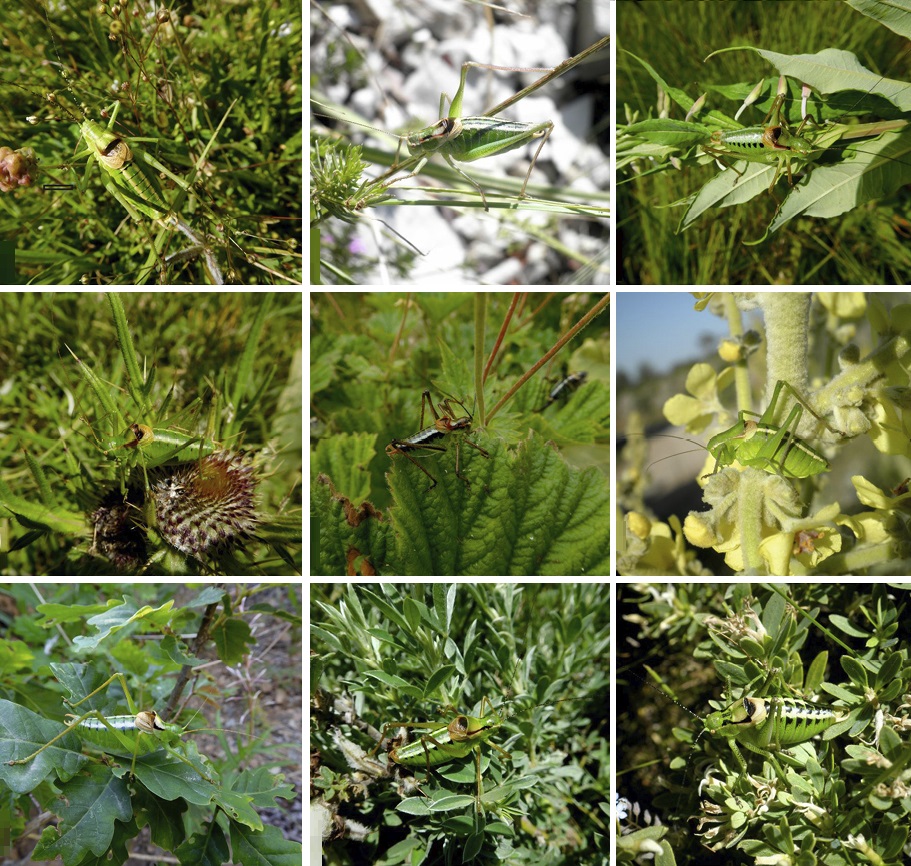
Poecilimon pseudornatus, B P. gracilioides, C P. a. affinis,
P. a. hajlensis, E P. gracilis, F P. nobilis,
G P. rumijae, H P. hoelzeli, I P. ornatus.

in Kociński, Chobanov & Grzywacz, 2022. 
Photos: Dragan Chobanov.

Abstract
The Balkan Peninsula is treated as a hotspot of biodiversity with over 40% of European bush-crickets occurring there. Poecilimon Fischer, 1853 is one of the largest Palaearctic orthopteran genera containing several species groups. One of them is the Poecilimon ornatus group (Schmidt, 1850) with 13 species and 5 subspecies. Among the group, the Poecilimon affinis complex is designated as consisting of P. pseudornatus Ingrisch & Pavićević, 2010, P. nonveilleri Ingrisch & Pavićević, 2010, and five subspecies of P. affinis (Frivaldszky, 1868). The aim of this study is to reconstruct the phylogenetic relationships among taxa of the P. ornatus group and to elucidate the position of taxa related to the P. affinis complex. Molecular phylogeny supported the monophyly of the P. ornatus group and showed that their ancestor probably originated in the southern Balkans. The underlying processes are thought to be six dispersals and five vicariance events linked to geological events and climate changes in the Pleistocene. The species delimitation analysis showed mostly nine hypothetical species among the group.

Keywords: biogeography, evolution, phylogeny, Poecilimon affinis complex, taxonomy


Poecilimon pseudornatus, B P. gracilioides, C P. a. affinis, D P. a. hajlensis, E P. gracilis, F P. nobilis, G P. rumijae, H P. hoelzeli, I P. ornatus
Photos: Dragan Chobanov.

Bayesian inference tree from a dataset including COI, ND2, CR, and ITS1 sequences of the Poecilimon ornatus group. Bayesian (BI) and Maximum likelihood (ML) topologies were consistent, so only one tree is shown. I – the first clade, II – the second clade, III – the third clade. The right panel shows groupings from different species delimitation approaches, as follows: bPTP ML – the Poisson Tree Processes; ASAP – Assemble Species by Automatic Partitioning; GMYC – maximum-likelihood approach based on the general mixed Yule-coalescent model; ABGD – Automatic Barcode Gap Discovery. The last grouping is based on localities of the taxa studied (NM – North Macedonia, MN – Montenegro, SR – Serbia, BG – Bulgaria, AL – Albania, GR – Greece). Scale bar: number of substitutions per nucleotide position.

Poecilimon pseudornatus, B P. gracilioides, C P. a. affinis,
P. a. hajlensis, E P. gracilis, F P. nobilis,
G P. rumijae, H P. hoelzeli, I P. ornatus.
Photos: Dragan Chobanov.


Maciej Kociński, Dragan Chobanov and Beata Grzywacz. 2022. New Insights into the Genetic Diversity of the Balkan Bush-crickets of the Poecilimon ornatus Group (Orthoptera: Tettigoniidae). Arthropod Systematics & Phylogeny. 80: 243-259.  DOI: 10.3897/asp.80.e82447