Showing posts with label Author: Anker. Show all posts

Friday, March 27, 2026

[Crustacea • 2026] Alpheopsis gorei • A mesophotic alpheid Shrimp (Decapoda: Caridea: Alpheidae) from the western Atlantic


Alpheopsis gorei  Anker, 2026

Papéis Avulsos De Zoologia. 66;  
 Photograph by Sarah Tweedt. 

Abstract
A new mesophotic alpheid shrimp, Alpheopsis gorei sp. nov., is described from several offshore localities in the northern and north-eastern Gulf of Mexico off Texas, Louisiana and western Florida. However, the distribution range of the new species extends to the Atlantic coast of Florida, with a previous record from deep-water reefs off Key Largo, under A. trispinosa Stimpson, 1860. The presently known bathymetric range of A. gorei sp. nov. is 42.1-126.2 m and the species appears to be free-living, mainly among coralline nodules and in crevices of deep coral rubble. The new species is morphologically closest to the eastern Altantic A. africana Holthuis, 1952 and A. azorica Anker, Poddoubtchenko & d’Udekem d’Acoz, 2005, the eastern Pacific A. equidactylus Lockington, 1877, and the Indo-West Pacific A. trispinosa, A. garricki Yaldwyn, 1971 and A. keijii Anker, 2007, differing from each of them by at least two morphological characters.

Keywords: Atlantic Ocean, USA, Gulf of Mexico, Florida, Crustacean, Deep-water shrimp, Alpheidae, ROV, ARMS

Alpheopsis gorei sp. nov., paratype, ov. female, cl 3.5 mm, off Louisiana, USA (USNM 1745065), shrimp alive, dorsal. Photograph by Sarah Tweedt.  

Alpheopsis gorei sp. nov.

Etymology: The new species is named after the decapod taxonomist, marine ecologist and biogeographer, Dr. Richard H. Gore, who first reported it from Florida (Gore, 1981, as A. trispinosus). 


Arthur Anker. 2026. Description of Alpheopsis gorei sp. nov., A mesophotic alpheid Shrimp from the western Atlantic (Decapoda: Caridea). Papéis Avulsos De Zoologia. 66; e202666006. DOI: 10.11606/1807-0205/2026.66.006 [2026-03-03]

Tuesday, March 3, 2026

[Crustacea • 2025] Trichocallia delicatula • A New Genus and Species of the Ghost-shrimp Family Callianideidae (Decapoda: Axiidea) from the Caribbean coast of Panama


Trichocallia delicatula   
Anker, 2025 
 

Abstract   
peculiar new species of ghost-shrimp from Bocas del Toro Archipelago on the Caribbean coast of Panama is assigned to the genus Trichocallia gen. nov. in the family Callianideidae. The holotype and presently the only known specimen of Trichocallia delicatula sp. nov. was collected with a suction pump on a silty-muddy bottom under a network of decomposing and partly overgrown mangrove roots. The new genus appears to be most closely related to Callianidea H. Milne Edwards, 1837, with two species in the Indo-West Pacific, and Paracallianidea Sakai, 1992, with two species, one in the western Atlantic and one in the eastern Pacific.

Keywords: Malacostraca, Decapod crustacean, New taxon, Caribbean Sea, West Atlantic, Marine biodiversity


Trichocallia gen. nov.  
 Trichocallia delicatula sp. nov. 


Arthur Anker. 2025. A New Genus and Species of the Ghost-shrimp Family Callianideidae from the Caribbean coast of Panama (Decapoda: Axiidea). Papéis Avulsos De Zoologia. 65; e202565009.  DOI: doi.org/10.11606/1807-0205/2025.65.009

Wednesday, December 17, 2025

[Crustacea • 2025] Alpheus sarapis • A New, conspicuously coloured Snapping Shrimp (Decapoda: Alpheidae) from the north-western Indian Ocean


Alpheus sarapis 
Anker, 2025 


Abstract
A new, brightly coloured and morphologically distinctive species of the alpheid genus Alpheus Fabricius, 1798 is described based on a single female specimen collected in shallow waters of Masirah Island, Oman. Alpheus sarapis sp. nov. appears to be morphologically somewhat intermediate between the A. leviusculus Dana, 1852, A. edwardsii (Audouin, 1826) and A. paracrinitus Miers, 1881 species groups, although the presence of slight sinuses on the major chela palm suggests that it may be a derived member of either of the former two groups.

Keywords: Caridea, Alpheid shrimp, New taxon, Oman, Indo-West Pacific, Marine biodiversity


Alpheus sarapis sp. nov. 


Arthur Anker. 2025. A New, conspicuously coloured Snapping Shrimp from the north-western Indian Ocean (Malacostraca: Decapoda: Alpheidae: Alpheus). Papéis Avulsos De Zoologia. 65e202565008. DOI: doi.org/10.11606/1807-0205/2025.65.008
 x.com/PAZ_journal/status/1994362857547252095


Monday, July 29, 2024

[Crustacea • 2024] Alpheus schubarti • A New alpheid Shrimp (Decapoda: Caridea: Alpheus) from the tropical western Atlantic


Alpheus schubarti 
Anker, 2024


Abstract
A new shallow-water species of the alpheid shrimp genus Alpheus Fabricius, 1798 is described based on five specimens from Maceió, Alagoas, northeastern Brazil. Alpheus schubarti sp. nov., belongs to the A. paracrinitus Miers, 1881 species complex and is most closely related to the eastern Pacific A. rostratus Kim & Abele, 1988, from which it can be separated by several morphological differences and the colour pattern of the major and minor chelae.

Keywords: Decapod crustaceans, Alpheidae, Snapping shrimp, Transisthmian speciation, New taxon, West Atlantic


Alpheus schubarti sp. nov.


Arthur Anker. 2024. Description of A New alpheid Shrimp from the tropical western Atlantic (Decapoda: Caridea: Alpheus). Papéis Avulsos de Zoologia (São Paulo). 64: e202464022. DOI: doi.org/10.11606/1807-0205/2024.64.022  

Friday, June 28, 2024

[Crustacea • 2024] New Species and Records of the symbiotic Shrimp Genus Leptalpheus Williams, 1965, with Notes on Fenneralpheus Felder & Manning, 1986 (Decapoda: Alpheidae), and preliminary Molecular Analysis of Phylogenetic Relationships


in Scioli, Robles & Felder, 2024  
 
Abstract
The shrimp genera Leptalpheus Williams, 1965 and Fenneralpheus Felder & Manning, 1986 are composed entirely of symbiotic species that co-inhabit burrows of infaunal macrocrustaceans. We report extensive collections of these genera from western Atlantic, eastern Pacific and Indo-West Pacific regions. Integrative taxonomy methods, including morphological comparisons and analysis of three mitochondrial genetic markers, are used to test species hypotheses and evolutionary relationships among members of these genera. Our molecular analysis failed to recover Leptalpheus or Fenneralpheus as monophyletic groups. Our results strongly supported the monophyly of three clades composed of species of Leptalpheus, loosely corresponding to previously proposed species groups. Three new species closely related to Leptalpheus forceps Williams, 1965, L. marginalis Anker, 2011, and L. mexicanus Ríos & Carvacho, 1983 are described. Leptalpheus ankeri n. sp., from the Caribbean Sea, Atlantic coast of Florida, and Gulf of Mexico, is a polymorphic species that exhibits two major cheliped morphotypes. Leptalpheus sibo n. sp., from the Pacific coast of Nicaragua, is morphologically very similar to L. ankeri n. sp., likely its transisthmian sister species, and shares its cheliped polymorphism. A reassessment of L. forceps concluded that records of this species from the Caribbean Sea and Brazil are not conspecific with L. forceps sensu stricto from the Atlantic coast of the USA and the Gulf of Mexico, and they are herein described as Leptalpheus degravei n. sp. Based on both molecular and morphological evidence, we found Leptalpheus bicristatus Anker, 2011 to be a junior synonym of L. mexicanus and Leptalpheus canterakintzi Anker & Lazarus, 2015 to be a junior synonym of Leptalpheus azuero Anker, 2011. First reports of Leptalpheus axianassae Dworschak & Coelho, 1999 in Texas and Mexico, Leptalpheus denticulatus Anker & Marin, 2009 in the Mariana Islands, Leptalpheus felderi Anker, Vera Caripe & Lira, 2006 and Leptalpheus lirai Vera Caripe, Pereda & Anker, 2021 in the USA, and Leptalpheus pereirai Anker & Vera Caripe, 2016 in Cuba are included.

Crustacea, Alpheidae, LeptalpheusFenneralpheus, Symbiosis, infauna 


Justin A. Scioli, Rafael Robles and Darryl L. Felder. 2024. New Species and Records of the symbiotic Shrimp Genus Leptalpheus Williams, 1965, with Notes on Fenneralpheus Felder & Manning, 1986, and preliminary Molecular Analysis of Phylogenetic Relationships (Crustacea: Decapoda: Alpheidae).  Zootaxa. 5466(1); 1-72. DOI: 10.11646/zootaxa.5466.1.1

Wednesday, May 24, 2023

[Crustacea • 2023] Alpheus octocellatus • A New Species of the Alpheus edwardsii Group (Decapoda: Alpheidae) with A distinctive colour pattern from the Indo-West Pacific


Alpheus octocellatus
 Anker & Benzoni, 2023


Abstract
A new snapping shrimp species of the Alpheus edwardsii (Audouin, 1826) group is described based on two specimens, one male and one female, collected on shallow-water reef flats of the Southern Ari Atoll in the Maldives, with a photographic record from Cebu in the Philippines. Alpheus octocellatus sp. nov. appears to be morphologically closest to A. edwardsii, A. pareuchirus Coutière, 1905, and A. leptochirus Coutière, 1905, but can be distinguished from all of them by a combination of morphological characters, mainly involving the chelipeds, third maxilliped and pleonal sternites. The new species also has a highly diagnostic colour pattern, with four pairs of conspicuous eyespots distributed in a unique and peculiar pattern on the pleon.

Keywords: Crustacea, Caridea, Alpheus, snapping shrimp, Indian ocean, Maldives, Pacific ocean, Philippines, coral reef, marine biodiversity
 

Arthur Anker and Francesca Benzoni. 2023. Description of A New Species of the Alpheus edwardsii Group (Decapoda: Alpheidae) with A distinctive colour pattern from the Indo-West Pacific. Zootaxa5271(3);549-559. DOI: 10.11646/zootaxa.5271.3.7


Sunday, May 21, 2023

[Crustacea • 2023] Alpheus dingabadi • A conspicuously coloured New Species of the Alpheus macrocheles Group (Decapoda: Alpheidae) from the central Indian Ocean


Alpheus dingabadi
 Anker, 2023


Abstract
A new snapping shrimp species of the Alpheus macrocheles (Hailstone, 1835) group is described based on a single adult male specimen collected on an exposed forereef near Magoodhoo Island, Faafu Atoll, Maldives. Alpheus dingabadi sp. nov. is one of several species of the A. macrocheles group characterised by the presence of a stout distoventral tooth on the merus of the third pereiopod, but can be separated from all of them by several morphological features, including the unusually long appendix masculina on the second pleopod, as well as by its conspicuous and highly diagnostic colour pattern.
 
Keywords: Crustacea, Alpheus, Caridea, coral reef, Indian Ocean, Maldives, marine biodiversity, snapping shrimp


Alpheus dingabadi sp. nov.


Arthur Anker. 2023. A conspicuously coloured New Species of the Alpheus macrocheles Group from the central Indian Ocean (Decapoda: Alpheidae). Zootaxa5271(1); 155-162. DOI: 10.11646/zootaxa.5271.1.6 

Wednesday, September 22, 2021

[Crustacea • 2021] Thor dicaprio • A New, conspicuously coloured Shrimp (Decapoda: Caridea: Thoridae) from the Tropical western Atlantic, with Taxonomic Remarks on the T. amboinensis (De Man, 1888) Complex


Thor dicaprio
Anker & Baeza, 2021

 
Abstract
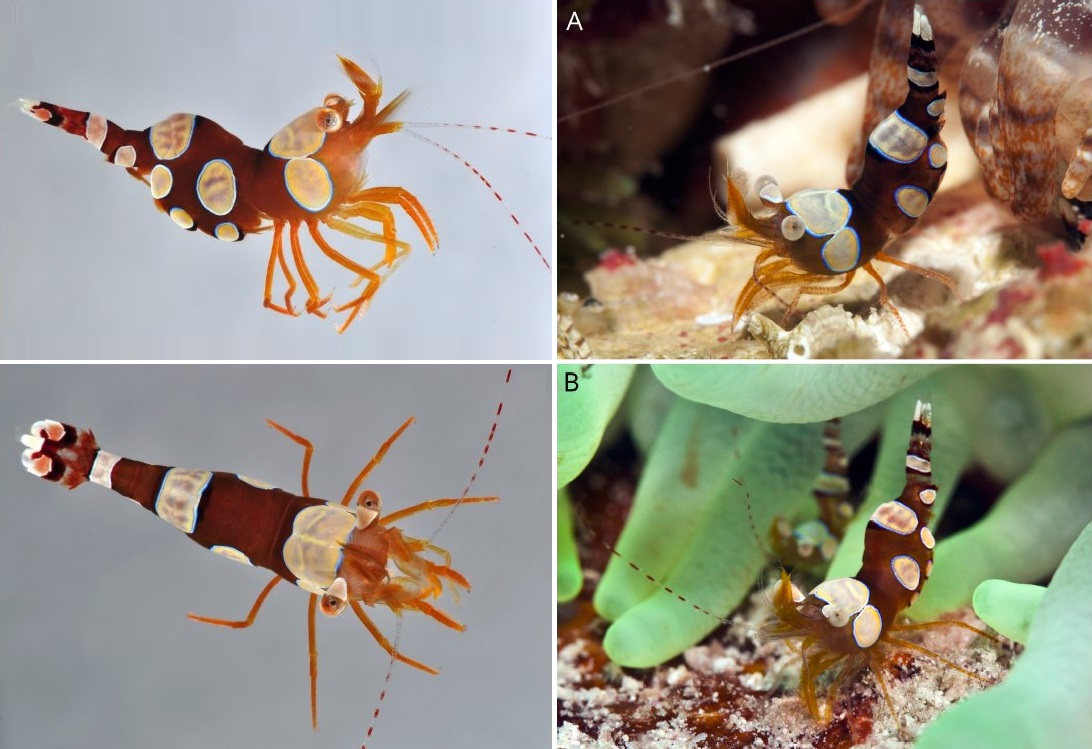
Thor amboinensis (De Man, 1888), known as “sexy shrimp” or “anemone squat shrimp” and popular among divers and aquarists, was previously believed to have a worldwide distribution, with populations throughout the tropical parts of the Indo-Pacific and Atlantic Ocean. However, consistent differences in some details of the colour pattern strongly suggest that T. amboinensis does not represent a single species, but a pantropical species complex. A recent phylogeographic analysis of T. amboinensis based on molecular data confirmed that this taxon is composed of at least five putative cryptic or pseudocryptic species. In the present study, a new cryptic species, Thor dicaprio sp. nov., is established for the western Atlantic populations previously referred to as T. amboinensis. The new species can be distinguished from all other members of the T. amboinensis complex by two differences in the colour pattern and a subtle difference in the size and setation of the appendix masculina, the latter yet to be confirmed. The conspicuous red-white banding of the antennal flagella appears to be the most diagnostic feature of the new species. In addition, T. dicaprio sp. nov. forms a genetically distinctive, homogeneous, tropical western Atlantic (TWA) clade, with the COI pairwise genetic distances from other clades ranging from 8.8% to 19.2%. The distribution of T. dicaprio sp. nov. includes the entire Caribbean Sea, parts of the Gulf of Mexico, Florida, Bahamas, Bermuda, as well as some offshore localities off northern and eastern Brazil. The main aspects and biology and ecological variability of T. dicaprio sp. nov. are discussed in the light of phylogeographic data presently available for the T. amboinensis complex.

Keywords: Crustacea, Caridea, Thor, cryptic species, coral reef, symbiosis, sea anemone, west Atlantic, Indo-Pacific


Arthur Anker and J. Antonio Baeza. 2021. Thor dicaprio sp. nov., A New, conspicuously coloured Shrimp from the Tropical western Atlantic, with Taxonomic Remarks on the T. amboinensis (De Man, 1888) Complex (Decapoda: Caridea: Thoridae). Zootaxa. 5039(4); 495-517. DOI: 10.11646/zootaxa.5039.4.3


Wednesday, January 6, 2021

[Crustacea • 2021] Opaepupu huna • A New Genus and Species of Bivalve-associated Shrimp (Decapoda: Caridea: Palaemonidae) from Hawai’i


 Opaepupu huna 
Anker & De Grave, 2021


Abstract
A new palaemonid shrimp genus, Opaepupu gen. nov., is established to accommodate a new species of bivalve-associated shrimp, Opaepupu huna sp. nov. from Hawaii. A single mated pair, the female holotype and the male allotype, were found inside the trapezid bivalve Trapezium oblongum (Linnaeus, 1758) at a depth of 14 m in Kâne’ohe Bay, Hawai’i. The new genus is characterised by the rostrum being proximally broad, distally pointed, mid-dorsally carinate, and non-dentate; the anterolateral margin of the carapace without supraorbital, hepatic or epigastric teeth, but with a strong sharp antennal tooth; the sixth pleonite posteriorly unarmed; the telson medially depressed, with the dorsal surface armed with two pairs of submarginal cuspidate setae and with the posterior margin armed with two pairs of spiniform setae; the distolateral angle of the first article of the antennular peduncle without a sharp tooth; the mandible without a palp; the maxillular palp furnished with one long stiff seta dorsal to a small tooth-like extension; the first maxilliped without a palp; the third maxilliped not being operculate; the second pereiopods moderately robust, relatively slender, subequal, subsymmetrical, with simple teeth on the cutting edges of the fingers; the ambulatory pereiopods being slender, each ending in an elongate biunguiculate dactylus; and the uropodal exopod with a faint diaeresis and greatly reduced distolateral spiniform seta. The phylogenetic position of Opaepupu gen. nov. remains unclear, although it does not appear to be closely related to other bivalve-associated palaemonid genera.

Keywords: Crustacea, Caridean shrimp, new genus, new species, Central Pacific, marine biodiversity, symbiosis, mollusc, clam, Bivalvia


 Arthur Anker and Sammy De Grave. 2021. Opaepupu, A New Genus and Species of Bivalve-associated Shrimp (Decapoda: Caridea: Palaemonidae) from Hawai’i. Zootaxa. 4903(1); 55–70. DOI: 10.11646/zootaxa.4903.1.3

Wednesday, November 4, 2020

[Crustacea • 2020] Strianassa lerayi • A New Laomediid Mud-shrimp (Malacostraca: Decapoda: Gebiidea) from the eastern Pacific, with New Records of Axianassa ngochoae and Heteroaxianassa heardi in the western Pacific


Strianassa lerayi  Anker, 2020

 si.edu 

 Abstract
A new laomediid genus, Strianassa gen. nov., is established to accommodate a new eastern Pacific species of mud-shrimp, Strianassa lerayi sp. nov. The holotype and single specimen of the new species was collected on a shallow subtidal flat at Isla Afuerita, Canales de Afuera, Coiba Archipelago, Panama. Strianassa gen. nov. appears to be most closely related to Axianassa Schmitt, 1924 and Heteroaxianassa Sakai, 2016, differing from both of them by the dorsal surface of the rostrum armed with teeth; the third maxilliped with an exopod and a set of setobranchs; and the epipodal complex of the fourth pereiopod including a small podobranch. In addition, Axianassa ngochoae Anker, 2010 and Heteroaxianassa heardi (Anker, 2011) are recorded for the first time from New Caledonia and Papua New Guinea, respectively, representing minor extensions of their previously known distributional ranges. The validity of Heteroaxianassa is discussed.

Keywords: Decapoda, Laomediidae, mud-shrimps, Axianassa, Heteroaxianassa, new genus, new species, East Pacific, West Pacific, Crustacea

Strianassa lerayi gen et sp. nov., holotype, male (cl 5.4 mm), FLMNH UF 53414, from Coiba Archipelago, Panama

Strianassa lerayi gen et sp. nov., holotype, male (cl 5.4 mm), FLMNH UF 53414, from Coiba Archipelago, Panama —living individual 


Family Laomediidae Borradaile, 1903 

Genus Strianassa gen. nov.


Etymology. The generic name combines the official abbreviation of the Smithsonian Tropical Research Institute / Instituto Smithsonian de Investigaciones Tropicales / STRI (Stri-) and the last six letters of the genus Axianassa (-anassa), a superficially similar and phylogenetically putatively closely related genus. Gender feminine. 

Type species. Strianassa lerayi sp. nov., by monotypy and present designation. Distribution. Presently known only from the tropical eastern Pacific.


Strianassa lerayi sp. nov.

Etymology. The new species is named after the author’s friend and colleague, Dr. Matthieu Leray, for his invitation to participate in the highly successful expedition to the Coiba Archipelago in February 2019, during which three new genera and one new species of decapod crustaceans were collected and described (Anker 2020a, 2020b, 2020c; present study).

Distribution. Presently known only from the type locality in the Coiba Archipelago, Pacific coast of Panama. 
 

Arthur Anker. 2020. Strianassa lerayi gen. et sp. nov., A New Laomediid Mud-shrimp from the eastern Pacific, with New Records of Axianassa ngochoae Anker, 2010 and Heteroaxianassa heardi (Anker, 2011) in the western Pacific (Malacostraca: Decapoda: Gebiidea). Zootaxa. 4820(3); 523–539. DOI: 10.11646/zootaxa.4820.3.6


Thursday, October 15, 2020

[Crustacea • 2020] Petrolisthes lazarus • A New Species of the Porcelain Crab Genus Petrolisthes (Decapoda: Anomura: Porcellanidae) from the Pacific coast of Panama, with Taxonomic Notes on Closely Related Species


Petrolisthes lazarus  
 Ferreira, Santana-Moreno & Anker, 2020


Abstract
A new species of porcelain crab, Petrolisthes lazarus sp. nov., is described from the Pacific coast of Panama, based on two female specimens. The new species is morphologically most similar to another eastern Pacific species, P. crenulatus Lockington, 1878, especially in the general configuration of the carapace, chelipeds and ambulatory legs. However, P. lazarus sp. nov. can be separated from P. crenulatus by the differences in the proportions of the carapace, the shape of the frontal region of the carapace, and the setation pattern of the cheliped. In addition, P. lazarus sp. nov. and P. crenulatus appear to be allopatric, the latter species presently being known only from Mexico. Among other eastern Pacific taxa, P. lazarus sp. nov. may have some affinities with P. ortmanni Nobili, 1901 and P. lewisi (Glassell, 1936), from which it can be easily distinguished by the chelipeds lacking a dense field of setae on the outer (lateral) surface of the palm and with different proportions of some articles, especially the carpus. The four species can also be distinguished from each other by their diagnostic, although somewhat variable colour patterns.

Keywords: Crustacea, Porcellanidae, porcelain crab, Petrolisthes, new species, marine biodiversity, Panama, eastern Pacific


 Luciane Augusto De Azevedo Ferreira, L. Daniel Santana-Moreno and Arthur Anker. 2020. A New Species of the Porcelain Crab Genus Petrolisthes from the Pacific coast of Panama, with Taxonomic Notes on Closely Related Species (Decapoda: Anomura: Porcellanidae). Zootaxa. 4858(4); 576–588. DOI: 10.11646/zootaxa.4858.4.6

Tuesday, September 29, 2020

[Crustacea • 2020] Taxonomic Notes on Alpheus inopinatus Holthuis & Gottlieb, 1958 and Alpheus cf. lobidens De Haan, 1849 (Malacostraca: Decapoda: Alpheidae) from Kuwait


Alpheus inopinatus Holthuis & Gottlieb, 1958

in Anker, Al-Kandari & Grave, 2020. 
Photograph by A. Anker.

Abstract
The status of the common intertidal snapping shrimp, Alpheus inopinatus Holthuis & Gottlieb, 1958, is discussed based on newly collected material from Kuwait. Alpheus inopinatus was previously confused with morphologically very similar species in the Alpheus lobidens De Haan, 1849 species complex, formerly identified as A. crassimanus Heller, 1862 and herein tentatively referred to as A. cf. lobidens. The material herein examined strongly supports the validity of A. inopinatus based on several morphological characters, as well as differences in the colour pattern, compared to other members of the A. lobidens complex.

Keywords: Crustacea, Alpheus, Alpheidae, snapping shrimp, Indian Ocean, Arabian-Persian Gulf

Alpheus inopinatus Holthuis & Gottlieb, 1958: male from Kuwait,
 OUMNH.ZC.2020-01-001 [fcn KUW-011] —lateral view.
Photograph by A. Anker.


 Arthur Anker, Manal Al-Kandari and Sammy De Grave. 2020. Taxonomic Notes on Alpheus inopinatus Holthuis & Gottlieb, 1958 and Alpheus cf. lobidens De Haan, 1849 from Kuwait (Malacostraca: Decapoda: Alpheidae). Zootaxa.  4851(1); 189–197. DOI: 10.11646/zootaxa.4851.1.10

Sunday, August 30, 2020

[Crustacea • 2020] Zoukaris festivus • A New Deep-water Palaemonid Shrimp Genus and Species (Decapoda: Caridea) from the French Antilles, with A New Record of Periclimenes milleri Bruce, 1986


Zoukaris festivus Anker & Corbari, 2020


Abstract
A new genus and species in the caridean shrimp family Palaemonidae is described based on three type specimens collected at a depth range of 208–385 m off Guadeloupe, French Antilles. Zoukaris festivus gen. et sp. nov. shares many characters with several western Atlantic deep-water species currently assigned to Periclimenes Costa, 1844, as well as with the monotypic western Atlantic genus Diapontonia Bruce, 1986 and the Indo-West Pacific genus Echinopericlimenes Marin & Chan, 2014. Zoukaris gen. nov. can be separated from all of them by a unique combination of morphological features, especially the configuration of the dactylus of the ambulatory pereiopods. In addition, Periclimenes milleri Bruce, 1986 is recorded from the French Antilles based on a single specimen, also from Guadeloupe; its colour pattern is illustrated for the first time.

Keywords: Crustacea, Palaemonidae, shrimp, new genus, new species, new record, marine biodiversity, deep-water, West Atlantic, Lesser Antilles


Zoukaris festivus gen. et sp. nov. 


 Arthur Anker and Laure Corbari. 2020. A New Deep-water Palaemonid Shrimp Genus and Species from the French Antilles, with A New Record of Periclimenes milleri Bruce, 1986 (Decapoda: Caridea). Zootaxa. 4834(3); 407–424. DOI: 10.11646/zootaxa.4834.3.4 

Monday, June 8, 2020

[Crustacea • 2020] A Revision of the Brazilian Species of Lysmata Risso, 1816 (Decapoda: Caridea: Lysmatidae), with Discussion of the Morphological Characters used in their Identification


Lysmata sp.

in Pachelle, Carvalho, Alves & Anker, 2020. 

Abstract
The present study is a taxonomic revision of the species of the shrimp genus Lysmata Risso, 1816 from Brazil, based on literature records and specimens deposited mostly in the Museu de Zoologia da Universidade de São Paulo (MZUSP). A total of eleven species are included, these being L. ankeri Rhyne & Lin, 2006, L. bahia Rhyne & Lin, 2006, L. grabhami (Gordon, 1935), L. intermedia (Kingsley, 1878), L. cf. jundalini Rhyne, Calado & Santos, 2012, L. lipkei Okuno & Fiedler, 2010, L. moorei (Rathbun, 1901), L. rathbunae Chace, 1970, L. uncicornis Holthuis & Maurin, 1952, L. vittata (Stimpson, 1860) and L. wurdemanni (Gibbes, 1850). The material from São Paulo recently reported as L. jundalini by Terossi et al. (2018) is re-identified as L. intermedia, based on a re-analysis of their voucher specimens. On the other hand, a single non-ovigerous specimen from Espírito Santo without a photographic voucher, is tentatively identified as L. cf. jundalini. The importance of some morphological characters often used in the taxonomy of Lysmata is discussed in the light of the present material. Several species are illustrated, some with new locality or state records along the Brazilian coast. Doubtful literature records are commented and an updated taxonomic key for the Brazilian species of Lysmata is provided.

Keywords: Decapoda, Lysmata, South-West Atlantic, peppermint shrimp, cleaner shrimp, ornamental species, aquarium trade


Paulo P.G. Pachelle, Leina Carvalho, Douglas F.R. Alves and Arthur Anker. 2020. A Revision of the Brazilian Species of Lysmata Risso, 1816 (Decapoda: Caridea: Lysmatidae), with Discussion of the Morphological Characters used in their Identification. Zootaxa. 4789(1); 55–90. DOI: 10.11646/zootaxa.4789.1.2