Showing posts with label Edinburgh Journal of Botany. Show all posts

Saturday, June 6, 2026

[Botany • 2026] Gentiana macneilliana (Gentianaceae) • A New Species Sikkim Himalaya (India) based on Morphological and Molecular Data


Gentiana macneilliana A.K.Halder & D.Maity, 

in Halder, Saha, Dwivedi, Banerjee, Jha, Pradhan, Maity et Pandey, 2026. 

Abstract
Gentiana macneilliana (Gentianaceae), a new species from North Sikkim, in the Eastern Himalayan region of India, is described, illustrated and discussed. It is morphologically similar to Gentiana lacinulata T.N.Ho of Gentiana sect. Chondrophyllae Bunge but differs markedly in having acute and usually mucronate leaf apex, ovate corolla lobes with acuminate apex, much longer plicae (1.5–2.6 mm), which are more than half as long as corolla lobes, and longer pedicel (up to 8 mm). This new species also resembles Gentiana muscicola C.Marquand (Gentiana sect. Chondrophyllae) but can easily be differentiated by its unique corolla lobe, shorter petiole, narrowly based leaf lamina, longer pedicel and shorter style. The affinity of the new species with Gentiana grata Harry Sm., a member of the same section, is also highlighted. A taxonomic description, images and illustrations of the new taxon are provided, along with a discussion of closely related taxa.

Keywords: Gentiana sect. Chondrophyllae, Eastern Himalaya, ITS, IUCN, trnL-F, new species

Gentiana macneilliana A.K.Halder & D.Maity, sp. nov.
A, Habitat; B and C, habit; D, open flower
Photographs: A. K. Halder (A–D) 

Gentiana macneilliana A.K.Halder & D.Maity, sp. nov.

Gentiana macneilliana is morphologically most similar to Gentiana lacinulata but differs from that species by its short petiole, 0.5–1.5 mm long (vs up to 3 mm); acute and usually mucronate leaf apex (vs obtuse leaf apex); narrowly revolute leaf margin (vs flat leaf margin); longer pedicel, up to 8 mm long (vs up to 3 mm long); ovate corolla lobes with acuminate apex (vs suborbicular with obtuse-rounded or rounded apex); much longer plicae, 1.5–2.6 mm long (vs 0.7–1 mm); and plicae more than 1/2 as long as corolla lobes (vs less than 1/3 as long as corolla lobes). It also resembles Gentiana muscicola but can be differentiated from that species by its unique ovate, acuminate corolla lobes with erose margin and distinctly contracted base (vs ovate–lanceolate or ovate–triangular, obtuse or subacute lobes with entire margin and widened base); short petiole, 0.5–1.5 mm long (vs up to 2.5 mm); narrowed leaf bases (vs rounded to cordate leaf bases); long pedicel, up to 8 mm (vs up to 3.1 mm); and short style, 1.5–1.9 mm (vs 3–4 mm). 

Etymology. The specific epithet ‘macneilliana’ is given in honour of Dr John McNeill, Royal Botanic Garden Edinburgh (E), the legendary taxonomist and nomenclature specialist, who has given immense support with the nomenclature of Indian Gentiana.


A.K. Halder, S. Saha, M. D. Dwivedi, A. Banerjee, B. K. Jha, D. K. Pradhan, D. Maity and A. K. Pandey. 2026. Gentiana macneilliana (GENTIANACEAE), A New Species Sikkim Himalaya (India) based on Morphological and Molecular Data. Edinburgh Journal of Botany. 83; 1-21. DOI: doi.org/10.24823/ejb.2026.2089 [2026-05-18]


Thursday, May 14, 2026

[Botany • 2026] Gaultheria rostrata (Ericaceae) • A New Species endemic to Mindanao Island, Philippines

 
Gaultheria rostrata M.N.Tamayo, P.W.Fritsch & Medecilo,  

in Tamayo, Lagunday, Amoroso, Tandang, Fritsch et Medecilo-Guiang, 2026. 

Abstract
Gaultheria rostrata, a new species of wintergreen endemic to Mindanao Island, Philippines, is here described and illustrated. It resembles Gaultheria bartolomei, endemic to Luzon Island, but differs by having a terrestrial habit, shorter petioles, longer pedicels, white or pale-pink corollas, coiled corolla lobes, longer anther tubules, and a longer style. The flowers of Gaultheria rostrata are unique among Asian species of Gaultheria on account of their coiled corolla lobes exposing the anthers and style at anthesis. This discovery raises the number of Gaultheria species in the Philippines to 16.

Keywords: Biodiversity, endemic, Gaultheria sect. Diplycosia, Southern Philippines, Taxonomy

Gaultheria rostrata M.N.Tamayo, P.W.Fritsch & Medecilo, sp. nov.
A, Habit in situ; B, leafy branchlets; C, leaf, abaxial surface; D, leaf, adaxial surface; E and F, flowering branchlets; G, flower bud; H, I and J, upper pedicel, bracteoles and flower; K, stamens, ventral view.
Photographs: A–E and H, M. M. Medecilo-Guiang from M.M.M.-G. 1030; F, G, I and J, D.N. Tandang; K, M. N. Tamayo from M.M.M.-G. 1030.

Gaultheria rostrata M.N.Tamayo, P.W.Fritsch & Medecilo, sp. nov.

This species resembles the Philippine endemic Gaultheria bartolomei (Ferreras & Argent) Kron & P.W.Fritsch but differs by having a terrestrial habit (vs epiphytic), shorter petioles (4–4.5 mm vs 5–7 mm), longer pedicels (20–35 mm vs 20–25 mm), white or pale-pink corollas (vs deep pink), corolla lobes coiled (vs reflexed), longer anther tubules (4–4.5 mm vs c.1 mm), and a longer style (10–11 mm vs c.8 mm).

Etymology. The specific epithet rostrata alludes to the morphological resemblance of the flowers of the new species to avian beaks or proboscides.


M. N. Tamayo, N. E. Lagunday, V. B. Amoroso, D. N. Tandang, P. W. Fritsch and M. M. Medecilo-Guiang. 2026. GAULTHERIA ROSTRATA (sect. Diplycosia, ERICACEAE), A New Wintergreen Species endemic to Mindanao Island, Philippines. Edinburgh Journal of Botany. 83; DOI: doi.org/10.24823/ejb.2026.2104 [2026-05-05]

Friday, April 10, 2026

[Botany • 2021] Dionysia jamzadiae (Primulaceae) • A New Species from the Fars Province of Iran


Dionysia jamzadiae Lidén, M.Irvine, Alvén & Mehregan, 

in Lidén, Irvine, Alvén et Mehregan, 2021. 

ABSTRACT
Dionysia jamzadiae Lidén, M.Irvine, Alvén & Mehregan, from the east Zagros Mountains, Fars, Iran, is described as new to science. It belongs in section Dionysiopsis and is similar to D. oreodoxa Bornm. but differs in, for example, its sparsely glandular hairy or almost glabrous corolla with emarginated lobes (densely non-glandular pubescent with entire lobes in D. oreodoxa). Dionysia jamzadiae is known from two places and is quite abundant at the type locality.

Keywords: New species, Fars, Iran, Dionysia

Dionysia jamzadiae Lidén, M.Irvine, Alvén & Mehregan, sp. nov.
Brevistylous (A) and longistylous (B) plants in the type locality.
 Photograph: M. Lidén.

 
Dionysia jamzadiae Lidén, M.Irvine, Alvén & Mehregan, sp. nov.

Differs from Dionysia oreodoxa Bornm., to which it is most similar, in its sparsely glandular hairy or almost glabrous corolla with emarginate lobes (versus densely non-glandular pubescent with entire lobes).


M. Lidén, M. Irvine, A. Alvén and I. Mehregan. 2021. Dionysia jamzadiae (Primulaceae), A New Species from the Fars Province of Iran. Edinburgh Journal of Botany. 78; DOI: doi.org/10.24823/EJB.2021.396 [2021-12-02]

Thursday, February 5, 2026

[Botany • 2026] Begonia matillanoae (Begoniaceae, sect. Baryandra) • A New Species from Malampaya Sound Protected Landscape and Seascape, Palawan Island, Philippines


Begonia matillanoae Y.P.Ang & Langbao,  

in Ang, Marcos-Langbao, Camangeg, Jose, Diego et Tamayo, 2026. 

Abstract
A new species, Begonia matillanoae, is here described and illustrated from Malampaya Sound Protected Landscape and Seascape, Palawan Island, Philippines. It closely resembles Begonia cabanillasii but is distinct in having an ovate leaf with irregularly lobed margin, an acute leaf apex, and a 5-tepalled pistillate flower with the larger wing flat to shallowly cucullate. Begonia matillanoae is the latest addition to the Palawan begonias bearing a conspicuously 5-winged ovary. Based on IUCN guidelines, we here propose a  Critically Endangered (CR) conservation designation for this species. A revised key to Palawan Begonia sect. Baryandra bearing five or six conspicuous ovary wings is also provided.

Keywords: Granite, Protected area, Sunda, Taxonomy, Threatened species

Begonia matillanoae Y.P.Ang & Langbao, sp. nov.
 A, Habitat and habit; B, rhizome, showing details of stipules and base of petioles; C, petiole and leaf base attachment; D, bracts and unopened flowers; E and F, leaf adaxial and abaxial surface, respectively; G, inflorescence; H and I, staminate flower (face and side views, respectively); J and K, pistillate flower (face and side views, respectively); L, immature ovary; M, ovary (cross sections).
All photographs from ACAP57, taken by Y. P. Ang.

 Begonia matillanoae Y.P.Ang & Langbao, sp. nov.

Begonia matillanoae resembles B. cabanillasii in having white-pilose indumentum on its petioles, leaves and peduncles, a 4-tepalled staminate flower, and a conspicuously 5-winged ovary. However, it differs in having an ovate leaf shape (vs suborbicular) with shallow acutely lobed margin (vs crenate), an acute leaf apex (vs acute, obtuse or rounded), and a 5-tepalled (vs 4-tepalled) pistillate flower with largest wing flat to shallowly cucullate (vs distinctly cucullate). 


Y. P. Ang, A. B. Marcos-Langbao, L. M. Camangeg, E. D. Jose, J. M. L. Diego and M. N. Tamayo. 2026. Begonia matillanoae (BEGONIACEAE), A New Species from Malampaya Sound Protected Landscape and Seascape, Palawan Island, Philippines. Edinburgh Journal of Botany. 83; DOI: doi.org/10.24823/ejb.2026.2102 [2026-02-03] 

Wednesday, January 21, 2026

[Botany • 2026] Elaeocarpus pulneyensis (Elaeocarpaceae) • A New Species from Peninsular India, based on Morphological and Molecular Evidence


Elaeocarpus pulneyensis Gole, N.V.Page, Sardesai, 
  
in Gole, Page et Sardesai, 2026.

Abstract
A new species of Elaeocarpus is described from the Kodaikanal region of Pulney Hills, India; it is morphologically allied to E. variabilis in having anther tips without setae or tuft of hairs and 3-locular pyrenes. It differs from the latter in having ovate, light-green sepals, and ellipsoid fruits enclosing ellipsoid pyrenes. Molecular phylogenetic analyses based on ITS and trnL–F regions revealed that Elaeocarpus pulneyensis is distinct from E. variabilis and support the novelty of the taxon.

Keywords: endemic, Kodaikanal, Oxalidales, Pulney Hills, Rudraksha


Comparative floral morphology of Elaeocarpus variabilis and E. pulneyensis.
 A–D, Elaeocarpus variabilis: A, flowering branch; B, dorsal view of the raceme; C, ventral view of the raceme; D, close-up of flower.
E–H, Elaeocarpus pulneyensis: E, flowering branch; F, dorsal view of the raceme; G, ventral view of the raceme; H, close-up of flower.
Photographs: Navendu Page.

Elaeocarpus pulneyensis Gole, N.V.Page, Sardesai, sp. nov.

Elaeocarpus  pulneyensis can be distinguished from the majority of species of Elaeocarpus from South India and Sri Lanka in having anther tips without setae or tuft of hairs. It is morphologically most similar to Elaeocarpus variabilis, the only other species which exhibits anther tips without setae or tuft of hairs and 3-locular pyrenes. Elaeocarpus pulnyensis can be distinguished from E.variabilis based on light green sepals (vs green or reddish brown), ellipsoid fruits (vs obovoid), pyrenes which are rounded at both base and apex (vs pyrenes which are tapering towards the base and rounded towards the apex), and a pyrene circumference at widest point of 6.3–6.7 cm (vs 4.8–5.4 cm).

Etymology. The specific epithet pulneyensis is derived from the type locality, Pulney Hills, situated in Kodaikanal, Tamil Nadu, peninsular India.


C. N. Gole, N. V. Page and  M. M. Sardesai. 2026. ELAEOCARPUS PULNEYENSIS, A New Species of Elaeocarpus (ELAEOCARPACEAE) from Peninsular India, based on Morphological and Molecular Evidence.  Edinburgh Journal of Botany. 83; 1-14. DOI: doi.org/10.24823/ejb.2026.2092 [2026-01-14]


Thursday, January 15, 2026

[Botany • 2025] Henckelia multiflora (Gesneriaceae) • A New Species from the eastern Himalayan region of Arunachal Pradesh, India


Henckelia multiflora N.V.Page, 

in Kishwan, Thackeray et Page, 2025. 

Abstract
Henckelia multiflora, a robust, caulescent herb, is described from the Upper Siang District of Arunachal Pradesh, India. The species is morphologically similar to Henckelia khasiana and H. oblongifolia but differs in having up to 30 (occasionally more) flowers per inflorescence, and a longer calyx with caudate-acuminate lobes. The species is presently known from only the Upper Siang District of Arunachal Pradesh.

Keywords: Caulescent, Endemic, Erect, Upper Siang District

Henckelia multiflora N.V.Page, sp. nov.
A, Terminal leaves; B, habit; C, abaxial side of leaf. Photographs: Navendu Page.

Henckelia multiflora N.V.Page, sp. nov.
A and B, Inflorescence; C, close-up of inflorescence, with white arrows indicating the position of bracts; D, corolla split between upper and lower lip. Photographs: Navendu Page.

Henckelia multiflora N.V.Page, sp. nov.

Henckelia multiflora is morphologically most similar to Henckelia khasiana Nampy & M.K.Akhil and Henckelia oblongifolia (Roxb.) D.J.Middleton & Mich.Möller in its caulescent habit and many-flowered cymose inflorescence. However, Henckelia multiflora differs from H. khasiana in having up to 30 (occasionally more) flowers per inflorescence (vs up to 12 in H. khasiana and up to 25 in H. oblongifolia), a longer calyx which is up to 4.2 cm long (vs 1.4–1.6 cm in H. khasiana and 0.6–2.2 cm in H. oblongifolia), caudate-acuminate calyx lobes (vs lanceolate in H. khasiana and triangular to triangular-acuminate in H. oblongifolia) and emarginate or shallowly bilobed stigma (vs chiritoid, distinctly forked in H. khasiana and truncate to obscurely emarginate in H. oblongifolia).

 Etymology. The specific epithet refers to its many-flowered inflorescence, which is one of the diagnostic features of this species.


S. Kishwan, T. U. Thackeray, N. V. Page. 2025. Henckelia multiflora (Gesneriaceae), A New Species from the eastern Himalayan region of Arunachal Pradesh, India. Edinburgh Journal of Botany. 82; 1-11. DOI: doi.org/10.24823/ejb.2025.2095 [18 December 2025]

Saturday, September 20, 2025

[Botany • 2025] Heteropolygonatum farreri (Asparagaceae: Convallarioideae) • A New Species from the Gaoligongshan in eastern Myanmar and western China


Heteropolygonatum farreri Floden, 

in Floden et Pendry, 2025.

Abstract
A new species of HeteropolygonatumH. farreri, is described from the easternmost part of Myanmar and western Yunnan in a limestone region of the Gaoligongshan. It is morphologically similar to Heteropolygonatum marmoratum but differs by its shortly scabrous stem, narrowly cylindrical perianth with lanceolate tepals, red-orange fruit, and diploid chromosome count. An illustration of the new species is provided, as is a map of its distribution and that of its closest relative, Heteropolygonatum marmoratum, showing their disjunction. Chromosome counts for Heteropolygonatum farreri (2n = 32) and a second count for H. marmoratum (2n = 4x = 64) are given.

Keywords: Asparagaceae, China, Chromosome, Endemic, Heteropolygonatum, Myanmar

Heteropolygonatum farreri Floden, sp. nov.
A, Habit in the field in Myanmar; B, a leafy stem with fruit; C, the perianth (outer surface; dissected, showing the insertion level of the filaments, and the lengths of the ovary and style; and showing the filament shape and lightly papillose surface ornamentation).
Scale bars in C: 1 mm. All photographs of B.Olsen s.n. (TENN), 
taken by B. Olsen (A and B) and A. J. Floden (C).


A. J. Floden and C. A. Pendry. 2025. A New Species of Heteropolygonatum (ASPARAGACEAE: CONVALLARIOIDEAE, POLYGONATEAE) from the Gaoligongshan in eastern MYANMAR and western CHINA.  Edinburgh Journal of Botany. 82; DOI: doi.org/10.24823/ejb.2025.2057 

Sunday, April 13, 2025

[Botany • 2025] Memecylon coorgensis (Melastomataceae) • A New Species from the Central Western Ghats of Karnataka, India


Memecylon coorgensis S.S.Shrotri, T.U.Thackeray & N.V.Page,

in Shrotri, Thackeray et Page, 2025. 
 Photographs: Navendu Page.

Abstract
Memecylon coorgensis sp. nov., a small shrubby species from the Kodagu district of Karnataka, India, is described and illustrated. The species is similar to Memecylon gracile with respect to its axillary, peduncled inflorescence but differs in having up to six flowers per inflorescence, in addition to the conical shape of its buds, its acute sepals and its acuminate petals. The species is so far known only from the Kodagu district of the state of Karnataka.

Keywords: Endemic, Kodagu district, Long-peduncled group

Memecylon coorgensis S.S.Shrotri, T.U.Thackeray & N.V.Page, sp. nov.
A, Habit; B, inflorescences; C, terminal part of a twig with young and mature leaves; D, close-up view of flower; E, branch with immature fruits.
 Photographs: Navendu Page.

Memecylon coorgensis S.S.Shrotri, T.U.Thackeray & N.V.Page, sp. nov.

Memecylon coorgensis is morphologically most closely related to M. gracile with respect to its small shrubby habit, long acuminate leaf apex, and long-peduncled axillary inflorescence. Memecylon coorgensis differs from M. gracile in having up to 2 peduncles in the leaf axils (vs solitary peduncles), up to 5 secondary peduncles (vs secondary peduncles either absent or if present only 1 in number), 1–6(–8) flowers per inflorescence (vs 1–3 flowers per inflorescence), calyx deeply lobed with sepals acute or acuminate at apex (vs calyx shallowly lobed with sepals triangular-obtuse at apex), acuminate petals (vs petals obtuse), and berry 8–11 mm in diameter (vs berry 6 mm in diameter).


S. S. Shrotri, T. U. Thackeray, N. V. Page. 2025. Memecylon coorgensis (MELASTOMATACEAE), A New Species from the Central Western Ghats of Karnataka, India.  Edinburgh Journal of Botany. DOI: 10.24823/ejb.2025.2062 

Tuesday, December 24, 2024

[Botany • 2024] Pleurothallis markgruinii (Orchidaceae: Pleurothallidinae) • A New Species from the Northwestern Ecuador


Pleurothallis markgruinii Baquero & M.F.Monteros,  

Baquero, Monteros, Iturralde Jimenez et Dueñas. 2024.    

Abstract
Pleurothallis markgruinii, a particularly tall species for the genus, is described as new to science and an illustration provided. The new species is most similar to Pleurothallis gargantua and shares with that species its large size, reaching 1 m tall, but differs in the much smaller flowers with a deeply concave dorsal sepal, narrower petals, and a synsepal with strongly revolute margins that form an elongated, triangular shape. Comprehensive field research has shown Pleurothallis markgruinii to have a restricted geographical range in the northwest Andes of Ecuador, and it is assessed as Critically Endangered.

Keywords: Carchi, Dracula Reserve, New orchid species, Reserva youth land trust

Composite dissection plate for Pleurothallis markgruinii Baquero & M.F.Monteros, sp. nov.
 A, Habit; B1, flower, frontal view; B2, flower, lateral view; C, dissected perianth; D1, lip and column, lateral view; D2, lip and column, dorsal view with magnified image showing the rugulose-verrucose texture of the lip; E, capsule, dorsal view. Photographs: Marco F. Monteros.

Pleurothallis markgruinii Baquero & M.F. Monteros, sp. nov.

This new species is most similar to Pleurothallis gargantua in the large size of the plants (up to 1 m tall) and the large flowers (among the largest in the genus, between 5.6 and 10 cm long) borne at the base of a large (up to 30 cm long) ovate leaf, but it differs from that species in its considerably smaller flowers, 6.1 cm (vs 10.5 cm long when ...

Etymology. Named in memory of Mark Gruin, horticulturist, curator at Zoo America, and benefactor at the Rainforest Trust, who devoted the bulk of his life’s work to protecting nature and supporting budding conservationists.


L. E. Baquero, M. F. Monteros, G. A. Iturralde, M. M. Jimenez and R. Dueñas. 2024. PLEUROTHALLIS MARKGRUINII, A NEW PLEUROTHALLIDINAE(ORCHIDACEAE) FROM NORTHWESTERN ECUADOR. Edinburgh Journal of Botany. 81; DOI: 10.24823/ejb.2024.2032   journals.RBGE.org.uk/EJB/article/view/2032 

Pleurothallis markgruinii, una especie con plantas particularmente largas dentro del género se describe e ilustra aquí como nueva para la ciencia. La nueva especie es similar a Pleurothallis gargantua y comparte con esta las grandes plantas que alcanzan 1 m en longitud, pero se diferencia en las flores mucho más pequeñas con el sépalo dorsal muy cóncavo, pétalos más estrechos, y un sinsépalo con márgenes fuertemente revolutos que le dan una forma alargada y triangular. Investigación de campo exhaustiva muestra que Pleurothallis markgruinii tiene una distribución restringida, al noroeste de los Andes en Ecuador y es evaluada como en peligro crítico.

Sunday, December 8, 2024

[Botany • 2024] Primulina hsiwenii (Gesneriaceae) • A New Species from southeastern Yunnan, China


Primulina hsiwenii Lei Cai, Ting Zhang & J.D.Ya,

in Cai, Ya et Zhang, 2024.   
Edinburgh Journal of Botany. 81
锡文报春苣苔  ||   journals.rbge.org.uk/EJB
Photographs: Lei Cai.

Abstract
A new species of Gesneriaceae, Primulina hsiwenii Lei Cai, Ting Zhang & J.D.Ya, from the karst regions in southeastern Yunnan, China, is described and illustrated. Its morphological relationship with a similar species is discussed, and a detailed description, colour  photographs, distribution and habitat information and an IUCN conservation assessment are provided.

Keywords: Flora of China, Karst regions, New species, Primulina

Primulina hsiwenii Lei Cai, Ting Zhang & J.D.Ya, sp. nov. 
A, Habitat; B, flowering plant

Primulina hsiwenii Lei Cai, Ting Zhang & J.D.Ya, sp. nov. 
 C, adaxial leaf surface; D, abaxial leaf surface; E, flower, front view; F, flower, side view; G, flower, top view; H and I, opened corolla, exposing stamens and staminodes, and pistil with calyx; J, abaxial view of adnate anthers cohering face to face; K, adaxial view of cohering anthers.
Photographs: Lei Cai.

Primulina hsiwenii Lei Cai, Ting Zhang & J.D.Ya, sp. nov.

A species closely allied to Primulina luochengensis (Yan Liu & W.B.Xu) Mich.Möller & A.Weber in habit, flattened petiole, shape of leaf blade, and shape and structure of flower but mainly differing from the latter in leaf blade covered with appressed puberulent hairs adaxially, puberulent abaxially (vs pubescent on both surfaces), bracts ovate triangular, c.1 mm long (vs narrowly linear, 4–6 mm long), corolla narrow campanulate, 12–16 mm long (vs obliquely campanulate, 8–9 mm long), stamens adnate to ...

Etymology. The specific epithet is in memory of Prof. Li Hsi-Wen of Kunming Institute of Botany, Chinese Academy of Sciences, for his contribution to the taxonomy of the Gesneriaceae family in the Flora of China (Wang et al., 1998).

Vernacular name. The Chinese name is Xī Wén Bào Chūn Jù Tái (锡文报春苣苔).


L. Cai, J. D. Ya and T. Zhang. 2024. PRIMULINA HSIWENII (GESNERIACEAE), A NEW SPECIES FROM SOUTHEASTERN YUNNAN, CHINA. Edinburgh Journal of Botany. 81;  journals.rbge.org.uk/EJB/article/view/1912
  

Wednesday, July 31, 2024

[Botany • 2019] Viscum sahyadricum (Santalaceae) • A New Species from the Western Ghats of India


Viscum sahyadricum Sardesai, S.P.Gaikwad & S.R.Yadav, 

in Sardesai, Gaikwad et Yadav, 2019. 

Abstract
Viscum sahyadricum (Santalaceae) from the Western Ghats of India is here described as a new species with description, illustrations and notes.

Keywords: Epiparasite, mistletoe, Santalales, taxonomy


Viscum sahyadricum Sardesai, S.P.Gaikwad & S.R.Yadav, sp. nov.


M. M. Sardesai, S. P. Gaikwad and S. R. Yadav. 2019. Viscum sahyadricum (Santalaceae), A New Species from the Western Ghats of India. Edinburgh Journal of Botany. 76(3):1-8.  DOI: doi.org/10.1017/S096042861900012X 

Sunday, June 16, 2024

[Botany • 2024] Aerides obyrneana (Orchidaceae: Aeridinae) • A New Species from Sulawesi, Indonesia


Aerides obyrneana Metusala, 

 in Metusala, 2024. 

Abstract
A new species of Aerides from Sulawesi Island, Indonesia, is described and illustrated. This new species is placed in Aerides sect. Falcata and is, so far, the only member of this section recorded from Indonesia. The species is endemic to the northern part of Sulawesi Island.

Keywords: Aerides, Epiphyte, Wallacea

Aerides obyrneana Metusala.
A, Inflorescence; B and C, flower with lip in natural shape (oblique views); D, flower, natural shape (back view); E, lip, mid-lobe and side lobes, natural shape.
 Photographs: Destario Metusala.

Aerides obyrneana Metusala, sp. nov.

Aerides obyrneana is morphologically similar to A. upcmae Motes et al. but differs in having a broadly flabellate mid-lobe (vs elliptic ovate mid-lobe), mid-lobes deeply incised forming 4 unequally lobules (vs simple with bilobed apex), a low median callus that extends from the spur aperture to the centre of the mid-lobe (vs shallowly channelled at the posterior base), and a spur with an erect subquadrangular lower callus (vs an erect long oblong lower callus).

Etymology. The specific epithet honours the late Peter O’Byrne, a Southeast Asian orchid specialist who kindly taught the author during his early career as an Indonesian taxonomist.


D. Metusala. 2024. A New Species of Aerides (Aeridinae: Orchidaceae) from Sulawesi, Indonesia. Edinburgh Journal of Botany. 81; 1-8. DOI: 10.24823/ejb.2024.2001


Saturday, June 15, 2024

[Botany • 2024] Eugenia stenocarpa (Myrtaceae) • A New Species from the Atlantic Forest of São Paulo, Brazil, with a remarkable fruit


Eugenia stenocarpa Valdemarin & A.Maruy., 

in Valdemarin, Maruyama, de Lima, Souza et Mazine, 2024. 

Abstract
The new species Eugenia stenocarpa Valdemarin & A.Maruy. is described and illustrated. It is nested within Eugenia sect. Speciosae but is distinguished from other species in the section by the combination of its sparsely puberulent and glabrescent young twigs, revolute leaf margin with a thickened yellow edge, flowers with pubescent hypanthium, and remarkable cylindrical fruits. Images of a specimen in situ and of dried material are provided, as is a provisional conservation assessment and discussion of morphological similarities between Eugenia stenocarpa and other Eugenia species.

Keywords: Eugenia sect Speciosae, Fleshy fruit, Neotropics, Taxonomy

Eugenia stenocarpa Valdemarin & A.Maruy., sp. nov.
 A, Flower bud; B, flower after anthesis; C, immature cylindrical fruit; D, bark.
All photographs of the holotype (K.S. Valdemarin et al. 1496), 
taken by K. S. Valdemarin.

Eugenia stenocarpa Valdemarin & A.Maruy., sp. nov. 
A, Twigs with flower and immature fruits; B, detail of the leaf margin, with yellow thickening; C, immature cylindrical fruit.
 Photograph of the holotype (K.S. Valdemarin et al. 1496), 
taken by K. S. Valdemarin.

Eugenia stenocarpa Valdemarin & A.Maruy., sp. nov.

Eugenia stenocarpa is morphologically distinguished from all other species of Eugenia sect. Speciosae Bünger & Mazine by its cylindrical (vs globose) fruits. Additionally, it can be distinguished from the most similar species, Eugenia speciosa Cambess., by its leaf blades with inconspicuous oil glands above and slightly raised below (vs raised on both surfaces in E. speciosa), pedicels 25–39 mm long (vs 5–24 mm long), flowers with calyx lobes 4–5 mm long (vs 5–8 mm long) and pubescent hypanthium (vs glabrous).

Etymology. The specific epithet refers to the species’ narrowly cylindrical fruits, an unusual characteristic in Eugenia sect. Speciosae.

 
K. S. Valdemarin, A. S. C. Maruyama, A. G. de Lima, V. C. Souza and F. F. Mazine. 2024. Eugenia stenocarpa (Myrtaceae), A New Species from the Atlantic Forest of São Paulo, Brazil, with a remarkable fruit. Edinburgh Journal of Botany. 81; DOI: 10.24823/ejb.2024.1945

Thursday, January 18, 2024

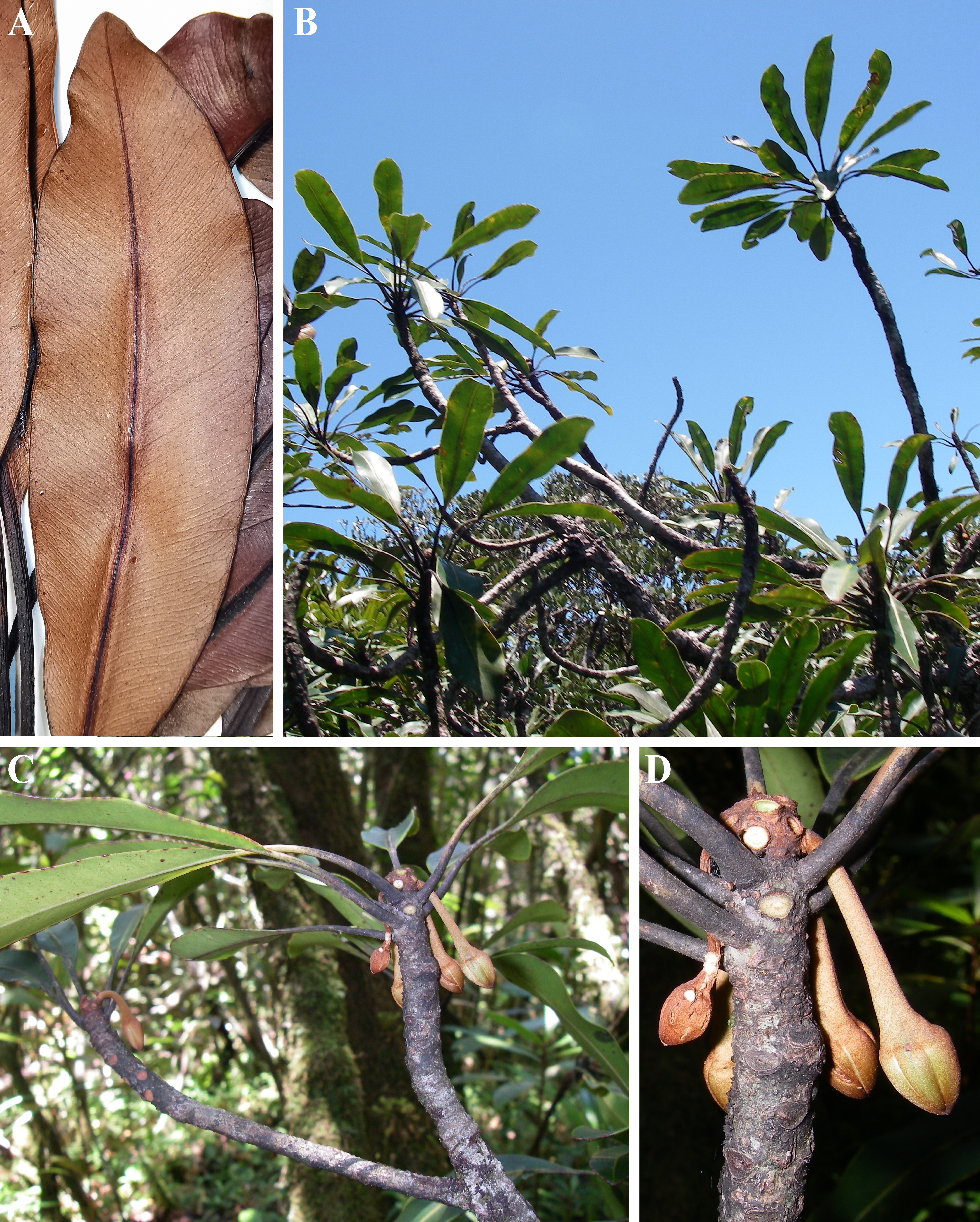
[Botany • 2023] Bemangidia frankliniae (Sapotaceae) • A Taxonomic Revision of the Madagascar-endemic Genus Bemangidia, with Description of A Second Species


Bemangidia frankliniae Boluda & L.Gaut., 

in Boluda, Randriarisoa, Naciri et Gautier, 2023.

Abstract
Bemangidia L.Gaut. (Sapotaceae) is a genus endemic to a restricted area in the southeastern lowland moist evergreen forests of Madagascar. It was published in 2013 to accommodate an undescribed species, Bemangidia lowryi L.Gaut., which showed a combination of characters unique in the family Sapotaceae. At the time of description, three atypical collections from the same locality but growing on a ridge, slightly higher in altitude, were already known. Although matching well with the Bemangidia genus, they were phenotypically different from B. lowryi and were therefore not included in the species description. In the present study, we evaluate whether these specimens correspond to a new species, using a combination of morphological and genetic data based on 638 nuclear genes. The results show that Bemangidia contains two lineages, each one corresponding to a different morphology, with a genetic branch length similar to those observed among species pairs in other genera of Sapotaceae. We conclude that the genetic and  morphological differences are sufficient to consider the two lineages as two distinct species. Consequently, the genus is here revised and a second species described.

Keywords: Bemangidia, critically endangered, Madagascar, new species, Sapotaceae

Bemangidia frankliniae Boluda & L.Gaut.
A, Detail of the abaxial surface of a dried leaf; B, tree upper branches; C, detail of a flowering branch; D, flower buds.
Photographs: A (the type specimen, Razakamalala et al. 3976), Carlos G. Boluda; B–D (Gautier 5790), L. Gautier.

Bemangidia frankliniae Boluda & L.Gaut., sp. nov.

Differs from the only other known species in the genus, Bemangidia lowryi, by its smaller stipules (1–3.5 mm vs c.8 mm), its smaller leaf lamina (4.3–14 × 1.4–3.5 cm vs 18–22 × 6–6.5 cm), the apex usually acute (vs mostly rounded), the midrib raised on the adaxial surface (vs nearly flat to depressed), depressed or rarely slightly raised on the abaxial surface (vs strongly raised), its faintly raised to flat lateral veins (vs raised and forming a conspicuous striate surface), the less numerous lateral veins (70–145 vs 175–330) forming an angle of 45°–60° with the midrib (vs 70°–90°), and its smaller sepals (12 mm vs > 20 mm)

Etymology. The specific epithet honours the Franklinia Foundation, a non-governmental organisation dedicated to the conservation of trees, which founded the project ‘Understanding Malagasy Sapotaceae, a critical step towards conservation of a threatened group of prime importance trees’, in the framework of which this species is described.


C.G. Boluda, A. Randriarisoa, Y. Naciri and L. Gautier. 2023. A Taxonomic Revision of the Madagascar-endemic Genus Bemangidia (Sapotaceae), with Description of A Second Species. EDINBURGH JOURNAL OF BOTANY. 80, 1996. DOI: 10.24823/ejb.2023.1996

Saturday, November 18, 2023

[Botany • 2023] Rhododendron astrophorum (Ericaceae, sect. Schistanthe) • A New micro-endemic Species from Central Palawan, Philippines


Rhododendron astrophorum M.N.Tamayo, Y.P.Ang & A.S.Rob., 

in Tamayo, Marcos-Langbao, Bustamante, Ang, Schubert, Mustaqim, Fritsch et Robinson, 2023. 

Abstract
A new micro-endemic species of Rhododendron is described and illustrated from botanical expeditions to the Victoria-Anepahan  Mountain Range on the island of Palawan. It closely resembles Rhododendron wilkiei but differs in having leaves with laminae that are  narrowly elliptic-oblanceolate, have adaxially indistinct venation, and are arranged in 4–8 active and mostly terminal pseudowhorls  along the length of the stem; bracts without scales on the margin; yellow flowers with a red corolla tube interior that is densely hairy  towards the base; and hairy anther filament bases. Morphological and geographical data place the species in Rhododendron sect. Schistanthe. The new species, together with a first record of Rhododendron vidalii on Palawan as part of this research, represent the  tenth and eleventh members of this genus recorded from the island. A revised key to the Palawan species of Rhododendron is provided.

Keywords: Euvireya, Malesia, Taxonomy, Ultramafic, Vireya

Rhododendron astrophorum M.N.Tamayo, Y.P.Ang & A.S.Rob., sp. nov.
A, Flowering branch; B, flower (apical view); C, flower and growth point (lateral view, showing bracts); D, size and shape variation in larger pseudowhorl leaves; E, leaf (abaxial surface); F, corolla (internal surface); G, calyx and filament bases, showing trichomes; H, base of corolla tube, showing trichomes; I, flower (corolla removed); J, anther (ventral and lateral view); K, pistil.
Photographs of the holotype (AVAMR 85): A, F and I, Y. P. Ang; B and C, M. Tamayo; D, A. Robinson; E, G, H, J and K, R. Bustamante.


Rhododendron astrophorum M.N.Tamayo, Y.P.Ang & A.S.Rob., sp. nov.

Closely resembles Rhododendron wilkiei Argent but differs in having leaves with laminae narrowly elliptic-oblanceolate and c.5–7 times as long as wide (vs elliptic and c.2.5 times as long as wide), venation adaxially indistinct (vs prominent) with 4–8 active pseudowhorls of leaves along the length of the stem (vs 2–3(–4) mostly terminal pseudowhorls), bracts without scales on the margin (vs with scales), yellow corollas with the tube interior red (vs red throughout), the internal surface of the corolla tube densely hairy on the proximal 3/4 (vs glabrous), and filaments hairy at the base (vs glabrous).

Etymology. The specific epithet astrophorum is derived from the Greek ἄστρον (ástron= star), and the suffix -φόρος (-phóros = bearing) in reference to the bright yellow corolla, which resembles small clusters of stars in the forest canopy


M. N. Tamayo, A. B. Marcos-Langbao, R. A. A. Bustamante, Y. P. Ang, D. C. Schubert, W. A. Mustaqim, P. W. Fritsch and A. S. Robinson. 2023. Rhododendron astrophorum (ERICACEAE, Rhododendron sect.  Schistanthe), A New micro-endemic Species from Central Palawan, Philippines. EDINBURGH JOURNAL OF BOTANY. 80; 1-14. DOI: 10.24823/ejb.2023.1979