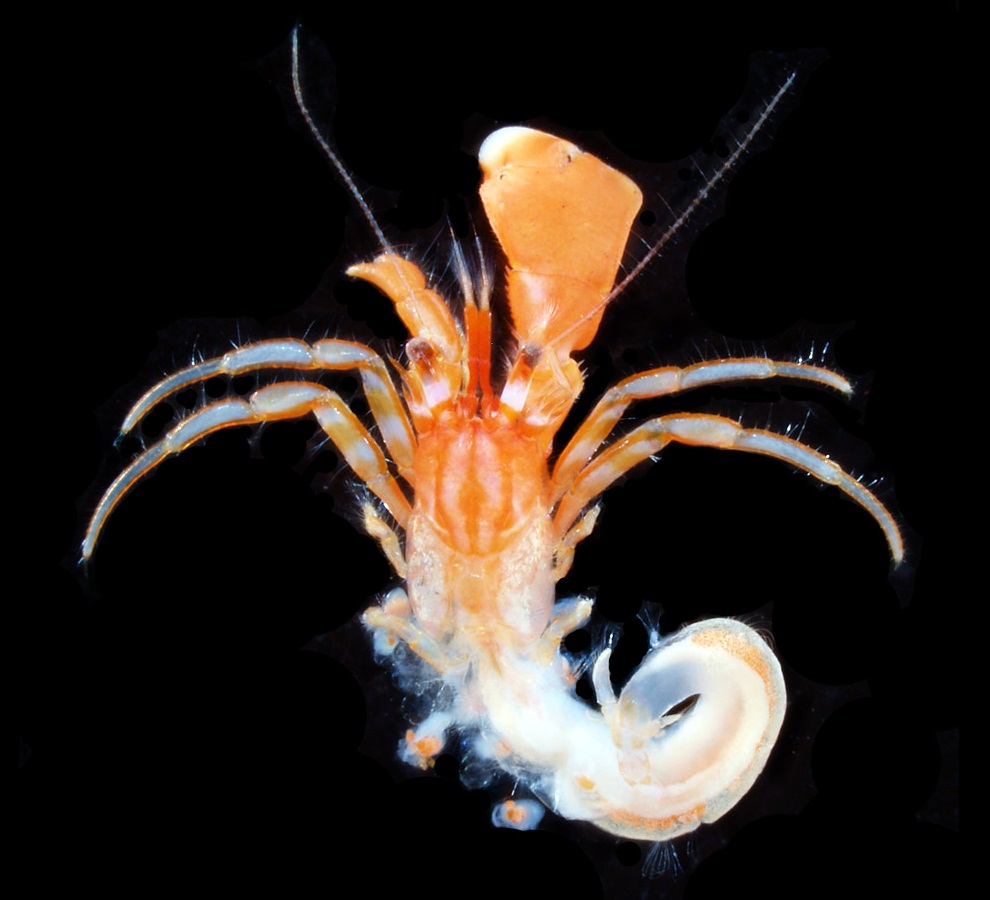
Showing posts with label Anomura. Show all posts

Wednesday, February 25, 2026

[Crustacea • 2026] Galathea balasubramaniani • A New Species of the Squat Lobster Genus Galathea Fabricius, 1793 (Decapoda: Galatheidae) from Lakshadweep, India


 Galathea balasubramaniani  
Sureandiran, Divya, Naeem, Sundaramanickam & Kumar, 2026 

 
Abstract
A new species of galatheid squat lobster, Galathea balasubramaniani sp. nov. is described from Lakshadweep Island, India. The G. balasubramaniani sp. nov. belongs to the ‘Gmauritiana’ group, identified through having a pterygostomian flap with 1 or 2 spines and an uninterrupted mesogastric ridge. This group includes: G. acis Macpherson & Robainas-Barcia, 2015, G. aequata Macpherson & Robainas-Barcia, 2015, G. ahyongi Macpherson & Robainas-Barcia, 2015, G. mauritiana Bouvier, 1914 and G. senta Macpherson & Robainas-Barcia, 2015. The G. balasubramaniani sp. nov. resembles G. mauritiana Bouvier, 1914, but differs based on the presence of an epipod on P1, and P2 with propodus 4.2–4.7 times as long as wide and the merus with the proximal spine reaching or slightly over-reaching the distal margin of the article. Maximum Likelihood analysis of the new species, using mitochondrial genes cytochrome c oxidase (COI) and 16S rRNA also supported the findings and suggests that G. balasubramaniani sp. nov. is closely related to G. mauritiana, with pairwise genetic distances estimated at 6.0–14.3 % (COI) and 3.1–16.9% (16S rRNA).

Crustacea, Arabian Sea, Galatheid squat lobster, Genetic divergence, Indian Ocean, Phylogeny

 Galathea balasubramaniani sp. nov. 
A–H, holotype female, GALGBAL/NBFGR (PCL 2.85 mm); I, paratype male, GALGBAL/NBFGR.2 (PCL 1.88 mm). A, carapace, dorsal view; B, pterygostomian flap, left lateral view; C, right P1, dorsal view; D–F, right P2–4, lateral view; G, maxilliped 3 dorsal view; H, thoracic sternum, ventral view; I right G2, dorsal view. Scale bar for A–F, H = 1 mm, G–I = 0.5 mm.

 Galathea balasubramaniani sp. nov. in live condition, collected from Agatti Island, Lakshadweep. Specimen not preserved.

Galathea balasubramaniani sp. nov.


B. SUREANDIRAN, P.R. DIVYA, U.P. MOHAMMED NAEEM, A. SUNDARAMANICKAM, T.T. AJITH KUMAR. 2026. A New Species of the Squat Lobster Genus Galathea Fabricius, 1793 from Lakshadweep, India (Crustacea: Decapoda: Galatheidae).  Zootaxa. 5757(4); 382-392. DOI: doi.org/10.11646/zootaxa.5757.4.6 [2026-02-09]

Monday, February 23, 2026

[Crustacea • 2022] Raymunida shraddhanandi, Munidopsis bengala & M. kadal • Squat Lobsters of the Genera Raymunida and Munidopsis (Decapoda: Anomura: Galatheoidea) from the Indian Exclusive Economic Zone, with Descriptions of Three New Species


Raymunida shraddhanandi 
Munidopsis bengala and M. kadal  
Tiwari, Padate, Cubelio & Osawa, 2022
   

ABSTRACT
We report four squat lobster species of the genera Raymunida Macpherson and Machordom, 2000 (Munididae) and Munidopsis Whiteaves, 1874 (Munidopsidae) from the Indian Exclusive Economic Zone. The genus Raymunida is recorded for the first time from Indian waters, including a new species Raymunida shraddhanandi sp. nov. and R. vittata Macpherson, 2009 based on material from the Andaman Sea. Raymunida shraddhanandi sp. nov. differs from its closest congener R. formasanus Lin, Chan and Chu, 2004 in the armatures of the anterior branchial carapace region, antennal peduncle and third maxilliped merus, and the length of the fourth pereopod. Two new species of the genus Munidopsis, referred to the Anoplonotus group, are described from the south-western Bay of Bengal and the south-eastern Arabian Sea. Munidopsis bengala sp. nov. and M. kadal sp. nov. are distinguished from all of their allies – M. bruta Macpherson, 2007, M. shulerae Vázquez-Bader, Gracia and Lemaitre, 2014, and M. truculenta Macpherson and Segonzac, 2005 – by the unarmed dorsodistal margin of the third maxilliped merus and the relative length of the antennal peduncle, respectively.
 
KEYWORDS: new record, new species, fauna, Indian ocean


Raymunida shraddhanandi sp. nov.  
Munidopsis bengala sp. nov.  
M. kadal sp. nov.

 
Shivam Tiwari, Vinay P. Padate, Sherine S. Cubelio and Masayuki Osawa. 2022. Squat Lobsters of the Genera Raymunida Macpherson & Machordom, 2000 and Munidopsis Whiteaves, 1874 (Decapoda: Anomura: Galatheoidea) from the Indian Exclusive Economic Zone, with Descriptions of Three New Species. Journal of Natural History. 56(41-44); 1819-1839. DOI: doi.org/10.1080/00222933.2022.2138600 [29 Nov 2022]
 

Thursday, February 12, 2026

[Crustacea • 2026] Leiogalathea samudragiri • A New deep-sea munidopsid squat lobster of the Genus Leiogalathea Baba, 1969 (Decapoda: Anomura: Munidopsidae) from the southeastern Arabian Sea, India


Leiogalathea samudragiri  
Tiwari, Padate & Cubelio, 2026


Abstract
The present study describes a new species of the deep-water munidopsid squat lobster genus Leiogalathea Baba, 1969. Leiogalathea samudragiri sp. nov. resembles L. achates Rodríguez-Flores, Macpherson & Machordom, 2019, L. evander Rodríguez-Flores, Macpherson & Machordom, 2019, and L. laevirostris (Balss, 1913) by the unarmed hepatic margin of the carapace. However, the new species differs from these congeners mainly in having uninterrupted mesogastric and mid-transverse ridges on the carapace and the presence of six transverse ridges on the posterior half of the carapace.
 
Keywords: Anomura, Arabian Sea, New species, Seamount, Taxonomy

Leiogalathea samudragiri sp. nov. Holotype, ovigerous female (IO/SS/ANO/00195; PCL 4.8 mm, CW 3.7 mm).
a carapace, dorsal view, b thoracic sternum, ventral view, c left eye, antennular article 1 and antennal peduncle, ventral view, d left mxp3, lateral view, e right P1, dorsal view, f right P2, lateral view, g right P2 dactylus, lateral view, h right P3, lateral view, i right P4, lateral view

Leiogalathea samudragiri sp. nov. Holotype, ovigerous female (IO/SS/ANO/00195; PCL 4.8 mm, CW 3.7 mm). Dorsal habitus

Leiogalathea samudragiri sp. nov.  
 
 Etymology: The species name is derived from a combination of the Sanskrit “samudra” meaning ocean, and “giri” meaning mountain, which refers to the seamount habitat of this species.


Shivam Tiwari, Vinay P. Padate and Sherine Sonia Cubelio. 2026. A New deep-sea munidopsid squat lobster of the Genus Leiogalathea Baba, 1969 (Decapoda: Anomura) from the southeastern Arabian Sea, India.  Discover Oceans. 3, 6. DOI: doi.org/10.1007/s44289-026-00117-5 [04 February 2026]

Monday, December 22, 2025

[Crustacea • 2025] Leucolepidopa nubes • A New Species and A New record of the albuneid subfamily Lepidopinae (Decapoda: Anomura) from China


Leucolepidopa nubes
Wan, Meng, Li & Dong, 2025

云纹白鳞目蟹 | DOI: doi.org/10.1080/24750263.2025.2487513  
 
Abstract
A new species of the albuneid sand crab, Leucolepidopa nubes sp. nov., is described based on a specimen from the coastal waters of Hainan Island, northern South China Sea, China. The new species can be distinguished from the sole congeneric species, L. sunda Efford 1969, primarily by the number of antennal flagellum articles, the size of the setal field of the carapace, and the shape of the P4 dactylus heel. The diagnosis of the genus Leucolepidopa is emended to include the new species. The present paper is the first report of the subfamily Lepidopinae from the South China Sea and China. This new species is the second member in the genus Leucolepidopa and extends the distribution range record of the subfamily to the northern tropical area in Asia.

Keywords: Lepidopinae, Leucolepidopa, new distribution record, new species, South China Sea


Leucolepidopa nubes sp. nov.

Etymology. The species name is derived from the Latin nubes (= cloud), referring to the pattern of thesetae grooves on the carapace. Used as a noun inapposition. The Chinese name of the new species is“云纹白鳞目蟹”. 


Y. Wan, F. Meng, X. Li and D. Dong. 2025. A New Species and A New record of the albuneid subfamily Lepidopinae (Crustacea: Decapoda: Anomura) from China. The European Zoological Journal. 92(1); 558-566. DOI: doi.org/10.1080/24750263.2025.2487513 [27 May 2025]

Tuesday, February 25, 2025

[Crustacea • 2025] Trapezionida hercules, Typhlonida annieae, Munidopsis giribeti, etc. • New Species of Deep-sea Galatheoidea (Anomura: Galatheidae, Munididae, Munidopsidae) from Central Pacific Seamounts, with remarks on their phylogenetic placement, habitat associations, and significance for the biogeography of squat lobsters


Munidopsis giribeti
Rodríguez-Flores, 2025


Abstract
Seamounts in the Central Pacific Ocean remain largely unexplored. Squat lobsters, a major deep-sea invertebrate group, are poorly known in this area, whereas recent sampling efforts in the Western Pacific have resulted in a populated database of Galatheoidea Samouelle, 1819. Material recently collected by the E/V Nautilus during several expeditions to Central Pacific seamounts is reviewed herein, revealing the presence of 16 species. Ten species constitute geographic range expansions, and five are new taxa: Trapezionida hercules sp. nov., T. tapina sp. nov., Typhlonida annieae sp. nov., Munidopsis giribeti sp. nov., and M. nemo sp. nov. Using 3D imaging via micro-CT scanning and molecular phylogenetic analysis of COI and 16S mitochondrial genes, these species are described and illustrated, and their phylogenetic positions are revealed. Several of the new species represent highly divergent lineages not closely related to known species, indicating a need to continue exploring the deep ocean in the Central Pacific. The study herein also describes the habitats and biological associations of these species, ranging from corals to chemosynthetic environments. The new data fill an important geographic gap in the distribution of squat lobster species and contribute to understanding the speciation processes and connectivity among seamounts in the Pacific Ocean.


Paula C Rodríguez-Flores. 2025. New Species of Deep-sea Galatheoidea (Anomura: Galatheidae, Munididae, Munidopsidae) from Central Pacific Seamounts, with remarks on their phylogenetic placement, habitat associations, and significance for the biogeography of squat lobsters. Journal of Crustacean Biology.  45(1); ruae080. DOI: doi.org/10.1093/jcbiol/ruae080

Tuesday, October 8, 2024

[Crustacea • 2023] Automate arturi • A New Species of Automate (Decapoda: Alpheidae) from the Persian Gulf


Automate arturi
Ashrafi & De Grave, 2023 

 
Abstract
During 2019, two specimens belonging to a new species of the alpheid shrimp genus Automate De Man, 1888 were collected from two islands in the northern part of the Persian Gulf. The new species is a member of the A. hayashii group which hitherto only comprised two species. However, the new species Automate arturi can be separated from them by several morphological features: a shorter rostrum with rounded tip, a shorter stylocerite barely extending beyond the first antennular article, the scaphocerite not reaching to the end of the second antennular article, the third maxilliped coxa with a subtriangular-shaped lateral plate, the ischia of the first pereiopods (chelipeds) dorsally armed with spiniform setae and ventrally with a small tubercle, and the ischia of the walking pereiopods armed with a single ventrolateral spiniform seta.

Keywords: Automate, new species, Persian Gulf, northern Indian Ocean

Automate arturi sp. nov., female holotype, Hengam Island, Persian Gulf (MNHN-IU-2014-1264).
 A, major cheliped, mesialview; B, same, lateral view; C, same, distal portion of palm and fingers, lateral view; D, minor cheliped, mesial view; E, same, lateralview; F, same, distal portion of palm and fingers, lateral view. 


Automate arturi sp. nov., female paratype, Abu-Musa Island, Persian Gulf (MNHN-IU-2014-1265).
A, right, dorsolateralaspect; B, left lateral aspect.
Photos by Rashed Abdollahi.

Automate arturi 
 

Hossein Ashrafi and Sammy De Grave. 2023. A New Species of Automate (Crustacea: Decapoda) from the Persian Gulf. Crustacean Research. 52; 79-89. DOI: 10.18353/crustacea.52.0_79 

Wednesday, September 11, 2024

[Crustacea • 2024] Munidopsis sedna • Integrative Taxonomy reveals A New Species of Deep-sea Squat Lobster (Galatheoidea: Munidopsidae) from Cold Seeps in the Gulf of Mexico


Munidopsis sedna 
 Rodríguez-Flores, Ambler & Nizinski, 2024


Abstract
The western Atlantic Ocean harbors a diverse fauna of squat lobsters, particularly in the family Munidopsidae. This study introduces Munidopsis sedna sp. nov., a species only found in the Gulf of Mexico and the first species reported to be endemic to cold seeps in the western Atlantic. Our investigation incorporates morphological analyses including micro-CT scanning evidence, multilocus molecular phylogeny, and mtDNA phylogeography, as well as ecological data derived from in situ observations and geographic distribution patterns to substantiate the recognition of the new species. Shallow molecular divergences and multiple morphological differences differentiate the new species from its closest relative, M. longimanus (A. Milne-Edwards, 1880). Additionally, we explore the potential scenario for ecological speciation within this newly identified taxon and discuss its significance in the context of conservation efforts in the Gulf of Mexico.

Key Words: Anomura, Atlantic, barcoding, chemosynthetic systems, morphology, nanopore, speciation

Superfamily Galatheoidea Samouelle, 1819
Family Munidopsidae Ortmann, 1898

Genus Munidopsis Whiteaves, 1874
 
In situ image of Munidopsis sedna sp. nov. in a brine pool in the Gulf of Mexico.
Photo courtesy of the BBC.
 
 Munidopsis sedna sp. nov.

Etymology: In Inuit mythology, Sedna is the goddess of the sea and marine animals, also known as the Mother or Mistress of the Sea. The specific name is substantive in apposition.


 Paula C. Rodríguez-Flores, Julie W. Ambler and Martha S. Nizinski. 2024. Integrative Taxonomy reveals A New Species of Deep-sea Squat Lobster (Galatheoidea, Munidopsidae) from Cold Seeps in the Gulf of Mexico. Zoosystematics and Evolution. 100(4): 1243-1257. DOI: doi.org/10.3897/zse.100.127169

Tuesday, September 3, 2024

[Crustacea • 2024] Galathea bharata, Nanogalathea longispina, Sadayoshia brevirostrum, etc. • Galatheoid Squat Lobsters (Decapoda: Anomura) from the epipelagic bottom of the Indian Exclusive Economic Zone, with descriptions of Five New Species


Galathea bharata sp. nov., G. kalingasagara sp. nov., 
G. quadrangularis sp. nov., Nanogalathea longispina sp. nov., and Sadayoshia brevirostrum sp. nov.

 Tiwari, Padate, Cubelio & Osawa, 2024

 
Abstract
Seven species of galatheoid crustaceans, including five new species, are reported from the southeastern Arabian Sea, southwestern Bay of Bengal, and western Andaman Sea, India, based on material collected from 56 to 113 m depths. Distinctions between the five new species (Galathea bharata sp. nov., G. kalingasagara sp. nov., G. quadrangularis sp. nov., Nanogalathea longispina sp. nov., and Sadayoshia brevirostrum sp. nov.) and their morphological close congeners are given in detail. The genus Nanogalathea Tirmizi & Javed, 1980 is rediagnosed to include N. longispina sp. nov. Trapezionida latior Baba, 2005 is recorded for the first time from Indian waters, indicating northward extension of its known geographical range. A specimen tentatively referred to Galathea aff. nasimae Karasawa, 2019 is also reported from the Andaman Sea.

Crustacea, Galatheidae, Munididae, new species, new record, India


Shivam Tiwari, Vinay P. Padate, Sherine Sonia Cubelio, Masayuki Osawa. 2024. Galatheoid Squat Lobsters (Crustacea: Decapoda: Anomura) from the epipelagic bottom of the Indian Exclusive Economic Zone, with descriptions of Five New Species.  Zootaxa. 5501(2); 291-314. DOI: doi.org/10.11646/zootaxa.5501.2.4


Saturday, March 30, 2024

[Crustacea • 2024] Trichopagurus spinibrachium • A New Species of the Genus Trichopagurus de Saint Laurent, 1968 (Decapoda: Anomura: Paguridae) from A semi-submerged marine cave in Okinawa Island, southwestern Japan


Trichopagurus spinibrachium
Nakajima, Fujita & Osawa, 2024

 
Abstract
A new hermit crab species of Paguridae, Trichopagurus spinibrachium n. sp., is described on the basis of a single male specimen collected from the anchialine environment of a semi-submerged marine cave in Okinawa Island, Ryukyu Islands, southwestern Japan. It is morphologically similar to T. macrochela Komai & Osawa, 2005 and T. tenuidactylus Komai, 2013, but differs in the shape and armature of the ocular, antennular and antennal peduncles, chelipeds, and ambulatory legs. The new species may be distinguished from all known congeners by the stronger armature of the carpi and meri of both chelipeds. Trichopagurus spinibrachium n. sp. is the third species of the genus recorded from submarine caves, although it may also occur on nearby coral reefs as does T. macrochela and T. trichophthalmus (Forest, 1954).

Key words: Crustacea, Paguroidea, cryptic fauna, dark environment, taxonomy, western Pacific


Trichopagurus spinibrachium n. sp.


Hiroki Nakajima, Yoshihisa Fujita and Masayuki Osawa. 2024. A New Species of the Genus Trichopagurus de Saint Laurent, 1968 (Crustacea: Decapoda: Anomura: Paguridae) from A semi-submerged marine cave in Okinawa Island, southwestern Japan.  Zootaxa. 5419(1); 121-129. DOI: 10.11646/zootaxa.5419.1.5

沖縄島・恩納村の海底洞窟から新種ヤドカリを発見!

[Crustacea • 2024] Petrolisthes coeruleus • A New Species of the Petrolisthes galathinus complex (Anomura: Porcellanidae) from the Caribbean Sea, and Resurrection of Petrolisthes occidentalis from the East Pacific


 Petrolisthes coeruleus Hiller & Werding, 2024
  

Abstract
The Petrolisthes galathinus complex currently consists of six American species distributed in the West Atlantic, including the amphi-American P. galathinus. All species in the complex are similar in their adult morphology but differ in colour, size, larval morphology, and shape of the adult sternal plate. The West Atlantic species have different geographic ranges, which overlap in the southern Caribbean. Previously published molecular data support the monophyly of the complex, and the reciprocal monophyly of each described species and further clades corresponding to different colour morphs. Here, the morph P. caribensis “Blue” is described as Petrolisthes coeruleus sp. nov., and Petrolisthes occidentalis is formally resurrected for the Pacific individuals of P. galathinus. By adding these two species to the P. galathinus complex, this now consists of eight species. Colour illustrations of all species and colour morphs are provided and their geographic distributions and ecological ranges are discussed and updated.

Key words: Caribbean, colour morphs, ecological range, geographical range, Petrolisthes coeruleus sp. nov., Petrolisthes occidentalis

Dorsal view of Petrolisthes coeruleus sp. nov., male, Punta Galeta, Colón, Panamanian Caribbean. Setae on outer margin of cheliped manus omitted to depict spines. Scale bar: 0.4 cm.
 
Dorsal view of Petrolisthes coeruleus sp. nov.
a male, Islas del Rosario, Colombian Caribbean b male, Islas del Rosario, Colombian Caribbean c Bocas del Toro, Panamanian Caribbean, photograph courtesy of T. Deuss.
Scale bars: 0.5 cm (a); 0.65 cm (b).

Family Porcellanidae Haworth, 1825: 184.

Genus Petrolisthes Stimpson, 1858: 227.

 Petrolisthes coeruleus sp. nov.
 
Etymology: The name coeruleus alludes to the blueish tone of carapace and extremities, which comprises a reliable diagnostic character to distinguish this species from P. caribensis.


 Alexandra Hiller and Bernd Werding. 2024. Description of A New Species of the Petrolisthes galathinus complex from the Caribbean Sea, and Resurrection of Petrolisthes occidentalis from the East Pacific (Crustacea, Anomura, Porcellanidae). ZooKeys 1191: 391-407. DOI: 10.3897/zookeys.1191.111570


Monday, May 15, 2023

[Crustacea • 2022] Enosteoides lapis • A New infaunal Species of the Genus Enosteoides Johnson, 1970 (Decapoda: Anomura: Porcellanidae) from Okinawa, southwestern Japan


Enosteoides lapis 
 Osawa, Nakajima & Hamamoto, 2022

 
Abstract
A new porcellanid species of the genus Enosteoides Johnson, 1970 is described on the basis of a single specimen collected from the burrow of an unidentified snapping shrimp of the genus Alpheus Fabricius, 1798, on the subtidal coarse sediment in Okinawa Island, Ryukyu Islands, southwestern Japan. Enosteoides lapis n. sp. is similar to E. melissa (Miyake, 1942) and E. philippinensis Dolorosa & Werding, 2014 in the general morphology of the frontal region of the carapace, third thoracic sternite, and ambulatory legs, but is distinguished from both by the dorsal surface of the carapace being more strongly uneven, as well as by the absence of dense plumose setae on the lateral margins of the carapace, anterodorsal surfaces of the chelae, and anterior and posterior margins of the ambulatory meri.

Keywords: Crustacea, new species, porcelain crab, burrow, infauna, western Pacific


Masayuki Osawa, Hiroki Nakajima and Kohei Hamamoto. 2022. A New infaunal Species of the Genus Enosteoides Johnson, 1970 (Crustacea: Decapoda: Anomura: Porcellanidae) from Okinawa, southwestern Japan. Zootaxa. 5182(6); 582-592. DOI: 10.11646/zootaxa.5182.6.6

Thursday, December 24, 2020

[Crustacea • 2020] Cancellus heatherae • A New Species of the Hermit Crab Genus Cancellus H. Milne Edwards, 1836 (Decapoda: Diogenidae) from A Mesophotic Deep Bank in the northwestern Gulf of Mexico


Cancellus heatherae  
Felder & Lemaitre, 2020


Abstract
Recent sampling on mesophotic deep banks in the northwestern Gulf of Mexico has produced a previously undescribed hermit crab assignable to the genus Cancellus H. Milne Edwards, 1836. Members of the genus are most often found to occupy cavities of eroded coral, siliceous sponges, porous calcareous rock fragments, algal concretions, or worm tubes as shelters. The present specimen was found loose as by-catch in a dredged rhodolith sample taken for algal life history studies. In situ, it likely occupied a cavity within one of the collected calcareous rhodoliths or small sponges in the by-catch. While our description is based on a single female specimen, the holotype is fully mature and intact, and it was solidly frozen in seawater until its coloration could be photographically documented and tissues extracted for sequencing. In comparison to the three other known western Atlantic species, the frontal rim of the carapace shield in the new species is continuous between the blunt lateral teeth as in C. ornatus Benedict, 1901 and C. viridis Mayo, 1873, and thus distinct from the subdivided front found in C. spongicola Benedict, 1901. The rim itself is somewhat flattened as in C. ornatus rather than inflated as in C. viridis. However, each of the ocular scales bears a pair of spines at the tip, as in C. viridis. The lower palms of the chelipeds, while distinctly rugose, do not have a separated patch of stridulating ridges comparable to those reported for C. spongicola. The yellow-orange to deep-orange pigmentation of the color pattern differs from fresh coloration in both C. ornatus and C. viridis, but that of C. spongicola is unknown for other than preserved specimens. Description of the single available specimen is in this case justified by the low likelihood for timely acquiring of additional samples from the type locality or adjacent habitats, most of which are deep banks warranting protection under pending habitat management changes. Our diagnosis includes GenBank accession numbers for COI sequences to facilitate future molecular phylogenetic comparisons.

Keywords: Crustacea, new species, Anomura, Cancellus, mesophotic, Gulf of Mexico


FIGURE 3. Cancellus heatherae n. sp., female holotype, sl 4.0 mm (USNM 1618800 = ULLZ 18309), northwestern Gulf of Mexico: A, habitus, dorsal; B, habitus, right side; C, habitus, ventral; D, sixth tergite and telson, dorsal.
 Cancellus viridis Mayo, 1973, female, sl 2.2 mm (USNM 1544358 = ULLZ 8947), southeastern Gulf of Mexico: E, in carcinoecium, front; F, habitus, dorsal. 
Cancellus ornatus Benedict, 1901, female, sl 6.9 mm (USNM 1539291 = ULLZ 2089), northeastern Gulf of Mexico: G, front; H, habitus, dorsal.


Taxonomy 
Family Diogenidae 

Genus Cancellus H. Milne Edwards, 1836 

Cancellus heatherae n. sp.

Diagnosis. Cephalothoracic shield width not exceeding length; rostrum well developed, angular, produced anteriorly beyond blunt anterolateral projections; narrow flattened frontal rim continuous across front between anterolateral projections, crossing rostrum without disjuncture; dorsal surface with angular depression on either side of shield posterior to rim behind each ocular peduncle. Median calcified plate of cardiac region subrectangular, slightly longer than wide. Ocular acicles armed with 2 spinules distally. Antennal acicle extending anteriorly less than onehalf length of ocular peduncle. Cheliped and second pereopod distal segments adapted to form operculum when withdrawn into habitat opening, outer surfaces of carpus and propodus with concave opercular depression. Cheliped propodus (palm) with opercular depression limited mesially by crest of 7 or 8 marginally denticulate lobes. Second pereopod propodus with opercular depression limited laterally by crest of 5 marginally denticulate lobes. Pleon elongate, with lightly sclerotized transverse tergites dorsally, 4 minute biramous pleopods on left side, depressed longitudinal groove along left side; sixth pleonite greatest width exceeding three-fourths greatest length, anterior lobes to either side of median incision each armed by 7 or 8 strong spines. Uropods and telson symmetrical; telson subovoid, anteriorly with subtriangular median dorsal prominence, posterior margin entire, unarmed except for setae. Color pattern of orange to yellow-orange dominating most dorsal surfaces and superior surfaces of anterior appendages, darker blotches and spots of deeper orange to reddish brown. A diagnostic COI gene sequence available under GenBank accession number MT800937. 

Etymology. This species name “heatherae” is chosen to honor Heather Bracken-Grissom for her extensive contributions to molecular phylogenetic studies of decapod crustaceans, including works focused on hermit crabs and other anomurans populating Gulf of Mexico waters. Her laboratory also generously made available the gene sequences here reported in our diagnosis.


Habitat. The sole specimen was found among rhodoliths and other calcareous rubble on a mesophotic offshore bank at 95 m depth. 

Distribution. The species is known only from the type locality off Louisiana in the northwestern Gulf of Mexico, western Atlantic Ocean. 


 Darryl L. Felder and Rafael Lemaitre. 2020. A New Species of the Hermit Crab Genus Cancellus H. Milne Edwards, 1836 from A Mesophotic Deep Bank in the northwestern Gulf of Mexico (Crustacea: Decapoda: Diogenidae). Zootaxa. 4890(4); 589–598. DOI: 10.11646/zootaxa.4890.4.10


Thursday, October 15, 2020

[Crustacea • 2020] Petrolisthes lazarus • A New Species of the Porcelain Crab Genus Petrolisthes (Decapoda: Anomura: Porcellanidae) from the Pacific coast of Panama, with Taxonomic Notes on Closely Related Species


Petrolisthes lazarus  
 Ferreira, Santana-Moreno & Anker, 2020


Abstract
A new species of porcelain crab, Petrolisthes lazarus sp. nov., is described from the Pacific coast of Panama, based on two female specimens. The new species is morphologically most similar to another eastern Pacific species, P. crenulatus Lockington, 1878, especially in the general configuration of the carapace, chelipeds and ambulatory legs. However, P. lazarus sp. nov. can be separated from P. crenulatus by the differences in the proportions of the carapace, the shape of the frontal region of the carapace, and the setation pattern of the cheliped. In addition, P. lazarus sp. nov. and P. crenulatus appear to be allopatric, the latter species presently being known only from Mexico. Among other eastern Pacific taxa, P. lazarus sp. nov. may have some affinities with P. ortmanni Nobili, 1901 and P. lewisi (Glassell, 1936), from which it can be easily distinguished by the chelipeds lacking a dense field of setae on the outer (lateral) surface of the palm and with different proportions of some articles, especially the carpus. The four species can also be distinguished from each other by their diagnostic, although somewhat variable colour patterns.

Keywords: Crustacea, Porcellanidae, porcelain crab, Petrolisthes, new species, marine biodiversity, Panama, eastern Pacific


 Luciane Augusto De Azevedo Ferreira, L. Daniel Santana-Moreno and Arthur Anker. 2020. A New Species of the Porcelain Crab Genus Petrolisthes from the Pacific coast of Panama, with Taxonomic Notes on Closely Related Species (Decapoda: Anomura: Porcellanidae). Zootaxa. 4858(4); 576–588. DOI: 10.11646/zootaxa.4858.4.6

Wednesday, October 7, 2020

[Crustacea • 2020] Kumepagurus kaikata (Decapoda: Anomura: Paguroidea) • A New Species of Pagurid Hermit Crab assigned to the Genus Kumepagurus Komai & Osawa, 2012 from the Kaikata Seamount, Izu-Ogasawara Arc, Japan


Kumepagurus kaikata  Komai, 2020


Abstract
A new pagurid hermit crab species is assigned to the genus Kumepagurus Komai & Osawa, 2012, previously represented only by the type species, K. cavernicolus Komai & Osawa, 2012, known only from a marine cave on Ryukyu Islands, northwestern Pacific. The assignment is made because of the lack of an accessory tooth on the maxilliped 3 ischium, the operculiform right chela, the presence of two distal corneous claws on the left chela fixed finger, the simple pereopods 4 and the development and structure of the male sexual tubes on both coxae of pereopods 5, all characteristic to the type species of the genus. However, in contrast to K. cavernicolusK. kaikata n. sp. lacks pleurobranchs on the thoracomeres 5 and 6, and in this regard, Kumepagurus is unusual in the family Paguridae. The generic diagnosis of Kumepagurus is emended to accommodate the new species, which is readily distinguished from K. cavernicolus by the proportionately shorter antennular and antennal peduncles and the right cheliped structure and ornamentation, in addition to the difference in the gill number.

Keywords: Crustacea, gill number, Kumepagurus kaikata, northwestern Pacific


Tomoyuki Komai. 2020. A New Species of Pagurid Hermit Crab assigned to the Genus Kumepagurus Komai & Osawa, 2012 (Decapoda: Anomura: Paguroidea) from the Kaikata Seamount, Izu-Ogasawara Arc, Japan. Zootaxa. 4858(2); 241–250. DOI: 10.11646/zootaxa.4858.2.5

Tuesday, September 1, 2020

[Crustacea • 2020] Neolithodes indicus • A New Species of Deep-water King-crab (Decapoda: Anomura) from the southeastern Arabian Sea


Neolithodes indicus
Padate, Cubelio & Takeda, 2020


Abstract
A new species of the deep-water king-crab genus Neolithodes A. Milne-Edwards & Bouvier, 1894 (Anomura: Lithodidae) is described herein from the southeastern Arabian Sea (1064–1338 m depth). Neolithodes indicus sp. nov. shows morphological proximity with three congeneric species, N. brodiei Dawson & Yaldwyn, 1970, N. flindersi Ahyong, 2010a and N. nipponensis Sakai, 1971 in bearing less numerous secondary spines on the carapace, the dactylus of the chelipeds with a convex dorsal margin and dorsoventrally compressed meri of the pereopods 2–4. The new species can be easily distinguished from these congeners in possessing the less densely spinulose carapace and appendages, short rostrum, simple antennal scaphocerite, the absence of large spines on the flexor margins of the pereopods 2–3 meri, and a stouter pereopod 4 propodus.

Keywords: Crustacea, Lithodidae, Neolithodes, taxonomy, India


Vinay P. Padate, Sherine Sonia Cubelio and Masatsune Takeda. 2020. Description of A New Species of Deep-water King-crab (Crustacea: Decapoda: Anomura) from the southeastern Arabian Sea. Zootaxa. 4845(1); 71–82.  DOI: 10.11646/zootaxa.4845.1.5