Showing posts with label Bioluminescence. Show all posts

Wednesday, November 13, 2024

[Mollusca • 2024] Bathydevius caudactylus • A remarkable bathypelagic Nudibranch (Nudibranchia: Bathydeviidae fam. nov.) from the North Pacific Ocean

 
Bathydevius caudactylus  
Robison & Haddock, 2024 
  

Highlights: 
• We present a previously undescribed genus and species of deep-sea nudibranch.
• It has unique morphology and is not closely related to any known families.
• In a molecular phylogeny, it resolves as a distinct sister to the rest of known nudibranchs.
• The species is bioluminescent and represents the third independent origin of bioluminescence among nudibranchs.

Abstract
We describe an exceptional nudibranch, new to science, from bathypelagic depths in the eastern North Pacific Ocean. More than 100 individuals of Bathydevius caudactylus gen. et. sp. nov. have been observed in the water column at depths between 1013 and 3272 m. Twenty spawning individuals were observed on the seafloor at depths between 2269 and 4009 m. Anatomy, diet, behavior, bioluminescence, and habitat distinguish this surprising nudibranch from all previously described species, and genetic evidence supports its placement in a new family.
 
Keywords: Nudibranch, Bathypelagic, bioluminescence, Deep-sea, New species, New genus, New family
 

 Bathydevius caudactylus gen et sp. nov. in situ, from a video frame grab.

 Hood configuration modes for Bathydevius caudactylus gen et sp. nov.:
 (a) fully expanded; (b) the hood is closed around an open sphincter; (c) the hood is bi-lobed, closed along its vertical axis; (d) invagination in the upper margin with a pinched projection in the lower margin; (e) the peripheral lip of the hood is rolled back against the outer surface of the bell; (f) in a propulsive pulse.

Systematics
Class GASTROPODA.
Subclass HETEROBRANCHIA.
Order NUDIBRANCHIA
Suborder incertae sedis.

Family Bathydeviidae fam. nov.

Bathydevius gen. nov.

Bathydevius caudactylus sp. nov.

 Diagnosis: Bathydevius caudactylus gen. et sp. nov. (Fig. 1) is a mostly transparent, gelatinous nudibranch composed of three distinct regions: the head, supporting a voluminous, bell-shaped oral hood; a body enclosing the internal organs and bearing the columnar ventral foot; and a spatulate tail fringed with 9–16 caudal appendages “dactyls.” The dorsal surface has two stubby, unsheathed rhinophores and a gently curved ridge of gills with the anal opening just posterior to the center of the gill ridge. Ventrally, the body merges into a short, cylindrical foot. Visible through the transparent body, the stomach is typically red, the rugose digestive gland is orange or brown, and in mature individuals, gonadal tissue on the right side of the digestive gland is opaque white.
 
 Etymology: The generic name Bathydevius gen. nov. describes a deep-living deviation, to reflect its diversion from the evolutionary path of its relatives in appearance, molecular signature, and natural history. The species name caudactylus sp. nov. refers to the finger-like projections that line the posterior margin of the tail.

Bathydevius caudactylus gen et sp. nov. on the seafloor in the posture associated with the release of an egg-bearing ribbon. Distance between the red laser dots is 29 cm.

 Bioluminescence of Bathydevius caudactylus gen et sp. nov., recorded in situ. Light emanates from the surface of the oral hood and within the dactyls (at left).


Bruce H. Robison and Steven H.D. Haddock. 2024. Discovery and Description of A remarkable bathypelagic Nudibranch, Bathydevius caudactylus, gen. et. sp. nov. Deep Sea Research Part I: Oceanographic Research Papers. 214; 104414.  DOI: doi.org/10.1016/j.dsr.2024.104414


Tuesday, September 17, 2024

[PaleoEntomology • 2021] Cretophengodes azari • Cretophengodidae, A New Cretaceous Beetle Family (Coleoptera: Elateroidea), sheds light on the Evolution of Bioluminescence


Cretophengodes azari Li, Kundrata, Tihelka & Cai, 

in Li, Kundrata, Tihelka, Liu, Huang et Cai, 2021. 

Abstract
Bioluminescent beetles of the superfamily Elateroidea (fireflies, fire beetles, glow-worms) are the most speciose group of terrestrial light-producing animals. The evolution of bioluminescence in elateroids is associated with unusual morphological modifications, such as soft-bodiedness and neoteny, but the fragmentary nature of the fossil record discloses little about the origin of these adaptations. We report the discovery of a new bioluminescent elateroid beetle family from the mid-Cretaceous of northern Myanmar (ca 99 Ma), Cretophengodidae fam. nov. Cretophengodes azari gen. et sp. nov. belongs to the bioluminescent lampyroid clade, and would appear to represent a transitional fossil linking the soft-bodied Phengodidae + Rhagophthalmidae clade and hard-bodied elateroids. The fossil male possesses a light organ on the abdomen which presumably served a defensive function, documenting a Cretaceous radiation of bioluminescent beetles coinciding with the diversification of major insectivore groups such as frogs and stem-group birds. The discovery adds a key branch to the elateroid tree of life and sheds light on the evolution of soft-bodiedness and the historical biogeography of elateroid beetles.


Order Coleoptera Linnaeus, 1758
Suborder Polyphaga Emery, 1886
Superfamily Elateroidea Leach, 1815

Cretophengodidae Li, Kundrata, Tihelka and Cai fam. nov.

Type genus. Cretophengodes gen. nov.

Diagnosis (male). Mandibles slender, sickle-shaped. Frontoclypeal region moderately declined anteriorly. Eyes large, strongly protruding. Antennae 12-segmented; antennomere 1 stout, expanding apically; antennomeres 2 and 3 short; antennomeres 4–11 elongate, bipectinate. Prosternum in front of coxae longer than diameter of procoxal cavity. Prosternal process narrow and elongate, acute apically, reaching posterior edge of procoxae. Elytra oblong, sub-parallel sided, nearly completely covering abdomen, leaving at most only apex of ultimate tergite exposed. Tarsal formula 5-5-5; tarsomeres 2–4 each with membranous lobe. Abdomen with six apparently immovable ventrites; photic organ present on median portions of the basal three abdominal ventrites.

Composition and distribution. Monogeneric, with Cretophengodes gen. nov. known only from mid-Cretaceous Burmese amber.

Cretophengodes Li, Kundrata, Tihelka and Cai gen. nov.
 
Etymology. The generic name is derived partly from ‘Cretaceous’, in reference to the age of the fossil, and the genus Phengodes, the type genus of the morphologically similar and presumably closely related Phengodidae. The gender is masculine.

Diagnosis. As for the family with additional characters: body moderate (approx. 7.3 mm long); pronotum sub-pentagonal, wider than long; elytra irregularly punctate, with several raised interstrial intervals forming indistinct carinae; claws simple.

 General habitus of Cretophengodidae and representatives of the closely related Phengodidae and Rhagophthalmidae, under incident light.
(a, b) Cretophengodes azari gen. et sp. nov., dorsal and ventral views, respectively, with arrowhead showing the photic organ.
(c, d) Zarhipis sp. (Phengodidae), dorsal and ventral views, respectively.
(e, f) Rhagophthalmus sp. (Rhagophthalmidae), dorsal and ventral views, respectively.
Scale bars: (a,b,e,f) 2 mm; (c,d) 4 mm. (Online version in colour.)

Cretophengodes azari Li, Kundrata, Tihelka and Cai sp. nov.

Etymology. After Prof. Dany Azar, palaeoentomologist extraordinaire.

Type material. Holotype, NIGP173775, male, mid-Cretaceous (upper Albian to lower Cenomanian [26,27]), from amber mine near Noije Bum Village, Hukawng Valley, Tanai Township, Myitkyina District, Kachin State, northern Myanmar.

Geographical distribution of Cretophengodidae (genus Cretophengodes), Phengodidae (subfamilies Cydistinae, Mastinocerinae and Phengodinae) and Rhagophthalmidae. World map adapted from Natural Earth (NaturalEarthData.com).  

 Artistic reconstruction of Cretophengodes azari gen. et sp. nov. The larviform female in the background is reconstructed based on extant Phengodidae and Rhagophthalmidae.  
 
 
Yan-Da Li, Robin Kundrata, Erik Tihelka, Zhenhua Liu, Diying Huang and Chenyang Cai. 2024. Cretophengodidae, A New Cretaceous Beetle Family, sheds light on the Evolution of Bioluminescence. Proc. R. Soc. B. 288: 20202730

Wednesday, May 8, 2024

[Invertebrate • 2019] Ophiopsila xmasilluminans • Brittle Stars from A Submarine Cave of Christmas Island, northwestern Australia, with Description of A New Bioluminescent Species (Echinodermata: Ophiuroidea) and Notes on Its Behaviour


Ophiopsila xmasilluminans
Okanishi, Oba & Fujita, 2019

RAFFLES BULLETIN OF ZOOLOGY. 67

 Abstract
 Three species of ophiuroids are reported from a shallow water submarine cave on Christmas Island in northwestern Australia, including a new bioluminescent species, Ophiopsila xmasilluminans, which is described herein on the basis of 15 specimens. This new species occurs on sandy bottoms in the cave with disc buried and arms extended above the substratum. This species possesses a disc entirely covered by thick skin with small and delicate embedded scales and granules; 3 oral papillae, basically flat, fan-shaped but sometimes innermost or middle papilla spiniform; diamond shaped oral shield with rounded edges, as long as wide; long and flat arm spine; inner tentacle scale narrow, flat and long, arms approximately 18 times the disc diameter. We describe bioluminescence and burying behaviour, which suggest adaptation to submarine cave environments. Also reported herein is a rarely encountered species, Ophiomora elegans, based on a single specimen. Ophiomora elegans was previously known only from southern Mozambique, the east coast of Africa and the Ryukyu Islands. We also include a new record of Ophioconis claviculata, which was previously known only from the Ryukyu Islands. 

Key words: brittle star, endemism, new species, submarine cave, bioluminescence, Christmas Island

 Ophiopsila xmasilluminans new species, living, anesthetised
(A: one paratype, RUMF-ZE-00152), in situ (B, C: specimens not collected):
A, aboral view; B, with buried disc and extended arms; C, an excavated specimen.


Ophiopsila xmasilluminans new species

Diagnosis. Disc surface entirely covered by thick skin with embedded small and delicate scales and granules; 3 oral papillae, basically as scales, but sometimes spiniform for one on innermost or middle position; diamond-shaped oral shield with rounded edges, as long as wide; long and flat arm spines, 6 in maximum number; inner tentacle scale narrow, flat and long; arms approximately 18 times longer than disc diameter.

Etymology. The specific name is an adjective in apposition formed as a compound of the island name “xmas” and the Latin participle, illuminans, meaning “lighting”, referring to its sampling locality name (Christmas Island) and luminescence. 
Common Japanese name. Dohkutsu-hikari-kumohitode. 

Distribution. Known only from the type locality, a submarine cave called as “Thunderdome Cave”, northern coast of Christmas Island, northwestern Australia, approximately 10 m depth (type locality, Fig. 1). Tan et al (2014) noted that Ophiopsila pantherina [= this new species] was also found at “Thundercliff Cave”, which is located near Thunderdome Cave. However, specimens of this species were only collected from Thunderdome Cave by the last author (Yoshihisa Fujita). 

Habitat. All type specimens of Ophiopsila xmasilluminans new species were collected in sandy bottoms in the submarine cave, with buried disc and arms extended into the water (Fig. 2B).


 Masanori Okanishi, Yuichi Oba and Yoshihisa Fujita. 2019. Brittle Stars from A Submarine Cave of Christmas Island, northwestern Australia, with Description of A New Bioluminescent Species Ophiopsila xmasilluminans (Echinodermata: Ophiuroidea) and Notes on Its Behaviour. RAFFLES BULLETIN OF ZOOLOGY. 67: 421–439. DOI 10.26107/RBZ-2019-0034


南の島のクリスマスイルミネーション?クリスマス島(豪)の海底洞窟から新種の光るクモヒトデを発見! (大場裕一教授ら) 中部大学の研究活動 中部大学 www3.chubu.ac.jp/research/news/25228/


Friday, May 26, 2023

[Invertebrate • 2023] Polycirrus aoandon, P. onibi & P. ikeguchii • Investigating the Diversity of Bioluminescent Marine Worm Polycirrus (Annelida), with Description of Three New Species from the Western Pacific


Polycirrus onibi Jimi, P. aoandon Jimi, & P. ikeguchii Jimi,
 
in Jimi, Bessho-Uehara, Nakamura, Sakata, Hayashi, et Ogoh, 2023

Bioluminescence, a phenomenon observed widely in organisms ranging from bacteria to metazoans, has a significant impact on the behaviour and ecology of organisms. Among bioluminescent organisms, Polycirrus, which has unique emission wavelengths, has received attention, and advanced studies such as RNA-Seq have been conducted, but they are limited to a few cases. In addition, accurate species identification is difficult due to lack of taxonomic organization. In this study, we conducted comprehensive taxonomic survey of Japanese Polycirrus based on multiple specimens from different locations and described as three new species: Polycirrus onibi sp. nov., P. ikeguchii sp. nov. and P. aoandon sp. nov. The three species can be distinguished from the known species based on the following characters: (i) arrangement of mid-ventral groove, (ii) arrangement of notochaetigerous segments, (iii) type of neurochaetae uncini, and (iv) arrangement of nephridial papillae. By linking the bioluminescence phenomenon with taxonomic knowledge, we established a foundation for future bioluminescent research development. We also provide a brief phylogenetic tree based on cytochrome c oxidase subunit I (COI) sequences to discuss the evolution of bioluminescence and the direction of future research.

Keywords: Polycirrus aoandon sp. nov., Polychaeta, Polycirrus onibi sp. nov., Polycirrus ikeguchii sp. nov., terebelliformia, bioluminescence

Polycirrus onibi sp. nov.

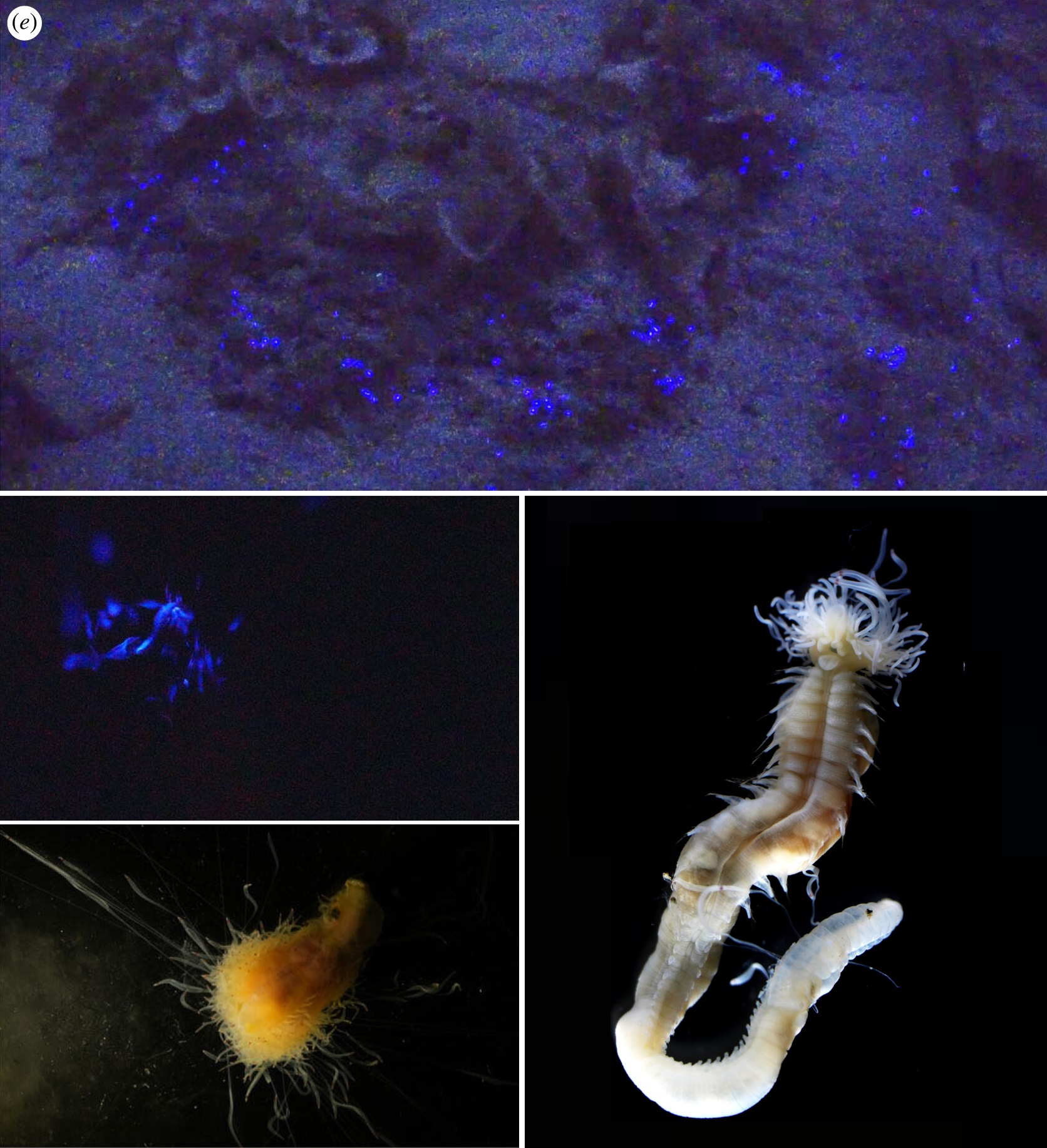
 Bioluminescence of Polycirrus spp.
 (a, c) Polycirrus onibi sp. nov.; (b, d) Polycirrus aoandon sp. nov.;
(e) in situ observation of Polycirrus spp. (mixture of P. ikeguchii sp. nov. and P. onibi sp. nov., most of them are P. ikeguchii sp. nov.) at Notojima.

Genus Polycirrus Grube, 1850 
[New Japanese name: Hikari-Fusa-gokai-zoku]

Type-species. Polycirrus medusa Grube, 1850 [13].

Polycirrus onibi Jimi, sp. nov.
[Japanese name: Onibi-fusa-gokai]

Diagnosis. Polycirrus with transparent body wall, tentacles with subterminal red spots, mid-ventral groove from segment 3, notochaetae on segments 3–14, neurochaetae on segment 15 and following segments, type II uncini, nephridial papillae in anterior area of parapodia on segments 3–14.

Etymology. The new species name derives from the Japanese yōkai onibi’. Onibi represents the soul of a deceased human or animal, manifested as a floating blue flame. It is often equated with the Will-o'-the-wisp. The blue–purple bioluminescence is reminiscent of this yōkai.


Polycirrus ikeguchii Jimi, sp. nov.
[Japanese name: Ikeguchi-fusa-gokai]

Diagnosis. Polycirrus with transparent body wall, tentacles with subterminal red spots, mid-ventral groove from segment 2, notochaetae on segments 3–19, neurochaetae on segment 17 and following segments, type II uncini, nephridial papillae in anterior area of parapodia, on segments 3–17.

Etymology. The species is named after Mr Shinichiro Ikeguchi. He is the former deputy director of the Notojima Aquarium, and he contributed to the discovery of the luminescence phenomenon of this species.


Polycirrus aoandon Jimi, sp. nov.
[Japanese name: Aoandon-fusa-gokai]

Diagnosis. Polycirrus with orange body wall, tentacles without subterminal red spots, mid-ventral groove from segment 3, notochaetae on segments 3–56, neurochaetae on segment 16 and following segments, type I uncini, nephridial papillae in anterior area of parapodia on segments 3–14.


Etymology. The new species name derives from the Japanese yōkai Aoandon’. Aoandon carries a blue (= Ao in Japanese) lantern (= andon in Japanese). The blue–purple bioluminescence is reminiscent of this yōkai.

 
Naoto Jimi, Manabu Bessho-Uehara, Koji Nakamura, Masahiko Sakata, Taro Hayashi, Shusei Kanie, Yasuo Mitani, Yoshihiro Ohmiya, Aoi Tsuyuki, Yuzo Ota, Sau Pinn Woo and Katsunori Ogoh. 2023. Investigating the Diversity of Bioluminescent Marine Worm Polycirrus (Annelida), with Description of Three New Species from the Western Pacific. Royal Society Open Science. DOI: 10.1098/rsos.230039
 phys.org/news/2023-03-newly-sea-worms-dark-creatures.html
 

Monday, August 12, 2019

[Entomology • 2019] Neoceroplatus betaryiensis • the First Record of A Bioluminescent Fungus-gnat (Diptera: Keroplatidae) in South America


Neoceroplatus betaryiensis Falaschi, Johnson & Stevani

in Falaschi, Amaral, Santos, Domingos, Johnson, et al., 2019. 

Abstract
Blue shining fungus gnats (Diptera) had been long reported in the Waitomo caves of New Zealand (Arachnocampa luminosa Skuse), in stream banks of the American Appalachian Mountains (Orfelia fultoni Fisher) in 1939 and in true spore eating Eurasiatic Keroplatus Bosc species. This current report observes that similar blue light emitting gnat larvae also occur nearby the Betary river in the buffer zone of High Ribeira River State Park (PETAR) in the Atlantic Forest of Brazil, where the larvae were found when on fallen branches or trunks enveloped in their own secreted silk. The new species is named Neoceroplatus betaryiensis nov. sp. (Diptera: Keroplatidae: Keroplatinae: Keroplatini) based on a morphological analysis. Neoceroplatus betaryiensis nov. sp. larvae emit blue bioluminescence that can be seen from their last abdominal segment and from two photophores located laterally on the first thoracic segment. When touched, the larvae can actively stop its luminescence, which returns when it is no longer being agitated. The in vitro bioluminescence spectrum of N. betaryiensis nov. sp. peaks at 472 nm, and cross-reactivity of hot and cold extracts with the luciferin-luciferase from Orfelia fultoni indicate significant similarity in both enzyme and substrate of the two species, and that the bioluminescence system in the subfamily Keroplatinae is conserved.

Figure 1: Different locations and habitats where larvae of Neoceroplatus betaryiensis nov. sp. were photographed.
(A) Decaying log where larvae were collected. (B) Larvae on the surface of the log surrounded by a web-like mucus. (C) Association of a larva with a Favolus brasiliensis (Fr.) Fr. mushroom raised in a terrarium. (D) Photo of a typically translucid N. betaryiensis sp. nov. (E) Details of the larva head and (F) last abdominal segment.

Figure 2: Life cycle of Neoceroplatus betaryiensis nov. sp. (A) Pupal stage. (B) Emerged adult female. (C) Emerged adult male.

Figure 3: Bioluminescence of Neoceroplatus betaryiensis nov. sp. larvae.
(A) Light emission under illumination and (B) in the dark. (C) Detailed view of the two photophores located laterally on the first thoracic segment.

Neoceroplatus betaryiensis Falaschi, Johnson & Stevani nov. sp.

Diagnosis and comments: Neoceroplatus betaryiensis nov. sp. can be distinguished from the other Neotropical Neoceroplatus¸ especially from N. dissimilis, its closest species, by the shape of the genitalia, particularly the gonostylus (Figs S3E, S4B,C) and the absence of spines in the gonostylus as appears in N. paicoenai.

Etymology: The specific epithet refers to the Betary brook, in whose banks the specimens were collected.

Conclusion: 
Here we report the discovery of the first bioluminescent species of fungus-gnats of the family Keroplatidae in the Neotropical region. Similar to the Palearctic and Oriental Keroplatus species, N. betaryiensis also lives under dead logs and is probably sporophagous. The bioluminescence is blue, and likely shares the same luciferin-luciferase system of the North-American Orfelia fultoni, and possibly of the Palearctic Keroplatus spp. These findings show how Neotropical biodiversity is still poorly known, despite being recognized as the most diverse biogeographic region on the planet. Unfortunately, the anthropic pressure on natural areas has been increasing, causing disturbances in different habitats, with damage in megadiverse countries such as Brazil. These threats affect especially small invertebrates, which have been extinguished at a much faster rate than their discovery and description. This reinforces the need for conservation policies for areas such as the Betary Reserve, a place that provides new taxa for science, the Keroplatidae being one of them.


Rafaela L. Falaschi, Danilo T. Amaral, Isaias Santos, Adão H. R. Domingos, Grant A. Johnson, Ana G. S. Martins, Imran B. Viroomal, Sérgio L. Pompéia, Jeremy D. Mirza, Anderson G. Oliveira, Etelvino J. H. Bechara, Vadim R. Viviani and Cassius V. Stevani. 2019. Neoceroplatus betaryiensis nov. sp. (Diptera: Keroplatidae) is the First Record of A Bioluminescent Fungus-gnat in South America. Scientific Reports. volume 9, 11291. nature.com/articles/s41598-019-47753-w


Tuesday, July 30, 2019

[Entomology • 2019] Sinopyrophorus schimmeli • Sinopyrophorinae, A New Subfamily of Elateridae (Coleoptera, Elateroidea) with the First Record of A Luminous Click Beetle in Asia and Evidence for Multiple Origins of Bioluminescence in Elateridae


Sinopyrophorus schimmeli Bi & Li

in Bi, He, Chen, Kundrata & Li, 2019.

Abstract
The new subfamily Sinopyrophorinae within Elateridae is proposed to accommodate a bioluminescent species, Sinopyrophorus schimmeli Bi & Li, gen. et sp. nov., recently discovered in Yunnan, China. This lineage is morphologically distinguished from other click-beetle subfamilies by the strongly protruding frontoclypeal region, which is longitudinally carinate medially, the pretarsal claws without basal setae, the hind wing venation with a well-defined wedge cell, the abdomen with seven (male) or six (female) ventrites, the large luminous organ on the abdominal sternite II, and the male genitalia with median lobe much shorter than parameres, and parameres arcuate, with the inner margin near its apical third dentate. Molecular phylogeny based on the combined 14 mitochondrial and two nuclear genes supports the placement of this taxon far from other luminescent click-beetle groups, which provides additional evidence for the multiple origin of bioluminescence in Elateridae. Illustrations of habitus and main diagnostic features of S. schimmeli Bi & Li, gen. et sp. nov. are provided, as well as the brief description of its luminescent behavior.

Keywords: China, mitochondrial genome, molecular phylogeny, new genus, new species, taxonomy

Figures 2–3. Habitus of Sinopyrophorus schimmeli Bi & Li, gen. et sp. nov. 
paratypes 2 male 3 female. a, dorsal view; b, ventral view; c, lateral view. 


Figures 4–16. Sinopyrophorus schimmeli Bi & Li, gen. et sp. nov. 
 Male 4 head (anterior view) 5 labrum and mandibles (dorsal view) 6 labium 7 maxilla 8 prothorax 9 scutellum (dorsal view) 10 mesoventrite (ventral view) 11 mesoventrite (lateral view) 12 tarsomeres II–IV (lateral view) 13 tarsal claw (lateral view) 14 hind wing 15 ventrites IV–VII 16 abdominal luminescent organ (pale area above ventrite I). a, dorsal view; b, ventral view; c, lateral view. Scale bars: 0.25 mm (4–11); 0.1 mm (12, 13); 1 mm (14); not to scale (15, 16).

Taxonomy
Sinopyrophorus Bi & Li, gen. nov.

Sinopyrophorus He et al., 2019: 565
[nomen nudum; published without description, unavailable name according to the ICZN (1999, Art. 13)].

Type species: Sinopyrophorus schimmeli Bi & Li, sp. nov., here designated.

Diagnosis: Head with frontoclypeal region (Fig. 4) strongly protruding, longitudinally strongly carinate medially; antennomeres II and III short, subequal in length; clicking mechanism (i.e., prosternal process fitting into mesoventral cavity) fully developed; prosternal process straight in lateral view, pretarsal claw (Fig. 13) lacking setae at base; hind wing (Fig. 14) with well-defined wedge cell; abdomen with seven (male) or six (female) ventrites; large transverse luminous organ present on abdominal sternite II (Fig. 16); aedeagus (Fig. 20) with parameres arcuate and median lobe much shorter than parameres.

Etymology: The generic name is derived from the Latin prefix sino-, which means Chinese, and Pyrophorus, a bioluminescent click-beetle genus from Central and South America. Gender masculine.

Distribution: China: Western Yunnan.


Sinopyrophorus schimmeli Bi & Li, sp. nov.

Etymology: This species is named in honor of late Mr. Rainer Schimmel, a specialist in Elateridae, who kindly provided valuable comments at the beginning of this study.


Sinopyrophorinae Bi & Li, subfam. nov.

 Type genus: Sinopyrophorus Bi & Li, gen. nov., here designated.

Diagnosis: The molecular phylogenetic analysis (Fig. 1) and morphology (Figs 2–23) justify the establishment of a new monogeneric subfamily Sinopyrophorinae Bi & Li, subfam. nov. within Elateridae. Sinopyrophorinae are easily recognizable by the strongly protruding frontoclypeal region (Fig. 4), which is medially distinctly longitudinally carinate, antennomeres II and III subequal in length and together less than half as long as antennomeres IV–XI, pronotal hind angles (Fig. 8) acute, produced posterolaterally, prosternal process (Fig. 8c) straight in lateral view, tarsomeres III and IV (Fig. 12) with ventral lobes, abdomen with seven (male) or six (female) ventrites, with a luminous organ (Fig. 16) on sternite II, and aedeagus (Fig. 20) with a median lobe shorter than phallobase, and arcuate parameres.


 Wen-Xuan Bi, Jin-Wu He, Chang-Chin Chen, Robin Kundrata and Xue-Yan Li. 2019. Sinopyrophorinae, A New Subfamily of Elateridae (Coleoptera, Elateroidea) with the First Record of A Luminous Click Beetle in Asia and Evidence for Multiple Origins of Bioluminescence in Elateridae.  ZooKeys. 864: 79-97.  DOI: 10.3897/zookeys.864.26689

The first bioluminescent click beetle discovered in Asia represents a new subfamily bit.ly/30PbABV via @Pensoft @EurekAlert