Showing posts with label Hydrothermal Vent. Show all posts

Tuesday, February 11, 2025

[Mollusca • 2025] Delectopecten thermus • Integrative Morphological, Mitogenomic and Phylogenetic Analyses reveal New Vent-dwelling Scallop Species (Bivalvia: Pectinidae: Camptonectinae)


Delectopecten thermus Lin, 

in Lin, Peng, Chen, Xu et Qiu, 2025.

Abstract
Delectopecten is a small genus of the family Pectinidae (Bivalvia: Pectinida) that remains poorly studied in terms of both morphology and phylogeny. Here, we describe the first member of this genus from deep-sea hydrothermal vent ecosystems, D. thermus sp. nov., based on morphological investigations and molecular analyses of a specimen collected from the Higashi–Ensei vent field (962-m depth) in the northern Okinawa Trough. Morphologically, this new species resembles D. vancouverensis and D. gelatinosus in shell size, shape, auricle size and sculpture. However, D. thermus sp. nov. can be distinguished from its congeneric species (including 9 extant and 12 fossil species) by its unequal auricles (the anterior one being larger than the posterior), inwardly recurved anterior auricle of the left valve and a large byssal notch angle of ~90°. Comparisons of genetic sequences from three mitochondrial and three nuclear gene fragments supported the placement of the new species in the genus Delectopecten. Further phylogenetic analyses using these gene markers support that Delectopecten is monophyletic and positioned as an early diverging clade of the family Pectinidae. Additionally, the mitogenome of D. thermus sp. nov. was assembled and annotated, a first for its genus – revealing significant divergences in gene order compared to other pectinids. The 16S rRNA amplicon analysis of the gill tissue indicated that this vent-dwelling scallop does not exhibit symbiosis with chemosynthetic bacteria. A key to all known species of Delectopecten is provided to aid the identification of species in this understudied genus.

Keywords: bivalvia, deep sea, Delectopecten, heterotrophy, Higashi–Ensei, hydrothermal vent, identification key, new species, Okinawa Trough, Pectinidae, systematics, taxonomy, trophic mode.

Delectopecten thermus sp. nov., holotype (NSMT-Mo 79569).
(a, b) External and internal views of the left valve. The ‘6’-like structure on the outer surface is the calcareous tube of an annelid worm.
(c, d) External and internal views of the right valve. 

Order: PECTINIDA Gray, 1854

Family: PECTINIDAE Rafinesque, 1815
Subfamily: CAMPTONECTINAE Habe, 1977

Delectopecten Stewart, 1930
Type species: Delectopecten vancouverensis Whiteaves, 1893 

Delectopecten thermus Lin, sp. nov.

Etymology: The species epithet ‘thermus’ means ‘thermal’ in Latin, refer-ring to its hot vent habitat.


Yi-Tao Lin, Ying-Bei Peng, Chong Chen, Ting Xu and Jian-Wen Qiu. 2025. Integrative Morphological, Mitogenomic and Phylogenetic Analyses reveal New Vent-dwelling Scallop Species. Invertebrate Systematics. 39, IS24091. DOI: doi.org/10.1071/IS24091


Friday, January 31, 2025

[Mollusca • 2025] Shinkailepas tiarasimia & S. cornuthauma • Integrative Taxonomy of New neritimorph Limpets (Gastropoda: Neritimorpha: Phenacolepadidae) from Indian Ocean Deep-sea Hot Vents shed light on their Biogeographic History


Shinkailepas cornuthauma
Gu, Chen, Gao, Zhou & Sun, 2025 
 

Abstract
Red-blooded neritimorph gastropods in the subfamily Shinkailepadinae are specialists of chemosynthesis-based ecosystems, with the most diverse genus Shinkailepas endemic to deep-sea hydrothermal vents. All described Shinkailepas species have so far been from the western Pacific, despite reports of unidentified Shinkailepas from the Indian Ocean in the literature for decades. Here, we use an integrative approach to characterize and describe these Indian Ocean vent neritimorphs for the first time, based on material collected from the Carlsberg Ridge (CR) and the Central Indian Ridge (CIR). We name two new species: Shinkailepas tiarasimia sp. nov. from both the CR and the CIR, and Shinkailepas cornuthauma sp. nov. from the CR. A combination of shell and epipodial lobe characters reliably separate these new species from their described congeners. A phylogenetic reconstruction of all known Shinkailepas species using 658 bp of the mitochondrial COI gene reveal two separate major clades within the genus, each with an Indian Ocean species—implying two independent colonizations of Indian Ocean vents by separate lineages. Our finding of two new species on the CR, including one not known anywhere else, underscores the unique biodiversity at these vents and strengthens the case for protecting them from potential deep-sea mining activities.

biodiversity, biogeography, COI mtDNA, Gastropoda, Indian Ocean, new species, phylogenetics, taxonomy


Xinyu Gu, Chong Chen, Kexin Gao, Yadong Zhou and Jin Sun. 2025. Integrative Taxonomy of New neritimorph Limpets from Indian Ocean Deep-sea Hot Vents shed light on their Biogeographic History. Zoological Journal of the Linnean Society. 203(1); zlae167. DOI: doi.org/10.1093/zoolinnean/zlae167  

Tuesday, January 7, 2025

[Crustacea • 2024] Lebbeus parvirostris • A New Species of the thorid shrimp Genus Lebbeus White, 1847 (Decapoda: Caridea) from the Amami Rift hydrothermal vent field in the Ryukyu region, Japan


Lebbeus parvirostris 
Komai & Chen, 2024


Abstract
A new species of the thorid shrimp genus Lebbeus White, 1847, is described and illustrated on the basis of two specimens collected from the recently discovered Amami Rift hot vent field in the Ryukyu region in southwestern Japan, at a depth of 628 m. Lebbeus parvirostris sp. nov. is morphologically similar to L. microceros (Krøyer, 1841), L. mundus Jensen, 2006, L. saldanhae (Barnard, 1947), L. schrencki (Bražnikov, 1907), L. spongiaris Komai, 2001, and L. tosaensis Hanamura & Abe, 2003, but differs from all of them in the lack of a pterygostomial tooth on the carapace in the female. Other diagnostic characters useful in differentiating the new species from the aforementioned close relatives are also discussed. Genetic analyses using sequences of two mitochondrial markers, including cytochrome c oxidase subunit I (COI) and 16S rRNA, are also presented to provide preliminary support for the status of the new species. Lebbeus parvirostris sp. nov. is the second representative of Lebbeus known from active hydrothermal vents in the Ryukyu region.

 Crustacea, COI, deep sea, genetic analyses, Lebbeus parvirostris, 16S rRNA
 
Lebbeus parvirostris sp. nov., habitus in lateral view of a specimen photographed on-board R/V Yokosuka, showingthe living colouration.

Lebbeus parvirostris sp. nov. 

Etymology. From the combination of the Latin “parvus” (= small, short) and “rostris” (= front), in reference to the short rostrum in the new species. Used as a noun in apposition. 


Tomoyuki KOMAI and Chong CHEN. 2024. A New Species of the thorid shrimp Genus Lebbeus White, 1847 (Decapoda: Caridea) from the Amami Rift hydrothermal vent field in the Ryukyu region, Japan.  Zootaxa. 5523(2); 254-268. DOI: doi.org/10.11646/zootaxa.5523.2.7

Monday, July 15, 2024

[Crustacea • 2024] Alvinocaris webberi • Check for UpdatesGenetic connectivity and Isotopic Niches of alvinocaridid Shrimps from Chemosynthetic Habitats in Aotearoa/New Zealand, with A New Alvinocaris Species


Alvinocaris webberi 
Methou, Ogawa, Nomaki, Ohkouchi, Chen et Schnabel, 2024
 

ABSTRACT
Chemosynthetic ecosystems off Aotearoa/New Zealand comprise both hydrothermal vents on the Kermadec Arc and methane seeps on the Hikurangi Margin which host rich communities of specialized fauna including 4 alvinocaridid shrimp species. The systematic positions of these New Zealand alvinocaridid shrimps have not been studied using genetic tools and little is known about their habitat use and feeding habits. Here, we re-evaluate the taxonomy of alvinocaridid shrimps from New Zealand using genetic barcoding and characterize their connectivity and isotopic niches across 8 localities. We describe a new species, Alvinocaris webberi sp. nov., previously confused with A. longirostris. We also show that A. alexander and A. chelys are junior synonyms of A. dissimilis, revealing a high genetic connectivity across hydrothermal vents and methane seeps from Japan to New Zealand, greatly extending its range. Finally, we find clear niche separation in co-occurring alvinocaridid shrimps, suggesting different diets and/or habitat use. Nevertheless, all species rely on chemosynthetic resources, regardless of the habitat depth, which ranges from 380 to 1650 m.

KEY WORDS: Alvinocarididae · Chemosynthesis · Connectivity · Stable isotope · Hydrothermal vent · Hydrocarbon seep · Methane seep


 Alvinocaris webberi sp. nov.


Pierre Methou, Nanako O. Ogawa, Hidetaka Nomaki, Naohiko Ohkouchi, Chong Chen and Kareen Schnabel. 0224. Check for UpdatesGenetic connectivity and Isotopic Niches of alvinocaridid Shrimps from Chemosynthetic Habitats in Aotearoa/New Zealand, with A New Alvinocaris Species. MEPS. 739:85-109. DOI: 10.3354/meps14611
 

Tuesday, May 28, 2024

[Mollusca • 2024] Symmetromphalus mithril, Symmetriapelta becki, & Symmetriapelta radiata • Integrative Taxonomy of New neomphaloidean Gastropods (Gastropoda: Neomphaloidea) from Deep-sea Hot Vents of the southwestern Pacific


Symmetromphalus mithril sp. nov.
Symmetriapelta becki sp. nov. &
 Symmetriapelta radiata sp. nov. 

Chen, Poitrimol & Matabos, 2024

Abstract
Neomphaloidean gastropods are endemic to chemosynthesis-based ecosystems ranging from hot vents to organic falls, and their diversity and evolutionary history remain poorly understood. In the southwestern Pacific, deep-sea hydrothermal vents on back-arc basins and volcanic arcs are found in three geographically secluded regions: a western region around Manus Basin, an eastern region around North Fiji and Lau Basins, and the intermediate Woodlark Basin where active venting was confirmed only recently, on the 2019 R/V L’Atalante CHUBACARC expedition. Although various lineages of neomphaloidean snails have been detected, typically restricted to one of the three regions, some of these have remained without names. Here, we use integrative taxonomy to describe three of these species: the neomphalid Symmetromphalus mithril sp. nov. from Woodlark Basin and the peltospirids Symmetriapelta becki sp. nov. from the eastern region and Symmetriapelta radiata sp. nov. from Woodlark Basin. A combination of shell sculpture and radular characters allow the morphological separation of these new species from their described congeners. A molecular phylogeny reconstructed from 570 bp of the mitochondrial cytochrome c oxidase subunit I gene confirmed the placement of the three new species in their respective genera and the superfamily Neomphaloidea. The finding of these new gastropods, particularly the ones from the Woodlark Basin, provides insights and implications on the historical role of Woodlark as a dispersing centre, in addition to highlighting the uniqueness of the Woodlark faunal community.

COI, deep-sea vents, Gastropoda, Indo-West Pacific, mitochondrial DNA, Mollusca, morphology, new species, phylogeny, taxonomy


Symmetromphalus mithril sp. nov.
Symmetriapelta becki sp. nov.,
Symmetriapelta radiata sp. nov. 

Chong Chen, Camille Poitrimol and Marjolaine Matabos. 2024. Integrative Taxonomy of New neomphaloidean Gastropods from Deep-sea Hot Vents of the southwestern Pacific. Zoological Journal of the Linnean Society. zlae064. DOI: 10.1093/zoolinnean/zlae064

Tuesday, January 9, 2024

[Invertebrate • 2023] Xyloplax princealberti (Echinodermata: Asteroidea) • A New Species that is not always associated with Wood Falls


Xyloplax princealberti 
Payne, Tilic, Boschen-Rose, Gannon, Stiller, Hiley, Grupe, Mah & Rouse, 2023


Abstract
Xyloplax is a genus of three species of sea stars previously found only on sunken wood in the deep ocean. Their circular and petaloid bodies, which lend them their common name “sea daisy”, and their presumed exclusive diet of wood make them an unusual and rare element of deep-sea ecosystems. We describe here the fourth species of Xyloplax from the eastern Pacific Ocean, Xyloplax princealberti n. sp., which ranges from offshore Canada to the Gulf of California (Mexico) and Costa Rica. Though sampled geographically close to another described species of Xyloplax from the northeastern Pacific, X. janetae, this new species is unique morphologically and according to available DNA data. The short abactinal spines are the most obvious feature that distinguishes X. princealberti n. sp. from other Xyloplax. The minimum distance for mitochondrial cytochrome c oxidase subunit I from Xyloplax princealberti n. sp. to the only other available Xyloplax, X. janetae, was 13.5%. We also describe Ridgeia vestimentiferan tubeworm bushes from active hydrothermal vents as a new Xyloplax habitat, the first record of a non-wood substrate, and a new reproductive strategy, simultaneous hermaphroditism, for this genus. We generated the first mitochondrial genome for a member of Xyloplax and analyzed it with other available asteroid data using nucleotide-coding or amino acid (for protein-coding genes) plus nucleotide coding (for rRNA genes). The nucleotide-coding results place Xylopax as part of the clade Velatida, consistent with a previous phylogenomic analysis that included Xyloplax princealberti n. sp. (as Xyloplax sp.), though the placement of Velatida within Asteroidea differed. The amino acid plus nucleotide coding recovered Velatida to be a grade with X. princealberti n. sp. as sister group to all other Asteroidea.

Keywords: deep sea; asteroid; hydrothermal vent

 Collection sites and representative individuals of Xyloplax princealberti n. sp.
 (A) Recovered wood block from Juan de Fuca Ridge, offshore Canada, showing a specimen on the surface (indicated with white arrow). Inset shows an animal in situ on the wood surface. (B) Ridgeia vestimentiferan bush sampled at the Juan de Fuca Ridge, offshore Canada. (C) Wood found with seven specimens of Xyloplax princealberti n. sp. at 2421 m on the Alarcón Rise, Gulf of California, Mexico. (D) Wood deployment at 1845 m at Jaco Scar, offshore Costa Rica. (E) Specimens in abactinal view collected from wood deployment in the Juan de Fuca Ridge, offshore Canada. (F) Specimens in abactinal view collected from wood in the Gulf of California, Mexico. (G) Two specimens in abactinal view from Jaco Scar, offshore Costa Rica. (H) Two specimens in actinal view from Jaco Scar, offshore Costa Rica.

 Images of Xyloplax princealberti n. sp. from the wood deployment in Juan de Fuca Ridge, offshore Canada.
(A) Live specimen (from lot SIO-BIC E6809), abactinal view. * indicates hydropore. (B) Live specimen (lot SIO-BIC E6809), actinal view. (C) Closeup of the abactinal view of a live specimen (lot SIO-BIC E6809), showing adambulacral spines and short abactinal spinelets. * indicates hydropore. (D) Closeup of the actinal view of a live specimen (lot SIO-BIC E6809), showing tube feet and adambulacral spines. (E) Preserved holotype (SIO-BIC E11463), abactinal view. (F) Preserved holotype (SIO-BIC E11463), actinal view. (G) Preserved holotype (SIO-BIC E11463), closeup ambulacral area showing 7 tube feet and abactinal spinelets, abactinal view.

VELATIDA

XYLOPLACIDAE Baker, Rowe & Clark, 1986 

Xyloplax Baker, Rowe & Clark, 1986 
 
Xyloplax princealberti n. sp.

Diagnosis: Xyloplax with rounded abactinal spine bases, spines uniformly short. Two to three adambulacral spines per plate; more than 100 total spines around margin. Tube feet rounded, bulbous, up to ten per segment. Terminal plates badge-shaped. Mouth, gut, and anus absent. “Viviparous”, simultaneous hermaphrodite.

Etymology: This species honors His Serene Highness Prince Albert II of Monaco for his efforts to protect the marine environment through the Prince Albert II of Monaco Foundation.


  Cheyenne Y. Payne, Ekin Tilic, Rachel E. Boschen-Rose, Amanda Gannon, Josefin Stiller, Avery S. Hiley, Benjamin M. Grupe, Christopher L. Mah and Greg W. Rouse. 2023. Xyloplax princealberti (Asteroidea, Echinodermata): A New Species that is not always associated with Wood Falls. Diversity. 15(12), 1212. DOI: 10.3390/d15121212
(This article belongs to the Special Issue Diversity and Biogeography of Sea Stars (Echinodermata, Asteroidea))

Thursday, October 19, 2023

[Invertebrate • 2023] Diversity and Biogeography of Scale Worms in the Subfamily Lepidonotopodinae (Annelida: Polynoidae) from Indian Ocean Hydrothermal Vents with Descriptions of Four New Species


Levensteiniella pettiboneaeL. longqiensis
 Branchinotogluma jiaolongae
B. kaireiensis
 Han, Zhou, Chen & Wang, 2023


Abstract
Lepidonotopodinae is a subfamily of Polynoidae endemic to deep-sea chemosynthetic ecosystems around the world. Nevertheless, their species composition and phylogeny have only been systematically studied in hydrothermal vents of the Eastern and Western Pacific. Here, we morphologically and genetically examined worms in Lepidonotopodinae from vents across three Indian Ocean ridges, revealing two new Branchinotogluma species (B. jiaolongae sp. nov. and B. kaireiensis sp. nov.) and two new Levensteiniella species (L. pettiboneae sp. nov. and L. longqiensis sp. nov.). Primary morphological characters distinguishing them from other congeners include the number and arrangement of both pharyngeal papillae and ventral papillae. The reconstructed molecular phylogeny of Lepidonotopodinae supports a monophyletic Levensteiniella, with the two new Indian Ocean species recovered as sisters. As revealed in previous studies, a paraphyletic Branchinotogluma was also found, with the three Indian Ocean species separated into distinct clades with sister-relationships to species from the Mid-Atlantic, Alarcon Rise, and Manus Basin, respectively. This indicates three separate historical invasions to Indian Ocean vents. Our findings increase the number of Indian Ocean Lepidonotopodinae worms to seven, now the most diverse annelid group there, and help to elucidate the biodiversity, distribution, and biogeography of this subfamily in the Indian Ocean.

Keywords: deep-sea vents, taxonomy, molecular phylogeny, morphology


Yuru Han, Yadong Zhou, Chong Chen and Yueyun Wang. 2023. Diversity and Biogeography of Scale Worms in the Subfamily Lepidonotopodinae (Annelida: Polynoidae) from Indian Ocean Hydrothermal Vents with Descriptions of Four New Species. Zoological Journal of the Linnean Society. zlad140. DOI: 10.1093/zoolinnean/zlad140

Monday, January 23, 2023

[Ichthyology • 2023] Pyrolycus jaco • A New Deep-sea Eelpout of the Genus Pyrolycus (Teleostei: Zoarcidae) associated with A Hydrothermal Seep on the Pacific Margin of Costa Rica


 Pyrolycus jaco 
Frable, Seid, Bronson & Møller, 2023


Abstract
A new species of the zoarcid genus Pyrolycus Machida & Hashimoto, 2002, Pyrolycus jaco sp. nov., is described from a hydrothermal seep environment named Jacó Scar in the eastern Pacific of Costa Rica. Four specimens were collected in 2018 between 1746–1795 m among tubeworm colonies around the seep. The new species is differentiated from its two western Pacific congeners by having a shorter head, snout, jaw, and pectoral fins. It is further diagnosed by having three postorbital pores and two occipital pores. Molecular sequences of the cytochrome c oxidase I gene are provided and are the first for the genus. The character states indicating miniaturization in this species are discussed. This is the first vertebrate species known from this composite reducing ecosystem and is the fourth hydrothermally-associated zoarcid from the eastern Pacific.

Key words: Jacó Scar, Lycodinae, methane seep, Reducing ecosystem, Zoarcoidei

Holotype of Pyrolycus jaco sp. nov., SIO 20-41, 107+ mm SL, Jacó Scar, Costa Rica
 A) freshly collected; B) in preservation, note caudal region removed by collectors; C) superimposition of radiograph over fresh image to estimate vertebral count. Scale bar= 20 mm. 

Live images of  Pyrolycus jaco sp. nov., not collected, living among Lamellibrachia barhami and Escarpia spicata colonies.
Photo credit: ROV SuBastian/Schmidt Ocean Institute.

Pyrolycus jaco sp. nov.

Diagnosis. A species of Pyrolycus differentiated from its congeners with the following combination of characters: five suborbital bones (vs. six) with 5 pores, occipital pores 2, postorbital pores 3, vertebrae 23 + ~57 = ~80, vomerine and palatine teeth present, total gill rakers 2–3+13–15= 16–17, pectoral fin rays 14–15, upper jaw short 33.9–42.4% HL and snout short 21.3–24.3% HL. It is specifically separated from Pyrolycus moelleri in having fewer precaudal vertebrae and total vertebrae, palatine teeth present (vs. absent), three postorbital pores (vs. two) and 14–15 pectoral-fin rays (vs. 13–14). And from P. manusanus by having two occipital pores (1-0-1 vs. one, 0-1-0), more gill rakers, fewer vomerine teeth, more palatine teeth, fewer pectoral-fin rays, a larger eye diameter, and a narrower gill slit.

Etymology. Named for the type locality and only known habitat, the Jacó Scar site on the Pacific Costa Rica margin, which itself is named in honor of the nearby coastal district of Jacó, Puntarenas, Costa Rica. Name treated as an appositional noun. 

Habitat and distribution. Specimens were collected or observed in association with colonies of the tubeworms Lamellibrachia barhami and Escarpia spicata at depths of 1604–1854 m exclusively at Jacó Scar.

  
Benjamin W. Frable, Charlotte A. Seid, Allison W. Bronson and Peter Rask Møller. 2023. A New Deep-sea Eelpout of the Genus Pyrolycus (Teleostei: Zoarcidae) associated with A Hydrothermal Seep on the Pacific Margin of Costa Rica. Zootaxa. 5230(); 79-89. DOI: 10.11646/zootaxa.5230.1.5

Sunday, August 7, 2022

[Mollusca • 2022] Provanna exquisita • A New provannid Snail (Gastropoda, Abyssochrysoidea) discovered from Northwest Eifuku Volcano, Mariana Arc


Provanna exquisita
Chen & Watanabe, 2022


Abstract
Gastropods in the family Provannidae are characteristic members of deep-sea chemosynthesis-based communities. Recently, surveys of hydrothermal vents and hydrocarbon seeps in the western Pacific have revealed a high diversity of provannids, with new discoveries continuing to be made. Here, we report and describe further new species, Provanna exquisita sp. nov., discovered from the Northwest Eifuku volcano on the Mariana Arc. This new species is distinguished from all other described Provanna species by its exaggerated sculpture characterised by two to three sharply raised, flange-like keels on the teleoconch whorls. The status of P. exquisita sp. nov. is also supported by a molecular phylogeny reconstruction using the mitochondrial cytochrome c oxidase subunit I (COI) gene, which suggested that it is most closely related to a clade of three species described from Okinawa Trough vents including P. clathrata, P. subglabra, and P. fenestrata. Despite being one of the better-explored regions of the world in terms of hydrothermal vent biodiversity, new discoveries like P. exquisita sp. nov. continue to remind us that we are nowhere near fully documenting the species diversity in these unique ecosystems—despite the species being threatened from imminent anthropogenic impacts such as deep-sea mining.

Keywords: Deep sea, hydrothermal vent, Mollusca, new species, Provannidae, Western Pacific

In situ habitat of Provanna exquisita sp. nov. on the summit of Northwest Eifuku Volcano.
A overview of the habitat showing dominance by the deep-sea mussel Bathymodiolus septemdierum
B close-up of the mixed provannid aggregation, arrowheads indicate examples of P. exquisita sp. nov. Photos taken by ROV ROPOS on dive #792 in Champagne vent, 21°29.25'N, 144°02.49'E, 1608 m deep.


Provanna exquisita sp. nov., type specimens 
A–D holotype (MNHN-IM-2000-37945), shell height 10.4 mm 
E–H paratype #1 (NSMT-Mo 79360), shell height 11.6 mm 
I, J paratype #2 (MNHN-IM-2000-37946), shell height 13.1 mm 
K, L paratype #3 (NSMT-Mo 79361), shell height 9.4 mm.
 Scale bar: 1 cm, applies to all parts of the figure.

Systematics
Subclass Caenogastropoda Cox, 1960
Superfamily Abyssochrysoidea Tomlin, 1927

Family Provannidae Warén & Ponder, 1991

 Provanna Dall, 1918
Type species: Provanna lomana (Dall, 1918).

 Provanna exquisita sp. nov.
Provanna aff. fenestrata —Giguère and Tunnicliffe 2021: supplementary table S2
 
Diagnosis: A large Provanna reaching over 13 mm in shell height (exceeds 15 mm if spire intact), teleoconch whorls with two or three sharply raised, flange-like spiral keels crossing with weaker axial ribs to form a regularly latticed sculpture.

Distribution: So far, it is only known from a hydrothermal vent field on the summit of Northwest Eifuku Volcano, Mariana Arc. In addition to the Golden Lips site where specimens were collected, it has also been visually confirmed from the Champagne site 40 m away (Fig. 1B).

Etymology: Exquisita (Latin, feminine adjective in the nominative singular), meaning “inquiring” or “exquisite”.


 Chong Chen and Hiromi Kayama Watanabe. 2022. A New provannid Snail (Gastropoda, Abyssochrysoidea) discovered from Northwest Eifuku Volcano, Mariana Arc. ZooKeys. 1112: 123-137.  DOI: 10.3897/zookeys.1112.85950


Saturday, April 30, 2022

[Invertebrate • 2022] Vampire Worms: A Revision of Galapagomystides (Phyllodocidae, Annelida), with the Description of Three New Species


Light microscopy (LM) images of Galapagomystides patricki n. sp. 
A—in situ Galapagomystides inside Vestimentiferan tube, Alvin Dive 4508, Mound Quepos, Parrita Seep, Costa Rica, paratype (SIO-BIC A13420; A13420). 
B—dorsal view of anterior, paratype (SIO-BIC A1424).

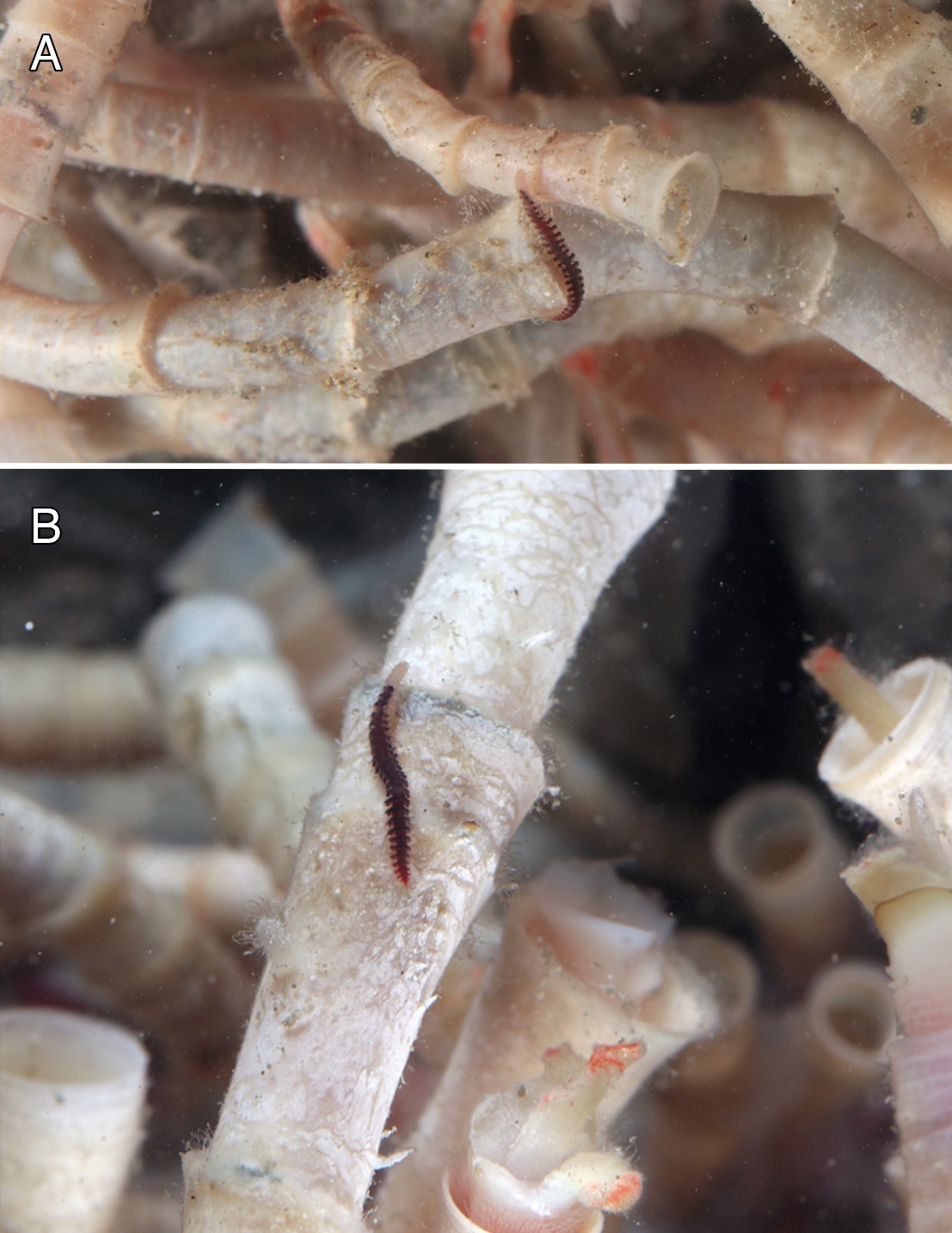
in situ dorsal-view images of Galapagomystides verenae n. comb. associated with juvenile Escarpia spicata tubes at Parrita Seep off Costa Rica.

Pearson & Rouse, 2022

Abstract
Galapagomystides is an exclusively deep-sea group of Phyllodocidae, originally erected for Galapagomystides aristata from hydrothermal vents of the Galapagos Rift. In this study, Phyllodocidae collected from hydrothermal vents and methane seeps from the Pacific Ocean, including specimens from vents of the East Pacific Rise identified as Galapagomystides were studied using morphology (light microscopy and scanning electron microscopy) and DNA sequence data. Phylogenetic analysis of the newly generated molecular data (cytochrome c oxidase subunit I, 16S rRNA, 18S rRNA, and 28S rRNA) combined with an already available extensive dataset for Phyllodocidae resulted in a monophyletic Galapagomystides comprising five species. Galapagomystides aristata was found to occur on the East Pacific Rise vents as well as the Galapagos Rift and is redescribed. Two new species were from hydrothermal vents in the West Pacific, G. bobpearsoni n. sp., and G. kathyae n. sp., as well as one new species from a cold seep in the eastern Pacific, G. patricki n. sp. These new species are formally described, and a previously known vent species, Protomystides verenae, is redescribed and transferred to GalapagomystidesGalapagomystides verenae n. comb. was found to occur in both vents and seeps in the eastern Pacific, from Oregon to Costa Rica. The diagnosis of Galapagomystides is amended and the biogeography and habitat evolution of the five species of Galapagomystides is discussed.

Key words: new species, hydrothermal vents, methane seeps, cold seeps, Pacific Ocean, Aciculata, Phyllodocida


A & B—in situ dorsal-view images of Galapagomystides verenae n. comb. associated with juvenile Escarpia spicata tubes at Parrita Seep off Costa Rica.
 
Galapagomystides Blake, 1985 (emended) 
(Pleijel 1991; Blake 1994)

Type species. Galapagomystides aristata Blake, 1985

Diagnosis (emended). Prostomium wider than long. Two antennae; two palps similar in size/shape to antennae. No median antenna or nuchal papilla. Nuchal organs unknown. Eyes absent. Smooth proboscis, papillae at distal end. Segment 1 fused or not (dorsally) to prostomium. Segment 1 distinct ventrally. Elongated dorsal cirri (EDC) (= tentacular cirri) on segments 1, 2; EDC on segment 3. No ventral cirri on segment 1. Ventral cirri on segment 2 elongated or like following segments. Parapodia uniramous, notopodial chaetae absent. Neuropodium with central fascicle containing compound chaetae; one simple emergent acicula. Compound chaetal shaft cylindrical; pointed blade extended from falcate joint. Rostrum of chaetal shaft asymmetrical/hooked. Presence of segmental bands of cilia. Pygidial cirri robust ellipsoid lobes. Living animals are red.


Galapagomystides aristata Blake 1985

Diagnosis. First segment fused dorsally to prostomium. Elongated dorsal cirri on segments 1 and 2. Elongated ventral cirri on segment 2. Exaggerated hook-like joint of compound chaetae.


Galapagomystides verenae (Blake and Hilbig 1990) new combination

Diagnosis. First segment not fused to prostomium. Trapezoidal prostomium that is dorsally “V” shaped posteriorly. Elongated dorsal cirri on segments 1, 2 and 3. Elongated ventral cirri on segment 2.


Galapagomystides bobpearsoni n. sp. 

Diagnosis. First segment fused dorsally to prostomium. Elongated dorsal cirri on segments 1, 2 and 3. The elongated dorsal cirri on segments 2 and 3 are the longest of all Galapagomystides species. Elongated ventral cirri on segment 2.

Etymology. Galapagomystides bobpearsoni n. sp. is named after the lead author’s father, Bob Pearson, for his invaluable love and support, and who inspired the lead author’s passion and curiosity for the ocean. 


Galapagomystides kathyae n. sp. 

Diagnosis. First segment fused dorsally to prostomium. Wider prostomium. Elongated dorsal cirri on segments 1, 2 and 3. Elongated ventral cirri on segment 2.

Etymology. Galapagomystides kathyae n. sp. is named after the lead author’s mother, Kathy Reimer-Pearson, for her invaluable love and support, and who sparked the lead-author’s interest and enthrallment in invertebrates.


Light microscopy (LM) images of Galapagomystides patricki n. sp. 
A—in situ Galapagomystides inside Vestimentiferan tube, Alvin Dive 4508, Mound Quepos, Parrita Seep, Costa Rica, paratype (SIO-BIC A13420; A13420).
B—dorsal view of anterior, paratype (SIO-BIC A1424).

Galapagomystides patricki n. sp. 

 Diagnosis. First segment not fused to prostomium. Elongated dorsal cirri on segments 1 and 2. No elongated ventral cirri.

Etymology: Galapagomystides patricki n. sp. is named after Patrick Shaughnessy, whose love and support during this project was instrumental to the lead author’s success.


Kaila A. M. Pearson and Greg W. Rouse. 2022. Vampire Worms: A Revision of Galapagomystides (Phyllodocidae, Annelida), with the Description of Three New Species. Zootaxa. 5128(4); 451-485. DOI: 10.11646/zootaxa.5128.4.1

Tuesday, November 30, 2021

[Mollusca • 2021] Neolepetopsid True Limpets (Gastropoda: Patellogastropoda) from Indian Ocean Hot Vents shed light on Relationships Among Genera


Abstract
Neolepetopsidae is a family of true limpets restricted to deep-sea chemosynthesis-based ecosystems. It is a small and little-studied family with about a dozen species in three genera, namely Eulepetopsis, Neolepetopsis and Paralepetopsis, and all named species were from the Pacific or Atlantic Oceans. Here, we describe three new species from Indian Ocean vents, namely Eulepetopsis crystallina sp. nov. found across three ridges, Neolepetopsis ardua sp. nov. from the Southwest Indian Ridge and Neolepetopsis prismatica sp. nov. from the Carlsberg Ridge. Given that Neolepetopsis appears to specialize on inactive sulfide deposits, the apparent wider distribution of E. crystallina is probably attributable to bias in sampling effort at inactive chimneys. The molecular phylogeny of Patellogastropoda, reconstructed using the COI gene, supported the monophyly of Neolepetopsidae. These are the first molecular data available for Neolepetopsis, confirming that the three genera are genetically distinct. Eulepetopsis appears to be adapted to active vents, and its derived position compared with Paralepetopsis indicates a possible ‘stepping-stone’ evolutionary pathway from seeps and organic falls to vents. Our results provide new insights into this enigmatic family and highlight the importance of surveying the vent periphery, especially given that inactive vents are being eyed as a replacement for active ones in deep-sea mining.

Keywords: deep sea, deep, sea vents, Mollusca, molecular phylogeny


Consensus tree of Patellogastropoda from phylogenetic reconstruction.


Chong Chen, Yadong Zhou, Hiromi Kayama Watanabe, Ruiyan Zhang and Chunsheng Wang. 2021. Neolepetopsid True Limpets (Gastropoda: Patellogastropoda) from Indian Ocean Hot Vents shed light on Relationships Among Genera. Zoological Journal of the Linnean Society. zlab081, DOI: 10.1093/zoolinnean/zlab081

Monday, June 28, 2021

[Mollusca • 2021] Lirapex felix • A New Peltospirid Snail (Gastropoda: Neomphalida) adds to the Unique Biodiversity of Longqi Vent Field, Southwest Indian Ridge


Lirapex felix
Chen, Han, Copley & Zhou, 2021

 
ABSTRACT
The biodiversity of deep-sea hydrothermal vents in the Indian Ocean remains poorly characterised compared with that of their Pacific and Atlantic counterparts. Although the Longqi hydrothermal vent field is the most extensively explored vent site on the ultra-slow-spreading Southwest Indian Ridge, it is still a source of new discoveries. Here, we report and formally describe a new peltospirid snail from Longqi – Lirapex felix sp. nov. Known from only two specimens, it differs from other named Lirapex species by a depressed spire and the lack of coil loosening on the body whorl. Examinations of the external anatomy and radular characteristics agree with its placement in Lirapex, which is also supported by a molecular phylogeny reconstructed using the barcoding fragment of the mitochondrial cytochrome c oxidase I (COI) gene. This is the fifth peltospirid snail known to inhabit the Longqi field, three of which (including Lirapex felix sp. nov.) have been found nowhere else. There is growing evidence that the Longqi field represents a biogeographically unique site among Indian Ocean vents. The discovery of Lirapex felix sp. nov. adds to the unique biodiversity of Longqi field, with implications for conservation in the light of potential deep-sea mining.

KEYWORDS: deep sea, hydrothermal vent, Indian Ocean, Mollusca, new species


 Lirapex felix sp. nov. 
 

Chong Chen, Yuru Han, Jonathan T. Copley and Yadong Zhou. 2021. A New Peltospirid Snail (Gastropoda: Neomphalida) adds to the Unique Biodiversity of Longqi Vent Field, Southwest Indian Ridge. Journal of Natural History. 55(13-14); 851-866. DOI:  10.1080/00222933.2021.1923851